I Stopped for Two Stray Cats Clinging to Each Other Beside the Road—Then the Vet Told Me What I Had Really Rescued.
PART3:
No pet food except three cans my sister had left behind months earlier when her cat stayed with me for a weekend.
My apartment lease technically allowed one pet with an added deposit I had not paid.
And I had never wanted two cats.
That list should have been convincing.
It wasn’t.
I looked in the rearview mirror.
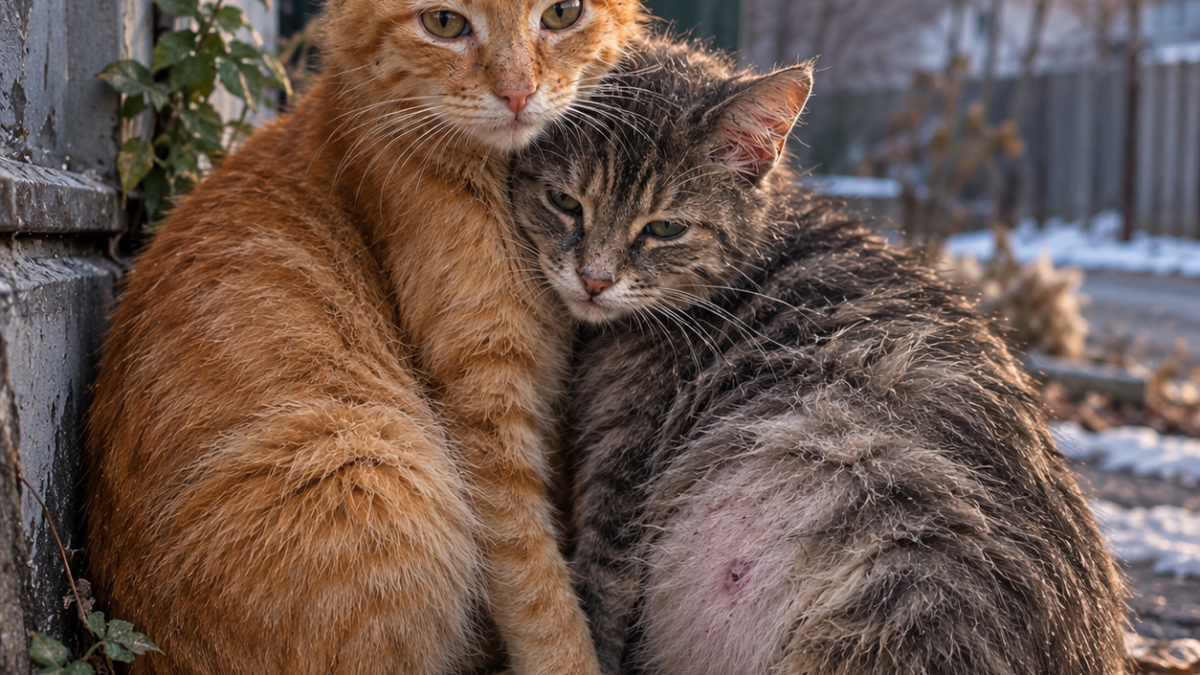
The gray cat was still pressed against the orange one.
“Damn it.”
I backed onto the shoulder.
Hazard lights.
Parking brake.
Then I sat there another moment.
Because wanting to help and knowing how to approach two frightened animals are very different things.
I got out slowly.
The orange cat saw me immediately.
His body stiffened.
The gray one tucked herself even closer behind him.
“Hey.”
I kept my voice low.
“I’m not going to touch you.”
The orange cat stared.
I crouched about twelve feet away.
Cars passed behind me.
Wind pushed grit across the pavement.
The gray cat looked smaller up close.
Maybe not actually smaller.
Just more fragile.
Her fur was smoky gray with faint darker stripes.
One front paw was white.
Her face was narrow.
Too narrow.
Her hip bones showed.
There was dirt around her nose.
Her coat along the belly looked tangled and uneven.
She kept blinking slowly, as though staying awake required work.
The orange cat was alert enough for both of them.
He watched my hands.
My feet.
The road.
Every sound.
“Okay.”
I looked at him.
“You’re security.”
One ear twitched.
“And she’s management?”
Nothing.
“I’m terrible at this.”
I stood slowly.
Neither ran.
That surprised me.
I opened my back passenger door.
They watched.
I returned to the driver’s seat, grabbed the emergency granola bar I kept in the console, realized cats probably did not need peanut-butter granola bars, and put it back.
Then I remembered the old cat food.
At home.
Ten minutes away.
I considered leaving.
I knew if I did, I might never find them again.
So I called work.
My supervisor, Denise, answered.
“You’re driving?”
“Parked.”
“You okay?”
“I’m going to be late.”
“How late?”
I looked at the cats.
“Unknown.”
Silence.
“Claire.”
“There are two cats.”
Another silence.
“What?”
“On the road.”
“Are you calling me from an animal emergency?”
“Yes.”
Denise exhaled.
“We have a meeting.”
“I know.”
“You’re presenting the inventory discrepancy.”
“I know.”
“Are the cats actively dying?”
I looked at the gray one.
“I don’t know.”
That changed Denise’s tone.
“Okay.”
“I’m sorry.”
“Don’t get bitten.”
“Useful.”
“Text me.”
I hung up.
Then I called my sister.
Emily answered on the fourth ring.
“You never call this early. Who died?”
“Do you still have cat food in your trunk?”
“What?”
“Cat food.”
“Why would I—”
“You had some when you brought Milo over.”
“That was three months ago.”
“Emily.”
“What happened?”
“I found two cats.”
“Of course you did.”
“What does that mean?”
“You once stopped traffic to move a turtle.”
“That turtle was in danger.”
“You named it Kevin.”
“I did not name it.”
“You called me and said, ‘Kevin made it across.’”
I looked at the road.
“Please focus.”
Emily laughed.
“Yes, I have a small bag of dry food.”
“Where are you?”
“Home.”
“I’m coming.”
“What about the cats?”
“I’m hoping they stay.”
They stayed.
I drove the ten minutes to Emily’s apartment like someone transporting a human organ.
I took the food.
An old blanket.
A cardboard box.
Emily came outside wearing slippers.
“Do you need help?”
“No.”
“You definitely need help.”
“I have a plan.”
“What plan?”
“Feed cats.”
“That’s not a plan.”
“It’s phase one.”
She stared at me.
“You are absolutely bringing them home.”
“I am absolutely not.”
“Okay.”
“What?”
“Nothing.”
“Say it.”
“Call me tonight when you need litter.”
I left.
Both cats were still there when I returned.
That felt important.
I poured food onto a paper plate.
The orange cat approached first.
Slowly.
He kept looking back at the gray one.
She did not move.
He sniffed.
Ate one bite.
Then turned.
Walked back to her.
He touched his nose to her face.
Only then did she follow.
They ate side by side.
Shoulders touching.
The orange one took larger bites but repeatedly paused.
Whenever the gray cat stopped eating, he stopped too.
I had never seen anything like it.
I poured water into the lid of a plastic container.
The gray cat drank for almost a full minute.
Then stopped.
The orange cat drank.
Then she drank again.
They were hungry enough to approach me.
That scared me more than if they had run.
Desperation creates courage.
I sat near my open car door.
“Okay.”
They ate.
“I have an apartment.”
No response.
“It’s small.”
The orange cat looked up.
“I work full-time.”
The gray one continued eating.
“I’m not financially stable enough for whatever this is.”
They ignored me.
“This conversation feels one-sided.”
I moved the food closer to the car.
The orange one followed.
Gray followed him.
A little closer.
Then again.
Ten minutes later, the plate was on the floor behind the passenger seat.
The orange cat stood at the open door.
He looked inside.
Then at me.
Then behind him.
The gray cat pressed against his leg.
I expected him to run.
He jumped into the car.
Just like that.
The gray one followed before I could even process it.
She climbed in so quickly that she almost landed on him.
Then they both turned toward me.
Two cats.
Inside my vehicle.
I stared.
“Seriously?”
The orange cat crouched behind the seat.
The gray one flattened beside him.
“All right.”
I closed the door gently.
“This is either compassion or kidnapping.”
They came home with me.
My apartment had never looked smaller.
One bedroom.
Living room.
Tiny kitchen.
Bathroom with enough room for a tub, toilet, sink, and little else.
I put them in the bathroom because it was the only room with a door I could close without risking them getting behind appliances or disappearing under furniture.
Old towels.
Water.
The canned food.
My sister’s emergency litter box, delivered twenty minutes later because of course she had been right.
Emily stood in the doorway.
The orange cat immediately placed himself between us and the gray cat.
She stared.
“Oh.”
“See?”
“Yeah.”
“That’s why I stopped.”
Emily crouched.
“Hey, big guy.”
He watched her.
“What are you naming them?”
“I’m not.”
“You already named the turtle.”
“I did not.”
“Orange looks like Rusty.”
“No.”
“Gray looks like Smoke.”
“Absolutely not.”
“Pepper?”
“Emily.”
“Okay.”
I shut the bathroom door.
Both cats ate.
Then ate again.
I had to stop myself from giving them more because I worried too much food at once might make them sick.
The orange cat walked around the bathroom sniffing everything.
The gray cat drank.
Then crawled beneath the sink.
Orange noticed.
He went to her.
She came out.
They lay on an old towel together.
Gray tucked her face under his neck.
Orange curled his body around hers.
I sat on the closed toilet lid.
Emily whispered, “That is not normal.”
“What?”
“They’re like glued together.”
“I know.”
“Littermates?”
“Maybe.”
“They don’t look alike.”
“That doesn’t mean anything.”
“True.”
She watched them.
“Boy and girl?”
“I think.”
“You know how to tell?”
“No.”
“Neither do I.”
We looked at each other.
Emily pointed toward the cats.
“You have six hours before you fall in love.”
“I’m not keeping them.”
“Five hours.”
I went to work ninety minutes late.
Denise looked at me when I walked into the conference room.
“You smell like cat food.”
“Thank you.”
“Did they survive?”
“They’re in my bathroom.”
The entire table looked up.
One coworker said, “You kidnapped cats?”
“I rescued them.”
“From where?”
“Service road.”
Another coworker asked, “Are you keeping them?”
“No.”
Everyone laughed.
I hated them.
I spent lunch posting photos.
FOUND TWO CATS.
Orange male-looking cat.
Gray female-looking cat.
Found near Central Avenue service road.
Very thin.
Bonded or closely attached.
Please message with identifying information.
I posted in local lost-pet groups.
Neighborhood Facebook pages.
Nextdoor.
A rescue group.
Animal control page.
I called nearby shelters.
No matching missing reports.
No microchip information yet because I had not taken them in.
I told myself their owner would appear.
Somebody would see the photos and say:
Those are mine.
I imagined relieved people.
A family.
A kid.
Maybe the cats had slipped through a door.
Maybe they had been missing for days.
That would solve everything.
It would also mean I did not have to figure out how to afford two cats.
Nobody called.
That evening I stopped at a discount store.
Cat food.
Two bowls.
Litter.
A litter scoop.
A cheap toy mouse.
Parasite shampoo I later learned I should not have bought without veterinary advice.
My receipt was forty-six dollars.
I stared at the total.
Then at the cashier.
Then paid.
At home, I opened the bathroom door.
Orange immediately walked out.
Not ran.
Walked.
Gray followed.
She stayed so close to him their bodies touched every few steps.
He explored.
She explored whatever he explored.
He rubbed against the couch.
She rubbed against his side.
He jumped onto a chair.
She tried.
Missed.
He jumped down.
Stayed beside her.
That was the first time I noticed how tired she was.
Orange could move.
Gray seemed drained.
I picked her up for the first time.
She did not fight.
She weighed almost nothing.
Her belly, though, felt strangely firm.
I thought:
Worms.
Probably.
I had no idea.
I named them accidentally that night.
Orange knocked the toy mouse beneath my refrigerator.
I said, “Seriously, Jasper?”
I do not know why Jasper.
The name appeared.
He looked at me.
I froze.
“Oh no.”
Emily, on speakerphone, started laughing.
“You named him.”
“Temporary.”
“Sure.”
The gray cat was sitting near my bathroom rug.
I stared.
She had greenish-gray eyes.
Quiet.
Soft.
“Mae.”
Emily stopped laughing.
“Mae?”
“Maybe.”
“That’s cute.”
“Temporary.”
“Of course.”
Jasper and Mae.
The names stayed.
The next two days taught me their personalities.
Jasper was a disaster.
Affectionate.
Restless.
Talkative.
He rubbed against my legs constantly.
Jumped onto the counter.
Tried to eat my breakfast.
Knocked toothbrushes into the sink.
Sprayed once near my laundry basket, which sent me into a late-night search for “why is male cat peeing vertically?”
Unneutered.
Likely.
Great.
Mae slept.
She ate.
Drank.
Used the litter box.
Then slept again.
Not ordinary cat sleeping.
Deep exhaustion.
If Jasper left the room, Mae woke.
If he returned, she relaxed.
At night, they slept together.
Always touching.
One night I woke at two because I heard crying.
I walked into the living room.
Jasper stood near the bathroom.
Mae was inside, accidentally closed behind the door.
I opened it.
She came out.
Jasper immediately groomed her face.
Mae pressed against him.
The crying stopped.
I stood there half asleep.
“You two are weird.”
They ignored me.
On day three, I noticed Mae’s belly.
Really noticed.
She was thin everywhere except there.
Rounded.
Low.
I sat on the floor.
“Mae.”
She approached.
I touched her side gently.
No obvious pain.
Jasper watched.
Mae lay down.
Her belly looked too round for her frame.
I called Emily.
“I think she’s pregnant.”
Silence.
Then laughter.
“Don’t.”
“I’m sorry.”
“This is not funny.”
“It is a little funny.”
“I have a one-bedroom apartment.”
“I know.”
“I have two stray cats.”
“Four hours ago you had no cats.”
“Now one might contain additional cats.”
Emily laughed harder.
“I hate you.”
“Vet.”
“I know.”
“Call one.”
“I know.”
I called three clinics.
The first had no new-patient appointments for two weeks.
The second quoted an exam fee that made my stomach hurt.
The third, a small practice called Riverbend Veterinary Care, said:
“Bring them tomorrow morning.”
The receptionist asked how I found them.
I explained.
“Any vomiting?”
“No.”
“Diarrhea?”
“Not that I’ve noticed.”
“Eating?”
“Like they’re trying to avenge every missed meal.”
She laughed.
“Keep meals moderate.”
“Could the gray one be pregnant?”
“She could.”
“What do I do?”
“Nothing until the vet sees her.”
“That seems suspiciously calm.”
“We’ve seen pregnant cats before.”
“I haven’t.”
“You’ll survive until tomorrow.”
“I appreciate the confidence.”
I did not sleep.
I searched everything.
Cat pregnancy signs.
How long are cats pregnant.
Can underweight cats give birth safely.
How many kittens do cats usually have.
How much do emergency C-sections cost.
That search nearly gave me a heart attack.
Jasper slept on my chest.
Mae slept beside my hip.
At some point around three, I stared at the ceiling.
“This is not my life.”
Jasper purred.
The clinic confirmed three things.
First, Jasper was an intact male, approximately one year old.
Second, Mae was female, maybe ten to fourteen months.
Third, she was pregnant.
Dr. Anita Shah looked at the ultrasound.
“Four.”
I stared.
“Four what?”
She smiled.
“Kittens.”
I knew what she meant.
My brain simply refused to process it.
“Four?”
“Looks like four.”
Emily was on speakerphone because she demanded updates.
I heard:
“Oh my God.”
I held the phone away.
“Stop enjoying this.”
Dr. Shah laughed.
Mae lay calmly on the exam table.
Jasper was in a carrier beside us, furious at the indignity.
“How far along?”
“Probably around six weeks.”
“How long do cats—”
“About sixty-three to sixty-five days total, generally.”
“So…”
“Maybe two to three weeks.”
I sat down.
“Two weeks?”
“Possibly.”
“I thought I had time.”
“For what?”
“I don’t know.”
That was honest.
Dr. Shah examined Mae carefully.
“She’s underweight.”
“How bad?”
“Enough that we need to be thoughtful.”
“Is pregnancy dangerous?”
“Any pregnancy can have complications.”
I apparently looked terrified.
“But she’s young.”
“Her heart sounds good.”
“No fever.”
“She’s alert.”
“Parasites?”
“Yes.”
Both cats had fleas.
Likely intestinal parasites.
Treatable.
Mae needed calorie-dense kitten food.
Fresh water.
A quiet warm place.
Monitoring.
Follow-up.
“Can she stay with Jasper?”
Dr. Shah looked toward the carrier.
“Are they bonded?”
“Extremely.”
“Any aggression?”
“Never.”
“He may be the father.”
“Can you tell?”
“No.”
“Genetically?”
“Not without testing.”
“Should he be around newborns?”
“Initially, I’d give Mae a private nesting area where she can choose separation.”
“But if she wants him?”
“Supervised contact.”
I nodded like someone receiving instructions for a human neonatal unit.
Dr. Shah smiled.
“You’re doing fine.”
“I found them three days ago.”
“I know.”
“I don’t own cats.”
“You do currently possess cats.”
“That is different.”
“Sure.”
“How much is this going to cost?”
I hated asking.
But I had to.
Dr. Shah understood.
She gave me an estimate.
Exam.
Parasite treatment.
Vaccinations delayed appropriately for Mae because of pregnancy.
Future spay.
Jasper neuter.
Potential kitten care.
It was more than I had.
Not impossible.
But enough.
I stared at the paper.
“Okay.”
Dr. Shah said, “We work with a rescue fund.”
“I’m not asking for charity.”
“Why not?”
That embarrassed me.
“I have a job.”
“So do many people who need help.”
I looked at her.
She leaned against the counter.
“Claire, you found two animals on a road.”
“You brought them inside.”
“You’re feeding them.”
“You’re trying to locate owners.”
“You came here.”
“Accept help before pride becomes expensive.”
I hated how reasonable that was.
“Fine.”
She reduced part of the exam through the clinic’s community fund.
I paid the rest.
That evening I spent another thirty-eight dollars on kitten food, a plastic storage bin I converted into a nesting box, washable pads, and a fleece blanket.
My apartment changed.
The corner of my bedroom became Mae’s nursery.
Jasper got neutered five days later.
He returned home wearing a cone and the rage of a betrayed emperor.
Mae inspected him.
Then groomed the edge of the cone.
Jasper glared at me.
“This was for everyone’s benefit.”
He glared harder.
“You were committing property crimes.”
No response.
Mae slept beside him anyway.
The lost-pet posts remained up.
Still nothing.
I expanded the search.
Flyers near the service road.
Gas stations.
Convenience stores.
Apartment complexes.
A grocery bulletin board.
One man at a laundromat recognized them.
Or thought he did.
“Two cats used to hang around behind the old garden center.”
“How long?”
“Couple weeks.”
“Did anyone feed them?”
“Some lady.”
“Do you know her?”
“No.”
I went to the garden center.
It had closed three months earlier.
Behind the building were empty pallets.
A dumpster.
Old bowls.
One was orange plastic.
Another metal.
Someone had been feeding cats there.
I found paw prints in dirty snow.
Maybe Jasper and Mae.
Maybe not.
A woman from a neighboring nail salon came outside while I was hanging a flyer.
“You looking for orange and gray?”
I turned.
“Yes.”
“You have them?”
My heart jumped.
“Do they belong to someone?”
She hesitated.
“I don’t know.”
“Have you seen them?”
“For months.”
“Months?”
“They stayed near that building.”
“Before it closed?”
“Yes.”
“Were they strays?”
“I thought maybe someone’s outdoor cats.”
“Did they stay together?”
“Always.”
That word.
“What do you know?”
She crossed her arms against the cold.
“The gray one had babies before.”
My stomach dropped.
“What?”
“Last summer.”
“You’re sure?”
“Three kittens.”
“What happened?”
“One disappeared.”
“Two were taken by somebody.”
“What about her?”
“Stayed.”
“And orange?”
“He was around then too.”
My mind raced.
Mae was barely more than a kitten herself.
Pregnant again.
Maybe second litter.
“Did anyone try to rescue them?”
“People tried.”
“Couldn’t catch them.”
“Orange one would distract.”
“What?”
The woman smiled sadly.
“If someone went near gray, orange would come running.”
“Sometimes hiss.”
“Sometimes let people chase him.”
“While she hid.”
I thought about the service road.
Him stepping in front.
“How long were they together?”
“At least last spring.”
“Do you know where they came from?”
She shook her head.
“Ask apartment complex behind the garden center.”
I did.
The property manager was not interested.
“Cats?”
“Yes.”
“We had lots of strays.”
“Orange male, gray female.”
“Lady, do you know how many cats are orange?”
I showed pictures.
He glanced.
Then longer.
“Maybe.”
“Maybe what?”
“A tenant had cats like that.”
My chest tightened.
“Which tenant?”
“Can’t give tenant information.”
“Former tenant?”
“Still can’t.”
“Did they abandon them?”
“I didn’t say that.”
“What did you say?”
The man sighed.
“There was a woman in Building C.”
“Had two young cats.”
“She moved.”
“When?”
“Last year.”
“What happened to the cats?”
“I don’t know.”
“You just said—”
“I said she had cats.”
“What was her name?”
“Can’t tell you.”
I called animal control.
They could investigate only if there was evidence of abandonment or cruelty.
I had suspicions.
Not evidence.
So I went home.
Mae met me at the door.
She had started doing that.
Jasper followed.
I sat on the floor.
“You had babies before?”
Mae rubbed against my knee.
Jasper head-butted my arm.
“That means you’re probably terrible at birth control.”
Jasper purred.
“Not helping.”
Over the next two weeks, Mae changed.
Physically.
Emotionally.
She gained weight.
Her coat became softer.
Her eyes brighter.
She explored.
She discovered my bed.
Then claimed half of it.
Jasper became calmer after neutering.
He still followed Mae constantly.
But his restless pacing decreased.
They played.
That was new.
The first time I saw them chase each other through the hallway, I laughed aloud.
Mae ran badly.
Not because of injury.
Because she was heavily pregnant and looked like a gray football with legs.
Jasper hid behind the couch.
Mae stalked him.
He jumped.
She swatted.
Then they both sprinted toward the bedroom.
I filmed it.
Sent it to Emily.
She replied:
Your children look happy.
I wrote:
Blocked.
She sent twelve laughing emojis.
At night, Mae often slept in the nesting box.
Jasper slept outside it.
Not inside.
Just close enough.
He faced the entrance.
I noticed he did that with almost every room she entered.
If she was eating, he watched.
If she slept, he relaxed.
If she went somewhere he could not follow, he waited.
I began to wonder what they had survived.
Not romanticize.
Animals can bond without tragedy.
But their attachment had a vigilance to it.
As if being separated was not simply unpleasant.
It was dangerous.
The night Mae went into labor began at 11:48 p.m.
I knew because I was watching television when she started pacing.
She went to the nesting box.
Left.
Returned.
Meowed.
Jasper followed.
She snapped at him.
Not viciously.
Enough.
He stopped.
I called Riverbend.
The overnight answering service connected me to Dr. Shah.
“I think she’s in labor.”
“What is she doing?”
I described.
“Any discharge?”
“A little.”
“Contractions?”
“I think.”
“How long?”
“Maybe twenty minutes.”
“Okay.”
“Okay?”
“Stay calm.”
“I am calm.”
Mae yowled.
“I am not calm.”
Dr. Shah laughed.
“Let her choose her spot.”
“Keep Jasper away unless she wants him nearby.”
“Watch for prolonged straining without a kitten.”
“How long is prolonged?”
She gave me specific warning signs.
I wrote them on a grocery receipt because apparently I had no paper.
Mae chose the box.
Then changed her mind.
Chose the bathtub.
Changed her mind again.
Finally climbed into the bottom drawer of my dresser because I had left it open.
“No.”
She stared at me.
“Absolutely not.”
She climbed out.
Returned to the box.
Jasper sat six feet away.
At 12:37, the first kitten was born.
Orange.
Tiny.
Wet.
Making a noise so small I almost could not believe it came from a living creature.
Mae immediately began cleaning.
I cried.
Instantly.
Embarrassingly.
Jasper stood.
I pointed at him.
“Don’t.”
He sat.
His eyes never left the box.
Second kitten.
Gray.
Third.
Orange.
Then a long pause.
I called Dr. Shah again.
“She has three.”
“How is she acting?”
“Tired.”
“Contractions?”
“Not sure.”
Mae strained.
“Wait.”
At 2:18, the fourth arrived.
Orange.
Four.
Exactly what the ultrasound showed.
Mae cleaned them.
Fed them.
Curled around them.
Jasper stayed outside the box.
He did not approach until Mae lifted her head and chirped.
I swear she called him.
Maybe that is projection.
Maybe not.
Jasper walked closer.
Slowly.
Mae watched.
He sniffed the edge.
One orange kitten squeaked.
Jasper jumped backward.
I laughed through tears.
“Brave protector.”
He approached again.
Mae allowed him to sniff one kitten.
Then another.
He lay down beside the box.
Not inside.
Guarding.
I sat on the bathroom floor until sunrise.
Mae.
Jasper.
Four kittens.
Six cats.
My apartment smelled like cat food, litter, and questionable decisions.
I had work in three hours.
I was exhausted.
My bank account was suffering.
And I felt happier than I had in months.
The kittens grew.
They became ridiculous.
At two weeks, eyes opened.
At three, they started moving.
At four, my apartment became a war zone.
Tiny paws everywhere.
One orange kitten climbed my pajama leg.
The gray kitten slept in my slipper.
Jasper became obsessed with them.
Not fatherly in a human sense.
But attentive.
He followed them.
Groomed them occasionally.
Sat near them.
If one wandered too far, he watched.
Mae became a different cat.
Confident.
Affectionate.
She slept away from Jasper sometimes.
That seemed small.
It was not.
She had reached a point where she could close her eyes without physically touching him.
Jasper seemed fine with that.
Their bond was changing.
Less fear.
More choice.
I began talking to rescues.
I could not keep six cats.
No matter what my sister suggested.
Emily said:
“Six is basically one cat in six locations.”
“That is not biology.”
“Emotionally.”
“No.”
We planned adoptions after the kittens were old enough.
Applications.
References.
Indoor-only homes.
Spay/neuter agreements.
The rescue group helping me insisted the kittens go in pairs if possible.
I agreed.
Two orange boys went together to a retired couple.
The gray girl and remaining orange boy went to a family with two teenagers.
Mae watched the first pair leave.
She called once.
Then searched.
My chest hurt.
Jasper stayed beside her.
That night, they slept together again.
When the final two left, Mae searched longer.
I cried.
I almost canceled the adoption.
Emily stopped me.
“You’re not keeping every animal because goodbye hurts.”
“Why not?”
“Because then you’ll die with forty cats.”
“Acceptable.”
“No.”
The adopters sent photos.
Kittens thriving.
Safe.
Loved.
That helped.
Then came the question I had been avoiding.
Mae and Jasper.
What next?
The rescue offered to list them as a bonded pair.
I filled out the profile.
Then did not submit it.
For three days.
Emily noticed.
“You’re keeping them.”
“I have not said that.”
“You changed your lease.”
“That was practical.”
“You paid the pet deposit.”
“For current occupancy.”
“You bought a cat tree taller than you.”
“It was on sale.”
“You installed window shelves.”
“Enrichment.”
“You refer to them as ‘the kids.’”
“I do not.”
“You texted me yesterday, ‘The kids destroyed a paper towel roll.’”
I stared at her.
“Fine.”
She smiled.
“You’re keeping them.”
“I can barely afford them.”
“You’ll adjust.”
“My apartment is small.”
“They don’t care.”
“I work all day.”
“They have each other.”
That was the sentence.
They have each other.
I looked toward the couch.
Mae was asleep.
Jasper was beside her.
Not pressed tightly.
Just nearby.
Safe enough for space.
I submitted adoption paperwork.
For myself.
Officially.
Mae and Jasper became mine.
Or maybe I became theirs.
Life settled.
Then, two months later, I got a message.
From an unknown woman.
Subject:
I THINK THOSE ARE MY CATS.
My stomach dropped.
I opened it immediately.
Her name was Hannah.
She had seen one of my old found-cat posts shared again in a neighborhood group.
She wrote:
The orange cat looks like Milo.
The gray cat looks like Ellie.
I used to live at Greenview Apartments behind the old garden center.
Please call me.
I sat staring at the screen.
Milo.
Ellie.
I looked at Jasper and Mae.
They were sleeping near the window.
My first thought was selfish.
No.
Absolutely not.
They were mine.
I had found them.
Fed them.
Paid veterinary bills.
Stayed through birth.
Adopted them.
My second thought was more reasonable.
If someone had genuinely lost them, she deserved answers.
I called.
Hannah answered crying.
“Do you have them?”
“I need you to prove they’re yours.”
“Yes.”
Immediate.
“I have pictures.”
“Vet records?”
“Yes.”
“Any identifying marks?”
“Orange male has a notch in his right ear.”
Correct.
“Gray female has one white front paw.”
Correct.
“Anything else?”
“She has a tiny patch under her chin where the fur is lighter.”
I walked toward Mae.
Yes.
My stomach tightened.
Hannah sent photographs.
There they were.
Younger.
Healthy.
Jasper—Milo—wearing a blue collar.
Mae—Ellie—curled beside him.
Together even then.
I called Hannah back.
“What happened?”
Silence.
Then:
“I left them.”
Anger rose instantly.
“You abandoned them?”
“No.”
She started crying harder.
“I left them with my boyfriend.”
“Why?”
“I was leaving him.”
That changed my tone.
Not completely.
Enough.
Hannah explained.
She had adopted Mae first.
Then Jasper six months later.
Mae was frightened by almost everyone.
Jasper attached himself to her immediately.
They became inseparable.
Hannah lived with a man named Tyler.
The relationship became controlling.
Then violent.
The last night, she left with one bag after Tyler shoved her into a kitchen cabinet.
She went to her mother’s house three hours away.
“I couldn’t take the cats that night.”
“Why?”
“Tyler was watching me.”
“I barely got myself out.”
She cried.
“He told me he’d keep them until I found a place.”
“How long?”
“Two weeks.”
“What happened?”
“He said they escaped.”
My chest tightened.
“When?”
“May.”
That matched the garden-center sightings.
“Did you look?”
“I drove back.”
“He wouldn’t let me inside.”
“I called animal control.”
“I posted.”
“I checked shelters.”
“They were gone.”
“What about Mae’s first litter?”
Silence.
“What?”
“She had kittens before I got her spayed.”
“You never spayed her.”
“I had the appointment scheduled.”
Hannah sounded ashamed.
“She got pregnant before.”
“Milo?”
“I don’t know.”
“Tyler wouldn’t let me spend money on the surgery after she gave birth.”
There it was.
Control.
Again.
“What happened to the kittens?”
“Two went to homes.”
“One disappeared.”
The nail-salon woman had told the truth.
I sat down.
“Do you want them back?”
The words hurt to say.
Hannah went silent.
Then:
“Are they happy?”
“Yes.”
“Together?”
“Yes.”
“Healthy?”
“Yes.”
“Where do they sleep?”
I looked.
Jasper had moved.
Mae slept in the window.
Jasper on the couch.
“Everywhere.”
Hannah laughed through tears.
“Does Ellie still need Milo beside her all the time?”
I looked at Mae.
“No.”
A pause.
“That’s good.”
Her voice broke.
“That means she feels safe.”
I closed my eyes.
“Hannah…”
“I don’t want them back.”
I was not prepared for that.
“You don’t?”
“I want to see them.”
“If you’ll let me.”
“But I don’t want to take them.”
“Why?”
“Because they’re home.”
She said it simply.
“You kept them together.”
“You helped her through pregnancy.”
“You fixed him.”
“Neutered.”
A tiny laugh.
“Tyler always refused.”
“He said it would make Milo weak.”
I looked at Jasper.
Nothing about him looked weak.
Hannah continued.
“I lost them because I trusted the wrong person.”
“I’ve spent almost a year hating myself.”
I did not tell her not to.
I had learned enough by then to know that quick absolution can feel like erasure.
Instead I said:
“You got yourself out.”
She cried.
“I left them behind.”
“Yes.”
Both true.
“I should’ve gone back sooner.”
“Maybe.”
“I should’ve—”
“You thought he was keeping them safe.”
“I knew he wasn’t safe.”
“For you.”
Silence.
“That’s not always the same information.”
Hannah came to visit two weeks later.
She arrived with no carrier.
No bag.
No expectation.
Just a small envelope.
Inside were puppy—kitten—photos.
Mae at four months.
Jasper at seven.
Sleeping together.
Eating together.
Jasper licking Mae’s face.
The same behaviors.
Years before the road.
When Hannah entered my apartment, Jasper noticed first.
He froze.
Then walked toward her.
Hannah covered her mouth.
“Milo.”
Jasper stopped.
Listened.
She crouched.
“Milo.”
His ears lifted.
He came closer.
Sniffed.
Then rubbed against her knee.
Hannah collapsed.
Not physically.
Emotionally.
She cried so hard she could barely breathe.
Jasper stayed.
Mae watched from the hallway.
Hannah looked up.
“Ellie?”
Mae froze.
Hannah extended her hand.
“Baby.”
Mae did not approach.
That hurt Hannah.
I saw it.
But she did not force it.
“Okay.”
She lowered her hand.
“You don’t have to.”
We sat on the floor.
Jasper moved between us.
Eventually Mae came closer.
One foot.
Then another.
She sniffed Hannah’s shoe.
Then her fingers.
Hannah whispered, “I’m sorry.”
Mae rubbed her cheek against one knuckle.
That was enough.
Hannah smiled through tears.
“She remembers.”
“Maybe.”
“I think she does.”
We talked for two hours.
I showed kitten pictures.
Hannah cried again.
“Three orange.”
“One gray.”
“That sounds right.”
I told her Mae had been a good mother.
Hannah smiled.
“She always took care of Milo.”
“That was obvious.”
“And he protected her.”
“Yes.”
“Always.”
There it was.
The answer.
Not why they became bonded.
Why they could not bear separation.
They had spent most of their young lives being each other’s stability.
Mae had been timid.
Jasper had become her shield.
Then the human home became unsafe.
Their owner disappeared.
The man left behind abandoned them.
They survived outdoors.
Mae raised kittens.
Jasper stayed.
People came.
People left.
Buildings closed.
Food disappeared.
They moved.
Together.
When I found them, they were not simply two strays.
They were the only remaining constant in each other’s lives.
That explained the service road.
The car.
The bathroom.
The sleeping pressed together.
The panic when a door separated them.
The way Jasper ate only if Mae ate.
The way Mae moved only when Jasper moved.
They had learned a terrible equation.
People disappear.
Places disappear.
Food disappears.
But you stay.
Hannah left the envelope of photographs.
“You should have these.”
“They’re yours.”
“No.”
She looked at Jasper.
Then Mae.
“They belong with their story.”
I placed them in a drawer.
Eventually I made a small album.
Not because the past was more important than the present.
Because it mattered that they had existed before me.
Rescue does not begin a life.
It enters one.
That distinction changed me.
People love saying rescued animals are grateful.
I do not know if Mae and Jasper were grateful.
They did not owe me gratitude.
I interrupted a bad situation.
That was enough.
Hannah visited again months later.
Mae approached faster.
Jasper still responded to Milo.
We never changed his name back.
Not because Hannah’s name was wrong.
Because he had become Jasper in my home.
Mae remained Mae.
Hannah said she liked them.
“They got second names.”
“Like witnesses in protective custody.”
I laughed.
“Pretty much.”
She eventually adopted another cat.
One.
An older black female from a shelter.
Spayed.
Indoor-only.
Hannah sent me a picture.
I wrote:
She looks judgmental.
Hannah replied:
She is. I deserve it.
I wrote back:
No. You don’t.
That time, she accepted it.
Tyler was later charged in an unrelated domestic violence case.
Animal control investigated after Hannah provided information about the abandoned cats.
There was not enough evidence for a separate cruelty prosecution.
I was angry.
Hannah was less surprised.
“People want paperwork for things men do when nobody’s watching.”
She said it without bitterness.
Mostly.
I learned to stop expecting legal closure to equal emotional closure.
Mae and Jasper did not care what happened to Tyler.
Their lives moved forward.
That was better.
The kittens grew in their new homes.
We stayed in touch with adopters.
One orange boy became seventeen pounds and afraid of bananas.
His brother learned to open doors.
The gray girl slept with a little boy every night.
The last orange kitten became obsessed with water faucets.
Every birthday, the adopters sent photos.
Mae never saw them again.
Some people thought that was sad.
I did not.
Her kittens were safe.
That was the outcome.
Not lifelong physical closeness.
Safety.
Mae and Jasper stayed together.
Over time, their bond became less desperate.
That was beautiful too.
At first they had needed constant contact.
Years later, Jasper could sleep in the bedroom while Mae slept in sunlight by the window.
No panic.
No searching.
They knew.
The other would still be there later.
That may have been the greatest evidence of healing I ever saw.
Security created distance.
Healthy distance.
The ability to separate without believing separation meant abandonment.
I wish humans learned that as easily.
Five years after I found them, I moved.
Not far.
A better apartment.
Two bedrooms.
More windows.
A balcony enclosed safely for cats.
My finances improved.
Not magically.
Slowly.
Promotion.
Better salary.
Paid-off car.
A little savings.
On moving day, Mae hated everything.
Jasper supervised.
When the movers carried the couch, Jasper sat on a box like a foreman.
Mae hid in my bedroom.
I transported them last.
Together.
Same carrier, because even years later they preferred it for travel.
At the new apartment, I opened the door.
Jasper walked out first.
Of course.
Mae followed.
They explored.
Not glued together.
Just near.
That evening, I sat on the floor eating takeout because I had not unpacked plates.
Jasper slept near the balcony door.
Mae lay beside me.
I thought about the service road.
My old car.
My failing heater.
The thought:
I don’t have time for this.
If I had kept driving, what would have happened?
Maybe someone else would have stopped.
Maybe they would have survived.
Maybe Mae would have delivered in an abandoned shed.
Maybe some kittens would have lived.
Maybe Jasper would have stayed.
Maybe he would have been hit by a car.
Maybe Mae would have died during labor.
There is no value in torturing yourself with alternate timelines.
But there is value in remembering how close compassion sometimes comes to losing an argument with convenience.
I was late.
I was broke.
I was tired.
I had reasons.
Valid ones.
Stopping did not eliminate them.
My bills remained.
My job remained.
The tire still leaked.
My landlord still raised rent.
I simply added two cats to an already imperfect life.
Then four kittens.
It was inconvenient.
Expensive.
Messy.
Wonderful.
Mae died first.
Years later.
Kidney disease.
She was thirteen, as best we could estimate.
Her decline was gradual.
Jasper knew.
He stayed near her more during the final weeks.
Not constantly.
Enough.
Hannah came once.
Mae allowed her to sit beside the bed.
When the time came, the veterinarian came to my apartment.
Mae lay on her favorite blanket.
Jasper beside her.
I held her.
Hannah was there.
Emily too.
Mae’s breathing slowed.
I whispered, “You don’t have to hold on anymore.”
That sentence broke me.
Because holding on had defined so much of her life.
Roadside.
Hunger.
Pregnancy.
Fear.
Jasper.
Me.
Everything.
Her final breath was quiet.
Jasper stayed beside her body for several minutes.
Sniffed.
Waited.
Then walked away.
I was terrified for him.
I thought losing Mae would destroy him.
He searched for two days.
Called at night.
Slept in her favorite places.
Then something unexpected happened.
He attached himself to me.
Not as replacement.
Different.
He slept on my pillow.
Followed me room to room.
Waited at the door.
For the first time, I understood something about his relationship with Mae.
Jasper had always needed someone to protect.
Maybe that was how he understood love.
When Mae was gone, he did not know what to do with the vigilance.
So eventually he let me care for him.
That was new.
He had spent a lifetime standing in front.
Now he could stand behind me sometimes.
He lived three more years.
Old.
Loud.
Spoiled.
He developed arthritis.
Then thyroid disease.
Needed medication twice daily.
Hated every pill.
I told him he was dramatic.
He agreed loudly.
Hannah visited near the end.
She called him Milo.
He still responded.
Even after all those years.
Jasper.
Milo.
Both.
One life could hold more than one name.
On his final day, he slept in the same blanket Mae had used.
I sat beside him.
His orange coat had faded.
His face looked small.
He was no longer the skinny young cat standing between me and Mae on the road.
But when the veterinarian entered, Jasper lifted his head.
Watched.
Still assessing.
Still security.
I put my hand on him.
“It’s okay.”
He looked at me.
“You’re off duty.”
I cried saying it.
“You did your job.”
His eyes closed.
“You kept her safe.”
One breath.
“You kept those babies safe.”
Another.
“You kept me from becoming the kind of person who drives past.”
Then he was gone.
The apartment felt impossible afterward.
Two cats had filled it so completely that their absence seemed physically larger than their bodies had ever been.
I kept the album.
Roadside photo.
First bathroom photo.
Ultrasound.
Four kittens.
Mae nursing.
Jasper outside the nesting box.
Adoption pictures.
Hannah visiting.
New apartment.
Old age.
The entire story.
People sometimes ask why I never got another cat.
That changed.
Eventually.
But not immediately.
For a while, I needed to let their life remain what it had been without rushing to fill the silence.
Then one Saturday, years later, Emily called.
“I found something.”
“No.”
“You don’t know what.”
“Animal?”
Silence.
“Emily.”
“There’s a bonded pair at the shelter.”
I laughed.
Absolutely not.
She sent a photograph anyway.
Two senior cats.
Black and white.
Both twelve.
Their owner had died.
The shelter wanted them adopted together.
I stared for a long time.
Then drove over.
Not because I was trying to recreate Mae and Jasper.
You cannot.
Love is not a mold.
I went because I understood what it means when two lives have spent years building safety around each other.
The shelter worker asked:
“Would you consider both?”
I smiled.
“I think I have experience.”
Sometimes I still drive that old service road.
The garden center is gone.
A storage facility stands where it used to be.
The curb where I first saw Mae and Jasper has been repaved.
Nothing marks the place.
No sign.
No plaque.
No evidence that six lives once turned in a different direction because of one ordinary morning.
That seems appropriate.
Most important decisions do not announce themselves.
There was no music.
No photographer.
No feeling of destiny.
Just two starving cats.
One gray.
One orange.
Pressed together beside dead grass.
And one tired woman sitting behind a steering wheel listing every reason she should keep going.
I think about that whenever people say they are waiting for the right moment to help.
The right moment rarely feels right.
It usually feels inconvenient.
You are busy.
Tired.
Underqualified.
Short on money.
Late.
Scared.
Unsure.
You do not know the outcome.
You simply notice something.
Then decide whether noticing creates responsibility.
That morning, I stopped because Mae was holding onto Jasper.
Later I learned Jasper had been holding onto her too.
They had survived losing a home.
Losing a person.
Living outdoors.
Pregnancy.
Hunger.
Winter.
Their bond was not some perfect romantic story.
It was survival.
Then, once they became safe, it changed into something gentler.
They no longer needed to cling.
They could simply choose each other.
That distinction became the part I loved most.
On the roadside, Mae pressed into Jasper because he might have been the only thing left in her world that did not disappear.
Years later, she sometimes slept in another room.
And Jasper did not panic.
Because by then, both of them knew something they had not known before.
Food would still be there.
The door would open again.
The room would remain warm.
The other cat had not vanished.
I would come home.
Safety had become predictable.
That is what rescue gave them.
Not ownership.
Not gratitude.
Predictability.
And in return, they gave me something I had not known I needed.
Before them, I thought having room in your life meant extra money.
A bigger apartment.
More time.
Fewer problems.
I had none of those things when I stopped.
What I had was one empty back seat.
One bathroom floor.
A sister with leftover cat food.
A veterinarian willing to help.
A rescue fund.
A few strangers who later adopted kittens.
Enough.
That was the lesson.
Sometimes enough does not arrive before you act.
Sometimes it assembles itself after.
One bowl.
One blanket.
One phone call.
One vet.
One person saying yes to two kittens.
Another person sharing a post.
A former owner finding the courage to ask whether the animals she lost are safe.
A frightened cat learning she can sleep without touching the only friend she trusts.
A protector learning he can rest.
I thought I stopped for two lives.
Then the veterinarian showed me four more.
For years, I told people that was the surprise.
Two became six.
But I eventually realized that was not the real surprise.
The real surprise was how much room appeared after I thought I had none.
Not in the apartment.
In me.
I had almost driven past because I believed my life was already full of problems.
Bills.
Work.
Gas.
Groceries.
The usual worries.
Those things mattered.
They still do.
But none of them would have remembered that morning.
Mae did.
Jasper did.
So did I.
And when I picture them now, I do not picture the final days.
I do not picture sickness.
I do not even picture the kittens.
I picture two young cats beside a winter road.
The gray one leaning into the orange one.
The orange one moving in front of her when my car stopped.
Both painfully thin.
Both scared.
Both completely convinced that if the world took everything else, they still had each other.
Then I remember opening the back door of my car.
Jasper looking inside.
Mae waiting behind him.
And the second he jumped in, she followed.
No hesitation.
As though there had never been any question.
Where he went, she went.
That was how they survived.
And for the rest of their lives, I was lucky enough to go with them.








