I Started Feeding a Colony of 25 Stray Cats—Then One Little Tortie Ran to My Car Every Day, and the Vet Found Something I Never Saw Coming
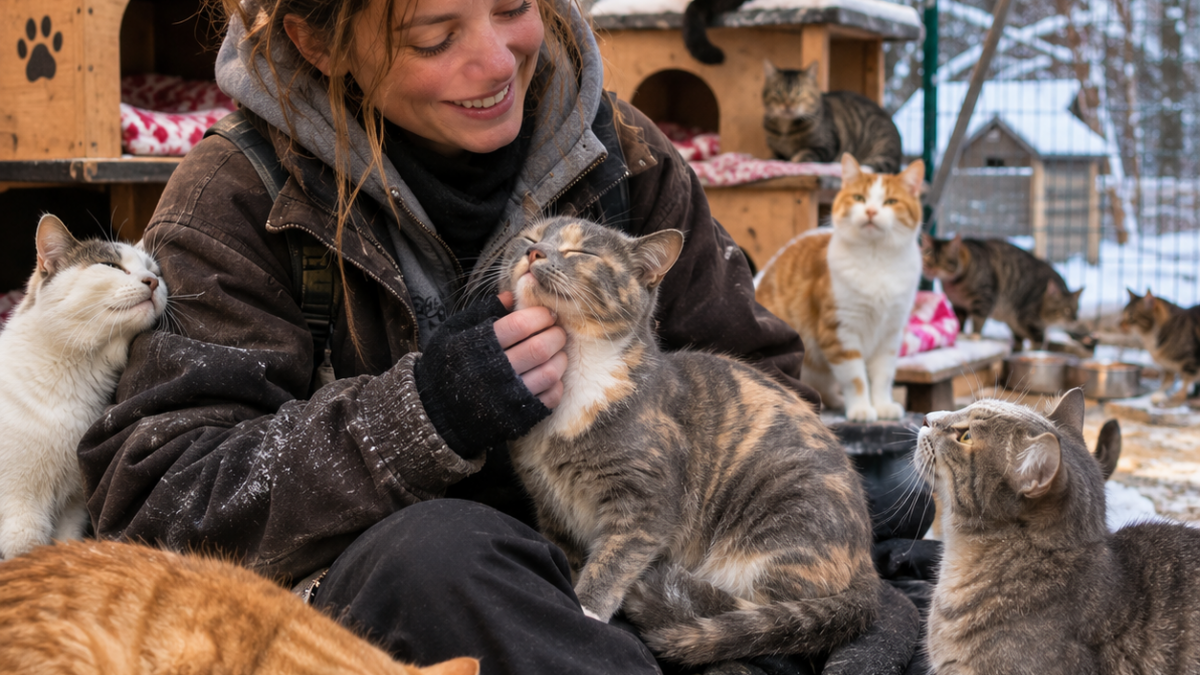
I Started Feeding a Colony of 25 Stray Cats—Then One Little Tortie Ran to My Car Every Day, and the Vet Found Something I Never Saw Coming
When I first walked onto that property, I thought there might be fifteen outdoor cats hiding somewhere in the weeds, but every day I came back, another face appeared until I realized an entire colony had been surviving there through heat, storms, freezing nights, disease, injuries, and litter after litter of kittens.
I told myself I was only going to feed them until someone more experienced figured out what to do, but then three kittens showed up in terrible condition, one with a severe wound on its tail, and suddenly “just feeding” turned into trapping, veterinary care, shelters, cameras, winter-proof feeding stations, and a full TNR effort for every cat we could reach.
And through all of it, one dilute tortie named Winnie kept running down the driveway to meet my car, climbing into traps she had already been caught in, rolling onto her back for belly rubs, grooming the other cats like their tiny exhausted mother—and when the veterinarian told me the infection we found during her spay could have killed her if we had waited much longer, I realized the cat who had made me stay might only be alive because I had.
The first time I drove up that driveway, I had no idea what I was looking at.
There were cats.
That much was obvious.
One under an old structure.
Another disappearing behind a stack of something near the edge of the property.
A gray shape slipping through tall grass.
A pair of eyes watching me from beneath a table.
Then nothing.
Silence.
Stillness.
If I had stood there for five minutes and left, I probably would have told someone there were maybe six or seven cats.
Ten at the absolute most.
But I had already been warned that there were probably more.
Fifteen.
Maybe twenty.
Possibly twenty-five.
Nobody knew.
That was the problem.
Outdoor colonies are like that.
The cats do not line up for a head count.
They do not come out because a stranger arrives with good intentions.
Some are bold.
Some are frightened.
Some have learned that people mean food.
Others have learned that people mean danger.
Some stay close to the place where they were born.
Others move between properties.
Some disappear for hours and return at night.
Some seem to vanish for days.
And when you first arrive, you have no way to know whether the eyes watching from underneath an old shed belong to the same cat you saw near the fence ten minutes earlier.
So I started with food.
That was the one thing I understood.
Food and water.
Nothing sophisticated.
No elaborate feeding station.
No weatherproof shelters.
No system.
At the beginning, I was literally putting food on the ground.
I would drive up, set it down, back away, and wait.
Sometimes nobody came.
At least not while I was standing there.
Then I would return later and the food would be gone.
The next day, maybe one cat would stay visible while I filled the bowl.
Then two.
PART2:
Then another would sit twenty feet away pretending not to care.
That was how it began.
Not with some dramatic rescue.
Not with a cat jumping immediately into my arms.
With distance.
I showed up.
They watched.
I left food.
They waited.
I came back.
That part matters more than I understood at the time.
Cats notice patterns.
Especially cats whose lives depend on patterns.
Where food appears.
What time people come.
Which cars are safe.
Which voices are familiar.
Which footsteps mean someone is bringing dinner and which footsteps mean they should disappear.
I did not realize I was becoming part of their routine until one day I turned into the driveway and saw movement before I had even stopped the car.
Cats.
Coming toward me.
Not all of them.
Never all at once.
But enough.
A little body running down the drive.
Another following.
Then another emerging from underneath cover.
I rolled down the window.
“Hi.”
A cat stopped.
Looked directly at me.
“Hello.”
PART3:
That became my greeting.
Hi.
Hello.
Hey, babies.
I’m here.
It probably sounded ridiculous to anyone listening.
I did not care.
Eventually they began recognizing my voice as quickly as the car.
I would pull in and there they were.
Waiting.
Running down the driveway.
Some more confidently than others.
Some stopping just out of reach.
Some winding around my feet before I could even unload the food.
That was when I started understanding that this was not simply a group of anonymous stray cats.
They were individuals.
Different personalities.
Different relationships.
Different levels of trust.
Different histories I would probably never know.
One cat wanted food but no touch.
One would sit nearby and watch everything.
One seemed to exist permanently behind another cat as if using its body as a shield.
One wanted to eat away from the rest.
One would push into the group like every bowl belonged personally to him.
Some groomed each other.
Some slept together.
Some tolerated everybody but clearly preferred solitude.
And then there was Winnie.
If I had to point to one cat and say, “This is the cat who made it impossible for me to walk away,” it would be her.
Winnie was a little dilute tortie.
Soft gray mixed with pale cream.
Not flashy in the way some cats are.
But beautiful once you really looked at her.
She carried herself differently from the others from the very beginning.
She did not seem impressed by danger.
That is the best way I can explain it.
Most of the cats had some level of hesitation.
Even friendly ones might pause when I moved too quickly.
Winnie acted as though I had been invited.
The first few times I saw her, she came closer than I expected.
Then closer again.
Soon she was right there.
At my feet.
Walking between my legs while I tried not to step on her.
Following whatever I was doing.
If I opened a bag, Winnie needed to inspect the bag.
If I set something down, Winnie needed to see why.
If I moved a shelter, Winnie appeared.
If I cleaned the feeding area, she was part of the cleaning crew whether I wanted help or not.
She wanted to be involved in everything.
There are cats who live outside and make it very clear that the outdoors is where they prefer to negotiate their relationship with humans.
Winnie never gave me that feeling.
She liked people.
She liked touch.
She loved being petted.
Eventually she trusted me enough to flop onto her back and expose her belly.
The first time she did it, I laughed.
“You cannot be serious.”
She stared at me upside down.
I rubbed her belly carefully.
She let me.
That was Winnie.
Unbothered.
Curious.
Confident.
Almost absurdly trusting for a cat living outside.
She started running toward my car before I was fully parked.
Sometimes she came so close to the road that I would panic.
“Winnie, no.”
She did not understand traffic anxiety.
She understood:
My car has arrived.
Therefore I should greet it personally.
Once, she jumped onto the car.
I just stared at her.
“Really?”
She looked perfectly satisfied with herself.
I began planning every arrival around the possibility that Winnie would be under a tire, beside a door, on the hood, or walking directly beneath my feet.
It became annoying in the most lovable way possible.
Then something else happened.
The more time I spent there, the more I noticed that Winnie was not only friendly with me.
She was connected to the colony.
She moved through the group like an elder.
That is the word I kept thinking.
Not necessarily because she was the oldest.
I had no way to know that for certain.
But she carried this strange calmness.
Almost a kind of wisdom.
She groomed other cats.
Rubbed her head against them.
Checked on them.
She seemed to know where everybody was.
Sometimes another cat would be nervous and Winnie would be nearby, completely relaxed, as though her confidence gave the others permission to relax too.
She felt like the colony’s mother even when the actual family relationships were unclear.
I started loving her before I admitted that was what was happening.
But Winnie was not the reason I first understood how serious the situation was.
The kittens were.
There were three that showed up in really rough shape.
That was the moment when the colony stopped feeling like a feeding project and started feeling like an emergency I did not know enough to handle.
Kittens outside are vulnerable to almost everything.
Weather.
Predators.
Cars.
Disease.
Parasites.
Injuries.
Lack of food.
Other animals.
A problem an adult cat might survive can overwhelm a kitten very quickly.
One of those kittens had a severe bite wound on its tail.
Even now, thinking about that tiny body and that injury makes me feel sick.
The kitten was already dealing with the basic difficulty of surviving outside.
Then add a wound like that.
Pain.
Risk of infection.
Difficulty resting.
Difficulty moving normally.
We had to pull those kittens.
There was no “let’s monitor it for another week.”
They needed help.
Once they were safe, I remember looking at one of them and saying something like:
“You’re cozy now.”
It was such a small sentence.
But that was what I wanted for them.
Cozy.
Safe.
Warm.
Normal words.
Normal things.
Things outdoor kittens often do not get.
That rescue forced the next question.
What happens after the emergency kittens?
Because we could remove three kittens.
But if the adult cats kept reproducing, there would be more.
Then more.
Then more.
That is the reality of colony care that I had not fully understood before getting involved.
Feeding helps the cats who are hungry today.
It does not solve uncontrolled reproduction.
If you want the cycle to slow, you need TNR.
Trap.
Neuter.
Return.
I had heard the words before.
Now they became my calendar.
My anxiety.
My education.
My life.
We needed to trap the adults.
Get them fixed.
Provide veterinary attention where needed.
Then return the cats who were suited to colony life.
For the friendly cats, we could think about other possibilities.
For kittens young enough to socialize and place, rescue and adoption.
Simple on paper.
Much less simple when the paper becomes thirteen, fifteen, twenty individual cats who do not understand that the strange metal box with food inside is supposed to help them.
The first traps taught me humility.
I had imagined that hungry cats would enter traps because food was inside.
Some did.
Others apparently had graduate degrees in trap avoidance.
They would walk around the trap.
Inspect the back.
Look through it.
Sit beside it.
Eat whatever tiny piece of food had somehow fallen outside.
Then stare at me as though asking whether that was the best plan I had.
Winnie was the opposite.
Of course she was.
She walked into the trap.
Caught.
Fine.
We dealt with her.
Then she came back.
And tried to go into traps again.
I would be working to catch a cat who absolutely needed to be caught, and there would be Winnie attempting to insert herself into the operation because perhaps the trap contained snacks and attention.
“Winnie.”
She would look at me.
“No.”
She would move closer.
“You already did this.”
No concern whatsoever.
Trapping became significantly harder because one of the easiest cats to trap apparently wanted to be trapped repeatedly.
That was one of the things I loved about her.
Even in stressful moments, Winnie found a way to make the situation ridiculous.
But the TNR process revealed something about her that was not funny.
When Winnie was taken in to be spayed, the veterinary team found a serious infection associated with her not having been spayed.
It was the kind of infection that can become life-threatening.
The veterinarian made it clear that the timing mattered.
If Winnie had remained outside much longer without treatment, she might not have survived.
I remember hearing that and feeling the room become very quiet.
Winnie?
The cat who ran down the driveway?
The cat who climbed into traps like they were entertainment?
The cat rolling onto her back demanding belly rubs?
She looked healthy enough.
Friendly.
Alert.
Engaged.
She was functioning.
And inside her body, something dangerous was happening.
That realization changed me.
Before, I had thought of TNR mainly in terms of population control.
Prevent more kittens.
Reduce fighting associated with mating.
Stabilize the colony.
All important.
But with Winnie, spaying also became the reason a serious medical problem was discovered in time.
We had caught her because we were trying to prevent more litters.
In doing that, we may have saved her life.
I kept thinking:
What if we had waited?
What if I had told myself I would start next month?
What if I had decided I was too busy?
What if Winnie had disappeared for a few days and nobody noticed?
Outdoor cats can hide illness incredibly well.
Sometimes they have no choice.
Weakness is dangerous.
They adapt.
They keep moving.
They show up for food.
They survive until they cannot.
Winnie had been showing me her belly.
Purring.
Following me.
And I had no idea.
That stayed with me through every later decision.
When the colony work became exhausting, I remembered Winnie.
When trapping felt impossible, Winnie.
When weather destroyed something I had spent hours building, Winnie.
When I wondered whether all the effort made enough difference, Winnie.
Because sometimes the difference between “cat living outside normally” and “cat in a medical crisis” is invisible until somebody gets close enough to find it.
Getting the colony fixed took time.
And while we were doing it, kittens kept being born.
That part was frustrating in a very specific way.
You make progress.
You trap cats.
You schedule appointments.
You transport them.
You recover them.
You keep records.
You return the appropriate adults.
You think:
Okay.
We’re getting somewhere.
Then somebody tells you there are kittens.
Or you see tiny faces where there had been none.
And suddenly the timeline changes again.
But we were lucky.
Those later kittens got into rescue.
They were adopted.
That matters enormously.
Every kitten safely placed indoors is one less cat growing into an outdoor reproductive cycle.
Eventually, after TNR and rescue placement, the colony stabilized at thirteen cats.
Thirteen.
The number felt manageable compared with what we had started with.
But “manageable” did not mean easy.
By then, I was going every day.
Every day changes the relationship.
There is a huge difference between seeing outdoor cats occasionally and knowing them.
Once you know them, weather becomes personal.
Before the colony, a storm was a storm.
Now I would hear wind outside my own house and immediately think:
The cats.
Cold snap?
The cats.
Heat advisory?
The cats.
Heavy rain?
The cats.
Snow?
The cats.
You sit inside somewhere warm and suddenly your brain produces an image of thirteen animals outside trying to stay dry.
You cannot turn it off.
That was one of the biggest emotional changes for me.
I had always cared about animals.
This was different.
I knew where these animals slept.
I knew which cat was slow to arrive at dinner.
I knew which ones ate together.
I knew who needed a separate bowl.
I knew who would come for petting and who needed distance.
I knew Winnie would probably be waiting near the driveway.
So when the weather became bad, I did not imagine “stray cats.”
I imagined specific faces.
That takes a toll.
People sometimes talk about rescue work only in terms of compassion.
Compassion is part of it.
But compassion can hurt.
Because once you understand enough to care, you also understand everything you cannot control.
I could bring food.
Water.
Shelter.
Medical care when possible.
I could TNR.
I could monitor.
But I could not remove every risk.
Cars still existed.
Coyotes.
Disease.
Other wildlife.
Extreme weather.
People.
All the dangers of living outdoors remained outside my control.
That helplessness can sit with you.
Especially at night.
So I did what people do when helplessness becomes unbearable.
I improved what I could.
The feeding setup changed gradually.
At first:
Food on the ground.
Then bowls.
Then a more organized place.
I wanted the cats to have a predictable feeding station.
Something cleaner.
Something protected.
A location where they knew:
This is where food appears.
Then weather forced more changes.
Cardboard went down in places because I was trying to keep food off wet ground.
Cardboard is not a solution.
It is what happens before you learn that the thing you thought would last one afternoon dissolves into sadness after one rain.
So we upgraded.
I found small greenhouse-style structures.
Little mini greenhouses that could function as feeding stations.
They were not designed originally for feral-cat dining, but rescue teaches you to look at objects and ask:
Could a cat use this?
Could this block wind?
Could this keep food dry?
Could this become shelter?
The small greenhouses worked better.
I remember seeing the cats use them and feeling ridiculously happy.
“Hi!”
I would talk to them through the opening.
“I’m so glad you guys are using those.”
The cats did not care that I had spent time planning the setup.
They cared that dinner was dry.
Fair.
But every improvement revealed the next thing that needed improving.
The temperature dropped.
Snow came.
I drove up one day and saw cats eating with their paws in the snow.
That image bothered me badly.
They were eating.
They were surviving.
But their feet were literally in snow while they tried to finish dinner.
I looked at the setup and thought:
This is not enough.
You begin rescue work thinking there will be a point when you finish.
There rarely is.
You solve food.
Now you need weather protection.
You solve weather protection.
Now you need better flooring.
You add flooring.
Now you realize water bowls freeze.
You manage water.
Now one cat has a medical problem.
Then another.
Then your structure blows over.
The work evolves because the animals keep teaching you where the weakness is.
I started planning better shelters.
Feeding areas.
Places where the cats could get out of wind.
Places where bedding could remain dry.
Then came the windstorm.
A really bad one.
I had cameras by then.
That was another upgrade.
Cameras gave me some peace of mind because I could check the colony without physically standing there every minute.
They also gave me new ways to panic.
One night during the storm, I checked the camera.
Black.
Just black.
My first thought:
Oh no.
Not “camera lost power.”
Not “connection failed.”
My brain went straight to:
Something happened.
I drove out.
The scene looked awful.
Tables moved from where they belonged.
Structures blown over.
The mini greenhouses ripped and damaged.
Things scattered across the yard.
The setup I had built piece by piece looked like somebody had picked it up, shaken it, and thrown it back down.
“Oh my gosh.”
I remember looking around for cats.
“You guys okay?”
That was all I cared about first.
Cats.
Count.
Faces.
Movement.
Once I knew the colony had gotten through the storm, I could look at the damage.
The little structures had helped until they didn’t.
They were not sturdy enough for what the site could experience.
I had a choice.
Rebuild the same thing.
Or admit the design had failed and create something stronger.
So I started looking for a better solution.
That led to the larger hoop greenhouse.
A proper structure.
More space.
More stability.
Better protection.
When we got it set up, I felt like I had built a tiny community center for cats.
Inside, we could organize the feeding area properly.
There was space.
Shelter.
Little cubby-style condos.
A playpen area.
Protected spots.
The cats could come and go.
They could eat without sitting directly in rain or snow.
They could rest.
They could interact in a more comfortable environment.
And most importantly, the structure held up.
Wind came.
Still there.
Bad weather.
Still there.
Every time I checked the camera after that, part of me expected the old black screen and wreckage.
Instead, I would see cats inside.
Using it.
Sleeping.
Eating.
Moving around.
It made me ridiculously proud.
Not because it looked impressive.
Because it worked.
The cats loved it.
That was enough.
Once the basic survival crisis became more stable, something beautiful started happening.
I got to observe them.
Really observe them.
Not just:
Who needs food?
Who needs medical care?
Who needs trapping?
But:
Who are you?
That was one of the greatest gifts of caring for the colony.
Cats have social lives people often miss.
Especially when they think of feral or community cats as interchangeable.
They are not.
I would see two cats groom each other.
One rubbing its head against another.
Certain cats sleeping close.
Others maintaining personal space.
One cat arriving late and getting tolerated anyway.
Some eating side by side.
Others needing separate feeding because competition stressed them.
I learned who was confident.
Who was anxious.
Who was pushy.
Who was gentle.
Who played.
Who watched.
Who acted like a teenager.
Who acted eighty years old.
There was a whole small society happening outside whether humans noticed or not.
Winnie seemed to float through all of it.
She would groom another cat.
Rub heads.
Walk between groups.
Then come straight to me as soon as I arrived.
She was often the first one down the driveway.
I started expecting her.
If Winnie did not appear immediately, I worried.
“Where’s Winnie?”
Then she would come running from somewhere and I would feel silly for panicking after thirty seconds.
She stayed right at my feet.
Constantly.
I would be carrying food and have to shuffle because she was walking exactly where my next step needed to go.
“Winnie.”
She would look up.
“You’re going to kill me.”
She remained unconcerned.
She wanted pets.
She wanted action.
She wanted to know everything.
If I crouched, she was there.
If I sat down, she moved closer.
If I reached for her, she leaned into it.
Belly rubs.
Head scratches.
Everything.
That friendliness created another question.
Should Winnie really stay outside?
TNR generally means trap, neuter, return because many community cats are not suited for traditional indoor adoption.
Some are truly feral.
Some are comfortable with colony life and deeply stressed by confinement.
But Winnie was different.
She sought people.
She seemed to want attention.
She was already demonstrating behaviors that made me think she could potentially adapt beautifully to an indoor home.
The problem was finding one.
Everyone says they love cats.
Then adoption gets complicated.
People want kittens.
Tiny.
Young.
No history.
Easy to imagine as a blank slate.
Winnie was an adult.
She had lived outside for years.
She had a story.
Possibly habits from colony life.
She was not the cat most people picture when they decide they want to adopt.
That made me sad.
Because once you knew her, Winnie was not a difficult sell emotionally.
She was incredible.
Sweet.
Funny.
Social.
Loving.
Confident.
A little ridiculous.
The kind of cat who would probably supervise your bathroom routine, sit directly on whatever paper you needed, inspect grocery bags, and greet you like you had been gone for three years when you returned from taking out the trash.
But getting someone to know that requires giving her a chance first.
I kept hoping.
Still do.
Because however good the colony setup became, I never confused it with the safety of a home.
The greenhouse is better than snow.
Shelters are better than wind.
Daily feeding is better than hunger.
TNR is better than uncontrolled breeding.
Medical monitoring is better than nobody watching.
But outside is still outside.
Cars do not care how friendly Winnie is.
Coyotes do not care that she gives belly rub access.
Disease does not care that she is the unofficial mother of the colony.
Extreme heat does not care.
Freezing weather does not care.
Every time Winnie ran toward my car, part of me loved it.
Another part thought:
Please stop running near cars.
That contradiction is colony care.
Joy and anxiety together.
You celebrate the cat trusting you while worrying that the trust makes them less cautious.
You build a better shelter while wishing they did not need it.
You feed them well while wishing their bowl were in someone’s kitchen.
You make outdoor life safer while knowing “safer” is not the same as safe.
Winnie especially kept me awake.
Maybe because we were close.
Maybe because almost losing her to that infection made the risk feel real.
I would think:
She survived that.
Now what if a car gets her?
What if she disappears?
What if she becomes sick and hides it?
What if something happens on the one night I do not check?
Rescue can make your brain cruel.
It offers unlimited imaginary emergencies.
You learn to manage that or you burn yourself out.
I started reminding myself:
Today, Winnie ate.
Today, she was active.
Today, she was affectionate.
Today, the shelter is standing.
Today, everyone has water.
Today.
That is enough for today.
I had to learn that.
Because when I first became involved, I wanted to solve the entire future.
All the cats safe forever.
No weather.
No predators.
No disease.
No danger.
Impossible.
What I could do was improve the next night.
And then the next.
One of the things I did not expect from colony care was how much community it would create among humans too.
People helped.
Some donated materials.
Some helped with TNR.
Some assisted with medical care.
Some contributed food.
Some supported the shelters.
Some helped with kittens.
Rescue organizations took cats we could place.
Veterinary professionals treated them.
People shared ideas.
Every part of that greenhouse contains somebody’s effort.
Every cat who got fixed represents coordination between people.
Every kitten adopted indoors exists because multiple people said yes at different moments.
No rescue story belongs to one hero.
I happened to be the person showing up every day.
That did not mean I did it alone.
The colony taught me that too.
I would arrive tired sometimes.
There were days I did not feel emotionally inspired.
That is another thing rescue stories leave out.
You do not wake up every morning feeling like a compassionate angel.
Sometimes you wake up thinking:
I am exhausted.
It is freezing.
I don’t want to drive there.
Then you go anyway.
Because thirteen cats have built your arrival into their day.
They do not know you had a bad night.
They do not know your schedule is inconvenient.
They know the car.
The voice.
The time food usually appears.
Responsibility becomes routine before it becomes identity.
At some point, I stopped saying:
“I’m helping this colony.”
And started saying:
“My colony.”
Not ownership.
Connection.
These are the cats I know.
The cats whose absence I notice.
The cats whose personalities I can explain.
The cats I think about during storms.
That shift happens quietly.
Then one day somebody asks why you are driving across town in bad weather carrying cat food, straw, water, and a bag of zip ties, and you realize there is no simple answer except:
Because they are waiting.
Winter was the hardest emotionally.
The cats actually handled more than I gave them credit for.
Outdoor cats are resilient.
But resilience should never become an excuse to stop helping.
Seeing paw prints in snow.
Seeing them come to eat in freezing temperatures.
Watching them choose protected areas.
It made every upgrade feel urgent.
I learned about keeping shelters insulated.
About avoiding materials that retain moisture in dangerous ways.
About keeping feeding spaces cleaner.
About how wind enters.
About where snow blows.
About placement.
About what cats actually use versus what humans think looks good.
Cats are excellent critics.
You can spend hours building something beautiful.
They may choose the cardboard box it came in.
The colony made its opinions clear.
Certain cubbies became popular.
Others remained empty.
Some spots turned into social areas.
Some became the preferred private corners.
I rearranged based on them.
They trained me very effectively.
Summer created a completely different kind of anxiety.
People think outdoor cats only struggle in winter.
Heat can be brutal.
Water matters constantly.
Shade.
Airflow.
Monitoring.
On extreme days, I would think about them while sitting inside air conditioning.
Again:
The cats.
You cannot unknow where they are.
That is what involvement does.
Before, I could hear a weather alert and think about my own plans.
After the colony:
Are the water bowls full?
Is the shelter ventilated?
Will they use the shaded area?
Do I need to go earlier?
Do I need to add water?
Every season became a problem-solving exercise.
And still, they played.
That was another thing that amazed me.
Even living outdoors, even after everything, cats find room to be cats.
Catnip helped reveal that.
I started bringing it.
Toys too.
At first, part of me felt almost silly.
These cats need food and shelter and medical care.
Why am I bringing toys?
Because survival is not the only need worth caring about.
Watching a colony cat play does something to you.
An animal you know spends its life negotiating risk suddenly attacks a toy like a kitten.
Rolls.
Pounces.
Chases.
For a few minutes, the world is not survival.
It is play.
That matters.
Winnie loved being in the middle of whatever was happening.
Of course.
Catnip?
Winnie.
New object?
Winnie.
Toy?
Winnie.
Person doing anything?
Winnie.
I started talking to her more than I realized.
“Hi, baby.”
“Hey, sweetheart.”
“I’m sorry, it’s so cold.”
“Move your little body before I step on you.”
She would answer by positioning herself more dangerously beneath my feet.
I sometimes wondered what she thought I was.
Food person?
Friend?
Large clumsy cat?
Probably a combination.
The relationship felt real either way.
Not human in disguise.
Not a fantasy that she understood my intentions.
Just trust built through repeated experience.
I show up.
I feed.
I touch gently.
I do not hurt her.
She comes closer.
That is enough.
There was a moment sometime after the main TNR work when I stood inside the greenhouse and looked around.
Cats resting.
Food organized.
Shelters in place.
Camera working.
The whole setup stable.
And I remembered the beginning.
Food on dirt.
No real count.
No plan.
Kittens injured.
Cats reproducing.
Weather exposure.
I remember thinking:
How did we get from there to this?
Not perfectly.
There is no perfect.
But comfortable.
Safer.
Thirteen fixed cats rather than a growing colony.
Kittens placed.
Medical issues treated when identified.
A structure that could survive wind.
Daily monitoring.
Relationships.
It was one of the first times I let myself feel proud without immediately thinking about the next problem.
That feeling lasted maybe five minutes.
Then a cat knocked something over.
Still.
Five good minutes.
People sometimes ask whether feeding outdoor cats makes you attached.
Yes.
That question answers itself.
You cannot look into the same faces every day and remain detached unless you work very hard to shut something off inside yourself.
Attachment has consequences.
When one does not show up, your stomach drops.
When one looks slightly off, you study it.
When one finally lets you touch them after months of distance, you feel absurdly honored.
When one disappears, you search.
When one dies, it hurts.
Colony care means accepting grief as part of the agreement.
I wish that were different.
It is not.
Outdoor life is hard.
That is exactly why the good moments matter.
A cat choosing your lap.
A formerly skittish cat eating while you stand nearby.
Two cats grooming each other in the sun.
Winnie running down the driveway.
The sound of cats eating inside a shelter while snow falls outside.
Little things.
Huge things.
The more I learned, the more I understood how invisible community cats are to most people.
You drive past a property.
Maybe you see one cat.
You think:
Someone’s outdoor pet.
Or:
Stray.
You have no idea there may be twelve more.
No idea who is feeding them.
No idea which have been fixed.
No idea how many litters were born there last year.
No idea which kittens survived.
No idea one cat has been living there eight years.
No idea a volunteer checks water before work every morning.
No idea somebody built shelters after watching cats eat in snow.
There are entire systems of care happening quietly in neighborhoods everywhere.
Much of it done by people who never planned to become rescuers.
That was me.
This was my first colony.
I learned everything while doing it.
Mistakes included.
Especially mistakes.
I fed food on the ground because I did not know better.
I built things weather later proved were inadequate.
I worried too much about some things and probably not enough about others.
I learned trapping through experience.
I learned cat personalities cannot be reduced to “feral” and “friendly.”
There is a huge spectrum.
Some cats change with time.
Some do not.
Some will tolerate a caregiver but never want indoor life.
Some are clearly asking for more human contact.
Winnie exists near one end of that spectrum.
She wants people.
That is why I still hope for an indoor home for her.
If someone met her without knowing her history, they might not guess how long she had lived outside.
She does not behave like a cat who wants six feet of distance.
She behaves like a cat who wants to be involved in your tax return.
I can picture her indoors too easily.
Sitting on a couch.
Sleeping in a sunny window.
Following somebody to the kitchen.
Rolling over for belly scratches.
Running to a front door when her person comes home.
That image makes me happy.
It also makes colony visits harder sometimes.
Because when she runs to me, I think:
You could do this every day inside a home.
Then I remind myself that finding the right adopter matters more than finding any adopter.
An indoor home must be safe.
Committed.
Patient.
Prepared to let Winnie adjust at her pace.
Outdoor cats can surprise you with how quickly they adapt, but transition still deserves care.
I do not want to move her from one known environment into another uncertain one simply because “indoors” sounds automatically better.
The right home.
That is what I want.
For Winnie.
For any of the friendlier cats who show signs they might thrive there.
Not every colony cat needs the same outcome.
That was another lesson.
Rescue is not one answer applied to every animal.
It is asking:
What does this individual need?
A kitten might need foster and adoption.
A truly feral adult may need TNR and a stable colony environment.
A sick cat needs medical intervention.
A friendly adult may be adoptable.
A bonded pair might need consideration together.
A dominant feeder may need a separate bowl.
Winnie needed emergency treatment we did not know she needed until we trapped her.
Individual cats.
Individual solutions.
That sounds obvious.
It is surprisingly easy to forget when looking at a group.
The colony taught me empathy in a way I did not expect.
Not only for cats.
For living things trying to survive with circumstances they did not choose.
Every one of those cats was doing what life had taught it to do.
Avoid.
Approach.
Fight.
Hide.
Eat quickly.
Wait.
Trust selectively.
Raise kittens.
Find warmth.
Find shade.
Survive.
Humans do versions of the same things.
We build routines around whatever has hurt us.
We come closer when experience teaches us something is safe.
We withdraw when it is not.
We protect resources when we have known scarcity.
We form bonds.
We care for each other.
We adapt.
Watching the colony made those parallels impossible for me not to see.
It made me softer.
More patient.
Not perfectly.
Ask anyone who has watched me trying to stop Winnie from entering a trap for the third time.
But generally.
Softer.
The cats did not need me to romanticize their lives.
Outdoor life is not some beautiful natural adventure.
It is hard.
That is why I do not like narratives that say:
They are free.
Yes.
They are also exposed.
Freedom from walls does not mean freedom from danger.
An indoor cat sleeping on a couch is not missing some morally superior struggle for survival.
Comfort is not weakness.
Safety is not a loss.
That is why, in an ideal world, I would love the friendly cats to have indoor opportunities.
Not because the colony is bad.
Because home can remove risks I will never be able to eliminate outside.
For the cats who remain, I will continue making the colony as good as I can.
Those two beliefs can coexist.
The greenhouse was one of the biggest upgrades, but it never made me stop thinking about improvements.
I looked at flooring.
Beds.
Cubbies.
Feeding placement.
How many cats could eat comfortably.
Where a shy cat could stay without being crowded.
How to keep things clean.
How to keep supplies dry.
I watched camera footage not just to confirm cats were alive, but to see how they used the space.
Which paths.
Which entrances.
Where conflict happened.
Where they rested.
It became almost like studying a tiny apartment complex.
One cat preferred a corner.
Another liked a raised spot.
Winnie liked anywhere other people were.
Obviously.
I started recognizing relationships more clearly through the camera.
Cats grooming.
Cats waiting for each other.
Cats playing when no human stood nearby.
That footage made me realize something.
The colony had a life independent of me.
Of course it did.
But caregivers can accidentally imagine themselves at the center because our experience begins when we arrive.
The camera showed everything after I left.
The cats remained.
They interacted.
Moved.
Played.
Rested.
I was one part of their day.
Important, maybe.
Not the whole thing.
I liked that.
It meant I was not creating their world.
I was supporting a world already there.
That distinction made me respect them more.
There were moments when I wished I could ask Winnie about her life before me.
Where were you born?
Did you always live here?
How many litters did you have?
Which cats are yours?
Were you once somebody’s pet?
Did someone leave you?
Did you wander here?
Why are you so friendly?
Why does nothing seem to scare you?
What made you Winnie?
I will never get answers.
Her body gives clues.
Her behavior gives clues.
But clues are not biography.
That is true for rescue animals everywhere.
Humans love complete stories.
Beginning.
Middle.
Explanation.
But rescued animals often arrive with missing chapters.
We need to become comfortable loving them without filling every blank with imagined tragedy.
Winnie’s life matters whether I know the first half or not.
What I know is:
She lived outside.
She became part of this colony.
She trusted me.
She needed medical care.
We got her in time.
She is still here.
She comes running.
That is enough.
The more people learned about the colony, the more help appeared.
That was deeply moving.
People sometimes see rescue work and assume the caregiver is uniquely selfless.
I do not feel that way.
The truth is the cats give something back.
Purpose.
Routine.
Relationship.
A reason to stop thinking about yourself for an hour.
On difficult days, I would drive to the colony carrying my own worries.
Work.
Life.
Stress.
Whatever.
Then the cats appeared.
Food needed filling.
Water needed changing.
Winnie needed to trip me.
A shelter needed adjusting.
Suddenly my problems existed in proportion again.
Not gone.
Just not the only thing.
Helping someone outside yourself does that.
Animal.
Person.
Community.
Anything.
Service interrupts the loop of self.
That became one of the biggest lessons for me.
You do not need to rescue thirteen cats.
You do not need to build a greenhouse.
You do not need to become the person who carries traps in your car and knows which brand of cat food a particular outdoor cat will accept.
Find something.
A cause that matters to you.
Do something useful.
Consistently.
The world changes through consistency more often than grand gestures.
That is literally what the cats taught me.
I did not gain their trust through one extraordinary day.
I showed up.
Then showed up.
Then showed up.
Food.
Water.
Voice.
Car.
Routine.
Trust formed from repetition.
Community formed the same way.
People helped once.
Then again.
Someone donated.
Someone transported.
Someone fostered.
Someone adopted.
Someone repaired.
Someone trapped.
Someone cared.
A network formed.
That is how rescue works when it works.
Not one hero.
A lot of people doing manageable pieces.
The colony is thirteen cats now.
That number still sounds strange when I compare it with those first uncertain estimates.
At least fifteen.
Maybe twenty-five.
Nobody knew.
Now I know them.
That is the difference.
Not only the number.
Their faces.
Personalities.
Patterns.
I know which cats I can pet.
Which cats tolerate me near the bowl.
Which cats need space.
I know who greets me.
Who observes.
Who grooms.
Who likes toys.
Who wants catnip.
Who needs food placed slightly away from everybody else.
And Winnie.
Always Winnie.
Some days I imagine the future and feel hopeful.
Maybe Winnie gets adopted.
Maybe another friendly cat does too.
Maybe the colony slowly becomes smaller over the years because no more kittens are being born and cats move into safe homes where appropriate.
That is success in colony work.
Not making cats disappear overnight.
Stabilizing.
Preventing suffering.
Reducing reproduction.
Improving individual lives.
I know there may be losses too.
I try not to live inside those future fears.
Today.
Remember today.
Today they have food.
Water.
Shelter.
Today Winnie is there.
I still talk to her when I arrive.
“Hi.”
She runs down the driveway.
“Hello.”
Sometimes she reaches the car before I am ready.
“Winnie, please don’t get under the tire.”
She winds around my feet.
I unload supplies.
She follows.
If I bend over, she pushes into my hand.
If I walk, she escorts me badly.
If I stop, she looks up.
I pet her.
Sometimes she rolls onto her back.
Belly exposed.
I rub it.
There are moments when the entire experience collapses into that small interaction.
A cat outside.
A hand.
Trust.
No colony statistics.
No TNR terminology.
No weatherproofing.
No rescue strategy.
Just Winnie.
Alive.
Her infection treated.
Her body warm beneath my hand.
Still here.
That is the part that gets me.
Still here.
Because she almost wasn’t.
We did not know.
That is what makes timing feel miraculous even though I know it was not magic.
We trapped her.
She got examined.
The problem was found.
Treatment happened.
Cause and effect.
Still, emotionally, it feels like we arrived at the edge of something without seeing it.
One different decision and maybe Winnie disappears.
Maybe I show up one day and she does not run down the driveway.
Maybe I assume she is elsewhere.
Then another day.
Then someone finds her too late.
Instead:
She is here.
The cat who kept walking into traps accidentally walked into the one that saved her.
I think about that constantly.
There is a temptation in rescue stories to say an animal “knew” help had arrived.
I do not know what Winnie knew.
Maybe she smelled food.
Maybe she liked boxes.
Maybe she simply had no trap fear.
I do not need the moment to be mystical.
The outcome is enough.
We got her.
The veterinarian found what was wrong.
She survived.
Sometimes ordinary timing is extraordinary enough.
Afterward, I watched her differently.
I checked her more.
Probably annoyed her more.
“Are you okay?”
Winnie:
Clearly trying to climb into something.
“You look okay.”
She would roll over.
Fine.
Belly rub.
Medical assessment complete.
Not exactly scientific.
But familiarity matters.
You learn normal.
When you know normal, abnormal stands out.
That is another reason consistent caregivers matter for colonies.
A stranger may see a cat resting and think nothing.
A caregiver thinks:
He usually comes faster.
She normally eats more.
That cat never sits there.
Why is his coat rough?
Why is she hiding?
Patterns create early warning.
I did not have that knowledge at first.
Now I do.
Not perfect.
Useful.
That makes the daily work feel more important.
Feeding is care.
Observation is also care.
Sometimes the most important thing you provide is noticing.
Winnie noticed me too.
I know that because of the car.
The voice.
The way she appears.
Animals build their own understanding of us.
Maybe she does not know my name.
She knows the sound of arrival.
She knows my hands.
She knows my routine.
That relationship means something to her in whatever way cats define meaning.
It means a lot to me.
There are days I wish I could bring Winnie home myself.
People ask that.
Why don’t you just adopt her?
Life is not always that simple.
Existing pets.
Space.
Household dynamics.
Resources.
Every rescuer eventually confronts the fact that caring deeply about an animal does not automatically mean your home is the right placement.
If love alone determined capacity, rescuers would live with seventy animals.
Then nobody would be safe.
So I keep looking for the right opportunity.
I tell people about Winnie.
Adult.
Dilute tortie.
Friendly.
Affectionate.
Outdoor history.
Loves pets.
Belly rubs.
Would like to be involved in literally everything you do.
Colony elder energy.
Professional trap trespasser.
Survived a serious infection discovered during spay.
Deserves warmth.
If somebody sees the cat I see, the “hard sell” disappears.
I believe that.
Until then, she has us.
That matters too.
She is not abandoned.
There is a difference between an outdoor community cat with consistent care and an animal nobody is watching.
The colony has people.
Food.
TNR.
Shelter.
Medical intervention when possible.
Cameras.
Support.
It is not indoor life.
It is not nothing.
Sometimes rescue requires living inside imperfect progress.
I used to want clean endings.
Cat found.
Cat adopted.
Done.
Colonies do not give you that.
They give you ongoing care.
Relationships measured in years.
No dramatic finale.
You keep going.
That is beautiful in its own way.
The ending is every ordinary day the cats eat.
Every winter shelter that stays standing.
Every kitten who is not born into danger because an adult was fixed.
Every friendly cat who gets adopted.
Every sick cat noticed.
Every morning Winnie runs down the driveway.
Those are endings and beginnings at the same time.
The original three kittens changed my trajectory.
I think about them too.
Especially the one with the tail wound.
How small it was.
How vulnerable.
How immediate the need felt.
Those kittens made it impossible for me to pretend feeding alone was enough.
They pushed me toward rescue contacts.
Toward TNR.
Toward learning.
In that sense, the most fragile animals changed the fate of the entire colony.
Because once we started fixing adults, the population stopped expanding in the same uncontrolled way.
Once rescue partners took kittens, those kittens got indoor futures.
Once I became consistent, the adults became easier to monitor.
One crisis created a system of care.
I wish the crisis had never happened.
That is important to say.
Good outcomes do not make suffering necessary.
The kitten did not need to be injured for humans to learn compassion.
Winnie did not need a dangerous infection to teach me urgency.
The cats did not need to freeze so I could learn shelter design.
Those things were bad.
We simply chose to respond afterward.
That is where meaning comes from.
Not from pretending hardship was meant to happen.
From deciding hardship will not be ignored.
The windstorm was bad.
We built stronger.
Snow was bad.
We improved shelter.
Kittens were hurt.
We got them help.
Cats were reproducing.
We implemented TNR.
Winnie was sick.
She received treatment.
Problem.
Response.
Again.
Again.
Again.
That is rescue.
Not miracles.
Responses.
Sometimes a response arrives early enough to look miraculous.
I have become grateful for ordinary things I barely noticed before.
A dry bowl.
Unfrozen water.
A shelter standing after wind.
A cat eating normally.
A camera feed showing movement.
A sunny afternoon in winter.
A day without a new kitten.
Winnie appearing on schedule.
Rescue recalibrates what good news means.
You stop needing spectacular.
No emergencies today?
Excellent.
Everyone showed up?
Perfect.
Food eaten?
Beautiful.
That kind of gratitude changes you.
It has changed me.
I am more aware now of how much life exists just outside people’s attention.
Animals.
People.
Needs.
Whole stories unfolding while everyone else drives past.
I do not say that judgmentally.
I drove past things too.
We all do.
Nobody can notice everything.
But once something becomes visible to you, you have a choice.
Look away.
Or get closer.
Getting closer has a cost.
Time.
Money.
Emotion.
Responsibility.
It also gives something back.
I know thirteen cats I never would have known.
I have watched trust form.
I have seen kittens go from danger to adoption.
I have seen a flimsy setup become a protected space.
I have seen people come together because animals needed them.
I have watched Winnie survive.
Those things are part of my life now.
I would not trade them to regain the version of myself who had fewer worries during storms.
Maybe that is the clearest proof.
Yes, the colony keeps me up sometimes.
Yes, it takes a toll.
Yes, I worry.
And I would still choose to stop that first day.
I would still put food down.
I would still come back.
Because the hardest part of caring is not that it hurts.
It is that once you know them, walking away would hurt worse.
There is a camera clip I love.
Nothing dramatic.
No rescue.
No medical emergency.
The colony is relaxed.
One cat grooming another.
Someone stretching.
Another walking through.
Winnie moving between them.
That clip probably looks boring to everyone else.
To me, it means safety.
Not absolute safety.
Enough safety for a cat to groom.
Enough calm to play.
Enough predictability to rest.
Those behaviors tell me the space is serving a purpose.
Animals cannot relax when they are constantly responding to immediate threat.
Seeing the colony relaxed is one of the greatest rewards.
It makes all the construction and carrying and driving and worrying feel tangible.
The cats are using what we built.
Not because they understand the effort.
Because it meets a need.
That is the purest kind of success.
I do not need gratitude from them.
Winnie gives plenty anyway.
Usually by obstructing my walking path.
The others show it differently.
Or not at all.
A cat who will never let me touch them still deserves food and shelter.
Care is not a transaction for affection.
That was another important lesson.
Friendly animals are easier emotionally.
They reward humans in recognizable ways.
Purr.
Head bump.
Belly roll.
A feral cat may take everything you provide and remain ten feet away.
That does not make the care less valuable.
Trust is not rent.
They do not owe me access to their bodies because I buy food.
Respecting that made the friendly moments more meaningful, not less.
When a cautious cat moved closer for the first time, I knew it had chosen the distance.
When Winnie threw herself at my feet, I knew that was her choice too.
Different cats.
Different boundaries.
All valid.
If more people understood that, I think community-cat care would become easier.
Some people see a cat outside and insist it must immediately become a pet.
Others see outdoor cats and say nobody should feed them.
Reality requires more nuance.
TNR.
Population management.
Responsible feeding.
Shelter.
Medical monitoring.
Adoption where appropriate.
Rescue of kittens.
Community cooperation.
Not one emotional answer.
The colony forced me to learn that nuance.
I am still learning.
That is probably another thing I would tell anyone starting.
You do not have to know everything before helping.
But you do have to be willing to learn.
Ask experienced people.
Work with legitimate rescue groups.
Use veterinary guidance.
Do not assume.
Do not let pride turn a beginner mistake into a permanent one.
My first feeding setup was food on the ground.
Now we have a hoop greenhouse.
You are allowed to improve.
That sounds obvious.
It felt liberating.
People can become so afraid of doing rescue “wrong” that they do nothing.
Do something responsible.
Then learn.
Then do better.
The cats do not need perfection on day one.
They need somebody willing to make day two better.
Winnie certainly did.
I wonder sometimes whether she remembers life before the colony became organized.
Probably not as a narrative.
But she experienced the change.
Food appearing consistently.
Shelters.
Less reproductive stress after TNR.
Medical treatment.
Human contact.
Maybe all she knows is that life became more predictable.
That is enough.
The rest is my story about her.
Her story is simpler.
Wake.
Stretch.
Find cats.
Eat.
Groom.
Wait for car.
Run dangerously close to car.
Demand attention.
Maybe that is why I love her.
She does not carry the emotional weight I put on everything.
I look at her and think:
You almost died.
She looks at me and thinks:
Pet me.
Healthy priorities.
One cold day, I arrived and apologized to her.
“Sorry, it’s so cold out here.”
Winnie pressed against my legs.
I remember the guilt.
As though I had personally scheduled winter.
Then I looked at the shelters.
The protected feeding area.
The work people had done.
And realized guilt was not useful.
Action was.
I could not make Texas or wherever the colony was never cold. [Need maybe source no location; don’t invent. Remove location reference mentally but already writing final; should not leave “Texas”. We’ll rewrite in final? We are in final; can edit this sentence in text mentally as we continue. Say “I could not stop winter from coming.”]
I could not stop winter from coming.
I could make sure there was somewhere out of the wind.
That became my mindset.
Do not confuse caring with controlling.
I cannot control nature.
I can provide options.
I cannot guarantee safety.
I can reduce risk.
I cannot save every outdoor cat.
I can care for the ones in front of me.
I cannot promise Winnie an indoor home tomorrow.
I can keep searching.
That balance keeps me going.
The colony has given me purpose in a way I never expected.
Purpose is an overused word.
People hear it and imagine some giant calling.
Sometimes purpose is very small.
Thirteen bowls.
Fresh water.
A bag of food in your trunk.
A camera alert.
A trap appointment.
A damaged shelter needing repair.
A tortie waiting by the driveway.
Purpose can be a repeated responsibility you choose to keep honoring.
That is what this became.
There are people who have done rescue work for decades.
Compared with them, I am still learning.
This was my first colony.
I say that because I do not want anyone hearing this story to imagine I arrived as an expert with a master plan.
I arrived with food.
Everything else happened because the cats kept showing me what the next problem was.
That is probably why the transformation means so much to me.
I remember every version.
Bare ground.
Cardboard.
Tiny shelters.
Greenhouses.
Wind damage.
Bigger structure.
Cubbies.
Play space.
Thirteen cats.
No new litters appearing constantly.
Winnie alive.
The progress is visible.
I can stand there now and see evidence that care accumulates.
One small upgrade does not look transformative.
Twenty small upgrades do.
One feeding does not build trust.
A hundred do.
One spay does not stabilize a colony.
Doing every cat you can does.
One person cannot solve everything.
A community can solve much more.
Accumulation.
That is the hidden theme of the entire experience.
Small actions gathering until the environment is different.
Winnie and the cats changed gradually too.
Some who once stayed back now allow petting.
Some remain cautious.
Relationships grew because of accumulated encounters.
No forcing.
No deadline.
That gives me hope beyond rescue.
A lot of good things work like that.
Trust.
Community.
Healing.
Responsibility.
You show up.
Again.
Again.
Eventually something exists that was not there before.
I do not know exactly what the colony will look like five years from now.
That uncertainty used to scare me.
Now I understand uncertainty is part of loving anything alive.
Cats age.
People move.
Circumstances change.
Maybe Winnie gets adopted.
I hope so.
Maybe several others do.
Maybe the colony becomes smaller naturally over time.
That is the goal.
I do know what I want.
No more unnecessary kittens born into danger.
Medical needs noticed.
Food and water consistent.
Shelters maintained.
Friendly cats given chances at indoor life.
Feral cats respected where they are.
People continuing to care.
That is enough of a plan.
And if Winnie does get adopted?
I already know what will happen.
I will cry.
A lot.
I will miss seeing her run down the driveway.
I will worry whether she is adjusting.
I will ask for too many updates.
I will probably watch every video five times.
Then I will check the colony and feel like something is missing.
But I will be happy.
Because loving an animal is not requiring them to stay where you can see them.
If a safer, warmer, permanent home becomes available and Winnie is happy there, that is success.
Even if success hurts.
That is rescue too.
For now, she is still my little greeter.
The unofficial mayor of the colony.
The cat who thinks traps are snacks dispensers.
The elder who grooms everybody.
The dilute tortie who survived an infection we almost did not know was there.
The reason I stayed longer that first day.
The reason I kept thinking:
I need to do more.
There are thirteen cats in the colony now.
Sometimes I stand inside the greenhouse and listen to them eat.
It is not a dramatic sound.
Crunching.
Bowls shifting.
Occasional tiny growl when somebody gets too close.
Movement through straw or bedding.
Then quiet.
I think about the early days.
Not knowing how many cats.
Not knowing names.
Not knowing what TNR would actually require.
Not knowing how to build shelter.
Not knowing one storm would destroy everything.
Not knowing Winnie was sick.
I know more now.
Enough to understand how much I still do not know.
That is okay.
The cats do not need me to know everything.
They need me to keep paying attention.
If there is one thing I hope people understand from this, it is not that everyone should become a colony caretaker tomorrow.
It is that caring becomes possible once you allow yourself to notice.
Maybe your thing is animals.
Maybe it is elderly neighbors.
Children.
The environment.
Food insecurity.
Rescue.
Whatever.
Find something outside yourself that needs steady hands.
Do not wait until you can fix the whole problem.
Start with the bowl.
Start with the phone call.
Start with one hour.
Start by showing up.
Then come back.
That is how the cats changed me.
I did not set out looking for purpose.
I found cats.
Then I found responsibility.
Then community.
Then friendship in forms I did not expect.
Including one four-legged little tortie who apparently decided my schedule belonged to her.
I still pull into the driveway and call:
“Hello.”
Sometimes Winnie appears immediately.
Sometimes another cat does first.
Then I see her.
Running.
Tail up.
No hesitation.
Straight toward the car.
And every time, some part of me returns to the first days when the cats stayed at a distance.
When I did not know whether they would ever trust me.
When I did not know how many there were.
When I definitely did not know I would one day organize my life around their dinner schedule.
Winnie reaches me.
I open the door carefully.
“Back up.”
She does not.
“Winnie.”
Nothing.
I step out like someone navigating a furry land mine.
She rubs against my leg.
I scratch her head.
She leans harder.
Then she rolls.
Belly.
Of course.
I laugh.
“All right.”
I rub her belly.
Around us, the colony starts appearing.
One from beneath shelter.
Another from behind the structure.
A cautious face near the feeding station.
Cats moving toward the sound they know.
The car.
The voice.
Dinner.
Their little world waking around my arrival.
For a few minutes I forget storms.
Coyotes.
Cars.
Temperature.
Adoption worries.
Medical fears.
Everything I cannot control.
There is only this.
Thirteen cats.
Food.
Shelter.
A greenhouse that survived the last wind.
A few toys.
Some catnip.
Fresh water.
And Winnie rolling beneath my hand like she has never doubted for a second that affection belongs to her.
Maybe that is the greatest thing she has taught me.
Not that animals automatically forgive.
Not that suffering makes them stronger.
I do not want to romanticize what outdoor cats endure.
The lesson is simpler.
Care can change what comes next.
Winnie lived outside for years before I knew her.
I cannot rewrite those years.
I cannot remove every danger waiting tomorrow.
But today she has a full bowl.
Today she has people watching.
Today she has shelter.
Today she has been fixed.
Today the infection that could have killed her is no longer silently growing inside her.
Today she gets belly rubs.
Today thirteen cats are not becoming twenty-five again.
Today kittens who might have been born outside are instead never placed in that danger.
Today some kittens already rescued are sleeping in homes.
Today the colony is more stable than it was.
That is not perfect.
It is real progress.
And sometimes real progress is the most compassionate ending available.
I used to look at the colony and see need.
Now I see need and life together.
The cats are not symbols of sadness.
They are funny.
Annoying.
Social.
Independent.
Affectionate.
Suspicious.
Playful.
Complicated.
Alive.
That matters.
Winnie especially refuses to be reduced to a rescue story.
She is too busy trying to climb on my car.
If she ever gets her indoor home, whoever adopts her needs to understand something immediately.
You will not own your personal space anymore.
You will be supervised.
Your bags will be inspected.
Your feet will become an obstacle course.
Your lap may become public property.
Your belly-rub obligations will be legally binding according to Winnie.
And if you buy a trap for any reason, she may attempt to enter it.
I hope somebody hears all that and thinks:
Perfect.
Because she is.
Not perfect in the fantasy sense.
Perfectly Winnie.
Until that person comes, I will keep going.
Food.
Water.
Check shelters.
Look for everyone.
Count.
Clean.
Watch.
Pet the ones who want pets.
Respect the ones who do not.
Listen to weather.
Charge cameras.
Repair whatever breaks.
Coordinate care.
Keep learning.
And when I pull up tomorrow, Winnie will probably run down the driveway again.
I hope she does.
I hope one day she runs toward someone’s front door instead.
A door that opens for her.
A warm house behind it.
A bed.
A window.
A family who already knows she likes belly rubs.
Maybe another cat to groom.
Maybe nobody but her.
Whatever she chooses.
I hope she spends the rest of her life never needing a greenhouse to survive winter.
I hope I worry about her for entirely different reasons.
Did she scratch the couch?
Did she steal someone’s pillow?
Did she wake her adopter at four in the morning?
Did she climb onto the kitchen counter?
Normal cat problems.
That is what I want for her.
Normal.
Safe.
Boring.
Loved.
The same thing I wanted when I looked at those injured kittens and whispered:
“You’re cozy now.”
Comfort should not feel like a luxury for an animal.
But outside, it often is.
So until we can give them something better, we build what we can.
A feeding station.
A shelter.
A rescue network.
A trap.
A routine.
A relationship.
One piece at a time.
The first day, I thought there might be fifteen cats.
Maybe twenty-five.
I did not know.
Now there are thirteen.
And I know every one is there because I look.
That may be the biggest transformation of all.
They were once a hidden problem people could estimate.
Now they are known.
Seen.
Fixed.
Fed.
Watched.
Loved.
And among them is Winnie, the little dilute tortie who came closer when the others were still deciding whether I could be trusted.
She made me stay.
Then she almost died without either of us knowing.
Now every time she runs toward my car, I am reminded how close ordinary life can sit beside disaster.
And how much difference it can make when somebody keeps showing up long enough to notice.
I thought I was bringing food to a group of outdoor cats.
Instead, those cats taught me what consistency looks like.
They taught me that trust is built slowly and lost quickly.
That helping one animal often means changing an entire system around them.
That weather exposes weak plans.
That communities can form around compassion.
That not every cat needs the same kind of help.
That rescue is not always taking an animal away.
Sometimes it is making the place they already live safer while you keep searching for something better.
Most of all, they taught me that purpose does not always announce itself.
Sometimes it waits at the end of a driveway.
It watches from under a shelter.
It inches closer every day.
And then one morning, before you even put the car in park, it comes running toward you with its tail in the air.
Her name is Winnie.
And I am still showing up.








