I Spotted a Tiny Kitten Frozen on an 8-Inch Ledge 60 Feet Above the Highway—Then a Truck Made the Whole Bridge Shake
PART3:
“Yes. Above the interstate.”
“Is it accessible from the pedestrian side?”
“There is no pedestrian side. She’s outside the barrier.”
“Sir, do not attempt to climb over.”
“I haven’t.”
Not yet.
“We’ll dispatch an officer.”
“How long?”
“Within the hour.”
I looked at the kitten.
A semi passed under the bridge.
The whole structure shuddered.
The kitten’s back legs slid half an inch.
My heart stopped.
She flattened herself harder against the wall.
“I don’t have an hour,” I said.
“Sir, please listen to me. Do not climb over that barrier.”
“I hear you.”
“Emergency services can be contacted if needed.”
“Then contact them.”
“We will, but you need to remain in a safe location.”
I stared at the kitten.
She was so small that my glove could have covered most of her body.
Another truck passed below.
She trembled.
I thought about every safety meeting I had ever attended.
Never climb without proper fall protection.
Never improvise a rescue beyond training and equipment.
Never turn one emergency into two.
All good rules.
All true.
Then the kitten tried to shift her weight, and one paw slipped again.
I said, “I don’t have an hour.”
Denise said my name though I had not given it. Maybe I had. I don’t remember.
“Sir—”
I hung up.
I stood there for maybe ten seconds.
That is the part people always ask about.
What was I thinking?
The honest answer is that I was thinking too much and not enough.
I was thinking about my daughter, Lily, who was seven and had cried for two days when we found a dead bird beneath our porch.
I was thinking about the tiny body below me and how easy it would be for everyone to say, “We did what we could,” after doing nothing fast enough.
I was thinking about my job.
My supervisor.
The company truck with the logo on the door.
The dash camera.
The motorists slowing now because people always slow when something might be tragedy.
And beneath all that, there was one thought louder than the rest.
She is going to fall while we wait for permission.
I opened the storage compartment on my truck and looked for rope.
I had straps.
Cones.
Gloves.
A hard hat.
Basic tools.
No climbing harness in that truck. I wasn’t scheduled for a line climb that morning. I was on a materials check, not a pole replacement. My full gear was at the yard.
I could have waited.
That is the truth.
I could have set cones, kept traffic away, called police, called fire, called my supervisor, waited for a ladder truck, waited for a rescue team, waited for someone else to arrive with the right equipment and the authority to act.
Maybe she would have survived that wait.
Maybe she wouldn’t have.
I will never know.
What I know is that she was slipping.
What I know is that she was shaking too hard to stay there much longer.
What I know is that I climbed over.
I put on my gloves because my hands needed something familiar.
I stepped onto the narrow shoulder, put one hand on top of the concrete barrier, swung one leg over, and lowered my boot onto the exterior ledge.
The world changed immediately.
On the roadway side, I was just a man standing beside a bridge barrier.
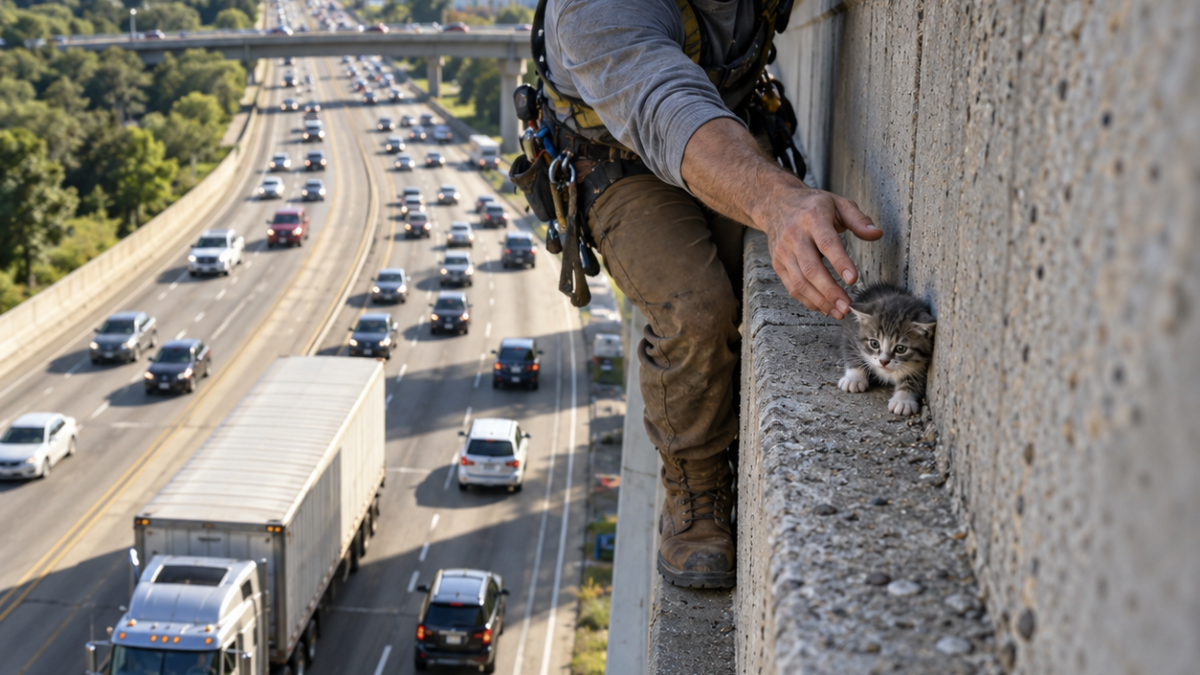
On the outside, I was a man with eight inches of concrete under my boots, one hand gripping the top of the wall, and sixty feet of empty air pulling at everything my body wanted to protect.
The ledge was narrower than it had looked.
It always is.
My left shoulder pressed against the wall. My right side faced open air. The wind tugged at my jacket. Below, traffic moved in flashes of white, red, silver, black. A horn sounded somewhere. Someone shouted from behind me.
I did not look down again.
That was not bravery.
That was strategy.
I moved sideways.
One boot.
Slide.
Stop.
One hand forward on the top of the wall.
Slide.
Stop.
The kitten was about twenty feet away.
Twenty feet can become a lifetime when your body understands that one wrong shift means falling.
A pickup passed behind me on the bridge deck, close enough that the gust hit my back. Below, a tractor-trailer roared under the span. The concrete vibrated under my soles.
I had climbed structures in storms.
I had stood on poles while wind bent the lines beside me.
But this was different.
A pole has steps.
A tower has rails.
A bucket truck has a floor.
A bridge ledge has nothing.
Nothing to hook to.
Nothing to lean against except a flat wall.
Nothing forgiving.
The kitten watched me come.
Her eyes were enormous.
Not blue exactly.
Not green.
That cloudy, fragile color young kittens have before the world settles into focus.
“Hey, sweetheart,” I whispered.
My voice sounded strange against the traffic.
“I’m coming. Don’t move.”
She moved.
Just a little.
Her back paw slipped.
I froze.
“Don’t.”
She flattened again.
I took another step.
Then another.
Behind me, someone shouted, “Man, get back!”
I did not answer.
My entire world had narrowed to concrete under my feet, wall under my hand, kitten ahead.
When I reached her, I had another problem.
I needed both hands.
She was pressed so tightly to the wall that I couldn’t scoop her with one easy motion. Her claws had hooked into tiny cracks. Her body was rigid with fear. If I pulled wrong, she might panic. If she panicked, she might bolt. If she bolted, there was nowhere to bolt but down.
I rested my forehead briefly against the concrete.
“Okay,” I breathed. “Okay.”
I shifted my left hand lower, gripping the top edge of the wall with my fingertips. With my right, I reached for her.
She hissed.
Good.
That sound gave me hope.
Anger meant she still had energy.
“I know,” I said. “I’d hiss too.”
I slid my hand beneath her chest.
Her claws dug harder into the concrete.
For a second, I could not move her.
She was tiny, but terror made her feel bolted to the bridge.
Another truck passed below.
The ledge trembled.
That decided it.
I closed my hand carefully around her body, firm enough that she couldn’t twist free, gentle enough not to crush her ribs, and peeled her from the wall.
She screamed.
A thin, sharp sound.
Her claws scraped the concrete.
Then she was in my hand.
The smallness of her hit me so hard I almost lost my breath.
All that danger.
All that noise.
All that concrete and traffic and height.
And in my palm was almost nothing.
A shaking handful of bones, fur, and fight.
I opened my jacket with one hand, shoved her inside against my chest, and zipped it up halfway. She climbed immediately, claws catching my shirt, then tucked under my chin, trembling so violently I could feel every beat of her heart.
“Okay,” I whispered.
I do not know if I said it to her or to myself.
I still had to get back.
That was the part people forget when they watch the video.
The rescue was not finished when I picked her up.
Now I had to cross the same ledge again, with a frightened kitten inside my jacket, one hand on the wall, boots on vibrating concrete, and a crowd forming behind me.
I started moving sideways.
Slowly.
One boot.
Slide.
Stop.
One hand.
Slide.
Stop.
The kitten pressed against my chest.
She was warm.
Too warm.
I could feel her breathing fast.
A siren wailed in the distance. Maybe police. Maybe fire. Maybe ambulance. I didn’t know. I couldn’t turn my head.
Halfway back, my right boot slipped on grit.
Not far.
An inch.
Maybe less.
But my body reacted before thought.
I slammed my shoulder into the wall and gripped the top so hard my fingers cramped.
The crowd made a sound.
I closed my eyes.
The kitten dug into my shirt.
For one moment, I was truly afraid.
Not aware.
Not cautious.
Afraid.
I saw Lily’s face.
I saw my wife, Mara, standing in our kitchen with her hand on the counter, getting the phone call.
I saw some headline reducing my life to a sentence about a reckless utility worker who fell trying to rescue a cat.
Then the kitten shifted beneath my jacket and let out one tiny, angry mew.
That sound brought me back.
“All right,” I whispered. “I’m still here.”
I moved again.
When I finally reached the place where I had climbed over, two men were waiting on the shoulder. One was a truck driver in a reflective vest. The other was a young guy in a baseball cap holding his phone up with one hand and reaching toward me with the other.
“Give me your hand,” the truck driver said.
“I’ve got it.”
“Give me your hand.”
This time, I listened.
He gripped my wrist. The younger man held the back of my jacket as I swung one leg over the barrier, then the other. My boots hit the shoulder, and suddenly the world became horizontal again.
My knees weakened.
I leaned against the barrier, one hand on the concrete, the other over the lump inside my jacket.
For a few seconds, I couldn’t speak.
The truck driver stared at me.
“You’re out of your mind.”
I nodded.
“Probably.”
The kitten moved.
I unzipped my jacket carefully.
A tiny gray-and-white face peeked out.
The young man with the phone whispered, “Oh, man.”
The kitten blinked.
Then hissed at all of us.
The truck driver laughed so hard he had to turn away.
I leaned back against my company truck and slid down until I was sitting on the shoulder.
Traffic continued moving.
People slowed.
Someone honked.
Someone cheered.
The kitten crawled higher under my jacket and wedged herself beneath my collar.
I put one hand lightly over her.
“You’re welcome,” I told her.
She bit my shirt.
“That seems fair.”
Police arrived first.
Then animal control.
Then my supervisor called.
Not because I called him.
Because the video had already been posted online.
That is how fast a private mistake becomes public now.
The man in the baseball cap had filmed from about fifty feet behind me. His video showed everything: me stepping over the barrier, the ledge under my boots, the traffic far below, my slow sideways movement, the kitten pressed to the wall, the moment I peeled her from the concrete, and the slow return.
It looked worse from the outside.
It looked insane.
When my phone rang and I saw my supervisor’s name, I considered throwing it into traffic.
Instead, I answered.
“Cole.”
“Yeah.”
There was silence.
Then Gary said, “Please tell me I am not watching you climb along the outside of Jefferson Overpass with no harness.”
I looked at the kitten tucked inside my jacket.
“You are not watching that.”
“Cole.”
“You said please.”
He made a sound like a man aging in real time.
“Are you alive?”
“Yes.”
“Is the cat alive?”
“Yes.”
Another pause.
“Do you have any idea how many safety violations I just watched?”
“Yes.”
“Do you?”
“Gary.”
“What?”
“She was going to fall.”
He went quiet.
The animal control officer approached slowly.
She was a woman in her fifties with tired eyes and a gentle voice.
“You must be the caller.”
“Yes.”
“I told you not to climb over.”
“I know.”
“That was stupid.”
“I know.”
She looked at the kitten.
“Is she injured?”
“I don’t know.”
Her expression softened.
“May I?”
The kitten had other opinions.
The moment the officer reached toward her, she hissed, flattened herself inside my jacket, and latched all four sets of claws into my shirt.
I winced.
The officer smiled.
“She’s got spirit.”
“She’s got knives.”
“We need to get her to a vet.”
“I’ll take her.”
“You don’t have to.”
I looked down at the kitten.
She was pressed so tightly against me that I could feel her trembling begin to slow.
“Yes,” I said. “I do.”
The officer studied me.
Maybe she heard something in my voice.
Maybe she had been doing the job long enough to recognize when a person had already crossed the invisible line between bystander and responsible.
“All right,” she said. “I’ll follow you.”
I drove to Riverside Veterinary Clinic with the kitten still inside my jacket because any attempt to put her in a box caused immediate violence from a creature weighing less than a sandwich.
At the clinic, the receptionist looked up and smiled professionally.
Then she saw my dirty boots, scraped gloves, windburned face, and the gray head sticking out of my jacket.
“Oh my God.”
“That’s pretty much where we are,” I said.
They took us into an exam room.
The kitten refused to leave my jacket.
A vet tech named Amara tried treats.
No.
A towel.
No.
A soft voice.
Absolutely not.
Finally, I sat on the exam table while Dr. Elaine Porter, the veterinarian, gently unzipped my jacket and examined the kitten in place.
“She’s very young,” Dr. Porter said.
“How young?”
“Six, maybe seven weeks.”
The kitten hissed at the stethoscope.
Dr. Porter smiled.
“And opinionated.”
“Is she okay?”
“We’ll see.”
They checked her temperature, hydration, paws, gums, eyes, breathing, and abdomen. Every time someone touched her, she made it clear she considered medical care a personal insult.
But she let me hold her.
That did something to me I wasn’t ready for.
I had not planned on being chosen.
I had only planned on not watching her die.
Dr. Porter’s final assessment came after fluids and a closer exam.
“She’s dehydrated. Extremely stressed. Her paw pads are raw from gripping the concrete. A couple of claws are damaged. She has minor abrasions, but no obvious fractures. Lungs sound clear. Heart is strong.”
I breathed out.
“So she’ll live?”
“If no complications show up, yes.”
The kitten sat wrapped in a towel on the table, glaring at everyone.
Dr. Porter looked at her.
“She’ll live loudly, I suspect.”
“What happens now?”
“Animal control will file the report. If no owner is found, she can go to a foster or shelter after stray hold.”
The kitten reached one paw out of the towel and hooked a claw into my sleeve.
Dr. Porter noticed.
“Or,” she said carefully, “if you are interested, you could apply to foster through animal control until the hold clears.”
“I’ve never had a cat.”
“That has never stopped a cat from having a person.”
“I have a wife and a daughter.”
“Do they like cats?”
“My daughter likes everything with a face.”
“And your wife?”
I pictured Mara’s expression when I walked in with a bridge kitten.
“She likes responsible decisions.”
Dr. Porter glanced at my scraped gloves.
“That may be a problem.”
I looked at the kitten.
She looked back.
Her eyes were still huge, still frightened, but there was something fierce inside them. Something that said the world had nearly killed her and she was furious about the inconvenience.
“What’s her name?” Amara asked.
“She doesn’t have one.”
“She needs one for the file.”
I thought about the concrete ledge.
The narrow strip of bridge.
The place where I had first seen her.
“Ledge,” I said.
Amara blinked.
“That’s either terrible or perfect.”
The kitten bit the towel.
Dr. Porter smiled.
“Perfect, then.”
Gary, my supervisor, met me in the clinic parking lot.
That was how I knew the day had officially become bad.
He stood beside his truck with arms crossed, company cap low over his forehead, watching me come out carrying a cardboard carrier containing one angry kitten.
Animal control had processed the temporary foster paperwork. The video had reached half the county. My phone had thirty-seven messages, most of them starting with some version of Are you crazy?
Gary did not start there.
He looked at the carrier.
“Is that her?”
“Yes.”
The carrier hissed.
Gary took one step back.
“She sounds ungrateful.”
“She’s had a day.”
“So have I, Cole.”
I nodded.
“I know.”
He rubbed both hands over his face.
“What you did violates every safety policy we have.”
“Yes.”
“You climbed onto the exterior ledge of a highway bridge with no harness, no fall protection, no spotter, no traffic control, and no authorization.”
“Yes.”
“If you had fallen, we would be having a very different conversation.”
“Yes.”
“If someone tried to copy you and died, we would be part of that conversation too.”
That landed hard.
I looked away.
“I didn’t think about that.”
“I know.”
His voice softened.
“That’s part of the problem.”
The kitten hissed again.
Gary looked at the carrier.
“And the cat is okay?”
I almost smiled.
“She’s on fluids, technically. But yes. She’ll be okay.”
Gary closed his eyes.
“Good.”
Then he pointed at me.
“You are suspended from field work pending review.”
I nodded.
“I understand.”
“And you are coming to safety training next month.”
“I teach that training.”
“Not anymore. Now you’re the cautionary tale.”
Fair.
I drove home with Ledge on the passenger seat, the carrier strapped in with a seat belt because after everything that had happened, I was not taking chances with vehicle safety.
She complained the entire way.
Tiny, raspy meows.
Indignant scratches.
The sound of a creature who had survived a bridge and now objected strongly to a box.
My wife opened the front door before I reached it.
Mara is a nurse.
That means she has the terrifying ability to read injuries, lies, and bad decisions from thirty feet away.
She stood on the porch with one hand on her hip.
Our daughter, Lily, peeked from behind her legs.
“Daddy has a cat!” Lily shouted.
Mara did not look away from me.
“Daddy has an explanation.”
I held up the carrier.
“It was on a bridge.”
Mara stared.
“That is not an explanation.”
“She.”
“What?”
“She was on a bridge.”
Mara closed her eyes.
Lily squeezed past her.
“She has a name?”
“Ledge.”
Mara opened her eyes.
“You named the bridge cat Ledge?”
“She was found on a ledge.”
“That is exactly why you should not have named her that.”
Lily crouched in front of the carrier.
Two small eyes glared back.
“She’s beautiful.”
Ledge hissed.
Lily gasped with delight.
“She talks.”
Mara pointed at me.
“Kitchen. Now.”
I set Ledge’s carrier in the laundry room because Dr. Porter had instructed us to keep her quiet, warm, and separated until we knew more about her health. Lily sat outside the laundry room door whispering, “Hi, Ledge. I’m Lily. I have crayons.”
In the kitchen, Mara folded her arms.
I told her everything.
Not the heroic version.
The real one.
The call.
The wait time.
The ledge.
The climb.
The slip.
The video.
Gary.
The suspension.
Mara’s face changed several times while I spoke.
Fear.
Anger.
Relief.
More anger.
When I finished, she said nothing for a long moment.
Then she walked toward me and hit my chest with both palms.
Not hard enough to hurt.
Hard enough to tell me fear needed somewhere to go.
“You idiot.”
“I know.”
“You absolute idiot.”
“I know.”
“You could have died.”
“I know.”
“Do you? Because you say that like you understand, but if you understood, you would not have done it.”
I had no answer.
That was the problem.
If I said I would do it again, I hurt her.
If I said I wouldn’t, I lied.
So I said, “I’m sorry.”
Her eyes filled with tears.
“Sorry doesn’t raise your daughter.”
That sentence hurt more than anything Gary had said.
Mara turned away, breathing hard.
From the laundry room, Ledge meowed.
A small sound.
Not angry this time.
Just lonely.
Lily whispered, “It’s okay. My dad is in trouble too.”
Mara laughed despite herself.
Then she cried.
I held her in the kitchen while our daughter comforted a kitten through a door.
That was how Ledge entered our family.
Not with a sweet adoption photo.
Not with a tidy decision.
With a safety violation, a marriage argument, a suspended lineman, a furious kitten, and a seven-year-old who decided immediately that the tiny animal behind the laundry room door was her new best friend.
The first night, Ledge slept in a crate with a heating pad under half the bedding, as instructed.
She meowed for thirty-eight minutes.
Lily cried for twenty.
Mara stood outside the laundry room at midnight in pajamas, whispering, “We are not keeping the cat.”
I nodded.
“Right.”
“She is a foster.”
“Temporary.”
“Until the hold clears.”
“Exactly.”
Inside the laundry room, Ledge meowed again.
Lily sniffled from the hallway.
Mara looked at me.
“You’re sleeping on the floor in there.”
“I assumed.”
So I did.
I slept on a folded blanket beside the crate with one hand near the bars. Around two in the morning, Ledge finally stopped meowing. She crept close enough to touch my fingers with one paw.
Then she fell asleep.
I stayed awake much longer, listening to her breathe.
The next morning, I became famous locally for all the wrong reasons.
The video had spread overnight.
By breakfast, it had thousands of views. By lunch, a news station had called. By dinner, my aunt in Ohio sent me the video with the message: IS THIS YOU????
It was not a flattering video.
My jeans looked dusty.
My jacket flapped in the wind.
My movements were slow and awkward because terror is rarely cinematic.
The caption people shared most was simple.
60 feet high. 8-inch ledge. No harness. He climbed over for a kitten.
People called me a hero.
Mara hated that.
So did I.
Heroes sound like people who know what they are doing.
I had known exactly enough to understand how badly it could go wrong and not enough to choose patience.
Online comments split into predictable groups.
God bless him!
That man is brave!
That man is reckless.
Where was animal control?
Why risk your life for a cat?
Because it was a life.
I hope he gets fired.
I hope he gets a medal.
Humans are wild.
Cats are worth it.
My company released a statement by noon.
We are grateful the animal was safely recovered. However, the actions shown in the video were not authorized and do not reflect company safety procedures. We urge the public never to attempt rescues from hazardous locations and to contact emergency services.
Gary called after it went out.
“You mad?”
“No.”
“You sound mad.”
“I sound employed.”
That was fair too.
Animal control called later to say nobody had reported a missing kitten matching Ledge. Not surprising. A kitten that young on an overpass was unlikely to have wandered there from a nearby living room.
“How do you think she got there?” I asked Denise, the dispatcher I had hung up on.
She paused.
“Honestly?”
“Yes.”
“I don’t know. Sometimes kittens climb into engine compartments and fall out. Sometimes people dump animals. Sometimes they get into places that make no sense and survive things they shouldn’t.”
“Do you think someone put her there?”
“I think a bridge ledge is not a place a six-week-old kitten usually chooses.”
I looked toward the laundry room.
Ledge was asleep in a shoebox Lily had decorated with marker hearts.
No one ever found out how she got there.
That bothered me at first.
I wanted a villain.
A person to blame.
A clear answer that would make the chaos feel organized.
But life rarely gives you that.
Sometimes all you get is the creature in front of you and the responsibility of what happens next.
Ledge recovered quickly.
Physically, at least.
Her paw pads healed.
Her hydration improved.
Her appetite became astonishing.
The first time she ate wet kitten food, she growled at the bowl as if warning it not to escape. Lily watched in awe.
“She sounds like a motorcycle.”
“She sounds like she means business,” Mara said.
“You said we’re not keeping her.”
“I did.”
“But you bought the chicken flavor.”
“That is medically recommended.”
“You bought three kinds.”
Mara looked at me.
“Do you have somewhere else to be?”
Ledge’s personality arrived in stages.
First came suspicion.
She watched us from behind the washing machine with narrowed eyes, emerging only for food and to attack the feather wand Lily dragged under the door.
Then came climbing.
She climbed the laundry shelves.
The hamper.
The folded towels.
My pant leg.
Mara’s robe.
Lily’s dollhouse.
One afternoon, I walked into the laundry room and found her perched on top of the water heater, staring down at me like a tiny gargoyle.
“How did you get up there?”
She blinked.
“Can you get down?”
She blinked again.
I lifted her down.
Ten minutes later, she was back up.
Mara said, “Maybe she likes height.”
“That’s concerning, considering her history.”
“Or maybe it’s the one thing she understands.”
Ledge climbed everything.
When we let her explore the kitchen, she climbed the stool.
Then the counter.
Then the refrigerator.
The first time she reached the top of the fridge, Lily clapped like Ledge had won the Olympics.
Mara said, “Do not encourage this.”
Lily whispered, “Good job.”
Ledge sat high above us, tail wrapped around her paws, looking deeply pleased with herself.
I thought about the bridge.
The wind.
The concrete.
The trembling.
Then I looked at her on the refrigerator, safe and smug, and something in me loosened.
Maybe height did not mean danger to her.
Maybe height meant visible.
Maybe height meant if she climbed high enough, someone would see her.
One night, after Lily had gone to bed and Mara was charting something on her laptop, I found Ledge on top of the bookshelf in the living room.
She had grown stronger by then. Her fur looked cleaner, softer. Her eyes had settled into a sharp green-gray.
I stood beneath the shelf.
“You know, most cats hide under furniture after trauma.”
Ledge flicked one ear.
“You went the other direction.”
She looked toward the window.
A truck passed outside.
For a second, her body lowered.
Not much.
But enough.
I saw the bridge still living somewhere inside her.
I reached up.
She did not come down.
That was okay.
I had learned something from rescue work I never intended to do.
Saving a life once does not give you ownership over its fear.
You do not get to decide when another creature feels safe.
You only get to keep proving safety exists.
So I sat on the couch below her and waited.
After twenty minutes, she climbed down on her own, walked across the back of the couch, and curled against my shoulder.
I did not move.
Mara looked up from her laptop.
“She picked you.”
“She’s using me for heat.”
“Sure.”
“She is.”
Mara smiled.
“Temporary heat?”
I looked down at Ledge.
She was asleep, one paw hooked into my shirt.
“Very temporary.”
Mara laughed softly.
The foster hold cleared after ten days.
No owner came forward.
Animal control sent the adoption paperwork.
Mara placed it on the kitchen table without speaking.
I looked at it.
Then at her.
“You said temporary.”
“I also said responsible decisions.”
“And?”
She looked toward the living room, where Lily was reading a book aloud to Ledge in a voice so serious it suggested the kitten’s literacy mattered deeply.
“And responsible adults sometimes admit when the cat already lives here.”
Lily looked up.
“Does that mean we’re keeping her?”
Mara pointed at me.
“Ask your father. He’s the one who climbed off a bridge for her.”
I sat at the table.
Ledge abandoned the book, ran across the room, climbed my jeans, and dug tiny claws into my thigh.
“Ow.”
Lily beamed.
“She loves you.”
“She is injuring me.”
“That’s cat love.”
Mara nodded.
“I believe that’s medically accurate.”
I signed the papers.
Ledge Mercer became official.
Two weeks later, Gary allowed me back to field work after safety review, written reprimand, retraining, and a meeting where the regional manager used the phrase “avoidable fatality” seven times.
I deserved all of it.
At the end of the meeting, Gary walked me outside.
“People keep calling you a hero,” he said.
“I know.”
“Don’t believe them too much.”
“I don’t.”
He nodded.
“But don’t beat yourself to death with the other side either.”
I looked at him.
“You sound like my wife.”
“She sounds smart.”
“She is.”
Gary leaned against his truck.
“My kid saw the video.”
“Yeah?”
“She asked if I would climb over for a kitten.”
“What did you say?”
“I said I’d call professionals with equipment.”
I smiled.
“Good answer.”
“Then she asked if the kitten was falling right now.”
I stopped smiling.
Gary looked away.
“I didn’t have an answer.”
That was the thing.
That was what stayed complicated.
Rules mattered.
Preparation mattered.
Safety mattered.
But so did timing.
Living with that tension became part of the story.
The city eventually installed additional mesh panels along sections of the bridge where animals or debris could slip outside the barrier. The transportation department claimed the work had already been scheduled.
Maybe it had.
Maybe public embarrassment helped.
I didn’t care as long as fewer small lives ended up where Ledge had been.
Animal control changed their dispatch protocol for animals trapped in high-risk traffic areas. Emergency services would be notified immediately instead of after officer assessment when height, traffic, or water was involved.
That mattered.
Ledge’s rescue had almost become a tragedy.
The best thing to do with an almost tragedy is build something that prevents the next one.
A month after the rescue, the man who filmed the video contacted me.
His name was Darnell Brooks, a delivery driver and father of three. He asked if he could meet Ledge.
Mara said yes before I could answer because she said if someone films your husband almost dying, you should at least know whether he’s polite.
Darnell came over on a Saturday afternoon with his youngest son, Marcus.
Ledge watched them from the top of the refrigerator.
Darnell pointed up.
“That’s her?”
“That’s her.”
“She smaller than I thought.”
“She looked bigger sixty feet up?”
“Everything looks bigger when your heart stops.”
His son stared at Ledge.
“She lives up there?”
“Not officially,” Mara said.
Ledge blinked down at us like she disagreed.
Darnell looked at me.
“I kept wondering if I should’ve done something.”
“You did.”
“I filmed.”
“You also called 911.”
He shrugged.
“Felt useless.”
I understood that.
“Sometimes witnessing matters,” I said.
“Didn’t feel like enough.”
“It helped prove what happened.”
“It also got you in trouble.”
“I got me in trouble.”
He laughed.
Then he grew serious.
“My wife said she couldn’t watch the video. She said, ‘That man has a family.’”
I looked toward Lily, who was showing Marcus how to use the feather toy.
“She was right.”
“Would you do it again?”
People asked me that constantly.
Reporters.
Coworkers.
Neighbors.
Strangers online.
I always hated the question because the honest answer refused to sit still.
Would I choose to risk leaving my daughter fatherless?
No.
Would I stand there watching a kitten slip while waiting for someone else to arrive?
Also no.
So I told Darnell the truth.
“I hope I never have to find out.”
He nodded.
“That’s probably the best answer.”
Ledge became a local celebrity for approximately six weeks.
Then the internet moved on.
We were grateful.
She did not care about fame. She cared about food, vertical surfaces, warm laundry, and attacking anything with a bell.
Lily made her a cape.
Ledge hated it.
Mara bought her a cat tree taller than Lily.
Ledge used the box.
I told Mara this was poetic given Ledge’s difficult relationship with structures.
Mara told me to assemble the cat tree anyway.
Once assembled, Ledge ignored it for three days, then climbed to the top at 2:00 a.m. and shouted until the whole house woke.
Lily stumbled into the living room, hair wild, eyes half-closed.
“What happened?”
“She reached the summit,” I said.
Mara stood behind me in her robe.
“We are not applauding.”
Ledge meowed again.
Lily clapped quietly.
Mara looked at both of us.
“I live with fools.”
But she was smiling.
As months passed, Ledge grew from a trembling handful into a sleek, confident cat with long whiskers and an unreasonable belief that every high place belonged to her.
She slept on top of cabinets.
She watched birds from the highest window ledge.
She climbed curtains until Mara replaced them with blinds and declared we could no longer have nice things.
She learned how to open one kitchen drawer and used this power for chaos.
She stole hair ties.
She stole socks.
She stole a piece of toast directly from my plate and dragged it under the couch like prey.
“Bridge trauma,” I told Mara.
“That is not an excuse for toast theft.”
“It might be.”
“It is not.”
At night, though, she changed.
When the house grew quiet, Ledge often came to our bed. She never slept near our feet like a normal cat. She climbed onto my chest, tucked herself beneath my chin, and pressed against the place where she had hidden inside my jacket on the bridge.
The first time she did it, I stopped breathing.
Mara noticed.
“What?”
I shook my head.
“Nothing.”
But it wasn’t nothing.
Some memories live in the body.
Hers.
Mine.
I would feel her small weight there, warm and alive, and suddenly I was back on the ledge with concrete under my boots and wind pulling at my jacket.
Only now, there was no ledge.
No traffic below.
No shaking bridge.
Just a house.
A sleeping wife.
A daughter down the hall.
A cat who had once been nearly lost to the air and now trusted my chest as a safe place.
That is the part people miss when they talk about rescue.
They think it ends when the animal is brought down.
It doesn’t.
That is just the moment danger changes shape.
The real rescue continues in ordinary days afterward.
Feeding.
Patience.
Vet visits.
Scratched furniture.
Trust earned slowly.
Fear respected.
Love becoming routine.
Six months after the bridge, I drove across Jefferson Overpass again for the first time since the rescue.
I had avoided it without admitting I was avoiding it.
But a work order took me that way, and the alternate route would have added twenty minutes I did not have.
As I approached, my hands tightened on the wheel.
Traffic moved normally.
Sunlight flashed on windshields.
The new mesh panels shimmered along the barrier.
I slowed.
Not enough to be unsafe.
Just enough.
At the center of the bridge, I glanced toward the shoulder where I had parked.
For a second, I saw everything again.
The kitten pressed to concrete.
The ledge under my boots.
Darnell filming.
The truck driver reaching for my wrist.
Then I was across.
Just like that.
My phone rang.
Mara.
I answered hands-free.
“You okay?”
I laughed once.
“How did you know?”
“You had the Jefferson work order today.”
“I’m okay.”
“Did you look?”
“Yeah.”
“And?”
I breathed out.
“They put up the mesh.”
“I know.”
“You knew?”
“I check city updates now. Marriage changes a person.”
I smiled.
“Ledge is why they did it.”
“Partly.”
“Partly?”
“You are also why they did it.”
I didn’t know what to say.
Mara continued.
“You scared people enough to fix something.”
“That’s not exactly a compliment.”
“It’s not exactly an insult.”
When I got home that evening, Ledge was on top of the refrigerator.
Of course.
I looked up at her.
“Your bridge has a fence now.”
She stared.
“You’re welcome.”
She yawned.
“Ungrateful.”
Then she jumped onto my shoulder and dug claws into my work shirt.
I yelped.
Lily shouted from the hallway, “That means she missed you!”
Mara called from the kitchen, “That means trim her nails!”
Life went on.
That is always the miracle and the insult.
Everything changes.
Then laundry still needs folding.
Dinner still burns.
Bills still arrive.
Cats still knock glasses off tables just to study gravity from a safer angle.
Ledge remained fascinated by height.
When Lily turned nine, she wrote a school essay called My Cat Was Rescued From a Bridge and Now Thinks She Is a Mountain Lion.
Her teacher gave her an A.
Ledge attempted to eat the paper.
When Lily was ten, she asked the question I knew would come eventually.
“Dad?”
We were in the garage. I was fixing a loose handle on her bike. Ledge sat on a shelf above us, supervising.
“Yeah?”
“Were you scared when you climbed over the bridge?”
I kept turning the screwdriver.
“Yes.”
“How scared?”
“Very.”
“Then why did you do it?”
I set the screwdriver down.
Because children deserve better than the clean version.
“I thought she might fall before help came.”
“But you could have fallen.”
“Yes.”
“Mom says you should have waited for firefighters.”
“Mom is probably right.”
Lily frowned.
“Then were you wrong?”
I looked up at Ledge.
She blinked slowly from the shelf.
“I don’t know,” I said.
Lily seemed surprised.
Adults are supposed to know whether their choices were right or wrong.
That is one of the lies childhood tells.
“I think saving her was right,” I continued. “I think the way I did it was dangerous. Both can be true.”
Lily thought about that.
“So what should I do if I see an animal in danger?”
“Call for help. Stay safe. Find an adult. Don’t do something that puts you in danger too.”
“But what if there isn’t time?”
There it was.
The question with teeth.
I could have given her a rule.
Instead, I gave her something harder.
“Then you remember that being brave does not mean forgetting the people who love you.”
She looked at me for a long time.
“Did you forget us?”
The screwdriver in my hand blurred.
“No,” I said softly. “But I didn’t think about you enough in that moment.”
Lily climbed into my lap even though she was getting too big for it.
I held her.
Above us, Ledge stretched on the shelf, then dropped down carefully beside us.
She pressed her head against Lily’s knee.
Lily wiped her face.
“She says sorry.”
I smiled.
“She probably says the bike is hers now.”
“That too.”
Years later, when people retold the story, they always focused on the numbers.
Sixty feet.
Eight-inch ledge.
No harness.
One kitten.
They liked the drama of it.
The height.
The danger.
The image of a man moving sideways along concrete with traffic below.
But numbers do not tell the whole story.
They do not tell you how small she felt under my jacket.
They do not tell you how angry my wife was because love had turned to fear while I was busy being called brave.
They do not tell you that for weeks, I woke at night feeling my boot slip.
They do not tell you that the kitten grew into a cat who climbed everything because the highest place was where someone had finally seen her.
They do not tell you that a city added mesh to a bridge because one small life exposed a gap everyone had ignored.
They do not tell you that my daughter learned courage is complicated.
They do not tell you that sometimes the thing you rescue becomes the thing that teaches your family how to talk honestly about fear.
Ledge lived with us for sixteen years.
That sounds impossible when I think of the shaking kitten on the bridge.
Sixteen years of cabinet tops.
Sixteen years of refrigerator naps.
Sixteen years of stolen socks, scratched furniture, vet visits, winter sunbeams, birthday photos, and holiday cards where she refused to look at the camera.
She became older.
Slower.
Less interested in curtains.
Still obsessed with height.
When her joints stiffened, I built little steps to the windowsill.
Then to the bookshelf.
Then to the top of the low cabinet in the living room because Mara said the refrigerator was no longer appropriate for a senior cat.
Ledge disagreed.
At fifteen, she still tried once.
I caught her halfway.
“Nope.”
She glared at me.
“You’re retired from extreme climbing.”
She bit my sleeve.
“Management decision.”
Mara watched from the couch.
“Now you know how Gary felt.”
Fair.
When Ledge’s final winter came, she spent most of her days on a heated bed near the window. Lily was in college by then, studying veterinary science, which surprised nobody.
She called every night to ask about Ledge.
“How’s she eating?”
“Some.”
“Drinking?”
“Yes.”
“Still climbing?”
“Only emotionally.”
“Dad.”
“She got onto the armchair.”
“That counts.”
Mara and I both knew what was coming.
So did Lily.
Knowing does not make goodbye smaller.
It only lets you prepare the room.
When Ledge stopped eating, Dr. Porter came to our house.
She had gray in her hair now.
So did I.
Lily drove home from school.
We gathered in the living room beneath the window Ledge loved most. The same cat who had once clung to concrete above a highway now lay on a soft blanket surrounded by the people she had gathered after being seen.
I held her the way I had on the bridge.
Against my chest.
Under my chin.
She was lighter than she had been in years.
Or maybe memory made that first day heavier.
Mara sat beside me.
Lily stroked Ledge’s head and cried quietly.
Dr. Porter gave us time.
There is kindness in people who understand that “ready” is not a real place. It is only the moment when love becomes more important than wanting.
I looked down at Ledge.
“You know,” I whispered, “you caused a lot of trouble.”
Her eyes opened halfway.
Mara laughed through tears.
“She knows.”
“You made me famous.”
Ledge blinked.
“You got me suspended.”
Another blink.
“You ruined curtains.”
Lily sniffled.
“Many curtains.”
“You scared your mother.”
Mara touched my arm.
“You both did.”
I held Ledge closer.
“You were worth it.”
Her breathing was slow.
Steady.
Tired.
I thought about the bridge one last time.
The wind.
The roar.
The ledge.
The moment I peeled her from the wall and felt her heart hammering against my hand.
Back then, I thought I was saving her from falling.
I did not know she would spend the next sixteen years holding parts of my family together in ways no one could have planned.
I did not know she would help Lily become the kind of woman who wanted to heal animals for a living.
I did not know she would teach Mara and me how fear and love often arrive together.
I did not know that one small kitten on a bridge could become a whole chapter of our lives.
Dr. Porter touched my shoulder.
I nodded.
Ledge passed with her body against my chest.
No wind.
No traffic.
No concrete trembling beneath her paws.
Just warmth.
Hands.
Voices she knew.
Afterward, Lily whispered, “She was visible.”
I looked at her.
“What?”
“That’s what you always said. She climbed because being high meant being visible.”
I nodded.
Lily wiped her face.
“She was visible her whole life after that.”
That broke me.
Because it was true.
Ledge had never disappeared again.
Not into traffic.
Not into a shelter file.
Not into an internet clip people forgot after sharing.
She had been seen.
Named.
Loved.
Remembered.
A few months after she died, the city invited me to a small safety event at Jefferson Overpass. They had finished additional barrier work along nearby spans. Gary was there, retired now. Denise from animal control came too. Darnell showed up with his son, who was taller than him by then. Dr. Porter came. Mara and Lily stood beside me.
Someone had installed a small sign near the maintenance access path.
Not a memorial, exactly.
More of a reminder.
REPORT ANIMALS IN DANGER.
WAIT FOR EMERGENCY RESPONSE.
EVERY LIFE MATTERS. SO DOES YOURS.
I liked that.
It was better than a plaque calling me a hero.
More honest.
More useful.
After the event, I stood on the safe side of the barrier and looked out toward the place where I had first seen Ledge.
The ledge was still there, but now mesh blocked the gap above it. Traffic still moved below. Trucks still made the bridge hum.
But no small animal could sit there unseen the same way again.
Lily slipped her hand into mine.
“You okay?”
I smiled.
“No.”
She leaned against my arm.
“Me neither.”
The wind moved across the bridge.
For a second, I could almost feel the small shape of Ledge beneath my jacket, trembling against my chest, alive because terror had met timing and timing had met a choice.
People still share the old video sometimes.
Every year or so, it resurfaces.
Someone sends it to me with a message.
Is this you?
I usually answer, Yes.
Sometimes they call me brave.
Sometimes reckless.
Sometimes both.
They are all partly right.
But none of those words mean as much to me as the one Lily used years later when she brought home her first rescue kitten from the veterinary clinic where she worked.
The kitten was orange, one-eyed, furious, and very loud.
Lily walked into our house holding him in a carrier and said, “Dad, don’t panic.”
Mara laughed from the kitchen.
I looked at the kitten.
Then at my daughter.
Then at the empty bookshelf where Ledge used to sit.
“What’s his name?”
Lily smiled.
“Summit.”
Of course.
I cried a little when she wasn’t looking.
That night, after Lily left, Summit climbed halfway up the curtains before Mara could stop him.
I heard her shout, “Absolutely not!”
I laughed harder than I had in months.
Then I looked toward the framed photo on our wall.
Ledge on top of the refrigerator, tail wrapped around her paws, eyes bright with the smug confidence of a creature who had once survived the impossible and never forgotten that high places led to being found.
Under the photograph, Lily had written a sentence from one of her school essays years earlier.
She climbed because the world had missed her once.
I stood there for a long time.
The house was quiet.
Not empty.
Quiet.
There is a difference.
I have known both.
A life can change because of something enormous: a diagnosis, a death, a birth, a fire, a storm.
But sometimes it changes because of something small.
A flash of fur where no fur should be.
A phone call answered too slowly.
A ledge too narrow for life.
A decision made before fear finishes speaking.
A kitten tucked beneath a jacket, furious enough to live.
Eighteen meters.
Twenty centimeters.
No harness.
Those are the numbers people remember.
I remember other things.
The sound of her first hiss.
The warmth of her body against my chest.
Mara’s voice saying, “Sorry doesn’t raise your daughter.”
Lily whispering through a laundry room door.
The first night Ledge slept under my chin.
The day she reached the top of the refrigerator and looked down at us like she had conquered the world.
The final breath she took in a room where everyone saw her.
The bridge story began with height.
But it was never really about height.
It was about being seen before it is too late.
It was about the strange responsibility that arrives the moment you notice a life in danger and realize you are no longer just passing by.
It was about the terrible, beautiful truth that sometimes love begins as an interruption.
A work order delayed.
A phone call ignored.
A man standing on a shoulder saying, “I don’t have an hour.”
I still would not tell anyone to do what I did.
I mean that.
Call for help.
Wait for trained rescue when waiting is safe.
Do not turn one emergency into two.
Every life matters.
So does yours.
But I also know this.
That morning, on that bridge, one tiny kitten had been visible to thousands of passing cars and unseen by almost everyone.
For reasons I still cannot fully explain, I saw her.
And once I saw her, really saw her, I could not keep driving.
Ledge spent the rest of her life climbing to the highest place in every room.
Maybe because height was familiar.
Maybe because fear had once lived there and she wanted to conquer it.
Maybe because being high meant being visible.
And being visible meant someone might come.
She wasn’t wrong.
That was how I found her.








