I Spent My Last $7 Feeding a Stray Cat at 2 A.M.—Three Weeks Later, She Was Waiting for My Headlights Every Night
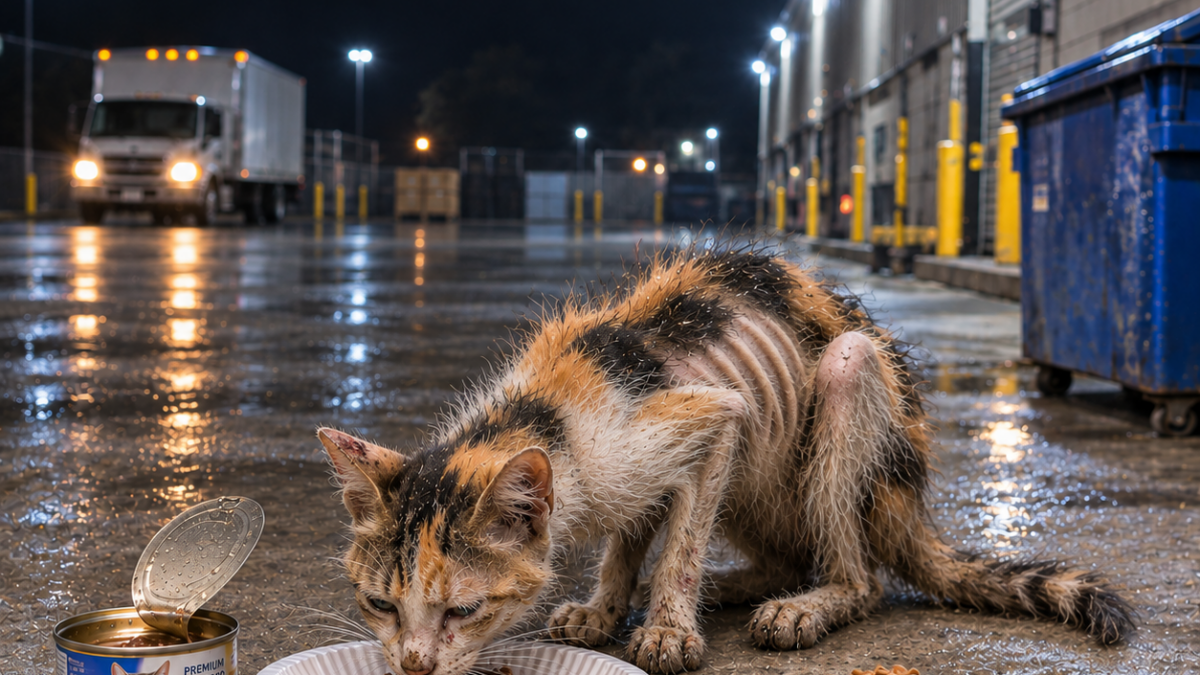
I Spent My Last $7 Feeding a Stray Cat at 2 A.M.—Three Weeks Later, She Was Waiting for My Headlights Every Night.
I was making fourteen dollars an hour on the night shift when I spent $7.12 at a Baton Rouge gas station on cat food for a starving calico I had seen beside a warehouse dumpster, and I remember feeling embarrassed that seven dollars already seemed like money I could not really spare.
Within three weeks, that frightened little cat had learned the sound of my truck so well that she would come out of the darkness before my headlights even reached the loading dock, waiting beside the same patch of concrete because somehow she had learned that one person always came back.
Then, on the coldest and wettest night of the month, I rounded the building at 2:07 a.m. and found her sitting in my parking space instead of beside the dumpster—and for the first time since I met her, she let me see what she had been hiding from me.
My name is Marcus Turner.
At the time this happened, I was thirty-eight years old and working overnight security at a distribution warehouse outside Baton Rouge, Louisiana.
Not the kind of security job people picture in movies.
No dramatic chases.
No armored trucks.
No radio calls about masked men climbing fences.
Most nights, absolutely nothing happened.
My shift started at ten in the evening and ended at six in the morning.
I checked employee entrances.
Drove around the perimeter every hour.
Made sure the loading docks were locked.
Wrote down license plates if somebody parked where they should not.
Checked the fence after storms.
Answered the occasional alarm that turned out to be a loose door or a forklift operator who forgot to punch in the right code.
Then I sat in my old Chevrolet Colorado drinking coffee that tasted worse every hour it stayed in the thermos.
The warehouse itself was enormous.
Gray concrete.
Twenty-six loading docks.
Bright white security lights mounted high along the walls.
Behind the building was a strip of weeds, drainage ditches, and two dumpsters where stray cats sometimes appeared looking for food.
Nobody paid much attention to them.
I didn’t either.
That sounds worse now than it felt then.
If you work overnight around warehouses, truck stops, industrial parks, or storage yards long enough, you see animals.
Cats.
Raccoons.
Possums.
Occasionally a fox.
Dogs sometimes.
Most of the cats knew exactly what they were doing.
They stayed twenty feet from people.
Waited until the loading crews left.
Checked dumpsters.
Disappeared before sunrise.
I had seen dozens.
Maybe hundreds.
I did not think every stray cat was my responsibility.
At fourteen dollars an hour, I was having enough trouble being responsible for myself.
My apartment cost nine hundred and seventy dollars a month.
My truck had started making a noise I was pretending not to hear.
My electric bill had gone up.
PART2:
I still owed money on a dental procedure from the previous spring.
And every other Friday, I sent what I could to my seventeen-year-old daughter, Kayla, who lived with her mother in Lafayette.
I was not starving.
I had a roof.
I had a truck that mostly started.
I had a job.
But there was rarely much left after bills.
That mattered later.
Because whenever people heard the story, they tended to imagine I had decided to become some kind of animal rescuer.
I didn’t.
I was just a tired man sitting in a truck at one-thirty in the morning when my headlights caught a cat beside a dumpster.
That was it.
I had just finished the north perimeter check.
The loading crew had gone home forty minutes earlier.
A rainstorm had passed through before my shift, leaving shallow puddles across the asphalt.
I turned behind Dock 19.
Something reflected in the headlights.
Two small eyes.
I slowed.
A calico cat sat beside the green dumpster.
Tiny.
White chest.
Orange patch above one eye.
Black patch over one shoulder.
She was sitting completely still.
I assumed she would run when the truck approached.
She did not.
I passed her.
Checked the rear fence.
PART3:
Drove another twenty yards.
Then looked in my mirror.
She was still there.
Same place.
Same posture.
Watching nothing.
Not watching me.
That was what bothered me.
Most stray cats I had seen around the property were alert.
They watched vehicles.
Watched doors.
Watched dumpsters.
Watched each other.
This one seemed exhausted enough that the entire world had stopped being important.
I put the truck in reverse.
She still did not run.
I parked ten feet away.
Opened the door.
The cat looked at me.
“Hey.”
She blinked.
I stepped closer.
Then I saw her body.
She wasn’t naturally small.
She was thin.
Terribly thin.
Her ribs showed when she breathed.
The fur along her back stood unevenly.
One ear had a fresh scratch near the edge.
Her front legs looked almost too thin to hold her.
When she stood, she wobbled once.
I stopped moving.
“All right.”
She stared.
“I’m not coming closer.”
I don’t know why I was talking to her.
There was nobody else around.
Maybe night shift makes you talk to things.
I talked to gates sometimes too.
The cat looked toward the dumpster.
Then back at me.
That was when it occurred to me.
Food.
I went to the truck.
Glove compartment.
Nothing useful.
Napkins.
Flashlight batteries.
Two pens.
An insurance card that had expired eight months earlier.
Then I found a granola bar.
Oats and honey.
Probably not good cat food.
I knew that.
But I also knew hunger when I saw it.
I broke off a small piece.
Put it on the pavement.
Backed away.
The cat approached immediately.
Not cautiously.
Immediately.
She swallowed it.
Then looked at me.
I broke off another.
Gone.
Another.
Gone.
She did not chew much.
That scared me.
“Slow down.”
She stared.
I gave her two more pieces.
Then stopped because I had no idea what granola bars did to cats and did not want to make things worse.
She licked crumbs from the concrete.
Every single crumb.
Then looked up again.
No meow.
No rubbing against me.
No begging.
Just those greenish-yellow eyes.
I remember saying:
“That’s all I got, kid.”
She sat.
I returned to my truck.
Closed the door.
Looked through the windshield.
She was still there.
I had another four hours left in my shift.
I checked the same area three times.
By 3:00, she had disappeared.
I told myself that was good.
Cats move.
She probably had somewhere else to go.
I finished work.
Drove home.
Took a shower.
Got into bed.
Closed my eyes.
And saw her licking granola crumbs from wet concrete.
I turned over.
Tried sleeping.
Could not.
At nine-thirty, I gave up and made breakfast.
At noon, I finally fell asleep.
The first thing I thought about when my alarm went off at eight that evening was the cat.
That irritated me.
I had enough things to think about.
Before work, I stopped at a gas station on Airline Highway.
Not because it had good pet food.
Because it was open and on the way.
I walked through the store still wearing my security uniform.
Coffee.
Energy drinks.
Chips.
Lottery tickets.
Motor oil.
Then one tiny shelf of pet food near the paper towels.
Two cans of chicken pâté.
Small bag of dry cat food.
I checked the prices twice.
The total was $7.12.
I remember that number exactly.
Seven dollars and twelve cents.
I had twenty-eight dollars in my checking account until payday.
Buying cat food reduced that to about twenty-one.
There is a stupid kind of embarrassment that comes with being an adult and doing math like that.
Seven dollars should not have mattered.
But it did.
I stood there holding two cans thinking:
This is ridiculous.
You don’t own a cat.
You don’t even know if she’ll be there.
Put it back.
Then I remembered her ribs.
I paid.
At 10:00, I started my shift.
For the first three hours, no cat.
I checked behind Dock 19.
Nothing.
Midnight.
Nothing.
One o’clock.
Nothing.
I started feeling stupid.
At 1:47, I came around the corner.
There she was.
Same place.
Beside the dumpster.
Waiting.
I parked.
The moment my door opened, she stood.
Not because she trusted me.
She backed away three steps.
But she did not leave.
I opened one can.
I had forgotten a bowl.
So I used a paper plate from the break room.
The smell hit the air.
The cat came closer.
I put the plate down.
Backed away.
She approached.
Sniffed once.
Then ate like she believed somebody might take it.
I sat on the bumper of my truck.
“Easy.”
She ignored me.
One minute.
The plate was almost clean.
Two minutes.
Completely clean.
Then she licked it.
The center.
The edges.
The concrete beneath it where a little gravy had spilled.
I poured a small amount of dry food beside the plate.
She ate that too.
When she finished, she looked at me.
Same silent look.
I smiled.
“You’re welcome.”
She walked away.
No affection.
No gratitude.
No dramatic moment.
She simply disappeared beneath a parked trailer.
That should have been enough.
Instead, the next night I brought food again.
And the night after that.
I began calling her Penny.
No deep reason.
The orange patches looked copper-colored beneath the security lights.
Penny seemed right.
I wasn’t sure she was female until almost a week later, when I got a better look.
She certainly never told me.
Our routine became surprisingly exact.
Somewhere between 1:30 and 2:15 in the morning, I would drive behind the loading docks.
Penny would appear.
Sometimes beside the dumpster.
Sometimes from beneath Trailer 7.
Sometimes from the weeds near the drainage ditch.
I put food on a paper plate.
Then sat six or seven feet away.
She ate.
I talked.
That was the arrangement.
I learned quickly that Penny did not like being approached.
If I walked toward her while she wasn’t eating, she backed away.
If I extended my hand, she moved three feet beyond reach.
So I stopped trying.
That turned out to be important.
People talk a lot about earning an animal’s trust.
Most of the time they mean persuading an animal to do what the person wants.
Come closer.
Let me touch you.
Get into this carrier.
Sit on my lap.
Penny taught me something else.
Sometimes trust begins when you stop asking.
I stopped reaching.
She stopped retreating quite as far.
The first week, she ate fifteen feet from my truck.
Second week, six.
Then four.
One night she ate while I sat on the concrete instead of inside the truck.
I didn’t look directly at her.
I talked about work.
“Dock 14 alarm went off again.”
Penny ate.
“I swear that sensor is possessed.”
She ate.
“My supervisor says we’re getting new radios.”
She ate.
“He’s been saying that since Christmas.”
Penny licked the plate.
“You don’t care.”
She looked at me.
“No.”
Her tail curled around her paws.
“You really don’t.”
I started looking forward to two o’clock.
That worried me slightly.
Most of my life at that time was routine without much connection.
Work.
Home.
Sleep.
Bills.
Phone calls with Kayla.
Occasional Sunday dinner at my mother’s house.
I had friends, technically.
People I had worked with.
Guys I could call if the truck died.
But friendship in your late thirties can become something you remember more than something you actively practice.
Everybody had schedules.
Kids.
Marriages.
Second marriages.
Overtime.
Responsibilities.
At two in the morning, nobody texted me except automated bank alerts.
Penny was there.
Not because she loved me.
Not yet.
She was there because I brought food.
I understood the arrangement.
Still, having something waiting felt different.
After ten days, I noticed her ribs were less sharp.
Not gone.
Just less visible.
Her fur looked smoother.
The scratch on her ear began closing.
She started grooming herself after meals.
That felt significant.
A starving animal spends energy differently.
When Penny started sitting beside the dumpster washing her paws, I took it as proof she had enough energy to care about being a cat again.
One Friday night, my coworker Terrence saw me carrying food toward the loading docks.
He was seventy pounds heavier than me and had worked security longer than some of the forklifts.
He looked at the can.
“You feeding those cats?”
“One.”
“You know they’ll all come.”
“Only seen her.”
“Next week you’ll have fifty.”
“Then I’ll quit.”
Terrence laughed.
“Man, you can’t afford fifty cats.”
“I can barely afford one.”
He stopped laughing.
“You serious?”
“About what?”
“Buying food every night.”
“Most nights.”
“How much?”
“Couple dollars.”
Terrence shook his head.
“Marcus.”
“What?”
“You driving a truck with a check-engine light that’s been on since Easter.”
“I know.”
“You brought ramen for lunch three nights this week.”
“I like ramen.”
“You hate ramen.”
“Everybody hates ramen after thirty.”
Terrence stared.
Then pulled a five-dollar bill from his pocket.
I pushed it back.
“No.”
“Take it.”
“I’ve got it.”
“Your pride worth more than the cat eating?”
That irritated me because it was accurate.
I took the five.
“Fine.”
Terrence smiled.
“Now I’m part owner.”
“You’re not touching her.”
“Why?”
“She won’t let me touch her.”
“Well, damn.”
The next night Terrence bought a twelve-pack of cat food from a grocery store.
Actual cat food from a grocery store.
Cheaper per can than the gas station.
“Economics,” he said.
“Look at you.”
“Don’t start.”
Penny’s food became a small line item in our unofficial security budget.
Not company budget.
Ours.
Terrence bought food sometimes.
I bought it mostly.
One forklift operator left a bag in my truck after hearing about her.
Another guy brought a plastic bowl.
The night shift supervisor pretended not to notice.
Nobody tried trapping Penny yet.
I called an animal rescue organization during my second week.
The woman who answered was kind.
Overworked.
They had no foster homes available.
She gave me suggestions.
Feed consistently.
Take photographs.
Check for obvious injury.
If Penny became approachable, try getting her scanned for a microchip.
She also offered to loan me a humane trap.
I hesitated.
“Then what?”
“If we trap her, we need somewhere for her to go.”
“Exactly.”
My apartment did not allow pets.
Not technically.
The lease said no animals except registered service animals.
My landlord enforced it because one tenant’s dog had destroyed carpeting the previous year.
I could not risk eviction over a cat I could barely touch.
That made me feel terrible.
Not because it was irrational.
Because Penny had finally started depending on me and my answer to what happens next was:
I don’t know.
One night I said that to her.
It was almost three.
Warm for November.
Louisiana weather making no sense as usual.
Penny ate chicken from a paper plate.
“I don’t know what I’m doing with you.”
She looked up.
“I can’t take you home.”
She ate again.
“Shelter’s full.”
Nothing.
“You’re making this emotionally inconvenient.”
Penny finished.
Then, for the first time, walked toward me after eating.
Two steps.
Stopped.
I did not move.
She came another step.
My heart started beating like something important was happening.
She sniffed the toe of my boot.
Then backed away.
That was it.
I smiled for the rest of my shift.
By the third week, Penny recognized my truck.
I know that because I tested it accidentally.
My regular patrol route brought me around the warehouse from the north side.
Usually she could hear the engine long before seeing me.
At 1:55 one morning, I drove a company golf cart instead because another guard needed the truck.
Penny did not appear.
I walked behind the loading dock.
Nothing.
Called softly.
“Penny.”
Nothing.
Ten minutes later I retrieved my truck.
Rounded the corner.
Before the headlights reached Dock 19, a little calico shape ran from beneath a trailer.
She stopped near the dumpster.
Waiting.
I laughed.
“Oh, so it’s the truck you love.”
Penny sat.
“Good to know where I stand.”
The sweetest part of our routine was not that she recognized me.
It was that she began doing something before I opened the food.
She would come within four feet.
Sit.
Wait.
No frantic rush.
No desperate swallowing until I set the plate down.
Three weeks earlier, food had been emergency.
Now she expected another meal tomorrow.
That changed the way she ate.
Slower.
She sometimes left a few pieces of dry food.
That might not sound important.
To me it was everything.
An animal who leaves food behind believes food exists again later.
Penny had learned tomorrow.
I did not realize how much that would affect me.
One Thursday, my daughter Kayla called around midnight.
She knew I was at work.
“Dad?”
“Everything okay?”
“Yeah.”
She sounded hesitant.
“What?”
“Mom said you might not come Saturday.”
I closed my eyes.
I had promised to drive to Lafayette for her school art exhibit.
Then my truck needed a new alternator.
I was waiting for payday.
“I’m coming.”
“You don’t have to if—”
“I’m coming.”
“Dad.”
“What?”
“I know money’s tight.”
That hurt.
Children should not have to know that.
Even seventeen-year-olds.
“I’m fine.”
“Mom said—”
“Your mom says a lot.”
Kayla laughed.
Good.
Then she asked:
“What’s the cat doing?”
I had sent her pictures.
“Probably sleeping under a trailer.”
“You should keep her.”
“Apartment.”
“Move.”
“Excellent financial plan.”
“I’m serious.”
“I know.”
She went quiet.
Then:
“Does she have a name?”
“Penny.”
“That’s cute.”
“Terrence says it’s stupid.”
“Terrence is wrong.”
“Frequently.”
Kayla paused.
“Dad?”
“Yeah?”
“You always do that.”
“What?”
“Say you don’t care about something while doing everything a person who cares would do.”
I laughed.
“That sounds like one of your mother’s lines.”
“It is.”
I should have changed the subject.
Instead I looked through the windshield toward the dark loading docks.
Penny had not appeared yet.
“Maybe.”
Kayla said:
“You can’t fix everything.”
“I know.”
“But you can fix some things.”
That sentence stayed.
Saturday I made it to her art exhibit.
Alternator survived.
Barely.
Kayla had painted a Louisiana swamp at sunrise.
Cypress trees.
Fog.
A small boat.
It won second place.
I told her it should have won first.
She told me fathers were biased.
On the drive back to Baton Rouge, I stopped at a discount store.
Bought Penny a six-dollar fleece blanket.
Then felt stupid.
She lived outside.
Where was I going to put a blanket without it becoming soaked or filthy?
Still, I brought it to work.
Terrence helped me make a little shelter behind the loading dock using a heavy plastic storage bin somebody had discarded.
We cut an entrance.
Turned it sideways beneath the overhang.
Put the fleece inside.
Penny refused to enter.
For three nights.
Terrence looked offended.
“She doesn’t respect construction.”
“You cut one hole in a plastic tote.”
“Still.”
Fourth night, she slept inside.
I found her there during my 4:00 patrol.
Only her face visible.
I did not wake her.
Something about seeing that tiny cat inside a six-dollar blanket and abandoned storage bin made me ridiculously happy.
It was not a home.
But it was dry.
Sometimes that has to count before better arrives.
The weather changed the following week.
A cold front pushed through Louisiana with heavy rain.
Not Maine cold.
Not dangerous for most healthy animals.
But wet and low forties can become dangerous for something small and underweight.
The forecast called for storms after midnight.
I worried all evening.
At 10:30, rain began.
By midnight, water poured off the warehouse roof.
Wind blew it sideways beneath the overhang.
I checked Penny’s shelter.
Empty.
Food untouched.
1:00.
Nothing.
1:30.
Nothing.
I drove around the property twice.
No cat.
“She’s got other hiding places,” Terrence said over the radio.
“I know.”
“You can’t search the whole industrial park.”
“I know.”
“Marcus.”
“What?”
“You said I know twice.”
“Because I know.”
At 2:07, I turned behind Dock 19.
Penny was not beside the dumpster.
She was sitting in my parking space.
Right in front of my truck.
Soaked.
I hit the brakes.
She did not move.
My headlights lit her entire body.
Her fur was plastered against her sides.
She looked small again.
Almost like that first night.
Then I noticed something else.
There was blood near one rear leg.
I got out.
“Penny.”
She backed away one step.
Then stopped.
“Hey.”
Rain hit my shoulders.
I crouched.
“What happened?”
She cried.
First real meow I had ever heard from her.
Sharp.
Urgent.
Then she turned.
Walked toward the drainage ditch.
Stopped.
Looked back.
I stared.
“You want me to follow you?”
She walked again.
I followed.
Penny crossed behind the dumpster.
Through weeds.
Toward the rear fence.
Rain made everything shine.
She moved slowly, favoring one rear leg.
I turned on my flashlight.
“Slow down.”
She led me toward an old wooden pallet leaning near the drainage culvert.
Then disappeared underneath it.
I crouched.
At first I saw darkness.
Then two tiny faces.
Kittens.
I stopped breathing.
One black.
One orange-and-white.
Maybe four weeks old.
Both wet.
Both crying.
Penny crawled beside them.
My heart sank.
“Oh, no.”
That was what she had been hiding.
She had not simply been a hungry stray.
She was a mother.
A terribly young one.
Probably not much more than a year old.
Maybe younger.
All those nights she had eaten.
Gained weight.
Waited for me.
Then disappeared.
I had assumed she was resting.
Maybe she had been nursing kittens the entire time.
I called Terrence.
“Get back here.”
“What?”
“Bring towels.”
“Why?”
“Kittens.”
Silence.
Then:
“You’re kidding.”
“Do I sound like I’m kidding?”
He arrived two minutes later carrying old shop towels and a cardboard box.
I called the rescue again.
No answer at that hour.
Then the emergency veterinary clinic.
They said bring everyone.
Easier said than done.
Penny still would not let me touch her.
The kittens I could reach.
I wrapped the black one first.
Penny growled.
First time.
I stopped.
“Okay.”
Her body flattened protectively.
She was injured.
Cold.
Scared.
And now the guy who had been bringing dinner was reaching for her babies.
I sat back.
Terrence whispered:
“What do we do?”
“Give me food.”
I opened a can.
Placed it just outside the pallet.
Penny sniffed.
Would not move.
I moved the plate farther.
Nothing.
Her kittens cried.
She stayed.
Then I did something I still think about.
I placed my hand on the concrete.
Palm down.
Not toward her.
Just there.
“Penny.”
She stared.
“You know me.”
Rain hammered the metal dock above us.
“You know me.”
I waited.
Five minutes maybe.
Felt like twenty.
Penny crawled forward.
One step.
Sniffed my fingers.
Then returned to the kittens.
I slid the cardboard box close.
Placed towels inside.
Terrence lifted one edge of the pallet carefully while I moved the kittens.
Penny panicked.
But instead of running, she followed them into the box.
For the first time, I touched her.
Only because I had to close the top enough to keep her inside.
She struck my wrist once.
No claws.
Just warning.
“Fair.”
Terrence looked at the blood on her leg.
“Car?”
“Maybe.”
We drove to the emergency veterinary clinic in my truck.
Security supervisor covered the property.
Penny cried during the drive.
The kittens cried.
I talked constantly.
“Everybody’s okay.”
No evidence.
Still said it.
“We’re going somewhere warm.”
Penny pushed against the box.
“I know.”
At the clinic, the bill estimate started at three hundred dollars.
I laughed.
Not because it was funny.
Because I had forty-three dollars available after payday expenses.
“I don’t have that.”
The receptionist looked tired but kind.
“Are these your cats?”
“No.”
“Strays?”
“Yes.”
“Animal control intake?”
“They’ll separate them?”
“Possibly.”
That word stopped me.
Penny was finally with her kittens somewhere warm.
I could not imagine immediately splitting them.
Then a veterinary technician named Rosa overheard.
She looked into the box.
Asked questions.
Where found?
How long feeding?
How old kittens?
Did mother allow handling?
I explained.
Rosa disappeared.
Returned with Dr. Miguel Alvarez, the emergency veterinarian.
He examined Penny.
The rear leg injury was a deep cut but not a fracture.
Probably metal.
Maybe fence.
The kittens were cold but stable.
Fleas.
One had mild respiratory symptoms.
No catastrophe.
Then Dr. Alvarez said:
“We have a rescue fund.”
I stared.
“For what?”
“For exactly this kind of stupidity.”
I laughed.
He smiled.
“People who bring us animals they can’t afford.”
“I can pay some.”
“Good.”
“How much?”
“What can you pay without missing rent?”
Nobody had ever phrased money that way to me.
I thought.
“Forty.”
“Pay forty.”
“You’re serious?”
“Yes.”
The fund covered the rest.
I sat in the waiting room at three-thirty in the morning feeling like somebody had removed a hundred pounds from my shoulders.
Terrence returned to work.
I stayed.
At 4:15, Rosa brought me a photograph.
Penny lying inside a warm kennel.
Her two kittens pressed against her.
“That one’s dramatic,” Rosa said, pointing toward the orange kitten.
“He screams if he can’t touch her.”
“Sounds familiar.”
“She has a microchip?”
“No.”
“Age?”
“Maybe ten months to a year.”
I stared.
“A year?”
“Could be younger.”
A baby raising babies.
That thought hurt.
Rosa continued:
“The rescue we work with may have a foster opening.”
“All three?”
“If we’re lucky.”
I looked at the photo.
“Don’t split them.”
“Not yet.”
“Please.”
She nodded.
“We won’t unless medically necessary.”
At 5:00, I returned to work.
My supervisor had already heard everything.
He looked at my wet uniform.
“You smell like cat.”
“Good morning to you too.”
“You leaving early?”
“Shift ends in an hour.”
“Go home.”
“I need the money.”
He stared.
Then sighed.
“I’m marking you through six.”
“You can’t.”
“I can if I decide you spent the last two hours responding to an animal safety issue on company property.”
“That is definitely not policy.”
“Then don’t make me explain it.”
I smiled.
“Thanks.”
I slept until noon.
When I woke, I had six missed calls.
One from Kayla.
Two from the rescue.
Three from an unknown number.
I called the rescue first.
A woman named Denise answered.
She had foster space.
For all three.
My throat tightened.
“When?”
“Today.”
“You’re sure?”
“Yes.”
“And the mom?”
“Especially the mom.”
I drove to the veterinary clinic that afternoon.
Penny was awake.
When I approached the kennel, she stood.
Not hiding.
She came to the front.
I put one finger against the bars.
She sniffed.
Then touched her nose to it.
Rosa saw.
“She knows you.”
I smiled.
“Probably thinks I’m food delivery.”
“Could be worse.”
The kittens had been named temporarily.
Black one: Bean.
Orange-and-white: Biscuit.
“Terrible names,” I said.
Rosa glared.
“I named them.”
“Excellent names.”
The foster mom, Denise Carter, arrived.
Late forties.
Elementary-school librarian.
Had fostered cats for nine years.
Her car contained three carriers, blankets, disposable litter pans, and enough pet supplies to open a store.
I liked her immediately.
She crouched beside Penny’s kennel.
Did not touch.
Did not baby-talk.
Just sat.
Penny watched.
Denise looked at me.
“How long did it take her to approach you?”
“About three weeks.”
“Then I won’t expect three minutes.”
Exactly the right answer.
We transferred Penny and the kittens together.
Before Denise left, I asked:
“Can I visit?”
She smiled.
“Of course.”
I visited five days later.
Penny lived in Denise’s spare bedroom.
The difference was almost unbelievable.
Clean fur.
Healing leg.
Full bowl.
Warm blankets.
Kittens gaining weight.
Penny still would not let Denise touch her.
But she slept openly instead of hiding.
When I entered, she recognized me.
I sat on the floor.
“Hey.”
Penny approached.
Closer than ever.
Sniffed my knee.
Then, for the first time, rubbed one side of her face against my hand.
I froze.
Denise smiled from the doorway.
“Don’t ruin it.”
“I know.”
Penny rubbed again.
I touched her cheek with one finger.
She stayed.
My eyes burned.
This little animal I had spent weeks feeding beside a dumpster was standing in a warm room allowing me to touch her.
Nothing dramatic.
No music.
No applause.
Just trust.
I visited every Sunday.
Bean became fearless.
Biscuit remained loud.
Penny became gradually affectionate.
Not lap-cat affectionate.
But she stopped hiding.
Accepted pets.
Purred sometimes.
Then adoption conversations began.
The kittens would be easy.
Kittens usually were.
Penny?
Young, beautiful calico.
But shy.
Needed patient home.
Denise wanted to keep her temporarily until she was more confident.
I agreed.
Then something happened I had not expected.
My landlord called.
Not about Penny.
About the apartment building.
Property had been sold.
New owner planned renovations.
Everyone’s lease would increase significantly at renewal.
I panicked.
Then got angry.
Then started apartment hunting.
My mother mentioned a small duplex owned by one of her church friends.
Cheaper.
Farther from work.
I visited.
Two bedrooms.
Old kitchen.
Small fenced yard.
Ugly carpet.
Pet friendly.
I stared at the lease.
PET POLICY: CATS AND DOGS UNDER 50 LBS ALLOWED WITH DEPOSIT.
I read it three times.
The owner, Mrs. Douglas, asked:
“Problem?”
“No.”
“You have a pet?”
I thought about Penny.
“No.”
Then:
“Maybe.”
She smiled.
“Deposit’s two hundred.”
My stomach dropped.
Of course.
Two hundred might as well have been two thousand that week.
I went home.
Did the math.
Again.
Always the math.
Move-in fees.
Truck.
Utilities.
Deposit.
Two hundred was impossible immediately.
I did not tell Denise.
Did not tell Kayla.
Did not tell anyone.
Then Terrence found out because apparently privacy does not exist around night-shift security guards.
“You moving?”
“Yeah.”
“Pet place?”
“Yeah.”
“You taking Penny?”
“Can’t afford deposit.”
Terrence stared.
“How much?”
“No.”
“How much?”
“Two hundred.”
He nodded.
The next night, an envelope sat on the security desk.
Inside:
$214.
I stared at Terrence.
“What is this?”
“Night shift took a vote.”
“What vote?”
“Cat tax.”
“I’m not taking this.”
“Yes, you are.”
“No.”
He pointed.
“Fifteen from me.”
“Twenty from Jamal.”
“Ten from Luis.”
“Supervisor put fifty.”
I looked toward our supervisor’s office.
“He did not.”
“He absolutely did.”
“Why?”
Terrence shrugged.
“You’ve been feeding that cat for two months.”
“So?”
“So some people like seeing a thing end right.”
I could not speak.
There was a note inside.
FOR PENNY’S DEPOSIT.
SHE ALREADY KNOWS YOUR TRUCK.
I sat down.
Terrence immediately looked uncomfortable.
“Do not cry at work.”
“Shut up.”
“Seriously.”
“I’m not crying.”
“You look terrible.”
I called Denise the next morning.
“Is Penny adopted?”
“No.”
“Can I apply?”
Silence.
Then:
“I was wondering when you’d ask.”
The adoption process was not automatic.
Good.
It should not have been.
Income.
Housing approval.
Veterinary plan.
References.
What happens if I lose work?
Can I afford routine care?
Emergency care?
I answered honestly.
Not perfectly.
I would need to budget.
I would use a low-cost clinic.
I had some savings now.
Not much.
But I had spent two months proving I would show up.
The rescue approved me.
The day I adopted Penny, Kayla drove from Lafayette.
She wanted to be there.
Denise placed the carrier inside my truck.
Penny sat quietly.
Bean and Biscuit had already been adopted together by a retired couple in Metairie.
That mattered to me.
Together.
Penny watched them leave the previous week without panicking.
She had raised them.
They were strong.
Safe.
Now it was her turn.
Kayla looked through the carrier door.
“Dad.”
“What?”
“She looks scared.”
“She always looks a little scared.”
“Does she know she’s going home?”
I smiled.
“No idea.”
The new duplex was almost empty.
Furniture still partly boxed.
I had prepared one room for Penny.
Litter box.
Food.
Water.
The six-dollar fleece blanket from the warehouse.
And the same plastic shelter, cleaned thoroughly, sitting in a corner without the lid.
Probably stupid.
But familiar.
I opened the carrier.
Penny did not move.
I sat on the floor.
Kayla sat beside me.
Ten minutes.
Twenty.
Penny stepped out.
Sniffed.
Returned halfway.
Then out again.
She walked directly to the fleece blanket.
Sniffed it for a long time.
Then sat.
Kayla whispered:
“She knows.”
“Probably smells like warehouse.”
“That counts.”
Penny spent the first night under my bed.
Second night too.
Third night, she came into the living room while I watched television.
Sat six feet away.
I put a paper plate on the floor.
Not because she needed one.
She had real bowls now.
Ceramic.
Kayla bought them.
But I wanted to see.
I opened one can of wet food.
Put it on the paper plate.
Penny approached.
Same sound.
Same smell.
Same person.
Different place.
She ate.
Then licked the plate.
When she finished, she walked toward me.
Jumped onto the couch.
Not my lap.
Beside me.
Curled up.
I did not move for an hour.
Three months earlier, Penny had been sitting beside a dumpster at one-thirty in the morning.
I almost kept driving.
That part still bothered me.
People like to tell stories where kindness seems inevitable.
I saw a starving cat and therefore naturally became the kind man who saved her.
That is not what happened.
I drove past.
Then looked back.
There is a difference.
And maybe the difference is actually the important part.
I was tired.
Poor.
Distracted.
Thinking about my own problems.
I saw something suffering and my first reaction was:
Not mine.
Then I looked again.
That second look changed both our lives.
Penny changed after coming home.
Slowly.
She became a cat instead of a survival machine.
I learned that there is a difference.
A survival animal notices everything.
Doors.
Feet.
Hands.
Food.
Distance.
Escape routes.
A safe animal begins wasting time.
That sounds funny.
But it’s beautiful.
Penny started wasting time.
She watched birds.
Slept in patches of sunlight.
Chased a bottle cap across the floor for absolutely no reason.
Sat on windowsills.
Attacked my shoelaces.
One morning I woke with her asleep at the foot of the bed.
Another month later, beside my legs.
Eventually she slept near my shoulder.
Kayla visited almost every weekend.
Penny loved her faster than she had loved me.
I complained.
“I’m the one who bought the seven-dollar gas-station food.”
Kayla smiled.
“She has standards now.”
Terrence visited once.
Penny hid for forty-five minutes.
He was deeply offended.
“I funded this animal.”
“She doesn’t understand equity.”
“Ungrateful.”
Before he left, Penny appeared.
Sniffed his shoe.
Terrence froze.
“She’s touching me.”
“Don’t ruin it.”
“I know.”
That became our phrase.
Don’t ruin it.
Trust arrives quietly.
You can scare it away by trying too hard.
A year later, I was promoted to shift supervisor.
Not because of Penny.
Though Terrence claimed the cat improved my leadership.
The extra money helped.
I started an emergency fund.
Partly for the truck.
Partly for Penny.
The check-engine light finally got fixed.
Turns out ignoring it had not been a valid mechanical strategy.
Penny’s first routine veterinary visit cost more than $7.12.
A lot more.
But I paid it.
Her vaccines.
Spay surgery.
Bloodwork.
Everything normal.
Dr. Alvarez eventually became her regular veterinarian because I trusted him.
The first time he saw her after adoption, he laughed.
“This is the dumpster cat?”
“Warehouse cat.”
“Same thing.”
Penny hissed at him.
He smiled.
“Looks healthy.”
“She hates you.”
“Healthy cats often do.”
Bean and Biscuit’s adopters sent photographs through Denise.
They grew enormous.
Biscuit remained loud.
Bean became obsessed with sleeping in sinks.
Penny never saw them again.
People sometimes thought that was sad.
Maybe.
But kittens grow.
Mothers separate.
The important part was that they lived.
That was enough.
Two years after I found Penny, the warehouse replaced the old dumpsters.
Dock 19 was renovated.
The plastic shelter Terrence and I built had long since been removed.
One night, around two in the morning, I parked in the same place where Penny used to wait.
New asphalt.
Brighter lights.
Nothing there.
For some reason I took a picture.
When I got home, Penny was asleep on my couch.
I showed her the phone.
“Remember?”
She sniffed it.
Walked away.
Fair.
I sat down.
She returned five minutes later and climbed onto my lap.
That was new.
She had never been a lap cat.
Apparently at three years old she changed her mind.
I texted Kayla:
SHE’S ON MY LAP.
Kayla replied:
DO NOT MOVE.
I didn’t.
An hour.
My leg went numb.
Worth it.
Penny remained part of my life through changes I had not expected.
Kayla graduated high school.
Then community college.
Then moved to Baton Rouge for nursing school.
My mother had knee surgery.
Terrence retired.
The warehouse changed ownership.
I dated a woman named Andrea for almost two years.
Penny disliked her for the first six months.
Andrea said:
“Your cat is judging me.”
“She judges everyone.”
Eventually Penny slept on her coat.
That was approval.
Andrea and I did not last.
Nothing dramatic.
Different lives.
Penny stayed.
That is another thing animals give you.
They become markers across time.
You remember who you were when they arrived.
Then realize years passed.
At thirty-eight, I had been a night guard counting dollars before payday.
At forty-two, I supervised twelve people.
At forty-four, I had enough savings that buying cat food no longer required arithmetic at a gas station.
But I never forgot $7.12.
Every November, on roughly the anniversary of the night I found Penny, I bought two cans of cheap gas-station cat food.
Not because she preferred it.
She had become annoyingly selective.
But because I remembered.
One year, the store no longer carried the original brand.
I stood in the aisle feeling strangely disappointed.
The clerk asked:
“Need help?”
“No.”
Then I laughed.
“Actually, I’m trying to find terrible cat food.”
He looked confused.
I bought the closest thing.
Penny ate it anyway.
At six, she developed a habit of waiting near the front window before I came home.
Kayla noticed when she temporarily stayed with me during nursing school.
“Dad.”
“What?”
“She knows your schedule.”
“Food schedule.”
“No.”
Kayla pointed.
“You’re not feeding her when you get home.”
True.
Penny ate earlier.
Still, every morning around 6:30, she sat in the window.
When my truck turned onto the street, she stood.
The first time Kayla recorded it, I watched the video repeatedly.
Penny asleep.
Engine faint outside.
Head rises.
Truck not visible yet.
She walks to the door.
Then headlights appear.
Just like the warehouse.
I said:
“She still knows the truck.”
Kayla smiled.
“Of course she does.”
That hit harder than expected.
The truck changed eventually.
Transmission died.
I bought a used Toyota.
First morning I drove home, Penny remained asleep.
I felt betrayed.
Within a week she learned the new engine.
Animals adjust.
Humans romanticize consistency more than they do.
Penny did not care which truck I drove.
She cared who came through the door.
At seven, she became overweight.
This was objectively hilarious considering how our story began.
Dr. Alvarez looked at the scale.
Then me.
“What?”
“She was starving when I found her.”
“That was seven years ago.”
“So?”
“So she no longer needs compensation.”
Penny stared at him from the exam table.
He pointed.
“This is your fault.”
I defended her.
“She’s fluffy.”
“She is fat.”
Penny hissed.
“See?”
Dr. Alvarez laughed.
Diet food.
Less treats.
Penny considered this betrayal.
Eventually she lost a pound.
At nine, her bloodwork showed early kidney changes.
Nothing severe.
We adjusted food.
More water.
Regular monitoring.
I hated hearing the phrase senior cat.
She had been tiny yesterday.
Not literally.
Memory has bad timekeeping.
At ten, she developed arthritis in her lower spine.
At eleven, she stopped jumping onto the kitchen counter.
I built steps to the couch.
At twelve, she slept more.
Kayla, now a registered nurse with a child of her own, brought my granddaughter Mia to visit.
Mia loved Penny.
Penny tolerated Mia under strict conditions.
“No chasing.”
“No grabbing.”
“Let her come to you.”
Those were rules Penny had taught me years earlier.
Mia sat on the floor.
Waited.
Penny approached.
Sniffed her fingers.
Mia whispered:
“She picked me.”
I smiled.
“Yeah.”
At thirteen, Penny began losing weight.
Not dramatically.
Enough that I noticed.
The irony hurt.
I brought her to Dr. Alvarez.
Kidneys worse.
Thyroid issue too.
Medication.
Fluids eventually.
I learned how to put a needle beneath her skin.
The first time, my hands shook more than they had during any security incident.
Penny tolerated it badly.
Then forgave me for chicken.
We continued.
Good months.
Bad weeks.
She still waited for my truck.
Not every morning.
Most.
One rainy November night, I came home at 6:18.
Penny was not at the window.
I knew before I opened the door.
She was on the couch.
Breathing strangely.
I sat beside her.
“Hey.”
She opened her eyes.
I touched her side.
Thin again.
Not starving.
Sick.
Different, but visually too familiar.
For one second I saw the warehouse cat.
Wet concrete.
Ribs.
Silent eyes.
I called Kayla.
Then the emergency clinic.
Same clinic.
Different staff now.
Dr. Alvarez had moved to daytime practice but came in after hearing.
I felt guilty.
“You didn’t have to.”
He looked at Penny.
“I remember this cat.”
Penny was fifteen.
Kidney failure advanced rapidly.
Fluid around her lungs.
Hospitalization could possibly stabilize her.
Maybe days.
Maybe weeks.
I asked the question Mark? No, Marcus.
“What would you do?”
Dr. Alvarez looked at me.
“The same thing I asked you fourteen years ago.”
“What can you do without losing what matters?”
I looked at Penny.
Home mattered.
Her window.
Couch.
Blanket.
Me.
I took her home.
Kayla came.
Mia stayed with her father.
We put Penny on the couch near the front window.
Rain tapped the glass.
Louisiana cold.
Not much below fifty.
Still, I turned the heat up.
Penny had spent enough of her life cold.
At midnight she drank a little water.
At one, she slept.
At two in the morning, I opened a can of wet food.
Not the kidney food.
Cheap chicken pâté from the gas station.
Kayla looked at me.
“Dad.”
“I know.”
Penny smelled it.
Her eyes opened.
I placed a little on a paper plate.
Same thing.
Paper plate.
Two a.m.
Quiet room.
Old cat.
She ate three bites.
Then stopped.
I cried.
Not dramatically.
Just tears falling while I sat on the floor.
Kayla sat beside me.
“You okay?”
“No.”
“Me neither.”
Penny lifted her head.
Looked at the plate.
Then at me.
I laughed through tears.
“Fourteen years and you’re still expensive.”
Kayla smiled.
“Seven dollars.”
“Seven twelve.”
“You remember the cents?”
“Of course.”
At 2:17, Penny stood.
Unsteady.
Walked toward me.
I expected her to lie on the floor.
Instead, she climbed slowly onto my lap.
One paw.
Then another.
I helped her.
She curled against my stomach.
Exactly where she had never allowed herself to be during those first weeks.
I touched her head.
“You finally trust me?”
Kayla started crying harder.
Penny purred.
Very faint.
I thought about the first night.
Granola bar.
Wet concrete.
The way she looked at me without asking.
I had thought I was feeding one hungry cat.
I had no idea I was starting the longest relationship of my adult life.
I had no idea she had kittens hidden near a drainage ditch.
I had no idea coworkers would collect money for her deposit.
I had no idea she would watch my daughter graduate.
Sleep beside me through heartbreak.
Learn two different truck engines.
Become overweight.
Grow old.
I thought kindness was the food.
It wasn’t.
The food mattered.
Of course it mattered.
Hunger is real.
But food was only the first sentence.
The rest was showing up.
Again.
Again.
Again.
Until a frightened animal learned tomorrow existed.
The veterinarian came to my house the following afternoon.
Penny had stopped eating completely.
Her breathing had become harder.
I knew.
Kayla knew.
I sat in the same chair by the window.
Penny on the six-dollar fleece blanket.
Yes.
That blanket.
Fourteen years old now.
Faded.
Thin.
Patched twice.
I had kept it through three moves.
Kayla always made fun of me.
Nobody laughed that day.
The veterinarian explained the medication.
I nodded.
Penny looked toward the window when a truck passed.
Not mine.
Her ears moved.
I smiled.
“Wrong truck.”
She looked at me.
I placed my hand beneath her chin.
“You don’t have to wait anymore.”
Her eyes closed.
The sedative relaxed her body.
I felt the tension leave.
For the first time in weeks she looked comfortable.
Kayla touched her back.
“You were a good girl.”
I laughed quietly.
“She was a menace.”
Penny’s ear moved.
Kayla smiled.
“Good menace.”
I whispered:
“You know what I thought when I first saw you?”
No response.
“I thought you were just another warehouse cat.”
My throat closed.
“I almost kept driving.”
That was the truth I had carried all those years.
Maybe unnecessarily.
But I wanted to say it.
“I’m glad I looked back.”
The veterinarian gave the final medication.
Penny breathed.
Once.
Again.
Then slowly exhaled.
Her head remained in my hand.
She was gone.
I stayed there.
Longer than necessary.
The veterinarian did not rush me.
Kayla held my shoulder.
Eventually I said:
“She was hungry.”
Kayla nodded.
“That was all.”
“What?”
“All I knew.”
I looked at Penny.
“I didn’t know anything else about her.”
Kayla wiped her eyes.
“You didn’t need to.”
Maybe that was the lesson.
We think helping requires understanding the entire story.
Why is this person struggling?
How did this animal get here?
Who failed them?
Are they deserving?
Will helping change everything?
Sometimes none of those questions matter first.
Something is hungry.
Feed it.
Something is cold.
Warm it.
Something is scared.
Don’t scare it more.
Then see what comes next.
Penny’s ashes came home two weeks later.
I placed them near the front window.
Not because I thought she was watching trucks.
Because that was where she had spent so many mornings waiting.
Terrence came over.
Older.
Retired.
Knee replacement.
He stood beside the small urn.
“That’s the cat?”
“That is an insensitive way to phrase cremation.”
“You know what I mean.”
“Yeah.”
He looked at the photograph beside it.
Penny at three years old.
Healthy.
Green eyes.
White chest.
“You know I gave fifteen dollars.”
“You’ve mentioned your ownership share for fourteen years.”
“Investment performed well.”
I laughed.
Then cried.
Terrence pretended not to notice.
Before leaving, he put seven dollars on the table.
I stared.
“What is that?”
“Cat food.”
“There is no cat.”
“I know.”
“Then why?”
He shrugged.
“Go feed somebody.”
The following night, I went to work.
Not security anymore.
I had moved into facilities supervision at another warehouse outside Baton Rouge.
Better pay.
Normal hours most weeks.
But that night we had an overnight project.
At 1:58 in the morning, I drove past a gas station.
The seven dollars remained in my wallet.
I turned around.
Bought four cans of cat food.
Prices had changed.
Seven dollars did not buy what it once did.
I laughed.
Then drove to the old warehouse.
Dock 19 had been rebuilt.
Different company now.
I knew the current manager.
He let me check the rear lot.
No cats.
I drove another industrial block.
Nothing.
Then beside a drainage ditch near an auto-parts warehouse, headlights caught two eyes.
A black cat.
Healthy-looking.
Alert.
It ran immediately.
I stopped anyway.
Put one can near the weeds.
Then left.
I did not need the cat to trust me.
Did not need a new story.
Did not need another Penny.
That was not the point.
The next week I brought food to a local rescue.
Then again.
Eventually I started donating twenty dollars a month.
Not much.
Enough for some cans.
Maybe litter.
Maybe part of a vaccine.
When people heard Penny’s story, they often focused on the $7.12.
I understand why.
A specific number makes kindness feel reachable.
But I no longer think the seven dollars were the most important part.
The important part was the next night.
And the next.
And the night after that.
The plate at two in the morning.
The truck turning the corner.
The same man getting out.
Food appearing.
No grabbing.
No chasing.
No demand that Penny become grateful.
Just consistency.
Three weeks after I met her, Penny knew my headlights.
Years later, she knew my truck.
Then a different truck.
Then my footsteps at the front door.
She learned me in pieces.
I learned her the same way.
At first:
A starving stray.
Then:
A mother.
Then:
A frightened cat.
Then:
My cat.
Then:
Family.
If you had shown me that entire future while I stood inside the gas station holding two cans of food, I would not have believed you.
I was tired.
Broke.
Thinking about an alternator.
Thinking about rent.
Thinking about how seven dollars mattered more than it should.
But I bought the food.
Not because I was especially good.
Because I had seen her twice.
That was enough to make walking away harder.
Sometimes people say:
“I can’t save them all.”
They’re right.
Nobody can.
I could not rescue every stray cat around Baton Rouge.
I could not fix every shelter shortage.
I could not pay every veterinary bill.
Back then I could barely keep my own truck running.
But Penny never needed me to save every cat.
She needed dinner.
That night.
Then breakfast eventually.
Then safety.
Then somewhere dry for her kittens.
Then a foster.
Then a home.
Those things happened one at a time.
That is what I understand now.
Compassion becomes overwhelming when you imagine all the suffering at once.
Millions of animals.
Shelters full.
Strays everywhere.
Bills.
Disease.
Abandonment.
Cruelty.
You look at the scale and decide your seven dollars cannot matter.
But Penny never experienced the scale.
She experienced one plate.
One night.
One truck.
One person who came back.
To her, that was the world changing.
I still think about the photograph I took during her third week.
Warehouse lights above us.
My old Chevy in the background.
Penny eating from a paper plate.
Concrete stained from rain.
Dumpster twenty feet away.
Nothing beautiful.
Nothing anyone would hang in an art gallery.
I used to look at that photograph and see poverty.
Cheap food.
Ugly setting.
A security guard sitting on the ground during a fourteen-dollar-an-hour night shift.
A stray cat with nowhere else to go.
Now I see something different.
I see the moment before either of us knew what was coming.
Penny did not know she would sleep on a couch.
She did not know her kittens would survive.
She did not know there would be veterinary care, a fleece blanket, ceramic bowls, a front window, or fourteen years of waiting for my truck.
I did not know I would become the kind of man who kept an old six-dollar blanket through three moves because a cat once slept on it beside a loading dock.
All we knew was that it was two in the morning.
She was hungry.
And I had food.
Sometimes that really is where a family starts.
Not with a plan.
Not with perfect finances.
Not with somebody saying, “I’m going to rescue this animal.”
Sometimes it starts when a tired person looks in the rearview mirror.
Sees that the little creature he already passed is still sitting there.
And decides to go back.








