I Spent Five Minutes With a Shelter Dog I Never Planned to Adopt—Three Days Later, They Called and Said He Was Still Waiting for Me
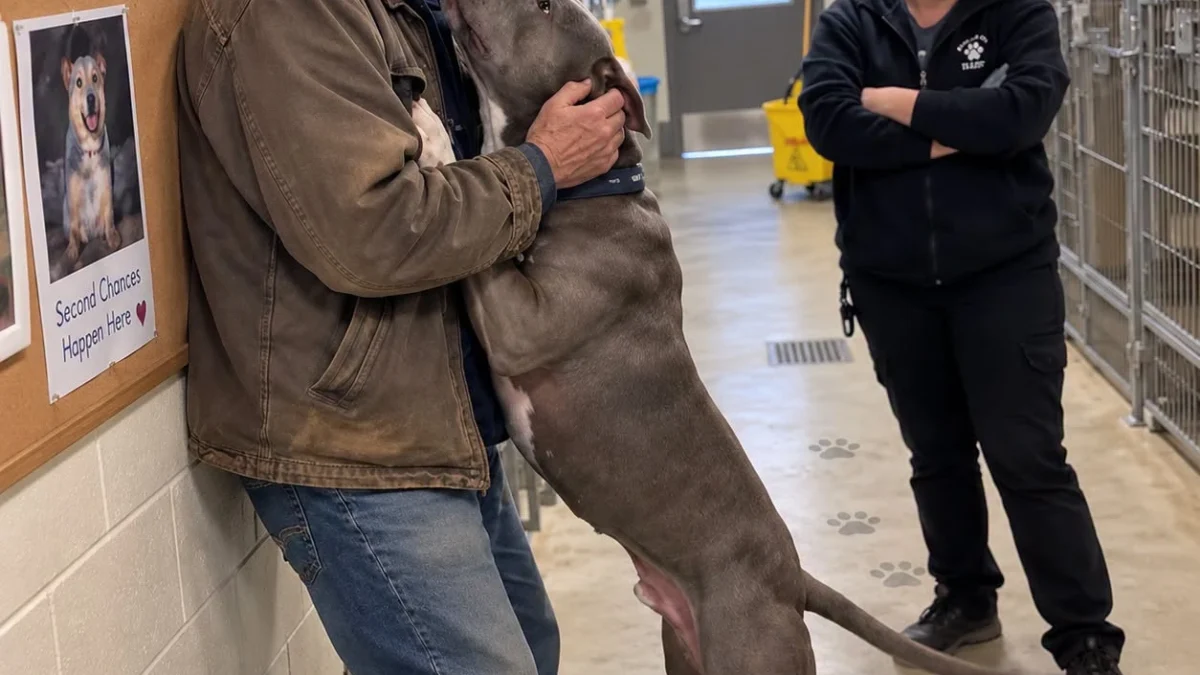
I Spent Five Minutes With a Shelter Dog I Never Planned to Adopt—Three Days Later, They Called and Said He Was Still Waiting for Me
I spent five quiet minutes beside a gray shelter pit bull I had absolutely no intention of adopting, rubbed his head once, told him “Hey, buddy,” and walked back into the empty life I had convinced myself was peaceful.
Three days later, the shelter called to say he had barely eaten, cried whenever the front door opened, and ran toward every stranger who entered as though he were searching for the retired man who had crouched beside him and asked for nothing.
When I came back and that frightened dog pressed himself against the kennel gate before collapsing against my legs in relief, I thought I was deciding whether to save him—I had no idea he was about to rescue the part of me that had stopped believing anyone would ever wait for me again.
My name is Walter.
I was fifty-nine years old when Milo entered my life.
Though if you had asked me that Tuesday afternoon whether I was looking for anything to enter my life, I would have told you no.
I would have meant it too.
At least I would have thought I meant it.
I had been retired for four years.
Retired is the word I used.
It sounded respectable.
Chosen.
Finished.
The truth was less flattering.
The manufacturing plant where I had worked for thirty-one years shut down when I was fifty-five.
Not downsized.
Not restructured.
Gone.
One Thursday morning we were called into the break room, where a regional manager most of us had never met stood beside a folding table and explained that production was moving somewhere cheaper.
There were charts.
Timelines.
Severance packets.
A man I had worked beside for twenty-seven years asked whether there was anything we could do.
The manager said no.
That was it.
Three decades of noise stopped in less than fifteen minutes.
I told everyone I was fine.
“Close enough to retirement anyway.”
I said it to my children.
My friends.
My neighbors.
The woman at the bank.
My former coworkers.
Eventually I said it so often I stopped noticing it was a lie.
I wasn’t devastated financially.
That would almost have been simpler.
I had savings.
A pension.
The mortgage was nearly paid.
My children were grown.
Nobody depended on my paycheck.
What I lost was harder to explain.
For thirty-one years, somebody had expected me somewhere.
5:45 a.m.
Monday through Friday.
Sometimes Saturdays.
PART2:
If I didn’t show up, somebody noticed.
If a machine failed, somebody called my name.
If a new guy didn’t know what he was doing, somebody pointed toward me.
“Ask Walter.”
There were responsibilities.
Problems.
People.
Noise.
Then suddenly there was coffee at seven.
The television at eight.
A walk if the weather was good.
Lunch.
Errands I stretched to take longer than necessary.
Dinner.
Television again.
Bed.
Repeat.
My marriage had ended years earlier.
Not dramatically.
No cheating.
No screaming.
No one particular betrayal.
PART3:
My ex-wife and I simply became two people who had spent so much time managing a life that we stopped noticing we no longer wanted the same one.
She moved to Florida.
We were cordial.
My daughter lived in Colorado.
My son lived in Georgia.
They called.
They visited.
They loved me.
But they had lives.
Jobs.
Partners.
Schedules.
Friends.
I had friends too.
Most of them still worked, or had wives who planned things for them, or grandchildren who treated retirement like free childcare.
I had a recliner.
That sounds like a joke.
It isn’t.
I spent too much time in that chair.
The television was always on because the sound of voices made the house feel less empty.
I called it peaceful.
Quiet.
Independent.
Simple.
Those words sounded better than lonely.
Then one Tuesday, because I had nothing else to do, I drove to the local animal shelter.
No plan.
No secret desire for a companion.
I did not grow up with dogs.
My parents had one old outside dog when I was small, but that was different.
I had never bought a crate.
Never researched food brands.
Never compared veterinarians.
Never pictured a leash hanging near my front door.
I simply thought an hour around animals might make an afternoon pass faster.
That sentence is uncomfortable to admit now.
I went there to make time pass.
At fifty-nine, with decent health and enough money to get by, I was trying to make my own life move more quickly.
The woman at the front desk introduced herself as Rachel.
Early thirties.
Brown ponytail.
Shelter T-shirt.
Gentle voice that made every conversation feel quieter than the room around it.
“You looking to adopt?”
“No.”
I said it immediately.
She smiled.
“That’s okay.”
“I mean it.”
“We allow visitors too.”
“I don’t want anyone getting the wrong idea.”
She laughed.
“Dogs usually survive disappointment better than people.”
That turned out not to be entirely true.
Rachel walked me through the kennel wing.
Dogs barked.
Jumped.
Spun in circles.
One shepherd mix pushed a tennis ball through the bars.
A little terrier barked at me as if I owed him money.
A hound sang.
Then I reached the gray dog.
He was in the back.
Didn’t bark.
Didn’t move.
Broad head.
Dark gray coat.
White patch on his chest.
Old scars across one shoulder.
Maybe sixty pounds.
He looked powerful even curled against the wall.
“What’s his story?”
Rachel stood beside me.
“His name is Milo.”
“How old?”
“We estimate six.”
“Pit bull?”
“Mostly.”
He watched me.
Not afraid exactly.
Not interested either.
“He always like this?”
“He’s quiet.”
“That’s shelter language for something?”
Rachel smiled faintly.
“Sometimes.”
She explained that Milo had arrived six months earlier after being found near an abandoned house, underweight and frightened, with no collar or microchip and no owner who ever came to claim him. He wasn’t aggressive; what worried staff was how thoroughly he had withdrawn from people.
I crouched.
I don’t know why.
Maybe because he wasn’t asking anything.
Maybe because he looked like I felt on certain mornings.
Present.
Functional.
Not participating.
“Hey, buddy.”
Nothing.
I put my fingers near the bars.
Not through.
Just close.
Rachel didn’t tell me what to do.
I appreciated that.
Several seconds passed.
Then Milo stood.
Slowly.
He walked toward me.
One careful step at a time.
Stopped halfway.
Looked at Rachel.
Looked at me.
Then continued.
His nose reached the bars.
I let him sniff.
His breath touched my knuckles.
I moved one finger.
He didn’t retreat.
So I rubbed the top of his head.
“Hey.”
His eyes closed.
That’s all.
No dramatic music.
No instant explosion of affection.
No paw through the bars.
He closed his eyes.
I remember feeling strangely honored by it.
I stayed five minutes.
Maybe a little longer.
I said things I don’t remember.
Probably nonsense.
“You’re a handsome guy.”
“You don’t say much, do you?”
“That’s all right.”
He stayed near me.
Eventually I stood.
His eyes opened.
I thanked Rachel.
Walked out.
Got into my car.
Went home.
That should have been the end.
Instead, all Tuesday evening, I thought about the gray dog.
Wednesday morning too.
I wondered whether he always sat in the back.
I wondered if somebody would adopt him.
Then I became annoyed with myself.
I wasn’t getting a dog.
Thursday, I thought about him during lunch.
I could have driven back.
I didn’t.
There is a particular kind of cowardice that disguises itself as practicality.
I had a list.
Dogs cost money.
Dogs require time.
Dogs complicate travel.
Dogs get sick.
Dogs die.
I was too old to start with a dog.
I had never owned one.
My house was quiet.
I liked quiet.
By Friday afternoon, I had almost convinced myself those five minutes hadn’t mattered.
At 2:38, my phone rang.
Unknown number.
I almost let it go to voicemail.
“Hello?”
“Hi, is this Walter?”
“Yes.”
“This is Rachel from the animal shelter.”
I knew immediately.
The strange thing was how quickly I sat upright.
“Is something wrong?”
She hesitated.
“I don’t know how to explain this without it sounding strange.”
“That’s not a comforting sentence.”
“It’s Milo.”
My chest tightened.
“Is he sick?”
“No. Not physically.”
“What happened?”
She told me.
Since Tuesday, he had barely eaten.
He cried.
Not constantly.
But enough to worry the staff.
Whenever the front entrance opened, he stood.
If footsteps came toward the kennel wing, he moved forward.
When volunteers approached, he looked past them.
When visitors walked by, he became alert.
Potential adopters had met him.
Nothing changed.
“He keeps looking toward the hallway,” Rachel said.
“For what?”
Silence.
Then:
“We think he’s looking for you.”
I laughed.
One short sound.
Not because it was funny.
Because the alternative was believing her.
“Me?”
“Yes.”
“I was there five minutes.”
“I know.”
“He doesn’t know me.”
“I know.”
“You’re saying a dog remembers some old guy who scratched his head?”
“Walter.”
Her voice softened.
“I’m telling you he hasn’t behaved like this with anybody else.”
I stood in my kitchen.
The television played behind me.
Somebody on a news panel was arguing.
Outside my window, the same street I looked at every day stretched between the same houses.
A truck drove past.
Everything looked normal.
Nothing felt normal.
Rachel said:
“Would you come back?”
I looked at my keys.
“To adopt him?”
“No.”
She said it quickly.
“I’m not asking you to promise anything.”
“Then why?”
“We want to know if he calms down when he sees you.”
I don’t know how long I stood there.
Twenty seconds maybe.
It felt longer.
“Walter?”
“Yeah.”
“You don’t have to.”
“I know.”
“We just thought—”
“I’m coming.”
I hung up.
Picked up my keys.
Then stood motionless again.
What was I doing?
I barely knew this dog.
I hadn’t decided anything.
I wasn’t prepared.
I hadn’t even changed my shoes.
Thirty minutes later, I was sitting in the shelter parking lot gripping the steering wheel hard enough to make my fingers ache.
That was when I realized I was nervous.
Ridiculously nervous.
This was a dog.
I had stood in front of industrial presses weighing several tons while maintenance crews tried to diagnose failures.
I had climbed inside machinery after lockout procedures.
I had been in emergency rooms with my children.
Courtrooms during my divorce.
Funeral homes.
Yet somehow walking toward a dog I’d met for five minutes made my heart pound.
I finally got out.
Rachel was already waiting inside.
“You came.”
“I said I would.”
She nodded.
Something about her expression unsettled me.
“Where is he?”
She motioned.
“Come with me.”
We walked.
Dogs barked around us.
My palms started sweating.
Rachel glanced at me.
“You don’t have to decide anything today.”
“I know.”
“I’m serious.”
“I know.”
“We just want you to see.”
“What exactly has been happening?”
She told me more.
Milo had tolerated shelter life for six months.
That was her word.
Tolerated.
He allowed feeding.
Exams.
Leashing.
Walks.
But rarely chose contact.
Visitors tried too hard sometimes.
Called him.
Tapped kennels.
Offered treats.
Bent over him.
He retreated.
“What did I do?”
Rachel smiled.
“Nothing.”
“Helpful.”
“No. That’s the point.”
She stopped outside the kennel room.
“You waited.”
I stared.
“That’s it?”
“For Milo, maybe that’s not an ‘it.’”
She opened the door.
The kennel room was loud.
Metal.
Barking.
Nails on concrete.
Then I saw him.
Back corner.
Head on his paws.
For one second, relief and disappointment hit at the same time.
He wasn’t waiting at the gate.
Rachel had exaggerated.
I knew it.
Then Milo looked up.
His entire body changed.
Head up.
Ears forward.
Eyes locked on me.
He stood so fast his paws slipped.
I stopped.
“Milo?”
He ran.
Not barking.
Not jumping.
Straight to the gate.
His tail slammed against metal.
His body shook.
Then he made a sound.
Rachel had called it crying.
That wasn’t right.
It was deeper.
Almost a moan.
Something from beneath the ribs.
“Milo.”
I stepped closer.
He pressed his muzzle through the bars.
I touched his face.
The sound stopped.
Then started again.
I looked at Rachel.
“Open it.”
“Walter—”
“Please.”
“You sure?”
“No.”
That was the truth.
“Open it anyway.”
She unlocked the gate.
I expected him to jump on me.
He didn’t.
He walked directly to my feet.
Sat.
Looked up.
That was all.
I have tried for years to describe that expression without turning an animal into a person.
I can’t.
The best word is recognition.
Not mine.
His.
As though three days of waiting had ended.
I dropped to one knee.
Milo pushed his muzzle into my palm.
His body relaxed.
The crying stopped.
Then he exhaled.
Long.
Slow.
Heavy.
Like something being set down.
Rachel covered her mouth.
She was crying.
That frightened me.
“You’ve got to be kidding.”
She shook her head.
“We tried everything.”
I rubbed Milo’s head.
“Why me?”
“We don’t know.”
“There has to be a reason.”
“Maybe.”
“What did I do?”
“You waited.”
“That can’t be everything.”
“For a dog who doesn’t trust people, being allowed to choose might be.”
Milo leaned against my leg.
I felt his weight.
Then Rachel said something I have never forgotten.
“Most people want a dog to prove he likes them.”
She crouched.
“You didn’t ask him to prove anything.”
I sat on the concrete.
Milo immediately lay beside me.
Then, as if he had known me for years, he placed his head across my thigh.
Within minutes, his eyes closed.
I looked at Rachel.
“He’s sleeping.”
“Yes.”
“Does he do that?”
“Not like this.”
She sat too.
“This is the calmest he’s been since Tuesday.”
My hand rested on his ribs.
In.
Out.
In.
Out.
Five minutes passed.
Then fifteen.
Then thirty.
Nobody rushed us.
At some point, I realized my legs were numb.
I didn’t move.
Finally I asked:
“What happens now?”
Rachel looked at me carefully.
“Depends.”
“On?”
“You.”
I laughed.
“I knew you were going to say that.”
“You asked.”
“I don’t know anything about dogs.”
“You can learn.”
“I’m fifty-nine.”
“Milo is six. He doesn’t seem concerned.”
“I live alone.”
“That isn’t automatically bad.”
“Never owned a dog.”
“That matters.”
“Small house.”
“Fenced yard?”
“Yes.”
“Retired?”
“Yes.”
“Time?”
“Too much.”
She raised an eyebrow.
I looked down.
Milo opened one eye.
Then closed it.
“I didn’t come here to adopt.”
“I know.”
“I came because I was bored.”
Rachel said nothing.
I looked at her.
“What?”
“Nothing.”
“That face means something.”
She hesitated.
Then:
“Were you bored?”
“Yes.”
“Or lonely?”
The word irritated me.
“I’m retired.”
“That wasn’t the question.”
I looked away.
Milo breathed against my leg.
Lonely sounded pathetic.
I didn’t feel pathetic.
I paid my own bills.
Kept my own house.
Fixed things.
Drove myself places.
Called my children.
I was independent.
But independence and loneliness are not opposites.
That was something I hadn’t learned yet.
“I don’t know if I’d be good for him,” I said.
Rachel studied me.
“You’re worried about that.”
“Obviously.”
“He spent three days worrying whether you’d ever come back.”
“That doesn’t make me qualified.”
“No.”
She nodded.
“Food. Exercise. training. Veterinary care. Behavior. Those all matter.”
“Exactly.”
“But fear isn’t evidence you can’t do it.”
Before I could answer, Milo woke.
He raised his head.
Looked at me.
Stood.
For a second, I thought he was leaving.
Instead, he stepped in front of me.
Pressed his muzzle into my chest.
And stayed.
Something inside me gave way.
I put both arms around him.
His heart beat against me.
Warm.
Steady.
Alive.
The last time I had held another living thing like that—
Really held something without self-consciousness—
I couldn’t remember.
My children had been small once.
My wife had slept beside me once.
My house had been noisy once.
But years had removed those things gradually.
So gradually I had never identified the moment I stopped being necessary to anybody’s ordinary day.
Now this dog behaved as though my return was the most important thing that had happened to him all week.
“All right.”
Rachel leaned closer.
“What?”
I looked at Milo.
“All right, buddy.”
His ear moved.
“You win.”
Rachel’s eyes widened.
“Are you saying—”
“I’m saying tell me what adopting him actually means.”
She stood so fast she almost slipped.
“I’ll get the coordinator.”
“Wait.”
She stopped.
“I’m not signing anything until I know I can do this.”
Her smile changed.
Not excited.
Respectful.
“That’s what responsible adopters say.”
The paperwork took more than an hour.
Housing.
Finances.
Hours alone.
Veterinary care.
Experience.
Emergency planning.
I answered everything honestly.
Own my house.
Live alone.
Retired.
No veterinarian yet.
Can afford care.
Never owned a dog independently.
Have time.
Maybe too much.
Milo’s file said approximately six years old.
Neutered.
Vaccinated.
Physically recovered.
Old scars.
No known serious chronic problems.
When they asked whether I understood that behavioral adjustment might take time, I looked toward the hallway.
“Might?”
Rachel smiled.
“With you, maybe different.”
“Don’t jinx me.”
The shelter sent us home with food.
Leash.
Collar.
Blanket.
Toys.
A seat-belt attachment.
Printed instructions.
“Keep things calm.”
“Easy.”
“Don’t overwhelm him with visitors.”
“Also easy.”
Rachel looked at me.
I ignored it.
“Routine.”
“Okay.”
“Let him retreat.”
“Okay.”
“Don’t force affection.”
We both looked down.
Milo sat directly on my shoe.
“Probably not the problem,” I said.
In the parking lot, he froze at the car.
The shelter had been his world for six months.
I opened the back door.
He looked at the seat.
Then me.
Rachel helped secure him.
I closed the door.
Walked around the back of the car.
Before I reached the driver’s side, Milo had moved toward the window to track me.
I opened my door.
His body relaxed.
“You thought I left?”
That became lesson one.
Milo expected departures.
Not returns.
During the drive, he stayed upright.
Eyes on me in the rearview mirror.
Every stoplight:
“Still here.”
Tail movement.
At my house, I opened the back door.
“Welcome to the estate.”
Two bedrooms.
Small kitchen.
Living room.
Fenced backyard I had taken for granted for years.
Milo inspected the yard first.
Then the front door.
He crossed the threshold.
Stopped.
Sniffed.
Took two steps.
Looked back.
“Go ahead.”
He went toward the living room.
Then checked whether I followed.
That became another lesson.
Milo did not explore the house.
We explored the house.
Kitchen.
Look back.
Hallway.
Look back.
Bedroom.
Look back.
At first it felt affectionate.
Then I understood.
He wasn’t making sure I saw him.
He was making sure I remained.
I filled his bowls.
He drank.
Sniffed his food.
Walked away.
“Seriously?”
He sat beside me.
I pointed.
“Food.”
Nothing.
I walked to the bowl.
He followed.
I stood beside it.
He ate.
I stepped away.
He stopped.
I came closer.
He ate again.
“You are not training me to supervise dinner.”
He did.
That night I called Rachel.
“Is it normal that he won’t eat unless I’m standing there?”
“How far can you move?”
“Three feet.”
“Anxiety.”
“What do I do?”
“Tonight? Stay.”
“I don’t want to reinforce dependence.”
“True.”
She paused.
“But today isn’t the day to prove you can disappear.”
I hated how reasonable she was.
So I stood there.
Milo ate.
Then I showed him the bed I’d made beside mine.
His shelter blanket.
Soft cushion.
“This is yours.”
He sniffed it.
Looked at my bed.
“No.”
He looked at me.
“Absolutely not.”
He lay on the floor beside my side instead.
I turned out the light.
Five minutes later, nails clicked.
His head appeared beside the mattress.
I reached down.
“You’re okay.”
He checked again twenty minutes later.
Then again.
Midnight.
One-thirty.
Three.
At three-fifteen, I gave up.
I sat on the floor against the bed.
Milo curled beside me.
His breathing slowed almost immediately.
“You realize one of us should be emotionally stable.”
Eyes closed.
“I was hoping it was you.”
I started talking.
Why?
Maybe because he listened.
Maybe because the house had been silent for too long.
I told him about the factory.
Thirty-one years.
Metal.
Oil.
Noise.
Men who complained every Monday and missed one another when somebody retired.
I told him how the plant closed.
How I told everybody it was fine.
Then I said:
“It wasn’t.”
The room stayed quiet.
Milo’s ear moved.
I had never said that aloud.
“My life had a schedule attached to everything.”
I rubbed his head.
“Then one day nobody needed me anywhere.”
He pushed closer.
“My kids are good.”
I told him about my daughter.
My son.
Christmases.
My marriage.
The dining table that had once been full.
How furniture can become too much furniture when people leave.
How setting a table for one made me feel foolish, so I stopped doing it.
Then I looked down at him.
“And then I walked into a shelter because I had nothing better to do.”
Milo opened his eyes.
“You looked at me like I was somebody.”
His tail tapped.
“That was rude.”
Another tap.
“I had plans.”
Tap.
“A very boring life.”
Tap.
“Now I’m sleeping on the floor with a pit bull.”
He closed his eyes.
I smiled in the dark.
“Maybe that’s an improvement.”
The first week was difficult.
Not bad.
Difficult.
Milo followed me everywhere.
Kitchen.
Garage.
Bathroom.
Backyard.
If a door closed, he paced.
If I carried trash to the curb, he watched through the window rigidly.
My first grocery trip lasted twenty-five minutes.
When I came back, he was exactly where I’d left him near the front door.
No jumping.
No barking.
He simply pressed himself into my legs.
“You thought I wasn’t coming back.”
His entire back end wagged.
I called Rachel again.
“This isn’t healthy.”
“It’s not unusual.”
“How do I fix it?”
“Teach him a pattern.”
“What pattern?”
“You leave.”
Pause.
“You return.”
“That simple?”
“No.”
“Of course.”
She taught me separation training.
Ten seconds outside.
Return only during calm.
Twenty seconds.
Thirty.
One minute.
No dramatic goodbye.
No celebration on return.
Make leaving boring.
Make coming back predictable.
We progressed.
Then regressed.
One afternoon I reached the mailbox.
Milo whined.
I came back immediately.
Rachel scolded me.
“You returned while he cried?”
“I couldn’t listen.”
“Now he learned crying summons Walter.”
“I hate this lesson.”
“He needs confidence, not control over your location.”
I hung up on her.
Politely.
Mostly.
But I followed the advice.
Because I was learning something.
Trust is built by repetition.
Not speeches.
You can tell a frightened dog “I’ll come back” a hundred times.
He doesn’t understand the sentence.
He understands the door.
It closes.
Then opens.
Again.
Again.
Again.
Eventually your return becomes more believable than his fear.
Twelve days after adoption, I took him to Dr. Patel.
He pressed against my leg through the entire exam.
Weight good.
Heart good.
Joints good.
Skin improving.
She said:
“Behavior is health too.”
“He thinks I’ll disappear.”
“Then become predictable.”
Predictable.
I had spent four years resenting that word.
Coffee.
News.
Walk.
Lunch.
Television.
Sleep.
Predictability had meant emptiness to me.
To Milo it meant safety.
Breakfast comes.
Walter returns.
Dinner happens.
Night happens.
Morning happens.
Nobody vanishes.
Maybe routine wasn’t the enemy.
Maybe an empty routine was.
Milo rebuilt my mornings first.
6:30.
Back door.
Leash.
Rain or shine.
The first rainy morning:
“No.”
Tail wag.
“Look outside.”
More wagging.
“That is water falling from the sky.”
He sneezed.
“You don’t care.”
We walked.
Three houses down lived a woman named Carol.
I had lived near her six years.
Never had a conversation.
She walked a golden retriever named Sam.
“Is he friendly?” she asked.
“I’m learning.”
She smiled.
“Aren’t we all?”
Milo and Sam sniffed.
Then wagged.
After that, Carol and I talked most mornings.
Weather.
Dogs.
Construction.
Nothing.
Everything.
At the park, Milo introduced me to Frank and his beagle.
Then the young couple with the shepherd mix.
Then the woman who knew every dog’s name.
People began saying:
“Morning, Milo.”
Then:
“Morning, Walter.”
I knew the hierarchy.
By month two, Milo ate without me standing beside his bowl.
I photographed it.
Sent it to Rachel.
She replied:
Congratulations. Your dog has achieved lunch.
I wrote:
This is serious.
Her reply:
I know. Proud of both of you.
Both.
I stared at that word.
Until then, I believed I was rehabilitating Milo.
I hadn’t considered what he was doing to me.
My daughter noticed first.
One Sunday she called.
“What are you doing?”
“Making eggs.”
“At ten-thirty?”
“We went to the park.”
“We?”
“Milo and me.”
Silence.
Then laughter.
“Dad.”
“What?”
“You said that like you’ve been married forty years.”
“Very funny.”
“How’s Milo?”
“Good.”
“How are you?”
“Fine.”
“Dad.”
Adult children know your evasions.
I looked toward the living room.
Milo asleep in sunlight.
“Better.”
Her voice softened.
“That’s good.”
“He makes me exercise.”
“I have told you to exercise for a decade.”
“He’s more persuasive.”
That Christmas, both my children came home.
First time in three years they were under my roof together.
They said it wasn’t because of Milo.
Nobody believed them.
My daughter arrived first.
Milo barked.
One bark.
Then stood between me and the door.
I touched his shoulder.
“It’s okay.”
She knew the rules.
Turn sideways.
Don’t reach.
Let him choose.
He sniffed.
Waited.
Then leaned into her hand.
She looked at me.
“Oh, Dad.”
“What?”
“You’re doomed.”
“I run this house.”
She looked around.
“Dog bed in three rooms.”
“He likes choice.”
She pointed.
“Basket labeled Milo Towels.”
“He gets muddy.”
“Framed adoption photo.”
“Gift.”
“From?”
“I printed it.”
She laughed so hard she had to sit.
My son came the next day.
Milo took longer.
Big man.
Deep voice.
But he waited.
By dinner, Milo slept beneath his chair.
And my dining table—
The table I had stopped using—
Was full.
My children.
My daughter’s partner.
My son.
Food.
Noise.
Laughter.
Milo asleep nearby.
I stood at the kitchen sink at one point.
Heard laughter through the doorway.
Stopped washing.
That sound had once been so ordinary I never valued it properly.
Then it disappeared gradually enough that I forgot what absence sounded like.
Milo walked into the kitchen.
Leaned against me.
I touched his head.
“You did this.”
He looked toward the table.
Probably thought I meant turkey scraps.
I let him.
Spring brought a thunderstorm.
Hard rain.
Lightning.
At the first crack, Milo shot upright.
Second thunderclap.
Gone.
I found him curled in the bathtub.
Shaking.
My instinct was to pull him out.
Then I remembered.
Wait.
I sat on the tile.
My knees complained.
I talked.
Baseball.
Weather.
How bathroom floors were designed by sadists.
Anything.
Twenty minutes.
Thirty.
Eventually Milo crawled toward me.
Pressed against my side.
We stayed until the storm ended.
Next morning:
“Rachel, I thought he was better.”
“Better at what?”
“Being scared.”
Silence.
Then:
“Walter, recovery doesn’t erase memory.”
I didn’t like that answer.
“He trusts me.”
“Yes.”
“He’s safe.”
“Yes.”
“Then why hide in the bathtub?”
“Because better doesn’t mean untouched.”
That stayed with me.
“He can trust you and fear thunder.”
She continued.
“He can be happy and have a bad night.”
“What is healing then?”
“Learning the past doesn’t control every day after it.”
After we hung up, I sat beside Milo.
I thought about myself.
Retired.
Divorced.
Children gone.
Quiet house.
I had treated those facts like identity.
This is what I am now.
Maybe they were things that happened.
Not things I had to become forever.
By summer, Milo and I had a life.
Not an exciting one.
A good one.
Morning walk.
Food.
Coffee.
Errands.
Backyard.
Evening park.
Television.
He liked nature documentaries.
Whenever a dog barked on television, he checked behind the screen.
Every time.
One evening we sat on a park bench.
Milo across my shoes.
Children on swings.
A Labrador chasing a ball.
Sun dropping through trees.
Nothing happened.
Absolutely nothing.
And I realized I was happy.
Not entertained.
Not distracted.
Happy.
For years, I had tried to make time move.
Now I wanted ordinary evenings to slow down.
“You know something?”
Milo raised his head.
“I’m not waiting anymore.”
He tilted his ears.
I realized that had been my life.
Waiting.
For my children to move closer.
For work to matter again.
For someone to call.
For life to become the version I remembered.
Milo rested his head back on my shoe.
“You waited too.”
I scratched his ear.
“Then five minutes happened.”
For months, I tried to understand why he chose me.
Maybe my voice reminded him of someone.
Maybe my smell.
Maybe I sat differently.
Maybe he simply preferred old men.
I eventually stopped asking.
Sometimes connection arrives before explanation.
A year after adoption, the shelter held a fundraiser.
Rachel called.
“You’re coming.”
“That sounded compulsory.”
“It is.”
“I don’t like crowds.”
“Milo handles them better now.”
“I meant me.”
She laughed.
We went.
The moment we stepped through the shelter doors, Milo stopped.
Body stiff.
Ears moving.
For one second, I regretted bringing him.
Then Rachel appeared.
“Milo?”
His head snapped toward her.
Tail.
He walked slowly.
Then faster.
Rachel knelt.
He licked her face.
She cried.
I pretended not to notice.
Then she looked at me.
“You look different.”
“Older?”
“No.”
“Fatter?”
“No.”
“Less hair?”
“Walter.”
“What?”
“You look alive.”
I laughed.
“That’s dramatic.”
She looked at Milo.
He returned to my side.
“So does he.”
Volunteers came over.
People who had known the old Milo.
They were stunned.
He accepted touch.
Approached.
Wagged.
One woman said:
“What did you do?”
I knew the answer.
“Nothing special.”
Rachel smiled.
I added:
“Then I kept showing up.”
That was the real story.
The five minutes mattered.
But five minutes didn’t heal Milo.
Every day afterward did.
Every bowl.
Walk.
Closed door.
Opened door.
Thunderstorm.
Vet visit.
Night.
Morning.
The first time he slept without checking whether I remained.
People love rescue moments.
The kennel door.
Adoption photograph.
The ride home.
But rescue is mostly boring.
It’s Thursday.
Then Friday.
Then a month.
It is doing the same safe thing long enough for somebody’s nervous system to believe you.
At the event, a couple asked me about adoption.
The woman said:
“Were you scared to adopt a pit bull?”
“Yes.”
She looked surprised.
“The breed?”
“No.”
“What then?”
I looked at Milo.
“He trusted me before I trusted myself.”
The man nodded.
“That’s responsibility.”
“It is.”
“What if you fail?”
“You will.”
They both stared.
I laughed.
“Not completely.”
I explained.
I had returned too soon when he cried.
Used too many treats.
Lost patience.
Forgot training rules.
Let him sleep in my bed.
Rachel shouted from across the room:
“That last one was voluntary.”
I ignored her.
“You make mistakes.”
I said.
“Then you adjust.”
The couple adopted an older dog a month later.
Their story.
Not ours.
I liked that.
By year two, Milo had changed my reputation.
Pharmacy clerk asked about him.
Mail carrier brought treats.
Carol called him her boyfriend.
My grandchildren argued about holding his leash.
And somehow, the man who had gone to a shelter to kill an empty afternoon became a volunteer there every Wednesday.
Rachel handed me my first leash.
“Careful.”
“About?”
“You came here lonely once.”
“Bored.”
“Right.”
“I am not adopting another dog.”
“Of course.”
“I mean it.”
She smiled.
“I didn’t say anything.”
I walked dogs that hadn’t found their Walters.
That’s how I thought of them.
Not unwanted.
Waiting.
Some pulled hard enough to hurt my shoulder.
Some barked.
Some hid.
One old shepherd named Duke sat in the back the way Milo once had.
So I sat outside his kennel reading the newspaper.
First visit.
Nothing.
Third.
He came closer.
Fifth.
Touched my hand.
Two weeks later, a retired teacher adopted him.
I watched Duke leave.
Rachel nudged me.
“What?”
“You’ve got the look.”
“What look?”
“The one I had when Milo left with you.”
I shook my head.
“I hate this place.”
“No, you don’t.”
She was right.
On our second adoption anniversary, Rachel called.
“Remember what you told Milo the first day?”
“I’ve said many wise things.”
“You told him he’d caused a tremendous amount of trouble.”
“Accurate.”
“Still true?”
I looked at the couch.
Milo asleep upside down.
Four legs in the air.
“Yes.”
“Regrets?”
I thought.
“One.”
“What?”
“I should’ve taken him Tuesday.”
Rachel laughed.
“Maybe you needed those three days too.”
I stopped.
“What does that mean?”
“Milo wasn’t the only one waiting.”
Afterward, I thought about Tuesday through Friday.
Milo wasn’t the only one thinking.
I had wondered about him every day.
I hadn’t gone back because going back would mean admitting I wanted something.
That is risky.
People talk about abandoned animals being afraid to need anyone.
Humans become very sophisticated at the same thing.
We call it independence.
Being realistic.
Being settled.
Sometimes “I don’t need anybody” is fear wearing good clothes.
Milo had been more honest.
He cried.
He waited at the gate.
He ran toward footsteps.
He didn’t care whether needing somebody looked dignified.
I learned from that.
Needing connection isn’t weakness.
Choosing it isn’t either.
By then, Milo had stopped panicking when I left.
He still liked being near me.
If I read, he slept at my feet.
If I cooked, kitchen doorway.
Television, half the couch.
At night, his back against mine.
But if I got out of bed?
Sometimes he never woke.
I celebrated that more than anything.
He finally believed I was coming back without monitoring me.
One night, I woke around two.
Milo asleep.
Slow breathing.
I remembered the sound from the shelter.
That low cry.
The shaking.
His tail pounding the gate.
“Why me?”
I’d asked Rachel.
I never got an answer.
Maybe there wasn’t one.
Maybe a lonely dog met a lonely man and each recognized something the other had become good at hiding.
Enough.
Milo learned doors could close without abandonment.
I learned retirement wasn’t the same as being finished.
He learned to eat when I wasn’t watching.
I learned to set the dining table sometimes even when it was only me.
Because living alone didn’t mean my own presence didn’t count.
He learned storms pass.
I learned bad years do too.
He learned people return.
I learned life can.
The shelter started telling our story.
“The dog who cried for the man he’d known five minutes.”
People liked that.
Five minutes sounds like fate.
Magic.
Recognition.
But five minutes did not build our life.
It opened a door.
The life came afterward.
Rachel once asked if I understood what Milo had been waiting for.
I said me.
She shook her head.
“Maybe.”
“What else?”
“The possibility you represented.”
Safety.
Patience.
Someone who wouldn’t demand a performance before offering kindness.
That hit me.
Because for five minutes outside Milo’s kennel, I had felt something similar.
I wasn’t retired Walter.
Divorced Walter.
Walter whose factory no longer existed.
Walter whose children lived far away.
Walter passing time until bedtime.
I was simply a man sitting beside another living thing.
Present.
Seen.
Maybe needed.
Milo and I were looking for the same word.
Home.
Before him, I thought home meant property.
Address.
Roof.
Mortgage.
Keys.
Now I think home is where your body stops preparing for somebody to leave.
Where you can sleep.
Where somebody notices an empty bowl.
Where someone knows what scares you.
Where a closed door is temporary.
Where returning becomes a pattern.
Milo found that in my house.
So did I.
Then I noticed gray on his muzzle.
First little hairs.
That frightened me.
Six becomes seven.
Seven becomes eight.
Dogs don’t give us enough years.
For several weeks, I began doing something stupid.
Grieving him while he was still alive.
Watching him sleep and calculating.
Thinking about the final vet visit.
The empty bed.
The leash nobody needed.
Coming home without him.
One afternoon at the park, I realized what I was doing.
Again.
I had done the same after the factory.
Grieved a future before it arrived.
Defined everything by an ending.
Milo was lying in warm grass.
Tail moving when children passed.
Completely unconcerned about mortality.
“You’re smarter than me.”
He sneezed.
“I mean it.”
He put his head on my knee.
So I stopped thinking about the last day.
I paid attention to that one.
Warm sun.
Grass.
Dog.
Bench.
Breathing.
Presence.
That might be Milo’s greatest lesson.
Not rescue.
Presence.
Not tomorrow.
This walk.
This meal.
This evening.
This breath.
The future arrives by itself.
You don’t have to drag it toward you.
When I was young, I measured life in large events.
Promotion.
House.
Children.
Graduations.
Retirement.
Now I measure differently.
The leash moving on its hook because Milo bumped it.
Coffee while he sleeps beneath the table.
My daughter calling and asking to speak to “her brother.”
Carol waving.
A frightened shelter dog taking a treat.
Rain hitting windows while Milo sleeps through a thunderstorm that once sent him into the bathtub.
Small things.
Most life hides there.
Not the days photographed.
The days nobody thinks to photograph.
This morning Milo woke me at 6:12.
Paw on my chest.
“No.”
Tail.
“Six-thirty.”
Stare.
I closed my eyes.
He licked my nose.
“Unacceptable.”
Then sneezed directly into my face.
Five minutes later, we were outside.
Pale sky.
Empty street.
Milo walked ahead.
Looked back.
He still does that.
Not fearfully now.
Just checking.
I follow.
At the corner, Carol and Sam waited.
“Morning, Walter.”
“Morning.”
“Beautiful day.”
I looked around.
“It is.”
Nothing happened.
No phone call.
No kennel.
No crying.
No rescue.
Just an old man walking with his dog while morning arrived.
Years ago, I would have called that uneventful.
Now I call it a life.
People ask whether I saved Milo.
Practically?
Yes.
I signed papers.
Bought food.
Paid veterinary bills.
Learned training.
Sat through storms.
Stayed.
But rescue is a strange word when both sides leave differently.
Milo left the shelter.
I left something there too.
The version of me who thought the useful part of life had ended when the factory closed.
The man who believed loneliness was simply what old age looked like.
The man who had stopped expecting anyone to wait for him.
That man did not come home with us.
Milo wouldn’t let him.
I’m sixty-one now.
Milo is asleep beside my chair as I tell this.
His muzzle is grayer.
Mine too.
Evening sunlight is moving across the floor.
Two years ago, Milo was a withdrawn gray dog at the back of a kennel.
I was a withdrawn gray man in a quiet house.
He barely approached people.
Neither did I, if we’re telling the truth.
We met for five minutes.
I walked away.
He waited.
Three days later, Rachel called and told me a dog I barely knew was crying because I had not come back.
At the time, I thought that was the strange part.
That Milo remembered me.
It wasn’t.
The strangest part was how quickly my own life remembered what it felt like to matter.
Milo sighs.
His paws twitch.
Dreaming.
Maybe running.
Maybe chasing rabbits.
I put one hand on his side.
He doesn’t wake.
He doesn’t need to.
He knows I’m here.
There was a time when that knowledge was impossible for him.
Now it is ordinary.
That may be the greatest thing I have ever given him.
And knowing he trusts it may be the greatest thing he gave me.
For years, I thought this house was my home because I returned here every evening.
But a building can hold everything you own and still be somewhere you are only waiting.
Milo taught me another definition.
Home is knowing someone comes back.
Home is sleeping without watching the door.
Home is a hand on your head.
A dog breathing beside the bed.
A leash by the entrance.
A reason to wake before sunrise when it’s raining.
A name someone is glad to hear.
A place where neither of you has to earn permission to stay.
I thought I went to that shelter because I had nothing better to do.
Maybe I did.
I thought I stopped outside Milo’s kennel by accident.
Maybe I did.
I thought five minutes was too short to mean anything.
Maybe it usually is.
There may have been no destiny in any of it.
No invisible plan.
No special force connecting a retired factory worker to a frightened pit bull.
Maybe it was simply two lonely lives crossing at the exact moment each had finally become quiet enough to notice the other.
That explanation is enough for me.
Because five minutes did change everything.
Not because five minutes built a home.
They didn’t.
Five minutes opened the door.
The home came afterward.
Every bowl of food.
Every walk.
Every storm.
Every veterinary appointment.
Every training mistake.
Every closed door followed by an open one.
Every time Milo trusted another inch.
Every morning he pulled me back into the world.
Every ordinary night when neither of us needed to ask where we belonged.
Tomorrow he’ll wake me too early.
I’ll complain.
He’ll ignore me.
We’ll walk the same street.
He’ll sniff the same tree as though a criminal investigation occurred overnight.
Carol will probably wave.
I’ll wave back.
We’ll come home.
He’ll eat.
I’ll make coffee.
He’ll find the warm patch of sunlight near the window.
And in that completely ordinary morning, I will probably remember the man I was before Milo.
The man whose days all looked the same.
Then I’ll look at the gray dog sleeping on my floor and remember what I know now.
Sometimes life does not change because you go searching for something enormous.
Sometimes it changes because you stop for five minutes.
Sometimes a frightened dog decides you are worth waiting for.
And sometimes the phone call that brings you back to rescue him is actually the call that brings you back to your own life.
Outside, the sun is going down.
Inside, my house is quiet.
But it is not empty anymore.
Neither am I.








