I Spent 30 Years Calling the Police on the Bikers Next Door—Then They Came When My Children Wouldn’t
PART3:
Respectable men did not cover their arms in tattoos or wear patches across their backs.
Respectable families did not gather in a garage beside roaring machines.
That was what I believed.
Ed did not.
He disliked the noise but never shared my hatred.
Sometimes I caught him speaking to the bikers near our fence. When I asked what they discussed, he said tools, baseball, weather, or the price of gasoline.
Once, I found a motorcycle carburetor on his workbench.
“It belongs to the people next door,” he explained.
“They can afford motorcycles. They can afford mechanics.”
“Bobby’s transmission failed. He’s trying to save money.”
“That is not our problem.”
Ed wiped grease from his hands.
“Helping someone doesn’t require their problem to belong to you.”
I remember rolling my eyes.
I remember calling him naive.
I remember so many moments when I was certain I understood the world better than the kindest man I ever knew.
In 2010, the Brotherhood elected a new president.
Ray “Hammer” Dawson came to my door to introduce himself.
He was six-foot-four, with a shaved head, a thick gray-streaked beard, tattooed arms, scarred knuckles, and a leather vest that made him look exactly like the men I had spent years warning everyone about.
He removed his sunglasses before speaking.
That small courtesy unsettled me.
“Mrs. Hoffman, my name is Ray Dawson.”
“I know who you are.”
“I figured you might.”
“What do you want?”
“I’d like to start over.”
“With what?”
“Being neighbors.”
“We are not neighbors. You occupy the property beside mine.”
His pale eyes remained calm.
“We’ve had disagreements.”
“You people have destroyed this street.”
Maple Street was not destroyed.
The houses remained tidy. Children rode bicycles on the sidewalks. Property values had risen. The Brotherhood had repainted its building, repaired the alley, and installed better exterior lighting than the city provided.
Facts did not matter because I had spent too long arranging my life around the opposite conclusion.
Ray held out a piece of paper.
It listed his phone number, the club’s gathering schedule, and the name of the member responsible for addressing neighborhood concerns.
“If the bikes get too loud or somebody blocks your driveway, call me first,” he said. “We’ll handle it.”
“I don’t associate with your kind.”
Then I shut the door in his face.
I felt righteous.
I felt victorious.
I was such a fool.
Ed died on a Friday morning in October 2015.
He went into the garage to find a wrench.
Five minutes later, I heard something fall.
I found him beside his workbench, one hand pressed against his chest.
He was conscious long enough to say my name.
I called 911, but panic made my fingers useless. I dropped the phone twice.
Before the dispatcher finished asking for our address, the back door opened.
Ray came in.
I never remembered calling for him.
Maybe Ed had knocked over a metal shelf. Maybe somebody next door heard me screaming.
Ray knelt beside my husband and began CPR.
Bobby met the ambulance at the corner and guided paramedics through traffic. James moved his motorcycle so the stretcher could reach our door. Tommy remained with me while the paramedics worked.
Ed never regained consciousness.
He was pronounced dead at the hospital.
After fifty-one years of marriage, my house became quiet in a way that felt less like peace than burial.
Our three children came home for the funeral.
Linda flew from Colorado. Richard drove from Texas. Beth arrived from California with her husband and two children.
They stayed five days.
For those five days, my house was full.
The refrigerator opened constantly. Doors closed. Children whispered in rooms that had been empty for years.
Then everyone left.
Linda promised to call every Sunday.
Richard said he would visit at Christmas.
Beth told me I could stay with her whenever I wanted.
At first, the calls came.
Then Sunday became every other Sunday.
Every other Sunday became the first weekend of the month.
Then birthdays.
Then holidays.
Eventually, even holidays became text messages with flowers attached.
I told myself the bikers had driven my family away.
It was easier than examining what really happened whenever my children visited.
I criticized Linda’s clothes.
I told Richard his wife spent too much money.
I corrected Beth’s children until they avoided sitting near me.
I compared all three of them to one another and then wondered why they did not enjoy being together.
Loneliness hardened me.
The harder I became, the lonelier I grew.
Instead of recognizing the circle, I found someone else to blame.
The motorcycles.
The clubhouse.
The men next door whose children still came home.
Three weeks after Ed’s funeral, I found a bouquet on his grave.
Six yellow roses tied with black ribbon.
The card said:
FOR THE MAN WHO SHOWED US WHAT A NEIGHBOR SHOULD BE.
—R
I assumed the R belonged to a woman.
Grief can make a person irrational, but pride makes irrationality feel like intelligence.
I became convinced Ed had hidden an affair.
Every Friday, another bouquet appeared.
Yellow roses.
Sometimes tulips.
Once, sunflowers.
Always the same short card.
THANK YOU, ED.
STILL RIDING, BROTHER.
WE REMEMBER.
I hated the person leaving them.
I imagined some secret life Ed had kept from me. A woman he had comforted. Someone who understood parts of him I had never bothered to ask about.
I began visiting the cemetery early on Fridays, hoping to catch her.
I never did.
The flowers were always there before sunrise.
What I did not know was that Ray and another Brotherhood member visited at five thirty each Friday before going to work.
The R was Ray.
There had been no affair.
Only a friendship my husband knew I would not allow him to speak about inside his own house.
In 2018, I fell in the garden.
I was trimming dead branches from a rosebush when my shoe slid on damp soil. My hip struck the edge of the brick path.
The pain took my breath.
I lay between the roses and the fence for twenty minutes, unable to move.
I screamed twice.
Nobody answered.
Then I heard boots running.
James appeared above me, followed by Bobby.
They had been repairing a motorcycle next door when they heard me.
James called 911.
Bobby knelt in the mud and held my hand.
“You’re going to be all right, Mrs. Hoffman.”
“Do not touch me.”
He did not release my hand.
“I’m going to keep touching you until the ambulance comes.”
My hip was broken.
I spent two weeks in the hospital and another month in rehabilitation.
James visited once with a pot of white chrysanthemums.
I told the nurse I was sleeping.
Bobby left a card.
I threw it away unopened.
When I returned home, the loose bricks in my garden path had been repaired.
A handrail had been installed beside the back steps.
I assumed Richard had hired someone.
I thanked him during our next telephone call.
He paused.
“Sure, Mom.”
He accepted gratitude for work he had not arranged.
The Iron Brotherhood had done it overnight.
I never asked.
I preferred the answer that required nothing from me.
The cancer arrived slowly.
First came the back pain.
Then the nausea.
Then the weight loss.
My doctor ordered tests in September.
By October, an oncologist sat across from me and used the words advanced, metastatic, and palliative.
“Six months,” I said.
“We do not predict exact timelines.”
“That means six.”
“It could be longer.”
“How much longer?”
He looked down at my chart.
“Treatment may give you additional time.”
Time.
Doctors speak of time as though it arrives empty.
Mine arrived filled with infusion appointments, vomiting, fatigue, mouth sores, sleepless nights, and a fear I refused to name.
I called Linda first.
She went quiet.
“Oh, Mom.”
“I need you to come.”
“This month?”
“Yes.”
“Work is impossible right now. Maybe after the quarterly review.”
“Your mother has stage-four cancer.”
“I heard you.”
“Then come.”
She sighed.
The sound hurt more than if she had shouted.
“I’ll look at flights.”
She did not come.
Richard said his company was restructuring.
Beth did not answer. She sent a message two days later.
Thinking of you. Let me know if there’s anything you need.
I wrote back.
I need you.
She reacted with a red heart.
No plane ticket followed.
Chemo was a beating.
I drove myself to the first three appointments.
After the fourth, I vomited in the hospital parking lot and remained in my car for two hours because I was too weak to turn the key.
Someone knocked on the window.
It was Tommy Reed from next door.
He had been visiting another patient.
He opened my door, gave me water, and drove me home while another biker followed in his truck to return Tommy.
I did not thank him.
Instead, I said, “I could have managed.”
Tommy looked at me through the rearview mirror.
“No, ma’am.”
I resented him for being correct.
By March, I could no longer use the stove safely.
My hands shook too much to lift a saucepan.
I lived on saltines, canned peaches, and flat ginger ale.
The weight fell off me.
My dresses hung like curtains.
I stopped showering because I was afraid of falling and lying naked on the tile for days before anyone thought to check.
Mail accumulated in the box.
My garden died in stages.
I did not notice the men who watered it before dawn.
I did not see Ray clearing snow from my driveway at five in the morning.
I did not know James had asked our mail carrier to call the clubhouse if letters remained untouched for more than three days.
On a Tuesday morning in April, I woke and could not lift myself out of bed.
I had been weak before.
This was different.
My arms felt disconnected from my body. My tongue stuck to the roof of my mouth. Each breath seemed too small.
I stared at the ceiling.
This is where it ends, I thought.
Not with my children beside me.
Not with a hand in mine.
Starved, filthy, and too weak to reach the phone.
I tried calling Linda’s name.
Only air came out.
Then the front door opened.
Heavy boots crossed the hallway.
“Mrs. Hoffman?”
I recognized James’s voice.
“Margaret?”
That was Ray.
They appeared in the bedroom doorway.
James had grown older since the garden fall. His beard was almost completely white. Bobby’s kind eyes had deeper lines around them.
Ray stood behind both men carrying my unopened mail.
“Get out,” I whispered.
There was no force behind it.
Bobby crossed the room.
“Ma’am, respectfully, you’re dying.”
“Leave me alone.”
“No.”
“This is my house.”
“Yes, ma’am.”
“I hate you people.”
“We know.”
“I called the police on you.”
“Eighty-nine times,” James said.
Ray gave him a look.
“What?” James asked. “We kept count.”
Bobby touched my wrist.
His expression changed.
“She’s dry as sand.”
Ray called an ambulance.
I caught his sleeve.
“No hospital.”
“You need fluids.”
“No more.”
He studied my face.
“Do you have hospice?”
I shook my head.
“Family?”
The humiliation of that question hurt more than the cancer.
I looked toward the window.
“Get out.”
Ray sat on the edge of my bed.
This was the man whose clubhouse I had tried to close. The man whose face I had described to city officials as intimidating. The man I had refused to treat as a neighbor.
“We’re not going anywhere,” he said.
“Why?”
The word came out as a sob.
“Why would you help me? For thirty years, all I’ve done is try to ruin you.”
James sat in the chair beside the bed.
“Thirty years ago, my mother was dying alone in a house outside Tulsa.”
I looked at him.
“I was twenty-two and locked up for something stupid. My sister was gone. My father had been dead for years.”
His eyes moved toward the hallway.
“A stranger started visiting her.”
“Who?”
“Your husband.”
The room seemed to move.
“Ed?”
James nodded.
“He was traveling through Oklahoma for work. His car broke down near her house. She let him use the phone. When he came back through two weeks later, he stopped to thank her.”
He rubbed one hand across his white beard.
“He saw she was sick. After that, he visited whenever his route brought him through. Brought groceries. Fixed the porch steps. Sat with her through hospice.”
“That’s impossible.”
“He never told you?”
I shook my head.
James looked at Ray.
Ray removed an old photograph from his wallet.
Ed stood beside a frail woman in a lawn chair. James, much younger, knelt on her other side wearing prison-release clothes and holding her hand.
On the back, in Ed’s handwriting, were the words:
JAMES CAME HOME. SHE WAITED.
“My mother lived long enough to see me get out,” James said. “Your husband made sure she wasn’t alone until then.”
I could not take my eyes from the photograph.
“Why didn’t Ed tell me?”
Ray answered gently.
“Because he knew how you felt about us.”
Shame spread through me.
“He asked us not to hold it against you.”
“Is that why you left flowers?”
Ray nodded.
“Every Friday.”
“I thought he had another woman.”
For one second, Bobby looked confused.
Then James laughed.
It was not cruel laughter.
It was startled, helpless laughter in the middle of an unbearable room.
Soon all three men were smiling.
Even I laughed once, though it became a cough.
Ray gave me water through a straw.
“Ed never cheated on you,” he said. “He talked about you constantly.”
“What did he say?”
“That you made the best peach pie in the county.”
“I did.”
“That you were stubborn.”
“He was worse.”
“And that you loved hard but got frightened whenever loving required trusting somebody you couldn’t control.”
My laughter stopped.
“That sounds like him.”
“He loved you, Margaret.”
It was the first time Ray used my first name.
I began to cry.
Not politely.
Not with the restrained tears I had allowed at Ed’s funeral.
I cried until my chest hurt.
“I wasted so much time.”
Ray took my hand.
“You still have today.”
The ambulance brought fluids, but I refused transport after the paramedics stabilized me.
A hospice nurse arrived that afternoon.
She evaluated the house, reviewed my medications, and asked who would provide daily care.
“No one,” I said.
“Us,” Ray replied.
I tried to object.
He ignored me.
The Brotherhood created a schedule before sunset.
Every day, someone would be in my home.
Not occasionally.
Not if convenient.
Every day.
James took mornings.
Bobby handled meals.
Tommy drove me to appointments.
Marcus managed medications after the hospice nurse organized them.
Ray coordinated nights.
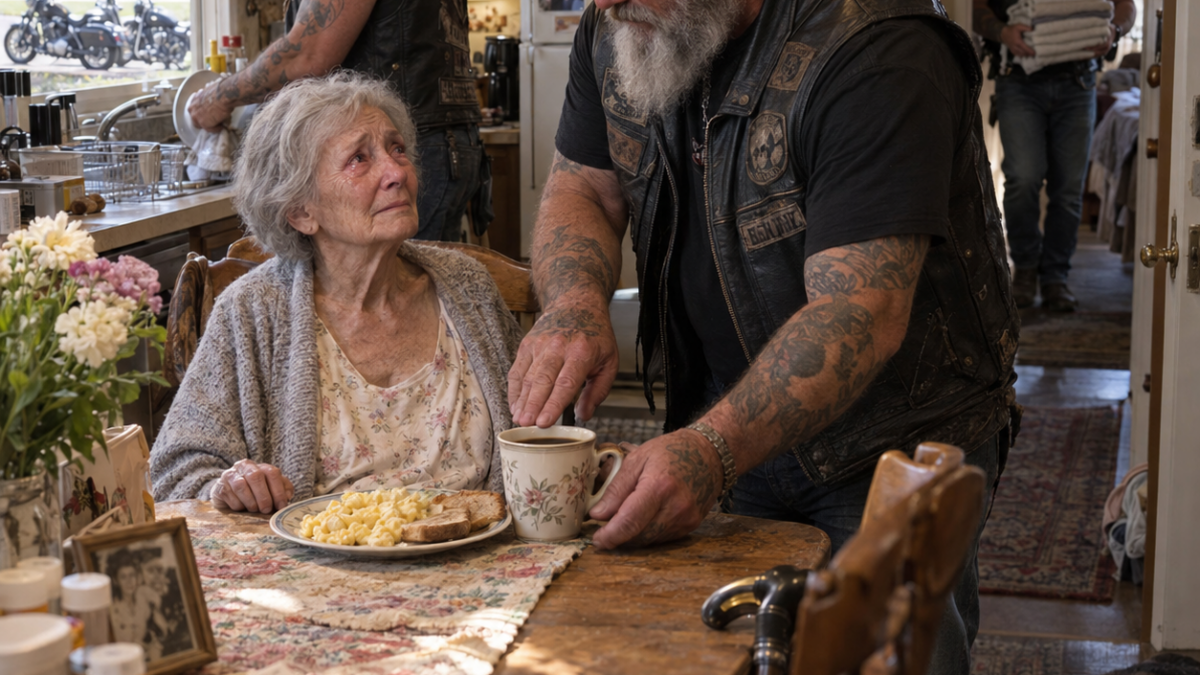
Their wives joined them. Carmen Alvarez washed my hair. Denise Walker changed my sheets. Bobby’s daughter, Mia, painted my nails a pale pink I would never have chosen and secretly loved.
The first time Bobby bathed me with warm cloths, I wanted to disappear from humiliation.
He kept his eyes respectful and explained every movement before touching me.
“Your left shoulder now, ma’am.”
“Stop calling me ma’am.”
“Yes, ma’am.”
“You are impossible.”
“So I’ve been told.”
He dressed me in a clean nightgown.
Then he fried eggs until they were soft enough to swallow, buttered toast, and made coffee with cream.
Ray tested the mug against his hand.
That was when I broke.
I began apologizing.
Not one apology.
Thirty years’ worth.
“I called you drug dealers.”
“We remember.”
“I said your children would become criminals.”
“Several became accountants,” Bobby said. “So you weren’t entirely wrong.”
Ray gave him a look.
“I tried to close your clubhouse.”
“Four times,” James said.
“Five,” Tommy called from the hallway.
“I circulated petitions.”
“We signed one of them,” Ray admitted.
I stared at him.
“You signed my petition?”
“Bobby wanted to see whether you actually read the signatures.”
“I did.”
“No, you counted them.”
That was true.
For the first time in decades, people teased me inside my own home.
I had forgotten how affection could hide inside irritation.
Days acquired shape again.
Someone opened the curtains each morning.
Someone brought soup, oatmeal, mashed potatoes, pudding, or peach ice cream.
The Brotherhood installed rails in my bathroom and a ramp over the back steps.
They moved a bed into the living room so I could watch the garden.
They repaired the radio Ed had kept on the kitchen counter.
Every evening at six, Ray tuned it to the oldies station.
At first, I waited for resentment to reveal itself.
Surely someone would remind me what I had done.
Surely they would demand gratitude.
They did neither.
One afternoon, I asked Ray how they had known I was in trouble.
He set down the spoon he was using to feed me soup.
“Margaret, we’ve been keeping an eye on you for years.”
“How many?”
“Since Ed died.”
I stared at him.
“We saw the kids stop coming.”
“That was none of your business.”
“No.”
“Then why?”
“Because Ed asked.”
“When?”
“The week before his heart attack.”
Ray told me my husband had visited the clubhouse late one evening.
Ed knew his heart had been troubling him, though he had hidden it from me. He made Ray promise that if anything happened, the club would watch the house.
Not intrude.
Not embarrass me.
Simply notice.
“We’ve been mowing your yard for three years,” Ray said.
“I hired someone.”
“No.”
“Richard arranged it.”
“No, Margaret.”
“Then who—”
“Tommy. Six in the morning.”
I looked toward the garden.
“The weeds?”
“Mia.”
“The snow?”
“Usually James and me.”
“The handrail after my hip?”
“Bobby.”
“The loose gutter?”
“Marcus.”
“All those years…”
“You kept saying you didn’t need us.”
“So you helped where I couldn’t see.”
Ray nodded.
“Why?”
“Because needing help and knowing how to accept it are different skills.”
His gentleness made the truth harder to escape.
I had called the police eighty-nine times.
The club remembered every call.
Most happened during their largest gatherings.
Children’s birthdays.
Thanksgiving dinners.
Christmas toy drives.
Memorials for dead members.
I had told myself the noise angered me.
Ray saw something else.
“You weren’t always mad at the motorcycles,” he said.
“What was I mad at?”
“That we kept showing up for one another.”
I looked away.
“Our kids came home. Our grandkids ran through the clubhouse. If somebody got sick, twenty people filled the driveway.”
“You’re saying I was jealous?”
“I’m saying loneliness can sound a lot like anger when pride translates it.”
The words landed heavily.
He was right.
Even before Ed died, I had looked through the fence and seen a kind of closeness our family never possessed.
The Brotherhood argued loudly, forgave quickly, and appeared without invitation whenever one of their members needed help.
My children arrived only after careful scheduling.
Our holidays looked proper in photographs, but tension followed us from room to room.
I had mistaken control for family order.
I corrected everyone because uncertainty frightened me.
Eventually, my children chose distance.
The bikers did not drive them away.
They were simply the easiest reason for me to use.
“My children left because I was impossible,” I whispered.
Ray shook his head.
“They made their choices too.”
“I gave them reasons.”
“Reasons aren’t chains. Adults decide what they do with them.”
“I should have been kinder.”
“Yes.”
His honesty startled me.
He did not erase my failures to make me comfortable.
Then he squeezed my hand.
“But dying alone is not the sentence for being difficult.”
Two weeks later, Linda finally called.
She had seen a photograph online.
Mia had posted a picture of me sitting on Ray’s Harley in the clubhouse driveway. I wore an oversized leather vest with a temporary patch reading HONORARY NEIGHBOR.
For the first time in months, I was smiling.
Linda did not ask about my weight, pain, or treatment.
She asked, “Why are motorcycle gang members inside your house?”
“They are caring for me.”
“You don’t know those people.”
“I’ve lived beside them for thirty years.”
“You’ve hated them for thirty years.”
“I was wrong.”
There was a long pause.
“Mom, do they have access to your bank accounts?”
“No.”
“Your medications?”
“Marcus organizes them with hospice.”
“Who is Marcus?”
“A retired pharmacist.”
“He’s a biker.”
“Those facts can exist together.”
“Have you signed anything?”
“No.”
“Is your jewelry still there?”
Anger returned with enough strength to make me sit straighter.
“You have not entered this house in eighteen months, Linda.”
“That doesn’t mean I don’t care.”
“What does it mean?”
“I have a life.”
“So do they.”
“That is not fair.”
“No. It isn’t.”
She hung up.
The next morning, Adult Protective Services arrived.
A social worker named Evelyn Price stood on my porch beside a police officer. Someone had reported that a motorcycle gang had taken control of a terminally ill widow’s home and finances.
Ray immediately stepped outside.
“You should speak to Margaret alone,” he said.
The officer appeared surprised.
“You’re leaving voluntarily?”
“It’s her house.”
Every Brotherhood member left.
Evelyn interviewed me for almost two hours.
She examined my medications, refrigerator, hospice records, bank statements, and legal documents.
She asked whether anyone had threatened me.
“No.”
“Asked for money?”
“No.”
“Pressured you to alter your will?”
“No.”
“Prevented contact with family?”
“My family prevents contact with my family.”
She inspected my body for unexplained injuries.
The only bruises came from blood draws and the cancer.
Then she checked my bank accounts.
That was when we discovered the withdrawals.
Twenty-four thousand dollars had disappeared over eight months.
The transfers went to an account belonging to Richard.
Years earlier, after my hip fracture, I had given him limited financial power of attorney so he could pay bills if I was hospitalized.
He had used it to withdraw money from my savings.
The transaction notes said home maintenance, medical support, and caregiver expenses.
He had provided none of those things.
The Brotherhood had done the maintenance for free.
I had paid my own medical bills.
No caregiver had entered my home until the bikers found me.
Evelyn asked whether I had approved the withdrawals.
I had not.
The betrayal felt strangely quiet.
Perhaps cancer had exhausted my ability to be surprised.
Or perhaps some part of me had already understood what my children’s absence meant.
Richard called that evening.
“You reported me?”
“I did not know there was anything to report.”
“That money was for future expenses.”
“My future is very short.”
“I was protecting the estate.”
“From whom?”
“Those people next door.”
“You were protecting my money by putting it in your account?”
“I’m your son.”
“That is not an answer.”
His voice hardened.
“They’re manipulating you.”
“They feed me.”
“They want the house.”
“They have a building.”
“Their property is worth more if they own both lots.”
“Did you come when I asked?”
Silence.
“Did Linda?”
“Mom—”
“Did Beth?”
“This is exactly what you do. You make everything a test.”
“No, Richard. Cancer made this one.”
He began speaking quickly about taxes, probate, future repairs, and the burden of managing property from another state.
I interrupted.
“Return the money.”
“I can’t.”
“Why?”
Another silence.
He had spent it.
Some paid gambling debts. Some covered business losses. The rest went toward a boat.
My son had purchased a boat while I survived on saltines.
I closed my eyes.
“You need to speak to Evelyn.”
“You’re choosing bikers over your own children.”
“No,” I said. “You made that choice for me.”
The investigation became public after Richard contacted a television station.
He described me as confused and vulnerable.
He claimed the Iron Brotherhood had isolated me and fabricated allegations to seize my property.
A reporter arrived outside my home.
Ray told every member to remain peaceful and say nothing.
That evening, the television showed old footage from city meetings where I called the Brotherhood dangerous.
Then it showed a recent image of Ray entering my house with a key.
The headline asked:
DYING WIDOW CONTROLLED BY MOTORCYCLE CLUB?
For thirty years, I had created the reputation now being used against the men caring for me.
My own words became weapons in my son’s hands.
That hurt almost as much as the theft.
I asked Ray to bring the reporter inside.
“Bad idea,” he said.
“It is my idea.”
“That doesn’t improve it.”
“Raymond Dawson, I am dying. My tolerance for being managed is gone.”
He sighed.
“Yes, Margaret.”
The reporter sat across from my bed with a camera.
I wore a blue robe and enough powder to hide the grayness in my face.
She asked whether I understood who the Iron Brotherhood was.
“Yes.”
“Did you previously accuse them of criminal activity?”
“Repeatedly.”
“Why did your opinion change?”
“Evidence.”
“What evidence?”
I pointed toward my clean kitchen.
“My refrigerator contains food. My medication is organized. My lawn is cut. Someone sleeps on that couch every night because I am afraid of dying alone.”
I looked into the camera.
“The people I called criminals for thirty years have never taken one dollar from me.”
Then I held up the bank records.
“My son took twenty-four thousand.”
The reporter became quiet.
“Did the club ask you to say that?”
“No. They asked me not to speak because they were afraid the stress would hurt me.”
“Do you intend to leave them your property?”
“I intend to leave my property wherever I choose.”
“Where is that?”
Ray shifted near the doorway.
He did not know.
I had met with an attorney that morning.
“My house will become a hospice residence for people who would otherwise die alone.”
The reporter stared at me.
“The Brotherhood has agreed to maintain it. A licensed nonprofit will operate it.”
Ray’s eyes filled.
“You didn’t tell us,” he said.
“I wanted one secret of my own.”
The interview aired without the station’s original headline.
Public opinion changed quickly.
Too quickly.
The same people who had called the Brotherhood predators now praised them as heroes.
Ray disliked both labels.
“We were criminals yesterday and saints today,” he said. “Nobody learned to wait for facts.”
Adult Protective Services cleared the club.
The district attorney charged Richard with financial exploitation of a vulnerable adult. I requested restitution rather than prison if the court considered it appropriate.
Some people said I was too forgiving.
Others said I was cruel for reporting my son.
Neither side understood.
I did not want revenge.
I wanted the truth to stand where manipulation had been.
Richard returned part of the money by selling the boat. The remainder came from a court-ordered repayment plan.
Linda called twice after the interview.
I did not answer the first time.
On the second, Ray placed the phone in my hand.
“You don’t have to forgive her,” he said. “But don’t let pride make the decision before you hear what she says.”
Linda cried.
She apologized for reporting the Brotherhood.
Then she explained why she still could not come.
Her company needed her.
Her husband was recovering from surgery.
Flights were expensive.
Every reason might have been true.
Together, they remained an answer.
“You don’t have to explain,” I said.
“I love you.”
“I love you too.”
“Do you?”
“Yes. Loving you and understanding your choices are separate matters.”
She promised to visit the following month.
The doctors did not expect me to have a following month.
Beth sent a letter.
Richard stopped calling on advice from his attorney.
None of them came.
By June, the cancer was everywhere.
Weeks became days.
The Brotherhood increased its schedule.
Someone remained in the house every hour.
They slept on couches, chairs, and a folding cot in the hallway.
Their wives filled my freezer with food I could no longer eat. Their children drew pictures for my walls. Their grandchildren read to me when my eyes could not focus.
A sixteen-year-old girl named Mia held my hand one evening.
“My dad said you used to be scared of us,” she said.
“I was.”
“Why?”
“Because I decided what you were before learning who you were.”
She considered this.
“Were we scary?”
“Your father still is.”
From the kitchen, Bobby called, “I heard that.”
Mia smiled.
“You don’t have to be scared anymore. We’ve got you.”
No child of my blood had said those words.
I did not mention that.
Some truths do not need to be sharpened against people who are already absent.
One morning, James brought the old photograph of Ed and his mother.
He placed it beside my bed.
“Tell me about her,” I said.
Her name had been Ruth.
She loved gospel music, blackberry jam, and television game shows. She had lung cancer and an unreasonable hatred of hospitals.
“Ed cooked for her,” James said. “Badly.”
“He made terrible eggs.”
“He burned them every time.”
“Why did she keep eating them?”
“Because he stayed.”
James looked at the photograph.
“When I got released, I expected to find her alone. Instead, Ed was sitting beside her reading the sports page.”
“Ed hated sports.”
“He invented scores.”
That sounded like my husband.
Ruth died three days after James returned home.
Before Ed left Oklahoma, James promised he would help someone else the same way.
“And I waited thirty years to keep it,” he said.
“No. You helped other people.”
“Not Ed’s person.”
He took my hand.
“I thought you’d never let us.”
“I almost didn’t.”
“That’s why doors need hinges on both sides.”
Ray laughed from the hallway.
“That doesn’t make any sense.”
“It does to me,” I said.
James looked satisfied.
Near the end, hospice increased my medication.
Time became soft.
I woke at odd hours and found different faces beside me.
Tommy reading.
Marcus checking my breathing.
Bobby sleeping upright with his arms crossed.
Ray standing at the window before dawn.
Sometimes I mistook them for Ed.
They never corrected me too quickly.
One night, I asked Ray to open my closet.
At the back hung Ed’s brown suit.
The one he wore to weddings, funerals, and every church Christmas service for forty years.
Inside the pocket was a folded sheet of paper.
I had found it after his death but never opened it. The outside said MARGARET, WHEN YOU’RE READY.
I had never been ready.
Ray brought it to me.
My hands were too weak to unfold it.
He read aloud.
My Maggie,
If you are reading this, I have gone somewhere you cannot follow yet, which I know will make you angry because you always preferred going first.
Ray stopped.
I smiled through my tears.
“Continue.”
You will tell everyone you can manage.
You will convince some of them.
Do not convince yourself.
The men next door are loud, stubborn, poorly dressed, and better than you have allowed yourself to see.
If you need them, open the gate.
If you cannot open it, they will probably climb over.
Ray’s voice broke.
Ed had written about James and Ruth.
He explained the flowers before there were flowers.
He admitted helping the Brotherhood with repairs, taxes, zoning forms, and job applications.
Then came the line that undid me.
You have spent years mistaking suspicion for strength.
Real strength is letting another person see where you are weak and trusting them not to use it against you.
I hope you learn that while there is still time to enjoy it.
Love always,
Ed
I pressed the letter against my chest.
“He knew,” I whispered.
Ray nodded.
“He always knew.”
“Why didn’t you give me this?”
“It was in your closet.”
“Why didn’t Ed make me read it?”
“Same reason we mowed at sunrise. He wanted you to come to the truth without feeling cornered.”
“That took a very long time.”
“You’re stubborn.”
“So I have heard.”
On my final Monday, I asked the Brotherhood to bring me to the clubhouse.
Hospice objected.
I insisted.
They wrapped me in blankets and carried me next door in a wheelchair.
I had spent thirty years imagining the building as a den of crime.
Inside were family photographs, children’s drawings, memorial patches, donated toys, and a bulletin board listing meal deliveries for sick neighbors.
One wall held copies of every complaint I had filed.
They had framed the first one.
I stared at it.
“You framed my complaint?”
Ray looked almost embarrassed.
“It’s part of the club’s history.”
The document read:
EXCESSIVE MOTORCYCLE NOISE, 4:27 P.M.
Beneath it, somebody had added:
WELCOME TO MAPLE STREET.
I laughed until I coughed.
They had prepared a leather vest for me.
It was softer and lighter than the others.
Across the back were three words.
IRON BROTHERHOOD SISTER.
Ray helped me put it on.
Everyone applauded.
The club photographer took a picture of me sitting on Ray’s Harley. I was thin, pale, and wrapped in a blanket beneath the vest.
But I was smiling.
Really smiling.
Perhaps for the first time in decades.
“I look ridiculous,” I said.
“You look dangerous,” Bobby replied.
“I have always been dangerous.”
“That’s true.”
The next morning, I knew.
Death did not arrive as a dramatic vision.
The room simply felt farther away.
Breathing required more attention. Voices blurred. Light gathered around the curtains.
Ray sat beside me.
The other brothers waited in the living room.
“Call everyone,” I whispered.
“They’re here.”
“My children?”
His silence answered.
“I called them.”
“I know.”
“Not one?”
“No.”
The grief still hurt.
Being loved by new people does not erase the wound left by those who refuse to come.
Both truths can occupy the same heart.
“Bring the brothers in.”
They gathered around my bed.
James.
Bobby.
Tommy.
Marcus.
Ray.
Danny and his wife Carmen.
Mia stood at the foot of the mattress crying openly.
Their large hands covered mine.
“I wasted so much time,” I whispered.
Ray leaned closer.
“Don’t spend what’s left measuring what’s gone.”
“I could have known you for thirty years.”
“You know us now.”
“I could have had this.”
“You have it.”
“I hurt you.”
“We survived.”
“I judged your children.”
“They grew up anyway.”
“I called the police eighty-nine times.”
James smiled.
“Some of the officers became members.”
A weak laugh moved through the room.
Then I began crying.
“I’m sorry.”
Ray bowed his head.
“You’re forgiven.”
“You cannot forgive thirty years that easily.”
“We forgave you before we moved the furniture inside.”
“Why?”
“Because Ed asked us to see the frightened woman behind the angry one.”
His thumb moved gently across my hand.
“We were waiting for you to see her too.”
I looked at the faces around me.
Men I had called thugs.
Women whose children I had treated as threats.
Young people who had no reason to offer me affection and did it anyway.
“I love you,” I said.
“Every one of you.”
“We love you too,” Mia whispered.
Ray touched the patch on my vest.
“You’re Iron Brotherhood now, Margaret.”
It was the first home I had entered without requiring everyone inside to become smaller for my comfort.
“You’re our sister,” he said.
At my request, they began singing “Amazing Grace.”
Not well.
Bobby was half a note behind everyone else. James forgot the second verse. Ray’s voice cracked almost immediately.
It was the most beautiful sound I had ever heard.
I died at 11:47 on Tuesday morning, June 24.
Ray held my right hand.
Mia held my left.
The Iron Brotherhood filled my house.
I did not die hungry.
I did not die frightened.
I did not die alone.
Fifty motorcycles escorted my casket to the cemetery.
My children did not attend.
Linda sent flowers.
Beth sent a letter.
Richard’s attorney sent notice that he would not contest my will.
Sixty members of the Iron Brotherhood and their families stood beside my grave.
They grieved me the way people grieve blood.
Because in the end, that was what I had become.
The hospice residence opened at 412 Maple Street the following spring.
It was called Ed and Margaret’s House.
I objected to the order of the names, but death had apparently reduced my voting power.
The home served people with terminal illnesses who had no family nearby or whose families could not care for them.
The Brotherhood maintained the house.
Their wives organized meals.
Nursing students volunteered overnight.
Nobody died there alone.
Every Friday, Ray placed yellow roses on Ed’s grave.
Then he placed another bouquet on mine.
My gravestone stood beside my husband’s.
Beneath my name and dates were the words the Brotherhood chose:
SISTER OF THE IRON BROTHERHOOD.
SHE OPENED THE GATE.
The photograph of me on Ray’s Harley hung inside the clubhouse.
Beside it remained the first complaint I filed in 1993.
Visitors sometimes asked why the club displayed both.
Ray always gave the same answer.
“One shows who she thought we were.”
Then he pointed to the photograph of me smiling in the leather vest.
“The other shows who we became to each other.”
The motorcycles still roll down Maple Street.
They remain loud.
The clubhouse still fills with children, arguments, birthdays, memorials, bad music, and enough food for anyone who arrives hungry.
The Brotherhood still clears snow before sunrise.
They still repair porch steps without leaving invoices.
They still watch for mailboxes that remain full too long.
And when somebody insists they do not need help, the men next door remember an old woman who spent thirty years calling the police because anger was easier than admitting she wanted what they had.
A place at the table.
A hand to hold.
People who came when called—and sometimes came when they were not.
I spent most of my life believing family was determined by blood, manners, respectability, and whether someone looked appropriate standing beside you in public.
I was wrong.
Family is the person who tests your coffee so it will not burn your mouth.
The man who washes dishes you are too weak to reach.
The woman who sits beside your bed through the part of the night when pain makes every minute feel endless.
The child who holds your hand after your own children choose not to.
Family is not the people whose names match yours.
Family is the people who show up.
I learned that lesson late.
But Ray was right.
I had it before the end.
And when death finally entered my room, it did not find the bitter old woman who had spent thirty years staring suspiciously through a fence.
It found a sister wearing leather.
It found her hands held tightly by the very men she had tried to drive away.
It found the gate open.








