I Sold My Harley of 22 Years to Pay for My 13-Year-Old Son’s Spinal Surgery—Five Years Later, He Rode the Same Bike Back Into My Driveway
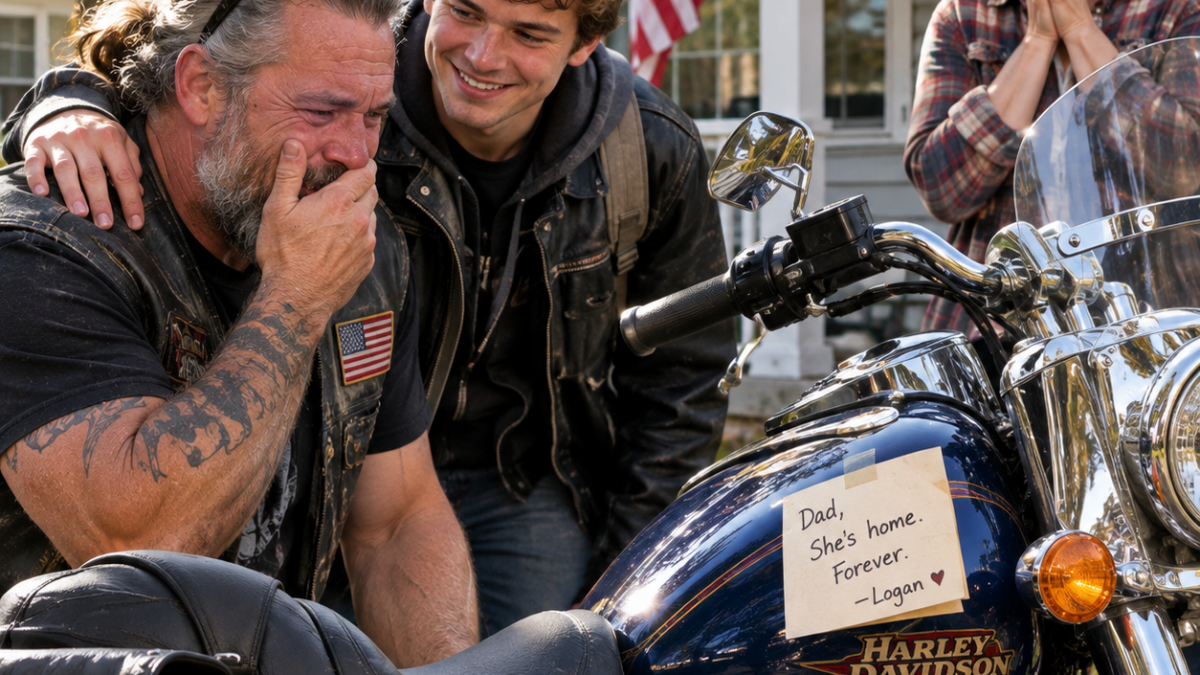
I Sold My Harley of 22 Years to Pay for My 13-Year-Old Son’s Spinal Surgery—Five Years Later, He Rode the Same Bike Back Into My Driveway.
I thought my thirteen-year-old son never learned that the Harley I had loved for twenty-two years disappeared because his spinal surgery cost more money than our family had.
For five years, I carried that secret like a quiet sacrifice, never realizing that my son had discovered the truth at fourteen and had been working two jobs in silence to undo what I had done for him.
Then, on an October afternoon, the unmistakable sound of my old Heritage Softail rolled down Maple Street, and the eighteen-year-old boy whose spine I had once been terrified of losing handed me the title and said, “It’s in my name now, Dad—so you can’t sell her again.”
My name is Daniel Voss.
I am fifty-six years old, and until October 11th, 2025, I thought I understood exactly what a father was supposed to do.
You work.
You pay the bills.
You keep the furnace running.
You make sure the truck starts in January.
You stand between your family and whatever comes through the door.
And when there is not enough money to save everything, you decide what can be lost.
That was the rule I had lived by most of my adult life.
Nobody taught it to me.
My father never sat me down at the kitchen table and explained sacrifice.
Men like him did not explain much of anything.
He worked at a machine shop outside Bay City for thirty-seven years, came home with metal dust in the seams of his hands, ate whatever my mother put in front of him, and fixed whatever broke.
When my sister needed braces, Dad sold his fishing boat.
When our furnace failed the week before Christmas, he worked sixteen-hour shifts until the replacement was paid for.
When my mother got sick, he stopped buying anything for himself that wasn’t absolutely necessary.
He never called those things sacrifices.
He called them Tuesday.
I suppose I became him without noticing.
The difference was that my one unnecessary thing had two wheels.
A 1998 Harley-Davidson Heritage Softail.
Cobalt blue.
Original engine.
Whitewall tires.
Chrome that could blind you if the afternoon sun hit it right.
I bought her new on May 11th, 1998, from a Harley dealer in Saginaw.
I was thirty years old.
Single.
Not particularly responsible.
I had been a journeyman electrician for less than a year, and the first truly decent money I ever earned disappeared into that motorcycle.
My mother said I was an idiot.
My father walked around the bike twice, rubbed his chin, and said, “You better ride the hell out of it.”
So I did.
I rode it north to Mackinaw City before the paint smell had fully disappeared.
I rode it through Wisconsin with three friends during the summer of 1999.
I rode it to Tennessee.
Ohio.
Indiana.
Kentucky.
Every corner of Michigan I could reach without sleeping in a ditch.
I rode it to my first date with Carrie.
PART2:
That almost ruined the relationship before it began.
She came outside her apartment wearing jeans and a blue sweater, looked at the bike, then looked at me.
“You expect me to get on that?”
“Yes.”
“No.”
I smiled.
“Then I guess dinner’s within walking distance.”
She stared at me for five seconds.
Then went upstairs, came back with a leather jacket, and said, “If I die, my mother will haunt you.”
Twenty-six years later, Carrie still tells people she married me despite the motorcycle.
I tell them she married me because of it.
The truth is probably somewhere in the middle.
We rode that Harley to our wedding reception after changing out of our formal clothes.
We rode it around Lake Huron on our fifth anniversary.
When Carrie became pregnant with Logan, she stopped riding.
I told myself that was temporary.
It wasn’t.
Parenthood has a way of quietly rearranging what matters.
The motorcycle stopped being our motorcycle and became mine again.
Saturday mornings.
PART3:
Sunday rides.
Brotherhood runs.
Charity events.
Long evenings when I needed wind instead of conversation.
I joined the Saginaw River Brotherhood Motorcycle Club when Logan was a toddler.
We were not an outlaw club.
Despite what people assume when they see leather vests and patches, most of our members were electricians, welders, retired firefighters, mechanics, factory workers and veterans.
We did toy drives.
Funeral escorts.
Fundraisers when somebody’s house burned.
We also drank too much coffee, argued about engines, and behaved as if riding in forty-degree rain proved something important about masculinity.
The Heritage became part of my identity in ways I never said aloud.
There were scratches on the right saddlebag from the time Logan, at four years old, tried to climb onto it with a plastic shovel in his hand.
A faint dent near the rear fender from a trip to Grand Rapids.
A tiny crack in the left leather strap where Carrie caught her boot getting off in 2003.
I knew every sound the engine made.
Every vibration.
Every flaw.
I could tell something was wrong before a mechanic could.
By 2020, I had owned that bike longer than I had known my wife.
Then my thirteen-year-old son stood shirtless in a doctor’s office, and everything changed.
Logan had always been tall and thin.
He shot upward around age eleven.
Carrie noticed first that one shoulder seemed higher than the other.
At first we blamed posture.
He played video games.
Carried a backpack that weighed more than some dogs.
Slouched like every middle-school boy I had ever met.
Then during a routine physical, his pediatrician asked him to bend forward.
I remember the room becoming quiet.
The doctor ran his fingers carefully along Logan’s back.
Then he looked at us.
“I want you to see orthopedics.”
We did.
The first measurement was twenty-two degrees.
Not good.
Not catastrophic.
The pediatric orthopedist called it adolescent idiopathic scoliosis.
Idiopathic is one of those medical words that sounds intelligent while meaning nobody knows why the hell it happened.
We monitored it.
Six months later it was thirty-one degrees.
Then forty.
Then fifty-two.
Logan wore a brace.
He hated it.
I hated making him wear it.
He would sit at the kitchen table doing homework with this hard plastic shell around his torso, irritated and embarrassed, while I told him it mattered.
“Dad, everybody can see it under my shirt.”
“They’ll survive.”
“I look weird.”
“You already looked weird.”
He glared at me.
Carrie said, “Daniel.”
I shrugged.
“What? He’s my son. Weird’s genetic.”
Logan tried not to laugh.
That was usually how we handled fear.
Make it smaller with a joke.
But by February of 2020, jokes stopped helping.
The curve had progressed to sixty-four degrees.
His ribs were beginning to rotate.
His left shoulder sat nearly three inches higher than his right.
His right lung was being crowded.
The doctor pulled up an X-ray at C.S. Mott Children’s Hospital in Ann Arbor.
I had seen plenty of construction drawings in my life.
Blueprints.
Wiring diagrams.
Industrial schematics.
My mind liked straight lines.
Logan’s spine looked like somebody had drawn an S down the center of his body.
The surgeon, Dr. Karen Patel, spoke carefully.
“Bracing isn’t controlling the progression anymore.”
Carrie squeezed my hand.
I asked, “What does that mean?”
“We recommend surgical correction.”
Logan stared at the X-ray.
“What kind?”
Dr. Patel turned toward him.
She was good that way.
She spoke to him, not around him.
“A posterior spinal fusion. Approximately T4 to L3.”
Logan had already read everything available online.
He was thirteen, which meant he knew enough to be terrified and enough to pretend he wasn’t.
“Rods and screws?”
“Yes.”
“How many?”
“Likely twenty or more fixation points.”
He nodded.
Carrie started crying quietly.
I didn’t.
Not yet.
I asked questions.
How long?
Eight to ten hours.
Risks?
Bleeding.
Infection.
Nerve injury.
Hardware failure.
Loss of mobility.
Rare risk of paralysis.
Hospital stay?
Several days if everything went well.
Recovery?
Months.
Contact sports?
Probably done.
Pain?
Significant at first.
Then I asked the question I was least prepared for.
“What happens if we wait?”
Dr. Patel looked at the X-ray.
“We don’t recommend waiting.”
That was enough.
The surgery was scheduled for August 14th, 2020.
Then came the financial counselor.
If you have never sat in a children’s hospital listening to someone discuss deductibles while your thirteen-year-old is trying not to imagine screws being placed into his spine, congratulations.
I hope you never do.
We had insurance.
People hear that and assume the problem is solved.
It wasn’t.
Between deductible limits, coinsurance, out-of-network components, imaging, anesthesia, rehabilitation, travel, equipment, medications, physical therapy, missed work and the bills that arrived months later wearing slightly different names, the number became ugly very quickly.
When everything finally stopped arriving near the end of 2020, our direct cost was roughly forty-seven thousand dollars.
At the beginning, we did not know the exact final number.
We knew enough.
More than we had.
I had eight thousand dollars in savings.
There was money in my 401(k), but I was fifty-one.
Every financial adviser on earth tells you not to crack retirement unless the building is actively on fire.
I had a pickup truck.
We needed it.
Carrie drove an older Equinox.
We needed that too.
We had equity in the house, but borrowing against it in the middle of a medical crisis didn’t feel smart.
Then there was the Heritage.
I avoided thinking about it for three weeks.
That is the embarrassing truth.
Not because I valued the motorcycle more than my son.
I didn’t.
There was no competition.
If selling both kidneys had been legal and useful, I would have asked which one they wanted first.
But human beings become attached to things because things hold memories better than we admit.
That bike contained twenty-two years of my life.
My father had touched it.
Carrie had ridden behind me on it.
Logan had fallen asleep against the gas tank when he was little while I sat on it with the engine off in our driveway.
There was a photo of him at age six wearing my helmet, which covered half his body.
Every summer of my adult life had that motorcycle somewhere inside it.
Selling it felt like removing a room from a house.
So I did what men are very good at doing.
Nothing.
I checked bank accounts.
I recalculated expenses.
I picked up overtime.
I stopped buying lunch at work.
Carrie canceled a weekend trip we had planned.
We pretended the numbers might become different if we stared at them long enough.
They didn’t.
Then one night in July, I found Logan awake in his room.
It was after midnight.
He was lying on his back because sleeping on his side had started hurting.
The brace was leaning against the desk.
His laptop was open.
I stood in the doorway.
“You okay?”
He closed the computer too fast.
“Yeah.”
“What are you looking at?”
“Nothing.”
“You’re thirteen. Nothing on the internet after midnight is usually bad.”
He rolled his eyes.
I walked closer.
The screen showed a video.
Spinal fusion recovery.
A teenage girl in a hospital bed.
She was crying while two nurses helped her stand.
Logan looked embarrassed that I had seen it.
“Just wanted to know.”
I sat on the edge of his bed.
“You don’t have to watch that stuff.”
“Why not?”
“Because you’ll scare yourself.”
“I already know it’s going to hurt.”
I had no answer.
He stared at the ceiling.
Then he asked, “What if I wake up and can’t move?”
I felt something inside my chest split.
“You will.”
“You don’t know that.”
“No.”
He turned toward me.
I wanted to lie.
I wanted to say doctors don’t make mistakes.
I wanted to say nothing bad would happen.
But thirteen-year-olds know when adults are lying about fear.
So I said, “You’re right.”
His eyes watered.
“I hate this.”
“I know.”
“I don’t want Mom to cry.”
“That’s impossible. She cries during dog-food commercials.”
That got half a smile.
Then he whispered, “What if it costs too much?”
I stared at him.
“What?”
“I heard you and Mom talking.”
Of course he had.
Children hear everything you think you hide.
“How much?”
“You don’t worry about that.”
“But—”
“Logan.”
He went quiet.
I leaned toward him.
“There is no number attached to whether you get what you need. Understand?”
He nodded.
“No matter what it costs?”
“No matter what.”
“What if you have to sell stuff?”
I remember the exact way he asked it.
Casual.
Too casual.
I wondered later whether he had already thought about the motorcycle.
I said, “Stuff is stuff.”
He looked at me.
“Even the Harley?”
My throat tightened.
I smiled.
“That old thing?”
His expression changed.
He knew me too well.
“Dad.”
I reached over and tapped his forehead.
“Go to sleep.”
He caught my wrist.
“You wouldn’t sell it, would you?”
I looked at my son.
Thirteen.
Scared.
Trying to determine whether his body was about to cost his father something irreplaceable.
And I knew immediately what I had to do.
Not sell the motorcycle.
That decision had already been made in my head.
I knew I had to make sure he never believed the sale was because of him.
So I lied.
“No.”
He studied my face.
“You promise?”
That word bothered me.
I should not have answered it.
I did.
“I promise.”
He let go of my wrist.
“Okay.”
Three days later, I listed the Harley.
I did not put it on Facebook Marketplace because too many people knew me.
I used a regional motorcycle forum and an old classified site.
The ad was simple.
1998 Heritage Softail.
One owner.
Original motor.
Well maintained.
Forty-eight thousand miles.
Cobalt blue.
Twelve thousand dollars.
Serious buyers only.
I stared at the post for almost twenty minutes before clicking submit.
Carrie found me in the garage afterward.
I was standing beside the bike.
She knew.
Wives know things before you say them.
“No,” she said.
I kept polishing a spot on the tank that was already clean.
“Daniel.”
“We need the money.”
“We’ll figure something else out.”
“This is figuring something else out.”
“You love that bike.”
“I love Logan.”
“That doesn’t mean—”
“I know.”
She came closer.
“We can borrow.”
“I don’t want the house under more debt.”
“Take from retirement.”
“I’ll be sixty someday.”
“You might also regret this someday.”
I stopped polishing.
“Carrie.”
She went silent.
“If a piece of metal can help pay for his spine, then it goes.”
Her eyes filled.
“You don’t have to act like it doesn’t hurt.”
“I didn’t say it doesn’t.”
That was the closest I came to admitting it.
A man named Brian Lazenby contacted me two days later.
Fifty-eight.
Retired auto worker.
Lived in Flint.
He asked intelligent questions.
Not whether the pipes were loud enough.
Not whether I would take nine thousand cash that afternoon.
He asked about oil changes.
Service records.
Wheel bearings.
Cam chain tensioners.
He knew the bike.
That mattered more to me than it should have.
He drove to Bay City on July 22nd.
Silver Chevy pickup.
Michigan State University cap.
Wedding ring.
He walked around the Heritage slowly.
I watched him inspect it.
“This yours from new?”
“Yes.”
“Twenty-two years?”
“Yes.”
“Why sell?”
That was the question.
I had prepared an answer.
Don’t ride enough.
Need garage space.
Thinking about something newer.
All reasonable lies.
Instead I said, “My boy needs surgery.”
Brian stopped.
He looked at me.
“What kind?”
“Spine.”
He glanced at the bike again.
Then at me.
“How old?”
“Thirteen.”
Brian stood very still.
“I got two grandkids.”
I nodded.
He didn’t haggle.
That mattered too.
He opened the tailgate of his truck, pulled out a small lockbox, and counted twelve thousand dollars in hundred-dollar bills on my workbench.
I signed the title.
My hand shook slightly.
Brian noticed.
“You sure?”
“No.”
He waited.
I looked at the Heritage.
Then toward the house.
Logan was inside playing Xbox with headphones on.
“Yes.”
Brian folded the title.
“I’ll take care of her.”
People say things like that when buying vehicles.
Usually they’re meaningless.
Coming from him, it helped.
We rolled the bike out.
Brian started it.
The engine sounded exactly right.
That hurt more than if something had been wrong.
He rode away at 4:36 in the afternoon.
I remember the time because I stood in the driveway until the sound disappeared.
Carrie came outside.
She didn’t say anything.
She just put her arms around me.
I let her.
That evening Logan came into the garage.
He looked around.
“Where’s the Harley?”
My stomach dropped.
I had not prepared the lie properly.
“A friend’s.”
“Why?”
“Storing it.”
“Why?”
“We need room.”
“For what?”
“Wheelchair. Recovery equipment. Whatever they send home after surgery.”
He accepted that faster than I expected.
“Oh.”
Then he looked at the empty space.
“Which friend?”
“Mike.”
Mike was in the Brotherhood.
He owned a pole barn.
Plausible.
I hated myself.
“Can I see it sometime?”
“Sure.”
Another lie.
Logan nodded and walked back inside.
The next morning I deposited twelve thousand dollars toward the hospital balance.
I kept the receipt.
Not intentionally.
It simply ended up in a folder with the medical paperwork.
That folder later became important.
On August 14th, 2020, we arrived at C.S. Mott before sunrise.
COVID restrictions made everything worse.
Masks.
Temperature checks.
Limited visitors.
Half-empty hallways.
Everybody afraid of an invisible disease while we were already carrying our own very visible fear.
Logan wore gray sweatpants and a Michigan Wolverines T-shirt.
He hated needles.
He pretended he didn’t.
When the nurse placed the IV, he looked away.
I held his left hand.
Carrie held his right.
Dr. Patel came in and marked his back.
The anesthesiologist explained everything again.
Eight to ten hours.
Maybe longer.
Neuromonitoring throughout.
They would watch spinal cord signals during correction.
The words sounded technical and reassuring until I understood what they were monitoring for.
Then it was time.
A nurse said, “Mom and Dad, this is where we say goodbye for now.”
Carrie kissed Logan’s forehead.
“I love you.”
“I love you too.”
I tried to say something useful.
Nothing came.
Logan looked at me.
“Dad.”
“Yeah?”
“You okay?”
That was my son.
About to have his spine opened, worried about me.
I smiled.
“I’m fantastic.”
“Liar.”
“Runs in the family.”
He held my hand tighter.
Then they rolled him away.
The doors closed.
Carrie folded into me.
I kept standing because one of us had to.
Those ten hours were the longest of my life.
We received updates.
Incision started.
Instrumentation progressing.
Correction underway.
Neuromonitoring stable.
Every update bought another hour of breathing.
Around hour seven, Carrie said, “You should eat.”
“I can’t.”
“You’ll pass out.”
“Then I’ll eat lying down.”
She did not laugh.
At hour nine, Dr. Patel came out.
She removed her surgical cap.
That movement frightened me.
I stood too fast.
“How is he?”
“He did very well.”
Carrie made a sound I had never heard from her.
Half sob.
Half laugh.
I gripped the back of a chair.
“The fusion is complete. Neurologic monitoring remained stable throughout. We corrected the primary curve to approximately eleven degrees.”
“Eleven?”
“Yes.”
“From sixty-four?”
She smiled.
“Yes.”
I sat down because my legs had stopped working.
“He’s okay?”
“He’s in recovery.”
“He can move?”
“All signals look good.”
Carrie hugged the surgeon.
I almost did too.
The first night was brutal.
There is no beautiful way to describe major spinal surgery.
Logan hurt.
Badly.
He vomited from medication.
His blood pressure dropped when they first tried to sit him up.
He cursed at me for encouraging him to stand.
I had never been happier to hear my child swear.
The physical therapist said, “Let’s get your feet underneath you.”
Logan said, “I hate you.”
She smiled.
“I hear that a lot.”
He stood.
Two nurses supported him.
I stood behind the wheelchair.
He looked taller already.
That sounds impossible.
It wasn’t.
The curve had compressed his body.
Correction gave him height back immediately.
But he looked fragile.
White face.
Trembling legs.
Hospital gown hanging from his shoulders.
A line of dressing running down his back.
I wanted to pick him up.
Carry him home.
Carry him backward thirteen years.
Instead I stood five feet away and said, “One more step.”
He glared at me.
“I’ll kill you.”
“After you walk.”
He took another step.
Carrie cried.
He took another.
By the fourth day, he walked the hallway.
By the fifth, we went home.
There was no wheelchair after all.
That made my garage lie even more ridiculous.
Recovery took months.
At first Logan needed help getting out of bed.
He couldn’t bend.
Couldn’t twist.
Couldn’t lift much.
I installed a temporary rail beside the downstairs toilet.
Moved a recliner into his bedroom.
Put everything he regularly used at waist height.
He hated needing us.
One morning he dropped his phone beside the couch.
He stared at it.
He could not bend far enough to pick it up.
I reached for it.
He snapped, “I can do it.”
I stopped.
He tried.
Couldn’t.
His face tightened.
I watched my thirteen-year-old fight tears over a phone lying on carpet.
That was when I understood recovery was not mainly about pain.
It was about dignity.
I backed away.
“Kitchen grabber’s behind you.”
He looked.
We had bought one of those long plastic reach tools.
He used it.
Picked up the phone.
“Got it.”
“Yep.”
He smiled.
Small victory.
There were hundreds.
First shower alone.
First full night of sleep.
First walk around the block.
First day back in class online.
First time wearing a normal shirt without worrying about how crooked his shoulders looked.
By the following summer, he had grown more than two inches.
He stood straight.
Not rigid.
Straight.
I caught myself staring at him sometimes.
He noticed once.
“What?”
“Nothing.”
“Why are you looking at me?”
“You’re tall.”
“You’re weird.”
“You’re welcome.”
He laughed.
We did not discuss the Harley.
Not once.
I assumed the lie had worked.
I assumed he had accepted that it lived in Mike’s garage.
Eventually enough time passed that asking about it would have been awkward.
Then more time passed.
Life filled the gap.
That is how secrets survive.
Not because everybody believes them.
Because ordinary days pile on top.
Logan turned fourteen.
Then fifteen.
He got his learner’s permit.
He learned to drive Carrie’s Equinox.
Then my truck.
He was a cautious driver, which I found deeply suspicious because he was my son.
At sixteen, he bought an old Ford Focus from a guy at work.
Dark gray.
One mismatched wheel.
Air conditioner that worked only when negotiating with God.
I helped him replace the alternator.
He paid for the part himself.
“Keep your money,” I told him.
“No.”
“You’re sixteen.”
“It’s my car.”
“I know.”
“My bill.”
That should have told me something.
At sixteen he started working at Tractor Supply.
Weekends and two evenings.
Later he added shifts at Nick’s Auto Parts.
I objected.
“Two jobs plus school is stupid.”
“I like money.”
“You’ll like graduating more.”
“My grades are good.”
They were.
“Save for college.”
“I am.”
Another lie.
Or half lie.
The most effective kind.
Carrie and I thought he was building savings.
And technically, he was.
We just didn’t know what for.
I did not learn until much later that sometime around age fourteen, Logan discovered the truth.
There had been a Facebook photograph.
One of my brother Eric’s old posts.
A 2019 Brotherhood ride.
I was sitting on the Heritage.
The caption included the words:
LAST SUMMER WITH THE OLD GIRL BEFORE DAN GETS TOO OLD TO KICK HER OVER.
Eric thought he was being funny.
Logan apparently noticed something else.
Last summer.
The photo was dated 2019.
The Harley disappeared in July 2020.
He started searching.
He found messages in my old email that I had forgotten existed.
Not the sale itself.
Enough pieces.
Then one day, looking for his hospital documents because he needed a medical record for school sports clearance, he found the folder.
Inside was the receipt.
July 23rd, 2020.
$12,000 payment.
And tucked behind it, because apparently I am an idiot, was a photocopy of the signed Harley title.
Buyer:
Brian Lazenby.
Flint, Michigan.
Logan was fourteen.
He told no one.
Not me.
Not Carrie.
Not his friends.
He made a decision.
That part I still have trouble understanding.
At fourteen years old, while most kids were trying to get around parental controls on their phones, my son decided he was going to find my motorcycle.
He searched Brian’s name.
Found a motorcycle forum.
Found an old post discussing the Heritage.
Found property records.
Found an address.
Then he waited.
Because at fourteen, he couldn’t drive.
At fifteen, he still didn’t have enough independence.
In August of 2023, barely sixteen, he drove the Ford Focus to Flint alone.
He told us he was working.
Technically, he did work that morning.
Until noon.
Then he drove south.
Brian later told me about the first visit.
I wish I could have seen it.
A skinny sixteen-year-old boy knocking on the door of a retired auto worker he had never met.
Brian opened it.
Logan said, “Did you buy a blue 1998 Heritage Softail from Daniel Voss?”
Brian apparently looked at him for a long time.
“You his kid?”
“Yes.”
“Thought so.”
Logan asked, “Do you still have it?”
Brian led him to the garage.
There she was.
Same cobalt paint.
Same saddlebags.
Same small dent.
Brian had changed the tires.
Added nothing.
Removed nothing.
He had kept her exactly the way he said he would.
Logan walked around the bike.
Then he asked the question that would eventually bring all of us back together.
“Would you sell it to me?”
Brian laughed.
Not cruelly.
He thought the kid was joking.
“You got twelve grand?”
“No.”
“Then probably not.”
“How much?”
Brian looked at him.
“You serious?”
“Yes.”
“Why?”
Logan told him.
All of it.
The surgery.
The lie.
The receipt.
What the bike meant to me.
What I had done.
Brian stopped smiling.
“He sold it for you.”
“I know.”
“He didn’t want you knowing.”
“I know.”
“You think buying it back fixes something?”
Logan apparently said, “No.”
Brian waited.
“Then why?”
“Because he shouldn’t have had to lose it.”
Brian told me later that was the moment he knew he was in trouble.
The Harley was worth more by then.
Vintage models had climbed.
He had maintained it carefully.
He could have sold it for sixteen or seventeen thousand depending on the buyer.
Instead he told Logan, “Fourteen.”
Logan did not negotiate.
He asked, “Will you wait?”
“How long?”
“I don’t know.”
Brian should have said no.
He told me that himself.
“You don’t hold a motorcycle for some kid with no deposit and no timeline.”
But he did.
He made Logan a deal.
Fourteen thousand dollars.
No interest.
No price increase.
No guarantee forever, but he would not actively list it.
Logan went home.
Then he worked.
Two years.
Tractor Supply.
Nick’s Auto Parts.
Summer overtime.
Inventory shifts.
Holiday weekends.
He skipped spring break trips.
Did not buy the gaming computer he wanted.
Kept his old phone.
Packed lunches.
He made a spreadsheet.
HERITAGE FUND — DO NOT TELL DAD.
The title makes me laugh now.
The numbers don’t.
Every paycheck.
Every deposit.
Every remaining balance.
He had a prepaid phone I did not know existed.
Not drugs.
Not girls.
Not some secret teenage life.
A forty-dollar prepaid Android phone kept in his school locker because he thought I might see the search history or spreadsheet if he used the family accounts.
My son ran an undercover motorcycle acquisition operation beneath my nose for two years.
I was completely oblivious.
In September 2025, he had fourteen thousand dollars.
He called Brian.
“I have it.”
Brian said, “Come Saturday.”
Logan drove to Flint.
Counted the money at the same workbench where, five years earlier, Brian had counted twelve thousand for me.
Brian signed over the Heritage.
But Logan couldn’t legally and safely ride it home yet.
He had obtained his motorcycle endorsement earlier that year without telling me the real reason.
I thought he wanted a sport bike someday.
I gave him a lecture about idiots on motorcycles.
The irony is painful.
He arranged transport back to Saginaw.
Had a shop inspect it.
Oil.
Fluids.
Battery.
Brakes.
Everything.
On Friday, October 10th, one of the Brotherhood members named Mike helped him practice in an empty parking lot.
Yes.
The same Mike whose garage I had falsely claimed housed the motorcycle.
Apparently the universe enjoys symmetry.
Mike knew for three months.
He said nothing.
I have threatened him repeatedly since.
He claims the Brotherhood takes confidentiality seriously.
At 2:47 p.m. on Saturday, October 11th, Carrie and I were sitting on our front porch.
It was cool.
One of those Michigan October days where autumn looks perfect for about fifteen minutes before winter starts threatening everybody.
Carrie had coffee.
I was pretending to drink coffee while actually scrolling through electrical supply prices on my phone.
Then I heard a motorcycle.
Not unusual.
Maple Street wasn’t busy, but riders passed occasionally.
I barely looked up.
Then the exhaust note changed as the motorcycle slowed.
Something in my body recognized it before my brain did.
Twenty-two years teaches you a sound.
I put my phone down.
Carrie looked at me.
“What?”
I stood.
The bike turned onto Maple Street.
Cobalt blue.
Whitewalls.
Chrome windshield trim.
Leather saddlebags.
My lungs stopped working.
“No.”
Carrie stood beside me.
“What?”
The motorcycle came closer.
I knew the dent.
You cannot mistake a scar you made yourself.
I stepped off the porch.
“Daniel?”
I couldn’t answer.
The rider wore a black helmet.
Jeans.
Brown boots.
Dark jacket.
He slowed in front of our house.
Turned into the driveway.
The Heritage rolled toward me.
For half a second, I thought Brian had come.
Maybe he had found me.
Maybe he wanted to sell it back.
Then the rider killed the engine.
Silence.
He removed the helmet.
Logan.
I stared at my son.
He grinned nervously.
“Hey, Dad.”
I said nothing.
Carrie whispered, “Oh my God.”
I walked toward him.
Slowly.
My legs felt unreliable.
“What…”
That was all I managed.
Logan swung one leg off the bike.
He was eighteen.
Five-foot-eleven.
Straight shoulders.
Long scar running down his back beneath the jacket where twenty screws and two rods had once rebuilt the architecture of his body.
He stood beside the motorcycle.
My motorcycle.
No.
Not mine.
Not anymore.
I touched the gas tank.
Cold metal.
Cobalt paint.
My hand remembered the shape.
“Where did you get this?”
Logan swallowed.
“Flint.”
I looked at him.
“Brian?”
His smile disappeared.
“You remember his name.”
Of course I remembered.
Some names become attached to things you lose.
“Logan.”
He reached toward the gas tank.
There was a folded white index card taped near the console.
I hadn’t noticed it.
He removed it and handed it to me.
My hands were shaking.
On the outside, in Logan’s careful block handwriting:
DAD — READ BEFORE YOU YELL.
I laughed once.
It sounded broken.
I unfolded it.
There were only a few lines.
You sold this bike because I needed you more than you needed it.
I know now.
I also know you lied because you didn’t want me to spend the rest of my life believing my back cost you something you loved.
You were right about one thing.
Stuff is stuff.
But sometimes stuff carries people inside it.
Grandpa is in this bike.
Mom is in this bike.
You are in this bike.
And part of my childhood is in this bike too.
So I bought our memories back.
I stopped reading.
Carrie was crying.
Logan watched me.
I looked down again.
One final line.
P.S. Title is in my name.
So you can’t sell her again.
I laughed.
Then I cried.
I do not mean one dignified tear.
I mean I folded.
Right there in the driveway.
Fifty-six years old.
Electrician.
Motorcycle club member.
A man who had spent his adult life believing emotions should be handled privately and efficiently.
I sat on the edge of our front step and covered my face.
Carrie put one hand on my shoulder.
Logan stood there looking terrified.
“Dad?”
I couldn’t answer.
“Are you mad?”
I looked up.
“Mad?”
“I didn’t tell you.”
“You…”
My voice disappeared.
I tried again.
“You bought my bike.”
He corrected me.
“My bike.”
That broke something else.
I started laughing through tears.
“You little son of a—”
“Daniel,” Carrie said.
“He’s right.”
Logan smiled.
“You always said titles matter.”
I pointed at him.
“I’ll kill you.”
“No bending, lifting or twisting.”
He still used the surgeon’s recovery rules against me five years later.
Carrie laughed.
I stood and hugged him.
Hard.
He hugged me back.
I could feel the line of his spine beneath the jacket.
Straight.
Strong.
Alive.
That was when I understood something that should have been obvious.
The motorcycle had never been the thing I was crying about.
I was crying because the thirteen-year-old boy I had tried to protect from knowing the cost of his survival had grown into a man who understood exactly what it had cost.
And instead of carrying guilt, he had carried gratitude.
That mattered more.
We sat on the porch.
The Heritage stood in the driveway.
I kept looking at it like it might disappear.
At 3:14 p.m., Logan finally told me everything.
The Facebook post.
The hospital receipt.
The title copy.
Finding Brian.
Driving to Flint.
The deal.
The jobs.
The prepaid phone.
The spreadsheet.
When he mentioned the spreadsheet, I interrupted.
“You had a secret phone?”
“Yes.”
“In your locker?”
“Yes.”
“For two years?”
“Mostly.”
I stared at Carrie.
She stared at me.
“We raised a criminal.”
Logan rolled his eyes.
“I was saving money.”
“You were conducting surveillance.”
“Public records aren’t surveillance.”
“Listen to him. He’s eighteen and suddenly an attorney.”
Carrie asked the question I had not yet managed.
“Fourteen thousand dollars?”
Logan nodded.
“You saved fourteen thousand dollars?”
“Yes.”
“In two years?”
“Two jobs.”
“What about college?”
“I have grants.”
“What about gas? Food?”
“I paid stuff.”
“How much do you have left?”
He looked away.
That was the first answer I disliked.
“Logan.”
“Enough.”
“How much?”
“Like seven hundred.”
I stood.
“No.”
He frowned.
“What?”
“No.”
“Dad—”
“You gave almost everything you have for a motorcycle?”
He stared at me.
The irony hit both of us simultaneously.
Carrie whispered, “Oh boy.”
Logan folded his arms.
“You sold it.”
“For your spine!”
“I bought it for you!”
“I didn’t need it.”
“Neither did I!”
“Exactly!”
We stood facing each other.
Both angry.
Both saying the same thing from opposite directions.
Carrie sighed.
“This family is exhausting.”
I pointed toward the Heritage.
“You are selling it back to Brian.”
“No.”
“Logan.”
“Title’s in my name.”
I hated that line.
He knew it.
He smiled slightly.
“So you can’t sell her again.”
“This isn’t funny.”
“No.”
His expression became serious.
“It isn’t.”
That stopped me.
He sat on the porch step.
For a moment he looked thirteen again.
“Dad, do you know what I thought when I found the receipt?”
I did not answer.
“I thought I had taken it from you.”
My anger vanished.
“Logan.”
“I know that’s not what you meant.”
He stared at his hands.
“But I remembered asking you if you’d sell it.”
My chest tightened.
“I remember.”
“You promised you wouldn’t.”
“I know.”
“You lied.”
“Yes.”
He nodded.
“I was mad for maybe ten minutes.”
“You had every right.”
“Then I figured out why.”
He looked at me.
“You didn’t lie because you cared about the motorcycle. You lied because you knew me.”
I sat beside him.
“What do you mean?”
“If you had told thirteen-year-old me, ‘Hey, we’re selling Dad’s favorite thing because your spine is expensive,’ I would have spent every bad day after surgery thinking about it.”
He smiled sadly.
“And there were a lot of bad days.”
I remembered.
The hospital.
The grabber tool.
The pain.
The anger.
“You kept that away from me.”
He looked toward the motorcycle.
“So yeah, I wanted it back.”
“That’s not your responsibility.”
“I know.”
“Do you?”
“Yes.”
“Then why work yourself half to death?”
“I didn’t.”
“Two jobs.”
“People work two jobs.”
“You’re in school.”
“My grades are good.”
“That isn’t the point.”
“What is the point?”
I struggled.
Then found it.
“I did not sell that motorcycle so you could spend two years buying it back.”
Logan looked at me.
“I know.”
“Then why?”
He thought.
“Because I wanted to.”
Simple.
No guilt.
No debt.
No tragedy.
Choice.
That made it harder to argue.
He continued.
“You always acted like the bike didn’t matter.”
“It mattered.”
“I know.”
“Not as much as you.”
“I know that too.”
He leaned his elbows on his knees.
“You know what Brian told me?”
“What?”
“He said you watched him ride away until he turned the corner.”
I looked down.
Damn Brian.
Logan continued.
“He said you had your hands in your pockets because they were shaking.”
I said nothing.
“He said he almost turned around.”
That surprised me.
“What?”
“He said he got two blocks away and thought about bringing it back.”
“Why didn’t he?”
“He figured you’d just sell it to somebody else.”
He was right.
Logan smiled.
“Smart guy.”
“Annoyingly.”
“Then he said something else.”
“What?”
“He said he’d owned a lot of motorcycles.”
Logan looked at the Heritage.
“But that one never felt completely like his.”
That hit me.
“Why?”
“He said every scratch had somebody else’s story.”
We sat quietly.
Carrie went inside.
I think she understood this part belonged to us.
After a while I asked, “Can I ride it?”
Logan looked horrified.
“No.”
I stared at him.
He held the expression for two seconds.
Then laughed.
“Your face.”
“You’re walking to college.”
He tossed me the key.
My hand closed around it.
Same shape.
Different key ring.
I stood.
The bike waited.
Twenty-seven years after I first bought it.
Five years after I sold it.
I swung my leg over.
The seat felt familiar.
Lower than newer bikes.
Wide handlebars.
Old grips.
I placed both hands on them.
The garage.
My father.
Carrie at twenty-eight.
Logan at four.
All of it rushed back.
I turned the key.
Hit the starter.
The engine came alive.
The sound traveled through the frame into my hands.
I closed my eyes.
For one second, I was thirty again.
Then forty.
Then fifty-one.
Then fifty-six.
Every version of me somehow sitting in the same seat.
Logan stood beside the bike.
“How’s she sound?”
I opened my eyes.
“Valve train’s a little noisy.”
He looked offended.
“Brian had it serviced.”
“I’ve known this engine longer than you’ve been alive.”
“It’s normal.”
“It’s not.”
“Old man.”
“Child.”
I shut the engine down.
Then I did something important.
I handed the key back.
Logan frowned.
“Keep it.”
“It’s yours.”
“I bought it for you.”
“No.”
“Dad.”
“No.”
He looked frustrated.
I touched the tank.
“You were right.”
“About?”
“The title.”
He waited.
“You own it.”
His expression changed.
“I don’t want it.”
“Yes, you do.”
“I bought it so you could—”
“Ride it?”
“Yes.”
“I will.”
He stared at me.
“But I’m borrowing it.”
“That’s stupid.”
“Maybe.”
“It’s literally your bike.”
“No.”
I pointed at him.
“It became yours the moment you spent two years earning it.”
He tried to interrupt.
I stopped him.
“And I am not taking fourteen thousand dollars from my eighteen-year-old kid.”
“You’re not taking money.”
“Same thing.”
He looked angry again.
Then I smiled.
“Besides, I hear the owner might let me ride it.”
Logan shook his head.
“You’re impossible.”
“Genetic.”
We compromised.
The motorcycle stayed titled to Logan.
It lived in my garage.
I paid insurance and maintenance.
We both rode it.
Only after he completed a real motorcycle safety course.
Not one afternoon behind Tractor Supply.
When I learned that part, I nearly had a coronary.
“You learned to ride yesterday?”
“I practiced before.”
“With what?”
“Mike’s Sportster.”
I called Mike.
He answered laughing.
“I knew this call was coming.”
“You put my surgically repaired child on a Sportster?”
“He’s eighteen.”
“He has metal rods in his spine.”
“So do half the guys at the club.”
“You’re dead.”
“Bike look good?”
I hung up.
The next Brotherhood meeting was worse.
Everybody knew.
Apparently everybody except me had known at least some piece of Logan’s plan.
Ray knew about the fund.
Mike knew about the practice.
My brother Eric had helped Logan locate old service records.
Carrie learned only three days before the reveal and somehow kept quiet.
I entered the clubhouse and twenty grown men started applauding.
I stopped at the door.
“I hate every one of you.”
Mike raised a beer.
“Welcome back, Heritage.”
Another man shouted, “Kid owns it!”
Laughter exploded.
I pointed at Logan.
“This is what happens when children aren’t disciplined.”
Logan stood beside me wearing a new riding jacket.
One of the Brotherhood members handed him a small package.
Inside was a patch.
Not club colors.
He hadn’t earned those and did not want them.
Just a rectangular patch.
HERITAGE KEEPER.
Logan read it.
His face went red.
“Seriously?”
Mike said, “Your dad was temporary management.”
I flipped him off.
Everybody laughed.
Then Brian walked in.
That was Logan’s last surprise.
I hadn’t seen him in five years.
Same MSU cap.
More gray in his beard.
He walked toward me.
“Daniel.”
“Brian.”
We shook hands.
Then hugged.
Men my age often pretend handshakes are enough.
Sometimes they’re not.
“You kept her good.”
“I told you I would.”
“Why’d you sell?”
He glanced at Logan.
“Persistent little bastard.”
“I’ve noticed.”
Brian smiled.
“Truth?”
“Yeah.”
“My knees are going.”
He tapped his left leg.
“Doctor says I shouldn’t be wrestling a Heritage much longer.”
“So the timing worked.”
“Maybe.”
Then he became serious.
“Your boy came to my house with two hundred eighty dollars.”
I looked at Logan.
“What?”
Logan stared at the floor.
Brian continued.
“First time he came.”
“You told me you had nothing.”
“I didn’t say nothing.”
“Two hundred eighty dollars is nothing for a fourteen-thousand-dollar bike!”
Logan sighed.
Brian laughed.
“He tried to give it to me as a deposit.”
“Did you take it?”
“No.”
“Good.”
“I told him to come back when he had a real plan.”
Logan said, “I had a plan.”
Brian looked at me.
“He had a spreadsheet.”
“Of course he did.”
Brian took a drink.
“He came back three months later with fourteen hundred.”
I turned toward Logan.
“You drove to Flint again?”
“Yes.”
“How many times did you go there?”
Logan became suspiciously quiet.
“Logan.”
Brian counted on his fingers.
“Eight?”
“Brian.”
“Nine?”
“You’re not helping.”
“Maybe ten.”
I stared at my son.
“I sent you location texts.”
“You lied about the locations!”
“No. I texted where I was.”
“After you got there!”
“Technically accurate.”
I rubbed my face.
“You’re going to give me a stroke.”
Brian put a hand on my shoulder.
“He’s a good kid.”
“I know.”
“He never asked me to lower the price.”
“That was stupid.”
Logan protested.
“You taught me not to agree on a price and then whine about it.”
“Not when you’re buying my motorcycle!”
Brian laughed.
“He also washed my truck twice.”
I looked at Logan.
“Why?”
“Brian wouldn’t take interest.”
“So?”
“I felt bad.”
Brian’s expression softened.
“I kept offering him money for the washing.”
“He wouldn’t take it,” Logan said.
Of course.
Two stubborn people had apparently spent two years trying to avoid owing each other anything.
I understood both of them too well.
Later that night, after most people left, Brian and I sat outside the clubhouse.
The Heritage was parked under a light.
“You really thought about bringing it back?” I asked.
He nodded.
“First day.”
“Why?”
“You looked like somebody had died.”
I stared at the motorcycle.
“Felt stupid afterward.”
“Why?”
“Because Logan was alive.”
Brian nodded.
“Doesn’t mean something else can’t hurt.”
I looked at him.
“Carrie told me that.”
“Smart woman.”
“She married me.”
“Everybody makes mistakes.”
I smiled.
Brian became quiet.
“You know the kid didn’t buy that thing because he felt guilty.”
“That what he told you?”
“Not exactly.”
“What did he say?”
Brian stared toward the bike.
“About a year into saving, I asked him whether he was trying to repay you.”
I waited.
“He got mad.”
That sounded like Logan.
“He said, ‘You don’t repay your dad for being your dad.’”
My chest tightened.
“What else?”
Brian smiled.
“He said he wanted you to have something back that proved the worst year of your life didn’t get to keep everything it took.”
I looked away.
The parking lot blurred.
Brian pretended not to notice.
“That kid’s smarter than us.”
“Low bar.”
“True.”
I thought about 2020.
COVID.
Hospitals.
Bills.
Surgery.
Pain.
The empty garage.
Fear.
He was right.
I had always remembered that year by what it took.
Logan’s normal childhood.
Carrie’s sleep.
Our savings.
My motorcycle.
Maybe Logan remembered it differently.
It gave him a straight spine.
A future without worsening deformity.
A father willing to sell something.
A stranger willing to preserve it.
A reason to work.
Maybe that was the strange thing about loss.
The same event can become different stories depending on who carries it.
The first real ride Logan and I took together happened two weeks later.
Late October.
Cold enough that any sensible person would have stayed home.
We rode north along the bay.
Logan rode the Heritage.
I borrowed Mike’s Road King.
I hated that arrangement.
Mostly because Logan looked too good on my—his—bike.
At a gas station near Pinconning, we stopped.
He removed his helmet.
His cheeks were red from the cold.
“How’s your back?”
“Fine.”
“Any pain?”
“No.”
“Numbness?”
“No.”
“Tingling?”
“Dad.”
“What?”
“Stop.”
I nodded.
Then thirty seconds later asked, “Shoulders okay?”
He stared at me.
I laughed.
“Sorry.”
We bought coffee.
Sat outside on a bench.
Logan looked at the motorcycles.
“You miss riding?”
“Yes.”
“Why didn’t you buy another one?”
I thought about it.
“Money.”
“After money wasn’t the problem.”
He knew.
I shrugged.
“Didn’t feel right.”
“Why?”
“I don’t know.”
But I did.
Because buying another motorcycle would have admitted the Heritage was really gone.
And maybe some part of me wanted the empty space to remain.
A private monument.
Evidence that I had done what fathers do.
That sounds noble.
It wasn’t entirely.
Sacrifice can become pride if you’re not careful.
You start loving the story of what you gave up.
I realized that sitting beside my son.
“You know something ugly?” I said.
He looked at me.
“What?”
“I think I liked being the guy who sold his bike for his kid.”
Logan frowned.
“You didn’t tell anybody.”
“I knew.”
“What does that mean?”
“I knew what I gave up.”
He waited.
“Maybe sometimes that made me feel like I had done enough.”
His expression softened.
“Enough what?”
“Parenting.”
He laughed.
“Unfortunately, no.”
“Yeah.”
We drank coffee.
I looked at his straight shoulders.
“You don’t owe me anything.”
“I know.”
“I’m serious.”
“I know.”
“College. Money. Motorcycle. None of it.”
“Dad.”
“What?”
“I know.”
Then he said something I have remembered ever since.
“But not owing you doesn’t mean I can’t give you something.”
I looked at him.
“Those aren’t the same thing.”
Eighteen years old.
Teaching me.
Annoying.
Correct.
We rode another sixty miles.
When we got home, Carrie was waiting in the driveway.
“Both alive?”
I removed my helmet.
“Barely.”
She looked at Logan.
“He drive too fast?”
“No.”
I said, “Too slow.”
Logan said, “He complained the whole time.”
Carrie smiled.
“Sounds normal.”
Normal.
That word mattered.
Five years earlier, I would have traded anything for normal.
We had it now.
Not the old normal.
A new version.
Scars included.
In December, Logan gave me another gift.
Smaller.
Cheaper.
In some ways harder to accept.
A framed photograph.
May 11th, 1998.
Me at thirty years old.
Standing beside a brand-new cobalt Heritage Softail outside the dealership.
My father beside me.
He had died in 2012.
I had forgotten the photograph existed.
On the back, Logan had written:
FIRST OWNER.
THEN BRIAN.
NOW ME.
BUT ALWAYS OURS.
I put it in the garage.
Above the motorcycle.
A month later, I added something beside it.
The hospital receipt.
Twelve thousand dollars.
July 23rd, 2020.
Logan noticed.
“That’s weird.”
“Why?”
“People don’t frame medical bills.”
“I’m starting a trend.”
He looked at the receipt.
Then the motorcycle.
“Why put it there?”
I thought about it.
“Because I used to think that receipt represented what the bike cost me.”
“And now?”
“It shows what the bike bought.”
Logan was quiet.
Not the surgery itself.
Twelve thousand didn’t buy the whole surgery.
But it helped buy time.
Correction.
Recovery.
A future.
More importantly, it became part of a chain.
The motorcycle paid toward the surgery.
The surgery changed Logan’s life.
Logan’s life led him back to the motorcycle.
Not debt.
Not repayment.
A circle.
In February of 2026, six years after his diagnosis, Logan had his annual follow-up.
He did not need me there.
He was eighteen.
Adult.
He invited me anyway.
Carrie came too.
Dr. Patel pulled up his X-rays.
The hardware looked almost unreal.
Two long rods.
Rows of screws.
A spine straight enough that I still had trouble reconciling it with the image from 2020.
“Everything looks excellent,” she said.
“Fusion is solid. No signs of hardware complications.”
Logan asked about lifting.
She gave him limits.
I asked about motorcycles.
Logan groaned.
Dr. Patel smiled.
“Motorcycles are outside my jurisdiction.”
“What about vibration?”
“Daniel.”
Carrie elbowed me.
I stopped.
Before we left, Dr. Patel looked at Logan.
“You’ve done well.”
He nodded.
“Thanks.”
Then he said, “My dad sold his Harley to pay for this.”
I froze.
We had never told the surgeon.
She looked at me.
“Oh.”
Logan continued.
“I bought it back.”
Dr. Patel blinked.
“You did?”
“Five years later.”
She smiled.
“Well, that’s a first.”
I tried to make a joke.
“Title’s in his name.”
Logan said, “So he can’t sell it again.”
Dr. Patel laughed.
Then she looked at me.
“You know, parents often ask me what they should do when a child feels guilty about the financial burden of treatment.”
I felt uncomfortable.
She continued.
“I usually tell them children shouldn’t have to carry adult finances.”
“I agree.”
She nodded toward Logan.
“But adult children sometimes understand what their parents did anyway.”
That was the entire story.
I had tried to protect him from the cost.
He eventually learned it.
What mattered was what he did with that knowledge.
He did not let it become a wound.
He turned it into an act of love.
Today, the Heritage is still in my garage.
Legally, it belongs to Logan.
Practically, we fight over it.
He rides it more than I expected.
I ride it less than I thought I would.
That surprised me.
For five years I imagined I missed the motorcycle itself.
I did.
But what I really missed was the life attached to it.
Now when I ride, the experience is different.
The seat carries new memories.
My son’s hands have been on those grips.
His name is on the title.
His money bought it back.
Brian cared for it between us.
The motorcycle is no longer a monument to something I lost.
It is proof that love can pass through people and come back changed.
Last spring, Logan and I rode to Flint.
We stopped at Brian’s house.
He had finally sold his second motorcycle after knee replacement surgery.
He walked with a slight limp.
Logan pulled the Heritage into the driveway.
Brian came outside.
He stood beside it and smiled.
“Still running?”
I said, “Barely. Kid doesn’t maintain anything.”
Logan said, “He changes the oil every thousand miles because he’s neurotic.”
Brian laughed.
He ran one hand across the tank.
For a second, I wondered if he missed it.
Of course he did.
Things can matter to more than one person.
That does not divide the meaning.
It multiplies it.
Brian looked at Logan.
“Any regrets?”
Logan shook his head.
“None.”
Brian looked at me.
“You?”
I thought.
“About selling it?”
“Yeah.”
I looked at my son.
“No.”
That answer surprised even me.
Would I have preferred never needing to?
Of course.
Would I have loved keeping the bike and somehow finding the money elsewhere?
Yes.
But regret?
No.
Because if I regretted selling it, some part of that regret would point toward the reason I sold it.
I will never attach regret to saving my son.
Not for a motorcycle.
Not for a house.
Not for anything.
Brian nodded as if he understood.
Then Logan said, “I have one regret.”
We both looked at him.
“What?”
“I overpaid.”
Brian nearly fell over laughing.
“Fourteen was fair!”
“Thirteen-five.”
“You agreed!”
“Dad says never accept first price.”
I stared at him.
“You never negotiated.”
“I was sixteen.”
“Excuses.”
Brian pointed toward the street.
“Get off my property.”
We rode home laughing.
There are people who hear this story and tell me I am a good father.
I appreciate the sentiment.
But I don’t think selling the motorcycle made me good.
Most parents I know would do the same.
Carrie would have sold anything she owned.
My father sold his boat.
A mother I worked with sold jewelry to cover her daughter’s medication.
A man in the Brotherhood refinanced his truck when his wife needed cancer treatment.
Parents do impossible math every day.
Money versus time.
Possessions versus health.
Retirement versus survival.
Sometimes there are no elegant decisions.
Only decisions.
What makes me emotional is not what I did.
It is what Logan understood.
At thirteen, he asked whether I would sell the Harley.
I lied.
At fourteen, he discovered the truth.
He could have felt responsible.
Instead he waited.
Worked.
Saved.
Planned.
Then at eighteen, he rode the same motorcycle into my driveway.
Not to repay a debt.
Not to erase my sacrifice.
Not to tell me I never should have made it.
He brought it back because he understood why I had been able to let it go.
Love had made the motorcycle less important.
Then his love made it important again.
Those ideas can exist together.
That took me fifty-six years to understand.
Sometimes we give up things because people matter more.
And sometimes the people we sacrifice for grow up and hand a piece of our old life back to us—not because we demanded it, not because they owe us, but because they noticed what we thought nobody saw.
A few weeks ago, I found Logan in the garage late at night.
He was sitting on a stool beside the Heritage.
Laptop open.
CAD drawings on the screen.
College assignment.
I stood in the doorway.
“Everything okay?”
“Yeah.”
He looked up.
“Couldn’t sleep.”
I entered.
The bike reflected the overhead light.
He had been polishing the tank.
I smiled.
“You’re doing it wrong.”
He rolled his eyes.
“I knew you’d say that.”
“You’re using too much.”
“I followed the bottle.”
“The bottle is written for amateurs.”
“Of course.”
I took the cloth.
Showed him.
Small circles.
Light pressure.
He watched.
“You know you’re going to have to let me learn sometime.”
“I am teaching you.”
“No. You’re taking over.”
“That’s teaching.”
He smiled.
For a while we worked quietly.
Then Logan asked, “Do you ever wish you’d told me?”
“About selling it?”
“Yeah.”
I considered the question.
“No.”
“Really?”
“You were thirteen.”
“So?”
“You had enough on you.”
He nodded.
“I think I would’ve been okay.”
“I know.”
“Then why?”
“Because being okay doesn’t mean you need one more thing to be okay about.”
He looked at me.
That sentence surprised me.
Maybe parenthood occasionally produces wisdom by accident.
Logan went back to the laptop.
After a moment he said, “I’m glad I found out.”
“I know.”
“Would you have ever told me?”
“Probably.”
“When?”
“Maybe when you were forty.”
He laughed.
Then he grew serious.
“I really didn’t do it because I felt guilty.”
“I know that now.”
“Good.”
He closed the laptop.
“I just wanted you to have something back.”
I touched the tank.
“You gave me more than that.”
He looked suspicious.
“Don’t get sentimental.”
“Too late.”
“Dad.”
“You gave me proof I raised you right.”
“Okay. I’m leaving.”
He stood.
I caught his shoulder.
“Logan.”
He stopped.
“Thank you.”
He looked toward the motorcycle.
Then at me.
“You’re welcome.”
He started toward the door.
I called after him.
“Hey.”
“What?”
“Leave the key.”
He smiled.
“No.”
“Logan.”
“My name’s on the title.”
“I hate you.”
“Love you too.”
He disappeared into the house.
I stood alone in the garage.
The framed photograph from 1998 hung above the workbench.
Thirty-year-old me beside the Heritage.
My father alive.
Everything ahead of us.
Next to it hung the hospital receipt from 2020.
And beneath both sat the same cobalt-blue motorcycle.
Older.
More miles.
More scars.
Same engine.
Not the same story.
I ran my hand across the tank.
Twenty-two years had made me think ownership was measured by how long you kept something.
Selling the Harley taught me otherwise.
Sometimes you prove what something means by being willing to let it go.
And sometimes somebody who loves you proves they understood by finding their way back to it.
On July 22nd, 2020, I watched that motorcycle disappear down Maple Street and told myself it was only a machine.
I needed that lie almost as much as Logan needed his.
Five years later, I heard the same engine coming home.
My son rode into the driveway.
He removed his helmet.
He handed me a note.
Then he gave me the one thing no father ever expects to receive from his child.
Not repayment.
Recognition.
He had seen what I did.
He had understood why.
And he had spent two years making sure the story did not end with something being lost.
The title is still in his name.
He reminds me constantly.
He is serious about that.
I am never allowed to sell the Heritage again.
And if I am lucky, someday he will be fifty-six years old.
Maybe I will be gone.
Maybe he will open that garage door and see faded cobalt paint beneath dust.
Maybe he will remember a frightened thirteen-year-old boy asking his father if surgery cost too much.
Maybe he will remember the lie.
The sale.
The work.
The secret phone.
Brian’s garage.
That October afternoon.
Maybe he will tell his own children why an old Harley was never really about a motorcycle.
And maybe, if they listen closely, they will understand what it took me most of a lifetime to learn.
The things we love are not measured only by how tightly we hold them.
Sometimes they are measured by what we are willing to give them up for.
And sometimes, if life is very kind, love finds a way to bring them home.








