I Slipped a Biker a Napkin That Said He Wasn’t My Dad
PART3:
“You are my daughter. We are driving to Texas to visit family. You have social anxiety. You don’t like talking to strangers.”
I nodded.
“Say it.”
“I’m your daughter,” I whispered. “We’re driving to Texas. I have social anxiety.”
He smiled.
“Good girl.”
Then his hand opened his jacket just enough for me to see the pistol tucked into his waistband.
“If you scream, I shoot the waitress first. Then anyone else who moves. If you run, I find your family. If you write anything, signal anything, mouth anything—”
“I know.”
His eyes went flat.
“I don’t think you do. But you will.”
Inside, the Copper Skillet smelled like scorched coffee, frying bacon, and old grease. The booths were covered in cracked vinyl. A waitress with tired eyes moved behind the counter. An elderly couple sat near the window, sharing a newspaper. A truck driver hunched over eggs in the corner, his cap pulled low.
Three other customers.
One waitress.
One cook in the back.
No one who could stop him.
Gregory chose a booth where he could see the front door, the counter, and the hallway to the restrooms.
He sat across from me.
He smiled at the waitress.
“Pancakes for my daughter,” he said. “Coffee for me.”
His voice was warm.
Friendly.
Fake.
The waitress looked at me.
“You want whipped cream, honey?”
My throat felt packed with cotton.
I shook my head.
Gregory laughed softly.
“She’s shy.”
The waitress smiled in a way that meant she believed him.
Why wouldn’t she?
He looked like a father.
I looked like a scared teenage girl, and scared teenage girls with strict fathers are common enough that people rarely ask the right questions.
When the pancakes came, syrup pooled across the plate until the edges turned soggy.
“Eat, sweetie,” Gregory said.
His hand rested below the table.
I knew where.
“We have a long drive before we hit the Texas border.”
Texas.
The word landed inside me like a stone.
He had mentioned Texas before, but never with that tone.
Final.
Planned.
Close.
I picked up my fork.
My fingers shook so badly the metal tapped the plate.
Gregory’s eyes flicked down.
Then back to my face.
“Careful.”
I forced a bite into my mouth.
It tasted like cardboard and sugar.
I scanned the diner without moving my head much.
Elderly couple.
Truck driver.
Waitress.
Cook.
No help.
If I screamed, Gregory would pull the gun.
People would die.
Maybe I would die.
Maybe that would still be better than whatever waited after Texas.
Then the floor began to vibrate.
At first, I thought it was an earthquake.
A low tremor under my shoes.
The syrup on my plate rippled.
The front windows rattled in their frames.
Then the sound grew louder.
Engines.
Not one.
Many.
Deep, heavy, roaring engines rolling over the desert like thunder.
Gregory frowned.
His hand tightened beneath the table.
Through the dusty windows, motorcycles pulled into the gravel lot.
Chrome.
Black paint.
Dust clouds.
Heavy boots hitting dirt.
The diner door opened, and the bell above it rang frantically as a group of men walked in.
Hells Angels.
I knew the patch from movies, news stories, warnings people gave when they thought they understood the world.
Death head.
Leather cuts.
Terrifying men with weathered faces, tattoos, scars, and the kind of presence that changed the air in a room.
The elderly couple froze.
The truck driver looked down at his plate as if eye contact might shorten his life.
The waitress stopped moving.
Even Gregory tensed.
That was when I saw it.
For the first time in three days, he looked afraid.
Not nervous.
Not irritated.
Afraid.
His shoulders lowered. His eyes dropped. He shifted slightly in the booth like he wanted to become smaller, less noticeable.
Predators know when something bigger has entered the room.
The Hells Angels took over the back section of the diner, dragging tables together. Their voices were loud, rough, alive. One laughed, a booming sound that made the waitress flinch. Another called for black coffee. Boots scraped the floor. Leather creaked.
The man leading them was enormous.
Six-foot-four at least, with a thick braided gray beard and tattooed arms. His face looked carved by sun, wind, and bad roads. A patch on his chest said PRESIDENT.
The man beside him was younger, leaner, with a scar down one cheek and eyes that missed nothing.
I looked at them and felt a thought spark so suddenly it scared me.
Gregory is scared of them.
That thought became another.
Maybe they won’t be scared of him.
My heart began pounding so hard I thought Gregory might hear it.
A cheap blue ballpoint pen lay near the salt and pepper shakers, chewed at the end by some customer before me.
A napkin sat under my fork.
My hand moved a fraction.
Gregory’s eyes snapped to me.
“What?”
“Nothing,” I whispered.
He looked toward the parking lot.
Just for one second.
I took the pen.
My hand dropped beneath the table with the napkin on my lap. My fingers shook so violently I could barely grip the plastic barrel.
I wrote as fast as I could.
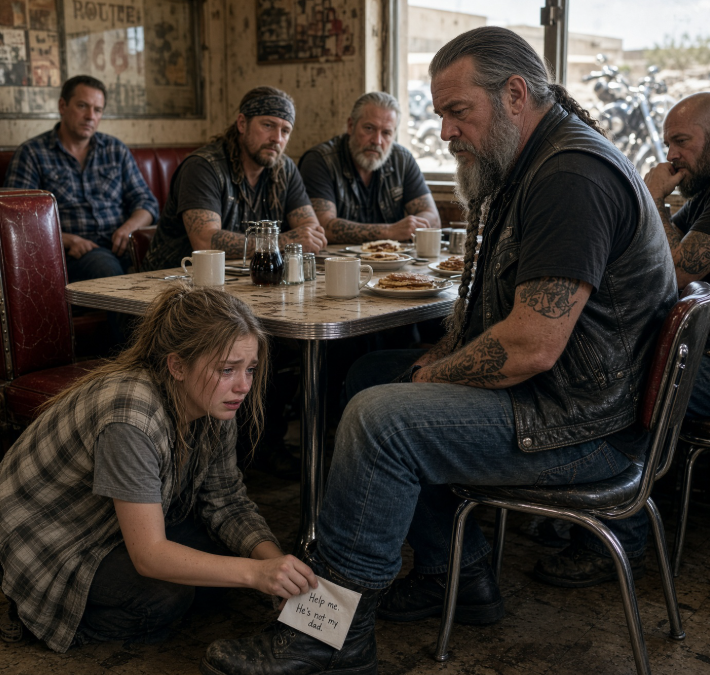
Help me. He’s not my dad. He has a gun.
The pen pressed so hard it nearly tore through the napkin.
I folded it into a tight square and palmed it.
My mouth had gone dry.
Now I needed to get it to them.
Somehow.
“I need to use the restroom,” I whispered.
Gregory turned back slowly.
His eyes narrowed.
“No.”
“Please.”
He leaned across the table and clamped his fingers around my wrist so hard pain shot up my arm.
“Make it quick.”
I nodded.
“And remember what we talked about.”
“I know.”
“I’m watching the door. You try the window in there, and I start shooting.”
“I know.”
He released me.
I slid out of the booth.
My legs felt like they belonged to someone else.
The restroom was at the back of the diner, which meant I had to walk directly past the Hells Angels’ tables.
Every step felt too loud.
I kept my eyes down.
The napkin stuck to my damp palm.
As I approached the big man with the braided beard, I smelled leather, diesel, tobacco, road dust, and coffee.
He was laughing at something the scarred man had said.
I prayed he would notice.
I prayed Gregory would not.
Then I stumbled.
Not a little.
Hard.
I bumped my hip against the edge of the president’s table and knocked over a glass of water.
It spilled across the tabletop.
“Whoa,” the giant biker grunted, shifting his vest away from the water. “Easy there, little lady.”
“I’m sorry,” I stammered. “I’m so sorry.”
I dropped to my knees and reached for the glass.
While the waitress rushed over with a towel and the bikers moved cups away from the spill, I shoved the folded napkin into the narrow space between the biker’s boot and the table leg.
Then I looked up.
Only for a second.
His eyes met mine.
I do not know what he saw.
I only know I put every word I could not say into that look.
Please.
Please.
Please.
Then I stood and hurried into the restroom.
I locked the door behind me and collapsed against the sink.
My breath came too fast.
I turned on the water to cover the sound and pressed both hands over my mouth.
Had he seen it?
Had he read it?
Had it fallen somewhere else?
Would they care?
Would they think it was a prank?
Would Gregory notice before they did?
My reflection looked like a stranger.
Pale.
Tangled hair.
Bruised wrist.
Eyes too wide.
I splashed water on my face.
I could not stay there forever.
If I took too long, Gregory would come.
He had promised.
I dried my hands on a paper towel and unlocked the door.
The walk back felt longer.
The bikers were still talking, but not quite as loudly.
I did not look at them.
I could not.
I slid into the booth.
Gregory leaned forward.
“Took your time.”
“Sorry.”
He studied my face.
My lungs stopped working.
Then he pulled a twenty-dollar bill from his wallet and slapped it onto the table.
“We’re leaving.”
My stomach dropped.
“Now.”
He stood and grabbed my bicep, fingers digging into the same spot he had bruised before.
I bit my lip to stop a cry.
He pulled me out of the booth and pushed me toward the front door.
No one moved.
The waitress looked down.
The elderly couple stared at their newspaper without reading.
The truck driver’s jaw clenched, but his hands stayed on the table.
I understood them.
I hated that I understood them.
Fear makes cowards of people who might have been brave under safer circumstances.
We were five feet from the exit when a shadow fell over us.
The big biker with the braided beard stood in the aisle, blocking the door completely.
The sunlight from the windows disappeared behind him.
Beside him stood the scarred man, arms crossed over his leather cut.
Behind them, the noise at the back tables died.
One by one, the other bikers turned toward us.
Gregory stopped.
“Excuse me,” he said, lowering his voice, trying to sound like a man used to being obeyed. “You’re blocking the door.”
The biker did not move.
His eyes dropped to Gregory’s hand wrapped around my arm.
Then to my face.
Then back to Gregory.
“You in a rush, friend?”
“My daughter and I have a long drive.”
“Daughter, huh?” the scarred man said. His voice was casual in a way that made it dangerous. “That right, sweetheart? This your daddy?”
My throat closed.
Gregory’s grip tightened.
Pain flared down my arm.
“She’s shy,” Gregory snapped. “She has severe social anxiety. You’re scaring her. Move.”
The big biker took half a step closer.
Gregory stepped back before he could stop himself.
“She don’t look shy,” the biker said. “She looks terrified.”
Gregory’s face changed.
The loving father disappeared.
Something cold and ugly showed through.
“Let go of her arm,” the biker said.
Instead, Gregory reached into his jacket.
For one awful second, I thought he was going for the gun.
He pulled out a leather wallet and flipped it open.
A silver badge flashed in the fluorescent light.
“Detective Hayes,” he said. “Nevada State Police. I’m transporting a ward of the state. You boys are interfering with official police business.”
My heart fell.
A badge.
Was it real?
Fake?
Did it matter?
The bikers were outlaws. Even if they believed me, would they risk fighting a cop?
Gregory smiled.
He thought he had won.
“Back off,” he said. “Or I’ll arrest every one of you.”
The big biker looked at the badge.
Then at Gregory.
Then at me.
A slow smile spread beneath his beard.
Not kind.
Not amused.
Something colder.
“Well, detective,” he rumbled, “I guess you’re going to have to arrest us.”
Gregory’s eyes widened.
“Because I don’t give a damn if you’re the governor of Nevada,” the biker continued. “The girl says you ain’t her daddy, and she ain’t leaving this diner with you.”
For half a second, nobody breathed.
Then Gregory moved.
Fast.
He dropped the badge, released my arm, and reached for the pistol under his jacket.
Everything happened at once.
The scarred biker lunged.
He did not pull a weapon.
There were too many people.
I was too close.
Instead, his steel-toed boot swept upward and slammed into Gregory’s forearm just as the gun came free.
There was a crack.
A gunshot exploded through the diner.
I screamed.
The bullet tore into the ceiling, raining plaster dust over the floor.
Gregory howled, the pistol flying from his hand.
Before it hit the ground, the big biker hit him.
It was like watching a truck strike a man.
They crashed backward through a wooden room divider, sending silverware, condiments, napkins, and coffee cups flying.
“Get the girl!” the big biker roared.
Hands grabbed me.
For one terrifying instant, I fought them.
Then a voice said, “Easy, kid. We got you.”
Two bikers pulled me behind the counter and put themselves between me and the fight.
Not holding me prisoner.
Shielding me.
One crouched in front of me.
Another stood with his back to me, leather cut blocking my view like a wall.
I heard shouting.
Furniture breaking.
Gregory screaming.
The truck driver yelling for someone to call police.
The waitress crying.
A heavy thud.
Then the big biker’s voice.
“You’re done.”
Silence fell slowly.
Ragged breathing.
Someone kicked the gun across the floor.
Plastic zip ties clicked tight.
I curled against the stainless steel refrigerator, shaking so hard my teeth hurt.
I had survived the car.
The highways.
The diner.
The gun.
But my body did not know that yet.
Heavy footsteps came behind the counter.
The two bikers blocking me moved aside.
The president lowered himself onto one knee.
Up close, he looked even bigger.
Older than my father, maybe.
Gray in his beard.
Lines around his eyes.
Plaster dust on his shoulder.
Blood on one knuckle.
But his voice, when he spoke, was gentle.
“You’re safe now, kid.”
I stared at him.
He took off his leather vest and draped it over my shoulders.
It was heavy and warm.
The patch smelled like leather, smoke, rain, and road.
“Nobody is taking you anywhere.”
I burst into tears.
Not pretty tears.
Not movie tears.
The kind that tear out of you when the part of your brain that has been holding everything together finally lets go.
He stayed crouched there.
Not touching me.
Not rushing me.
Just close enough that I knew he would not let anyone past him.
“What’s your name?” he asked.
“Samantha.”
“Okay, Samantha. I’m Bear.”
Bear.
It should have sounded ridiculous.
It did not.
It sounded like exactly the kind of name a wall would have.
“Did he hurt you?”
I could not answer.
His eyes dropped to my wrist.
The bruise was already darkening where Gregory had held me.
Bear’s jaw tightened.
But his voice stayed soft.
“Your people know where you are?”
I shook my head.
“My mom,” I whispered. “My dad. They don’t know. He took my phone.”
“Where from?”
“Portland.”
Bear looked over his shoulder.
“Declan.”
The scarred biker appeared.
“Yeah?”
“Portland. Family needs finding.”
“On it.”
Declan moved away.
Sirens came ten minutes later.
The local sheriff walked in with his hand near his weapon and stopped cold.
A dozen Hells Angels.
A destroyed diner.
A man zip-tied on the floor with a broken wrist.
A gun near the wall.
Me behind the counter wearing the president’s leather vest.
The sheriff stared at Bear.
“O’Connor.”
“Wade.”
“What the hell happened here?”
“Stopped a kidnapping.”
The sheriff’s expression shifted.
Bear nodded toward Gregory.
“He flashed a badge. Claimed Nevada State Police.”
The sheriff knelt and picked up the badge wallet from the floor.
He studied it.
His face went pale.
“It’s real.”
My stomach turned.
Bear said nothing.
The sheriff keyed his radio.
“Dispatch, run Nevada State Police badge eight-eight-four-one. Name Gregory Hayes.”
The diner waited.
Even Gregory stopped groaning.
The radio crackled.
The voice that came back changed everything.
The badge belonged to Detective Michael Hayes.
Reported stolen three weeks earlier.
By his estranged brother.
Gregory Hayes.
Subject of an active FBI manhunt.
Primary suspect in a multi-state human trafficking ring operating out of the Pacific Northwest.
Use extreme caution.
The words seemed to drain the air from the diner.
Human trafficking.
Multi-state.
FBI.
Gregory had not just taken me.
He had taken others.
Maybe many others.
Had I stayed silent until Texas, I would have disappeared into something so large and dark my mind could barely touch it.
The sheriff looked at Bear.
His voice was lower when he spoke.
“You boys didn’t just stop a kidnapping. You caught one of the FBI’s most wanted fugitives in the Southwest.”
Bear glanced at Gregory.
“Lucky us.”
But he did not sound lucky.
He sounded furious.
By midnight, the Copper Skillet parking lot had become something from a crime show.
Floodlights.
Yellow tape.
County cruisers.
Unmarked black SUVs.
FBI agents in tactical jackets.
Paramedics.
Detectives.
Cameras.
The diner that had felt so empty and hopeless hours earlier now pulsed with radios, orders, footsteps, and questions.
I sat on the bumper of an ambulance with a blanket over my lap and Bear’s leather cut still around my shoulders.
Someone gave me hot cocoa.
I held it with both hands even after it stopped steaming.
An FBI agent named Keller questioned me gently.
He was older, tired-looking, with kind eyes that had seen too much.
He asked what happened.
Where Gregory took me.
What roads I remembered.
What names I had heard.
What he said about Texas.
I answered as much as I could.
Sometimes my voice stopped working.
When it did, Bear stood nearby with his arms crossed, saying nothing.
Keller noticed.
At one point, he looked at the Hells Angels lined near their motorcycles and gave a humorless little shake of his head.
“I’ve spent half my career trying to put men in those cuts behind bars,” he muttered.
Then he looked back at me.
“And tonight they saved your life.”
A man with a camera appeared near the edge of the police lights.
I did not notice him at first.
Later, everyone would.
The photograph went everywhere.
Me sitting on the ambulance bumper, hot cocoa in my hands, swallowed by Bear’s massive leather vest.
Twelve Hells Angels standing around me in a protective half-circle.
Their faces hard.
Their posture defiant.
The death head patch bright against the desert night.
People online argued for weeks.
Some called them heroes.
Some said criminals could not be heroes.
Some said the photo looked staged.
Some said it changed how they saw the world.
I did not care about any of that.
To me, the photo captured something much simpler.
For one night, the most frightening men in the room had been safer than the man with the friendly smile and the stolen badge.
At 2:14 in the morning, another vehicle came screaming into the lot.
Before it fully stopped, the doors flew open.
My mother got out first.
Then my father.
For one frozen second, none of us moved.
My mother’s hair was pulled back badly, like she had done it while crying. My father wore the same sweatshirt he had been wearing when I vanished, as if changing clothes would have meant giving up.
“Samantha!”
I dropped the cocoa.
The mug shattered on the asphalt.
I ran.
My mother fell to her knees before I reached her, arms open, and I crashed into her so hard we almost toppled backward. She wrapped herself around me like she was trying to make my body part of hers again.
My father dropped beside us and pulled us both into his arms.
He was sobbing into my hair.
My father, who barely cried when our dog died, was sobbing so hard he could not speak.
“I’m sorry,” I kept saying.
My mother pulled back, holding my face between both hands.
“No. No, baby. No. You survived. You survived.”
“I was scared.”
“I know.”
“I thought he’d hurt you.”
“He didn’t.”
“I couldn’t call.”
“We know.”
“I tried—”
“You did everything right.”
I broke again.
This time, it did not feel like falling apart.
It felt like coming home.
From the shadows near their bikes, the Hells Angels watched quietly.
None of them interrupted.
None of them tried to turn the moment into theirs.
They simply stood there like sentries at the edge of a nightmare, making sure it stayed over.
Later, when agents prepared to move us to a safer location, I realized I was still wearing Bear’s vest.
It was heavy on my shoulders.
Too big.
Too warm.
Too important.
I pulled away from my mother and walked back toward him.
He was leaning against his motorcycle, lighting a cigarette.
I stopped in front of him and held out the vest.
“Thank you,” I whispered.
My voice was raw.
He took it carefully.
For a moment, the hard lines of his face softened.
“I knew you would read it,” I said. “I knew you would help.”
His eyes changed then.
Something like sadness moved behind them.
He reached into his pocket and pulled out a small silver bell.
It was tarnished and simple, with tiny marks along the side.
He placed it in my palm and folded my fingers over it.
“You know what this is?”
I shook my head.
“Guardian bell,” he said. “Old biker thing. Hang it low on a bike, it traps road demons and keeps bad spirits away. But it only works if someone gives it to you.”
I looked down at the bell.
It was cold from the night air.
“You keep it,” Bear said. “You ever find yourself in the dark again, you ring that and remember something.”
“What?”
His voice dropped.
“Monsters don’t always look like monsters. And you don’t ever ignore your gut when it tells you to run.”
I nodded.
He hesitated, then added, “And if the dark gets too loud, you tell it Bear from the Arizona charter said you’re under protection.”
My mother, standing behind me, made a small sound.
Bear looked at her.
“Ma’am.”
“Thank you,” she said.
He shifted uncomfortably, like gratitude sat worse on his shoulders than danger.
“She saved herself,” he said. “We just read the note.”
That was not true.
Not entirely.
But I understood why he said it.
Six months later, Gregory Hayes stood before a federal judge.
I did not testify in person.
The prosecutors said I did not have to. They had enough from the diner, the gun, the stolen badge, the burner phones, ledgers, routes, and evidence recovered from his sedan.
His arm was still in a brace.
I saw him once on a screen during a court update, and for a second my body forgot he was locked away.
My hands went cold.
My mother turned the screen off.
The case became bigger than me.
Twenty-two arrests.
Multiple states.
Other girls found.
Some alive.
Some not.
The news used words like ring, network, operation, trafficking, federal coordination.
I hated those words.
They made everything sound organized and distant.
To me, it was still pancakes I could not swallow.
A pistol under a jacket.
A napkin on my knee.
A man blocking a diner door.
Gregory received three consecutive life sentences without parole.
People said I must have felt closure.
I did not.
Closure sounds like a door clicking shut.
Trauma is not a door.
It is weather.
Some days clear.
Some days it rolls in without warning.
For months, I could not sit in restaurants with my back to the door. I hated gray sedans. I flinched when men spoke too softly. I checked exits everywhere. I slept with the little silver bell under my pillow until my therapist suggested I put it somewhere I could still see it but not grip it all night.
So I clipped it to my backpack.
It rang softly when I walked.
At first, the sound made me cry.
Then it made me breathe.
Back at school, people did not know how to talk to me.
Some stared.
Some avoided me.
Some asked terrible questions because teenagers can be cruel by accident and on purpose.
“Were you scared?”
“Did he hurt you?”
“Did the bikers beat him up?”
“Is it true you’re famous online?”
I stopped eating in the cafeteria for a while.
Then one day, a girl from my chemistry class sat across from me in the library.
Her name was Elise.
She did not ask about the diner.
She pointed at the bell on my backpack.
“That’s pretty.”
I touched it.
“Thanks.”
“Does it mean something?”
I thought about lying.
Then I said, “It means someone helped me when I needed it.”
Elise nodded.
Then opened her lunch.
That was how friendship began again.
Quietly.
Without making me explain everything.
Months later, my family drove past the Copper Skillet on the way to visit relatives.
My father asked if I wanted to take a different route.
I said no.
My mother looked back at me from the passenger seat.
“You sure?”
I touched the bell clipped to my backpack.
“I’m sure.”
The diner was still there.
Dusty windows.
Sun-faded sign.
Gravel lot.
For a second, I saw it all again.
The booth.
The pancakes.
The napkin.
Bear in the doorway.
Then the present returned.
My father’s hands on the wheel.
My mother beside him.
My brother asleep with headphones on.
Me in the back seat, alive.
We did not stop.
We just drove past.
That was enough.
People online still use the photo sometimes.
They turn it into arguments about crime, police, bikers, fathers, guns, girls, justice, whatever they already believed before they saw it.
I understand.
People like simple stories.
Bad men.
Good men.
Heroes.
Villains.
But I lived inside that story, and it was not simple.
The man who took me looked respectable.
The men who saved me looked terrifying.
The badge was stolen.
The outlaw told the truth.
The diner full of ordinary people froze.
The men everyone feared moved first.
I do not tell people that to make the world sound upside down.
I tell them because it already is.
You cannot always recognize safety by how it dresses.
You cannot always recognize danger by how politely it speaks.
And sometimes survival depends on trusting the one detail everyone else misses.
Gregory was afraid of them.
That was the detail that saved me.
Not because I thought the Hells Angels were angels.
I did not.
I knew enough to be scared of them too.
But fear is not all the same.
I was afraid of Gregory the way prey fears a trap.
I was afraid of Bear the way you fear a storm that might destroy the thing chasing you.
So I passed the napkin.
That is the part people call brave.
I still do not know if I agree.
Bravery sounds clean.
What I felt was panic wearing shoes.
But I wrote the words anyway.
Help me.
He’s not my dad.
He has a gun.
Sometimes that is what bravery is.
Not feeling strong.
Not knowing you will be saved.
Just moving your hand while it shakes.
Just telling the truth in the only way you can.
Just trusting that someone, somewhere, will read it before it is too late.
I still have Bear’s guardian bell.
It hangs from my backpack zipper, slightly tarnished, a little scratched, ringing softly when I walk across campus, through airports, into restaurants, down streets at night when my pulse tries to remember old fear.
Some people hear it and think it is just a bell.
To me, it is engines in the distance.
A wall of leather and muscle.
A giant man kneeling to my level and saying, “You’re safe now, kid.”
It is my mother’s arms around me in the desert.
My father crying into my hair.
A diner full of people finally breathing again.
It is proof that I was taken, but not erased.
Proof that I was terrified, but not silent.
Proof that monsters can wear badges and guardian angels can wear leather.
And whenever it rings, I remember the moment I learned the most important lesson of my life.
If your voice is trapped, find another way to speak.
If your hands are shaking, write anyway.
And if the world gives you one narrow chance to survive, take it.
Even if that chance looks like a table full of Hells Angels in the back of a lonely Route 66 diner.








