I Sealed the Crawl Space Without Looking—Eleven Days Later, I Found What She Had Done to Keep Her Kittens Alive
PART3:
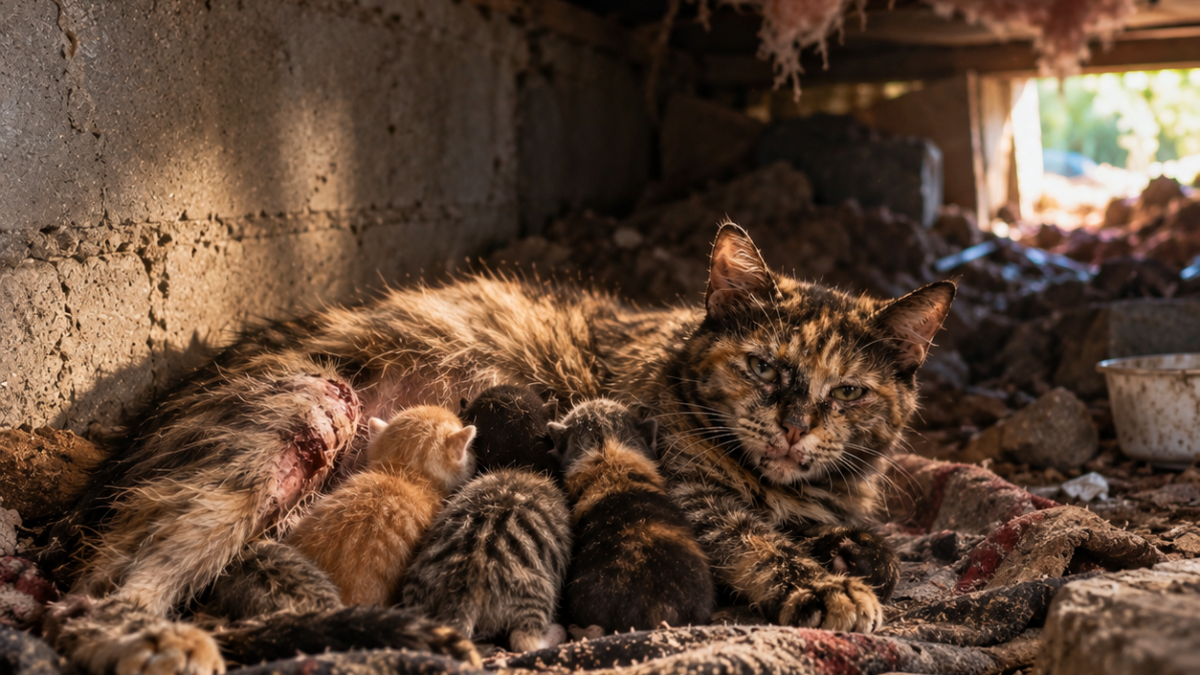
Behind her, in a nest made of torn insulation and dirt, were five kittens.
Tiny.
Thin.
Weak.
But alive.
All five of them.
I said something then that I will not write here.
Not because it was angry.
Because it was broken.
The mother cat did not run toward the opening.
She did not try to save herself.
She stood between us and the kittens, barely able to remain upright, still guarding them with the last scraps of strength she had.
“She’s alive,” Mrs. Whitaker whispered.
I could not answer.
My flashlight moved over the space, and that was when I saw the wall.
Part of the old concrete foundation near the far corner had been damaged over years by moisture. I remembered noticing it during the job, but only from outside. A weak patch. Old concrete. Nothing urgent, I had thought.
Now there was a hole in it.
Small.
Maybe three inches across.
Just enough for outside air to pass through.
Not enough for the mother to escape.
Not enough for the kittens to crawl out.
Just enough to breathe.
Around the hole, the inside surface of the foundation was covered in marks. Scratches. Gouges. Hundreds of them. Thin lines from claws. Rougher chips from teeth. Dust lay beneath it in a pale gray pile, mixed with darker spots I did not want to understand but already did.
Blood.
Concrete dust and blood.
My stomach turned.
“She did that,” Mrs. Whitaker said.
I nodded, though I could barely move.
The mother cat had not dug an exit.
She had made ventilation.
She had not abandoned her kittens.
She had not spent her strength trying to save only herself.
She had attacked a concrete wall until she opened a hole just large enough for air to come in and keep five tiny bodies breathing.
The owner whispered, “My God.”
I wanted to turn on him, blame him, blame the job, blame the heat, blame the schedule, blame anything that moved the weight off my own chest.
But the truth was right there.
I was the one who sealed it.
I had put the plywood over the access.
I had stapled the membrane.
I had filled the gaps with foam.
I had taken away her air.
And for eleven days, she had answered my mistake with a kind of courage I still struggle to understand.
We called animal rescue first, then a veterinary clinic. But no one was going to wait while five kittens lay in that heat. I crawled in with gloves, a mask, a towel, and a carrier someone brought from Mrs. Whitaker’s garage. The space was so hot my shirt stuck to me within seconds. The dirt was dry and rough under my knees. The air felt used up, even with the panel open.
The mother cat watched every movement.
Her eyes were not wild in the way frightened animals sometimes look. They were exhausted. Deeply, dangerously exhausted. But she still tracked my hands as I approached the nest.
“I’m not going to hurt them,” I whispered.
My voice sounded useless in that crawl space.
She could not know who I was.
She could not know that the same hands reaching for her babies were the hands that had sealed her in.
Maybe she did know.
Maybe that is why she did not trust me at first.
I would not have trusted me either.
When I got close, she tried to step forward and almost fell. Her front paws shook so badly that one folded beneath her. She caught herself with a weak, raw sound that barely counted as a meow.
That sound hit me harder than a scream would have.
Because she did not have enough left to scream.
I stopped moving.
“It’s okay,” I said, though nothing about it was okay. “I’m sorry. I’m so sorry.”
Behind me, the rescue volunteer arrived and crawled in partway. Her name was Elise, and she had the steady calm of someone who had seen too much and still chosen usefulness over panic.
“Start with the kittens,” she said softly. “Slow. Keep them together.”
I lifted the first kitten.
It weighed almost nothing.
A tiny scrap of fur, warm and limp, mouth opening silently against my glove. I placed it into the towel-lined carrier. Then the second. Third. Fourth. Fifth.
All alive.
All breathing.
All weaker than any newborn creature should be.
The mother watched, trembling.
When the last kitten was in the carrier, I reached for her.
She did not run.
She could not.
But she lifted her head and looked straight at me.
I have had people tell me not to humanize animals too much. Maybe they are right. Maybe a cat’s eyes are just eyes, and everything we see in them is what we bring ourselves.
But I know what I felt in that moment.
She looked at me like she had done her part.
Like she had kept them alive as long as she could.
Like now, finally, someone else could carry them.
I wrapped her in a towel and lifted her.
She weighed less than some tool bags I carry without thinking.
Her body was all bones and heat. Her fur came away in patches against the towel. Her front paws were swollen, raw, and strangely smooth at the pads from scraping against concrete. I saw her mouth open as she breathed, and inside it was red, torn, damaged in ways that made me look away for half a second.
Then I forced myself to look back.
She had lived through it.
The least I could do was witness it.
We carried all six of them into air-conditioning.
The kittens made tiny weak sounds as Elise checked them one by one. The mother lay on the towel, panting. She did not try to stand again. Her eyes stayed half open, fixed on the carrier where her babies were.
“She’s still watching them,” Mrs. Whitaker said.
Elise nodded.
“Mothers do.”
At the clinic, the vet moved quickly.
Fluids.
Cooling.
Careful rehydration.
Exams.
Bloodwork.
The kittens were dehydrated and underweight, but no chemical burns, no concrete dust in their mouths, no injuries from the wall. Their mother had kept them away from the place where she was destroying herself.
The mother was worse.
Much worse.
She weighed just over three pounds. She should have weighed close to eight.
Her front claws were not merely broken. Several were destroyed down into the nail beds. Some would never grow back properly. Her pads were flattened and raw from friction. Her gums were torn. Teeth were cracked and missing. Concrete dust had burned and scraped the inside of her mouth. Her stomach and throat were inflamed from swallowing mineral grit. Her kidneys were stressed. Her liver numbers were frightening.
The vet explained all of this with professional control.
I heard only one thing underneath every sentence.
She did this because I sealed her in.
The owner stood beside me in the clinic lobby, pale and silent. Mrs. Whitaker sat in a chair with a kitten carrier on her lap, crying without making a sound.
“How did they survive eleven days?” I asked.
The vet looked through the glass toward the treatment room.
“The hole,” she said. “Without that airflow, I don’t think they would have.”
I swallowed.
“She made it?”
“She made enough of one.”
“Why didn’t she try to get out?”
The vet’s expression changed.
“That hole wasn’t big enough.”
“I know. But why keep going?”
“To bring air in.”
The room went quiet.
“She wasn’t building an escape,” the vet said gently. “She was keeping them alive.”
I went outside after that and threw up behind my truck.
For two weeks, I barely slept.
Every time I closed my eyes, I saw the plywood panel.
My hands holding the drill.
Foam expanding into gaps.
The clean, finished look of the job.
Then the other images came.
Her in the dark.
The heat rising.
The kittens crying.
Air getting thinner.
Her finding the weak patch of wall.
Claws first.
Then teeth.
Again and again.
Night after night.
During the day, when the crawl space got too hot, she must have crawled back to the nest. Nursed them. Curled around them. Let her own body feed five lives while her body ate itself to keep going.
At night, when the temperature dropped just enough, she returned to the wall.
Scratched.
Bit.
Swallowed dust.
Bled.
Rested.
Went back.
No screaming.
No rescue.
No one knowing.
Just a mother solving the only problem that mattered.
Air.
I told the owner, “This is on me.”
He shook his head.
“I told you to seal it.”
“I didn’t check.”
“Neither did I.”
“I’m the contractor.”
He looked toward the clinic door.
“I don’t think blame helps them now.”
Maybe he meant that kindly.
Maybe he meant it for himself.
But blame had already found me.
It had moved in.
And for a while, I let it.
The rescue named the mother Mercy.
I did not choose the name, but I did not argue with it. At first, I thought it was too soft for what she had been through. Mercy sounded gentle, clean, almost too beautiful. But the more I visited her, the more it fit.
Not because mercy had been given to her.
Because she had given it.
To five kittens.
To the world that trapped her.
Even to me, eventually.
Mercy stayed at the clinic for days before moving to a medical foster. The kittens were supplemented with bottle feedings at first because her body had almost nothing left to give, yet she still tried to nurse them. Every time the babies were placed near her, she shifted toward them, weak but determined, as if motherhood had become the last operating system in her body.
The rescue workers kept telling her, “You can rest now.”
She did not seem to believe them.
I visited whenever I could.
At first, I told myself I was checking on the damage I caused. That I owed updates. That I needed to pay what I could toward her care. All true.
But the real reason was simpler.
I could not walk away from her again.
The first time I visited, Mercy was lying on a soft blanket in a crate with the door open. The kittens were tucked beside her in a little warm pile. She lifted her head when I entered.
I stopped.
“I don’t know if you remember me,” I said.
She stared.
“I’m the one who found you.”
That sounded too kind.
So I corrected it.
“I’m the one who sealed you in.”
The foster volunteer standing behind me said quietly, “You didn’t know.”
I nodded.
But I was talking to Mercy, not to myself.
“I should have checked,” I said. “I’m sorry.”
Mercy lowered her head back to the blanket.
One kitten squirmed toward her belly.
She adjusted just enough to help it find her.
That was all.
No forgiveness.
No accusation.
Just life continuing because she had fought too hard to waste strength on anything else.
The kittens improved quickly.
That is one of the miracles of young animals. Give them warmth, fluids, food, safety, and sometimes they begin turning back toward life almost immediately. They gained weight. Their cries grew louder. Their tiny bodies rounded out. Their eyes opened. They began to wobble, crawl, tumble, and eventually attack one another with all the seriousness of creatures who had no idea they were lucky to exist.
The rescue named them after doors.
Hinge.
Latch.
Key.
Knob.
And little Threshold, the smallest.
Ridiculous names.
Perfect names.
All five were adopted within six weeks.
Good homes.
Safe homes.
Homes with people who knew their story and promised never to close a door without checking what was on the other side.
Mercy took longer.
Nine weeks of treatment.
Nine weeks of wound care, fluids, dental surgery, special food, bloodwork, pain management, and patience.
She lost seven teeth.
Some claws never grew back right.
A few stayed split.
Two were gone completely.
Dry food hurt her mouth, so she needed soft wet food. Her kidneys recovered partly, but the vet said she would always need monitoring. Her front paw pads remained smooth and flattened, giving her less grip than other cats. She slipped sometimes on tile or wood floors, then looked offended, as if gravity had insulted her personally.
She had survived.
But survival had charged a price.
I paid the bills I could.
The rescue covered the rest through donations. People in town heard the story and helped. Mrs. Whitaker gave twenty dollars every week in an envelope marked “For the mother.” The owner paid a large portion too, quietly, without wanting his name attached.
But money did not feel like enough.
Nothing did.
One evening, near the end of Mercy’s recovery, I went to the foster home after work. I had drywall dust on my jeans and caulk under one fingernail. I sat on the floor because Mercy liked being approached low, not from above.
She was stronger by then, though still thin. Her fur had begun to come back in uneven patches. Her eyes were clearer. Her mouth healed enough that she no longer flinched with every bite.
She walked toward me slowly.
Not beautifully.
Not smoothly.
But on her own.
She stopped in front of my boot.
Sniffed it.
Then, very carefully, placed one damaged front paw on my knee.
I did not move.
She climbed into my lap with the awkward determination of someone crossing a mountain.
Then she curled there.
A tortoiseshell cat who had every reason to hate human hands settled against the man whose hands had sealed the last opening.
I cried.
I am not embarrassed to say it.
I sat on that foster room floor with a cat in my lap and cried harder than I had cried in years.
The foster volunteer leaned against the doorway.
“She picked you,” she said.
“She shouldn’t have.”
“Cats don’t care what we think they should do.”
“I don’t deserve her.”
“No,” she said gently. “But maybe deserving isn’t the point. Maybe responsibility is.”
That sentence stayed with me.
Responsibility.
Not guilt.
Guilt can freeze a man in place.
Responsibility makes him move.
So I applied to adopt Mercy.
The rescue asked if I understood her needs.
I did.
Soft food.
Regular vet checks.
No closed-in spaces.
Patience with touch around her paws and mouth.
Safe flooring where she would not slip.
A home that would not treat her history like a sad story to tell and then forget when the inconvenience began.
I signed every form.
Bought every supply.
Changed things in my house before she came home.
I added rugs so her smooth paw pads could grip. I removed the door from a small closet because the sight of it closed made me uncomfortable now. I bought low bowls, soft beds, wet food, pet stairs she mostly ignored, and a wide carrier with a top that opened so she would never have to be shoved through a narrow door.
Then I made myself a promise.
No door in my house would ever be closed on her.
Not bedroom doors.
Not closets.
Not the laundry room.
Not the bathroom if I could help it, though Mercy later decided human privacy was suspicious anyway.
All doors open.
That became our agreement.
When Mercy came home, I placed the carrier in the living room and opened the top.
She did not come out right away.
She sat inside, looking around, nose moving gently.
I sat on the floor several feet away.
“No hurry,” I said.
For twenty minutes, she stayed where she was.
Then she stepped out.
One paw.
Then another.
Her claws clicked strangely on the floor before she reached the rug. She paused there, as if noticing the difference. Soft surface. Grip. Safety.
She walked from the carrier to the center of the room.
Then looked toward the hallway.
Every door stood open.
Bedroom.
Bathroom.
Laundry.
Closet.
All of them.
Mercy walked slowly down the hall and inspected each opening like a building inspector with very personal standards.
When she returned to the living room, she climbed onto the old folded quilt I had placed near the window.
Then she slept.
Not lightly.
Not with one eye open.
She slept like something in her body had finally believed that air would keep coming.
I watched her for over an hour.
The house felt different with her in it.
Not louder.
Not fuller exactly.
Accountable.
That is the word.
My home had become accountable to the life inside it.
Months passed.
Mercy became stronger, but never ordinary.
I do not mean that in a sad way.
She simply carried her story in her body. Her walk was careful. Her mouth needed soft food. Her paws had limits. She did not like confined places. She hated the sound of spray foam cans so much that I stopped using them near the house altogether. If I came home smelling too strongly of construction adhesive or concrete dust, she would retreat under the coffee table and watch me until I changed clothes.
I respected that.
I had earned her caution.
But Mercy also became funny.
Stubborn.
Particular.
Deeply opinionated.
She liked warm laundry but only if folded poorly enough to reshape. She liked sitting near open doorways, never directly inside rooms, as if supervising access. She enjoyed wet food with gravy but rejected pâté with such disgust you would think I had personally insulted her ancestors. She loved Mrs. Whitaker, who visited every Sunday and spoke to her like a respected widow from church.
“Hello, brave girl,” Mrs. Whitaker would say.
Mercy always blinked slowly at her.
That was high praise.
The kittens’ adopters sent updates.
Hinge became a shoulder cat.
Latch grew enormous and slept in sinks.
Key liked children.
Knob learned to open cabinet doors, which felt appropriate.
Threshold, the smallest, became the boldest, climbing curtains and terrifying a golden retriever twice his size.
I printed their photos and placed them on the wall near Mercy’s favorite window.
People asked if she recognized them.
I do not know.
Sometimes she sat beneath the photos and looked up.
Maybe she smelled nothing.
Maybe she remembered everything.
Maybe she was simply enjoying the sun.
I stopped needing an answer.
The important thing was that they were alive.
All five.
Alive because their mother spent eleven nights biting concrete and eleven days feeding them from a body that was falling apart.
Alive because Mrs. Whitaker heard scratching and did not ignore it.
Alive because the panel came off before the last of Mercy’s strength did.
Alive despite me.
That last part took time to face cleanly.
For a while, every good thing Mercy did hurt.
If she purred, I thought, How could she trust me?
If she slept near me, I thought, She does not know enough to hate me.
If she placed her damaged paw on my arm, I thought, This is more mercy than I deserve.
But slowly, living with her changed guilt into something more useful.
I began checking everything.
Not just crawl spaces.
Sheds.
Garages.
Under porches.
Behind walls before closing them.
Inside cabinets before hauling them away.
My crew got tired of hearing me say, “Check it first.”
Then they heard Mercy’s story enough times that they stopped complaining.
I added it to every job briefing.
“Before we seal anything, board anything, foam anything, or close anything, we inspect inside. Flashlight, mirror, camera if needed. We listen. We wait. We make noise and give anything inside a chance to answer.”
One of my younger guys once said, “Boss, it’s probably empty.”
I looked at him.
He never said it again.
Probably is not good enough when the cost of being wrong has a heartbeat.
The owner of the Briar Lane house eventually repaired the foundation properly. I did that job too, but not alone. Before any work began, we inspected every inch of that crawl space. Then we waited. Then we checked again.
The place was empty.
Truly empty.
Still, when I reached the section of wall Mercy had opened, I stopped.
The hole had been widened during removal, but part of the original edge remained. Scratched. Gouged. Marked by a fight no one had witnessed. I cut that piece out carefully before replacing the foundation section.
The owner asked what I was doing.
“Keeping it,” I said.
He nodded.
I mounted that broken piece of concrete in my workshop.
Not as decoration.
As a warning.
A three-inch hole surrounded by claw marks and tooth marks.
Every time I see it, I remember that a sealed space is not empty just because no one looked.
I remember that silence is not proof of absence.
I remember that some mothers do not cry for help.
They get to work.
One year later, Mercy had gained weight.
Not all of it back, but enough that her ribs no longer showed. Her fur had grown in beautifully across most of her body, patchy only in a few places where stress and injury had taken their time letting go. Her mouth healed into a strange little expression because of the missing teeth, making her look permanently unimpressed.
She could not eat dry food, but she loved soft chicken stew.
She could not grip well, but she mastered rugs.
She could not tolerate closed doors, but in my house, she did not have to.
Every door stayed open.
Friends joked about it.
“You really never close doors?”
“Not if she’s inside.”
“What about guests?”
“They learn.”
“What about the bathroom?”
“Mercy has trauma and no respect for privacy.”
That usually ended the conversation.
At night, she slept at the foot of my bed, always positioned where she could see the bedroom door standing open. Sometimes she woke and walked the house. I would hear her soft, uneven steps in the hallway. She checked rooms. Doorways. Corners.
Then she came back.
The first time she did that, I thought she was anxious.
Maybe she was.
But over time, I wondered if she simply liked confirming the truth.
Open.
Open.
Open.
Still open.
One evening, during a thunderstorm, the power went out.
The whole house went dark at once.
Rain hammered the roof. Wind pushed against the windows. Somewhere outside, a branch snapped. I reached for my flashlight, and before I could turn it on, I heard Mercy moving fast.
Not toward me.
Toward the hallway.
I found her standing between the living room and the bedrooms, breathing hard, head turning toward each open door as lightning flashed.
For a moment, I saw her as she must have been in the crawl space.
Darkness.
Heat.
No air.
Five babies behind her.
No exit big enough.
Only the wall.
I sat down on the floor.
“Everything’s open,” I said softly.
She looked at me.
I shined the flashlight gently down the hall, not into her eyes.
“See? Bedroom’s open. Bathroom’s open. Closet’s open. You’re not trapped.”
She stood there a long time.
Then she walked to me and pressed her forehead against my knee.
I placed one hand lightly on her back.
The storm passed.
The power returned.
Mercy slept beside me that night instead of at the foot of the bed.
I did not move for hours.
Sometimes rescue is not one event.
Sometimes it is a promise you keep proving in ordinary moments.
A door left open.
A soft meal placed down.
A rug where paws can grip.
A flashlight in the dark.
A person sitting on the floor during a storm, explaining to a cat that the worst thing is not happening again.
People like to call Mercy a miracle.
I understand why.
Five kittens alive after eleven days sealed beneath a house in July heat feels impossible. A mother cat chewing concrete until her teeth broke and her claws were destroyed sounds like something from a legend, not a vacant rental on Briar Lane.
But when I look at her, I do not think miracle first.
I think mother.
That is what she was.
Not a symbol.
Not a story.
Not a lesson created for humans to feel inspired.
A mother.
A starving, overheated, trapped mother who understood one thing more clearly than anyone outside that house did.
Her babies needed air.
So she made air.
With her claws.
With her teeth.
With her blood.
With eleven nights of pain.
That truth deserves more than admiration.
It deserves change.
So yes, I adopted her.
Yes, I paid what I could.
Yes, I keep every door open.
But I also changed how I work.
That is the part I talk about most now.
When other contractors laugh about checking empty spaces, I tell them Mercy’s story. I tell them about the heat that came out when I removed the panel. I tell them about the five kittens in the insulation nest. I tell them about the three-inch hole in the concrete. I tell them about the destroyed claws and broken teeth, though I try not to make it crueler than necessary.
Then I say, “Take five minutes and look.”
Five minutes.
That is all I would have needed.
Five minutes to shine a light inside.
Five minutes to tap the beams.
Five minutes to notice torn insulation.
Five minutes to hear movement.
Five minutes would have spared Mercy eleven days.
That is the math I live with.
Not to punish myself forever.
To make sure the math is different next time.
Mercy is asleep right now as I write this.
She is lying on a folded blanket near the open hallway, paws tucked under her chest, whiskers twitching. Her front claws are strange and uneven. Some missing. Some split. Her mouth is still tender, so her dinner tonight was soft food warmed with a little water the way she likes it.
She ate slowly.
Then cleaned her face.
Then sat in the doorway between the kitchen and living room as if guarding the concept of access itself.
Every door in the house is open.
All of them.
That is our agreement.
Some people might think it is excessive.
They do not know what it means to see a creature nearly die because a space was closed without care.
They do not know what it means to look at a three-inch hole in concrete and understand that love can become physical force.
They do not know what it means to be forgiven by a cat who had to destroy her own body because of your mistake.
I do.
And I will carry that for the rest of my life.
In July of 2023, I sealed a crawl space without checking inside.
A tortoiseshell stray mother cat was trapped beneath the house with five newborn kittens.
For eleven days, the heat rose.
The air thinned.
Her body weakened.
But she did not leave them.
She clawed and chewed at an old concrete foundation until she made a hole just large enough for air.
Not large enough for escape.
Only breath.
She gave them that.
When we found her, she was almost gone.
Her kittens were weak.
But all five were alive.
All five.
People ask me sometimes why I adopted Mercy.
The answer is simple.
I owed her a home.
But more than that, I owed her a world where nothing would ever be sealed around her again.
No locked room.
No closed closet.
No carrier forced shut without care.
No space where she could call or scratch or work in silence while nobody listened.
She had already done enough.
She had bitten through concrete for love.
The least I could do was leave the doors open.








