I Saw Something Thrown From a Car at 70 MPH—Then I Realized It Was Still Alive
PART3:
“Somebody threw her out of a car in front of me. On the highway. She’s alive, but she’s hurt bad. I can’t ride with her. I need the truck.”
My wife did not ask whether I was sure.
She did not ask if there was a shelter nearby.
She did not ask why I had stopped.
She only said, “Send me your location. I’m leaving now.”
That is one reason I married her.
I sent the pin and sat down in the grass as far from traffic as I safely could. The cat stayed wrapped in my jacket, pressed against my lap. Every few seconds, I adjusted the leather to shield her from the wind. Her breathing was still fast, but she was conscious. Her eyes opened and closed slowly.
“Help is coming,” I told her.
A semi roared past.
She flinched.
I placed one hand lightly over her shoulders.
“I know. I hate it too.”
The highway did not care.
That is something you learn fast if you spend enough time on the road. Highways do not pause for grief. Cars kept passing. People glanced over, maybe saw a biker sitting in the grass, maybe saw nothing at all. A few slowed slightly, curious, then moved on. The dark sedan was long gone by then, swallowed into distance and traffic.
I tried to remember details.
License plate.
Make.
Model.
Anything.
But it had happened too fast. Sun glare, speed, shock. I remembered the passenger window. The color of the car. The movement. The bounce.
The bounce.
That image would not leave me.
The way her body had hit the road and risen again, not because she was strong, but because physics is cruel and asphalt gives nothing back gently.
I looked down at her.
“You deserved better than that,” I said.
Her ear twitched.
For thirty minutes, I sat beside the highway with that little cat in my lap.
My wife called twice to tell me where she was. Each time, I answered with one hand while keeping the other on the cat.
“She still breathing?” my wife asked the second time.
“Yes.”
“Keep talking to her.”
“I am.”
“Good. I’m ten minutes out.”
Those ten minutes stretched longer than the entire ride before them.
The cat shifted once and made another soft sound.
“I know,” I whispered. “You’re almost done with this part.”
When my wife’s truck finally pulled onto the shoulder, I felt my whole body loosen. She jumped out before the engine was fully off, her face pale.
“Oh my God,” she whispered when she saw the bundle in my arms.
“She’s alive.”
My wife opened the passenger door and cleared space without needing instruction. We laid the cat on a folded blanket from the back seat, still wrapped in my jacket. My wife’s hands were gentle but steady.
“What do we do?”
“Emergency vet.”
“I already looked one up,” she said. “Twenty-three minutes.”
I could have kissed her right there on the shoulder of the highway.
We loaded my motorcycle later. At that moment, I did not care about the bike. I climbed into the back seat beside the cat while my wife drove. I kept one hand near the cat’s head so she could smell me or feel me or simply know that the hands that had picked her up had not disappeared.
The emergency veterinary clinic smelled like disinfectant, fear, and coffee that had been sitting too long.
The technician at the desk looked up, saw the leather jacket in my arms, and immediately stood.
“What happened?”
“Thrown from a moving car,” I said. “Highway speed. She’s alive. Back leg’s broken, road rash, maybe more.”
The technician’s face changed in a way I recognized.
Not shock exactly.
Professional horror.
The kind people develop when they see cruelty often enough to move quickly through it.
They took her back right away.
A vet came out ten minutes later.
“She’s stable for the moment,” she said. “We’re going to do X-rays and check for internal bleeding. She has a clear fracture in the right rear leg. She has abrasions on the flank and chin. There’s some dental trauma. We’ll know more after imaging.”
My wife reached for my hand.
I realized mine was shaking.
The waiting room felt too bright. A dog whined somewhere behind a closed door. A man sat across from us holding an empty leash and staring at the floor. A woman in scrubs passed by carrying towels. The clock on the wall ticked so loudly it felt rude.
I kept seeing the sedan.
The window.
The throw.
My wife sat beside me in silence for a while.
Then she asked, “Did she look at you?”
“What?”
“When you found her. Did she look at you?”
I nodded.
That was all I could do.
The vet returned after what felt like hours but was probably less than forty minutes.
“No internal bleeding that we can see,” she said first.
I closed my eyes.
“No spinal damage. That’s very good news.”
My wife squeezed my hand.
“The right tibia is fractured. She’ll need surgery to stabilize it with pins. She has significant road abrasions along the right side and chin, and one canine is slightly broken from impact. But she’s young. Otherwise healthy. If surgery goes well, she has a good chance.”
“How young?” my wife asked.
“Maybe a year. Possibly less.”
A kitten, almost.
Old enough to have survived more than she should have.
Young enough that the world had shown her cruelty far too early.
Then came the estimate.
Eleven hundred dollars.
I looked at the paper.
The number sat there in black ink, practical and impossible.
My motorcycle, bought used and fixed piece by piece over the years, was worth maybe four thousand dollars on a good day. Probably less if the buyer noticed everything I pretended was “character.” Eleven hundred dollars was nearly a quarter of that.
For a cat I had known less than two hours.
A cat someone else had thrown away.
The vet’s voice softened.
“There are rescue options we can try. Payment plans. Surrender possibilities. We just need to know how you want to proceed.”
I looked through the small window in the exam room door.
I could see the edge of my leather jacket on the treatment table. A tiny gray-and-white face rested against it.
My wife followed my gaze.
She already knew.
“Do the surgery,” I said.
The vet nodded.
My wife did not argue.
Outside the clinic, while they prepared the cat for treatment, I called the highway patrol and made a report. I gave what little I had: dark sedan, passenger side, approximate mile marker, direction of travel, time. The officer took the information seriously, though we both knew the odds were not good.
No plate.
No clear description.
No camera guaranteed.
Still, I had to say it somewhere official.
Someone had done this.
Even if the law never found them, the act deserved to be named.
The vet asked if we wanted to give her a temporary name for the chart.
My wife looked at me.
I thought of soft names first.
Grace.
Lucky.
Molly.
Something sweet enough to cover the violence.
But none of them fit.
All I could see was that bounce.
The road.
The fact that asphalt should have killed her and somehow did not get to keep her.
“Asphalt,” I said.
My wife blinked.
“That’s awful.”
“I know.”
“She’s a little girl.”
“I know.”
“She deserves something softer.”
I looked at the treatment room again.
“She earned that name.”
My wife was quiet for a second.
Then she said, “Fine. But I’m allowed to call her Affy.”
“Deal.”
That was how Asphalt got her name.
The surgery happened the next morning.
We went home because the clinic told us there was nothing useful we could do by sitting in the waiting room all night, but sleep was impossible. My jacket smelled faintly of blood, grass, and clinic disinfectant. I had not gotten it back yet. They had kept it with her because she seemed calmer near it.
That detail undid me more than I expected.
I lay awake staring at the ceiling, thinking about how many cars had passed before I stopped. Maybe no one else saw. Maybe the angle was wrong. Maybe everyone thought what I first thought—that it was trash. Maybe they were scared. Maybe they had kids in the car. Maybe they could not safely stop.
I tried to be fair.
Then I stopped.
Fairness had limits.
A living creature had been thrown onto a highway. Whatever excuses belonged to the people who kept driving, I did not have to carry them.
My wife turned toward me in the dark.
“You did what you could.”
“I almost didn’t.”
“But you did.”
“I thought she was trash.”
“For a second.”
“That second bothers me.”
She reached for my hand.
“But you saw the bounce.”
I swallowed.
“Yeah.”
“And you stopped.”
The clinic called at 11:17 the next morning.
The surgery had gone well.
Pins placed.
Wounds cleaned and protected.
Tooth would be monitored.
Pain controlled.
Recovery would take time, but she was awake.
“She’s a fighter,” the vet said.
People say that about injured animals often, but with Asphalt it felt painfully literal. Her body had been thrown, broken, scraped, and still held on. She had not chosen the fight, but once trapped in it, she stayed.
We visited her that afternoon.
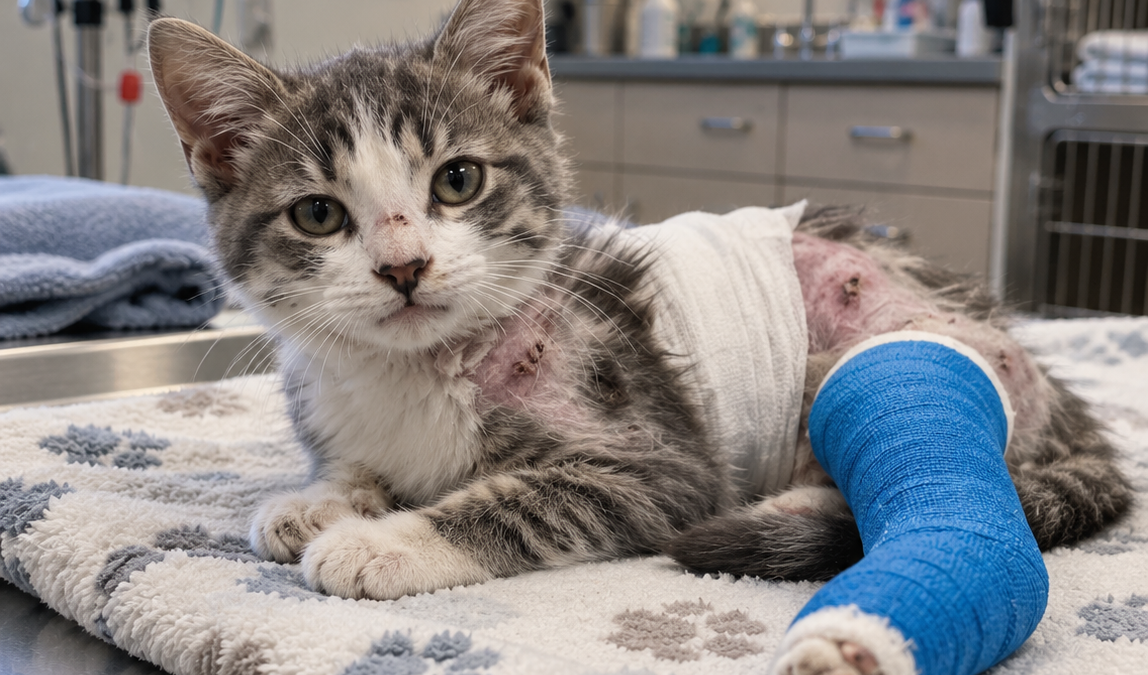
She was lying on a soft blanket, one back leg wrapped and stabilized, her side shaved around the abrasions. The raw patches looked angry but clean. Her chin was swollen. Her mouth sat slightly open, and I could see the tiny broken canine when she breathed.
She looked exhausted.
She also looked alive.
My wife covered her mouth.
“Oh, baby.”
I stepped closer.
“Asphalt,” I said softly.
Her eyes opened.
The vet tech smiled.
“She knows your voice.”
I do not know if that was medically true.
I chose to believe it.
I placed my hand near her head, not touching at first. She shifted just enough to press her cheek against my fingers.
The movement was tiny.
It felt enormous.
“I’ve got you,” I said.
My wife leaned down beside me.
“We’ve got you,” she corrected.
Asphalt blinked slowly.
That was the beginning.
We visited every day the clinic allowed it.
At first, she mostly slept. Her body needed rest more than affection, but each time we came in, her eyes opened. Sometimes she would press her chin weakly against my hand. Sometimes she would turn toward my wife’s voice. Sometimes she only looked at us, too tired for anything else.
I brought a clean T-shirt one day and asked if they could place it near her.
My wife teased me for becoming the kind of man who brought laundry to a cat.
I told her Asphalt had survived being thrown from a car and could have whatever she wanted.
The vet bills were paid.
That mattered.
I do not say that to sound noble. It was not noble when I handed over my card. It hurt. Eleven hundred dollars was real money to us. It meant delaying repairs. Cancelling a trip. Picking up extra hours. It meant looking at my motorcycle later and realizing the small cat at the clinic had cost nearly a quarter of what the machine under me was worth.
I did not regret it.
Not once.
A motorcycle is metal.
Important metal, yes.
Loved metal.
But metal.
Asphalt was warm. Breathing. Afraid. Alive because one impossible chain of seconds had not gone the other way.
Money could come back.
She could not.
News spread among our friends faster than I expected. My wife posted a small update, careful not to turn it into a spectacle. Just the facts. Cat thrown from car. Found alive. Surgery done. Recovering.
Messages came in.
Some angry.
Some heartbroken.
Some offering money, which I refused at first until my wife told me gently that refusing help can be pride pretending to be virtue. A few people sent twenty dollars anyway. One old riding buddy sent a hundred with a note that said, “For Asphalt. Toughest name I’ve ever heard for a cat.”
The name stuck.
Even my wife started using it.
Though when she thought I was not listening, she called her “little road warrior.”
After five days, Asphalt was released into our care.
The vet gave us instructions that made my head spin: medication schedule, wound cleaning, restricted movement, follow-up appointments, signs of infection, signs of pain, no jumping, no stairs, no rough play. We set up a recovery space in our spare room with soft bedding, a low litter box, water, food, and the leather jacket she had been found in.
I considered throwing the jacket away because of what it had been through.
Then I saw Asphalt curl against it.
So the jacket stayed.
It became hers.
For the first week at home, she barely moved except to eat, use the litter box, and shift positions. Her injured leg was awkward and protected. Her side was tender. She disliked medication with the focused betrayal of a creature who had survived highway trauma but considered oral antibiotics a step too far.
My wife was better at giving medicine.
I was better at being forgiven afterward.
Asphalt learned our voices.
She learned the sound of the refrigerator.
She learned the difference between my boots and my wife’s slippers.
She learned that the spare room door opening meant hands, food, medicine, or company, and after a while, she stopped flinching when it opened.
That was the first real victory.
Not walking.
Not healing.
Not eating.
Not even purring.
The first victory was when a door opened and she did not brace for something bad.
Healing is made of moments like that.
Small enough that people miss them if they are looking only for miracles.
The first time she purred, my wife cried.
I almost did too, but I pretended to inspect the litter box because men are occasionally ridiculous.
Asphalt was lying on her blanket after a wound check, exhausted but calm. My wife stroked the top of her head with one finger, carefully avoiding every sore place. At first, there was nothing. Then a faint vibration started under her chest.
So faint we both froze.
“Is that—?” my wife whispered.
I nodded.
Asphalt kept purring.
Not loud.
Not confident.
But real.
The sound filled the room more completely than any engine I had ever loved.
Weeks passed.
Her fur began to grow back along the scraped places. The raw pink skin faded to softer patches. The swelling went down. The broken canine remained slightly uneven, giving her a crooked little expression that made her look tougher than her size.
The leg took longer.
Recovery was slow, frustrating work.
At first, she put almost no weight on it. Then a little. Then more. Her walk was awkward, almost hopping. Every improvement made us celebrate like fools. Every setback made us panic and call the clinic too quickly.
The vet was patient.
“She’s doing well,” she told us more than once. “You have to let healing take the time it takes.”
That advice was meant for the cat.
I needed it too.
I wanted her past to be over quickly.
I wanted proof that the highway had not marked her permanently.
I wanted one clear moment where I could say, There, she is saved now.
But rescue does not work that way.
You can remove an animal from danger in one moment.
You cannot remove the memory from their body that fast.
Certain sounds scared Asphalt.
Car doors.
Loud engines.
The scrape of something heavy across pavement.
Once, I started my motorcycle in the driveway while the spare room window was cracked open, and my wife came running outside.
“Stop.”
I killed the engine immediately.
Inside, Asphalt had hidden under the low table, body pressed flat, eyes huge.
I felt sick.
“I didn’t think.”
“I know,” my wife said. “But now we know.”
For a while, I started the bike farther from the house.
Then, gradually, we helped Asphalt learn the sound did not always mean danger. Windows closed at first. Then open a little. Treats. Calm voices. No rushing. No forcing.
Months later, she would sit in the window and watch me roll the motorcycle down the driveway, unimpressed by the machine that had once brought me to her.
That felt like another miracle.
Asphalt became more herself as pain loosened its grip.
She was gentle, but not fragile.
That surprised people.
They expected a cat with her history to be either fearful or endlessly grateful. She was neither in the way they imagined.
She had preferences.
Strong ones.
She liked sleeping on my leather jacket but hated the expensive orthopedic pet bed we bought her. She liked my wife’s hair ties and stole them with criminal patience. She enjoyed sitting near the window but did not appreciate birds getting too close to the glass, which she seemed to consider disrespectful. She loved soft food, tolerated dry food, and treated medicine as an act of war.
She did not want to be carried for long.
Maybe being lifted reminded her too much of the wrong hands.
So we let her decide.
When she wanted touch, she came close.
When she wanted space, we gave it.
Trust grew better that way.
Not demanded.
Not grabbed.
Offered and accepted.
The first time she climbed into my lap on her own, I was sitting on the floor of the spare room reading through maintenance notes for the bike. She had been walking better by then, though still unevenly. I heard her little steps cross the room.
Slow.
Soft.
Determined.
She sniffed my boot, stepped over a folded towel, and placed one paw on my knee.
I held still.
She climbed up with great effort and settled there, pressing her body against my stomach.
Then she rested her head on my arm.
Just like she had on the side of the highway.
I did cry that time.
No pretending.
No litter box inspection.
Just tears.
My wife found us ten minutes later and quietly backed out without saying a word.
That night, Asphalt slept in my lap for nearly an hour.
My leg went numb.
I did not move.
Some weight is worth carrying.
Eventually, the follow-up X-rays showed the bone healing well. The pins were doing their job. The vet smiled more each visit. Asphalt hated the car rides, but she tolerated the clinic staff with royal exhaustion. Everyone there knew her by name.
“The highway girl,” one tech called her.
“Asphalt,” I corrected automatically.
The tech smiled.
“Asphalt.”
When the vet finally said she could gradually have more freedom in the house, my wife and I celebrated by opening the spare room door and letting Asphalt explore at her own pace.
She stepped into the hallway like an explorer entering disputed territory.
Sniffed the baseboards.
Inspected the living room.
Paused at the rug.
Discovered the couch.
Rejected the couch.
Discovered the laundry basket.
Accepted the laundry basket as her throne.
By evening, she had found the sunniest spot in the house.
By the next morning, it belonged to her.
Cats do not ask for ownership.
They reveal it.
My motorcycle friends wanted to meet her.
I allowed visits slowly. Asphalt had been through enough without a parade of loud men smelling like exhaust filling the house. But one by one, people came. They lowered their voices. They sat on the floor. They let her approach or not.
Most of them were men who looked, to strangers, like people you might avoid in a parking lot.
Big guys.
Beards.
Leather.
Tattoos.
Hands scarred from work, engines, and old mistakes.
Every single one softened when Asphalt entered the room.
One friend, Bear, a man who had once stitched his own hand with fishing line rather than go to urgent care, whispered, “Hi, baby,” in the tiniest voice I had ever heard.
Asphalt sniffed his boot and walked away.
Bear looked wounded.
“She hates me.”
“She just met you.”
“I would die for her.”
“Get in line.”
The jokes helped.
Not because the story was funny, but because joy had begun to return around her. For a while, every mention of Asphalt carried the weight of what had happened. Thrown from a car. Highway. Broken leg. Surgery. Road rash.
All true.
But she deserved to be more than the worst thing someone did to her.
She became Asphalt who stole hair ties.
Asphalt who slept on leather.
Asphalt who yelled at closed bathroom doors.
Asphalt who walked a little crooked but fast enough when she heard a can open.
Asphalt who survived.
Asphalt who stayed.
One evening, my wife found me standing in the garage beside the motorcycle, looking at the stretch of highway dust still caught in a hard-to-reach place near the frame.
“You okay?” she asked.
“Yeah.”
“You’re doing the thing where you say yeah but look haunted.”
I smiled despite myself.
“I keep thinking about the car.”
She leaned against the doorframe.
“Me too.”
“I hate that we don’t know who did it.”
“I know.”
“I hate that they probably just went home.”
“I know.”
“I hate that she trusted somebody before us and that person used her trust to get close enough to throw her.”
My wife was quiet.
Then she said, “But they don’t have her now.”
I looked toward the house.
Asphalt was visible through the laundry room doorway, sitting in her basket, licking one paw like she had never been involved in human tragedy and would appreciate better service.
“No,” I said. “They don’t.”
That became the thought I returned to when anger tried to take up too much space.
Whoever hurt her had one moment of power over her life.
They did not get the rest.
The rest belonged to Asphalt.
To healing.
To soft blankets.
To vet techs who spoke gently.
To my wife calling her Affy.
To friends sitting on the floor trying to earn approval.
To a motorcycle jacket that became a bed.
To a crooked walk across a safe living room.
To a name that sounded hard because she had been harder than the road.
A few months after the rescue, I rode that stretch of highway again.
I had passed it before in the truck, but riding it on the motorcycle felt different. The same wind. Same shoulder. Same rushing cars. Same long ribbon of asphalt stretching ahead like nothing had ever happened there.
My chest tightened as I approached the mile marker.
I slowed.
Not dangerously.
Just enough.
The grass had grown higher.
There was no sign of her now, of course. No mark on the road. No broken fur in the weeds. No evidence of the small life that had landed there and refused to die.
Highways erase quickly.
That does not mean nothing happened.
I pulled onto the shoulder near the place I had stopped that day. For a minute, I just sat on the bike, engine idling, boots planted, looking back.
Cars passed.
Wind pushed at my vest.
I thought about how close I had come to missing her.
A second later.
A glance away.
A different lane.
A decision to keep riding because stopping on a highway is dangerous and inconvenient and surely whatever came out that window was only trash.
One different choice, and Asphalt would have died alone in the grass while traffic moved around her.
That thought will never stop frightening me.
But it also reminds me of something.
Pay attention.
That sounds too simple, but maybe most important things are.
Pay attention to what moves when it should not.
Pay attention to what others dismiss.
Pay attention when your gut tightens before your brain has language.
Pay attention because sometimes the difference between life and death is one person noticing that trash does not bounce like that.
When I got home, Asphalt was in the window.
Her favorite spot.
Her body was longer now, healthier, fur grown in soft over the places where the road had torn it away. Her right back leg still looked slightly different when she walked, but she used it. She jumped carefully onto low furniture. She chased toys when she felt like it. She had become both survivor and spoiled house cat, which is exactly what she deserved.
I parked the bike and walked inside.
She met me halfway down the hall.
Not running.
She did not need to run.
She knew I would come to her.
I crouched, and she pressed her forehead against my hand.
“Hey, Asphalt,” I said.
She purred.
I thought of the first time I touched her in the grass, when every breath looked like a question.
Now the answer was here.
Warm house.
Full bowl.
Safe floor.
Her person kneeling in front of her.
Sometimes my wife still argues that we should have given her a softer name.
She says Asphalt sounds like a warning sign.
I tell her that is exactly why it works.
Asphalt is where the story could have ended.
Asphalt is what hurt her.
Asphalt is what she hit, what scraped her skin, what broke her leg, what should have been the last hard thing she ever felt.
But it did not get to define her as broken.
She took the name and made it mean survivor.
She made it mean the road did not win.
She made it mean someone saw.
One year after the rescue, we took a photo of her in the living room.
Not at the clinic.
Not injured.
Not wrapped in my jacket because she could not move.
This time, she was sitting on top of that same leather jacket by choice, front paws tucked neatly under her chest, eyes half closed in a patch of sun. Her fur had grown back. The marks on her side were faint beneath the gray and white. Her broken canine still gave her mouth a tiny crooked look, like she was permanently unimpressed.
My wife framed the photo.
Under it, she wrote:
She earned her name.
I did not argue.
That night, Asphalt climbed onto the couch between us.
She turned around three times, stepped on my stomach for no reason other than power, and settled with her head against my leg.
The television played quietly.
Outside, a car passed.
Then another.
Asphalt did not flinch.
That was the moment that got me.
Not the surgery.
Not the first steps.
Not the vet saying she would be okay.
This.
A car passing outside and her body remaining soft.
A sound that once belonged to terror becoming just another sound in the world.
I placed my hand lightly on her back.
She purred without opening her eyes.
The world had been cruel to her.
Then it had become ordinary.
And ordinary, after cruelty, is a miracle people do not talk about enough.
A bowl filled every morning.
A blanket that stays.
A jacket that smells like safety.
A person who leaves and comes back.
A passing car that does not mean pain.
A body allowed to sleep through the night.
That is what rescue becomes after the dramatic part ends.
It becomes ordinary love.
I still ride.
I still love the sound of my bike warming under me, the open road, the feeling of air moving around my body and everything unnecessary falling away for a while. But I ride differently now.
I watch more.
Shoulders.
Ditches.
Median strips.
Boxes that might not be boxes.
Bags that might not be bags.
Movement where there should not be movement.
I know I cannot stop for everything.
I know that.
But I also know what I saw.
The passenger window.
The small body.
The bounce.
And because I saw it, Asphalt is alive.
Not because I am special.
Not because I am a hero.
Because I paid attention one second longer than cruelty expected anyone to.
Most people on that highway saw nothing.
Maybe a few saw trash.
I saw something bounce.
Then I stopped.
That is the whole difference.
A tiny gray-and-white cat was thrown from a moving car at nearly seventy miles an hour.
She hit the road.
She bounced into the grass.
She broke a leg, scraped her body, damaged a tooth, and still kept breathing.
A biker riding behind the car saw it happen.
He pulled over.
He ran back.
He found her alive.
That is the story people like to tell because it has a clean shape.
Cruelty.
Rescue.
Survival.
But the longer Asphalt lives in my house, the more I understand that the real story did not end on the shoulder of the highway.
It began there.
It began when my wife drove thirty minutes without hesitation.
It began when a vet chose urgency over judgment.
It began when eleven hundred dollars became less important than one small life.
It began when Asphalt opened her eyes on a clinic blanket and pressed her cheek against my hand.
It began when she came home and learned that not every hand throws, not every engine means danger, and not every road leads back to pain.
Now she sleeps in sunlight.
She steals hair ties.
She growls at birds through the window.
She walks with a slight limp that makes me love every step more.
And sometimes, when she curls on my leather jacket and closes her eyes, I think about the person who threw her away.
I do not know their name.
I do not know their face.
I do not know whether they ever thought about her again.
But I know this.
They did not get the final word.
The road did not get the final word.
Pain did not get the final word.
Asphalt did.
Every time she purrs.
Every time she limps toward me with her tail lifted.
Every time she sleeps through the sound of passing cars.
Every time someone asks why I named such a sweet cat Asphalt and I say, “Because she earned it.”
She was thrown onto a highway.
She hit the ground.
She bounced into the grass.
And she lived.
Because one person saw what everyone else missed.
Because one person stopped.
Because sometimes the smallest life on the side of the road is still fighting harder than the whole world deserves.
And sometimes all it takes to change the ending is to notice that what fell from the window was never trash.
It was someone.








