I Saw Something Move in My Rearview Mirror—Then I Found a Cat Taped to a Fence Post
PART3:
A cat does not get taped to a fence post by bad luck.
No storm did this.
No traffic did this.
No machinery did this.
Human hands had held her there.
Human hands had wrapped tape around her legs, around her body, across her mouth.
Someone had made sure she could not run.
Someone had made sure she could not call for help.
That knowledge hit me so hard I felt sick.
The cat’s nostrils flared.
Her body trembled.
That brought me back.
“Hey,” I said, and my voice sounded wrong in the empty morning. Too loud, then too soft. “Hey, sweetheart. I see you. I’ve got you.”
Her eyes followed my hand as I reached for the utility knife.
I moved slowly.
Pain makes animals unpredictable, and fear makes them fight. I would not have blamed her if she tore into me the moment her mouth was free. But I also knew I could not leave the tape over her muzzle while I cut everything else unless removing it first made her thrash and hurt herself worse.
I had to think.
That was harder than it sounds when anger is pounding behind your eyes.
I wanted to rip every piece of tape away at once.
I wanted to shout.
I wanted the person who had done it to be standing there so I could ask what part of them had gone missing.
But she did not need my anger right then.
She needed steady hands.
I forced myself to breathe.
“Okay,” I whispered. “We’re going slow.”
I started with the tape around her front legs.
The blade was sharp, and that scared me. Her legs were thin. The tape was tight. I had to slide two fingers beneath the edge where I could, lifting it away from her body before cutting. The adhesive had stuck hard to her fur. Every movement pulled at her skin.
She flinched once.
Only once.
The smallest movement.
Then she held still.
I kept talking.
“Good girl. Good girl. I know. I know it hurts. I’m sorry. I’m getting you out.”
The first strip loosened.
One paw shifted forward, then fell weakly.
Her claws were out, but she did not strike.
I cut the next strip.
Then another.
The tape around her chest was worse. It had been wrapped several times, tight enough to hold her against the post, tight enough that her breathing must have been difficult for hours. I could see where her body had slid down and the tape had dragged along her fur, leaving raw lines beneath.
I wanted to remove the tape from her mouth.
I forced myself to wait until I could support her body.
If I freed her muzzle too soon and she panicked, she might twist against the remaining tape and tear skin. So I cut around her torso first, sliding my arm beneath her as the last support began to loosen.
She weighed almost nothing.
That frightened me too.
When most of the tape holding her body gave way, she sagged into my forearm. Her back legs were still partially bound. I held her carefully against my chest and cut those strips next.
Finally, only the tape across her mouth remained.
I looked at her.
She looked back.
“I’m going to take this off,” I said. “Then you can breathe better. Okay?”
My hand shook despite everything I did to stop it.
The tape had been pressed across her muzzle and around just enough to hold firm. I did not want to rip it. I worked at the edge with my fingernail first, then used the blade only to loosen the smallest part. The adhesive pulled fur from the bridge of her nose. A red mark crossed her muzzle beneath it.
I peeled slowly.
The tape came free.
The moment it lifted from her mouth, the cat opened her jaws and took one enormous breath.
She did not meow.
She did not scream.
She did not bite.
She simply breathed.
A full, desperate inhale, like someone coming up from underwater.
That sound will stay with me for the rest of my life.
People think rescue is dramatic because of movement—the cutting, the carrying, the rushing to a clinic. But sometimes the moment that breaks you is quieter. It is one breath taken by a creature who was almost denied even that.
When the last piece of tape fell, she collapsed completely into my arms.
Not struggling.
Not fighting.
Just done.
Her head rested against my wrist.
Her body was trembling so hard I could feel it through my sleeve.
I stood there on the shoulder of a two-lane road in the gray light before sunrise, holding a cat someone had tried to silence with tape, and I felt a kind of rage I did not know what to do with.
Then she leaned her head against my arm.
That small trust put the rage back where it belonged.
Later.
Anger could wait.
She could not.
I carried her carefully toward the truck.
The walk back felt longer than it had going out. Every sound seemed sharper now. Gravel under my boots. Engine idle. A crow calling from a power line. My own breath. Her tiny breaths, too fast but there.
I opened the passenger door and climbed up awkwardly, holding her close. I spread my jacket across the seat and wrapped her inside it. The jacket was old, faded at the seams, stained with years of road dust and coffee. It became the softest thing I owned the moment she touched it.
She curled as much as her sore body allowed.
Her eyes stayed on me.
“I’m not leaving you,” I said.
I do not know why I said it.
Maybe because somebody had.
Maybe because she needed to hear the opposite.
Maybe because I did.
I grabbed my phone and called dispatch.
Ron answered on the fourth ring, sounding like a man who had not yet decided whether coffee would make him human.
“You better not be calling to tell me you blew a tire.”
“I have to stop my route.”
Silence.
Then, sharper, “What happened?”
“I found a cat.”
Another pause.
“A cat?”
“She was taped to a fence post.”
Ron said nothing.
I looked at her.
She had closed her eyes, but her breathing was still fast.
“Her legs were tied. Mouth taped shut. I cut her down, but she’s hurt. I need to get her to a vet.”
Ron exhaled slowly.
“Where are you?”
I told him.
“There’s a town about twenty minutes ahead,” he said after a moment. I could hear him typing. “Clinic opens at seven.”
“It’s not seven.”
“I know.”
“I can wait there.”
“Go.”
“I’m going to miss the delivery window.”
“Go,” he repeated.
His voice changed then.
Less dispatcher.
More person.
“We’ll deal with the load. Get her help.”
I swallowed hard.
“Thanks.”
“And send me the clinic name when you get there.”
“Why?”
“So I know where to call if they need proof you had a reason to be late.”
That was Ron’s way of caring.
It was enough.
I pulled back onto the road with the cat wrapped in my jacket on the passenger seat. I drove differently than I had ten minutes earlier. Slower. Softer, as if the truck itself had to understand we were carrying something fragile now.
Every bump made me wince.
I kept glancing at her.
Her eyes opened now and then. She did not try to move. Once, when I hit a rough patch and apologized out loud, she stretched one paw slightly from the jacket. The paw was swollen, the fur uneven where tape had pulled at it.
“I know,” I said. “I know, baby. Almost there.”
The town was small enough that the veterinary clinic sat between a feed store and a closed hair salon. I pulled into the parking lot at 6:18 a.m.
The sign on the door said they opened at seven.
Forty-two minutes.
That is not a long time in ordinary life.
It is forever when you are sitting in a truck with an injured animal breathing in your jacket.
I killed the engine.
The sudden quiet felt strange.
The cat lifted her head a fraction, then lowered it again.
I moved carefully into the passenger seat area and gathered her onto my lap, jacket and all. She did not resist. Her body felt warmer now, or maybe my hands had gone cold. I could see the places where the tape had torn her fur away from her sides and legs. Red, irritated skin showed beneath. Her muzzle had a raw mark across it, a cruel line where silence had been forced onto her.
I kept thinking about the hours.
Eight to twelve, the vet would later say.
But I did not know that yet.
I only knew she had been there all night.
Darkness.
Cold.
Road noise.
Unable to move.
Unable to cry out.
Every passing car another chance that came and went.
How many headlights had crossed her before mine?
How many people had seen the shape and thought, Plastic?
How many had not looked in their mirror?
I do not ask those questions to blame everyone who passed. Maybe they truly did not see. Maybe the angle was wrong. Maybe the light was too low. Maybe the shape looked like trash until the exact second I looked back.
But I have thought about it.
I still do.
At 6:35, a woman pulled into the lot in a little blue car and parked near the side door. She wore scrubs beneath a jacket and carried a lunch bag. When she saw my truck and then saw me in the cab holding something wrapped in a jacket, she hesitated.
I opened the door carefully.
“Ma’am,” I called. “I know you’re not open yet, but I found an injured cat.”
She came closer, cautious but kind.
“What happened?”
I looked down at the cat.
“She was taped to a fence post.”
The woman’s face changed.
No professional mask can cover that first flash of horror completely.
“Bring her in.”
The clinic was not fully awake yet. Lights flicked on one by one. The air smelled of disinfectant, paper, animals, and coffee that had not finished brewing. The woman, a vet tech named Allison, led me into an exam room and laid a towel on the table.
When I set the cat down, she tried to tuck herself back into my jacket.
That nearly undid me.
“It’s okay,” Allison said softly. “We’ll keep the jacket with her.”
The veterinarian arrived fifteen minutes later, earlier than scheduled because Allison had called her from the back. Her name was Dr. Monroe. She had silver-streaked hair pulled into a messy knot and the calm, focused expression of someone who had seen enough emergencies to know panic helped no one.
She examined the cat gently.
Dehydrated.
Exhausted.
Skin irritated and torn where the adhesive had pulled fur loose.
Front paws swollen from compression.
Raw places along the legs and flanks.
A red abrasion across the muzzle.
No fractures that she could feel.
No signs, thank God, of internal trauma.
“We’ll do a full check,” Dr. Monroe said. “But from what I’m seeing, she’s very lucky.”
Lucky.
The word sat strangely in the room.
Lucky to be alive, yes.
Lucky that I saw her.
Lucky that the tape had not covered her nose.
Lucky that she had not slipped farther and suffocated.
Lucky that no predator had found her in the night.
Lucky that cold had not taken what cruelty left behind.
But there are forms of luck that should never be required.
“How long?” I asked.
Dr. Monroe looked up.
“What do you mean?”
“How long was she tied there?”
She hesitated.
“Based on dehydration, swelling, the way the tape marks look, and how exhausted she is? I would estimate eight to twelve hours. Possibly overnight.”
Overnight.
I had known.
Still, hearing it made something heavy settle in my chest.
“With her mouth taped,” I said.
Dr. Monroe’s jaw tightened.
“Yes.”
“So she couldn’t call.”
“No,” she said quietly. “She couldn’t.”
The cat lay still under the towel, eyes half open. Allison prepared fluids. Dr. Monroe cleaned the raw skin around the worst tape marks. They worked with quick gentleness, speaking softly to her as if every word mattered.
“What’s her name?” Allison asked.
I almost said I did not know.
Then I stopped.
A name formed, not because it was clever, but because it felt like the only thing the morning had given me.
“Mirror,” I said.
Both women looked at me.
I touched the edge of my jacket where the cat’s paw rested.
“I saw her move in my rearview mirror. That’s why I turned around.”
Allison’s eyes filled.
“Mirror,” she repeated. “That’s a good name.”
I do not know if names matter to animals right away.
But I think they matter to us.
They stop a suffering creature from being a case, a stray, a female domestic shorthair, a found animal. They make the heart understand what the hands are already doing.
Mirror had a name now.
Dr. Monroe gave her fluids, cleaned the wounds, treated the irritated skin, checked her mouth and nose, and gave medication for pain and inflammation. Mirror tolerated all of it with a kind of exhausted surrender that made me hurt for her. She flinched when adhesive-stressed skin was touched, but she never lashed out.
No biting.
No scratching.
No wild panic.
Just tired eyes and a body too worn out to argue with help.
When the exam was finished, Dr. Monroe gave me the cost.
Two hundred eighty-five dollars.
I paid it.
I am not rich.
Most truckers I know are not. People see big rigs and assume big paychecks, but there is always fuel, repairs, insurance, bills at home, food on the road, and the thousand small costs of keeping a life moving. Two hundred eighty-five dollars was not nothing.
But there are moments when money becomes very simple.
Not easy.
Simple.
A living creature had been taped to a fence post all night with her mouth sealed shut.
She needed care.
I had a card that still worked.
So I paid.
Dr. Monroe gave me a receipt, then hesitated.
“Do you plan to keep her?”
The question surprised me.
I looked at Mirror, wrapped again in my jacket on a clean towel. Part of me wanted to say yes immediately. Another part of me saw the cab of my truck, the long routes, the hours, the changing states, the impossibility of giving her the quiet recovery she needed from inside a sleeper berth.
“I’m on the road most of the time,” I said. “I don’t think that would be fair to her.”
“That’s honest.”
“It doesn’t feel good.”
“Honest doesn’t always.”
Allison stepped in then.
“There’s a rescue we work with. Small one. Good people. They might be able to place her in foster.”
“Can you call them?”
“Already did.”
That was the first time I realized the rescue had begun expanding beyond me. I had turned the truck around. I had cut the tape. I had carried her in. But saving an animal is rarely one person’s work after the emergency moment passes.
A person stops.
A tech opens the door early.
A vet leaves home before her shift.
A rescue answers the phone.
A foster makes space.
A dispatcher says go.
A chain forms.
Mirror’s chain formed fast.
The rescue volunteer arrived a little after nine. Her name was Beth, a woman in her fifties with a soft voice and the tired eyes of someone who had loved many animals through terrible beginnings. She brought a clean carrier lined with fleece and a little blanket patterned with yellow stars.
She listened while I explained where I found Mirror.
Her mouth tightened, but she did not interrupt.
People who do rescue work learn to hold outrage in one hand and logistics in the other.
“She’ll go to a quiet foster home,” Beth said. “No kids, no dogs, just recovery. We’ll watch the swelling, continue meds, and follow up with Dr. Monroe.”
I nodded.
Mirror’s eyes were half closed now.
“Will she be okay?”
Beth looked at her.
“She has a good chance.”
“A good chance?”
“She’s eating a little. No fractures. No internal injuries. She’s exhausted, dehydrated, traumatized, and sore. But yes, I think she’ll be okay.”
Okay.
Another word that felt too small and too enormous.
Before Beth placed Mirror in the carrier, I crouched beside the exam table.
“Hey,” I said softly.
Mirror opened her eyes.
“I can’t take you with me,” I told her. “I wish I could. But these people are going to help you. You’re safe now.”
She blinked slowly.
Maybe it meant nothing.
Maybe it meant everything.
I put my hand near her face. She did not press into it right away. She was too tired. But after a moment, her head shifted just enough for her cheek to rest against my knuckle.
That was her goodbye.
Or mine.
I am still not sure.
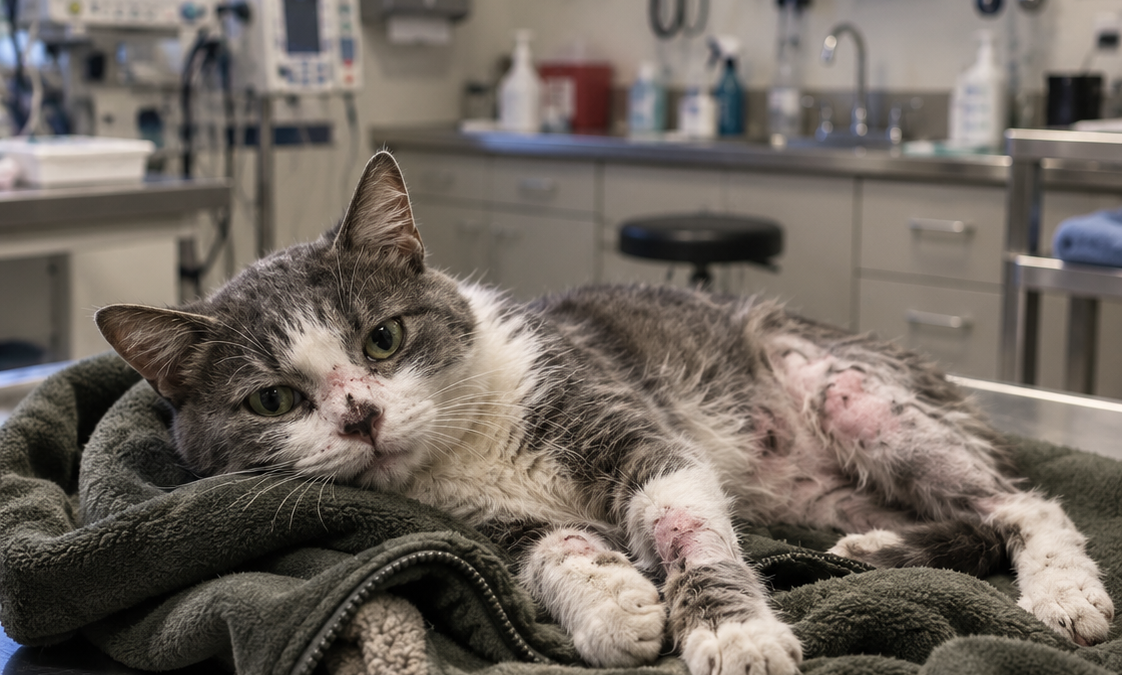
Beth took a photo before the first full round of treatment began. Mirror lay on the exam table wrapped in my old jacket, eyes open, fur missing in patches along her sides and legs, red mark across her muzzle visible even in the soft clinic light.
I have looked at that photo several times since.
Not because I enjoy seeing her hurt.
I do not.
But because it tells the truth.
She looked exhausted.
Confused.
Almost impossibly small.
Her eyes seemed to ask two opposite questions at once.
Why did someone do this to me?
And why did someone else stop?
I cannot answer the first.
I know exactly why I answered the second.
Because at sixty miles an hour, in the middle of nowhere, something on a fence post looked wrong.
Because I looked in my mirror.
Because that something moved.
One small movement.
One turn of the wheel.
That was the distance between being seen and being left.
I went back to my truck after Beth drove away with Mirror.
The parking lot was brighter now. Morning had fully arrived. A man in a baseball cap walked into the feed store next door carrying a bag of something over one shoulder. A woman in scrubs parked near the clinic entrance and hurried inside. Somewhere down the street, a school bus squealed to a stop.
The world had continued.
That felt offensive for a minute.
How could everything look so normal after a morning like that?
I climbed into the cab and sat with both hands on the steering wheel.
My jacket was gone.
The passenger seat looked empty in a way it had not looked before.
Ron called.
“You at the clinic?”
“Leaving now.”
“How’s the cat?”
“Alive.”
“That’s something.”
“Yeah.”
“You okay?”
I looked through the windshield.
I thought about the fence post. The tape. Her first breath.
“No,” I said.
Ron was quiet for a moment.
“Fair.”
He gave me the revised delivery plan. Another driver would meet me two towns over and swap trailers. I would lose time but not the whole route. Logistics moved around the emergency like water around a stone.
Before I pulled out, Allison came outside carrying my receipt and a paper bag.
“You forgot this,” she said.
I rolled down the window.
In the bag were the cut pieces of duct tape.
My stomach turned.
“I didn’t forget.”
“I know,” she said. “Dr. Monroe thought animal control might want them if you report it.”
I took the bag carefully.
Evidence.
That word made the cruelty feel heavier.
I called the county animal control office before I got back on the main road. I told them exactly where the post was. I told them the time. I told them the condition of the cat. I told them the clinic had treated her and the rescue had taken her.
The officer on the phone sounded tired but not indifferent.
“We’ll send someone to photograph the site,” she said. “Can you email us any pictures?”
“I didn’t take any at the post.”
“That’s okay. The clinic can send medical documentation with your permission.”
“Do it.”
“We may not find who did it.”
“I know.”
I did know.
That was part of the anger.
Cruelty often escapes consequence because it happens quickly, privately, in places where the victim cannot speak and the witness arrives too late. A fence post on a rural road does not tell you who stood there in the dark wrapping tape around an animal’s mouth.
But reporting still mattered.
Even if nothing came of it, the record would exist.
Someone did this.
Someone saw.
Someone said it was wrong.
I drove the rest of the morning differently.
Not badly.
Not distracted enough to be unsafe.
But changed.
Every fence post caught my eye.
Every piece of plastic along the road made me check again. Every strange shape on the shoulder became a question. I found myself using the mirror more than usual, scanning behind me not just for traffic but for movement, for proof that the road had not swallowed something small while I looked forward.
By lunchtime, Beth from the rescue texted me.
Mirror is settled in foster. She ate a few bites. Resting.
There was a picture attached.
Mirror was curled in a small bed, wrapped in the yellow-star blanket. Her eyes were closed. A shallow dish of food sat nearby. My jacket was folded under the blanket, still with her.
I pulled into a rest area before opening the message fully.
I sat there in the cab, surrounded by the sound of trucks idling, and cried.
Not loudly.
Not long.
But enough.
Truckers are supposed to be hard, or people like to think so. Maybe some are. Most of us are just tired human beings who spend too much time alone with our thoughts and know how to keep moving because stopping emotionally is not always an option.
That day, I stopped.
Just for a minute.
Then I wiped my face, answered Beth with thank you, and got back on the road.
Over the next several days, updates came in small pieces.
Mirror slept most of the first day.
She ate more on the second.
The swelling in her paws began to go down.
The raw skin where the tape had torn fur away was being treated and watched carefully.
The red mark across her muzzle started fading at the edges.
She did not like medication, which Beth said was a good sign because opinions meant energy.
By the fourth day, Mirror accepted chin scratches from her foster.
By the fifth, she used the litter box.
By the sixth, she stood in a patch of sunlight near a window and stayed there for twenty minutes.
Beth sent a photo.
The sunlight touched the gray fur along Mirror’s back. You could still see uneven patches where hair was missing. You could still see the thin red line across her muzzle. But her eyes looked different.
Less empty.
Less far away.
“She’s going to make it,” Beth wrote.
I stared at that sentence longer than necessary.
She’s going to make it.
There are words that feel like a door opening.
That was one.
I shared the update with Ron.
He replied, Good. Also your paperwork from Tuesday is still wrong.
That was Ron.
The rescue posted Mirror’s story online, keeping the details respectful but honest. The post spread farther than any of us expected. People were horrified. Angry. Heartbroken. Some offered donations. Some asked to adopt her. Some shared stories of animals they had rescued from ditches, parking lots, dumpsters, highways, and empty houses.
A few called me a hero.
I hated that part.
I do not mean I hated their kindness. People were trying to say something good. But the word hero felt too big and too clean. I had not planned anything. I had not done something extraordinary because I was brave. I had seen movement and turned around.
That should be ordinary.
That should be the minimum.
Maybe that is why the story affected people. Not because I was special, but because the decision was so small. A glance in a mirror. A foot on the brake. A walk back along the shoulder.
People understood, maybe, that their own small decisions might matter more than they realized.
I went back to that route two days later.
Same road.
Same farms.
Same fence lines.
Different sky.
When I saw the post, my chest tightened before I reached it.
Animal control had already been there. The tape was gone except for a few dried streaks of adhesive clinging to the wood. The post looked ordinary now. So ordinary that anyone passing would see nothing but weathered wood beside a road.
I slowed slightly, though not enough to create danger.
My eyes moved to the mirror automatically.
The post shrank behind me.
No movement.
No shape.
Nothing.
That should have relieved me.
Instead, it made me sad.
Because the absence of suffering leaves no marker. The road does not remember out loud. The fence does not explain itself. A person could pass that spot every day and never know a little cat spent the night there fighting to breathe through her nose.
But I knew.
So I remembered for the road.
Every week after that, I passed the post twice.
Once heading out.
Once coming back.
Every time, I looked.
At first, it was fear.
Then habit.
Then something like respect.
The post became a private mile marker, not for distance, but for a promise I had made without saying it aloud: I will keep looking.
Not just there.
Everywhere.
Because Mirror changed the way I saw the edges of the road.
Before her, strange shapes were usually trash until proven otherwise.
After her, strange shapes became possibilities.
Most still were trash.
Plastic bags.
Torn tarps.
Feed sacks.
Once, embarrassingly, a child’s stuffed dinosaur that had fallen from somebody’s car and scared the life out of me at dawn.
But twice, looking twice mattered.
A month after Mirror, I spotted a dog limping near a drainage ditch and called animal control before he reached traffic. Another time, I found a box of kittens near a closed gas station and waited until a rescue volunteer arrived. I am not saying this to make myself sound noble. I am saying one rescued animal teaches your eyes to stop dismissing small movements.
That is not always comfortable.
Seeing more means hurting more.
But it also means helping more.
Mirror stayed with her foster for several weeks.
Her fur began to grow back.
At first, the new growth came in uneven, soft little patches that made her look like a badly repaired stuffed animal. Beth said she was affectionate but cautious. She did not like the sound of tape being pulled from rolls, which broke my heart in a way I cannot describe. She did not like being picked up unexpectedly. She loved soft blankets. She loved window light. She loved wet food with gravy and showed no shame about that.
Good, I thought.
Let her want things.
Let her have preferences.
Let her be more than what happened to her.
Beth invited me to visit when Mirror was ready.
I almost said no.
Not because I did not want to see her.
Because I was afraid she would not know me.
That sounds selfish, but it is true. I had built something in my mind around that morning—the way she rested her head against my arm, the way I promised not to leave her, the way she rode beside me wrapped in my jacket. But to her, maybe I had been only a blur inside terror. A smell. A voice. A pair of hands during the worst morning of her life.
Maybe seeing me again would mean nothing.
Maybe it would frighten her.
Maybe I wanted recognition she did not owe me.
Beth seemed to understand without my explaining.
“She may remember your scent,” she said. “She may not react much. Either is okay.”
I went on a Sunday afternoon.
Beth’s foster room was quiet, with a cat tree by the window, soft beds, and shelves arranged for animals who needed control over their space. Mirror sat on a blanket in a square of sunlight. She was smaller than I remembered and healthier than I feared. The raw places had softened. The red mark on her muzzle had faded to a pale shadow. Her eyes were clearer.
I crouched just inside the doorway.
“Hey, Mirror,” I said softly.
Her ears moved.
Beth stood behind me, silent.
Mirror looked at me for a long moment.
Then she stood.
Slowly.
She walked across the room with the careful dignity of a cat who had survived human cruelty and saw no reason to rush for anyone now.
She stopped two feet away.
Sniffed the air.
Then came closer and pressed her cheek against my hand.
I had prepared myself not to need that.
I needed it anyway.
“Hi, sweetheart,” I whispered.
She purred.
Softly at first.
Then louder.
I sat on the floor, and she climbed onto my lap. Not fully. Just front paws first, the rest of her body still ready to leave if she chose. But she stayed there, pressing those paws into my jeans.
Making biscuits.
The same paws that had been taped to wood.
The same paws that had swelled from being bound.
Now pressing gently against me in a sunlit room.
Beth turned away.
I pretended not to notice.
Mirror’s adoption came later.
Not by me.
That surprised some people.
It did not surprise Beth, and it did not surprise me after I met the family.
They were a quiet couple who lived in a small house with screened windows, no children at home, and a senior cat who had recently passed, leaving a cat-shaped silence in every room. They had experience with trauma. They did not want a perfect animal. They wanted to give safety to one who needed time.
When Beth told me Mirror had an approved home, I felt two things at once.
Joy.
And loss.
That is the strange selfishness of rescue. You want the animal safe, loved, settled, chosen. Then when that happens, some part of you aches because the story is moving on without you.
I asked if I could meet the adopters.
They said yes.
The woman’s name was Carol. The man’s name was James. Carol held Mirror’s carrier like it contained a sleeping baby. James listened carefully to every instruction Beth gave. Medication history. Skin care. Triggers. Slow introductions. No tape sounds if avoidable. Let her come to you.
“Her name is Mirror,” Beth said.
Carol smiled.
“We’d like to keep it.”
I looked at her.
“Really?”
“She survived because someone looked back,” Carol said. “That seems worth remembering.”
I had to clear my throat.
“Yeah,” I said. “It does.”
Before they left, I crouched beside the carrier.
Mirror looked out through the door.
“You’re going home,” I told her.
Her eyes blinked slowly.
“Not the side of a road. Not a clinic. Home.”
I placed one finger against the carrier bars. She pushed her cheek into it.
Carol promised to send updates.
She kept that promise.
The first photo showed Mirror under a bed, eyes bright in the shadows.
The second showed her halfway out from under the bed, suspicious but curious.
The third showed her sleeping on a folded quilt.
The fourth showed her in a window, watching birds with fierce concentration.
The fifth, weeks later, showed her lying on James’s chest while he sat in a recliner, both of them asleep.
I saved every photo.
Months passed.
Mirror’s fur grew back.
The mark on her muzzle disappeared almost completely.
Carol said she still startled at certain sounds but recovered faster now. She had claimed a blue blanket as hers. She liked James’s slippers. She disliked closed doors. She had a tiny chirp she used when dinner was late, and dinner was late if it was not early.
She was becoming a cat with opinions.
That made me happier than any dramatic rescue update could have.
A healed animal is not one who forgets everything.
A healed animal is one who gets to be ordinary again.
Hungry at dinner.
Annoyed by a closed door.
Sleepy in sunlight.
Mischievous at midnight.
Loved without needing to perform gratitude for the rest of her life.
I still drive that route twice a week.
The post is still there.
Weathered wood.
Fence wire running from either side.
Fields beyond it.
Sometimes cows graze nearby, uninterested in human memory. Sometimes mist hides the lower rails. Sometimes the sunrise hits the post just right and turns the dried adhesive marks silver for half a second.
There is not much left now.
A little glue.
A faint discoloration.
Nothing more.
No sign.
No memorial.
No explanation.
Nobody passing at normal speed would guess what happened there.
Maybe that is why I always look in my mirror.
Not because I expect to see her again.
I know she is safe.
I have photos.
I have updates.
I know Mirror sleeps on a blue blanket in a house where tape is kept in a drawer and doors open gently.
I look because that morning taught me how thin the line can be.
Between seen and unseen.
Between dismissed and saved.
Between “probably nothing” and “turn around.”
The road is full of things people do not want to see.
Pain.
Trash.
Accidents.
Animals.
People.
Small movements at the edge of vision.
And every day, all of us make decisions about what deserves our attention.
I am not proud that I almost kept driving.
I am grateful that I did not.
There is a difference.
Pride says, Look what I did.
Gratitude says, Thank God I looked again.
When people ask why I stopped, I tell them the simple answer.
Because something moved.
But that is not the whole truth.
I stopped because once I saw movement, I had a choice. And I knew if I kept going, I would carry that choice farther than the load in my trailer. It would ride with me past the next town, past the delivery, past dinner, past sleep. I would see that shape in every mirror and wonder what I had left behind.
Stopping cost me time.
Not stopping would have cost me more.
I do not know who taped Mirror to that post.
I may never know.
I do not know whether they felt powerful, angry, bored, cruel, or simply empty in whatever place compassion is supposed to live. I do not know whether they thought she would die before morning or whether they thought nothing at all.
I have stopped trying to understand it.
Some acts do not deserve the dignity of being made understandable.
But I do know what came after.
A truck pulled onto the shoulder.
A utility knife cut through tape.
A dispatcher said, “Go.”
A vet opened early.
A rescue answered.
A foster made room.
A family chose her.
Her fur grew back.
Her muzzle healed.
Her paws stopped swelling.
She learned windows, blankets, food bowls, and hands that did not hurt.
That is the part I choose to carry.
Not the cruelty alone.
The chain that formed against it.
Because cruelty was the beginning of Mirror’s story with me, but it was not the ending.
The ending is a photo Carol sent last week.
Mirror sits in a patch of afternoon sun on the back of a couch, one paw tucked beneath her chest, eyes half closed, looking deeply inconvenienced by comfort in the way only cats can. Behind her, through the window, you can see a quiet yard and a bird feeder. There is no road. No fence post. No tape. No cold morning.
Just sunlight.
Safety.
A life continuing.
I keep that photo on my phone.
Sometimes, when I stop for fuel or sit in a loading dock waiting on paperwork, I open it and look at her.
I remember the shape on the post.
I remember the mirror.
I remember her first breath.
Then I look at the photo and remind myself that sometimes one turn of the wheel is enough to divide a nightmare from a second chance.
Yesterday, I passed the post again.
The sun was rising, just like that morning.
The road was quiet.
Mist sat low in the fields.
For a moment, the whole world looked almost the same.
I slowed slightly.
Not dangerously.
Just enough.
I looked at the fence post.
Then, as always, I looked in my rearview mirror.
Nothing moved.
The post grew smaller behind me.
The road opened ahead.
And in the cab of my truck, with the engine humming and the morning coming on, I said her name once out loud.
“Mirror.”
Not because she was there.
Because she made me look back.
Because she made me keep looking.
Because somewhere in this world, while people do terrible things in the dark, there are still small lives waiting for someone to notice one movement, one breath, one silent plea from the edge of the road.
And because if there is one thing I know now, it is this:
The world does not always give the helpless








