I Saw Security Follow a Hells Angel Through Every Aisle—Then I Realized He Was Buying Shoes for My Barefoot Son
PART3:
Behind the customer service counter, Sherry lifted her radio.
“Preston. Aisle six, kids’ apparel headed toward footwear. Big guy. Leather vest. Motorcycle club patches. Stay on him.”
Preston Yates was Riverbend’s loss prevention officer. Thirty-four years old. Former county corrections until a knee injury ended that path. He liked rules, cameras, patterns, and the quiet pride of catching trouble before it became expensive.
He crossed the sales floor with a radio in hand and fell into step two aisles behind Holt, close enough to watch, far enough to pretend he was not.
Holt walked past men’s boots.
Past work gloves.
Past flannel shirts.
Straight to the wall of children’s shoes.
I did not see that part.
Micah and I were in the restroom. I had him sit on the closed toilet lid while I unwrapped the wet newspaper from his feet. His skin looked pale and blue around the toes. I rubbed them between my hands, trying to bring warmth back.
“Does it hurt?”
“Only when I think about it.”
I closed my eyes.
“Baby.”
“I’m okay.”
“You don’t have to be okay all the time.”
He looked embarrassed.
“I know.”
But he didn’t.
Not really.
Poor kids learn to be okay because they can feel when not being okay costs too much.
I dried his feet with paper towels. Wrapped them again with fresh ones from the restroom dispenser, which were stiff and useless but dry. Then I tucked the plastic strips back around them as best I could.
“Just to school,” I said. “I’m going to figure something out after my shift.”
He nodded.
I hated the way he believed me.
Outside the restroom, Holt was crouched by the children’s shoe wall.
Preston watched from behind a rack of umbrellas.
Holt moved slowly, carefully, like his knees hurt. He began working down the shelf, size by size. He picked up shoes, checked soles, checked tread, checked price tags.
Then he started stacking boxes.
Four.
Six.
Eight.
Different sizes.
Toddler Velcro sneakers.
Boy’s high-tops.
Girls’ light-up shoes with pink straps.
A black sneaker with navy trim.
A pair with flowers stitched on the side.
No child stood beside him.
No woman helped him.
No list was visible except the small spiral notebook he pulled from inside his vest, soft at the corners from years of handling.
Preston radioed Sherry.
“He’s not shopping normal. Grabbing shoes in like six different sizes. No kid with him. Could be return scam. Could be resale.”
“Keep eyes on,” Sherry said. “I’m calling district loss prevention. Don’t lose him.”
Holt knew he was being watched.
Or maybe he knew and had stopped caring years ago.
That was something I would understand later.
Some people get followed once and feel offended.
Some get followed so often the sting turns into a callus.
Holt balanced the growing stack of shoe boxes against his forearm and pulled his phone from his vest pocket. He opened a text thread saved under the initials P.W.
Sizes running big this year, he typed. Got a boy out front looked like a 1, maybe 1.5. Newspaper in his shoes. You know him?
The reply came back fast.
Paige Whitcomb.
Roosevelt Elementary.
Renshaw family. New to shelter list this week. Eviction Thursday before last. Mom works nights at distribution center and mornings at diner on Trent. I’ll check roster for exact size. Give me 10.
Holt read the message.
Then looked toward the front of the store, where Micah and I would soon come out of the restroom and try to leave before anyone asked too many questions.
He went back to the shelf.
More shoes.
More sizes.
More notes in the little spiral notebook.
From where Preston stood, it looked like planning.
Columns.
Initials.
Sizes.
Dates.
Check marks.
To a suspicious mind, any private system can become evidence.
Preston edged close enough to read over the umbrellas.
R 8 boy 1 / 1.5.
Check mark.
He thought, He’s tracking something.
Then, because he had already decided what kind of man Holt was, he added another thought.
He’s documenting his own theft.
That made no sense.
But suspicion does not require sense once it has momentum.
What Preston could not see was that the notebook was the sixth in a series Holt had started fourteen years earlier in a supply tent forty miles from Mosul.
Staff Sergeant Holt Sheffield.
United States Army Quartermaster Corps.
Three deployments.
Operation Inherent Resolve.
He had never been famous, never decorated in the way civilians understand, never the kind of soldier movies chase with music.
His job had been boots.
Socks.
Cold-weather gear.
Water purification tablets.
Vehicle parts.
Replacement gloves.
The things men stop appreciating until they do not arrive.
Holt had learned to read supply lines like weather. He knew how many pairs of dry socks a platoon would burn through crossing mud for six days. He knew what happened when a boot size got guessed instead of confirmed. He knew paperwork could be too slow for cold feet and that systems failed most often when people assumed someone else had already checked the line.
He had never fired his weapon in anger.
But more than once, he had been the reason exhausted infantrymen got dry socks before frostbite set in.
Nobody at Riverbend knew that.
They saw leather.
Tattoo.
Size.
Silence.
A notebook.
A cart full of children’s shoes.
And their minds wrote the rest.
Holt pushed the cart toward the clothing section and added two packs of gray socks, then a navy child’s puffer coat. He checked the tag twice.
His phone buzzed again.
Size 1 confirmed, Paige wrote. Also, new info. He’s not the only one who needs help this month. Mom just found out diner cut her hours. If you’re already in there, grab a coat too. I’ll cover you Friday for the church drive.
Holt typed one word.
Already.
Then another.
On it.
At that moment, Sherry told the front registers to prepare for a possible theft intervention.
Micah and I came out of the restroom at 3:52.
I remember the time because the clock above customer service was right in front of me, and I was calculating whether we could make it to Roosevelt before the afternoon program doors closed.
Micah walked carefully beside me, trying not to let the paper slide off his feet.
He saw Holt before I did.
“That’s the shoe man,” he whispered.
“What?”
“The guy from outside. He looked at my feet.”
“Don’t stare.”
“I’m not.”
He was absolutely staring.
Across the store, Holt saw us.
He went still for half a second.
Not dramatically.
Just enough that his whole body seemed to brace around an old memory.
Then he pushed his cart forward.
Toward the checkout lanes.
Toward Preston.
Toward Sherry.
Toward a confrontation none of us understood yet.
Preston stepped into his path three steps from the register.
“Sir,” he said, feet apart, radio visible, voice pitched just above casual, “before you check out, I need to take a look through your cart.”
Holt stopped.
He looked down at Preston. There was nearly a foot of height between them.
For one second, his face did something complicated.
Tired.
Resigned.
Almost unsurprised.
Then it settled into a flat patience that made him look even more intimidating.
“Go ahead,” he said.
He stepped back from the cart without another word.
Preston had not expected that.
Most people argued.
Some got angry.
Some ran.
Some performed innocence so loudly that everyone nearby turned.
Holt simply moved aside, arms loose at his sides, and watched while Preston lifted box after box of children’s shoes and set them on the counter.
Toddler Velcro sneakers.
Boy’s size 13 high-tops.
Black sneakers with navy trim.
Girls’ shoes with flowers.
Light-up shoes.
Eleven pairs.
Two coats.
Four packs of socks.
Nothing hidden.
Nothing tampered with.
No security tags removed.
No mismatched inventory.
“You buying all this for one kid?” Preston asked.
Even from where I stood, six feet away, I could hear how much the question sounded like an accusation dressed up as small talk.
“No,” Holt said.
That was all.
He did not explain.
Did not offer a story.
Did not perform the kind of warm reassurance people expect from a large man trying to seem harmless.
That unsettled Preston.
I could see it.
Guilty men overexplain.
Innocent men often do too, out of panic.
Holt stood there patient as a fence post, letting silence answer for him.
For the first time, doubt crossed Preston’s face.
It lasted until Sherry arrived.
She came from customer service with her phone in one hand, corporate loss prevention apparently on the line, and the tight expression of a woman who had already told someone important that there might be an incident.
“Sir, I’m going to need you to step over to customer service with me while we sort this out,” she said.
Loud enough that two shoppers turned.
Loud enough that I stopped walking.
Loud enough that Micah’s fingers tightened around mine.
Something in Holt’s shoulders dropped half an inch.
Not fear.
Old disappointment.
The kind a man carries when a moment he hoped might go differently goes exactly the way it always has.
“Ma’am,” he said quietly, “I haven’t done anything but shop.”
“Then it won’t take long to clear up.”
Sherry reached for the cart handle.
In that half second, as the cart moved between them, Holt’s vest shifted. A folded photograph slid halfway out of the inside pocket where he kept it against his chest.
Preston saw it first.
So did I.
A woman with a wide, easy smile stood in front of a classroom door. Above her was a hand-lettered sign.
Mrs. Sheffield’s Shoe Closet.
At her feet sat a cardboard box filled with children’s shoes.
“That yours?” Preston asked before he could stop himself.
Holt’s hand closed over the photograph.
He pushed it back into his vest without answering.
For the first time since he walked through the doors, something like real strain showed on his face.
Not guilt.
Grief wearing guilt’s clothes because grief had not found anywhere else to sit.
He let Sherry take the cart.
Then followed her toward customer service with the slow, heavy patience of a man who had decided long ago that being misjudged was a tax he paid for having a body that frightened people.
Arguing about the tax had never lowered the bill.
Micah tugged my sleeve.
“Mom,” he whispered. “Those shoes.”
“Come on.”
“But maybe—”
“Micah.”
I wanted to leave.
I wanted to get out before someone looked down and saw the paper around his feet. Before someone asked if I needed help in a voice that made help feel like exposure. Before my son became another object in the store that people watched and judged.
But Micah did not move.
His eyes stayed on the black-and-navy sneakers now sitting on the counter beside customer service.
The ones Holt had held up earlier.
The ones that looked almost exactly his size.
At customer service, Holt sat on a hard plastic chair meant for men half his size.
For the first time that day, I saw how tired he was.
Not sleepy.
Soul tired.
His phone buzzed.
He pulled it out and typed.
I learned later the message went to a man named Dutch Lockridge, another rider waiting outside.
Getting detained, Holt wrote. Thought I bought shoes. Turns out I bought suspicion.
Thirty seconds later, a motorcycle engine kicked over outside.
Through the front windows, I saw another older biker swing off his bike and walk toward the doors.
He moved unhurriedly, but there was certainty in him. The kind old soldiers and old cops carry when they have already walked into worse rooms and survived.
He came through the automatic doors at 4:47.
Nobody had told me his name yet.
Dutch Lockridge.
Sixty-one.
Road captain.
Holt’s friend for almost twenty years.
He entered the store and looked first at Preston, holding eye contact long enough to make clear he was not there to start trouble.
“I’m looking for my friend,” Dutch said. “Big guy. Leather vest. Probably sitting somewhere looking like he already knows how this ends.”
Preston pointed toward customer service.
Then, to my surprise, walked beside Dutch instead of behind him.
Dutch reached Holt’s chair and put one hand on his shoulder.
Sherry’s posture tightened when she saw the second biker arrive.
Then Dutch looked at her name tag.
“Sherry Ostrom,” he said. “You want to know what’s in that cart and why? I can tell you. Or you can keep your supervisor on the phone another twenty minutes while she figures out you’ve got nothing. Your call.”
Sherry’s mouth tightened.
The phone in her hand crackled faintly.
Then she said, “I’m listening.”
Dutch nodded once.
“His name is Holt Sheffield. Staff Sergeant, United States Army, retired. Three tours running supply for units in Iraq and Syria. Operation Inherent Resolve, if you want to look it up.”
Holt looked away.
Dutch kept going.
“He kept convoys in dry socks and clean water when the systems above him fell apart. Did it by memorizing sizes and needs down to the ounce because getting it wrong meant somebody froze or went thirsty in the field.”
The store seemed to grow quieter.
“He came home and married a first-grade teacher named Deborah. Deborah ran a shoe closet out of her classroom at Roosevelt Elementary for kids who showed up barefoot, same as that boy you probably saw out front this afternoon.”
My breath caught.
Micah looked up at me.
Sherry’s face changed.
Dutch’s voice stayed even.
“She died of cancer six years ago. Holt never stopped the shoe closet. He just stopped telling anybody he was the one keeping it going because the last time a store manager saw him carrying eleven pairs of children’s shoes, this is exactly what happened.”
For several seconds, nobody spoke.
Preston set his radio on the counter.
Slowly.
Deliberately.
Like he was returning a weapon he no longer believed he needed.
He looked at the notebook sticking slightly from Holt’s vest.
“The initials,” Preston said quietly. “The sizes. He never wrote full names.”
Holt finally looked at him.
Preston swallowed.
“You let me check the cart.”
Holt said nothing.
“You didn’t argue. Didn’t run.”
Still nothing.
Preston’s face reddened.
“I’m sorry,” he said.
He meant it.
You could hear the difference.
Holt nodded once.
The smallest possible acknowledgment.
Then he reached slowly into his vest, giving Preston every chance to watch him do it, and pulled out the photograph.
He did not hand it to Sherry.
He handed it to Dutch.
Dutch had probably seen that picture a hundred times.
He took it anyway because some gestures are not about information.
They are about letting someone else hold the weight for a second.
Holt’s voice was low when he finally spoke.
“She used to say the same thing every year to the new teachers,” he said. “You can’t teach a cold kid to read.”
His hand rested near the photograph.
“She said people look at a boy like me and decide what he is before he says a word, and they’ll be wrong nine times out of ten. And the tenth time doesn’t give them the right to guess wrong the other nine.”
He looked at Sherry.
Then Preston.
“A man’s not dangerous because he’s big. He’s dangerous because somebody decided he was before he did a single thing to earn it. That’s the part nobody wants to sit with.”
Sherry lowered the phone from her ear.
The voice on the other end—Renata Cole, district loss prevention—came through thin and tinny.
“Sherry?”
Everyone looked at the phone.
Renata continued, “Release the hold. Comp whatever is reasonable. Put a note in the file that this customer is not to be flagged again. And you might want to think carefully about what actually triggered this stop before the next incident review.”
Sherry set the phone down.
She looked at the eleven pairs of shoes lined up on the counter, the coats, the socks, the notebook, the photograph, Holt’s huge hands folded in front of him.
“Mr. Sheffield,” she said, and her voice came out smaller than she meant it to, “I owe you an apology. A real one. Not a store policy one.”
Holt looked at her for a long moment.
“You were doing your job.”
That made her wince harder than anger would have.
“Wrong read doesn’t make you a bad person,” he said. “Makes you like most people.”
Micah broke the silence.
He pulled free of my hand before I could stop him and crossed the last few feet of tile toward Holt.
“Micah,” I whispered.
But he kept going.
He stopped in front of the enormous tattooed man on the little plastic chair and looked at the shoes on the counter, then at Holt’s face.
“Are those for somebody?” he asked.
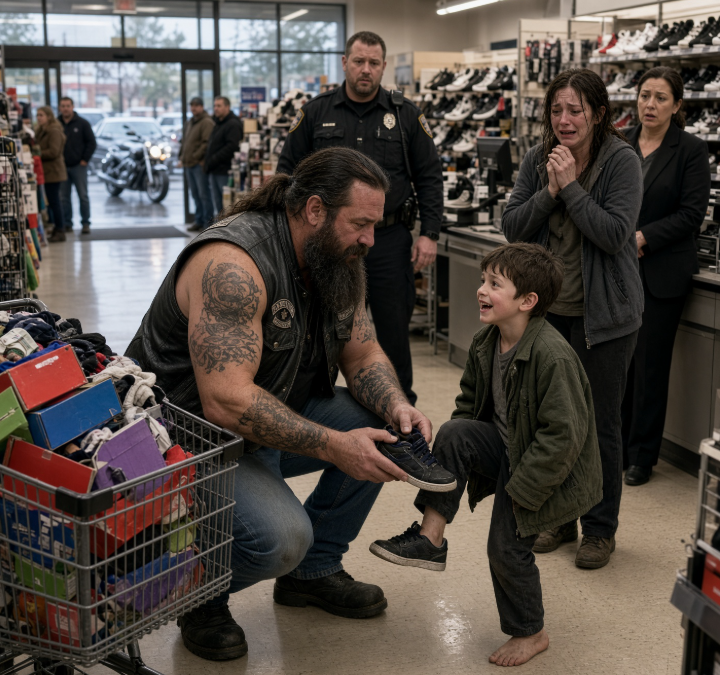
Holt crouched slowly until he was closer to my son’s eye level. His knees popped audibly.
“Might be,” he said. “What size shoe do you wear, partner?”
Micah looked down at the paper around his feet.
“I don’t know. I just know these ones broke.”
Holt reached for the black sneaker with navy trim, the one he had held in the aisle, the one I had noticed without wanting to hope.
“This one is a one and a half,” he said. “You want to see if it fits?”
My whole body tightened.
I wanted to say no.
Not because Micah did not need them.
Because he did.
So badly my throat hurt.
I wanted to say no because accepting help in public can feel like undressing under fluorescent lights. Because I had spent six days carrying more than one person should carry alone, and I had held myself together by pretending I still had control over something.
A stranger holding out shoes to my barefoot child meant everyone could see exactly how bad things had gotten.
Holt did not look at me with pity.
That was why I managed not to run.
He looked at me like a supply problem had been identified, and supply problems had solutions.
“Ma’am,” he said softly, “only if you say yes.”
Only if you say yes.
Not, Don’t be proud.
Not, It’s for the child.
Not, I’m trying to help.
Only if you say yes.
I nodded once.
Micah sat on the bench while Holt untied the sneaker. My son pulled the wet paper from one foot, embarrassed now that everyone could see. Holt positioned himself in front of him, blocking part of the view with his own broad back.
I noticed that.
So did Preston.
The shoe fit perfectly.
Micah stood in the middle of the aisle and turned his foot side to side. The small light on the heel blinked when he shifted his weight.
His face opened into a grin wide enough to show the gap where his front tooth had not grown back.
“They light up,” he whispered.
Holt’s beard moved.
“Makes you faster.”
“I knew it.”
Sherry turned away quickly, but not before I saw her wipe under one eye.
I tried to speak.
“I can’t accept all this.”
Holt packed socks into a bag.
“Sure you can.”
“No, I mean—”
He added the coat.
“Arms up, partner.”
Micah looked at me.
I nodded again.
Holt helped him into the navy puffer coat. It was slightly big, but not ridiculous. Room to grow. Mothers notice room to grow because poverty rarely leaves any.
“I can pay something,” I said, though we both knew I couldn’t.
Holt kept folding the second pair of shoes into the bag.
“It’s not charity.”
I almost laughed.
“It looks a lot like charity.”
“It’s logistics.”
I blinked.
“What?”
He spoke quiet enough that only I could hear.
“Somebody’s got surplus. Somebody’s got shortage. You move the surplus before it does anybody good sitting in a warehouse. He needed shoes. I had shoes. That’s the transaction.”
It was not entirely true.
There was a photograph in his vest and a classroom sign that still hung somewhere in memory.
But it was true enough to let me keep my dignity.
That mattered more to him than being thanked.
So I swallowed the thank-you that would have broken me open and said instead, “Then I appreciate the logistics.”
Holt nodded.
“That I’ll take.”
Twenty minutes later, Paige Whitcomb arrived at the store, breathless and damp from the rain. She had driven straight from Roosevelt Elementary after Holt’s second text.
I recognized her from the school office.
She recognized me immediately.
“Tasha.”
My face burned.
She did not make a scene.
Bless her forever for that.
She looked at Micah’s shoes, then at the bags, then at Holt.
“You’re H.S. Roosevelt?”
Holt shrugged as if initials were less revealing than a full name, though clearly they were not anymore.
Paige shook his hand with both of hers.
“I’ve been writing those intake reports for four years,” she said. “I never knew who you were.”
“Worked better that way.”
“Maybe for you.”
He did not answer.
Within a week, Paige connected me to a housing assistance fund through the district and helped me swap shifts at the diner so I could pick Micah up from school three days a week. She found emergency clothing vouchers, a school counselor who knew which forms mattered, and an apartment lead off Nevada Street that would become real by December.
But that afternoon, all I knew was that my son had dry feet.
Dry socks.
Shoes that blinked when he walked.
A coat that zipped.
And a smile I had not seen in too long.
Sherry checked us out herself.
She comped part of the purchase, though Holt tried to argue. Renata apparently overruled him through Sherry’s phone, which amused Dutch enough that he laughed for the first time.
“Big man losing a fight to corporate,” Dutch said. “Historic day.”
Holt grunted.
Micah whispered to me, “Is the shoe man mad?”
“No, baby.”
Dutch heard him.
“The shoe man always looks like that.”
Holt gave him a flat look.
Dutch smiled.
As we prepared to leave, Preston approached me near the entrance.
His radio was back on his belt, but his hand did not touch it.
“Ma’am,” he said, awkwardly. “I’m sorry your son had to see all that.”
I did not know what to say.
So I told the truth.
“He’s seen worse.”
That landed.
Preston looked at Micah, who was stomping gently to make the shoes light up.
“Still,” he said. “He shouldn’t have had to.”
“No.”
He glanced back toward Holt.
“Neither should he.”
I followed his gaze.
Holt stood near the counter, receiving his photograph back from Dutch. He tucked it carefully into his vest, over his heart.
“No,” I said quietly. “He shouldn’t.”
The rain had thinned when we stepped outside.
Not stopped.
Just softened into mist.
Holt and Dutch walked out behind us. Their motorcycles waited near the curb, dark and shining with rain.
Micah stood in the parking lot and looked down at his new shoes.
Blink.
Blink.
Blink.
Then he looked up at Holt.
“Thank you for logistics.”
Holt’s face changed.
Just barely.
But enough.
“You’re welcome, partner.”
“Are you a teacher?”
“No.”
“Your wife was?”
Holt went still.
I put a hand on Micah’s shoulder.
“You don’t have to answer,” I said quickly.
Holt looked at me.
Then at Micah.
“She was,” he said.
“Did she like kids?”
A long pause.
“She loved kids.”
Micah nodded.
“She would like the shoes.”
Holt looked away.
Dutch put one hand on his shoulder again.
“Yes,” Holt said roughly. “She would.”
That night, in the motel room, Micah refused to take the shoes off until bedtime. Even then, he placed them beside the bed where he could see them.
“Mom?”
“Yeah?”
“Do you think people thought he was bad because he looked scary?”
I sat on the edge of the mattress.
“I think people got scared because they thought they knew what scary looked like.”
“He wasn’t scary.”
“No.”
“He was sad.”
My throat tightened.
“You saw that?”
Micah nodded.
“When he looked at the picture.”
I brushed damp curls back from his forehead.
“You notice a lot.”
“So do you.”
“I missed some things today.”
“Like what?”
I looked at the shoes.
“At first, I saw the vest before I saw the person.”
Micah thought about that.
“People probably see my feet before me sometimes.”
I closed my eyes.
That one hurt.
When I opened them, he was watching me carefully.
I took his hand.
“Then we will both practice looking longer.”
He accepted that.
Children forgive in ways adults do not deserve.
The story spread through Riverbend before the week ended.
Not loudly at first.
Cashiers whispered.
Corporate called.
Sherry held a staff meeting with her jaw tight and a stack of notes in her hand. She did not use Holt’s name more than necessary. She did not make herself the hero for apologizing. She told them what Renata had told her: suspicious behavior and behavior that makes you uncomfortable are not the same thing, and treating them as the same costs people dignity, time, and trust.
She added a line herself.
“Ask before you assume.”
New hires later thought it was a customer service phrase.
Sherry knew exactly what it meant.
She taped an index card with those words inside her office door.
I saw it months later.
Ask before you assume.
Preston changed more quietly.
Three weeks after the incident, Dutch met him at a diner booth. I heard this part from Paige, who heard it from Dutch, who apparently had decided the whole town needed a little informal education one cup of bad coffee at a time.
Preston had started showing up off duty, asking questions about the club, about Holt, about wars he had never served in and grief he was only beginning to understand.
Dutch stirred sugar into coffee he did not want and said, “Man spent twenty years learning the biggest danger to a person isn’t a stranger who looks rough. It’s a room full of people who already decided what he was before he opened his mouth.”
Preston did not have much to say back.
But he kept coming.
Sometimes change looks like a speech.
More often, it looks like someone returning to the place where he was wrong and staying long enough to learn.
Holt kept bringing shoes to Roosevelt.
Not with ceremony.
Not with photos.
Not with speeches.
He would idle his motorcycle outside the school on delivery days, walk in with boxes labeled only by initials and sizes, nod to Paige, and leave before anyone made too much of him.
Micah called him the shoe man.
Holt accepted this with the resignation of a man who had survived worse titles.
In November, Micah outgrew the first pair.
Before I could panic, a second pair appeared at Roosevelt’s front office.
Size two.
Black with gray trim.
No note.
Just the initials H.S. on Paige’s intake sheet.
By Thanksgiving, my diner hours steadied. Paige’s housing contact helped us move into a small apartment off Nevada Street. It was not fancy. The kitchen drawer stuck. The heater clanged. The upstairs neighbor walked like he was personally angry at the floor.
But it was ours.
Micah had a bed that did not fold into a motel wall.
I had a door that locked.
And on the first night, he lined his shoes beneath the window like treasure.
In December, the first hard freeze turned puddles along Division Street into gray ice. I walked Micah to school myself that morning. He wore the navy coat, the gray-trim shoes, and a hat Paige had found somewhere.
Outside Roosevelt, Holt’s motorcycle sat near the curb.
Micah ran ahead.
“The shoe man!”
Holt lifted a gloved hand.
“Partner.”
Micah stopped in front of him.
“My shoes still fit.”
“I checked with Paige.”
“You spy on shoe sizes?”
“Logistics.”
Micah grinned.
Then, with the directness that makes children both dangerous and holy, he asked, “Do you still miss your wife?”
Holt’s eyes moved to me.
I started forward.
He lifted one hand slightly.
It was okay.
“Yes,” he said.
“All the time?”
“Most of it.”
“Even when you give shoes?”
“Especially then sometimes.”
Micah nodded like this made sense.
“I miss our old apartment even though this one’s better.”
Holt crouched slowly.
“That’s how missing works. Doesn’t always care what got better.”
Micah looked relieved.
No therapist in the world could have explained it more gently.
Holt stood, knees protesting.
“You get to class.”
“Okay.”
Micah ran inside.
I remained on the sidewalk.
“Thank you,” I said.
Holt shrugged.
“You already thanked me.”
“Not for the shoes.”
He looked at me then.
“For what?”
“For not making his sadness smaller just because he has something better now.”
Holt was quiet for a moment.
Then said, “Deborah taught first grade. I learned most of what I know from listening through the classroom door.”
I smiled.
“She sounds wonderful.”
“She was.”
This time, the grief in his voice did not look like guilt.
It looked like love with nowhere else to go but forward.
The following February, Riverbend held a shoe drive.
Officially, it was a store-community partnership.
Unofficially, it existed because Sherry Ostrom had not been able to stop thinking about eleven pairs of shoes lined up on a counter like evidence of her worst assumption.
There were bins near the entrance. Signs printed neatly. Discounts for donations. A partnership with Roosevelt and two shelters.
Holt hated it.
Not the help.
The attention.
Dutch told him to stop being dramatic, which coming from a man who rode a motorcycle the size of a sofa and wore a vest covered in patches was rich.
Micah and I went on the first Saturday.
I brought two pairs of shoes.
One pair Micah had outgrown.
One pair I bought new with money from my own paycheck.
Size one and a half.
Black with navy trim.
Same as the pair Holt had given him.
I held them for a long time before dropping them into the bin.
Micah watched me.
“Hard?” he asked.
“A little.”
“Good hard?”
I nodded.
“Good hard.”
Preston was near the front, off duty but helping. He saw us and came over.
“Hey, Micah. Shoes still making you faster?”
Micah lifted one foot.
“These are the new ones. Better traction.”
“Important.”
Preston held out a sticker from the donation table.
Micah took it.
Then Preston looked at me.
“I put a pair in too,” he said quietly.
“That’s good.”
He nodded.
“I didn’t tell anybody.”
“Sometimes that’s better.”
His eyes moved toward the counter where Holt had once been detained.
“Yeah,” he said. “I’m learning that.”
Holt arrived later with Dutch, carrying boxes from the club’s own drive. Men in leather vests walked through Riverbend with children’s shoes stacked in their arms, and this time no radio crackled with warnings.
People still looked.
Of course they did.
Looking is human.
But the story attached to the looking had changed.
Sherry met Holt near the entrance.
“Mr. Sheffield.”
“Sherry.”
There was awkwardness between them still, but not the brittle kind.
The honest kind.
“Thank you for coming,” she said.
“Dutch made me.”
Dutch said, “Lies build character if used properly.”
Sherry smiled.
Then handed Holt a clipboard.
He looked at it like it had insulted him.
“What’s this?”
“Inventory.”
His eyes narrowed.
“You want me to organize it?”
“You said you don’t miss sizes.”
For the first time, I saw Holt almost smile.
Almost.
He took the clipboard.
“Your columns are bad.”
Sherry laughed.
“Then fix them.”
He did.
For three hours, Holt Sheffield, the man security had followed through every aisle, stood near the front of Riverbend Family Outfitters organizing donated children’s shoes by size, condition, season, and likely school need. Preston carried boxes. Sherry checked labels. Dutch pretended not to enjoy directing traffic. Micah helped by matching pairs and announcing when shoes looked “too sad to donate.”
At one point, I stood near the doorway and watched.
A mother came in with a toddler on her hip and a boy about six hiding behind her leg. She looked embarrassed. I knew that look. Pride fighting need and losing slowly.
Sherry approached her first.
Not with suspicion.
Not with pity.
With a question.
“What size are we looking for?”
The woman’s face crumpled with relief.
Holt looked over from his clipboard.
“Six boys’ winter. Left bin. Two good options.”
Sherry blinked.
“You memorized the bins?”
Holt looked offended.
“Of course I did.”
Dutch leaned toward me.
“World’s scariest shoe fairy.”
I laughed harder than I expected.
Holt heard.
“Don’t encourage him.”
By spring, Micah knew Holt’s motorcycle by sound.
Not all motorcycles.
His.
A deep, steady rumble that turned the corner near school on delivery days. Micah would look up before I did and say, “That’s him.”
Sometimes Holt stopped.
Sometimes he only lifted a hand and rode on.
Micah never learned Holt’s whole story.
Not the details of Iraq.
Not every convoy.
Not the long hospital months with Deborah.
Not the nights Holt sat at his kitchen table wondering whether the shoe closet was generosity or grief wearing a disguise.
He only knew Holt as the shoe man.
The giant with the beard who brought shoes to kids who needed them and acted like it was just logistics.
That was enough.
Maybe more than enough.
A year after that rainy October afternoon, I returned to Riverbend to buy Micah shoes with my own money.
Full price.
No voucher.
No emergency fund.
No shame burning holes through my shirt.
Micah tried on three pairs and chose the second-cheapest because, despite everything, old habits linger.
“You can pick the ones you like,” I told him.
“I do like these.”
“Because of the price?”
He looked caught.
I sat beside him on the fitting bench.
“Micah.”
He looked down.
“I don’t want you to worry.”
“That is my job.”
“Mr. Holt says logistics works better if everybody knows what they need.”
I smiled.
“He’s right.”
“I need shoes that don’t make you scared at the register.”
That sentence hit me so hard I had to breathe before answering.
I took his hands.
“Baby, I am not scared at this register today.”
“You promise?”
“I promise.”
He chose the blue pair with stronger soles.
At checkout, Sherry was working the front.
She recognized us immediately.
“My goodness,” she said. “You grew.”
Micah stood taller.
“New size.”
“I see that.”
She scanned the shoes.
I paid.
Such a simple thing.
Card inserted.
Approved.
Receipt printed.
Nobody watching us like we did not belong.
Outside, Holt’s motorcycle was parked near the curb.
I had a feeling Sherry had texted him.
He leaned against it, arms folded, pretending coincidence.
Micah ran to him with the shoebox.
“I bought these.”
Holt looked down.
“With your own money?”
“My mom’s.”
“Still counts.”
“They’re size three.”
“Good tread.”
“I checked.”
Holt nodded gravely.
“Proud of you.”
Micah’s face lit.
Then he asked, “Are you proud of my mom too?”
I froze.
Holt looked at me over my son’s head.
His pale eyes were kind in a way I had not noticed that first day because fear had stood too close.
“Yes,” he said. “Very.”
I had to look away.
Some words reach places charity cannot.
Later, Sherry came outside and stood beside me while Micah talked to Holt about speed, traction, and whether light-up shoes were scientifically faster.
“I never told you this,” Sherry said, “but that day changed the way I manage the floor.”
“I saw the training sign.”
“Ask before you assume.”
“Yes.”
She folded her arms.
“I thought I had good instincts. Maybe I did sometimes. But instinct without questions is just prejudice with confidence.”
I looked at her.
“That’s a hard thing to admit.”
“Yes.”
“You admitted it.”
“After I humiliated someone.”
I watched Holt listening seriously while Micah explained playground racing rules.
“He let you apologize,” I said.
“That doesn’t erase it.”
“No.”
“But it let me change.”
“That matters.”
Sherry nodded.
“I still watch the floor. I still stop real theft. But I ask more questions now.”
I smiled faintly.
“Holt would call that better logistics.”
“He already has.”
Of course he had.
On the Friday evening before Thanksgiving, Preston clocked out after a long shift. I only know this because Sherry told me months later. He walked past the donation bin near the entrance, stopped, looked around once to make sure nobody was paying attention, then reached into his own bag.
He pulled out a pair of boy’s sneakers, size six, bought on his lunch break.
No note.
No announcement.
No photo.
He dropped them into the bin and walked out into the cold, tugging his collar up against the wind like anyone might at the end of an ordinary shift.
That is how real change enters the world most of the time.
Quietly.
Not with speeches.
With shoes in a bin.
With a manager asking one more question before lifting the radio.
With a biker carrying a photograph and a notebook full of initials that were not names because children deserve help without exposure.
With a mother learning that accepting help does not mean surrendering dignity.
With a child getting to walk into school without wet newspaper around his feet.
People still ask me about that day.
They want to know whether I was afraid of Holt.
Yes.
I was.
I will not pretend otherwise to make the ending cleaner.
He was huge. Tattooed. Silent. Wearing a vest that carried a reputation louder than his voice. I had reasons in my past to fear men who looked rough before they proved anything.
But fear is only the first page.
It should not be the whole book.
Sherry saw Holt and wrote thief.
Preston saw Holt and wrote suspect.
I saw Holt and wrote danger.
Micah saw Holt look at his feet and wrote shoe man.
My eight-year-old got closest to the truth.
That still humbles me.
Because children are not magically wiser than adults. They can be wrong too. They can misread danger. They need protection. That day, I was right to be careful with my son.
But I was wrong to think careful meant certain.
Certainty is where harm began.
Holt had spent years being read wrong before he ever reached the register. His body became evidence. His silence became guilt. His notebook became a criminal ledger. His grief became suspicious behavior. Eleven pairs of children’s shoes became proof of a scam because no one asked why a man with rough hands might know that kids needed different sizes.
The truth was simpler and heavier.
A first-grade teacher named Deborah Sheffield once kept a cardboard box of shoes behind her classroom door because she knew you cannot teach a cold child to read.
Cancer took her.
Her husband kept the box going.
That was all.
That was everything.
He did not do it to be thanked.
He did not do it to soften his image.
He did not do it because he was secretly gentle in a way that made the leather untrue.
The leather was true too.
The tattoos were true.
The motorcycle was true.
The grief was true.
The supply sergeant was true.
The shoe closet was true.
People are allowed to contain more than the first thing you notice.
That is what I want Micah to remember.
Not that every stranger is safe.
Not that uniforms, patches, or appearances mean nothing.
They mean something.
But not everything.
Ask before you assume.
Look again before you decide.
Leave room for the possibility that the person you fear may be carrying exactly what someone else needs.
Micah is ten now.
He still grows out of shoes too fast.
Every time I buy a new pair, I think of wet newspaper under the Riverbend awning and the way Holt blocked the view with his own broad back so my son could try on shoes without every eye in the store on his bare feet.
That was kindness.
Not the loud kind.
The kind that understands dignity has to be protected in small angles.
Holt still delivers shoes to Roosevelt.
Paige still pretends not to cry when certain boxes show up.
Sherry still keeps the index card on her office door.
Preston still drops shoes into donation bins when he thinks no one is watching.
Dutch still calls Holt the world’s scariest shoe fairy and survives only because Holt loves him too much to object properly.
And me?
I keep a pair of Micah’s old black-and-navy sneakers on the top shelf of our apartment closet.
Not because they fit.
They do not.
Not because I want to remember being poor.
I could never forget.
I keep them because they remind me of the day a store full of people decided they knew a man by the way he looked, and one child’s cold feet told the truth instead.
Security followed a Hells Angel through every aisle.
They watched his hands.
His cart.
His notebook.
His silence.
They thought they were watching a crime form.
But he was buying shoes.
For my son.
For other children too cold to learn comfortably.
For a dead teacher whose classroom door still lived in a folded photograph.
For every kid the world looked at too quickly and judged too soon.
And maybe, in some quiet way, for himself.
Because grief needs somewhere to go.
Holt Sheffield found a shoe aisle.
A notebook.
A school closet.
A way to keep love moving after loss tried to make it stop.
That day, my son walked into Riverbend with newspaper around his feet.
He walked out in shoes that lit up when he stepped.
And every time those little lights blinked across the wet parking lot, I felt something inside me blink back on too.
Not pride.
Not yet.
Not peace.
Something smaller.
Hope.
The kind that arrives quietly, in the wrong-looking hands, asking no praise.
The kind that says, Somebody has surplus. Somebody has shortage. Move what is needed.
The kind that looks like logistics.
The kind that saves a child’s feet before it ever explains itself.








