I Saw a Tied Garbage Bag Moving in the Creek—Then a Mother Cat Dove Back Under for Something She Refused to Leave
PART3:
I had seen animals protect their young before.
Birds dive at dogs.
A doe stand between a fawn and a road.
A dog refuse to leave a burning porch until firefighters found puppies beneath it.
But I had never seen anything like this.
This was not instinct in the simple way people talk about instinct.
This was decision.
Again.
Again.
Again.
She knew the water was killing her.
And still she chose to go back.
The third time, she was slower.
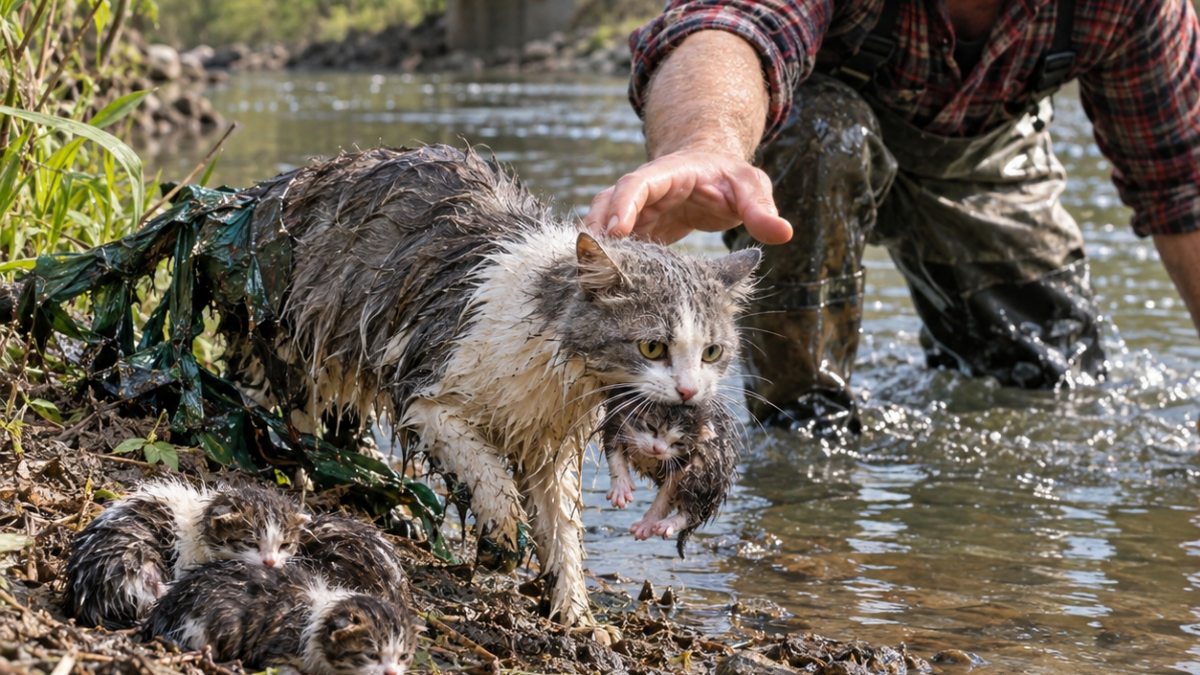
The bag had filled more completely. Every movement dragged dead weight behind her. The knot, still tied around what remained of the plastic, had twisted tight near her hind legs. She swam with her front paws only, shoulders breaking the surface, head dipping under, mouth clamped around the kitten.
I could hear her coughing between strokes.
Not a normal cough.
A wet, choking sound.
She was swallowing water.
Inhaling it.
Drowning in small pieces while fighting her way to shore.
I pushed through the creek toward her, but the current between us was stronger than it looked from above. My boots sank into silt. Mud sucked at my legs. Branches and weeds tangled around my calves. I was moving, but not fast enough.
She hit the bank sideways and nearly lost the kitten.
I dropped to one knee in the water and reached, but she twisted away from my hand just long enough to place the third kitten beside the others.
Alive.
Three tiny bodies in the mud.
Three miracles no bigger than my palm.
The mother stood over them, shaking so violently her legs nearly gave out.
Her fur clung flat to her ribs. Water ran from her mouth. The torn bag was still attached to her hind legs, trailing behind her like a shadow.
“Let me help you,” I said.
My voice cracked.
I was close enough now to see her eyes.
They were pale green, wide with terror and pain, but focused.
She looked at me.
Then she looked at the water.
I understood before she moved.
“There’s another one,” I whispered.
She turned.
This time, I did not shout.
I did not tell her no.
Because I knew she would go.
The fourth time nearly killed her.
She disappeared beneath the surface, and the creek closed over her completely.
Ten seconds.
Fifteen.
Twenty.
I waded forward blindly, arms out, feeling for plastic, fur, anything. The current pushed against my hips. My heart hammered so hard it drowned out the sound of the water.
I thought she was gone.
Then she surfaced less than a yard from the bank.
The fourth kitten was in her mouth.
Her body was nearly vertical in the water. The plastic bag had twisted around both hind legs and was pulling her backward and down. She could barely keep her nose above the surface.
She slammed against the muddy edge once.
Slipped.
Tried again.
Slipped again.
But she did not release the kitten.
Even as her own head dipped under, she lifted the baby higher.
That image has never left me.
The kitten above the water.
The mother beneath it.
If I live to a hundred, I will still see it when I close my eyes.
I lunged and grabbed her by the scruff.
She weighed almost nothing, but the bag fought me like a thing alive. Water had filled it completely, and the knot around her hind legs was so tight I had to brace one foot against the bank and pull with both hands.
The cat made no sound.
Not when I dragged her up.
Not when the plastic tore against her injured legs.
Not when I fell backward into the mud with her and the kitten against my chest.
She waited until we were on land.
Then she opened her mouth and placed the fourth kitten beside the others.
It moved.
Alive.
Only then did she collapse.
I have never felt as helpless as I did in that moment.
Four kittens lay on the mud, wet and squirming, each no longer than my fingers. The mother lay beside them, chest heaving, mouth open, eyes unfocused. The remains of the dark green garbage bag were still knotted around her hind legs.
I pulled my pocketknife from my jeans with shaking hands and cut the plastic away.
The knot had dug into her ankles. Deep. Too deep. The plastic had sliced through fur and skin until blood mixed with creek water and mud.
She did not flinch.
That frightened me more than if she had screamed.
I took off my flannel shirt and scooped the kittens into it. They were cold but moving. Their tiny mouths opened silently. One made a faint squeak. Another twitched its paws as if still swimming in whatever nightmare it had been born into.
The mother tried to lift her head toward them.
“They’re here,” I said. “They’re here. I’ve got them.”
I don’t know if she understood the words.
But her eyes shifted toward the bundle.
Then she passed out.
I called 911 first because my hands were too muddy to search for the animal hospital number, and because something in me needed a human voice on the other end of the line.
The dispatcher asked what the emergency was.
I said, “Someone threw a bag of cats into the creek.”
There was a pause.
Then she said, “Sir, are you safe?”
“I’m fine. They’re not. I need a vet. I need animal control. I need somebody now.”
I heard her typing.
“How many animals?”
“Five. A mother and four babies.”
“Are they alive?”
I looked down.
The mother’s chest rose.
Fell.
Rose again.
“For now,” I said.
Animal control arrived first, then a sheriff’s deputy, then a woman from a nearby rescue who had been called by the dispatcher because she was closer than the vet. Her name was Joanne, and she came running down the bank with towels and a carrier, breathless and pale.
When she saw the kittens, she whispered, “Oh, sweetheart.”
When she saw the mother, she stopped speaking entirely.
We wrapped them all.
The mother’s breathing sounded like wet paper tearing.
Every inhale rattled.
Every exhale seemed uncertain.
Joanne pressed a towel gently around the cat’s body and said, “She needs oxygen now.”
The deputy stood nearby, staring at the torn plastic bag.
His face had gone hard.
“Somebody tied it?”
“Yes,” I said.
“And threw it from the bridge?”
“I saw it hit.”
He looked up toward the road.
Cars passed above us, ordinary and careless.
The world had already gone back to moving.
I wanted to scream at it to stop.
At the veterinary clinic, they took the mother immediately.
The kittens went into warming blankets. Two had inhaled water, but they were responsive. Their temperatures were low but not as low as the vet expected. Joanne said the mother must have freed them inside the bag before carrying them out.
That hit me harder than I expected.
“She didn’t just tear herself loose,” Joanne said. “She got them loose first.”
I sat down in the waiting room because my legs suddenly did not feel reliable.
The sheriff’s deputy took my statement there, his notebook balanced on one knee. I told him everything. The splash. The bag. The first kitten. The second. The third. The fourth. The way the bag kept dragging her down. The way she held the last kitten above the water when she couldn’t climb.
He wrote it all.
Then he closed the notebook and said, “I wish I could promise we’ll find who did it.”
“But you can’t.”
“No.”
I nodded.
I already knew.
No cameras.
No license plate.
No face.
Just an act.
That is one of the cruelest things about cruelty. Sometimes it arrives, damages everything it touches, and leaves no name behind.
Dr. Patel came out after nearly an hour.
She was a small woman with silver in her black hair and a surgical mask pulled under her chin. Her eyes looked tired in the way doctors’ eyes get tired when the fight is not over.
“She’s alive,” she said.
I let out a breath I hadn’t realized I was holding.
“But she’s critical.”
“What’s wrong?”
“Water in both lungs. Not just residual moisture. Creek water. Sediment. Her oxygen saturation was seventy-nine when she came in.”
I didn’t know enough medical science to understand all of that, but I understood the look on her face.
“That’s bad.”
“That’s critical. We’re giving oxygen support. She aspirated during at least two of the dives, maybe more. Her body is exhausted.”
“And her legs?”
“Deep lacerations around both hind ankles. The plastic tightened as the bag filled with water. It cut into the tissue. She’ll need sutures once she’s stable enough.”
Dr. Patel hesitated.
“There are injuries in her mouth too. Lacerations inside the cheeks and along the gums. Two teeth are cracked.”
“From the bag?”
“Most likely from chewing through it.”
Chewing through it underwater.
I pressed both hands against my knees.
Dr. Patel’s voice softened.
“She weighs five pounds.”
I looked up.
“She was fighting a waterlogged bag that weighed more than twice that.”
I stared at the floor.
Five pounds.
She had dragged something heavier than herself through the water four times with newborns in her mouth.
I had spent most of my life believing courage looked a certain way. Uniforms. Medals. Emergency lights. Men running into smoke. Soldiers carrying each other through fire. And yes, courage can look like that.
But that day, courage weighed five pounds, had torn gums, bleeding ankles, water in her lungs, and refused to stop until every kitten was on land.
“What happens now?” I asked.
“Now we see if she makes it through the next twenty-four hours.”
I stayed.
Joanne stayed too.
Ellen arrived after I called her, taking one look at my soaked jeans and mud-covered shirt before pulling me into a hug so hard I almost broke.
When I told her the whole story, she cried quietly into my shoulder.
“She went back four times?” she asked.
“Four.”
“God.”
“I know.”
The kittens stabilized first.
They were about a week old, Dr. Patel said. Eyes still closed. All four needed feeding, warmth, and monitoring. Two had a little water in their lungs, but it cleared faster than expected. None had injuries from the bag.
Their mother had protected them from the plastic before she protected herself.
That fact became the center of everything for me.
I kept coming back to it.
Not just that she saved them.
The order of it.
Them first.
Then her.
For three days, the mother cat stayed on oxygen.
She lay in an incubator with tubing near her face, chest moving fast even while sedated. Her front paws twitched sometimes. Her back ankles were bandaged. Her mouth was too sore for solid food. Dr. Patel said the oxygen support was helping, but she still had a long way to go.
The kittens were brought to her briefly when it was safe.
Even half-conscious, she reacted.
Her head lifted.
Her body tried to move.
The staff had to keep her still so she wouldn’t hurt herself, but once they placed one kitten near her, she settled. Her breathing remained rough, but her eyes softened.
She licked the kitten’s head once.
Only once.
Then she was too tired.
Joanne whispered, “She knows.”
On the third night, Dr. Patel called me at home.
I thought it was bad news.
It wasn’t.
“She’s breathing on her own,” she said.
I sat down at the kitchen table.
Ellen gripped my shoulder.
“She’s off oxygen?”
“For now. We’ll keep watching her, but yes.”
I covered my face with one hand.
Dr. Patel waited.
When I could speak, I asked, “Can I see her tomorrow?”
“Yes.”
“What happens to them after?”
“The rescue can place them when they’re ready. Unless…”
She let the sentence hang.
Ellen looked at me.
I looked back.
Some choices are made before they are spoken.
“We’ll take the mother,” I said.
Ellen smiled through tears.
“And the kittens until they’re old enough,” she added, because she knew me and knew I was already halfway there.
Dr. Patel chuckled softly.
“I thought you might say that.”
The first time I held the mother cat after the rescue, she was wrapped in a towel, bandages on both hind legs, breathing with a faint whistle when the air caught wrong in her chest.
Her eyes were open.
Pale green.
She looked at me like she remembered.
Not with gratitude. Animals are not obligated to be grateful for surviving human cruelty. She looked at me with assessment, like she was deciding whether my hands were safe.
I sat still.
No sudden movement.
No reaching too fast.
“You don’t owe me anything,” I told her.
Her ears flicked.
“You did all the work.”
She blinked slowly.
I took that as permission to breathe.
The rescue asked what to call her for the paperwork.
I did not answer immediately.
For days, people had been calling her “Mama,” which was true but not enough. She was more than what had been done to her. More than what she had survived. More than the kittens she had saved.
She was evidence.
Evidence against the person who tied that bag.
Evidence against every excuse people make about animals not feeling, not understanding, not mattering.
Evidence that value does not come from what humans assign.
I thought about what I had told my friend Mark over the phone the night before.
“Someone tied a cat and her four kittens in a garbage bag and threw them into a creek,” I had said. “That’s what a human decided they were worth.”
Mark had gone quiet.
“And she decided her babies were worth dying for. One of those decisions was right.”
Now, standing at the clinic counter, I looked through the glass at the little gray-and-white cat who had dragged her body out of death four times.
“Verdict,” I said.
The receptionist looked up.
“Verdict?”
“Yes.”
Ellen tilted her head.
I explained it later.
People ask why I named her that.
I tell them because she is the answer.
Someone decided she was garbage.
She decided her kittens were everything.
One of those decisions was correct.
That is the verdict.
Verdict came home nine days after the creek.
The kittens came with her in a heated carrier, four tiny bundles of impossible survival. We named them River, Mercy, Hook, and June, though the rescue warned us not to get too attached because they would eventually need homes.
That warning did not work.
For the first week, Verdict stayed in a quiet spare room with dim light, soft blankets, medication, and no plastic of any kind. We learned quickly that plastic bags terrified her. Ellen opened a grocery bag in the kitchen once, and Verdict froze in the doorway, ears flattened, body low, eyes huge.
I threw every plastic bag in the house away that afternoon.
Every single one.
Trash bags.
Shopping bags.
Freezer bags.
Packaging.
If it crinkled like the thing that had nearly killed her, it went.
Ellen came into the kitchen and found me stuffing plastic into an outdoor bin.
“We still need garbage bags,” she said gently.
“Paper.”
“For garbage?”
“I’ll figure it out.”
She didn’t argue.
That is marriage.
Sometimes love is not saying the practical thing twice.
Verdict healed slowly.
Her lungs improved, but her breathing remained noisy in damp weather. A faint whistle, especially on rainy mornings. Dr. Patel said scar tissue might stay. Her ankles healed into two pale rings where fur never grew back fully. Her cracked teeth had to come out months later. The fur on her chest remained thinner where water and stress had damaged it.
The kittens grew fast.
Too fast.
Their eyes opened.
They learned to wobble, then pounce, then terrorize everything lower than a coffee table. Verdict watched them with strict attention. If one squealed too loudly, she was there. If one wandered too close to the hallway, she blocked the way. If I picked one up, she watched my hands until I put it back down.
I never took offense.
Trust is not owed.
It is built.
With Verdict, it was built in inches.
The first time she let me touch her, it was by accident. I was sitting on the floor of the spare room while the kittens climbed over my boots. Verdict lay nearby, half-dozing, eyes nearly closed. I reached to move a blanket, and my knuckles brushed her shoulder.
She stiffened.
I stopped.
“Sorry,” I whispered.
For a long second, she did not move.
Then she relaxed.
Only a little.
But enough.
A week later, she allowed two fingers under her chin.
A month later, she climbed onto the couch beside me.
Six months later, she fell asleep with one paw touching my leg.
I did not move for forty-seven minutes.
Ellen laughed when she found me.
“You need anything?”
“My left foot is numb.”
“Move it.”
“I can’t.”
“Why?”
I pointed to Verdict.
Ellen smiled.
“Then I guess you live there now.”
When the kittens were old enough, the rescue found homes.
River went to a family with two gentle daughters who sent photos every month. Mercy went to a retired teacher. Hook went to a young couple who already had a senior cat. June stayed with us because Ellen said she was “too small to leave,” though by then June was the largest of the four.
Verdict seemed to understand when each kitten left.
She sniffed the carriers.
Watched the doors.
Listened.
Then returned to June.
I worried the departures would break her, but animals understand growth better than humans sometimes. Her babies were alive. Warm. Fed. Safe. Maybe that was enough.
What she never accepted was water.
Not bowls.
She drank from those.
But open water.
The creek, the tub, rain hitting a metal roof, even the sound of a sink filling too fast—those things changed her. Her body would lower. Her ears would flatten. Her breathing would whistle. She would leave the room and hide under the bed.
So we adjusted.
No baths.
No running water near her.
No plastic bags.
Paper grocery sacks only.
Fabric trash liners in small bins.
Covered carriers with soft blankets, never anything that could rustle around her legs.
People sometimes said we spoiled her.
I never corrected them.
I just thought, You didn’t see her in the water.
The story spread after Joanne posted about it online.
She did not include the worst photos, thank God. Just one image of Verdict wrapped in a towel at the clinic, eyes open, kittens bundled safely beside her. And another later, after she came home, with June sleeping against her chest.
The comments were endless.
Some people were furious.
Some wanted punishment.
Some said they could not read it.
Some said animals are better than humans.
I understood the feeling.
But I did not fully agree.
Because if animals were better than humans, then what was I supposed to do with Dr. Patel? With Joanne? With the dispatcher who called rescue? With the deputy who stood in the mud looking like he wanted justice so badly it hurt? With Ellen throwing out every plastic bag because one cat could not bear the sound?
Humans had done the terrible thing.
Humans also carried them out of the creek.
That contradiction is hard to live with.
But it is the world as I have found it.
Years passed.
Verdict is about five now.
She is smaller than she should be, just over five pounds, with a narrow face, pale green eyes, and a chest that rises a little harder when the air is wet. The rings around her back ankles are still there, hairless bands of scar tissue where the plastic cut deep. When she yawns, you can see the gap where the cracked teeth were removed.
She does not like strangers.
She does not like bags.
She does not like water.
She loves sun on the back porch, paper grocery sacks with the handles cut off, sleeping on Ellen’s folded laundry, and sitting on my tackle box as if to remind me she outranks fishing now.
I still go to the creek sometimes.
Not as often.
Never without thinking of her.
The bridge is the same. The water moves slowly most days. People still throw trash sometimes, though less now. The county put up a camera after the story went around, and signs warning against dumping. Whether they help, I don’t know.
Every May, on the anniversary, I stand on the bank where she climbed out.
I can see it as clearly as if it were still happening.
The torn green plastic.
The mud.
The four kittens moving in my shirt.
Verdict collapsing only after the last one was safe.
People call her a hero.
She is.
But I think that word can become too neat.
It can turn suffering into something people admire from a distance.
Hero sounds clean.
What happened to Verdict was not clean.
It was wet, muddy, violent, and terrifying. It left scars in her lungs, her ankles, her mouth, and whatever part of an animal remembers the sound of plastic closing around her babies.
She is not inspiring because she suffered.
She is inspiring because even while suffering, she chose them.
Again.
Again.
Again.
Again.
One day, a boy from the neighborhood came over with his mother to meet her. He had read about Verdict for a school assignment on animal courage. He was maybe ten, serious-eyed, holding a notebook.
He asked, “Why didn’t she just save herself?”
His mother looked embarrassed.
“It’s okay,” I said.
Verdict was sitting in a patch of sun, tail around her paws, watching us with mild suspicion.
I thought about the question.
Why didn’t she save herself?
Because she was a mother, some people would say.
Because of instinct.
Because animals don’t think that way.
But I had seen her look back at the water after the third kitten.
I had seen the tremble in her legs.
I had seen the decision.
“She did save herself,” I finally said.
The boy frowned.
“But she went back.”
“Yes.”
“So how did she save herself?”
I looked at Verdict.
“By saving what mattered most to her.”
The boy wrote that down.
Carefully.
Ellen read it later in the school newsletter and cried.
Verdict did not care.
She was busy knocking a pen off the table.
Sometimes at night, when rain taps against the windows and her breathing whistles faintly in her sleep, I remember the bag rising under the water.
I remember thinking it was trash.
That is the thought that still shames me.
Because someone else had thought the same thing first.
Trash.
A disposable thing.
A problem to be tied up and thrown away.
But the bag was not trash.
It was a mother.
It was four newborns.
It was five lives.
It was a verdict waiting to be delivered.
I have spent years trying to understand the person who threw them in.
I can’t.
I do not know if they were angry, drunk, desperate, ashamed, cruel, or empty. I do not know whether they looked into the bag before they tied it. I do not know whether they heard the kittens cry. I do not know whether they stood on that bridge for even one second after the splash.
Maybe they walked away feeling nothing.
Maybe they have forgotten.
I haven’t.
Verdict hasn’t either, not entirely.
Her body remembers.
The way she freezes at plastic.
The way she avoids the bathroom when the tub runs.
The way she watches June if a storm gets loud, even though June is grown and safe and twice her size now.
But her body remembers other things too.
The porch sun.
The softness of blankets.
The sound of Ellen opening a can of food.
My hand resting near her but not grabbing.
June pressing against her side.
Safety, repeated often enough to become believable.
That is what healing is, I think.
Not forgetting.
Not becoming what you were before.
Healing is when terror is no longer the only thing your body expects.
One evening, not long ago, I was sitting on the porch after rain. The air was damp, and Verdict’s breathing had that soft whistle. She sat beside me on the old bench, close but not touching.
The yard smelled like wet grass.
Ellen was inside, washing dishes.
June chased a moth against the screen door.
Verdict looked toward the road, ears moving at every sound.
I said, “You know, you won.”
She blinked.
“I don’t know if anyone told you that.”
She turned her head slightly, unimpressed.
“You did. Whoever threw you in thought the story ended there. But you brought every one of them out.”
Verdict stretched one paw forward.
The scar around her ankle caught the porch light.
I reached down slowly and rested my hand beside her.
After a moment, she leaned her shoulder against my fingers.
Not much.
Just enough.
Enough from a cat like Verdict is everything.
People ask why I kept her.
The answer seems obvious to me.
Because I watched her do what many humans fail to do.
I watched her value life when someone else had thrown it away.
I watched her fight for the helpless while helpless herself.
I watched her place each kitten on the shore and return to death until there was no one left behind.
How could I put her in another cage after that?
How could I hand her off like she was only a survivor and not a witness?
No.
Verdict came home with me because she had already made her case in the water.
She had already shown the court of anyone willing to look that an animal is not a thing, not waste, not property without feeling, not a problem to be discarded.
She was five pounds of wet fur and torn gums, and she delivered a judgment stronger than anything I could ever say.
Someone tied the bag.
Someone threw it.
Someone decided they were nothing.
Verdict tore through that decision with her teeth.
She dragged love to shore four times.
That is why I named her Verdict.
Because after what I saw in that creek, the question was settled forever.
Animals feel.
Animals choose.
Animals grieve.
Animals fight.
Animals love with a force that can shame the rest of us.
And sometimes, when the world tries to drown that truth, it comes back up with a kitten in its mouth.








