I Saw a Scarred K9 Sitting at Gate C12—Then I Said the Name I Thought I’d Never Say Again
PART3:
Some said things like, “At least he died doing what he loved,” which made me want to put my fist through drywall.
Odin did not love war.
Dogs do not love war.
They love handlers, routines, purpose, food bowls, praise, the smell of home, and the certainty that if they stand between danger and their person, their person will still be there when the smoke clears.
I was not there.
That was the part that stayed.
The blast took the vehicle, most of my memory of that day, and half the men in the convoy. Odin had dragged me out before the fuel cooked off completely. I knew that from the after-action report. I knew it from the burns on his body described in the same sterile paragraph that told me he later died.
He saved me.
Then he died without me.
That is a debt with no place to send payment.
A year later, I was at Sea-Tac because my sister had guilted me into coming home to Michigan for Thanksgiving.
She did not call it guilt.
She called it “family concern.”
My mother called it “necessary.”
My father said nothing because he had been a Marine and knew when silence was kinder than pressure.
So there I was, sitting at Gate C12 on a bleak Tuesday in November, waiting for Flight 412 to Chicago, then a connection home I was not sure I wanted to make.
The terminal was miserable.
Rain hammered the glass. Flights were delayed. People were tired, trapped, and looking for somewhere to put their frustration. Businessmen snapped into phones. Parents negotiated with toddlers like hostage teams. Gate agents absorbed abuse with dead-eyed professionalism.
I sat near the charging stations with an unread newspaper on my lap and a steel travel mug on the table beside me.
I had chosen the shadows by habit.
Back to the wall.
Sight lines open.
Exits counted.
Crowd density noted.
I wore a faded olive drab tactical jacket, jeans, and boots that still looked military no matter how civilian I tried to be. My hair was high and tight because some habits survive retirement better than others.
Mostly, people left me alone.
That was all I wanted.
At least, that was what I believed until I heard the first laugh.
Not a normal laugh.
Not the irritated amusement of travelers watching some airport absurdity.
Cruel.
Sharp.
Directed.
I looked up.
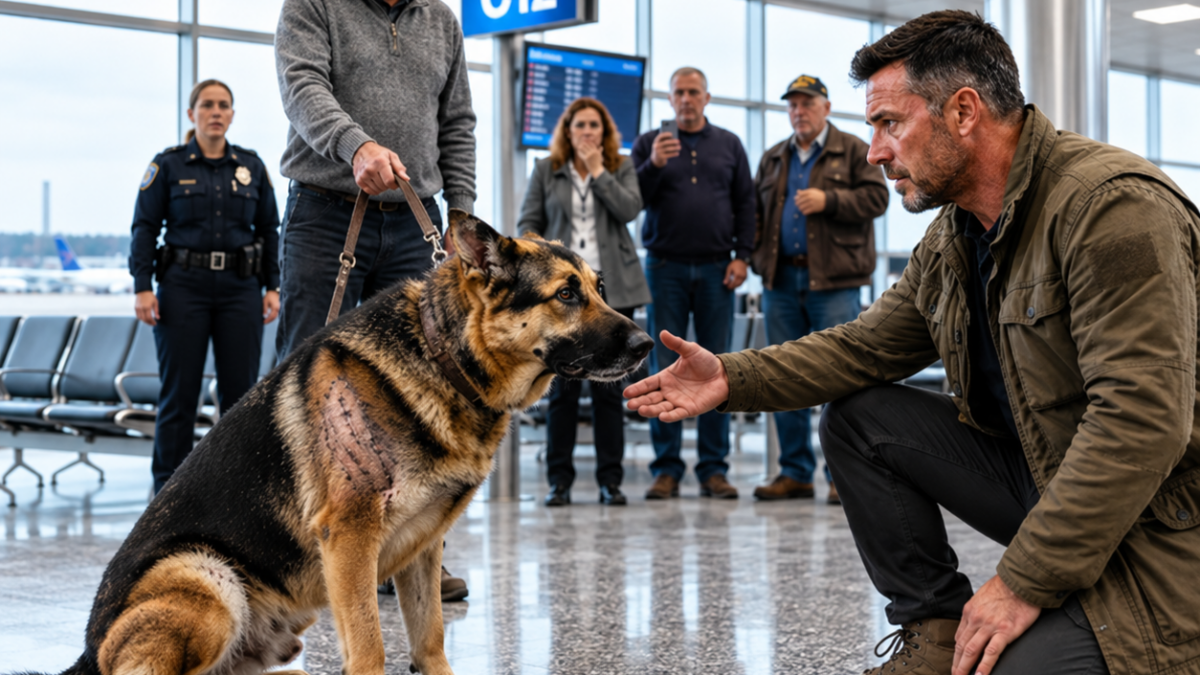
Across the gate area, a civilian volunteer in a gray sweater sat rigidly on a bench with a heavy leather leash clenched in one hand. He was around fifty-five, maybe older, with the nervous posture of a man who wanted to disappear but had been given something too important to abandon.
At his left knee sat a German Shepherd.
For half a second, I saw only damage.
That is the truth.
One ear missing completely.
Burn scar tissue running down the right shoulder and across the rib cage.
Laceration marks along the muzzle.
Scarred eyelids.
A titanium cap gleaming on one lower canine when he panted.
Ninety pounds of muscle and trauma sitting in a rigid heel under fluorescent airport light.
Passengers saw him and recoiled.
I saw him and felt my lungs stop working.
Not because I knew yet.
Because something in the shape of him reached into a place I had sealed off.
The dog did not pace.
Did not sniff bags.
Did not beg.
Did not react to people pointing.
He scanned the terminal.
Hands.
Doors.
Movement.
Perimeter.
Not nervous.
Working.
Even scarred and exhausted, he was doing the job.
A woman in a designer trench coat yanked her son away.
“Don’t look at it, sweetie,” she hissed. “It’s probably diseased.”
The volunteer’s jaw tightened.
The dog did not move.
Then a man in a navy suit nearly tripped over the volunteer’s duffel bag and decided the entire terminal needed to hear his opinion.
“Jesus Christ!” he shouted. “What the hell is that thing?”
The gate area shifted.
People love a spectacle when they are bored and delayed.
The volunteer stood halfway.
“He’s a rescue dog, sir. We’re just waiting for the flight. He won’t bother you.”
“A rescue?” the man scoffed.
He was in his thirties, expensive suit, expensive watch, expensive haircut, the kind of man who looked like he had never been told no in a tone that stuck. His fiancée stood beside him with an oversized iced coffee and a phone in her hand.
“That thing looks like a junkyard mut that got hit by a lawnmower,” the man said. “Why is it in the terminal? Dogs like that belong in cargo. Or a shelter. Actually, looking at it, it probably belongs in an incinerator.”
Something moved through me.
Slow.
Dangerous.
The dog remained still.
That made it worse.
If he had barked, lunged, snarled, anything, maybe the passengers could have pretended fear justified them.
But he sat there.
A scarred old soldier enduring civilians who had no idea what they were looking at.
The fiancée giggled.
“Ew, Brad, look at its face. It’s completely deformed.”
The volunteer’s face flushed.
“Ma’am, I assure you he’s perfectly safe. He has clearance to be on this plane.”
“Clearance?” Brad barked. “Listen, pal. I paid two thousand dollars for a first-class ticket, and I am not sitting anywhere near a mangy, scarred-up stray that looks like it crawled out of a fighting ring.”
The dog’s eyes shifted to Brad.
Only his eyes.
Cataloging.
Elevated voice.
Aggressive posture.
Potential threat.
People began whispering.
“Look at its ear.”
“Probably a bait dog.”
“They shouldn’t allow aggressive breeds.”
Phones came up.
Teenagers recording.
A mother covering her child’s eyes as if scars were contagious.
The volunteer knelt beside the dog, one trembling hand on the scarred neck.
“I’m sorry, buddy,” he whispered.
I heard it because the part of me trained to hear battlefield murmurs still heard everything.
“I’m so sorry they don’t understand.”
The dog leaned his battered head slightly against the volunteer’s leg.
No whine.
No fear.
Just contact.
That was when the suited man marched to the gate counter.
“I need security over here right now,” he demanded. “There is a safety hazard at this gate.”
My hand tightened around the newspaper.
I told myself to stay seated.
It was not my problem.
That is what people say when they are trying not to become who they are.
An airport security officer hurried over, tired and overworked, radio crackling on his shoulder.
The suited man pointed dramatically.
“That’s him, officer. Dangerous animal. My fiancée feels threatened. Half the terminal feels threatened. I demand he be removed immediately.”
The officer approached the volunteer.
“Sir, I’m going to have to ask you to step away from the seating area. We’ve had a complaint.”
The volunteer stood fully now, hands shaking.
“Officer, I have his paperwork right here. He’s an authorized transport. He’s docile. He hasn’t made a sound.”
“It doesn’t matter,” Brad snapped. “Look at the freak. Missing an ear. Covered in scars. That is a fighting dog, and if you don’t remove him, I’m calling the police and suing the airline. Get that ugly piece of trash out of my sight.”
I set my travel mug down.
Heavy steel on metal.
The clack cut through the gate area.
Final.
People turned.
I stood.
The terminal seemed to narrow around me.
I walked toward them without rushing.
Rushing gives people time to call you emotional.
Slow makes them wonder what you know.
The crowd parted before I reached it.
Brad turned toward me, annoyance already forming.
Then he saw my face and took half a step back before he could stop himself.
Good.
Some instincts work even in men who have ignored most of them.
I stopped two feet in front of him.
“You got a problem with the dog?”
My voice was low.
Not loud.
Low carries better when everyone is afraid to breathe.
Brad blinked.
“Excuse me, who the hell are you?”
“You got a problem with the dog?”
He tried to recover his arrogance.
“Yes, I have a problem. That thing is a hazard. It’s an ugly scarred-up mut that shouldn’t—”
“Shut your mouth.”
I did not raise my voice.
He shut it anyway.
I stepped half an inch closer.
“You’re complaining about his scars. Calling him a fighting dog. You think you’re looking at a stray.”
Then I turned my eyes to the dog.
For the first time since I had stood up, the dog moved.
His head snapped up.
His one good ear pricked forward.
The amber eyes that had been scanning the terminal locked onto me.
Everything stopped.
Not outside.
The airport still existed.
Rain still struck glass. Phones still glowed. A flight board still changed somewhere overhead.
But inside me, the whole world stopped.
Because I knew those eyes.
Scar tissue changed the face.
Age changed the muzzle.
Pain changed the posture.
But eyes keep what war cannot steal.
My chest stopped moving.
“No,” I whispered.
The dog stared.
I saw the missing ear then.
Not as a feature.
As a memory.
A village outside Al-Hasaka.
A grenade.
Odin lunging before anyone else understood what had landed near us.
The explosion in the ditch.
Blood on his head.
His ear gone.
His body still between us and the blast.
I saw the burn scars.
A burning Humvee.
My legs trapped.
Smoke.
Heat.
A dog thrown clear and coming back anyway.
I saw the titanium tooth.
Not airport light on metal.
A suicide bomber running toward children near a market checkpoint, Odin hitting him low and hard, clamping down until bone broke and the bomb never reached the crowd.
My knees weakened.
“It can’t be.”
The volunteer looked down at me, confused.
“Sir?”
I dropped slowly to one knee in the filthy airport terminal.
I did not care.
I stared at the dog.
“They told me,” I said.
My voice cracked so badly I barely recognized it.
“They told me you were KIA.”
The dog’s chest rose once.
“They said the medevac didn’t make it.”
The volunteer’s voice came from somewhere above me.
“Sir, do you know this dog?”
I did not answer him.
I could not.
I squared my shoulders because if this was real, there was only one way to know.
The old language.
The sacred one.
The one built from mud, fire, dust, blood, trust, and thousands of repetitions until command and love became the same thing.
“Odin.”
The dog’s body trembled.
I gave the command.
“Hier.”
The response was explosive.
Odin lunged so hard the leash nearly tore from the volunteer’s hand. He crashed into my chest with the force of ninety pounds of scarred muscle and desperate recognition.
The sound he made destroyed me.
It was not a bark.
Not a growl.
A high, broken wail of grief and joy so raw that I heard people gasp around us.
He buried his scarred muzzle into the side of my neck, shaking violently. His paws scrabbled at my shoulders. He licked my face, my scars, my tears, whining like he was trying to tell me everything at once.
I wrapped both arms around him.
“Bones,” I choked out.
The nickname came from another lifetime.
Another team.
Another me.
“I got you, brother. I got you.”
He shook harder.
“I’m here. I’m right here.”
I buried my face in his coarse, scarred fur and wept on the airport floor.
Openly.
Ugly.
Like a man whose missing half had walked out of the dead and hit him in the chest.
Nobody spoke.
For once, the terminal knew enough to be silent.
Odin pressed his body against mine so hard I could feel his heart hammering through my jacket.
I held him until I could breathe again.
Then I gave a soft command in Dutch, more reflex than thought.
He sat instantly, still leaning against my leg, refusing to break contact.
I kept one hand buried in his fur and stood.
The vulnerability closed inside me.
Not gone.
Never gone.
Contained.
I turned back to Brad.
He had gone pale.
Good.
“You want to know where he got those scars?”
Brad swallowed.
No answer.
I pointed to the missing ear.
“He lost that outside Al-Hasaka. We were ambushed. A grenade landed three feet from my team. Odin grabbed it and threw it into a ditch. Shrapnel took his ear. He saved four men.”
The terminal remained silent.
I moved my hand to the burn scars along Odin’s ribs.
“These burns came two months later. Our Humvee hit an IED and caught fire. I was unconscious, trapped under the steering column. Odin was thrown clear.”
My throat tightened.
“He ran back into the burning truck. Grabbed my vest in his teeth. Dragged my two-hundred-twenty-pound body out while rounds were still coming in.”
Brad’s mouth opened.
Nothing came out.
I pointed to the titanium tooth.
“That tooth replaced the one he cracked stopping a suicide bomber from reaching a group of civilian children. He took the man’s arm, broke it, bought us enough time to stop the blast.”
I stepped closer.
“This dog did not get scarred in a junkyard. He gave pieces of his body so men like me could come home. So people in this terminal could stand around complaining about delays without ever knowing the cost.”
Brad looked like he might vomit.
“I didn’t know.”
“No,” I said. “You didn’t. Because you were too busy looking at the damage to see the hero carrying it.”
The words hung there.
Nobody rushed to fill the silence.
Then his fiancée moved.
Chloe, I remembered someone calling her.
She had been laughing minutes earlier.
Now her face was pale with horror.
She stared at Brad like she had just seen him clearly for the first time.
Without a word, she picked up her designer carry-on and stepped away from him.
“Chloe,” Brad whispered.
“Don’t.”
Her voice trembled with disgust.
“I am not getting on that plane with you. I don’t think I’m going anywhere with you ever again.”
She turned toward me and Odin.
Her eyes shone.
“Thank you for your service,” she whispered.
Then she walked away.
Brad stood alone.
The security officer removed his hat.
He held it against his chest, cheeks red.
“Chief Mitchell,” he said softly, somehow recognizing enough from the exchange or from my jacket or from the way I had carried myself. “I am profoundly sorry. If I had known—”
“You were doing your job.”
He nodded once.
Shame still sat on him, but not the useless kind.
The kind that might make him look closer next time.
I turned to the volunteer.
He still held the leash, eyes wide, face stunned.
“Sir,” I said, voice thick. “How do you have my dog?”
The question came out harsher than I meant.
He flinched slightly, then recovered.
“My name is David Miller. I volunteer with Project K9 Hero. We relocate retired military working dogs. I was transporting him to a sanctuary in Montana.”
“No.”
It was not directed at him.
At the universe maybe.
At paperwork.
At every officer who had looked me in the eye and told me Odin was gone.
“They told me he died.”
David reached into his duffel with careful movements and pulled out a thick manila folder.
“It was a catastrophic failure of military bureaucracy, Chief Mitchell.”
He opened the file.
Inside were transport documents, veterinary records, retirement forms, medical logs, stamped pages, copied emails, and the kind of paperwork that makes disasters look accidental even when they are unforgivable.
“After the IED blast, you were medevaced to Landstuhl and then to Walter Reed,” David said. “You were placed in a medically induced coma.”
“I know where I was.”
He nodded.
“Odin was flown to Lackland Air Force Base in Texas for emergency veterinary treatment. He flatlined twice during surgery. Initial casualty reports sent back to your command stated he succumbed to his injuries.”
My jaw locked.
“But he didn’t.”
David looked down at Odin with something like awe.
“No. He fought like hell.”
Odin leaned harder against my leg.
David continued.
“He spent eight months in recovery. Severe burns. Shrapnel trauma. Oral reconstruction. Infection. Behavioral trauma. By the time he was stable, your unit had rotated, your medical status was classified through channels I don’t fully understand, and his records were processed as a medical retirement with no listed handler. Somewhere between corrected reports, restricted assignments, and transfer logs, you disappeared from his file.”
I closed my eyes.
A year.
I had mourned him for a year.
He had been alive for a year.
“Where was he?”
“A holding kennel in Virginia first. Then a specialized facility. No listed handler, severe visible trauma, high-drive combat dog with PTSD. He was deemed unadoptable by the public.”
The word hit like a slap.
Unadoptable.
Odin, who had pulled men out of fire.
Odin, who had stood between children and death.
Odin, who had come back for me when every instinct should have driven him away from flames.
Unadoptable because civilians saw missing pieces and called him ugly.
David’s voice gentled.
“I was taking him to a sanctuary in Montana. It’s a good place. Quiet. Experienced handlers. He would have been safe.”
I looked at Odin.
His scarred chin rested on the top of my boot now. One amber eye watched me with exhausted devotion, as if he too feared that if contact broke, the world might correct its mistake and take us apart again.
“He is not unadoptable,” I said.
David looked at me.
“He is mine.”
My voice sharpened.
“I don’t care if I have to call the Secretary of the Navy from this terminal. He is not leaving my side again.”
David’s face changed.
Not defensiveness.
Relief.
He smiled through tears.
“Chief Mitchell,” he said, unclipping the heavy leather leash from his belt and placing the loop in my hand, “I’ve been transporting dogs for ten years. This is the best paperwork screw-up I have ever had the honor of witnessing.”
My fingers closed around the worn leather.
Odin felt the transfer instantly.
He gave one heavy thump of his tail against the floor.
Someone started clapping.
An older man in a faded Vietnam veteran ball cap near the window.
Slow.
Steady.
Then a teenager joined.
Then a mother.
Then half the gate.
Within seconds, Gate C12 was on its feet, applauding the scarred German Shepherd they had been afraid to look at minutes earlier.
Phones were still up, but differently now.
Not mocking.
Recording something they knew they did not deserve to witness.
I hated applause.
Still do.
But that day, I let it wash over Odin.
Not me.
Him.
Let them stand for him.
Let them learn.
The PA system crackled.
The gate agent leaned toward the microphone, voice shaky.
“Ladies and gentlemen, Flight 412 to Chicago is ready for boarding. We will begin with first class passengers and those needing special assistance.”
Brad moved fast.
Humiliation made him desperate to escape. He grabbed his briefcase and practically sprinted toward the boarding lane, thrusting his first-class ticket at the agent without making eye contact.
Before she could scan it, a deep voice came from the jet bridge.
“Excuse me.”
A tall man in a pilot’s uniform stepped out, silver hair, four gold stripes on his shoulders.
Captain Richard Hayes.
I knew the type immediately.
Old military bearing under airline polish.
He walked to the boarding desk and looked Brad up and down.
“Mr. Thornton, is it?”
Brad swallowed.
“Yes. I have a first-class ticket.”
“I’m afraid you won’t be boarding my aircraft.”
Brad’s head snapped up.
“What? Why not? I paid two thousand dollars for this seat.”
The captain’s voice did not move.
“Under federal aviation regulations, I am final authority over who boards my aircraft. I reserve the right to refuse transport to any passenger who creates a disturbance, harasses crew or passengers, or poses a threat to safety and comfort. Today, you have done all three. You berated my gate agent, incited a panic, and harassed a decorated combat veteran.”
Brad looked around as if searching for allies.
There were none.
“You can’t do this.”
“I just did.”
Captain Hayes turned to the gate agent.
“Cancel his ticket and rebook him tomorrow. Economy. Middle seat, if available.”
A murmur moved through the crowd.
Not laughter.
Approval.
Brad walked away dragging his briefcase behind him, smaller with every step.
The captain then approached me.
His posture shifted as he got close.
Not quite a salute.
Airports have their own rules.
But respect is recognizable.
“Chief Mitchell.”
I stood straighter.
“Captain.”
He extended his hand.
I shook it.
“I flew C-130s out of Bagram in the early 2000s,” he said. “I know what you boys did on the ground. I know what these dogs mean.”
My throat tightened.
“Thank you, sir.”
“You heading to Chicago?”
“Yes. Connection to Michigan.”
He looked at Odin.
For the first time since I had called his name, Odin’s tail wagged.
Not much.
A low sweep against my boot.
Captain Hayes smiled.
“We have a sudden vacancy in seat 1A. First-class bulkhead window. Plenty of floor space for a hero. I would consider it a personal honor if you and Odin would join us.”
I looked down.
“What do you say, Bones? You want the window seat?”
Odin bumped his nose against my hand.
That was answer enough.
As we walked toward the jet bridge, the passengers parted.
No pointing now.
No disgusted whispers.
Some nodded.
Some saluted.
Some simply looked ashamed, which was fine. Shame can be useful if it teaches the eyes to work better.
David Miller stood near the gate, wiping his face.
I stopped beside him.
“I need copies of everything.”
“You’ll have them.”
“And the sanctuary—”
“I’ll call them,” he said. “They’ll celebrate.”
I looked at him properly then.
This quiet civilian had sat under public cruelty rather than abandon his charge. His hands had shaken, yes. But he had stayed. That mattered.
“Thank you for getting him this far.”
David swallowed.
“Thank you for finding him the rest of the way.”
I could not answer.
So I nodded and boarded.
Seat 1A was wide, absurdly comfortable, and meaningless compared to the space at my feet.
Odin circled once, lowered himself onto the carpet, and placed his scarred chin directly on my boot.
Then he sighed.
Long.
Shuddering.
The kind of sigh that leaves a body after too much waiting.
He did not scan the aisle.
Did not watch the passengers.
Did not track the flight attendants.
For the first time since I saw him, Odin closed his eyes.
His watch was over.
At least for that moment.
I kept my hand on his back during takeoff.
The plane lifted into cloud.
Seattle disappeared beneath us.
Odin slept.
I did not.
I watched him breathe and let memory return in pieces.
The first time we trained together, he had ignored me for three days.
The trainers told me that was normal.
I thought they were lying.
Odin was eighteen months old then, all energy and judgment, with a bite like a steel trap and a habit of looking at me as if I were slowing him down.
On the fourth day, I dropped a glove near the obstacle course. He picked it up, carried it to me, and shoved it against my chest hard enough to make me stagger.
The trainer laughed.
“He has accepted that you are trainable.”
From then on, we belonged to each other.
He slept outside my quarters when allowed.
Worked on my left.
Ate like every meal might insult him by ending.
Hated helicopters until he didn’t.
Loved children in the careful way dangerous dogs sometimes do, as if they understand small humans require different rules.
He saved me before the final blast.
More than once.
The grenade in Syria was not a story I told to make people cry. It was the truth. It landed near us during a village clearance, a dark shape hitting dirt where four men stood too close together. Odin moved before command. He seized it by the casing and hurled it toward a drainage ditch. It detonated before he cleared fully.
The shrapnel took his ear.
Blood covered the left side of his head.
He still got up.
He still searched for me.
The IED came two months later.
I remembered heat first.
Then pressure.
Then nothing.
The after-action report filled in what memory could not. Vehicle engulfed. Incoming fire. Visibility low. Handler unconscious. K9 thrown clear, returned under fire, extracted handler by vest before secondary ignition.
Those words were too small for what he did.
Language often is.
When the flight attendant came by, she crouched carefully.
“Chief Mitchell?”
“Yes, ma’am?”
“Captain asked if Odin needs water.”
I looked down.
Odin opened one eye.
“He always needs water. He believes dehydration is a command failure.”
She smiled softly.
“I’ll bring a bowl.”
News travels fast in airplanes. By the time we landed in Chicago, most of the cabin knew some version of what had happened. People behaved better than I expected. No one crowded him. No one reached without asking. A little boy in row three whispered, “Is he a superhero dog?”
I looked at Odin.
He was asleep again, snoring faintly, one missing ear turned toward nothing.
“Yes,” I said.
The boy nodded like that confirmed a theory.
In Chicago, airline staff helped reroute us properly. Captain Hayes had already made calls. David had emailed documents. Project K9 Hero contacted military records. Somewhere, phones were ringing in offices where men would soon discover that a paperwork error involving a decorated K9 and a Navy SEAL does not remain quiet for long.
By midnight, Odin and I were on the final leg to Michigan.
By 2:30 a.m., my sister was crying in the airport arrivals lane before I even reached her.
She knew Odin from photos, stories, old video clips I had sent before the world went bad.
She dropped to her knees on the curb.
“Is that him?”
Odin leaned against my leg.
“Yes.”
My sister covered her mouth.
“Oh my God, Caleb.”
“He’s alive.”
The words still did not feel real.
She reached out slowly, palm down, waiting.
Odin sniffed her hand.
Then, because apparently a year in limbo had not dulled his ability to surprise me, he stepped forward and pressed his head against her shoulder.
My sister cried harder.
At my parents’ house, my mother opened the door before we knocked.
She saw me.
Then Odin.
Her face crumpled.
“Oh, honey.”
I did not know which of us she meant.
Maybe both.
My father stood behind her, silent, one hand gripping the doorframe. He had aged since I last saw him. Or maybe I was finally noticing.
Odin stepped inside and paused in the entryway.
New smells.
Old wood.
Coffee.
Dog treats my mother had bought years ago and probably kept because mothers keep hope in strange containers.
He scanned once.
Then looked at me.
“Free,” I said softly.
He moved into the living room.
Not like a working dog clearing a room.
Like a tired soul entering shelter.
My mother had made up a bed for him near the fireplace. Thick blankets. Water bowl. Soft food approved by David’s emergency notes. Toys, though Odin had never cared much for toys except one rubber ball he used to destroy out of principle.
Odin sniffed the bed.
Then returned to me and lay across my boots.
My mother looked at me.
“He doesn’t want the bed?”
“He spent a year thinking I didn’t come back for him.”
My mother’s eyes filled.
I sat down on the floor beside him.
“I’m not making him sleep anywhere else.”
So we slept there.
The first night.
And the second.
By the third, Odin accepted the bed as long as it stayed within three feet of wherever I was.
The paperwork storm began the next morning.
Calls from Project K9 Hero.
Military records.
A colonel who sounded both apologetic and terrified.
Veterinary transfer offices.
A handler liaison.
A legal officer.
A nonprofit director.
My phone rang until I wanted to throw it into the lake.
I answered most of them because Odin deserved a clean file.
Not because files matter more than bodies, but because files determine whether bodies get lost again.
His record had been wrong in six different systems.
Killed in action in one.
Medically retired in another.
No handler listed in a third.
Sanctuary placement approved because he was “unadoptable due to severe disfigurement and trauma response.”
Every time I saw that word, I felt my jaw tighten.
Unadoptable.
Odin slept beside my chair through most calls, occasionally opening one eye when my voice sharpened.
The military offered formal corrections.
Expedited ownership transfer.
Medical support options.
Ceremonial recognition.
I accepted the medical support and corrected records.
I declined ceremony.
Odin did not need another room full of strangers clapping at him.
He needed pain management, stability, and the certainty that when he woke up, I would still be there.
That was what we worked on.
The first week was not beautiful.
People like reunions to end with music.
Real reunions after trauma are messy.
Odin had nightmares.
So did I.
Sometimes his were louder.
He would jerk awake, growling, trying to stand too fast on joints stiff from old injuries. I would wake with my hand already reaching for him.
“Easy,” I would say.
“Easy, Bones. I’m here.”
Sometimes he calmed immediately.
Sometimes he scanned the room for threats that existed only in memory.
Sometimes I had to turn on every light in the room and let him check each corner before his breathing slowed.
On the fifth night, I woke from a nightmare of fire to find Odin standing over me, trembling.
Not guarding the room.
Guarding me.
His scarred muzzle touched my chest.
I placed both hands on his neck.
For a moment, neither of us knew which one had been dreaming.
Maybe both.
“I thought you were dead,” I whispered.
Odin pressed his forehead under my chin.
“I thought you were dead.”
He exhaled against my shirt.
I held him until dawn.
The public learned the story because airport videos exist and people post before thinking. Within twenty-four hours, clips from Gate C12 had spread everywhere.
The scarred dog being mocked.
Me standing.
The moment I called his name.
Odin lunging into me.
The explanation of his scars.
Bradley Thornton going pale.
Captain Hayes refusing him boarding.
The internet did what the internet does. It turned a sacred moment into headlines, comments, edits, arguments, tribute posts, and outrage.
Some of it helped.
Donations flooded Project K9 Hero. Their director called me crying because they could fund medical care for dogs who had been waiting months.
Some of it did not.
Reporters wanted interviews.
Morning shows wanted us on couches.
Podcasts wanted “the emotional reunion.”
A company offered to make Odin a brand ambassador for tactical dog gear.
I said no so often my sister made a sign for the kitchen that read:
NO, ODIN IS NOT AVAILABLE FOR CONTENT.
Odin chewed the corner off it.
Fair criticism.
I did one interview only.
Not on television.
Written.
With a veterans’ journal that let me review the focus before publication.
I talked about paperwork failures.
Retired working dogs.
Handler separation.
Visible trauma.
Civilian assumptions.
I said, “Scars are not warnings to look away. Sometimes they are records of service.”
They used that quote as the title.
I pretended not to care.
I cared.
Bradley Thornton issued a public apology three days after the video went viral.
It was exactly the kind of apology a lawyer writes after a man becomes unemployable in comments sections.
He said he had acted “in a moment of travel-related frustration.”
He said he “deeply respected veterans and service animals.”
He said he was “learning.”
Chloe’s statement was shorter.
I ended the engagement.
People liked hers better.
So did I.
Weeks passed.
Odin and I built a routine.
Morning walks before the neighborhood woke.
Medication with breakfast.
Stretching exercises recommended by the veterinary rehab specialist.
Short training sessions, not because he needed obedience, but because working dogs need purpose like lungs need air.
Scent games.
Object searches.
Light mobility work for both of us.
Rest.
Always rest, though neither of us liked admitting it.
In public, he wore a vest that identified him as a retired military working dog and medical service animal. People still stared. Sometimes children asked questions. Adults usually whispered.
I learned to answer when I had patience.
“He was hurt doing his job.”
“No, you may not touch him without asking.”
“Yes, he is friendly when approached properly.”
“No, scars do not make a dog dangerous.”
“Yes, he saved my life.”
That last one always changed the air.
A little girl at the park once asked, “Did it hurt when he lost his ear?”
I crouched carefully.
“I think it did.”
“Was he scared?”
“Probably.”
“But he did the brave thing?”
I looked at Odin.
He was watching ducks with intense professional suspicion.
“Yes.”
She thought about that.
“My brother has a scar from surgery. He doesn’t like people looking.”
“Then ask him before you look.”
She nodded seriously.
“Okay.”
Children understand respect faster than adults when someone bothers to explain it.
One month after the airport, David Miller visited.
He arrived with the manila folder, updated transfer papers, and a bag of treats Odin accepted after sniffing them like they might be evidence.
David stood in my parents’ living room, looking at Odin by the fireplace.
“He looks different,” he said.
“Better?”
“Lighter.”
That was the right word.
Odin still carried scars.
Still startled sometimes.
Still woke from dreams.
But something in him had unclenched.
David sat on the couch with coffee my mother forced on him.
“I thought I was failing him that day,” he admitted.
“At the airport?”
He nodded.
“I’m not good with confrontation. Never have been. When they started mocking him, I froze. I had his papers. I knew who he was. I just couldn’t make my voice work.”
“You stayed.”
“I didn’t do enough.”
“You stayed,” I repeated. “That counts.”
He looked down.
“I kept thinking, what kind of world does he save if that world looks at him like that?”
I knew the answer.
“A human one.”
David looked at me.
“We’re not always worth what they give.”
“No,” I said. “But sometimes we try to become worth it afterward.”
David nodded slowly.
Before he left, he gave me Odin’s corrected file.
Handler: Chief Petty Officer Caleb Mitchell.
Status: Permanently placed with original handler.
Medical support authorized.
Service record corrected.
Not deceased.
I read that last line three times.
Not deceased.
There are few phrases more beautiful when they return someone you loved.
In January, I took Odin to the lake near my parents’ house.
Snow covered the ground. The air was sharp enough to hurt. He wore a fitted cold-weather coat because the burn scars did not regulate temperature well.
He hated the coat.
He tolerated it because I told him it made him look tactical.
We walked slowly along the shore.
My leg ached.
His hips stiffened.
We were both too proud to mention either.
At a bench overlooking the frozen water, Odin stopped.
Not alerting.
Choosing.
I sat.
He lowered himself beside me, leaned into my knee, and looked out at the ice.
For the first time since I returned home, I felt quiet without feeling empty.
That distinction mattered.
My phone buzzed.
A message from my sister.
Mom wants to know if Odin likes chicken or beef stew.
I looked at him.
He looked back.
“Classified,” I said.
His tail moved once.
I typed:
Yes.
My sister replied:
That was not an option.
I wrote:
Tell Mom he served his country.
She sent back:
Mom says that means both.
Odin did get both.
He deserved both.
Spring came slowly.
My scars tightened less in warmer weather. Odin moved easier on dry ground. We relocated from my parents’ house to a small place of my own nearby, close enough for family, far enough for breathing room. My mother cried when we left and packed Odin a blanket “for the road,” though the road was fourteen minutes.
The house had a fenced yard.
A porch.
A living room with enough space for Odin’s bed beside my chair.
I hung no medals.
No framed citations.
But on a shelf near the door, I placed three things.
Odin’s corrected file.
His old titanium tooth record.
A photograph David gave me from the airport, taken by someone in the crowd. In it, I am on my knees, arms wrapped around Odin, face buried in his fur. His body is pressed into mine like he is holding me upright.
I almost did not display it.
Then I did.
Not because it was heroic.
Because it was true.
Some days, veterans from the area came by.
Word travels quietly among people who know not to ask too much.
A Marine with a cane brought homemade jerky for Odin.
An Army medic brought a stuffed toy shaped like a duck, which Odin ignored until the medic left, then carried to his bed.
A retired Air Force loadmaster sat on my porch for twenty minutes without speaking, then said, “Glad you got him back.”
I said, “Me too.”
That was the whole conversation.
It was enough.
One afternoon, Captain Hayes mailed a letter.
Real paper.
Airline letterhead.
He wrote that Flight 412 had been delayed another forty minutes after we boarded because weather worsened over Chicago. He apologized unnecessarily. He also wrote that the crew still talked about Odin.
At the bottom, in neat handwriting, he added:
Some passengers board with baggage. Some board with proof that courage survives the landing. It was an honor to fly you both.
I kept that letter in the file.
The airport invited us back six months later for a small event supporting retired working dogs.
I almost declined.
Then David called.
“Project K9 Hero could use the visibility.”
I sighed.
“That’s unfair.”
“Yes,” he said. “I learned advocacy from watching your sister.”
We went.
Not to Gate C12 at first.
To a conference room near airport administration.
There were handlers, volunteers, airline employees, security officers, and families. Officer Jenkins attended. He apologized again, privately this time, without excuses.
“I should have looked at the paperwork first,” he said.
“Yes,” I said.
He accepted that.
Then I added, “But you listened after.”
He nodded.
“I do now.”
Good.
The event was small, controlled, respectful. Odin handled it well. He accepted attention from two former handlers and ignored a local news camera like a professional.
Afterward, before leaving, I took him to Gate C12.
It looked ordinary.
Travelers eating snacks.
Laptops open.
Boarding signs glowing.
People tired and impatient as always.
The world does not permanently transform because one sacred thing happened in a place.
That is all right.
We found the spot near the charging stations.
I sat.
Odin stood at my left knee.
For a moment, I saw it all again.
David’s white-knuckled grip.
Brad’s disgust.
Phones raised.
My travel mug hitting metal.
Odin’s head snapping up.
Hier.
The impact of him in my arms.
My hand dropped to his neck.
This time, fur was there.
Odin leaned against me.
“You ready?” I asked.
He looked toward the jet bridge.
Not scanning.
Just looking.
Then he sighed and sat.
A mother nearby watched us. Her little boy stared at Odin’s missing ear. The mother opened her mouth, probably to tell him not to stare.
Then she stopped herself.
Instead, she crouched beside him and said quietly, “That dog was hurt helping people.”
The boy nodded.
“Can I say thank you?”
She looked at me.
I looked at Odin.
Odin’s body stayed relaxed.
“If you ask him from there,” I said.
The boy stood two feet away, hands to himself.
“Thank you,” he said solemnly.
Odin blinked once.
The boy looked at his mother.
“He said you’re welcome.”
I almost smiled.
Maybe he did.
Odin is old now.
Older than his years in ways that do not show on charts. Trauma ages dogs too. The burns ache in cold weather. His missing ear makes certain sounds harder to locate. The titanium tooth gleams when he yawns. His muzzle has gone silver around the edges.
He still sleeps at my feet.
Still wakes if my breathing changes.
Still insists on checking doors before bed.
Still believes squirrels are suspicious but beneath his operational priority.
Sometimes he dreams.
His paws twitch.
His scarred lip lifts.
I place one hand on his side and say his name.
Not a command.
A reminder.
“Odin.”
Most nights, he settles.
Some nights, I do too.
People like to say we saved each other.
It is true enough, though too clean.
The real thing is less poetic.
Some mornings, I wake angry for no reason I can name, and Odin refuses breakfast until I sit beside him.
Some nights, he limps after a long walk and I feel a guilt so old it has no edges.
Sometimes I look at his scars and hate every person who ever reduced him to them.
Sometimes I look at mine and understand why they did.
We are both learning to be seen without mistaking attention for danger.
That takes time.
But we have time now.
That is the miracle.
Not applause.
Not viral videos.
Not first-class seats.
Time.
A dog I thought was dead sleeps in my living room.
A man he thought had abandoned him wakes beside him every morning.
The paperwork has been corrected.
The leash hangs by the door.
His bed is three feet from mine.
When people visit, Odin decides when to approach. Most are smart enough to wait. The ones who are not do not get invited twice.
My mother still cooks him both chicken and beef stew.
My sister still calls him her favorite brother.
David visits once a year and always brings the same kind of treats.
Captain Hayes sends a holiday card addressed to Chief Mitchell and Odin, Seat 1A.
And sometimes, when rain hits the windows hard and fluorescent light from a memory flickers behind my eyes, I sit on the floor beside Odin and run my hand along the scar where his ear used to be.
“You made it,” I tell him.
He presses his head into my palm.
“So did I.”
Neither of us made it whole.
That is not how surviving works.
We made it scarred.
Changed.
Slower in some places.
Harder in others.
But alive.
Together.
And if anyone ever asks me what those scars mean, I tell them the truth.
They are not damage.
They are receipts.
They prove the price Odin paid for men who came home, children who kept breathing, teammates who got another sunrise, and one stubborn SEAL who spent a year grieving a dog who was still fighting his way back.
At Gate C12, people mocked what they did not understand.
Then I called his name.
And my dead dog came home.








