I Saw a Paralyzed Cat Crawling Across a Frozen Highway—Then I Found What She Was Trying to Reach
PART3:
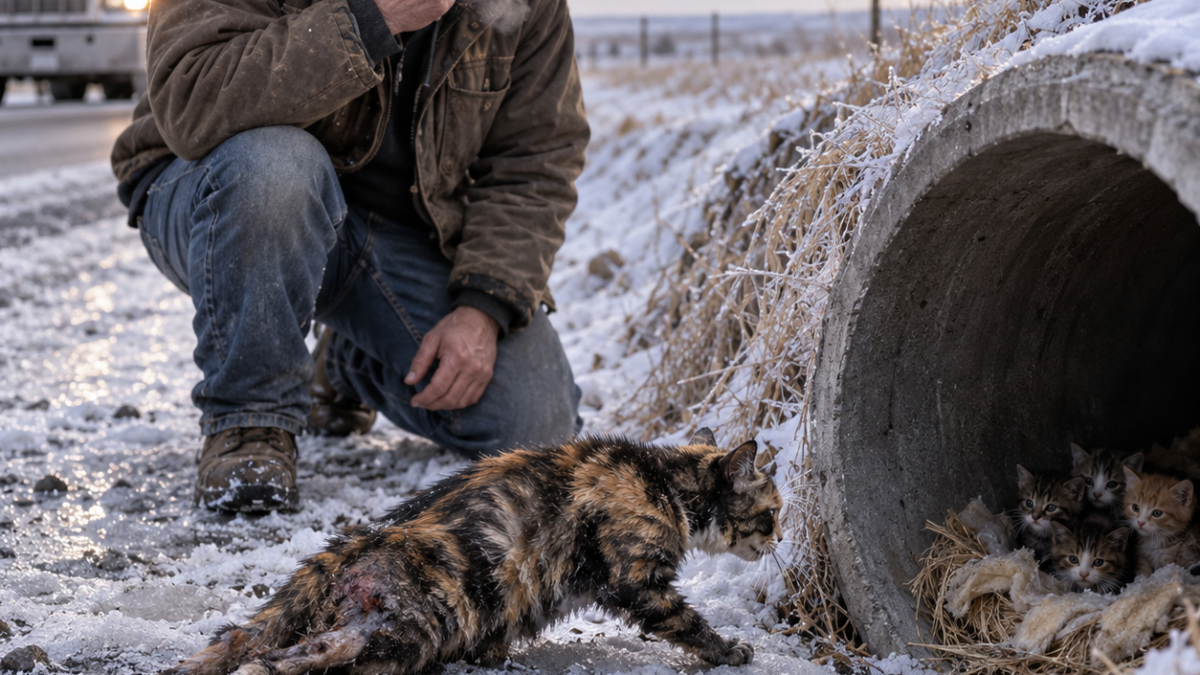
I crouched in front of her, expecting glassy eyes, shock, the dull fading look of an animal already leaving its body.
That was not what I saw.
Her eyes were clear.
Wild with pain, yes.
Terrified, yes.
But fixed.
Not on me.
Past me.
Across the highway.
Toward the far shoulder.
She was not dying in the road.
She was going somewhere.
That is the first thing I want people to understand.
She was not crawling randomly.
She had a destination.
I reached for her carefully.
“Easy, mama,” I said, though I did not yet know she was a mother. “Easy. I’ve got you.”
When my hands slid under her chest, she did not bite me. She did not cry. She did not go limp either. She twisted with shocking force for something so small and damaged, front paws scraping against my glove, trying to keep moving in the direction she had chosen.
She weighed almost nothing.
Later, the veterinarian would say 1.8 kilograms, just under four pounds. At that moment, she felt even lighter. Like bones, fur, and determination.
But as I lifted her, I felt the broken shape of her body.
There are things you know without being a doctor.
The wrong looseness.
The absence of resistance where there should have been muscle.
The way the back half of her hung motionless while the front half fought me.
Her spine was broken.
I held her against my jacket, and she kept straining toward the other side of the highway.
“Stop,” I whispered. “You can’t.”
She did not care what I thought she could do.
I turned and looked where she was looking.
Across the lane, beyond the gravel shoulder, the land dipped into a shallow ditch. A concrete drainage pipe stuck out of the embankment, half choked with dead grass, frozen mud, and weeds. One of those ordinary roadside culverts no one notices unless it floods or clogs.
Then I heard it.
A thin cry.
Faint.
High.
Then another.
Not one sound.
Several.
I looked down at the cat in my arms.
Her front paws were still reaching toward the culvert.
“Oh,” I said.
It was not a word so much as a breath knocked out of me.
I carried her across the highway, moving fast but careful. Every second felt wrong. She was bleeding. She was freezing. I needed to get her to a vet. But the cries from the pipe were growing clearer.
I knelt near the culvert entrance and set her down on the gravel.
The instant her front paws touched ground, she dragged herself forward.
No hesitation.
No pause.
She pulled her broken body the last few feet and disappeared into the concrete pipe.
I dropped to my stomach beside the ditch, ignoring the ice burning through my jeans. I pulled my phone from my pocket, turned on the flashlight, and aimed it into the pipe.
At first, I saw only mud.
Then two tiny faces.
Then four.
Four kittens.
Their eyes were barely open, little blue-gray slits blinking against the light. They were huddled in a shallow hollow scratched into the frozen mud at the back of the pipe, pressed together on a torn piece of insulation—the kind of padding road crews wrap around guardrail posts or construction materials. Somehow, their mother had dragged it into that pipe and made a nest.
They were alive.
All four.
Moving.
Crying.
Warm enough that steam rose faintly when the cold air reached them.
The mother cat had wedged herself around them despite the useless back half of her body. Her front legs curved around them. Her chin dropped over their backs. She was shaking so violently the kittens shifted with each tremor.
I had seen a lot of things on roads.
I had never seen anything like that.
I lay there on the frozen ground, my breath fogging the entrance of that concrete pipe, and I said the only thing I could think of.
“You made it.”
She blinked at me once.
Then lowered her head to the kittens.
I did not know what to do first.
The mother needed emergency care. The kittens needed warmth. My truck was still on the shoulder with a loose strap. Traffic was moving behind me. The wind was cutting through my clothes. My hands were starting to go numb.
I backed out and ran to the cab.
I kept an old cardboard box behind the passenger seat for receipts, rags, and whatever else ended up loose in a truck. I dumped it out, grabbed a clean sweatshirt from my overnight bag, and found a chemical hand warmer from a winter kit. I shook it hard, wrapped it in a rag so it wouldn’t burn them, and sprinted back.
The mother cat growled when I reached into the pipe.
Not a big sound.
Not threatening.
More like the last warning her body could afford.
“I know,” I said. “I know. I’m not taking them from you. I’m taking all of you.”
I pulled the kittens out one by one.
Each fit easily in my palm.
One squealed.
One rooted blindly against my glove.
One was quiet enough to scare me until it moved.
The fourth had mud on its nose, and I wiped it gently with my thumb.
I put them in the box on the sweatshirt with the wrapped warmer tucked beneath one corner. Then I reached for their mother.
She tried to crawl back to the box.
Even now.
Even with her body destroyed.
Even with blood on the gravel and frost clinging to her whiskers.
She wanted to reach them.
“I’ve got them,” I told her. “They’re right here.”
I opened my jacket and wrapped her inside against my chest, because I didn’t have a better way to keep her warm. She was icy to the touch but burning with effort. Her heart beat fast against my ribs. Her breathing sounded shallow and rough.
I carried her in one arm and the box in the other across the highway.
A semi blasted past in the far lane, shaking the ground beneath my boots.
I looked down at the cat.
Nearly two hundred yards.
That was what the vet estimated later from the blood trail and the distance between impact site and culvert. Almost 180 meters, close to two football fields. Across frozen asphalt. With a broken spine. Using only front legs. Through pain that would have stopped almost anything.
She had not stopped.
The blood trail proved it.
Not once.
I tightened the strap on my load with one hand because I had to. Then I climbed into the cab, set the box of kittens on the passenger floor near the heater, and kept the mother cat wrapped in my jacket against my lap.
I called dispatch.
“Mercer, what’s your status?” came the voice through the line.
“I’ve got an emergency.”
“What kind?”
“Animal.”
There was a pause.
“Say again?”
“I found a cat hit on the highway. Broken back, I think. Four kittens in a drainage pipe. I’m taking them to a vet.”
Another pause.
“Are you serious?”
I looked down at the mother cat. Her eyes were half closed, but one front paw was stretched toward the box of kittens.
“Do I sound like I’m joking?”
“No. No, you don’t.”
“I’m going off route.”
“Nearest clinic is probably in Ashford. Twenty-something miles.”
“Find me one that answers.”
“I’ll call ahead.”
“Good.”
I ended the call and pulled onto the road.
The heater blasted. The kittens cried from the floor. The mother cat lifted her head weakly at the sound.
“They’re here,” I said. “You hear them? They’re here.”
She tried to move.
“No. Stay.”
Of course, she did not listen.
She dragged one front paw over my sleeve, trying to reach the box.
I shifted carefully, bringing the cardboard box up onto the passenger seat so she could see inside. The kittens squirmed on the sweatshirt, tiny bodies pressed together.
Only then did she stop fighting.
Her head sank against my arm.
I drove twenty-three kilometers to Ashford with one hand on the wheel and the other holding a dying cat steady.
I say dying because that is what she looked like.
I know she survived.
I know how the story ends now.
But in that cab, with her blood soaking into my jacket and her breath getting weaker every few miles, I believed I was racing death and losing.
The first clinic I reached looked closed.
Lights off in the waiting room.
Parking lot empty.
A sign on the door listed business hours and an emergency number.
I called it from the truck before I even shut off the engine.
A man answered on the third ring, voice thick with sleep or exhaustion.
“Ashford Veterinary.”
“I’m outside your clinic. I’ve got an injured cat. Spine broken, hypothermic, bleeding. Four newborn kittens.”
The voice changed immediately.
“I’ll be there in three minutes.”
He made it in two.
Dr. Samuel Harlan was in his late fifties, with gray hair smashed down on one side and a coat thrown over sweatpants. He opened the door, took one look at me standing there with the cat in my arms and the box of kittens at my feet, and said, “Treatment room.”
No paperwork.
No questions first.
Just movement.
A woman named Marcy, one of his techs, arrived five minutes later with wet hair and mismatched boots. She had clearly left home in a hurry. Together, they worked on that little cat while I stood against the wall feeling useless and too big for the room.
They weighed her.
1.8 kilograms.
Temperature 34.4 degrees Celsius.
Dangerously low.
Gums white.
Severely dehydrated.
Blood loss.
Deep abrasions on both elbows, where the asphalt had stripped fur and skin down to the tissue beneath. Two claws torn out at the root on the right front paw. One claw on the left split vertically into the quick. Her chest had embedded asphalt grit frozen into the tissue. Her hind legs had no motor response.
Dr. Harlan examined her back and went quiet.
That was worse than swearing.
“Is it broken?” I asked.
“Yes.”
“How bad?”
He looked at me.
“Bad.”
They stabilized her before taking radiographs. Warmth. IV fluids. Pain control. Wound cleaning. Oxygen. The kittens were checked, warmed, weighed, and given supplemental feeding. They were cold but not injured. Their temperature was low but not catastrophic. Their bellies were not empty.
Dr. Harlan noticed that last part.
“She nursed them before she left,” he said.
“What?”
“Their stomachs aren’t empty. They’ve eaten recently.”
I looked through the glass at the mother cat lying on the treatment table, battered beyond comprehension, still turning her head whenever the kittens cried.
“She fed them before crossing the road,” he said. “Probably went looking for food after.”
I sat down hard in the chair behind me.
That detail is one people sometimes miss when I tell the story.
She did not leave because she wanted to leave.
She left because they needed her to eat so she could keep feeding them.
And before she risked that road, she made sure their bellies were full.
That thought has followed me for years.
Even hungry, she fed them.
Even injured, she returned to them.
Even paralyzed, she dragged herself across the highway because four tiny stomachs in a pipe still needed her warmth.
Dr. Harlan cleaned her wounds for more than an hour. Bits of asphalt, gravel, and frozen road grit had to be removed from her elbows and chest. Marcy held her steady and whispered things like, “I know, sweetheart,” though the cat was too medicated to fight by then.
When the X-ray came back, Dr. Harlan carried the film into the small office where I was sitting with a vending-machine coffee I had not touched.
“Complete fracture at L4,” he said.
I stared at the image like I could understand it if I looked hard enough.
“Can surgery fix it?”
“No.”
The answer was gentle but firm.
“Could she walk again?”
“No.”
I looked at him.
“You’re sure?”
“Yes.”
There was no drama in his voice. No cruelty. Just the kind of certainty you do not argue with because it has already broken the heart of the person saying it.
“Her hind legs are permanently paralyzed,” he said. “She has no motor function below the injury. We’ll monitor sensation, bladder function, pain, quality of life. But walking normally again isn’t going to happen.”
The room felt too bright.
“What happens now?”
“Tonight, we keep her alive.”
“And after?”
He hesitated.
“That depends.”
“On what?”
“Whether she can stabilize. Whether she can manage pain. Whether she can adapt. Whether someone is willing to care for a paralyzed cat.”
I didn’t answer.
Not because I wasn’t willing.
Because at that moment, the idea had not fully formed.
I had never owned a cat.
I grew up with dogs outside and farm cats in barns, the kind nobody brought inside unless there was a blizzard. In my adult life, trucking made pets complicated. I was gone too much. Home too little. I rented a small house with furniture chosen because it was cheap and durable, not because anything about it felt like a home.
I knew nothing about litter boxes, feline diets, disabled animals, spinal injuries, physical therapy, bladder care, or how to keep a cat from climbing onto things and hurting herself.
But I knew what I had seen.
I knew that little animal had crossed a frozen highway with a broken back because something needed her on the other side.
And I knew I could not simply deliver her to safety and disappear back into my route like the story had nothing to do with me.
“Call me if she makes it through the night,” I said.
Dr. Harlan nodded.
I drove my load the rest of the way in silence.
Dispatch had rearranged delivery. The contractor was irritated until I told him why I was late. Then he stood there in a hard hat, clipboard in hand, not knowing what to say.
“Damn,” he finally muttered.
That was about right.
I slept in my truck that night outside a rest area but woke up every hour checking my phone.
At 3:12 a.m., there was no call.
At 4:30, no call.
At 5:48, my phone rang.
I sat up so fast I hit my shoulder on the cabinet.
“She survived the night,” Dr. Harlan said.
I closed my eyes.
He continued, “She’s not out of danger. Heart rhythm was irregular until early morning. She’s still weak. But she survived.”
“And the kittens?”
“Doing well.”
“Can I come?”
“Yes.”
I was at the clinic before sunrise.
The mother cat lay in a padded enclosure with warming support beneath her, bandages on both elbows and front paws, hind legs positioned carefully behind her. She looked even smaller in the clinic light. Smaller and somehow larger than anything else in that building.
The kittens were in an incubator nearby.
When they cried, her head lifted.
She could barely hold it up.
But she tried.
Eighteen hours after she arrived, Dr. Harlan and Marcy decided to let the kittens near her briefly, expecting maybe she would sniff them, maybe relax, maybe not react at all. They were prepared to continue supplemental feeding.
They were wrong.
The moment they placed the first kitten beside her, she dragged herself toward it.
Not far.
Just inches.
But it took everything.
Her front legs trembled. Her bandaged elbows slid on the towel. Her useless back half followed only because she pulled hard enough to move the rest of herself by force. She positioned her body around that kitten, then the second, then the third, then the fourth.
And she began to nurse them.
Marcy turned away and wiped her eyes.
Dr. Harlan stood with both hands on his hips, staring like he was watching medicine argue with a miracle.
“I thought she’d be too weak,” he said quietly.
The mother cat did not care what he thought.
She had work to do.
For five weeks, she nursed those kittens.
Five weeks.
With a broken spine.
Paralyzed hind legs.
Bandaged elbows.
Torn claws.
A body that had already spent everything and then kept spending.
Dr. Harlan supplemented her with syringe feeding because she was losing weight she could not afford to lose. She went from 1.8 kilograms to nearly 1.3 at her lowest point. Her body was burning calories making milk while also trying to heal catastrophic wounds. Every medical chart said it was too much.
She disagreed.
Every time the kittens cried, she moved.
At first, the staff kept the kittens beside her to spare her the effort. But she still repositioned. She wanted them under her chin, between her front legs, tucked against the part of her body that could still feel them. Her back half no longer responded, but she arranged herself like a wall around them anyway.
That image changed me in ways I did not understand at first.
I started coming by the clinic after routes.
Sometimes before.
Sometimes during lunch breaks if I was close enough.
I told myself I was checking on the animals I found. That was reasonable. Responsible. Temporary.
But every time I walked in, the mother cat lifted her head and looked at me.
Not friendly.
Not affectionate.
Just aware.
As if she knew I was part of the chain that had moved her from highway to warmth, and she was keeping track.
“She needs a name,” Marcy told me one afternoon.
I was sitting beside the enclosure, watching the kittens push their blind little faces into their mother’s fur.
“Doesn’t she have one on the chart?”
“Stray tortie female. Approximate age unknown. Paralysis secondary to trauma. Very poetic.”
I looked at the cat.
She looked back.
“What would you call her?” Marcy asked.
The word came before I could second-guess it.
“Highway.”
Marcy’s eyebrows lifted.
“That’s not exactly soft.”
“She isn’t exactly soft.”
The cat blinked.
Marcy smiled.
“Highway it is.”
I know some people think the name sounds harsh.
Maybe it does.
But to me, it meant the place where she should have died and didn’t. It meant the distance she crossed. It meant the thing that broke her and the thing she defeated. It meant she carried the road with her, not as a wound only, but as testimony.
Highway.
A name with pavement in it.
A name with survival in it.
A name that did not pretend the world had been gentle.
When the kittens were old enough, people wanted them immediately.
That is how it goes.
Kittens are easy to love. Tiny paws, big eyes, soft bellies, wobbling steps. The world sees them and melts. By eight weeks, all four had homes lined up. Good homes, Dr. Harlan said. Families who had been screened. People who understood their history.
The morning the first one left, I expected Highway to panic.
Instead, she sniffed the carrier, touched noses with the kitten through the little door, and watched quietly as it went.
By the fourth, she was tired.
Maybe relieved.
Maybe grieving in a way I did not recognize.
Maybe both.
After the last kitten left, the room felt too big.
Highway lay on a blanket with her front paws crossed, looking toward the empty space where they had been.
I stood beside her enclosure, hands in my jacket pockets.
“They made it,” I said.
Her ears moved.
“All four.”
She looked at me.
I wondered if she understood absence as safety.
Humans often don’t.
We hold on to what needs releasing because letting go feels too much like losing. Animals can be wiser. A mother raises the young until the young can go. The success hurts because the love worked.
Dr. Harlan came in carrying a folder.
“We need to talk about placement.”
I kept looking at Highway.
“Placement.”
“Yes.”
“You mean adoption.”
“Yes.”
“Who wants her?”
He was quiet.
That answered before he did.
“A few people have asked about donating. A rescue is willing to list her. But a paralyzed adult cat with ongoing care needs is not an easy placement.”
“What care?”
“Mobility support. Low-entry litter setup. Skin monitoring. Bladder monitoring. Possible infections. Weight management. She can live a good life, Thomas, but she’ll need someone attentive.”
I nodded.
“What else?”
“She’s cautious. Not aggressive, but guarded. Understandably.”
“What else?”
“She may eventually use a rear wheelchair. A company offered to donate one after I posted her radiographs and story in a professional forum. But she’ll need adjustment. Training.”
“What else?”
Dr. Harlan looked at me carefully.
“You’ve never had a cat.”
“No.”
“You drive for a living.”
“Regional now.”
“You live alone.”
“Yes.”
“You understand this isn’t a symbolic decision.”
That made me look at him.
“I’m not adopting a symbol.”
“Then what are you adopting?”
I looked at Highway.
She had dragged herself across two lanes of frozen highway because four kittens needed her.
A creature that small had done the impossible without asking whether it was fair, whether anyone would appreciate it, whether the outcome was guaranteed, whether she had anything left to give.
I thought about my own life.
How often I had told myself I was tired.
Too tired to call my daughter more.
Too tired to make my rented house feel like a home.
Too tired to start over after divorce.
Too tired to be needed.
Too tired to be anything except a man who delivered loads and paid bills and came home to a place that looked like he might leave again at any minute.
Then I looked at Highway’s bandaged front paws.
“She crossed that highway with a broken back because something needed her on the other side,” I said. “I can figure out a litter box.”
Dr. Harlan’s mouth twitched, but his eyes were wet.
“That’s not the only thing.”
“I’ll figure out the rest too.”
“You sure?”
“No.”
He nodded slowly.
“That’s probably the most honest answer.”
Highway came home with me two weeks later.
By then, her custom wheelchair had arrived: a small rear mobility cart with two light wheels, soft supports, and a harness designed to hold her back end while her front legs powered movement. The company donated it after hearing her story. Marcy cried when it came in. Dr. Harlan pretended he had dust in his eye.
Highway hated it at first.
She froze when we fitted it.
Flattened her ears.
Refused to move.
Then she realized her front legs could pull and the wheels would follow.
Three days.
That was all it took.
On day one, she took four steps and glared at everyone.
On day two, she crossed the exam room.
On day three, she turned too fast, bumped into a cabinet, corrected herself, and kept going like she had invented the wheel personally and was disappointed the rest of us had not applauded sooner.
When I brought her home, I had already changed the house.
Low-entry litter box.
Rugs over slippery floors.
Food and water stations raised slightly so she didn’t have to strain.
A soft bed near the heater.
A ramp to the couch.
A second ramp to my bed, which I built badly the first time and rebuilt after watching her refuse to use it with clear contempt.
“You could at least pretend to appreciate craftsmanship,” I told her.
She stared.
I rebuilt it again.
I also changed my routes.
That was the biggest thing.
I asked dispatch for regional work only. No overnight hauls unless unavoidable. No long distance. No three-day loops. I took less money. I ate at home more. I stopped pretending the inside of my truck counted as a full life.
My dispatcher, Carla, leaned back in her chair when I told her.
“For a cat?”
“For Highway.”
“For a cat named Highway.”
“Yes.”
“You know how ironic that is, right?”
“Yes.”
Carla shook her head.
“I’ve heard dumber reasons for drivers changing routes.”
“That mean yes?”
“That means I’ll see what I can do.”
She did more than see.
She made it happen.
At first, Highway treated my house like a suspicious warehouse. She explored slowly in the cart, wheels clicking softly over the floorboards. She avoided open doors. She disliked the television. She loved the heater vent. She tolerated me.
That was enough.
Every morning before work, I checked her skin, her paws, her harness fit, her appetite, her water, her litter box, her mood. Every evening, I came home and did it again. There is intimacy in care that has nothing to do with sentiment. You learn another living creature by repetition. How they eat when they feel good. How they sit when something hurts. Which sounds mean irritation, fear, hunger, comfort. Where they hide. When they forgive.
Highway did not become sweet all at once.
She became present.
That was better.
The first time she slept on my bed, I woke at 2:00 a.m. afraid to move. She had climbed the ramp and settled near my knees, cart removed for the night, back legs stretched behind her under a fleece blanket. Her breathing was soft. Her front paws twitched in a dream.
I lay there staring at the ceiling, listening to the old house settle around us.
For the first time in years, it did not feel like a place I merely stopped between drives.
It felt occupied.
It felt claimed.
It felt like something expected me to come back.
Months passed.
Highway gained weight slowly. Two kilograms. Then 2.3. Then 2.7, her highest since the rescue. Her elbows healed, leaving thick hairless patches where asphalt had taken the skin. Two missing claws never grew back. The split claw healed crooked, but usable. Her hind legs remained limp forever.
She did not seem ashamed of them.
Humans are the ones who turn disability into embarrassment. Highway treated her body as fact. This works. This does not. Move accordingly.
When she was in her wheelchair, she was fast.
Too fast sometimes.
She learned the hallway, the kitchen, the living room. She learned to back up by awkward little wheel adjustments. She learned that if she rammed the bathroom door hard enough, I would eventually come open it. She learned that she could chase bottle caps across the floor with only front paws and fury.
She also learned the bed ramp.
Every night, she climbed it.
Every night, she slept near my knees.
And every morning, when my alarm rang before dawn, she opened one eye as if to say, You again.
I talked to her more than I expected.
At first, practical things.
“Food’s here.”
“Hold still.”
“Don’t bite the strap.”
“That is my sock.”
Then other things.
“My daughter called.”
“Truck needs brake work.”
“Snow coming tonight.”
“Doctor says I should walk more. You believe that?”
Highway never answered.
But silence from an animal is different from silence in an empty room.
An empty room gives nothing back.
Highway gave presence.
One afternoon, my daughter, Melissa, came to visit.
She had not been to my house in over a year.
That was partly distance, partly divorce fallout, partly my own failure to make invitations sound like I meant them. Melissa was thirty-two, with her mother’s sharp eyes and my stubborn mouth. She stepped inside holding a small overnight bag and immediately looked down.
Highway rolled into the hallway, wheels clicking.
Melissa froze.
“So that’s her.”
“That’s Highway.”
Highway looked at Melissa.
Melissa looked at Highway.
“I thought she’d be…”
“What?”
“I don’t know. Fragile.”
Highway chose that moment to roll directly over my boot and continue into the kitchen.
“She’s rude,” I said.
Melissa laughed.
It had been a long time since I heard her laugh in my house.
That weekend changed things between us.
Not in one dramatic conversation. Real life rarely gives you that. It changed in small moments. Melissa helping refill Highway’s water. Melissa asking about the accident. Me telling the story without making it shorter because I was uncomfortable. Her sitting quietly afterward, one hand resting near Highway but not touching until Highway chose to sniff her fingers.
On Sunday morning, Melissa found me building a better ramp to the back window because Highway had discovered birds and was furious that the windowsill was inaccessible.
“You changed your routes for her?” she asked.
“Yes.”
“Do you miss long haul?”
“Sometimes.”
“Do you regret it?”
I looked through the doorway at Highway sleeping in a sun patch.
“No.”
Melissa was quiet.
Then she said, “You never moved back closer after the divorce because you said it would be too hard with work.”
I set down the drill.
There are sentences from your children that arrive like bills you forgot you owed.
“I know.”
“You could’ve figured it out.”
“Yes.”
“Why didn’t you?”
I could have defended myself.
I could have said money, routes, timing, your mother, life, complications.
Instead, I thought about Highway crossing the road.
“I told myself I was too tired,” I said.
Melissa looked toward the cat.
“And now?”
“Now I know tired isn’t always a good enough reason.”
She nodded.
We did not fix everything that weekend.
But we started.
Highway did that.
Not by being magical.
By making it impossible for me to keep pretending I was incapable of changing when she had changed everything with half a working body.
People heard her story because Dr. Harlan posted an update on the clinic page. He did not sensationalize it. He wrote plainly: hit by vehicle, paralyzed, crawled back nearly 200 meters to her kittens, all survived, adopted by the truck driver who found her. He included a photo of Highway in her wheelchair beside my work boots.
The post spread.
Local news called.
Then a regional paper.
Then an animal welfare organization.
I said no at first.
Carla told me I was being stubborn.
Ellen—my ex-wife, not to be confused with my lack of social grace—called after Melissa told her.
“You should talk,” she said.
“I’m not good on camera.”
“No one cares.”
“I care.”
“Thomas, that cat did something extraordinary. People should know animals are not disposable.”
That was the word that got me.
Disposable.
So I did one interview.
Then another.
I kept it simple.
“She weighed less than four pounds,” I said into one microphone. “Her back was broken. She crossed a frozen highway in the dark because something needed her on the other side. She didn’t think it over. She didn’t weigh the pros and cons. She just went. And I figured if something that small and broken could do that, I could at least be the one who made sure she never had to do it again.”
That quote followed me.
People repeated it online, sometimes accurately, sometimes with extra drama added. Some called me a hero. I hated that.
I was not a hero.
I stopped because my truck strap loosened.
I saw her because the wind made me pull over.
I helped because helping was the only decent thing to do once I knew.
Highway was the one who had done the impossible before anyone was watching.
The kittens grew in their new homes.
Their families sent updates through the clinic.
One became a big orange-and-black patchy chaos machine named Maple. One sleek little male named Culvert—yes, really—learned to open kitchen cabinets. One shy female named Penny bonded with a retired woman and slept on her pillow. The smallest, Scout, grew into a bold little menace who climbed curtains.
I printed their photos and put them on the refrigerator.
Highway noticed the papers only when one corner curled enough for her to bite.
I liked to imagine she knew they were safe.
Maybe she did.
Maybe animals understand scent, absence, memory, and survival in ways we cannot translate. Maybe some part of her body relaxed because the cries were gone, because no kitten needed her warmth in the night, because the work she had nearly died to finish was complete.
She became, slowly, more herself.
Not the mother in crisis.
Not the patient.
Not the symbol.
Just Highway.
She liked chicken but not turkey.
She hated being brushed until she loved being brushed and then demanded it by hitting the brush off the shelf.
She refused three expensive cat beds and adopted a flattened cardboard produce tray.
She watched birds with intense moral disapproval.
She greeted Melissa before she greeted me during visits, which I considered betrayal.
She learned that my work boots meant leaving and my slippers meant staying. On mornings when I put on boots, she would park her wheelchair in front of the door.
“Move,” I’d say.
She would stare.
“You know I have to work.”
Stare.
“Food costs money.”
Stare.
Eventually, I would lift her gently aside. She would allow this with the air of someone filing a formal complaint.
The house changed around her.
Ramps.
Low thresholds.
Soft rugs.
No clutter in the hallway because wheels catch on things.
A wider path between couch and table.
Litter setup in the laundry room with a cut-down entry.
A small camera I could check from the road when I was gone too many hours.
People talk about sacrifice like it always feels heavy.
Some of it did.
But much of it just became life.
Feed her.
Check harness.
Go to work.
Come home.
Clean wheels.
Cook dinner.
Call Melissa.
Watch Highway fall asleep near the heater.
Repeat.
A life can be rebuilt through repetition if you choose the right things to repeat.
One winter night, almost a year after I found her, snow started falling while I was on my way home. Not a big storm. Just steady. The kind that catches headlights and makes the world feel suspended.
I pulled into my driveway after ten hours on the road and sat there for a minute with the engine idling.
The porch light was on.
Through the window, I could see Highway sitting at the top of her ramp to the sill, watching for me.
My throat tightened unexpectedly.
For decades, I had come home to dark rooms, motel lights, empty kitchens, unmade beds, and the hum of refrigerators in places that were mine only because my name was on the lease. I had told myself that was freedom.
Maybe sometimes it was.
But that night, with snow falling and a paralyzed cat watching from the window, I understood something I had been avoiding.
Being needed is not the same thing as being trapped.
Sometimes it is the only thing that tells you where home is.
I went inside.
Highway rolled toward me, wheels clicking fast, then stopped just short of my boots as if she had not been waiting at all.
“Nice to see you too,” I said.
She turned and headed toward the kitchen.
Dinner, apparently, mattered more than emotional reunions.
Fair enough.
Years have passed now.
Highway is about five.
That is what Dr. Harlan estimates, though none of us know for sure. She uses her wheelchair every day. She weighs 2.7 kilograms, which Marcy calls “sturdy” and Highway clearly considers nobody’s business. Her elbows carry permanent thick scars without fur. Two claws are gone. Her hind legs will never work.
She does not know she is supposed to be tragic.
That is the gift animals give us when we let them live beyond the worst thing that happened to them.
They do not remain only the day of injury.
They become mornings, habits, preferences, annoyances, demands, naps, mischief, affection, and quiet companionship.
Highway is not an inspirational poster.
She is a cat who survived something brutal and now expects breakfast at 5:30 sharp.
She is also the reason I moved to a smaller regional route permanently, repaired my relationship with my daughter, learned to build ramps, learned more about feline bladder care than I ever expected to know, and stopped measuring my life only in miles delivered.
Sometimes people ask if I think she remembers.
I think her body does.
She does not like the sound of speeding traffic when the windows are open. She stiffens if tires screech on television. She dislikes the smell of road salt on my boots. On very cold nights, she sleeps closer to my chest than usual.
But she also remembers warmth.
She remembers the sound of my truck in the driveway.
She remembers Melissa’s suitcase.
She remembers where the treats are kept.
She remembers that the bed ramp leads somewhere safe.
Memory is not only trauma.
That is another thing she taught me.
One spring afternoon, Dr. Harlan invited me to speak at a small fundraiser for the clinic’s emergency fund. I said no twice. Carla said I was being stubborn again. Melissa said she would stand beside me if I wanted. Highway, unhelpfully, knocked my speech notes off the table the night before, which I chose not to interpret as commentary.
I went.
The room was full of people who had donated to help animals whose owners could not afford emergency care. Highway came in her wheelchair because Dr. Harlan insisted she was the guest of honor, though she seemed more interested in escaping the applause.
When it was my turn, I stood behind a small podium and looked at all those faces.
For a moment, I was back on the shoulder of that highway.
Cold.
Wind.
Blood on asphalt.
Four cries from a concrete pipe.
I gripped the edges of the podium.
“I’m not much of a speaker,” I began.
That got a polite laugh because people will laugh at almost anything when they want to help you feel comfortable.
“I drive trucks. That’s what I know. Roads, loads, schedules, weather. I used to think the important thing was to keep moving. Don’t get stuck. Don’t get sentimental. Don’t make life harder than it already is.”
Highway sat beside the podium, looking deeply bored.
“Then I saw her in the road.”
The room quieted.
“She was dragging herself with her front legs. Her back was broken. There was blood behind her. I thought she was trying to get away from the highway. But she wasn’t. She was trying to get back across it.”
I swallowed.
“Her kittens were in a drainage pipe. Four of them. Alive because she had fed them before she went to find food. Alive because after a vehicle broke her spine, she turned around and dragged herself back to them. Nearly two hundred yards. In the cold. Across traffic.”
I looked down at Highway.
She was washing one paw.
Typical.
“I’ve had people ask me what I learned from her. I usually say courage, because that’s the easy word. But it’s more than that. Highway taught me that love is not a feeling you announce. It’s a direction you move in, even when moving hurts.”
I heard someone sniffle.
I kept going.
“She moved toward what needed her. That’s all. No speech. No guarantee. No calculation. Just need on one side and her on the other. And she went.”
My voice threatened to break, so I paused.
Highway stopped washing and looked up at me.
That nearly did it.
“So if you donated tonight, thank you. If you foster, thank you. If you work in clinics like this, thank you. If you stop your car, make the call, pick up the box, open the door, pay attention to the small thing in the road that everyone else might miss—thank you. Because sometimes a life is waiting for one person to stop long enough to see where it’s trying to go.”
When I finished, people stood.
Highway startled at the applause and rolled behind my legs.
I bent down and touched her head.
“You’re fine,” I whispered.
She pressed her shoulder into my hand for one brief second.
Enough.
That night, after the fundraiser, I took the long way home—not on the highway where I found her, but on the county roads that ran parallel through fields. The sun was setting, turning the clouds orange and violet. Highway slept in a carrier on the passenger seat, wheelchair folded behind us.
I thought about the version of me who had pulled over just to tighten a strap.
A man tired of roads.
A man who believed he had seen enough.
A man who thought love mostly belonged to people with different lives.
Then I looked at Highway sleeping, scarred elbows tucked under her chest, back legs resting useless but no longer dragging behind her.
She had been broken in a way that could not be undone.
So had I, though not in the same way.
Neither of us became what we were before.
That used to sound like failure to me.
Now it sounds like truth.
Some things do not heal back to original shape.
They heal into something that can still move.
That is enough.
The highway where I found her still exists, of course.
Roads don’t remember unless people make them.
Drivers pass that culvert every day without knowing what happened there. They do not see the blood trail. They do not hear the kittens. They do not know that a four-pound tortoiseshell once crossed that frozen asphalt with only the front half of her body because she refused to let her babies cry alone in the dark.
But I know.
Dr. Harlan knows.
Marcy knows.
Melissa knows.
Every person who has met Highway and watched her wheels click across a room knows a piece of it.
And somewhere in four different homes, her kittens live ordinary cat lives because their mother did something extraordinary before they were old enough to remember needing it.
That matters to me.
That they do not remember.
Like all children who survive because someone else paid the price, they get to live without carrying the full weight of the rescue.
Maple sleeps in laundry baskets.
Culvert opens cabinets.
Penny sleeps on a retired teacher’s pillow.
Scout still climbs curtains.
They do not know the road.
They know home.
That is what Highway gave them.
Not a dramatic story.
Not a headline.
Home.
The last time someone asked why I changed my whole life for a cat, I didn’t give the long answer.
We were at a gas station. A man saw Highway in the cab through the open passenger door, her little wheelchair folded on the seat, and asked about her. I told him the short version. He shook his head and said, “That’s a lot to take on.”
I looked at Highway.
She was sitting upright, watching a pigeon with the intensity of an assassin.
“Yes,” I said.
He waited.
I added, “She took on more.”
That was all.
Because the truth is simple.
She weighed less than four pounds.
Her back was broken.
The road was frozen.
Her kittens were on the other side.
She went anyway.
And once you have seen something that small refuse to stop loving when stopping would have been easier, you do not get to keep living as if convenience is the highest law.
Highway is asleep on my bed as I write this.
The ramp I built for her is scratched from years of use. Her wheelchair waits beside the dresser. Outside, a truck passes on the road beyond my rented house, and she lifts her head for a moment, listening.
Then she settles again.
Safe.
Warm.
Needed.
No highway between her and anything she loves.
That is all I ever wanted to give her.
Not repayment.
You cannot repay what she did.
You can only honor it.
So every morning, when I lift her into her wheels and she charges down the hallway like she has somewhere important to be, I remember that day.
The wind.
The blood.
The frozen road.
The tiny cries from the pipe.
And a mother who should not have been able to move at all, dragging herself forward because love was on the other side.
She did not know I was coming.
She did not know there would be a clinic, a wheelchair, a ramp, a house, a man willing to learn, four kittens growing safe in other homes.
She only knew they needed her.
So she went.
And because she went, I stopped.
Because I stopped, she lived.
Because she lived, I learned that being broken does not mean being finished.
Sometimes it only means you move differently.
Sometimes it means someone builds you a ramp.
Sometimes it means your scars become the map of how far you were willing to go.
And sometimes, if you are very lucky, the life you thought you were just driving through becomes the place you finally come home to.
Highway is not the cat I expected.
She is not the life I planned.
But every night, when she climbs her ramp and settles beside me, I think of that frozen road and the four tiny cries that pulled her across it.
Then I reach down, rest my hand on her scarred shoulder, and say the same thing I said the first time I understood what she had done.
“You made it.”
And in the quiet, with her breathing steady beside me, I know she did more than that.
She brought all of us across.








