I Returned to My K9’s ICU 48 Hours Later—Then I Found His IV on the Floor and the Only Nurse He Trusted Was Gone
PART3:
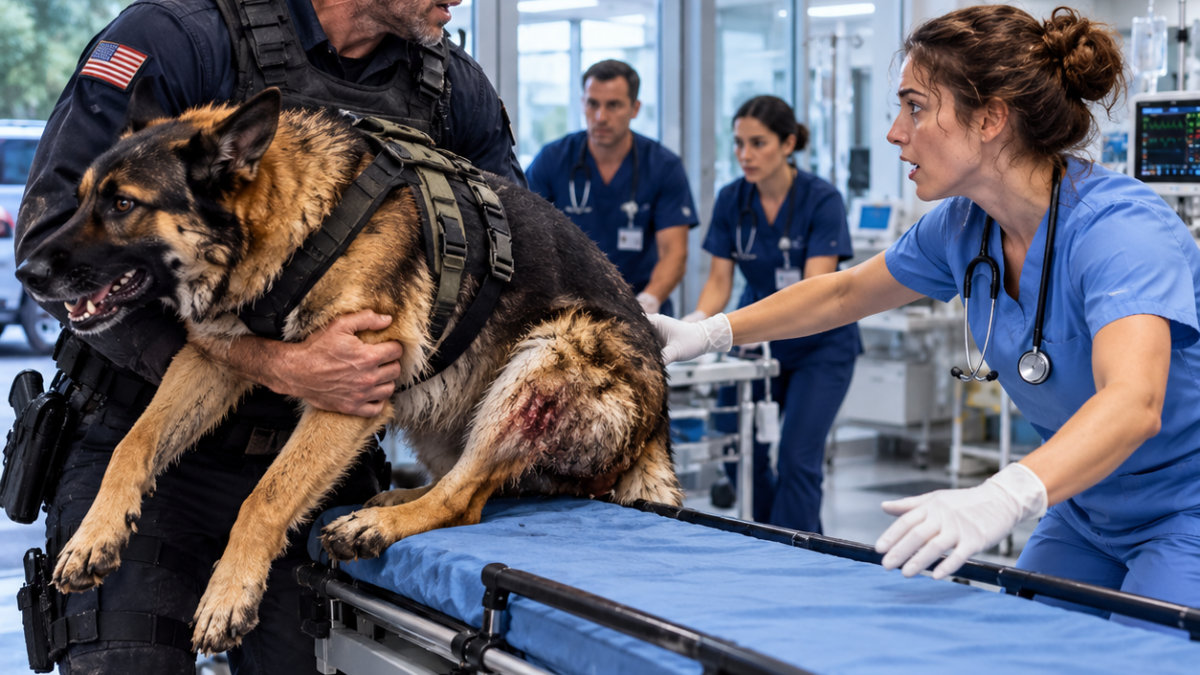
Six hours of fluorescent light, closed doors, rain streaking the windows, and me sitting outside the surgical wing with Titan’s blood drying beneath my fingernails.
Men came from base.
I sent them away.
A public affairs officer called.
I ignored him.
Someone brought coffee.
It went cold.
I had waited for extraction under fire with more patience than I waited outside that operating room.
When Dr. Hayes finally came out, he looked like a man who had spent the last six hours negotiating with death and won only a temporary ceasefire.
“He’s alive,” he said first.
I closed my eyes.
Then he continued, because good doctors do not hide the next part.
“Fractured pelvis stabilized. Shrapnel removed from the hindquarters. Significant soft tissue trauma. We’ll monitor for infection, necrosis, neurological issues. His breathing is better but guarded.”
“Will he walk?”
“Too early.”
“Will he live?”
Hayes glanced through the glass toward the recovery ward.
“If his body is the only thing we’re treating, maybe.”
I looked at him.
“What does that mean?”
“It means military working dogs are not like house pets. You know that better than I do. High drive. Hypervigilant. Handler-dependent. When they’re severely injured and cannot control their own movement, some spiral. They refuse food. Fight care. Rip out lines. Their stress can kill them.”
I had seen it in men.
A body saved by surgery, then lost because the mind could not find ground.
“What does he need?”
Before Hayes could answer, Clara stepped out of the surgical corridor, mask hanging under her chin, hair coming loose, eyes tired but steady.
“Consistency,” she said. “Low stimulation. Pain control. No crowding. No panic around him. No one approaches his blind side. No one uses that high-pitched pet voice people think is comforting.”
For the first time that night, I almost smiled.
“You don’t like the pet voice?”
“I hate the pet voice.”
“Titan does too.”
“I know,” she said. “He told me.”
She meant it.
That should have sounded ridiculous.
It didn’t.
For the next four days, Titan fought death in Ward 4.
Not quietly.
Not nobly.
There is nothing noble about pain.
He growled when techs approached. He snapped at hands. He thrashed when someone touched bandages too quickly. Twice, he nearly damaged the surgical site. Once, he ripped a monitor lead loose and sent two junior techs backward into a cabinet.
But when Clara entered, the room changed.
Not magically.
Professionally.
She did not treat him like a monster.
She did not treat him like a baby.
She treated him like a wounded operator who needed to know what was happening before it happened.
“Titan, eyes here.”
Pause.
“Left leg.”
Pause.
“Bandage change.”
Pause.
“Pressure.”
Her hands moved slowly, but not timidly.
There is a difference.
Fear makes dogs afraid.
Pity makes them suspicious.
Confidence gives them something to lean on.
After her shift ended, she sat on the floor outside his kennel with her back against the wall and read charts aloud in a low, rhythmic voice. Not because he understood the numbers. Because cadence mattered. Because hearing a steady human voice in a sterile room gave him a pattern to follow.
I watched his heart rate slow on the monitor when she spoke.
I watched his breathing settle.
I watched him refuse food from a bowl, then accept high-calorie paste from Clara’s fingers because she waited until he chose to lean forward.
I watched her change dressings other staff could not touch.
I watched my dog, who had faced gunfire without flinching, close his eyes when her hand rested on his neck.
On the fourth night, I stood outside the ICU glass with my arms folded because if I unfolded them, my hands would shake.
Clara came out carrying a tray.
“You saved him,” I said.
She stopped.
The rain had finally ended outside, but the hospital windows still held gray streaks of water.
“He wouldn’t have made it through Tuesday night without you.”
She looked uncomfortable with that.
Good people often are.
“We’re not out of the woods yet, Commander.”
“James.”
“We’re not out of the woods yet, James. But he’s a fighter. We just need to give him time.”
Time.
That was the one thing Titan had earned a hundred times over.
It was also the one thing Richard Caldwell refused to give.
I did not understand what Oakridge had become until later.
On the outside, it looked like the best veterinary hospital in Southern California. Advanced imaging. Surgical suites. Specialists. Polished floors. Beautiful glass. A reputation built partly on treating military working dogs from Coronado when normal clinics were not equipped for animals like ours.
But private equity had bought it six months earlier.
That phrase meant nothing to Titan.
It should not have mattered to any animal in pain.
But it did.
Private equity meant medical directors replaced by administrators.
Care plans reviewed through reimbursement caps.
Inventory tracked like ammunition.
Staff hours treated as leakage.
And at the center of it all stood Richard Caldwell, hospital administrator, a man whose suit cost more than some techs made in a week and whose eyes never seemed to land on patients unless they affected a spreadsheet.
On Friday morning, Caldwell called Clara into his glass-walled office.
I was not there.
I have replayed that fact more times than I can count.
I was on base for forty-eight hours, filing after-action reports about the blast. Reports that mattered to commanders, investigators, and men who needed to know why the training exercise had gone wrong.
I thought Titan was safe.
That assumption nearly killed him.
Caldwell had printed time cards and inventory logs.
He accused Clara of unauthorized overtime.
Twenty hours.
Twenty hours she had spent sitting on a cold ICU floor keeping Titan’s heart rate from spiking.
He accused her of using premium silver alginate dressings instead of the standard gauze covered by the current insurance clearance.
She told him standard gauze would stick to Titan’s wounds and tear tissue every time it was changed.
He told her Titan was a dog.
A dog.
As if the word reduced the debt.
As if Titan had not shielded six men from a blast.
As if service counted only when performed by humans with paperwork.
Clara told Caldwell if she had waited for approval, Titan would be dead.
So Caldwell fired her.
Effective immediately.
Security escorted her to her locker like she had stolen narcotics instead of saved a life.
Fifteen minutes later, as she stood in the parking lot in the rain, Titan howled from Ward 4.
They told me later that everyone heard it.
That low, mournful sound through the ventilation grates.
He knew she was gone.
The decline was fast.
By Friday night, he refused water.
By Saturday morning, he had ripped out his primary IV.
His wounds were weeping. His temperature climbed. His gums paled. He huddled in the far corner of the steel kennel with a continuous growl vibrating in his chest. A junior tech tried to administer antibiotics and Titan lunged—not to bite, but to stop the hand. The tech dropped a tray of instruments. Metal crashed across tile.
Titan panicked.
Full spiral.
Dr. Hayes tried to intervene and had to retreat before Titan tore open his own surgical sites.
That was when Hayes used the words that should have ended the debate.
“Stress-induced cardiomyopathy.”
Broken heart syndrome.
Titan’s body was failing because his mind had lost the only anchor it trusted.
Caldwell’s solution was sedation, transfer, and liability control.
A county facility.
For a critical post-op military working dog in acute cardiac distress.
Dr. Hayes told him Titan would not survive the ambulance ride.
Caldwell told him to prepare the transfer.
That was when I returned.
I walked into Ward 4 expecting progress.
Instead, alarms were screaming.
Blood spotted the floor from the torn IV.
Techs were backed against the walls.
Dr. Hayes stood with both hands raised, face pale with controlled fury.
Titan was in the kennel corner, eyes wild, panting, growling, surrounded by people he no longer trusted.
My dog looked like a feral animal.
No.
Worse.
He looked like a soldier waking alone in enemy territory.
My voice dropped.
“What the hell happened here?”
The room went still.
“Where is Nurse Jenkins?”
No one answered.
I looked at Hayes.
He closed his eyes briefly.
“James. Caldwell fired her yesterday.”
I turned.
Richard Caldwell stood near the hallway entrance, arms folded, expression tight with irritation disguised as authority.
“Over budget disputes,” Hayes added. “Titan has been spiraling since.”
I looked at Caldwell.
He took one step back before catching himself.
“Mr. Caldwell,” I said, “you are going to pick up your phone. You are going to call Clara Jenkins. And you are going to bring her back here right now.”
He puffed out his chest.
That was a mistake.
“I will do no such thing, Commander. This is private property, and I run this hospital. Your dog is completely out of control. Due to the liability he poses to my staff, I am ordering his immediate transfer.”
The sentence never finished.
I did not hit him.
I did not yell.
I did not threaten.
I removed my tactical belt slowly and placed it on the counter.
Then I looked at everyone in the ward.
“Everyone who is not Richard Caldwell, step out.”
Caldwell sputtered.
“Excuse me. You do not give orders here.”
I looked at Dr. Hayes and the techs.
“Out. Now.”
They heard what Caldwell did not.
This was not anger.
This was command.
The staff filed out.
Hayes hesitated at the door.
“James.”
“Get Clara.”
“I can’t.”
“Then get someone who can.”
He left.
The doors closed.
Only Caldwell, Titan, and I remained in Ward 4.
I walked to the reinforced double doors and pulled a handful of industrial zip ties from my cargo pocket. I carry them because old habits survive retirement, and because useful things are useful everywhere.
Three motions.
Zip.
Zip.
Zip.
The handles locked tight.
I dragged a steel triage table against the doors and wedged it in place.
Caldwell’s face drained.
“What are you doing?”
I carried a chair to Titan’s kennel and sat down between Caldwell and my dog.
“Creating a care environment.”
“This is false imprisonment.”
“Call the police.”
“I absolutely will.”
“Call the police. Call SWAT. Call the National Guard if that makes you feel important.”
Titan growled when Caldwell moved.
I kept my eyes on the dog.
“Easy, brother.”
Then I looked at Caldwell.
“But nobody touches this dog, and nobody comes through those doors, until Clara Jenkins walks through them first.”
Outside the glass, panic bloomed.
Staff rushed.
Security guards pulled at the doors.
Phones came out.
Someone shouted.
Someone else cried.
Inside, I kept my body still and my voice low.
Titan’s monitor beeped too fast.
Too sharp.
Every sound mattered now.
Caldwell clutched his phone.
“You are insane.”
“Lower your voice.”
“You are throwing away your career over a dog.”
“My career is over.”
“You’ll go to prison.”
“Maybe.”
“For a dog.”
I stood then.
Not fast.
Slowly.
Caldwell pressed back against the wall.
I pointed at Titan.
“That dog has saved my life and the lives of my men on three deployments. He has taken bullets. He has taken shrapnel. He has walked into rooms first so other men could walk out alive. He has never left a man behind.”
My voice stayed quiet.
That made Caldwell look more afraid.
“I am not leaving him behind because you wanted to save forty dollars on bandages.”
The first patrol cars arrived within minutes.
Red and blue light flashed through the rain-streaked windows.
Then more.
Then a mobile command unit.
Oakridge became a police scene because one administrator mistook a living war hero for a cost overrun.
Caldwell tried to call his CEO, his lawyer, security, anyone who might give him back the authority he had lost the moment he decided Titan’s life was negotiable.
I ignored him.
I sat beside the kennel and spoke to my dog.
“Titan. Eyes here.”
His ears twitched.
“Stay with me.”
His breathing remained too fast.
His gums looked pale.
His eyes were not fully tracking.
Fear like that has gravity. If it pulls hard enough, the body follows.
Captain Thomas Harrison of the San Diego Police Department crisis negotiation team arrived outside the glass about twenty minutes in. Late forties. Marine posture. Eyes that assessed before judging.
That probably saved the night.
He looked through the glass and saw more than a barricade.
He saw me seated between a suit and a dying dog.
He saw Titan’s monitors.
He saw Caldwell pressed against the wall.
He saw that no one was being used as a shield.
He tapped on the glass.
“Commander Reynolds. I’m Captain Harrison.”
I turned my head.
“We don’t want to breach this room,” Harrison said, voice muffled through the thick glass. “We know who you are. We know what Titan did. But there is a civilian in there, and you are obstructing medical operations.”
“The hospital obstructed medical operations when it fired the only nurse keeping him alive.”
“I need a peaceful resolution.”
“Then bring Clara Jenkins.”
“Commander—”
“She stabilizes the dog. Then I walk out in handcuffs if that’s what you need.”
Harrison’s jaw tightened.
“If tactical teams breach with flashbangs and rifles, the shock could kill him before they reach me,” I said. “You know I’m right.”
Harrison looked down at the tablet someone handed him.
I watched his face as he read Titan’s file.
The blast.
The saved operators.
The service history.
The current cardiac instability.
He keyed his radio.
“Stand down tactical breach. Nobody touches those doors. Find Clara Jenkins now.”
That was the first time I breathed halfway.
Outside, the story escaped.
A junior tech had filmed part of the confrontation before the lockdown. The footage hit a local station within the hour.
Navy SEAL Locks Down Vet Hospital to Save Wounded K9 Hero.
That was the headline.
I hate headlines.
They flatten everything.
But that night, the headline became a weapon Caldwell had not prepared for.
Oakridge’s phones exploded.
Veterans gathered at the perimeter in the rain. Active duty sailors from Coronado. Motorcycle clubs. Dog handlers. Civilians holding umbrellas and signs. People who knew nothing about Titan except that he had served and someone had decided his nurse cost too much.
The private equity firm’s social media pages lit up with public fury.
The CEO called Caldwell directly.
Arthur Pendleton.
I heard both sides because Pendleton was shouting loudly enough through the phone.
“You fired a specialized trauma nurse over bandages,” he snapped. “Now we have a decorated war hero barricaded in a hospital on live television.”
Caldwell tried to talk about protocols.
Pendleton told him to burn the protocols.
Then he fired him.
Effective immediately.
Caldwell lowered the phone like a man watching the floor vanish beneath his shoes.
I looked at him.
“Looks like we’re both out of a job.”
He had no answer.
Then the movement outside the glass changed.
Officers parted.
Captain Harrison stepped forward.
Beside him, soaked by rain, hair plastered to her face, breathing hard like she had run from the parking lot, stood Clara Jenkins.
Titan lifted his head a fraction.
Only a fraction.
But I saw it.
So did she.
The danger in me drained so fast I almost lost my balance.
“Clara,” I mouthed.
Harrison raised both hands.
“She’s here. Commander, open the doors. You have my word as a Marine. No tactical team enters. Just Jenkins and Dr. Hayes.”
I did not hesitate.
I cut the zip ties with my knife, shoved the triage table aside, and opened the doors.
Clara did not wait for police to secure the room.
She ran past Harrison.
Past Caldwell.
Past me.
Straight to Titan.
She dropped to her knees in front of the kennel.
“Hey, buddy,” she whispered.
Her voice broke on buddy, but only for a second.
Then it steadied.
“I’m right here. I’m not going anywhere.”
Titan was in terrible shape.
His gums were nearly white. His breathing was rapid and shallow. His paws were wet with blood from the torn IV site. Pain, fear, and cardiac stress had dragged him close to the edge.
Clara reached toward the bars.
Titan bared his teeth.
Pure instinct.
Pain talking before recognition could catch up.
I stepped forward.
“Clara, careful.”
“He doesn’t know where he is, James.”
She did not pull back.
She began to hum.
Low.
Rhythmic.
The same cadence from the long nights after surgery.
Then she pressed her forehead against the cold steel of the cage.
“Stand down, Titan,” she whispered. “Mission’s over. You’re safe.”
The snarling stopped slowly.
Not all at once.
His lips lowered.
His throat worked.
A ragged exhale left him, almost a whimper.
Then he dragged his broken body forward a few inches and pressed his wet nose against the bars exactly where her forehead rested.
Clara closed her eyes.
“Open it,” she told Dr. Hayes.
The kennel door swung open.
She slipped inside.
She did not restrain him.
She wrapped her arms around his neck and buried her face in his fur.
I had seen battlefield medics do something similar with wounded men who woke fighting the hands trying to save them. Ground the body first. Then treat it.
“Give me the meds and fluids,” Clara said, one hand behind her while the other stroked Titan’s ear. “We need to bring his stress response down now.”
Hayes handed her the syringe.
Her hands were perfect.
No shake.
No wasted motion.
She found a viable vein in the uninjured front leg while speaking continuously into Titan’s fur.
“Good. Stay with me. That’s it. I’ve got you. Breathe down. You’re not alone.”
Medication entered.
Fluids followed.
The monitor still screamed.
Then changed.
One beep at a time.
Fast.
Less fast.
Less sharp.
A rhythm slowly returned.
Titan’s rigid muscles loosened under Clara’s arms. His head sank into her lap. His eyes closed.
The crisis broke.
Only then did I slide down the wall and sit on the floor, elbows on my knees, face in my hands.
I had led men through gunfire.
I had held pressure on wounds in dust and darkness.
I had given orders while helicopters burned.
But when Titan finally slept in Clara’s lap, I nearly came apart.
Because for twenty-four hours, powerful people had treated his life as a debate.
And one underpaid nurse had walked through rain and ended the argument with her hands.
Captain Harrison stepped into Ward 4 once Titan was stable.
Caldwell stood near the corner, pale, holding his briefcase like it might protect him from consequence.
Harrison looked at him.
“Mr. Caldwell, the CEO of your former company emailed the department. He wants you escorted off the property immediately.”
Caldwell opened his mouth.
Harrison continued.
“I suggest the back door. There are about three hundred angry veterans out front who would love to discuss hospital budgets with you.”
Caldwell left without a word.
Then Harrison turned to me.
I stood and held out my wrists.
“I know the drill.”
He looked at my hands.
Then at the barricaded doors.
Then at Titan asleep with Clara still sitting inside the kennel, one hand resting on his neck.
Harrison pulled a small notebook from his pocket.
“Commander Reynolds,” he said, “according to my official report, I responded to a distress call regarding a highly agitated, dangerous animal.”
I stared at him.
“Upon arrival, I found you assisting medical staff in securing the room to prevent injury to civilian personnel. Once the senior veterinary nurse arrived, the animal was safely stabilized. No property was damaged. No one was injured. No one was held against their will.”
He paused.
“Is that an accurate assessment?”
For the first time all night, something like a smile touched my face.
“That is highly accurate, Captain.”
“Good.”
He closed the notebook.
“Get your dog healthy, Commander. That’s an order.”
I looked at Clara.
She had heard everything.
Her hand stayed in Titan’s fur.
Harrison tipped his cap to her and walked out.
The standoff of Ward 4 ended not with handcuffs, but with a monitor beeping steadily in a room that finally remembered why it existed.
The aftermath changed Oakridge.
Not because the company found morality overnight.
Companies rarely do.
But public pressure has its uses.
Arthur Pendleton moved fast to save his firm’s reputation. Caldwell was gone by morning. Clara Jenkins was reinstated by noon and promoted to director of critical care within the week. Not a symbolic title. Real authority. Control over specialized trauma protocols. Supply approvals. Staffing decisions. Military working dog cases no longer went through administrators before clinicians.
Pendleton also authorized a donation to a military working dog rehabilitation fund.
He called it a commitment to service animals.
I called it the price of bad press.
Clara called it useful and spent it well.
Titan’s recovery took four more months.
People like clean endings. They imagine the nurse returns, the dog sleeps, the hero salutes, and the story is over.
Real recovery is uglier.
There were infections.
Setbacks.
Pain nights.
Bandage changes that took two hours because Titan shook from memory before anyone touched him.
Days when he refused food.
Mornings when he woke disoriented and tried to stand on hind legs that could not yet hold him.
Hydrotherapy.
Physical therapy.
Pain control adjustments.
Surgical reviews.
Scar tissue.
Frustration.
But Clara was there.
Not every minute—no human can be—but every crucial one. She built a care team around Titan instead of making herself the only solution. That mattered. She taught other nurses his signals, his thresholds, his safe approach, his danger signs. She insisted on proper dressings, not because they were expensive, but because they were right.
She taught me too.
That was harder.
I had commanded men in combat, but I had to learn how not to command healing.
Healing does not respond to force.
It responds to patience, repetition, and humility.
One night, about six weeks after the standoff, I found Clara sitting beside Titan after a difficult dressing change. His head rested on her knee. My dog looked exhausted. So did she.
“You should go home,” I said.
“So should you.”
“I don’t have a shift.”
“You have a face that says you’re about to start giving orders.”
I leaned against the wall.
“Occupational hazard.”
She looked up at me.
“He’s going to have bad days, James.”
“I know.”
“No, you know it strategically. I need you to know it emotionally.”
That annoyed me because it was accurate.
She continued.
“He may never be exactly what he was.”
“He doesn’t have to be.”
“Do you believe that?”
I looked at Titan.
Scars under bandages.
Hind legs healing slowly.
Proud head lowered in sleep.
He had been my point man, my shield, my partner. The thought of him limping through retirement while I asked him to accept less than full strength felt like betrayal.
Clara saw it.
“He gave everything to a mission,” she said. “Now his mission changes.”
I was quiet.
She stroked Titan’s ear.
“That doesn’t make him less.”
I swallowed.
“No.”
“It makes him alive.”
That was Clara.
She never softened the truth.
She just made sure you could survive hearing it.
On a bright Tuesday morning, four months after the blast, Oakridge opened its double doors for a different reason.
No sirens.
No rain.
No police.
No barricade.
Just California sun on clean pavement, staff gathered quietly near the entrance, and Titan standing beside me in a custom support harness.
He had a limp.
He always would.
His hindquarters bore scars that looked like lightning beneath the fur. One leg moved stiffly when he tired. He would never deploy again. His working life was over.
But his life was not.
That morning, he walked out under his own power.
Slow.
Proud.
Head high.
Clara stood by the doorway with her arms folded, trying and failing not to cry.
I wore my formal Navy whites because Titan deserved ceremony.
I had buried men with less silence than that staff gave him when he crossed the threshold.
Every step was work.
Every step was victory.
When we reached my truck, Titan paused and looked back.
At Clara.
She pressed one hand over her heart.
I turned too.
For a moment, I wanted to say something clever, something sufficient, something equal to the debt.
There was nothing.
So I did the only thing that felt right.
I faced Clara Jenkins, brought my heels together, and gave her a full, formal salute.
Not casual.
Not symbolic.
A commander acknowledging someone who had held the line.
Her face crumpled.
Then she straightened and nodded once.
Titan leaned against my leg.
I lowered my hand.
“Ready, brother?” I asked him.
His tail moved once.
That was enough.
We went home.
Retirement did not come naturally to either of us.
Titan hated being told not to patrol. I hated sleeping more than four hours. He learned the backyard perimeter. I learned the grocery store at low-traffic hours. He chased tennis balls with modified enthusiasm and strong opinions about stopping early. I learned to sit on the porch without scanning every roofline.
Sometimes he woke from nightmares.
Sometimes I did.
On those nights, he would limp into my room and press his head against the bed. I would put one hand on his neck and feel the steady rhythm Clara had fought to preserve.
Mission’s over.
You’re safe.
I said it to him.
Sometimes to myself.
Months later, Oakridge invited us back for the dedication of the new military working dog trauma ward.
Clara hated ceremonies almost as much as I did.
But she stood at the front in clean scrubs, hair pinned back, badge reading Director of Critical Care. Behind her, a plaque bore Titan’s name—not because he had been famous, but because his case forced a hospital to choose what kind of place it wanted to be.
Caldwell’s name was nowhere.
Good.
Some men are lessons, not legacies.
After the speeches, Captain Harrison came by in plain clothes. He brought Titan a toy shaped like a police cruiser.
Titan sniffed it, took it gently, and dropped it in my lap.
“Not impressed,” Harrison said.
“He has standards.”
Harrison laughed.
Then he looked at Clara.
“Still saving lives?”
“Still arguing over supply budgets.”
“But winning?”
“More often.”
He nodded.
Then to me, quietly, “You know I almost had to breach.”
“I know.”
“I’m glad I didn’t.”
“Me too.”
He watched Titan lean against Clara’s leg while she talked to a young vet tech.
“You were wrong about one thing that night,” Harrison said.
“What?”
“You said you’d walk out in handcuffs if she stabilized him.”
I looked at him.
“I was ready.”
“I know. That’s why I didn’t need them.”
I thought about that for a long time.
People later asked whether I regretted locking down Ward 4.
The legal answer is complicated.
The moral answer is not.
I regret that it became necessary.
I regret that Clara was fired.
I regret that Titan suffered twenty-four hours of preventable terror.
I regret that Dr. Hayes had to argue with a man who valued bandages over tissue.
I regret every system that waits for public outrage before doing the decent thing.
But sitting between Titan and Caldwell?
No.
I do not regret that.
Not for one second.
Because there are moments when obedience becomes abandonment.
And I have seen too much abandonment disguised as policy.
Titan never left a man behind.
Neither did Clara.
That night, neither could I.
Today, Titan is officially retired.
He walks with a limp, sleeps on a thick orthopedic bed near my porch door, and still lifts his head whenever thunder rolls over San Diego Bay. He visits Oakridge once a month for follow-up care, though I suspect Clara schedules more checkups than strictly necessary because Titan likes the attention and she pretends not to.
When we enter the hospital now, young techs straighten.
Not because of me.
Because of him.
Some dogs carry rank without knowing the word.
Titan always looks for Clara first.
The moment he hears her voice, his body settles.
She still speaks to him in that low cadence.
“Eyes here.”
“Good.”
“Mission’s over.”
And every time, I remember Ward 4.
The rain.
The zip ties.
The red and blue lights.
Caldwell shaking in a corner.
Harrison at the glass.
Clara running in soaked and breathless.
Titan pressing his nose to the bars like a drowning man reaching shore.
People call me the one who saved him.
They are wrong.
I guarded the door.
Clara saved him.
There is honor in knowing the difference.
And if you ask me what I learned, it is this:
A hero does not stop being a hero because he is wounded.
A nurse does not stop being essential because an administrator calls her expensive.
And a hospital does not become a place of healing because it has advanced machines and polished floors.
It becomes one when the people inside choose life over margins.
That night, Clara Jenkins chose life.
Titan chose to hold on.
Captain Harrison chose not to make a bad situation worse.
And I chose to become a locked door between my dog and anyone who had forgotten what he was worth.
I would make that choice again.
Every time.
Because some bonds are not sentimental.
They are sworn.
In blood.
In service.
In the silent language between a handler and the dog who walked ahead of him into danger.
Titan took the blast for us.
Clara brought him back.
And when the world tried to reduce him to cost, liability, and inconvenience, I sat down in Ward 4 and reminded them all of something they should never have forgotten.
Nobody gets left behind.
Not men.
Not dogs.
Not the ones who carried us through fire.
Not while I am still breathing.








