I Rescued a German Shepherd Pup at a SEAL Base—Then He Did the One Thing No Soldier in the Room Could Survive Watching
PART3:
Competent people are often where they need to be before the schedule admits it.
She opened the glass door herself after my second knock.
Celeste was thirty-eight, tall, precise in her movements, with close-cropped natural hair, dark brown skin, and a quiet authority that made people lower their voices without realizing they had done it. She had spent six years as a Navy veterinarian before transitioning to civilian contract work at Little Creek, and she had the calm hands of someone who had stitched torn things back together and still chose gentleness as her daily uniform.
Her eyes went from my face to the bundle in my arms.
“What happened?”
“Found him in the drainage ditch behind east perimeter.”
She stepped aside.
“Table.”
The puppy lay still on the metal exam table while she worked.
I stood in the corner, arms folded, still wearing the soaked shirt beneath where my jacket had been. Water dripped from my sleeves onto the tile. Nobody commented on that because nobody in the room was stupid.
Celeste examined him for eleven minutes without unnecessary speech.
Spine.
Ribs.
Mouth.
Hydration.
Pupils.
Paw pads.
Abdomen.
Leg.
He watched her hands, then my face, then her hands again.
“Right hind leg,” she said finally. “Hairline fracture. Painful, but not displaced. Minor dehydration. No obvious internal trauma. Nine weeks, maybe ten.”
She checked him again for a chip.
Nothing.
“No collar,” she said. “No chip. Came from outside the perimeter.”
“He didn’t make a sound when I picked him up.”
Celeste glanced at the puppy, then at me.
“Some of them don’t.”
She said it like she was talking about more than dogs.
Maybe she was.
She splinted his leg, started fluids, cleaned mud from his coat, checked temperature, and set up a temporary kennel in the back room. The puppy accepted everything with a kind of exhausted patience that bothered me more than panic would have.
A puppy should resist.
Complain.
Cry.
This one simply endured.
When I moved to leave, he turned in the kennel and fixed those amber eyes on me through the gate.
Not panicked.
Not pleading.
Just watching.
The way Meredith used to watch from the porch when I drove away for deployment.
Not asking me to stay.
Only making sure I knew she saw me go.
“I’ll check in tomorrow,” I said.
I meant it.
I checked in that afternoon.
By the third day, the puppy had been moved to temporary kennel space in the base canine facility. I had quietly rearranged my schedule so my first hour each morning and last thirty minutes each evening passed through those doors.
I told myself it was because he remained under observation.
I was very good at telling myself things.
Celeste named him Ridge in the behavioral log.
“Because of the dark fur down his back,” she said. “Like a raised line on a topographic map.”
“Military dog gets a terrain feature for a name.”
“He’s not a military dog.”
“He’s on a military base.”
“So are vending machines. I don’t salute them.”
The name stuck.
Ridge did not object.
Within days, the whole facility knew him.
Not because he was loud.
He was not.
Ridge made normal puppy sounds when he wanted to: short bright barks when hungry, a low grumble when someone moved too fast near his splint, an occasional soft whine in the hour before dawn.
But those sounds were not why people started talking.
They talked because Ridge seemed to know.
I do not mean he knew commands.
He did not, not beyond the simplest luring Celeste introduced once his pain was controlled.
I mean he knew where grief was in a room.
He located it the way other dogs locate buried objects.
A mechanic with divorce papers folded in his cargo pocket came in to fix a kennel latch. Ridge limped to the gate and pressed his little body against the bars until the man stopped working and rested two fingers through the chain link.
A corpsman came through after a call with his mother about his father’s diagnosis. He said nothing about it. Ridge rose from a nap and leaned against his boot until the corpsman crouched and whispered, “How’d you know, little man?”
A young woman from admin came in smiling too brightly, asking if she could see “the ditch puppy.” Ridge took one look at her, walked straight to the corner of the kennel nearest her, and laid down with his paw through the bars. She laughed once, then cried so suddenly she looked shocked by herself.
I told myself it was scent.
Body chemistry.
Posture.
Dogs read humans well.
Working breeds especially.
No need to make it mystical.
But explanation did not make it less remarkable.
Corporal Bryce Malloy was the first one the whole base talked about.
Bryce was twenty-three, a junior SEAL trainee from Oklahoma, square-jawed, polite, always ten minutes early, always smiling when asked how he was doing. He had the kind of energy older instructors either trusted or watched closely because young men who work too hard at seeming fine usually are not.
His younger brother had died of an overdose six weeks earlier.
Nobody on base knew.
Bryce had gone home for the funeral, come back early, and resumed training like pain could be outworked.
He came to see Ridge because another trainee, Zach Bellamy, told him, “You have to see this pup. Looks like he got built from spare shepherd parts.”
I was in the facility that afternoon, reviewing training notes at the far table.
Bryce stepped inside with Zach behind him.
Ridge had been lying near the back of the kennel, chewing halfheartedly on a rubber toy Celeste said was safe for his age and I thought looked stupidly expensive for something designed to be bitten.
The moment Bryce crossed the room, Ridge stopped chewing.
He watched him.
Then he rose carefully, favoring his splinted leg, and walked to the kennel gate.
No bark.
No wagging.
He sat down and leaned his whole side against the bars.
Bryce smiled at first.
“Hey, buddy.”
Ridge looked up at him.
Whatever Bryce saw in that expression, it hit somewhere armor does not cover.
His jaw worked.
He put one hand flat against the gate.
Then he sat down on the concrete floor.
Not gracefully.
Like his body had received orders from somewhere deeper than pride.
For a long moment he stared through the bars.
Then Corporal Bryce Malloy, who had been smiling through six weeks of private grief, began to weep.
Quietly.
No dramatic sobbing.
No collapse.
Just the long, slow release of a man who had been holding something underwater and could not hold it one more second.
Zach froze.
I did not move.
Ridge pressed his nose through the gate and rested his chin on Bryce’s knee.
Bryce bent over him, shoulders shaking, one hand gripping the wire, the other buried in his own hair.
“I’m sorry,” he whispered.
Not to us.
Not to Ridge.
To someone else.
Maybe his brother.
Maybe himself.
Zach was not supposed to have his phone out in the facility.
He filmed twenty-eight seconds anyway.
Later, he said he meant to send it to his mother in Nashville, who collected animal videos the way some people collected stamps.
By the next morning, the clip had forty thousand views.
By evening, it passed two hundred thousand.
A veteran support organization shared it with the caption:
This rescued pup at a Navy base somehow always knows.
Then the messages began.
Veterans writing that they had not cried in years.
Military wives writing about every goodbye they swallowed at gates, docks, and runways.
Parents writing about sons and daughters deployed, returned, changed, lost.
A woman in Nebraska wrote simply:
I needed to see this today.
Ridge became known as the pup who knew.
I hated the phrase at first.
It felt too soft.
Too online.
Too simple for what I had seen in Bryce’s face.
But people need names for things before they can talk about them, and that was the name that stuck.
Ike Stroud heard about Ridge from the chow hall, because Ike heard about everything from the chow hall.
Ike was sixty, civilian maintenance chief, built like a man who had moved heavy objects for four decades without asking for help. Broad face the color of weathered brick. Gray beard kept at exactly the length of someone who had decided not to care what anybody thought about beards. Hands scarred and permanently stained with something industrial.
He had no professional reason to be anywhere near the K9 facility.
He showed up the next morning carrying a folded blanket and a piece of grilled chicken wrapped in foil.
“I heard the dog isn’t eating standard issue,” he said.
Celeste looked at the foil.
“That’s from the officers’ mess.”
“I wouldn’t know anything about that.”
From inside the kennel, Ridge made a bright, delighted chirp that climbed at the end like a question.
Ike pointed at the kennel without turning his head.
“I am not here because of that noise. I had leftover chicken.”
“You brought a blanket too.”
“Blanket was cold.”
“The blanket was cold?”
“Look, Doc, do you want to interrogate me or save the damn chicken from going to waste?”
Celeste took the chicken, inspected it, removed seasoning-heavy edges, and allowed Ridge a small approved portion.
Ike pretended not to watch.
Ridge ate from Celeste’s fingers, then looked toward Ike.
Ike looked at the ceiling.
“I’m maintenance,” he said. “Not emotionally involved.”
He came back the next morning.
And the morning after that.
By the end of the week, Ridge had a blanket that nobody admitted was his, a schedule nobody admitted was built around him, and half the base pretending they had reasons to pass the canine facility.
That was when Commander Aldous Nash arrived.
Nash ran programs the way a well-maintained engine runs: correctly, efficiently, and without sentiment. He was fifty-one, compact, silver-haired, pale-eyed, and capable of making a room stand straighter just by entering it. He believed in purpose. In potential. In evaluation. In sending resources where they could be refined into capability.
I understood him better than I wanted to.
He came on a Friday with two officers from the Naval Special Warfare K9 program and a folder that already had routing stamps on three corners.
He observed Ridge through the kennel gate for ninety seconds.
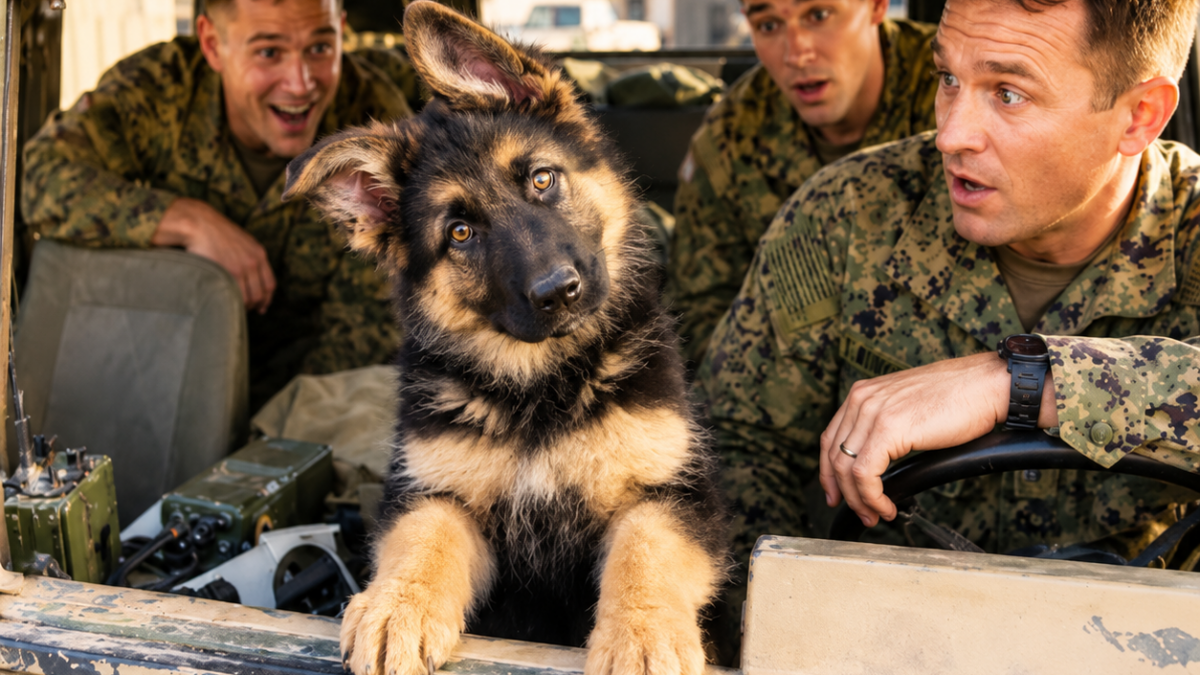
Ridge sat on his blanket, one ear upright, one flopped sideways, watching him back.
“Unusual animal,” Nash said.
I stood near the wall with my arms folded, wearing the face I had built over thirty years for situations where everything inside me was doing something different from what the moment required.
Nash opened the folder.
The paperwork was complete.
Ridge would be transferred to Lackland Air Force Base in San Antonio within forty-eight hours for military working dog assessment. The behavioral evidence on record suggested potential for specialized service. The Navy did not leave potential unexamined.
Potential.
The word fell inside my chest like a stone dropped into still water.
Celeste stepped forward immediately.
“Commander, Ridge is ten weeks old. His stress profile is still forming. Pressure testing at Lackland at this age could permanently alter the behavior we’re documenting.”
Nash did not turn fully toward her.
“The facility is equipped for juvenile evaluation.”
“For aggression drive and environmental confidence,” Celeste said, voice precisely even. “That is not what Ridge is demonstrating.”
“What is he demonstrating?”
“Emotional attunement to human distress.”
One of the officers looked skeptical.
Celeste saw it.
“These are different things,” she continued. “One you can evaluate at Lackland. The other you can break by asking it to become something it isn’t.”
Ike stood near the back wall, cap low over his brow.
“I once took a compass apart to improve it,” he said without looking up. “Only pointed south after that. Just south. Every time.”
Nash slowly turned his head.
“And you are?”
“Maintenance,” Ike said with full dignity, as if that answered everything and always had.
Nash turned to me.
“Contractor Donahue. Your professional assessment?”
I looked at Ridge.
Ridge watched me with the same steadiness he had shown from the ditch. Patient. Already decided. Waiting for me to arrive at the thing he already knew.
“Sir,” I said, “I think we’d be sending a compass to a workshop to measure its weight.”
Nash closed the folder.
“Forty-eight hours. Prepare the animal for transport.”
He left.
Nobody spoke for almost a full minute.
Then Ike said, “I hate when engines think they’re people.”
Celeste sat down hard on the bench.
I looked at Ridge.
He tilted his head slightly, floppy ear shifting.
As if to ask why humans made everything more complicated than staying.
The rain came that night the way October rain comes in off the Atlantic.
Without hurry.
Without negotiation.
I sat on the floor outside Ridge’s kennel after everyone else had gone. The transfer documents lay untouched on the bench beside me. The metal roof ticked and tapped overhead. The facility lights glowed amber in the quiet.
Ridge was awake.
He had been awake since I arrived.
He sat at the gate watching me with complete attention. Not needy. Not anxious. Just present.
I reached beneath my shirt collar and lifted the chain I had worn since Meredith’s funeral.
My wedding ring hung from it.
I had moved it there because I could not take it off, but I could no longer bear the feeling of it on my finger when I reached for something and she was not reaching back.
The kennel light caught the gold.
“I was on mission when she went,” I said.
I did not plan to say it.
The words came because the rain was loud enough to hide them from the rest of the world.
“She told me to go. Said she’d be fine for three more weeks.”
Ridge watched the ring in my palm.
“She wasn’t fine.”
My throat tightened.
“She knew she wouldn’t be. She told me to go anyway because she understood something I didn’t. I was going to carry guilt either way. At least this way there’d also be one thing I hadn’t failed.”
Ridge made a sound.
Low.
Old.
Not a whimper.
Something older than a whimper.
“I keep thinking she did it on purpose,” I said. “Dying while I was gone. So I’d have to come back to something instead of just coming back to where she wasn’t.”
I closed my fist around the ring.
“I don’t know how to do that. Come back to something.”
Ridge stood.
Carefully.
He pushed his nose through the kennel bars and nudged my closed fist.
Once.
Gently.
Then again.
I opened my hand.
Ridge took the chain between his teeth.
Not playing.
Not tugging.
With deliberate care, he moved it two inches forward in my palm and set it down again.
Then he rested his chin over the ring.
Eyes closed.
I sat in the rain sound and amber light with a ten-week-old dog’s chin covering my wedding ring, and I did not speak for a long time.
Something in me shifted.
Not healed.
Not fixed.
Shifted.
Finally, I said, “I’m not going to let them send you somewhere that doesn’t know what you are.”
Ridge’s tail moved once.
Slow.
Certain.
Like a flag when the wind has finally made up its mind.
The letter arrived the next morning.
Plain envelope.
Handwritten in careful cursive.
Hand delivered to public affairs by a woman who had driven three hours from the Shenandoah Valley and asked only that it reach the man who found the dog.
I read it standing at the entrance to the canine bay, October sun low and cold at my back.
Her name was Edith Castle.
She was sixty-seven years old.
Her son, Sergeant First Class Aaron Castle, had died at Little Creek eight months earlier in a training accident on the water. He was thirty-four. He left behind a wife named Dana and a son named Noah, eight years old, who had not spoken more than five words in a row since the morning two officers came to the door.
Edith had seen Zach’s video.
She watched it six times.
Then she showed Noah.
He watched it once and said nothing.
Then asked to see it again.
He watched it four more times in silence.
The next morning, for the first time since Aaron died, Noah ate breakfast without being asked.
At the bottom of the envelope was a drawing folded into quarters.
Pencil.
A boy and a dog standing side by side in an open field, both facing away from the viewer, looking toward something the drawing did not show.
The boy’s hand rested on the dog’s back.
No words.
Just the two of them facing whatever was out there.
Together.
I folded the drawing carefully and placed it in the inside pocket of my jacket against the place where I carried a photograph of Meredith from the day we were married.
Then I went to find Celeste.
The assessment room had once been a training classroom near the canine wing.
Nash had arranged it with two rows of chairs, a steel table, a speaker system, and a rubber mat in the center of the floor. A small fluorescent-lit arena designed to determine what Ridge was worth.
I hated it before the assessment began.
That was not fair.
The room was just a room.
But grief teaches you to resent places before they earn it.
At 8:50, I stood near the door in full contractor dress, shoulders square, jaw set. Ridge sat at my left boot, splinted leg supported, eyes bright, floppy ear tipped sideways.
Celeste stood opposite Nash with her tablet.
Ike stood near the back wall with his arms folded, cap low, looking like a man who had accidentally entered a courtroom and already rendered a verdict on the judge.
The assessment was scheduled for 0900.
At 8:57, the door opened.
Edith Castle entered first.
She was taller than I had imagined from her letter, silver braid down one shoulder, wearing a dark green wool coat. One hand rested on the shoulder of the boy beside her.
Noah was small for eight, with light brown hair falling across his forehead and gray-blue eyes the color of winter sky. His other hand gripped the hem of his grandmother’s coat so tightly his fingers had gone white.
I knew that kind of courage when I saw it.
The kind that has nothing left to spend on itself, so it spends everything on the person standing nearest.
Nash’s jaw set.
“This was not on the schedule.”
“Supplemental witness documentation,” Celeste said without missing a beat.
She held up Noah’s drawing.
“Noah Castle submitted a behavioral observation exhibit.”
Nash looked at the boy.
Then the drawing.
Then Ridge.
He said nothing.
The assessment began.
The speakers played combat audio.
Distant rifle fire.
Heavy helicopter blades.
Low reverberant thump of simulated concussive blast.
Ridge’s ears lifted.
His body stiffened.
His eyes went to me.
I kept my face still.
“Hold,” I said.
Ridge held.
Nash made a note.
“Command sequence,” one officer said.
“Ridge, sit.”
Ridge sat, eyes fixed on my face.
“Down.”
He went down, chin toward the mat, watching.
“Stay.”
He stayed.
The speakers escalated.
A sharp close concussive crack cut through the room.
The kind of sound that still lived in my own body in places I had learned not to examine too closely.
Noah made no sound.
He simply went away.
That was the only way I could describe it later.
His eyes fixed on a point that was not in the room.
His grip on Edith’s coat went slack.
His breathing shortened.
His shoulders rose toward his ears and stayed there, rigid, like a child bracing for a blow that had already landed and had not finished arriving.
Edith bent immediately.
“Noah, sweetheart. Look at me.”
Noah did not look.
He was somewhere else entirely.
Somewhere with a road.
A house.
Two officers at the door.
A morning that split his eight-year-old life into before and after.
“Turn it off,” Nash said sharply.
But Ridge was already moving.
He did not run.
Did not startle.
Did not hesitate or check with me.
He responded to nothing in that room except the boy.
He crossed the assessment floor at an even trot.
Not too fast to frighten.
Not slow enough to miss the moment.
He reached Noah and lay down across his feet.
Completely.
Not beside him.
Not leaning.
He laid his whole small body flat over Noah’s shoes, chin on the floor, amber eyes looking straight up.
Like a weighted blanket.
Like an anchor.
Like something that had done this specific thing before in a life he had not lived yet.
The speakers went silent.
The room went silent.
I could feel my own breath stopped in my chest.
Nash stood at the table, one hand still raised toward the audio controls.
Ike’s head was bowed toward his chest, like he was reading something written on the floor.
Noah looked down.
For a long moment, nothing happened.
Then he sat down beside Ridge.
Drew his knees to his chest.
Laid his cheek against the dog’s back.
His eyes closed.
His face pressed into warm fur.
His breathing began to change.
Slowly.
A child resting against a wall he had finally decided he could trust.
No one moved for thirty seconds.
Then Noah spoke.
Without lifting his head.
His voice sounded like a window opening after a winter that had gone on too long.
“He’s warm like Dad’s jacket.”
The sound of Commander Nash closing his folder was very small in that room.
“Cancel Lackland,” he said.
One officer looked up sharply.
Nash kept his eyes on the boy and the dog.
“Dr. Waring will revise classification. Therapeutic attunement. Pilot program for active-duty and family support applications.”
He straightened the folder against the table edge.
“We don’t assess things we don’t understand by dismantling them into things we do.”
In the back, Ike made a sound that was not quite a word but carried the weight of a man who had been right for a long time and was choosing, with great restraint, not to say so.
Celeste nodded once.
Only once.
Anything more and she might have cried.
I looked at Ridge lying across Noah’s feet, chest rising and falling with the slow breath of a dog who had done what he was built to do and knew it.
Then I looked at Edith Castle.
She crouched beside her grandson, silver braid slipped over one shoulder, eyes tired and overflowing with something that had waited eight months for somewhere to go.
I thought about Aaron Castle, who died at this base doing the work he was trained to do.
I thought about Meredith, who died in a house full of flowers I had ordered from overseas because flowers were the only thing I could send across that distance.
I thought about every person handed a loss so large it had no door.
Ridge had not fixed any of it.
He was ten weeks old.
He could not fix anything.
But he knew where the weight was.
And he would lie down in it with you.
Without rushing.
Without leaving.
Without asking anything in return.
Until the room felt less like the place where impossible things happened, and more like a place where you might survive them.
The pilot program was approved faster than anything I had seen move through military channels in years.
That was partly Nash.
He was many things, but once convinced, he did not waste motion pretending to remain undecided.
Ridge would not be sent to Lackland.
He would remain under Celeste’s medical oversight while a therapeutic support framework was built around him. No pressure testing. No bite work. No attempt to shape him into a traditional military working dog. His talent would not be forced into a mold simply because the mold already existed.
Celeste wrote the classification herself.
Therapeutic attunement.
Ike said it sounded like a machine part.
“Better than emotional distress puppy,” Celeste replied.
“I would have approved that.”
“No one doubts that.”
Edith invited Ridge to the Shenandoah Valley once his leg healed enough for safe travel.
More precisely, Noah drew another picture.
This one showed a farmhouse, a red barn, a fence, a boy, and a dog. Above the gate he wrote, in uneven letters:
RIDGE’S PLACE.
Noah did not speak much yet.
But he drew.
Sometimes that is where language comes back first.
I drove Ridge to the Shenandoah Valley on a Saturday in late October when the mountains had turned the colors of a fire burning itself out slowly and without regret.
Ridge slept most of the way with his chin on my thigh.
He was bigger already.
Puppies grow while you are looking at them and somehow still surprise you the next morning.
His splint had been removed, though he still favored the leg when tired. His upright ear remained upright. The other still folded sideways. Celeste said it might stand eventually.
I hoped it never did.
Edith’s farmhouse sat at the end of a gravel lane lined with old oaks. The fence needed painting. The red barn leaned slightly in the way old barns do when they have survived more generations than the people criticizing their posture.
At the gate stood a hand-painted wooden sign.
RIDGE’S PLACE.
I stopped the truck.
For one breath, I sat there looking at the sign.
The afternoon light came through the oaks low and gold, catching fresh paint. I felt the particular weight of things named.
A name makes something real.
Makes it stay.
Makes it mean more than the moment that created it.
Then Noah came running out of the house in a blue jacket too big at the sleeves, mud already on his boots.
Ridge launched off the seat before I had fully opened the door.
Paws scattering gravel.
Back half wagging with complete structural independence from the front.
Noah caught him and went down laughing.
Actually laughing.
The sudden, startled kind that surprises the person it comes out of.
A laugh that had been waiting somewhere inside that boy for eight months for something to call it home.
Ridge climbed onto Noah’s chest and licked his face with shameless devotion.
Edith stood on the porch with both hands wrapped around a mug.
She caught my eye and nodded once.
No words.
No need.
I planned to stay one night.
I stayed two.
Then a third.
Because Ridge sat on my foot every time I moved toward the truck.
Because Noah asked over breakfast whether I had known his father.
I told him no.
Then I told him what kind of man Aaron Castle must have been to raise a son who could walk into a room full of strangers on the worst kind of errand and still reach for his grandmother’s coat instead of falling.
“Sometimes,” I told him, “the bravest thing a child can do is hold on for someone else when his own legs are giving out.”
Noah thought about that for a while, chewing toast.
Then he said, “Dad used to say brave isn’t when you’re not scared. Brave is when you’re scared and you show up anyway.”
I had to look down at my coffee.
“Your dad was right.”
Before I left on the third morning, I went into Edith’s front room and took Meredith’s photograph from the inside pocket of my jacket.
Small.
Worn.
Soft at the corners.
Her on our back porch in Virginia Beach, laughing at something just beyond the frame, sun catching the silver in her hair.
I set it on Edith’s mantel beside a photograph of Aaron Castle in uniform.
I did not ask permission.
Did not explain.
Edith saw me do it from the doorway.
She said nothing.
Only placed one hand over her heart.
Some houses understand grief better than others.
They do not try to remove it.
They make room.
I drove home on a Sunday.
The roads were dry, and the mountains held their color a long time in my rearview mirror.
For the first time in fourteen months, the quiet waiting in my house did not feel like accusation.
It was still quiet.
That had not changed.
Meredith was still gone.
Ridge was in the Shenandoah with a boy who needed him.
The kitchen still held one mug too many and one voice too few.
But when I stepped inside, the rooms seemed less like evidence of abandonment and more like rooms.
A kettle.
A chair.
A counter needing to be wiped.
A place where a man might live, if he stopped treating survival like betrayal.
I put the kettle on.
Then I stood for a long time with my hand on the phone.
My daughter’s number was still saved under Ellie Bug, though she was twenty-seven and probably would have changed it herself if she knew.
We had spoken since Meredith died.
Of course we had.
Logistics.
Check-ins.
Holidays.
Careful conversations where both of us avoided stepping too hard on the floorboards of shared grief.
But I had not really called her.
Not without reason.
Not without armor.
I pressed the number.
She picked up on the second ring.
“Hey, Dad.”
Her voice was careful.
Surprised.
Already beginning to hope before she knew what she was hoping for.
Warmth moved through me the way it moves through a cold room when someone opens the right window.
“Hey,” I said. “I wanted to tell you about a dog.”
There was a pause.
Then softer, “Okay.”
So I told her.
About the ditch.
About Ridge’s folded ear.
About Celeste and Ike and Bryce Malloy crying on the concrete.
About Commander Nash and the folder.
About Noah.
About Ridge lying across that boy’s shoes until breath returned to his body.
At first, Ellie was quiet.
Then I heard her crying.
Not loudly.
Not in a way that asked me to stop.
Just crying.
When I finished, she said, “Mom would have loved that dog.”
I looked at the empty kitchen.
“Yes,” I said. “She would have.”
“And you?”
I closed my eyes.
There it was.
My daughter, who had inherited her mother’s ability to ask the one question that found the locked door.
“I think he found something I was trying not to lose.”
“What?”
I touched the chain beneath my shirt.
“The ability to come back.”
Ellie breathed out.
“Dad.”
“I know.”
“No, you don’t.”
There was a smile in her voice now, cracked but real.
“That’s what Mom wanted.”
I leaned one hand against the counter.
“I’m starting to understand that.”
The pilot program grew carefully.
Not fast.
Fast ruins delicate things.
Celeste insisted on guardrails. Ridge’s exposure to distressed personnel and families had to be monitored, limited, and always voluntary. He was not a prop. Not a mascot. Not a miracle machine. He was a dog, still growing, still needing rest, training, safety, and protection from human need becoming too hungry.
Nash backed her fully.
That surprised people who did not understand him.
Nash had not become sentimental.
He had become convinced.
There is nothing more effective than a precise man who has corrected course.
Ridge split time between Little Creek and Edith’s farm as the program took shape. Officially, the farm became part of the therapeutic pilot environment, especially for Gold Star families and children struggling with loss. Unofficially, everyone called it Ridge’s Place.
Noah spoke more there.
Never all at once.
Grief does not hand back language like a lost wallet.
It returns it in pieces.
A sentence over breakfast.
A question beside the fence.
A laugh when Ridge chased leaves.
A whisper into fur when he thought no one could hear.
The first time Noah said, “I miss Dad,” Edith called me after he fell asleep.
She could barely get the words out.
“He said it, Seth. He said the whole sentence.”
I sat on the edge of my bed for a long time after that call, holding the phone after she had hung up.
Then I said aloud, to the room, to Meredith, to myself, “He said it.”
As if saying pain clearly could become a kind of survival.
Bryce Malloy became Ridge’s first official active-duty support case.
That was Celeste’s phrase.
Bryce called it “hanging out with the pup so Dr. Waring stops looking at me like that.”
He began coming twice a week.
At first, he sat outside the kennel while Ridge leaned against the bars.
Later, once Ridge’s leg healed, they walked together under supervision.
Bryce eventually told his team leader about his brother.
Not everything.
Enough.
That mattered.
One day, months later, Bryce found me outside the training building.
“Sir?”
“I’m a contractor. Don’t sir me unless you want Ike to start saluting vending machines.”
He almost smiled.
“I called my mom last night.”
I waited.
“I told her I was mad at my brother.”
His jaw tightened.
“I never said that before. Not even to myself.”
I nodded.
“Anger’s part of it.”
“Doesn’t feel like grief.”
“It wears different uniforms.”
Bryce looked across the yard where Ridge was trying to carry a stick twice his length while Noah cheered him on during a family visit.
“Dog doesn’t care which one it is.”
“No,” I said. “He doesn’t.”
Ike built Ridge a ramp for the farmhouse porch even though Ridge did not need one.
“Future planning,” he said.
“He’s a puppy.”
“And I am maintenance.”
That ended all debate.
He also fixed Edith’s barn door, replaced two fence posts, rebuilt a gate latch, and claimed each task was “unrelated to emotional developments.”
Edith started packing him lunches.
Ike accepted them with solemn dignity.
Celeste kept pretending not to notice.
Ridge grew.
His body lengthened. His paws became less ridiculous, though not much. His coat darkened along the saddle. The upright ear stayed in command. The folded ear rose halfway and then apparently decided compromise was honorable.
He never became what Lackland would have tested for.
He did not show the aggression drive Nash’s original paperwork sought. He had environmental confidence, but not in the usual way. Loud sounds startled him, then turned him toward whoever in the room had gone too still. Movement interested him only when attached to emotion. He ignored decoys, rubber toys, and bite sleeves with almost philosophical disinterest.
But if someone’s breathing changed, Ridge noticed.
If a hand clenched too long, Ridge moved.
If a child shut down, Ridge lowered himself.
If a grown man stared into middle distance with the look of someone no longer present, Ridge pressed warm weight against him until some part of that man returned.
Celeste wrote papers.
Nash secured funding.
Ike built things that were not in anyone’s budget.
Edith opened her home.
Noah drew the program logo: a boy and dog facing the horizon, hand on fur, no words.
The Navy approved a limited therapeutic support initiative for active-duty personnel, veterans, and families connected to training losses.
They gave it a formal name.
Everyone still called it Ridge’s Place.
Meredith’s photograph stayed on Edith’s mantel beside Aaron’s.
The first time Ellie visited, she stood before it quietly.
Then she added a photo of Meredith and me from some forgotten beach weekend years earlier, both of us laughing, my arm around her shoulders, her hair blown across her face.
“You should have one there too,” Ellie said.
“I’m not dead.”
“I know.”
She looked at me.
“That’s the point.”
I did not have an answer.
So I made coffee.
That is what men like me do when confronted with emotional precision.
We make coffee, fix hinges, check tires, or stand outside looking at weather.
Ellie came to Ridge’s Place with her husband and my grandson in the spring.
My grandson was three, suspicious of dogs larger than breadboxes, and immediately fascinated by Ridge’s half-folded ear.
“Broken?” he asked, pointing.
Ridge sat patiently.
“No,” Noah said from beside him. “That’s just how he listens different.”
I looked at Noah.
He scratched Ridge behind the good ear and did not notice all the adults in the yard had gone quiet.
Children, when healing, sometimes say theology by accident.
That summer, a group of Gold Star families visited the farm for the first official family retreat.
No ceremony.
No speeches beyond safety instructions.
Just space.
Grass.
Shade.
Coffee.
Children who did not need to explain why Father’s Day crafts hurt.
Mothers who could sit beside other mothers without pretending anniversaries were “hard days” instead of body blows.
Ridge moved among them with Celeste watching closely.
He chose carefully.
A little girl whose father had died before she was born. Ridge rested beside her while she stacked pebbles on his paws.
A teenager who refused to speak to anyone. Ridge sat with his back against the boy’s shin until the boy’s hand slowly lowered onto his head.
A widow who said she was fine three times in five minutes. Ridge followed her to the fence line and leaned into her until she laughed once and said, “Okay, okay, I’m not fine.”
No miracles.
No cures.
Just moments where grief did not have to stand alone.
One evening after everyone left, I sat on Edith’s porch with Ridge at my feet and Noah beside me drawing in a sketchbook.
The air smelled like cut grass and warm wood.
Edith and Ellie were inside washing dishes, though Edith kept insisting guests should not help and Ellie kept ignoring her in the inherited tradition of every woman I have ever loved.
Noah looked up from his drawing.
“Do you still miss her?”
I knew who he meant.
“Yes.”
“Every day?”
“Yes.”
“Does Ridge help?”
I looked at the dog.
Ridge slept with one paw against my boot.
“He helps me not be afraid of missing her.”
Noah thought about that.
“I’m afraid if I don’t miss Dad all the time, it means I’m forgetting him.”
I felt something twist in my chest.
“I used to think that too.”
“What do you think now?”
I looked toward the open kitchen window where my daughter’s laugh moved through the screen, mixed with Edith’s voice and the clink of dishes.
“I think remembering isn’t the same as hurting all the time.”
Noah drew one line across the paper.
Then another.
“Grandma says Dad would want me to be happy.”
“She’s right.”
“I know. But sometimes that makes me mad.”
I nodded.
“Me too.”
He looked at me then.
Not surprised exactly.
Relieved.
Adults lie to children all the time by making grief sound noble too quickly.
Sometimes a child needs permission to be angry at the dead for leaving, even when leaving was not their fault.
Ridge opened one eye, lifted his head, and laid it across Noah’s ankle.
Noah smiled faintly.
“He knows.”
“Yes,” I said. “He does.”
A year after I found Ridge, Little Creek held a small ceremony at the canine facility.
Nash called it a program recognition event.
Ike called it “a bunch of uniforms standing around pretending not to cry.”
Celeste threatened to ban him from the refreshments.
There was a plaque placed near the entrance to the renovated therapy wing.
RIDGE’S PLACE
For those who carry invisible weight.
Established in honor of the service members, families, and dogs who teach us to stay.
Ridge attended wearing a blue service vest Celeste approved after rejecting four designs.
Noah stood beside him holding the leash.
Edith stood behind them.
Bryce Malloy came too, now steadier, not fixed, but steadier. He knelt when he saw Ridge, and Ridge greeted him with a tail wag that nearly took out a folding chair.
Commander Nash gave brief remarks.
Very brief.
Because he was Nash.
“We made an error at the beginning,” he said, looking directly at the crowd. “We attempted to classify an animal based on existing categories instead of asking whether the existing categories were sufficient. This program exists because several people were willing to challenge the assumption that usefulness always looks familiar.”
His eyes flicked to Ike.
Ike raised one eyebrow.
Nash continued.
“Ridge reminded us that service is not always force. Sometimes service is presence.”
That was the closest Nash got to poetry.
Everyone recognized the effort.
After the ceremony, I walked behind the building to the drainage ditch.
The grate had been replaced.
The concrete cleaned.
The water level low.
Nothing visible marked the spot where Ridge had been found.
I stood there anyway.
Celeste found me.
“Thought you might be here.”
“Am I that predictable?”
“Yes.”
We stood in silence for a while.
Then she said, “He was never going to die in that ditch.”
“You know that how?”
“Because you found him.”
“That’s not an answer.”
“It is. You just don’t like answers that involve you mattering.”
I looked at her.
She shrugged.
“Clinical observation.”
I almost smiled.
“He saved a lot of people,” I said.
“He helped a lot of people.”
“You always correct that.”
“Because it matters. Ridge doesn’t save people by replacing their grief. He helps them stay in the room with it.”
I looked down into the ditch.
“Meredith used to say something like that.”
“What?”
“That love wasn’t supposed to make life painless. Just less lonely.”
Celeste nodded.
“She sounds smart.”
“She was.”
“She still is, if you’re repeating her.”
That one landed.
I had spent so long thinking of Meredith as gone that I forgot wisdom does not die at the same speed as breath.
It remains in the people who heard it.
That winter, Noah spoke at his school during a Veterans Day assembly.
Not a long speech.
Just five sentences.
Edith sent me the video.
Noah stood behind a microphone too tall for him, Ridge sitting at his side.
“My dad was Sergeant First Class Aaron Castle,” he said. “He died in a training accident. For a long time I didn’t talk because talking made it real. Ridge helped me talk because he doesn’t get scared of sad. I think brave means showing up even when you are sad. My dad taught me that, and Ridge helped me remember.”
The gym was silent.
Then applause came slowly, then all at once.
I watched the video alone in my kitchen and cried so hard I had to sit down.
Not because it hurt.
Because it opened something.
There are tears that empty you.
These did not.
They made room.
I called Ellie afterward.
“I watched Noah’s speech.”
“I know,” she said.
“How?”
“Because Edith texted me first. Women communicate, Dad.”
“I see.”
“Are you okay?”
I looked around the kitchen.
At the kettle.
The mug.
The photo of Meredith I had finally placed on the windowsill instead of keeping hidden in my jacket.
“Yeah,” I said. “I think I am.”
Not fixed.
Not finished.
Okay.
That was enough.
Years will pass.
Ridge will grow old someday.
That is the bargain we make with dogs and keep making because the alternative is a life with less love in it.
His muzzle will silver. His joints will stiffen. One day his half-folded ear may droop completely. Noah will grow taller. Bryce will move on. Celeste will write more protocols. Nash will retire and probably reorganize retirement itself into a more efficient system. Ike will deny every feeling until the end of time. Edith’s porch will need repainting again.
And I will still miss Meredith.
But missing her no longer means standing outside my own life.
Ridge taught me that, though he would not understand those words.
Dogs do not teach in sentences.
They teach by lying across your feet when the floor falls away.
By nudging open a fist closed around a ring.
By pressing warm ribs against someone shaking too hard to speak.
By staying.
That is the whole of it sometimes.
Staying.
The morning I found him, I thought I was going into the ditch after a drowning puppy.
Maybe I was.
But now I think Ridge was lying there at the edge of my life, half-submerged in the cold and the dark, waiting for me to stop walking past the thing that needed saving.
Not him.
Not only him.
Me.
All of us, eventually.
The ones trained to endure.
The ones praised for being strong.
The ones who keep moving because if we stop, the grief might catch up.
Ridge catches it first.
He does not defeat it.
He does not chase it away.
He simply lies down in the weight of it and looks up as if to say:
You do not have to carry this standing.
Tonight, somewhere in the Shenandoah Valley, a boy is falling asleep with a German Shepherd warm across his feet.
A grandmother is turning out lights in a farmhouse where grief has learned to share rooms with laughter.
A Navy commander has a revised program manual on his desk with language he once would have rejected as too soft.
A young corporal has called his mother again.
A maintenance chief has built three more ramps nobody asked for.
My daughter sends me pictures of her son wearing a toy stethoscope and examining a stuffed dog named Ridge.
And in my house, Meredith’s photograph sits on the windowsill where morning light can reach it.
I still wear the ring on the chain.
But some evenings, when I sit on the porch and the Atlantic air moves through the neighborhood, I take it into my palm and do not feel only what is gone.
I feel the nudge of a small nose.
The weight of a puppy’s chin.
The moment he moved the chain two inches forward and rested over it as if showing me what I could not see.
Not leave it behind.
Not bury it.
Just move it forward.
That is what healing has been for me.
Two inches.
Then two more.
A step.
A breath.
A phone call.
A drive to the mountains.
A photograph on someone else’s mantel.
A boy saying, “He’s warm like Dad’s jacket.”
A dog sleeping across the feet of someone who thought the world had become unsafe forever.
Ridge did not save me.
Not in the way people write on plaques or captions.
But he found me.
He found Bryce.
He found Noah.
He found the place where sorrow was hiding in plain sight and laid himself down there without fear.
And sometimes being found is enough to begin again.








