I Rescued a Dying Baby Squirrel—Then My Cat Did Something I Never Expected
I Rescued a Dying Baby Squirrel—Then My Cat Did Something I Never Expected
I almost left the tiny squirrel where he had fallen because everything I knew about wild animals told me his mother should be given the chance to come back for him.
Instead, I watched his mother climb down, stare at her injured baby for a few silent moments, and leave him bleeding in the wet grass—and that was when I realized he probably had only one chance left.
But after I carried him home and placed him near my two rescued cats, one of them walked over, lowered her head, and did something that changed the little squirrel’s life in a way none of us could have predicted.
It happened on an ordinary April afternoon in Denmark in 2014.
I was a single father then.
Life was busy in the ordinary way single-parent life tends to be busy.
There were meals to make, clothes to wash, work to finish, children to care for, bills to pay, and never quite enough hours in the day.
Our home was not especially unusual except for the fact that animals had a way of finding us.
I already shared the house with two rescued cats.
Tiger and Coco.
Brother and sister.
They had completely different personalities.
Coco was gentle.
Patient.
The kind of cat who seemed to study everything before deciding whether it deserved her attention.
Tiger was more independent.
He liked affection when he chose it, food whenever it was available, and naps in places that were inconvenient for everybody else.
They were family.
I thought our little household was complete.
Then something fell from the fourth floor of my apartment building.
I did not immediately know what it was.
I only heard the impact.
Soft.
Wrong.
I looked toward the wet courtyard below.
Something tiny moved in the grass.
At first I thought it might be a bird.
Then I saw the tail.
A baby squirrel.
He was lying in the middle of the yard.
So small that from a distance he almost disappeared against the wet ground.
I hurried downstairs.
Then stopped myself before reaching him.
Anyone who has ever found a young wild animal has probably heard the same advice.
Do not interfere too quickly.
A mother may be nearby.
A baby that appears abandoned may not actually be abandoned.
Human involvement can sometimes make things worse.
So I stood several meters away and watched.
The squirrel barely moved.
His fur was wet.
There was blood across his chest.
He looked impossibly small.
Maybe four weeks old.
PART2:
Old enough to have fur and recognize the world around him.
Far too young to survive alone.
Every instinct in me said pick him up.
But I waited.
Maybe his mother would come.
Minutes passed.
Then she did.
An adult squirrel moved down from the building area and cautiously approached.
I remember feeling relief.
There.
Good.
His mother had found him.
Now I could leave.
Nature would take over.
Except nature did not behave the way I wanted it to.
The mother squirrel approached her baby.
She stopped.
Looked at him.
Moved closer.
Then waited.
For several moments she seemed to inspect him.
The baby barely moved.
I expected her to pick him up.
Expected her to stay.
PART3:
Expected some version of the rescue I had imagined.
Instead, she turned around.
And left.
I stood there staring after her.
At the time, I interpreted it in the only way that made sense to me.
She believed he would not survive.
Maybe she could smell the injury.
Maybe she understood something I did not.
Maybe she simply could not carry him.
I will never know.
What I did know was that the little squirrel was now alone.
Bleeding.
Cold.
Wet.
And nobody else was coming.
So I picked him up.
He weighed almost nothing.
His body fit easily in my hands.
I could feel his heart beating much faster than mine.
There was a deep wound running across his chest.
Not a little scratch.
Not something I could clean and hope for the best.
He needed help.
I wrapped him as carefully as I could and went straight to a veterinarian.
The vet examined him.
Four weeks old, approximately.
Deep chest wound.
Serious trauma from the fall.
He had survived four floors.
That alone seemed impossible.
But surviving the fall did not mean he would survive what came afterward.
The veterinarian was realistic.
The injuries were significant.
The squirrel was wild.
Very young.
The outcome uncertain.
Then came the suggestion I had hoped not to hear.
Euthanasia might be the kindest option.
I understood why.
Veterinarians make those recommendations because they are trying to prevent suffering.
Not because they do not care.
But I looked at that tiny animal and could not make that decision yet.
He was still alive.
Still fighting.
I asked:
“Can you treat him?”
The answer was yes.
There were no guarantees.
I did not ask for any.
“Then please try.”
The wound was cleaned.
Stitched.
He was stabilized.
And I went home carrying a baby squirrel I had never expected to meet.
My children loved The Adventures of Tintin.
That gave him his name.
Tintin.
At first, I did not know whether he would survive the night.
His wound needed constant care.
He needed warmth.
He needed feeding.
He needed monitoring.
And because he was only about four weeks old, he needed the kind of attention normally provided by a mother squirrel.
I obviously was not one.
I did what I could.
Bottle feeding.
Cleaning the wound.
Checking the stitches.
Keeping him warm.
Every four hours.
Day and night.
That first week blurred together.
I slept in pieces.
Wake.
Feed Tintin.
Check wound.
Clean him.
Try to sleep.
Wake again.
Parenting human children had already taught me something about functioning while tired.
Apparently that skill transferred to squirrels.
Tintin hated having his wound cleaned.
I could not blame him.
Sometimes he struggled.
Sometimes he seemed too tired to struggle.
Those moments scared me more.
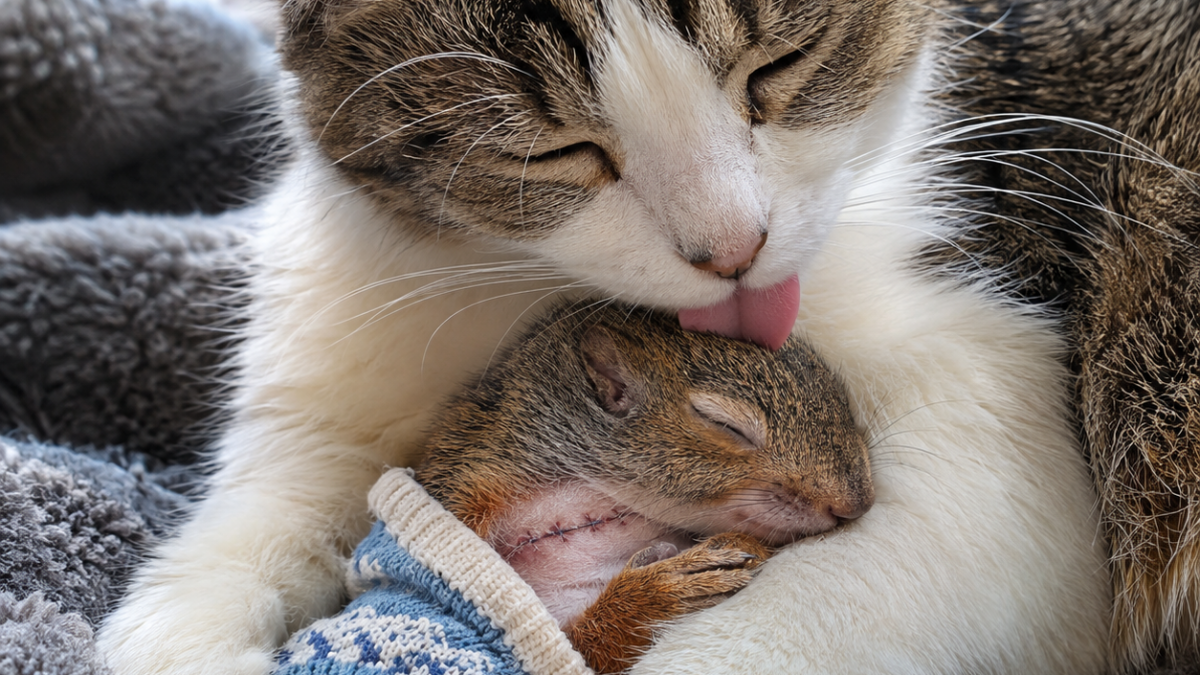
I began making tiny protective sweaters from my children’s old socks.
They were not fashionable.
Tintin did not care.
The goal was simply to keep him from scratching or disturbing his stitches.
He looked ridiculous.
A tiny squirrel in a little sock sweater.
It was one of the sweetest things I had ever seen.
And also one of the saddest.
Because beneath that tiny sweater was a wound that could still take him from us.
Then Coco noticed him.
I had been careful introducing the cats.
A squirrel is prey to many animals.
Cats included.
I did not assume that because Coco and Tiger were gentle with people they would automatically understand that this tiny wild animal was not something to chase.
Tiger stayed back.
He watched.
His expression suggested the house had become even stranger than usual and he wanted no responsibility for it.
Coco reacted differently.
She approached slowly.
I stayed close.
Ready to intervene.
Tintin was curled in a blanket.
Coco leaned forward.
Sniffed him.
Then she began licking him.
Gentle strokes across his head.
His back.
The fur around his neck.
I froze.
Coco continued.
Tintin did not pull away.
He relaxed.
Then moved closer to her.
Coco lay down beside him.
Tintin pressed against her warmth.
That first moment changed everything.
I could feed Tintin.
Clean his wound.
Keep him safe.
But Coco provided something I could not.
Animal companionship.
Warmth from another body.
Grooming.
A calm presence.
Perhaps something that felt enough like family for a frightened baby to recognize.
Coco never seemed confused by the fact that Tintin was not a kitten.
Or maybe she noticed and simply did not care.
She cleaned him as if he belonged there.
Stayed near him.
Let him sleep against her.
Sometimes I would enter the room and find Tintin tucked against Coco’s stomach.
Her paw draped nearby.
He looked less like a wild squirrel recovering from a near-fatal fall and more like somebody’s tiny strange baby.
Tiger continued observing from a safe distance.
He was not aggressive.
Just skeptical.
If Coco had decided the squirrel was family, Tiger seemed willing to accept the decision without becoming personally involved.
Days passed.
Tintin became stronger.
His appetite improved.
His movements became faster.
The wound began healing.
His eyes became brighter.
The frightened little animal I had lifted from wet grass started becoming a squirrel.
A very confident squirrel.
At least inside the house.
He climbed.
Investigated.
Chewed things he was not supposed to chew.
Moved with increasing speed.
His body recovered faster than my furniture.
The veterinarian checked him again.
The wound was healing.
No infection.
Stitches eventually came out.
We had reached the point I had been hoping for from the beginning.
Tintin was going to survive.
That should have made the next decision easier.
It did not.
Because Tintin was a wild animal.
The goal should never have been to turn him into a pet.
The goal was to save his life and eventually give him the opportunity to return to the outdoors.
I knew that.
Intellectually.
Emotionally, things were more complicated.
Tintin had become part of our daily life.
My children knew him.
Coco treated him like family.
Even Tiger had stopped looking surprised every time Tintin ran through the room.
But survival was only the first part of rescue.
A wild animal also needed a life appropriate to its nature.
So when Tintin was healthy enough, I began trying to introduce him to the outside world.
I expected him to be thrilled.
Trees.
Grass.
Branches.
Freedom.
He was a squirrel.
Surely this was what he wanted.
I opened the door.
Tintin stopped.
He stared outside.
Then backed away.
I tried again later.
Same thing.
The animal who confidently climbed furniture inside the house became nervous when confronted with open space.
Even the backyard frightened him.
That made sense when I thought about it.
Tintin’s last major outdoor experience had been falling four stories, lying injured in wet grass, and being abandoned by his mother.
Everything safe after that had happened indoors.
Bottle.
Warmth.
Coco.
Home.
To me, the outdoors represented freedom.
To Tintin, perhaps it represented uncertainty.
I could not simply carry him outside, put him on the ground and walk away.
That did not feel like giving him freedom.
It felt like abandoning him again.
So I tried something gradual.
I made a small leash.
Not because squirrels are supposed to walk on leashes.
They are not.
But because I wanted Tintin to be able to explore while still having a secure connection to the place he trusted.
At first he barely moved.
Then curiosity began winning.
A few steps.
A smell.
A leaf.
A low branch.
Back toward me.
Then farther.
Every day, a little more.
Coco often watched from nearby.
She did not interfere.
She simply stayed close.
It looked almost like she was supervising him.
Tintin eventually started climbing.
Not high at first.
Then higher.
He learned bark.
Branches.
Wind.
Birds.
Sounds coming from places he could not see.
He became more confident.
Some days he would rush toward the door as if he could not understand why I was taking so long.
The backyard stopped being frightening.
It became his world.
Then one morning, Coco did not wake up.
There was no warning.
No long illness.
No dramatic final moment.
She simply went to sleep.
And did not wake.
Peaceful.
Quiet.
Gone.
The entire house felt different immediately.
Anyone who has lost an animal knows how strange that silence can be.
The bed is still there.
Food bowl still there.
Favorite places still exist.
But something about the entire geometry of the home changes.
We missed her.
My children missed her.
I missed her.
Tintin had lost the animal who had cared for him when he was at his weakest.
But Tiger’s reaction affected me most.
Tiger searched.
Room after room.
He checked places Coco normally slept.
He walked through the house as if she had simply moved somewhere he had not checked yet.
Watching him was painful.
They had been brother and sister.
They had spent their whole lives together.
Now one was missing and the other could not understand why.
For a while, Tiger seemed lost.
Then something changed.
He began paying more attention to Tintin.
Not instantly.
Not in some movie moment where one animal clearly understands another has inherited a responsibility.
It happened gradually.
Tiger stayed nearby when Tintin ate.
He began sleeping closer to him.
Outside, Tiger started following.
Then one day I saw Tintin climb onto Tiger’s back.
Tiger did not shake him off.
He simply walked.
That became normal.
A squirrel riding on the back of a cat.
If somebody had described it to me before I saw it myself, I probably would have assumed the scene had been staged.
It was not.
Tintin simply climbed aboard.
Tiger accepted it.
They explored the yard together.
Tintin on his back sometimes.
Beside him other times.
Tiger was not Coco.
He did not groom Tintin the same way.
Their relationship was different.
Coco had been almost maternal.
Tiger became something closer to a protector and companion.
He watched.
Especially outside.
If another cat appeared, Tiger moved between it and Tintin.
If a dog came too close, he positioned himself in front.
If a hawk passed overhead, Tiger became alert.
It did not look trained.
Nobody taught him to guard a squirrel.
He simply did it.
Tintin trusted him completely.
The squirrel who once feared leaving the house now spent long afternoons outside with a cat watching over him.
The relationship became one of those ordinary miracles people sometimes miss because they happen gradually.
Nothing magical occurred.
Tiger did not stop being a cat.
Tintin did not stop being a squirrel.
They simply learned each other.
Then another complication arrived.
Keeping a squirrel as a pet is generally illegal in Denmark.
That mattered.
Tintin’s circumstances were unusual, but good intentions do not automatically override wildlife laws.
I eventually had to explain his situation to a special committee.
How I found him.
The fall.
The injury.
Veterinary treatment.
His dependence during recovery.
His unusual attachment to our household.
His gradual outdoor access.
I understood the concern.
Wild animals should not routinely be removed from nature simply because somebody wants an unusual pet.
That was never what happened with Tintin.
The committee looked at the situation.
Fortunately, they allowed him to remain with us because of the exceptional circumstances and the bond that had developed.
There was one condition they raised strongly.
The leash.
They believed it restricted him too much as a wild animal.
I understood.
The leash had never been intended as a permanent restraint.
It had been a bridge.
Something Tintin used while he learned that the outdoors was safe.
So we stopped using it.
That brought back some of my original fear.
What if Tintin left?
What if he climbed too far?
What if he never returned?
That was the whole point, though.
Freedom is not freedom if you only allow it when you know the outcome.
Tintin stepped outside without a leash.
At first, he remained close.
Then farther.
Tree.
Fence.
Branches.
Back again.
His range expanded.
He became more confident.
Then one day he disappeared longer than usual.
I remember standing near the door wondering whether this was it.
Maybe Tintin had finally chosen the wild life we had always hoped he could have.
I felt proud.
And miserable.
Then he came back.
Completely casual.
As if he had only been checking whether dinner was ready.
That became his pattern.
He could leave.
He did leave.
And he returned.
That distinction mattered enormously to me.
Tintin was not staying because a leash prevented him from going.
He stayed because home had become part of his life.
He could be a squirrel outdoors.
Then return to Tiger.
Return to the house.
Return to us.
We gave him the choice.
He kept choosing both worlds.
Years passed.
Animals teach you to measure time differently.
Children change obviously.
Height.
Voices.
School.
Clothing.
Animals change more quietly.
A little gray around the muzzle.
Longer naps.
Slight hesitation before jumping.
Tiger grew older.
Tintin remained energetic.
Their friendship continued through the ordinary days that rarely become photographs.
Eating together.
Sleeping nearby.
Watching birds.
Exploring the yard.
Tintin riding on Tiger’s back.
Tiger looking mildly annoyed while allowing it.
Those were the best days.
Not dramatic.
Not rescue days.
Not veterinary emergencies.
Just ordinary days.
I eventually understood that ordinary days are what rescue is supposed to create.
The dramatic moment gets attention.
An injured animal.
A fall.
Blood.
Veterinarian.
Stitches.
But survival only matters because of what comes after.
Breakfast.
Sunlight.
Naps.
Friends.
Trees.
Seasons.
A life.
In 2020, another animal found us.
There was scratching at the back door.
I opened it.
A tiny stray cat was outside.
Female.
Thin.
Fleas.
Old injuries.
She had apparently lost kittens.
There was something tired about her.
Not aggressive.
Just worn down.
I named her Miss Marble.
Our house had once again become a place where an animal in trouble somehow appeared and refused to remain a stranger.
Miss Marble recovered.
She and Tintin slowly learned each other.
By then, Tiger was elderly.
He had spent years as Tintin’s companion.
Guardian.
Transportation system.
Eventually age caught him.
Tiger passed away from old age.
That loss was different from Coco’s.
Coco’s death had been sudden.
Tiger’s was the closing of a long life.
It still hurt.
Tintin had lost both of the cats who had shaped his world.
Coco first.
Then Tiger.
I wondered how much animals remember.
People like to answer that question confidently.
I cannot.
I know what I saw.
After Tiger was gone, Tintin sometimes behaved differently in places they had shared.
He would stop.
Look.
Sit longer.
Was he remembering?
Waiting?
Simply watching something I could not see?
I do not know.
I prefer not to invent thoughts for animals when their behavior is already beautiful enough.
But I do believe Tiger mattered to him.
Deeply.
Fortunately, Tintin was not entirely alone.
Miss Marble began spending more time near him.
Their bond was quieter.
Different.
She was never Coco.
Never Tiger.
And that was good.
New relationships should not have to become replacements for old ones.
Tintin and Miss Marble found their own rhythm.
They spent afternoons sitting together.
Watching the world through windows.
Resting near each other.
Sometimes outside.
Sometimes indoors.
Nothing dramatic.
Just companionship.
I would look at Tintin beside Miss Marble and think about the animal I first found lying in wet grass.
Four weeks old.
Bleeding.
His mother walking away.
Veterinarian suggesting we let him go.
I had no idea what waited after that decision.
Coco.
Tiger.
Miss Marble.
Years.
Freedom.
Loss.
Friendship.
Ordinary afternoons.
Tintin survived because several things happened in the right order.
I happened to see him fall.
I happened to wait long enough to see his mother leave.
The veterinarian agreed to treat him after I asked.
His wound healed.
Coco accepted him.
Tiger eventually protected him.
The wildlife committee considered his unusual case individually.
And Tintin himself kept choosing life at every stage.
I do not think any of that means people should automatically take wild animals home.
Quite the opposite.
Tintin taught me how complicated wildlife rescue can be.
Wild animals have needs that domestic animals do not.
Legal questions.
Diet.
Development.
Behavior.
Release.
Safety.
Humans can hurt animals while believing they are helping.
That is why experts matter.
Veterinarians matter.
Wildlife rehabilitators matter.
Knowing when not to intervene matters too.
If I had found a healthy young squirrel sitting alone for a few minutes and simply decided I wanted him, that would have been wrong.
Tintin was critically injured.
His mother came.
Saw him.
Left.
His survival required intervention.
Even then, the goal was never possession.
That became clearer as he recovered.
I did not save Tintin so he would belong to me.
I tried to save Tintin so he could eventually belong to his own life.
That meant opening the door.
Taking away the leash.
Accepting that he might leave.
Allowing trees to become more important than my fear.
And then accepting the incredible gift that he continued returning anyway.
There is a difference between an animal being trapped with you and an animal being free to go but choosing your home as part of its world.
Tintin had that choice.
That is probably the part of his story I treasure most.
People often focus on the cats.
Understandably.
A baby squirrel being raised beside cats is unusual.
Coco washing him.
Tiger letting him ride on his back.
Tiger standing guard against dogs, strange cats and birds of prey.
Those images are memorable.
But what stays with me most is not the unusual part.
It is how naturally the relationships developed.
Coco never needed applause for warming a tiny injured animal.
Tiger did not know people would find his friendship incredible.
They were simply animals responding to another living thing in front of them.
Humans sometimes overcomplicate kindness.
We ask whether somebody is ours.
Whether they belong to our group.
Whether helping is convenient.
Whether the story will end well.
Coco did none of that.
She smelled a tiny injured squirrel.
Then washed him.
Tiger spent years pretending he was above the whole situation.
Then eventually became Tintin’s protector.
There is something beautiful in that.
Not because it proves animals think exactly like humans.
They do not.
Because it proves care does not always need to look like ours to be real.
Tintin’s story also taught my children something I never could have taught with words alone.
They saw an animal nearly die.
They saw medical care.
Responsibility.
Bottle feeding.
Cleaning wounds.
Sleepless nights.
They saw recovery.
Then they saw the hardest part.
Love sometimes means opening the door.
Not every rescue should end with an animal becoming a permanent pet.
Sometimes the best possible ending is release.
Tintin’s situation became more complicated because he was unusually bonded to us and legally allowed to stay.
Still, I wanted my children to understand:
Helping something does not mean owning it.
Years later, when people asked about Tintin, they often focused on the question:
“Is he really a pet squirrel?”
I never knew how to answer that perfectly.
Pet?
Wild animal?
Family?
Visitor who stayed for years?
Tintin was Tintin.
He moved between worlds.
He knew the house.
He knew the yard.
He knew trees.
He knew cats.
He knew people.
He could leave.
He came home.
Categories were less important than making sure his life was healthy and safe.
As time passed, people online began hearing his story.
Photographs and videos spread.
Tintin with Coco.
Tintin riding Tiger.
Tintin sitting near Miss Marble.
People from other countries wrote to me.
Some said they had never seen a squirrel behave that way.
Others shared their own rescue stories.
Some asked how to keep squirrels.
That question always worried me.
Tintin was not an instruction manual.
He was an exception born from an emergency.
I always tried to make that clear.
If you find an injured wild animal, contact experts.
Do not assume the right answer is taking it home permanently.
Do not assume love replaces knowledge.
It does not.
Love without knowledge can harm.
Knowledge without compassion can become cold.
You need both.
That was true on the first day.
The veterinarian knew how serious Tintin’s injuries were.
I knew I wanted him given a chance.
Both perspectives mattered.
If treatment had meant prolonged suffering with no realistic possibility of recovery, I would have had to make a different decision.
Fortunately, that was not the outcome.
Tintin healed.
He lived.
And because he lived, we had years of moments I never could have predicted.
Coco curling around him.
Tiger walking through the yard with Tintin riding on his back.
My children laughing when Tintin investigated something he definitely should not have investigated.
The first time he returned voluntarily after exploring alone.
The quiet afternoons beside Miss Marble.
And the silences after Coco and Tiger were gone.
Loss became part of Tintin’s story too.
I wish it had not.
But that is the cost of a long life shared with others.
If you are fortunate enough to love many animals, eventually you become the one who remains.
Tintin experienced that in his own way.
Coco disappeared from his life.
Tiger disappeared.
New companions arrived.
The world kept changing.
He adapted.
That may be another reason his story means so much to me.
Recovery is not one event.
Tintin recovered from a physical wound first.
Then from fear of the outdoors.
Then he adapted to Coco’s death.
Then bonded with Tiger.
Then lost Tiger.
Then learned Miss Marble.
Life kept asking him to change.
He kept changing.
Humans do the same thing.
We just tell longer stories about it.
I sometimes think back to the courtyard.
That wet April afternoon.
I can still picture the mother squirrel.
Coming down.
Looking at her baby.
Leaving.
For years I wondered whether I had misunderstood her.
Maybe she did not abandon him because she believed he would die.
Maybe she was frightened by my presence.
Maybe she intended to return.
Maybe something happened to her later.
I cannot know.
And I have learned to be careful about turning animal behavior into a human story simply because it makes sense emotionally.
What I know is simpler.
Tintin was badly injured.
He was alone.
I waited.
No mother returned.
He needed medical help.
I picked him up.
Everything after that came from that decision.
Was I right?
I think so.
Not because Tintin became famous.
Not because cats accepted him.
Not because the story makes people smile.
Because he survived, healed, gained freedom, and had years of life.
That is the measure that matters.
If I had to choose one image to represent his story, it would not be the fall.
Not the wound.
Not even Tintin riding on Tiger’s back, although that always makes people smile.
It would be something quieter.
Tintin sitting by an open door.
Outside in front of him.
Home behind him.
Nothing holding him.
No leash.
No cage.
No hand.
Just choice.
That was the moment the rescue became complete.
The first part of kindness was keeping him alive when he could not save himself.
The second part was giving him enough confidence that he no longer needed to depend on me.
And the final part was accepting whatever he chose after that.
He chose to return.
Again.
And again.
That was his gift to us.
Today, when I think about Tintin, I do not think first about the dramatic beginning.
I think about ordinary days.
That may sound strange.
But ordinary days are what almost disappeared when he fell.
The veterinarian’s warning meant there might never be another morning.
No Coco.
No Tiger.
No trees.
No little sock sweaters.
No window beside Miss Marble.
No years.
When you rescue something close to death, every boring day afterward becomes evidence of success.
Tintin did not need his life to remain dramatic.
He needed it to become ordinary.
Safe.
Interesting.
Free.
Loved.
He got that.
So did we.
I sometimes still hear the old videos.
My own voice talking to Tiger.
Laughing.
Calling Tintin.
Moments I barely noticed while they were happening.
That is the strange cruelty of memory.
The days you most desperately want back were usually days you did not know were special.
Tiger walking through the room.
Coco sleeping nearby.
Tintin climbing something.
Children laughing somewhere off camera.
Nothing important happening.
Everything important happening.
I am grateful I recorded some of it.
But no camera contains the whole thing.
The warmth of Coco beside an injured squirrel.
The nervousness of Tintin’s first outdoor steps.
Tiger searching the house after Coco died.
The first day Tintin rode on his back.
The quiet after Tiger was gone.
Those things live mostly in memory.
And memory changes.
Details soften.
Feelings remain.
What remains strongest is gratitude.
A tiny animal fell four stories.
Against every expectation, he survived.
A rescued cat became his first source of comfort.
When she was gone, her brother stepped into a role nobody assigned him.
When Tiger eventually left us too, another injured cat arrived and became part of Tintin’s world.
None of them knew they were participating in a story.
They were simply living.
Maybe that is why the story works.
We want extraordinary friendship to arrive with some clear explanation.
Sometimes it does not.
Sometimes a cat looks at a squirrel and decides:
You can stay beside me.
Sometimes another cat spends years pretending not to care and then quietly becomes the squirrel’s bodyguard.
Sometimes a wild animal discovers that freedom and home do not have to be opposites.
And sometimes the most important thing a human can do is stop trying to control the ending.
Give treatment.
Give safety.
Ask experts.
Learn.
Open the door.
Then watch.
Tintin taught me that rescue is not about making an animal dependent on you.
It is about helping that animal reach a point where dependence is no longer necessary.
If it stays after that, wonderful.
If it leaves, that can be wonderful too.
The kindness is in giving it the chance.
I almost walked away that April afternoon because I did not want to interfere with nature.
I am still glad I waited before touching him.
I am also glad I understood when waiting had become the wrong choice.
Tintin was lying alone in wet grass.
Four weeks old.
Bleeding.
His mother had gone.
The veterinarian was not sure he would make it.
There was no promise of Coco.
No promise of Tiger.
No promise of freedom.
No promise of years.
There was only one tiny injured animal and a decision.
Try.
So we did.
And somehow that tiny squirrel who was not expected to survive grew strong enough to climb trees, brave enough to explore on his own, loved enough to mourn friends, and free enough to leave whenever he wanted.
Yet again and again, Tintin came home.








