I Rescued a 1-Month-Old Puppy Covered in Fleas and Raw Skin—By Sunrise, She Went Limp in My Arms and the Vet Said the Next Few Hours Would Decide Everything
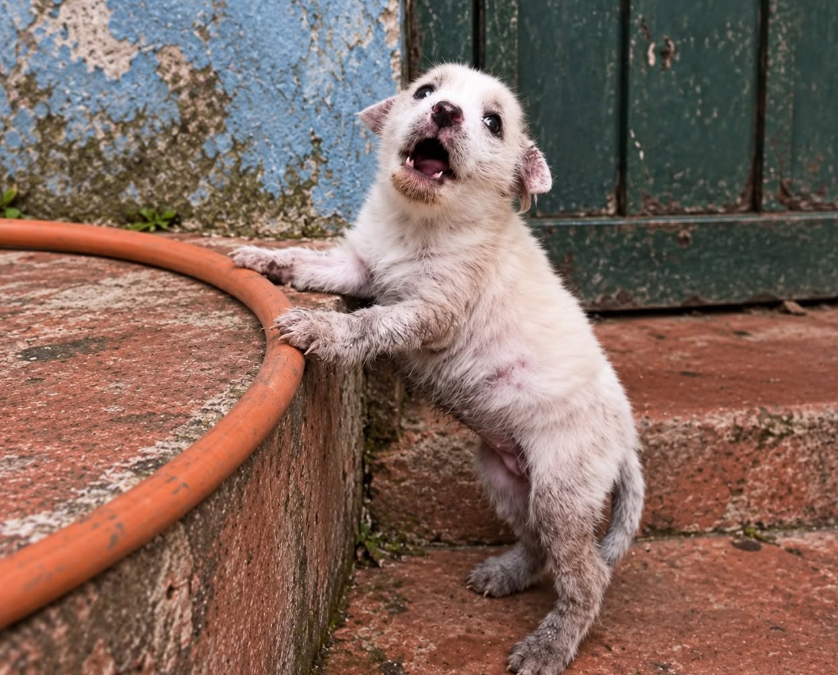
I Rescued a 1-Month-Old Puppy Covered in Fleas and Raw Skin—By Sunrise, She Went Limp in My Arms and the Vet Said the Next Few Hours Would Decide Everything.
Willow was so small when I found her that I could fit her trembling body against my chest, yet someone had already decided her life was not worth saving.
By sunrise, the puppy I had promised would be safe was burning with fever in my arms, and the veterinarian’s face told me the truth before she said a word.
I thought I was rescuing one abandoned baby from the dirt, but Willow would lead us to a hidden backyard operation, a room full of suffering, and a woman who smiled while pretending none of it belonged to her.
My name is Hannah Mercer, and before Willow, I thought rescue was something other people did.
I loved animals. I stopped to pet dogs tied outside coffee shops. I donated a few dollars to shelters around Christmas. I once drove twenty minutes out of my way to return a lost golden retriever to a frantic family after finding him wandering near a gas station.
But I was not brave in the way rescuers are brave.
I did not walk into broken places looking for what everyone else had ignored. I did not know how to look at suffering without flinching. I did not know how to hold something fragile in my hands and promise it a future when I had no idea whether morning would come.
At thirty-two years old, I had a neat little life in northern Georgia, just outside a small town called Briar Glen. I rented a pale yellow house at the end of a gravel lane, worked as an office manager for a dental clinic, and kept my world organized enough that unexpected things made me uncomfortable.
My mother used to tease me for it.
“Hannah,” she would say, “you make grocery lists like you’re planning a military operation.”
She was right.
I planned everything. Meals. Bills. Laundry. Routes. Conversations I was nervous about having. I had learned early that planning made the world feel safer, even though life had proven more than once that safety was never something you could schedule.
My older brother, Daniel, died when I was twenty-four after a drunk driver crossed the center line on a wet highway. After that, I became careful in ways that had very little to do with caution and everything to do with fear. I answered calls right away. I never drove in storms unless I had to. I avoided situations that looked messy, unpredictable, or painful.
Especially painful.
That was probably why I almost did not stop.
It was late afternoon when I found Willow.
The sky had that heavy gray color that comes before summer rain, and the air felt thick enough to lean against. I had left work early because a patient had canceled the final block of appointments, and I decided to take the back road home to avoid traffic near the high school.
That road ran behind a closed feed store, past an old equipment lot, a row of storage sheds, and a patch of scrubby grass where people sometimes dumped furniture they no longer wanted. I had driven it dozens of times.
That day, something moved near a pile of cardboard.
At first, I thought it was a rat.
Then I saw the ears.
Tiny.
Rounded.
Barely lifting.
I slowed the car.
A puppy was lying in the dirt near the edge of the lot.
For one second, my mind tried to protect me by making the situation less terrible than it was.
Maybe the mother is nearby.
Maybe someone is coming back.
Maybe she wandered from a yard.
Then the puppy tried to lift her head, failed, and collapsed again.
I pulled over so fast gravel sprayed against the underside of my car.
When I opened the door, the smell hit me first.
Sour dirt.
Old garbage.
Rain waiting in the air.
And beneath that, something sickly and warm, a smell I would come to associate with infection, neglect, and fear.
I stepped toward her slowly.
“Hey, baby,” I whispered.
She did not look up.
She did not wag her tail.
She did not cry.
That silence frightened me more than crying would have.
A healthy puppy that age should have been squirming, searching for her mother, biting fingers, stumbling toward anything interesting and discovering the world with reckless curiosity.
This puppy did none of those things.
She lay on her side with one front paw curled close to her chest and one back leg stretched at a wrong, painful angle. Her fur was missing in patches so large that for a moment I could not tell what color she was supposed to be. Her skin was red, raw, and inflamed. Fleas moved through what little fur she had left, crawling over her belly, around her neck, behind her ears.
She was so tiny.
One month old, maybe. Five weeks at most. Her eyes were open, but dull with exhaustion. Her ribs showed when she breathed. Her head seemed too heavy for her body.
I crouched down, my knees sinking into the dusty ground.
“Where is your mama?”
No mother appeared.
No dog barked from the nearby houses.
No person came running to claim her.
Nobody asked why I was kneeling in the dirt beside a dying puppy.
That was when I understood something I did not want to understand.
She had probably been suffering in plain sight for longer than anyone should have allowed.
I reached for her.
The puppy tensed, then went limp before my fingers even touched her.
That broke something in me.
Not the injury. Not the fleas. Not even the raw skin.
That limpness.
A baby that young should not already know surrender.
“Oh, sweetheart,” I whispered.
When I lifted her, there was almost no weight in my hands. Only heat, trembling bones, and the faint movement of a puppy who seemed too exhausted even to understand that someone had finally stopped for her.
She did not fight me.
She simply folded against my palms.
I pressed her carefully against my chest.
“I’ve got you,” I said. “I’ve got you now.”
The words came out before I knew whether they were true.
I looked around the lot again.
There were tire tracks in the dirt. A damp cardboard box lay on its side near the weeds. Something pale stuck to the inside of it. A towel, maybe. Or what had once been a towel. It was stained and stiff.
I should have photographed everything.
I know that now.
At that moment, all I could think was that the puppy was hot, filthy, and barely moving.
I carried her to my car, wrapped her in the old sweatshirt I kept in the back seat, and drove home with one hand on the steering wheel and one hand resting lightly on the trembling bundle beside me.
I talked the entire way.
“I don’t know where you came from,” I said. “I don’t know who did this. But we are not staying there.”
The puppy’s eyes opened once.
They were cloudy blue-gray, the soft uncertain color of a baby still becoming herself.
“You need a name,” I said, mostly to keep myself from crying. “Something gentle. Something that sounds like you’re supposed to grow.”
The road curved beneath oak trees, and I saw the willow branches near Miller’s pond moving in the wind.
“Willow,” I whispered.
The puppy blinked.
“All right,” I said. “Willow.”
PART2:
I brought her home immediately.
The first thing she needed was warmth and relief from the fleas covering her body. I did not know enough then to understand how dangerous a flea infestation can be for a puppy that small. I only knew they were crawling over her skin and she was too weak to scratch.
I called the after-hours number for the veterinary clinic I used years earlier when my mother’s cat was alive. The receptionist told me the doctor was in surgery but asked me to describe the puppy. When I did, her tone sharpened.
“Keep her warm,” she said. “Do not use harsh flea products. She’s too young and weak. A gentle bath with warm water and mild soap can help remove fleas, but be careful. If she becomes colder or weaker, bring her straight to emergency.”
I wrote down everything with shaking hands.
Then I prepared a shallow bath in my kitchen sink.
I tested the water again and again with my wrist, terrified of making it too hot, terrified of making it too cold, terrified of everything because suddenly this impossibly small life depended on me and I had no training beyond loving things from a distance.
When I lowered Willow into the water, I expected panic.
Instead, she relaxed.
Her tiny legs stopped trembling.
Her chin rested against my hand.
As the warm water moved over her damaged skin, she closed her eyes.
I nearly cried.
“You like that, don’t you?”
She gave the smallest sigh.
It was such an ordinary sound.
But with Willow, nothing felt ordinary.
I washed her slowly, removing dirt and fleas without rubbing the raw areas too hard. Fleas floated into the water. More crawled toward her face, and I picked them away with a comb and my fingertips. Every few minutes I stopped to make sure she was breathing normally.
“You’re doing good,” I whispered. “You’re doing so good.”
Afterward, I wrapped her in the softest towel I owned and dried her gently. Her little body shook from exhaustion. I used the skin treatment the receptionist recommended until the doctor could examine her, then dabbed around the worst areas with the kind of care I might have used on a burn.
Willow didn’t resist.
She simply watched me with exhausted eyes.
That evening, I made her a bed from folded blankets and placed it beside my couch. I warmed a heating pad on low, wrapped it in a towel, and tucked it under one side of the bedding so she could move away if she got too warm, though she barely had enough strength to shift.
I offered food softened with warm water.
She sniffed it.
Her head sank.
I tried a little formula from a syringe after calling the clinic again. She swallowed some, then turned away.
For what may have been the first time in her short life, Willow had a warm place to sleep.
She had clean water nearby.
Food.
Blankets.
Someone watching.
I remember sitting beside her on the floor and thinking that perhaps we had reached her in time.
“Sleep,” I whispered. “Tomorrow will be better.”
I believed it.
I desperately wanted to believe it.
Outside, rain began tapping against the windows. Not hard. Just steady enough to make the house feel smaller and warmer. I did not go to my bedroom. I lay on the couch with one hand hanging down near Willow’s blanket, waking every few minutes to check whether she was still breathing.
Each time, her tiny chest rose.
Each time, I let myself hope a little more.
Sometime before sunrise, I woke because Willow made a sound I had never heard from her before.
A sharp, tiny cry.
I switched on the lamp.
She was shaking.
Not trembling like before.
Shaking.
I touched her.
Her body was burning.
“Willow?”
She tried to raise her head.
It fell back onto the blanket.
“No, no, no.”
I lifted her carefully, and she cried again when her injured leg moved. Then her body suddenly went limp.
For one terrible second, I thought she had died in my arms.
“Willow!”
Her chest moved.
Barely.
I grabbed my phone with one hand and called the veterinary clinic while pulling on the first clothes I could find.
The person who answered heard the panic in my voice.
“Bring her now.”
I wrapped Willow in a blanket and ran to the car.
The streets were nearly empty. The rain had stopped, leaving everything dark and shining under streetlights. Every red light felt cruel.
“Stay with me,” I kept saying.
Willow opened her eyes for a few seconds, then closed them again.
“Please, Willow. Just stay with me.”
When I reached the clinic, a veterinary nurse was already waiting at the door.
She took one look at the puppy in my arms and called for the doctor.
Within seconds, Willow disappeared through the treatment-room doors.
I stood there holding the empty blanket.
Her warmth was still inside it.
That was the moment I realized I had already begun to love her.
Not later, after she healed.
Not when she wagged her tail or learned my voice or grew into herself.
Already.
Love had arrived without asking whether it was safe.
The veterinarian came back several minutes later. Her name was Dr. Priya Shah, and she had kind eyes that did not hide bad news.
The expression on her face made my stomach drop.
“How bad is it?” I asked.
She took a breath.
“Her fever is dangerously high. She’s severely weakened. She has a heavy parasite burden, probable mange or another serious skin infection, anemia from fleas, dehydration, and the pain from that leg is pushing an already exhausted body very hard.”
“Can you save her?”
“We’re treating her.”
“That’s not what I asked.”
Dr. Shah looked at me.
Then she said the sentence I had been terrified to hear.
“The next few hours may decide whether Willow gets to grow up at all.”
I sat down because my legs stopped trusting me.
“What do you need me to do?”
“Tell me exactly where you found her.”
I gave her the location.
She wrote it down.
“Was she alone?”
“Yes.”
“Any other puppies?”
“I don’t know. I didn’t look enough. I just saw her and—”
“It’s okay.”
“No, it’s not. There was a box. I should have checked.”
Dr. Shah’s face changed slightly.
“What kind of box?”
“Cardboard. Near the weeds. There was a towel inside.”
She exchanged a look with the nurse beside her.
“What?” I asked.
The nurse, a woman named Lacey with tired eyes and a messy bun, said, “We had a call yesterday about puppies being advertised out of a trailer not far from there.”
Dr. Shah gave her a look.
Lacey pressed her lips together.
“What puppies?” I asked.
Dr. Shah pulled a chair closer and sat across from me.
“I don’t want to jump to conclusions.”
“Please don’t say that sentence unless there’s something to conclude.”
She sighed.
“There have been complaints about a woman named Carla Briggs. She runs what she calls a small home breeding program outside town. Puppies, mostly mixed small breeds, sometimes shepherd mixes, sometimes whatever she can sell. Animal control has visited before, but people clean up very quickly when they know officers are coming.”
I looked toward the treatment-room doors.
“You think Willow came from there?”
“I don’t know.”
“Is it close to where I found her?”
“Yes.”
My stomach turned.
“What happens now?”
“First, we stabilize Willow. Then I’ll call animal control.”
I stared at the doors.
“Can I see her?”
“Not yet. We’re cooling her fever carefully, starting fluids, treating pain, drawing blood, checking glucose, and assessing the leg. She’s very fragile.”
I nodded because there was nothing else to do.
Dr. Shah stood.
“Hannah?”
I looked up.
“You got her here. Whatever happens, she is not lying in the dirt anymore.”
That should have comforted me.
It didn’t.
For the next four hours, I sat in the clinic waiting room while morning brightened beyond the windows. People came in with healthy dogs on leashes, cats in carriers, a sleepy golden retriever wearing a bandana covered in ducks. Life kept moving around me in normal, ordinary ways that felt almost insulting.
A man laughed at something on his phone.
A little girl asked if her cat could have a sticker.
Someone complained about the price of flea medication.
I sat with Willow’s empty blanket in my lap and stared at the hallway every time footsteps approached.
At 9:17 a.m., Dr. Shah came back.
“She’s alive,” she said.
The words went through me so hard I had to cover my face.
“She’s still critical,” she added gently. “But her fever has come down a little, and she’s responding to fluids.”
“Her leg?”
“We took X-rays. It isn’t broken, but there’s a severe soft-tissue injury and infection around the joint. It may have come from trauma, a bite, or getting trapped somewhere. We’ll treat aggressively and reassess.”
“Can I see her now?”
“Briefly.”
Willow was in an incubator lined with soft towels. She looked even smaller surrounded by tubes, monitors, and medical hands. An IV catheter was taped carefully into one tiny leg. Her skin looked raw under the bright exam light, and where fleas had bitten her belly, red dots covered her like a rash of suffering.
But her chest moved.
Up.
Down.
Up.
Down.
I pressed my fingers lightly against the clear side of the incubator.
“Hi, baby.”
Her ear twitched.
Lacey stood beside me.
“She knows your voice.”
“Do you think so?”
“I do.”
I didn’t know whether she was telling the truth or being kind.
I needed both.
That afternoon, Animal Control Officer Marcus Reed arrived at the clinic. He was a broad man in his forties with deep lines around his eyes and a voice that stayed low even when he was angry. He asked me to describe exactly where I found Willow.
This time, I gave every detail I could remember.
The cardboard.
The towel.
The tire tracks.
The way nobody came.
Officer Reed wrote everything down.
“You willing to show me the spot?”
“Yes.”
Dr. Shah did not want me to leave because Willow could change quickly, but she also said the location mattered. So I drove behind Officer Reed’s truck back to the lot where I had found her.
In daylight, it looked worse.
The pile of cardboard was still there. The towel was still in the box. Rain had dampened everything, but the smell remained. Officer Reed pulled on gloves and crouched near the weeds.
I stood a few feet away, arms crossed tight over my chest.
“Here?” he asked.
“Yes.”
He took photographs.
Then he lifted the towel carefully.
His face hardened.
“What?”
He didn’t answer immediately.
He reached into the box and removed a small strip of blue plastic.
A collar.
Tiny.
Chewed.
Still attached to it was a torn paper tag from a local feed store.
Officer Reed placed it into an evidence bag.
Then he walked a wider circle around the area, scanning the ground. Near the back of the lot, behind a rusted mower, he found something else.
A folded receipt.
Most of the ink had smeared from rain, but one line remained readable.
BRIGGS FAMILY PUPS — CASH ONLY.
Officer Reed looked at me.
“Now we have a place to start.”
Carla Briggs lived fifteen minutes away on a property at the end of a dirt lane lined with leaning mailboxes and overgrown grass. I was not allowed to go when Officer Reed visited her. He told me to return to the clinic and wait.
Waiting was becoming a form of torture.
When I got back, Willow had opened her eyes.
Lacey waved me over.
“She lifted her head.”
“She did?”
“Just for a second.”
I crouched beside the incubator.
“Willow?”
Her eyes shifted toward me.
Barely.
But they shifted.
I smiled so hard it hurt.
“That’s my girl.”
That evening, Officer Reed returned to the clinic with an expression that told me he had expected something bad and found something worse.
“What happened?” I asked.
He glanced toward the treatment area.
“Carla says she knows nothing about this puppy.”
“Of course she does.”
“She claims her last litter sold out two weeks ago.”
“And you believed her?”
“No.”
His answer was so immediate that I went quiet.
“She wouldn’t let me inspect the property beyond the front yard without a warrant,” he continued. “Said I was harassing a small business owner. But I heard dogs inside a back shed.”
“Puppies?”
“Some.”
I looked toward Willow.
“Can you get a warrant?”
“I’m working on it.”
“What does that mean?”
“It means I need enough to convince a judge.”
“We have the collar. The receipt.”
“We have evidence suggesting a connection. We need more.”
I wanted to scream.
Instead, I looked through the glass at Willow’s tiny body and asked the question that had been growing inside me all day.
“If Willow came from there, why dump her?”
Officer Reed’s face tightened.
“Because sick puppies cost money.”
The words landed like a slap.
Sick puppies cost money.
As if the answer could be that simple.
As if a living creature could become inconvenient enough to throw away.
That night, I slept in a chair at the clinic because Dr. Shah allowed it and because I refused to go home while Willow was still fighting. Lacey brought me a blanket and a cup of coffee at midnight.
“You don’t have to stay,” she said.
“Yes, I do.”
She smiled faintly.
“That’s usually how it starts.”
“What?”
“Rescue people.”
“I’m not a rescue person.”
Lacey glanced at Willow.
“Okay.”
At 2:40 a.m., Willow’s fever spiked again.
The monitor beeped. Dr. Shah came running from the back. Lacey moved fast, adjusting fluids, checking temperature, calling numbers I didn’t understand. I stood behind a line I had not been told not to cross but somehow knew I could not.
Willow made one thin cry.
I pressed my hands against my mouth.
“Please,” I whispered. “Please.”
Dr. Shah worked over her with terrifying focus.
Minutes stretched.
The fever stayed high.
Willow’s tiny body jerked once, then went limp.
“No,” I said.
No one answered me.
The room filled with quiet urgency.
Lacey looked pale.
Dr. Shah said, “Come on, little one.”
I will remember that forever.
Not as a dramatic movie moment.
As a doctor leaning over a puppy who had been treated like trash and speaking to her like she mattered.
“Come on, Willow.”
Maybe it was the medication.
Maybe it was the fluids.
Maybe it was simply that something inside that tiny body had not finished fighting.
Her chest moved stronger.
Then again.
The numbers improved slowly.
Dr. Shah exhaled.
I realized I had been holding my breath.
“She’s still with us,” Lacey whispered.
I cried then.
Quietly at first.
Then harder.
Lacey guided me into the hallway and pressed tissues into my hand.
“You love her,” she said.
I nodded because pretending otherwise would have been ridiculous.
“She weighs less than a bag of sugar,” I said through tears.
Lacey smiled sadly.
“That doesn’t seem to stop them.”
By morning, Willow was still alive.
That felt like a miracle.
At noon, Dr. Shah told me her blood work showed severe anemia, infection, malnutrition, and parasites, but also one small, stubborn sign of hope.
“She’s trying to respond,” Dr. Shah said. “Her body is fighting.”
“She wants to live?”
Dr. Shah looked through the glass at Willow.
“I think she does.”
That sentence became the rope I held for the next week.
Willow fought.
Not dramatically. Not in a way anyone would put on a poster. She fought by swallowing two drops of formula. By keeping her temperature down for six hours. By lifting her head. By sleeping without crying. By surviving a bandage change. By opening her eyes when I whispered her name.
On the fourth day, she licked formula from my finger.
I gasped so loudly that Lacey ran into the room.
“What happened?”
“She licked me.”
Lacey looked from me to Willow.
“Hannah, I thought she crashed.”
“She licked me.”
“That is very exciting,” Lacey said with a seriousness I appreciated.
On the sixth day, Willow wagged her tail.
It was barely a movement.
A tiny flutter against the towel.
But every person in the treatment room stopped to watch.
Dr. Shah smiled.
“Well,” she said, “somebody has decided to participate.”
By the end of the second week, Willow was stable enough to come home with strict instructions, medication, medicated baths, skin treatments, nutritional support, and more follow-up appointments than my work calendar could comfortably handle.
I took her home in a small carrier lined with fleece.
This time, when I placed her bed beside my couch, she looked around.
Her eyes were clearer now.
Still tired.
Still too old for her tiny face.
But clearer.
“This is home,” I told her.
She blinked.
“For as long as you want it.”
That first night, she woke me three times.
Not because she cried.
Because I woke myself checking if she was breathing.
By then, I had become the kind of person who could identify the sound of one small puppy sleeping beneath a blanket from across the room.
Willow’s recovery was not beautiful at first.
It was messy and exhausting. Her skin peeled. Her medicated baths smelled awful. She hated one of her antibiotics and learned to clamp her tiny mouth shut with shocking determination. Her injured leg remained stiff and painful. Some days she ate well. Some days she refused. Some days she looked almost playful, and other days she slept so deeply I put my hand against her side every five minutes.
I returned to work after taking two emergency days off, but my life was no longer orderly.
I fed Willow before sunrise. Bathed her before work. Came home at lunch to check on her. Set alarms for medication. Washed blankets constantly. Learned to clean wounds without crying. Learned to cheer for things no normal person would celebrate.
She pooped normally.
I texted Lacey a photo of the evidence.
Lacey replied, Congratulations to both of you.
I held Willow upright while she took three wobbly steps across a towel.
I called my mother.
“She walked.”
My mother said, “Isn’t that what puppies do?”
“Not this puppy.”
My mother went quiet.
Then softly, “I’m proud of you, sweetheart.”
I almost cried into the phone.
Because the truth was, I was proud of myself too.
Not in a loud way.
In a way that felt like discovering a room in my heart I hadn’t known was still open.
Meanwhile, Officer Reed’s investigation moved slowly.
Too slowly.
Carla Briggs denied everything.
She told him she had never seen Willow. She claimed the receipt could have blown out of anyone’s trash. She said competitors were trying to ruin her because she sold “affordable family puppies” instead of “overpriced designer dogs.”
She posted on Facebook the same afternoon Officer Reed visited her.
Some people hate small businesses and will do anything to smear a hardworking woman. My puppies are loved, clean, healthy, and raised in my home.
Under the post were heart emojis, angry comments, and women asking when her next litter would be ready.
I stared at the screen until my hands shook.
Then I clicked through her page.
Photo after photo of puppies in baskets. Puppies with bows. Puppies on plaid blankets. Puppies held by smiling children. Captions full of phrases like family-raised, vet-checked, first shots, healthy and happy.
And then, buried six months back, I saw a dog.
Not a puppy.
A thin tan female with tired eyes, standing behind a wire fence.
The caption read:
Our sweet mama Daisy taking a break after another beautiful litter.
Something about Daisy’s face made me feel sick.
I sent the photo to Officer Reed.
He called me within ten minutes.
“Where did you find this?”
“Her Facebook page.”
“Send me the link.”
“Do you think Daisy is Willow’s mother?”
“I don’t know.”
“But you think something.”
“I think Carla posts more than she realizes.”
Two days later, someone else called me.
A woman named Megan Rivers.
She had bought a puppy from Carla Briggs three months earlier. A friend of a friend had shared the news about Willow without naming me, and Megan had recognized the location of the dumping site because she had once met Carla in the same lot to pick up her puppy.
“She wouldn’t let me come to the house,” Megan said. Her voice trembled with guilt. “She said it was because of parvo risk. I believed her.”
“What happened to your puppy?”
“He got sick the next day. Vomiting, diarrhea, fever. We took him to emergency. He survived, thank God, but the vet said he was full of worms and too young to have been separated from his mother.”
“Did you report it?”
“I left a bad review. Carla messaged me and threatened to sue me for defamation. I deleted it.”
I closed my eyes.
“Would you tell Officer Reed?”
There was a pause.
“I should have done it months ago.”
“You were scared.”
“I was stupid.”
“No,” I said, looking at Willow asleep beneath a fleece blanket. “You were lied to.”
Megan did call.
Then another person came forward.
And another.
A man whose puppy died after three days.
A college student who met Carla in a parking lot and was told not to take the puppy to a vet for “at least a week because shots make them tired.”
A woman who had been blocked after asking for medical records.
A family who had adopted a puppy with mange so severe their own dog needed treatment.
Each story became another thread.
Officer Reed gathered them patiently.
Then, one Tuesday morning, he called me.
“We got the warrant.”
My knees nearly gave out.
“When?”
“Today.”
“Can I come?”
“No.”
“Officer—”
“No, Hannah.”
“I need to know.”
“And I will tell you what I can when I can. Stay home with Willow.”
I hated hearing that.
I also knew he was right.
So I stayed home with Willow.
By then, she had begun to look like a puppy instead of a shadow of one. Soft pale-gold fur was growing over her back. Her belly was healing. Her eyes followed me everywhere. She had discovered that my shoelaces were interesting and that biting them made me laugh even when I pretended to be stern.
Her injured leg was still weak, but she used it more each day. Sometimes it trembled. Sometimes she tucked it up when she got tired. Dr. Shah said we would know more as she grew.
That afternoon, I sat on the kitchen floor while Willow wrestled with a stuffed lamb twice her size.
“You know you’re terrifying,” I told her.
She growled softly.
It was the smallest growl in history.
“Oh, very scary.”
My phone rang at 4:38 p.m.
Officer Reed.
I answered immediately.
“How many?”
He was quiet.
That was how I knew the answer would hurt.
“Fourteen dogs,” he said. “Nine puppies.”
I put my hand over my mouth.
“Alive?”
“Yes.”
The word released something in me.
“But several are in bad shape,” he added. “Two adult females. One older male. Puppies in multiple pens. Unsanitary conditions. No proper records. Medications expired. Fleas. Parasites. One puppy with an untreated eye infection. A mother dog with severe mastitis.”
“Daisy?”
“We found a tan female that matches the photo.”
I looked at Willow.
“Can I see her?”
“Not yet. The dogs are evidence right now and receiving veterinary care.”
“Does Carla know about Willow?”
“She does now.”
“What did she say?”
Officer Reed’s voice hardened.
“She said she had no idea how that one got out.”
That one.
Not Willow.
That one.
My chest burned.
“She admitted it?”
“Not exactly. But she changed her story.”
“What happens to her?”
“Charges are being filed. Animal cruelty. Neglect. Operating without proper licensing. Fraud-related complaints may be separate, depending on what buyers can prove.”
“Can she get the dogs back?”
“We’re working to prevent that.”
I looked at Willow, who was now chewing the lamb’s ear with intense concentration.
“She can’t get them back,” I said.
“I agree.”
“No, I mean she can’t.”
“I know what you mean.”
That night, Carla Briggs posted again.
This time, the tone had changed.
I am being targeted by lies. Animal control stole my dogs today without warning. I have done nothing but love these babies. Sick puppies happen. Nature is cruel. People are crueler.
The comments were different now.
Some supportive.
Some furious.
Some from people who had bought puppies from her and were finally brave enough to speak.
You sold us a sick puppy and blocked me.
You told me not to go to a vet.
You met me in a parking lot because you knew your house was disgusting.
Where is Daisy?
Carla deleted the post within an hour.
But screenshots travel faster than shame.
The local news picked up the story after court documents became public. I refused to speak on camera at first. I did not want Willow turned into a symbol while she was still learning how to be alive.
Then I saw Carla outside the courthouse.
A reporter asked whether she had neglected the dogs.
Carla wore a floral blouse, sunglasses, and the expression of a woman offended by accountability.
“Absolutely not,” she said. “These animals were cared for. People don’t understand breeding. Some puppies are weak. You can’t save every single one.”
I was watching the clip on my phone while Willow slept in my lap.
Some puppies are weak.
I looked down at her tiny body.
Her fur was growing in uneven patches. One ear had started to perk up before the other. Her injured leg twitched in sleep.
Weak.
That was what people called the vulnerable when they wanted to excuse abandoning them.
I called Officer Reed.
“I’ll talk to the reporter.”
He paused.
“You sure?”
“No. But I’ll do it.”
The reporter’s name was Alyssa Grant. She came to my house the next evening with a cameraman and a softness I did not expect. I told her she could film Willow only if she did not use the worst images from the clinic.
“I don’t want people to pity her,” I said.
Alyssa looked at Willow, who was trying to climb onto her shoe.
“What do you want?”
“I want them to understand that somebody looked at her and decided she wasn’t worth helping. And they were wrong.”
The interview aired Friday night.
I wore a navy sweater and no makeup because I had forgotten cameras cared about such things. Willow lay in my arms, wrapped in a cream blanket, one tiny paw resting over my wrist.
Alyssa asked, “What was she like when you found her?”
I looked at Willow, not the camera.
“She was silent,” I said. “That was the scariest part. Puppies are supposed to ask the world for everything. Food, warmth, attention, play. Willow had already stopped asking.”
My voice broke.
I took a breath.
“She didn’t need someone to decide whether she was strong enough to deserve help. She needed someone to help her while she was weak.”
The clip spread quickly.
People cried.
People donated supplies to the clinic.
People called animal control about suspected neglect cases.
People asked to adopt Daisy.
People asked to adopt the other dogs.
And then something happened that I had not expected.
A woman came forward with a video.
Her name was Elena Torres, and she lived two properties over from Carla Briggs. Months earlier, after hearing dogs crying late at night, she had installed a camera facing her own driveway and side fence. The camera accidentally captured part of Carla’s back lane.
On the night before I found Willow, at 10:43 p.m., Carla’s white SUV drove down the lane.
At 10:57, the same SUV appeared near the old feed store lot.
The footage was grainy, but it showed a figure stepping out, carrying a cardboard box.
The figure set the box down near the weeds.
Then got back into the SUV and drove away.
Officer Reed called me after he saw it.
“It’s not perfect,” he said. “But it’s strong.”
“Strong enough?”
“Strong enough that her attorney called me this morning.”
“What did he say?”
“That Ms. Briggs may be willing to discuss surrendering all animals permanently.”
I closed my eyes.
Willow was asleep against my chest.
“Good.”
“Hannah?”
“Yes?”
“You did right by her.”
I looked at the puppy.
“She did most of the work.”
He was quiet a moment.
“They usually do.”
The court hearing for permanent custody of the seized dogs happened three weeks later.
By then, Willow had gained weight. She still looked ridiculous in the best way. Her fur was coming back in fuzzy patches, giving her the appearance of a stuffed animal that had been washed badly and loved anyway. Her injured leg worked, though not perfectly. Dr. Shah said she might always have a hitch in her step.
I told Willow that was fine.
I had a few hitches too.
I attended the hearing with Officer Reed, Dr. Shah, Megan Rivers, Elena Torres, and several other families who had purchased sick puppies from Carla.
Carla sat at the front with her attorney.
She did not look at us.
Her attorney argued that the situation had been exaggerated. That Carla was overwhelmed. That she loved animals but lacked resources. That public outrage had made her a target. That surrendering the dogs permanently would be devastating.
Then Dr. Shah testified.
She described Willow’s condition without melodrama.
One-month-old puppy.
Severe flea infestation.
Anemia.
Skin infection.
High fever.
Pain.
Dehydration.
Injured leg.
Critical condition.
Then she described Daisy.
The tan mother dog.
Underweight. Infected. Overbred. Nursing without adequate care.
Carla looked down.
The judge asked one question.
“Ms. Briggs, did you seek veterinary care for the puppy now known as Willow before she was found?”
Carla’s attorney stood.
“Your Honor, my client does not admit—”
The judge raised a hand.
“I asked Ms. Briggs.”
Carla lifted her chin.
“I didn’t know that puppy needed anything that serious.”
A murmur went through the room.
I felt Megan stiffen beside me.
The judge looked at the photographs.
“Ms. Briggs, this puppy was missing fur, covered in fleas, fevered, injured, and unable to lift her head. You operate a breeding business, do you not?”
Carla’s mouth tightened.
“A small one.”
“So you were experienced enough to sell puppies for money, but not experienced enough to recognize suffering?”
Carla’s face flushed.
“That’s not what I said.”
“No,” the judge replied. “But it appears to be what happened.”
That was the first moment Carla looked back.
Her eyes moved across the room, past Officer Reed, past Megan, past Dr. Shah, until they landed on me.
For a second, I saw anger there.
Not regret.
Not shame.
Anger.
As if I had done something to her by stopping for the puppy she left behind.
I held her gaze.
I wanted to say so many things.
I wanted to tell her how Willow went limp in my arms.
How her fever nearly took her.
How she cried when her leg moved.
How hard she fought for a life Carla had thrown away like spoiled inventory.
But I said nothing.
Willow was alive.
That was the testimony that mattered most.
The judge ordered all seized dogs permanently removed from Carla’s custody. She was prohibited from breeding or selling animals while the criminal case proceeded. Restitution was ordered for veterinary expenses. The dogs would be placed through approved rescues after medical clearance.
Carla’s business page disappeared two days later.
Her signs came down the following week.
The criminal case took longer.
Cases always do.
There were motions, delays, excuses, arguments over evidence, and attempts to minimize what had happened. Carla eventually accepted a plea arrangement that included animal cruelty and neglect charges, probation, fines, restitution, mandatory inspection conditions, and a ban on owning or breeding animals for years.
Some people thought it was not enough.
Some people thought it was too much.
I had learned from Willow that justice is rarely a clean feeling.
The better justice came in smaller, living forms.
Daisy was adopted by Elena Torres, the neighbor whose camera helped expose the truth. Elena sent me a photo three months later of Daisy asleep on a couch under a pink blanket, her body finally soft, her eyes finally calm.
The older male dog went to a retired couple with a fenced yard and an obsession with homemade dog biscuits.
The puppies went to foster homes, then permanent families.
Megan started volunteering with a rescue group that educated people about backyard breeders and puppy scams.
Dr. Shah’s clinic created a fund for emergency treatment of neglected puppies, and the first donation came from a child who mailed eleven dollars in crumpled bills and wrote:
For babies nobody wanted.
I pinned a copy of that note to my refrigerator.
Willow, meanwhile, became impossible.
That is the highest compliment I can give her.
She became demanding.
She became noisy.
She became curious about shoes, dust bunnies, socks, chair legs, leaves, paper towels, and one very unfortunate roll of toilet paper.
The puppy who had once been too weak to cry discovered her voice and used it to express opinions about everything.
Food taking too long?
Bark.
Bath time?
Bark.
I left the room for twelve seconds?
Bark.
A leaf moved suspiciously on the porch?
Bark bark bark.
My mother met her a month after the court hearing and immediately burst into tears.
Willow toddled across the living room with her uneven little gait and climbed onto my mother’s shoe.
“Oh, Hannah,” my mother whispered.
“I know.”
“She’s so small.”
“She thinks she’s enormous.”
Willow bit my mother’s shoelace.
My mother laughed through tears.
“She may be right.”
As Willow grew, her fur came in soft and golden with white on her chest and toes. One ear stood up. The other flopped sideways no matter what she was thinking, which made her look permanently skeptical. Her injured leg healed enough for normal life, but when she ran, there was always a little skip in her stride.
At first, I worried about it.
Dr. Shah didn’t.
“She’s not in pain,” she said during one visit as Willow attempted to chew the end of her stethoscope. “She’s adapting.”
“She looks uneven.”
“So do most of us if you know where to look.”
That stayed with me.
Willow did not run like other dogs.
She ran like Willow.
Fast, crooked, joyful, and completely unconcerned with whether anyone thought she was doing it correctly.
On the anniversary of the day I found her, I drove back to the old feed store lot.
I did not bring Willow at first.
I thought the place belonged to pain, and I did not want to give it to her.
But as I sat in my parked car looking at the weeds, the cracked pavement, the place where the cardboard box had been, I realized something.
That was not only where someone abandoned her.
It was where her life changed direction.
So I went home, clipped on her little purple harness, and brought her back with me.
She hopped out of the car, sniffed the ground, sneezed, and immediately tried to eat a piece of grass.
“No,” I said, pulling it gently from her mouth. “This is supposed to be meaningful.”
She stared at me with the expression of a dog deeply disappointed in human priorities.
I walked her to the edge of the lot.
The cardboard was gone. The towel was gone. Rain and sun and time had erased the evidence from the ground.
But not from me.
I could still see her there.
Tiny.
Raw.
Silent.
Too tired to ask for help.
Willow sniffed the dirt, then looked up at me.
Her tail wagged.
Not weakly.
Not barely.
Fully.
Wildly.
Like the whole world had arrived just to entertain her.
I crouched and touched her face.
“You have no idea, do you?”
She licked my chin.
I laughed.
“Good.”
I did not want her to remember.
I wanted her body to carry only what it needed.
Warmth.
Food.
Hands that healed.
A home.
Her own name spoken with love.
We stood there until the sky turned orange over the old feed store roof. Then Willow tugged the leash toward the car because dinner mattered more than symbolism, and honestly, she was probably right.
Years passed.
Not many.
Just enough for Willow to become fully herself.
She never grew large. Dr. Shah believed malnutrition had affected her early development, so she remained smaller than expected, compact and bright-eyed, with a foxlike face and that one ridiculous ear.
She became a therapy dog eventually.
That surprised everyone except my mother, who claimed she knew from the beginning that Willow had “a calling.”
I was skeptical.
Willow loved people, yes, but she also loved stealing napkins and once barked at a ceramic frog for eleven minutes.
Still, after training, she began visiting the children’s wing at the local hospital twice a month. The first time we walked through those doors, I thought about the clinic doors she had disappeared behind as a dying puppy. I thought about the empty blanket in my arms. I thought about how life sometimes circles back to the same kind of doorway and gives you a different ending.
Willow was gentle with children in a way she was not gentle with throw pillows.
She seemed to know.
A little boy named Evan was the first patient to ask about her limp.
“Why does she walk funny?” he asked.
His mother looked mortified.
“Evan.”
“It’s okay,” I said.
Willow rested her chin on Evan’s blanket.
“She got hurt when she was very little.”
“Did she get better?”
I looked at Willow.
“She did.”
“But she still walks funny.”
“Yes.”
Evan thought about that.
“I have scars.”
His mother’s eyes filled.
Willow licked his hand.
Evan smiled.
“Maybe she’s like me.”
I swallowed hard.
“Maybe she is.”
After that, I stopped thinking of Willow’s uneven run as something left over from cruelty.
It became part of her language.
Children trusted her because she was not perfect. Adults cried when they learned her story because somewhere inside themselves, they understood what it meant to survive and still carry evidence.
Willow never knew she was inspirational.
She knew she liked chicken treats.
She knew hospital floors were slippery.
She knew children often had crumbs.
She knew I carried a squeaky toy in my bag for after visits.
That was enough.
One December afternoon, after a hospital visit, I received a letter forwarded through the court victim-notification office.
There was no return address.
I opened it at my kitchen table while Willow slept beneath my chair.
Hannah,
You don’t have to read this. You don’t have to answer.
I saw the newspaper story about Willow visiting sick children. I stared at her picture for a long time.
I told myself for years that breeding was business. I told myself sick puppies happened. I told myself people like you were emotional and didn’t understand hard decisions.
The truth is I understood. I just didn’t care enough when caring cost money.
I remember that puppy. I remember putting her in that box. I remember thinking she would be gone by morning and it would be one less problem.
I am ashamed of that thought.
I don’t expect forgiveness.
I just wanted to say that I know her name now.
Willow.
I’m sorry.
Carla Briggs
I read the letter twice.
Then I folded it carefully.
I did not feel peace.
Not right away.
I did not forgive Carla in one beautiful, cleansing moment. Real life is rarely that generous.
I looked under the table at Willow, asleep on her back with one paw twitching in a dream. This dog, this loud, stubborn, crooked-running little miracle, had once been a problem someone wanted gone by morning.
I thought about answering.
I even took out paper.
But what could I say?
That sorry mattered?
Sometimes it does.
That it fixed anything?
It didn’t.
That Willow was fine now, so the past no longer counted?
No.
The past counted.
Her scars counted.
The fever counted.
The box counted.
The other dogs counted.
But I had also learned something from Willow that I might never have learned on my own.
A life is more than the worst thing done to it.
That was true for Willow.
It had to be true for people too, even when I didn’t like it.
So I placed Carla’s letter in the same drawer where I kept the child’s donation note.
For babies nobody wanted.
One note showed what care could become.
The other showed what happened when someone finally understood the shape of what they had done.
Both belonged in the story.
Willow lived thirteen years.
That may sound sudden, after everything I have told you, but time with a dog always feels like that. Impossible at the beginning. Endless in the middle. Unfairly brief at the end.
She grew old with the same stubbornness she had used to survive.
Her golden face turned white. Her good ear lost some hearing. Her crooked leg became stiff in cold weather. She stopped jumping onto the couch and began standing beside it, staring at me until I lifted her like royalty.
She still barked at leaves.
She still hated baths.
She still believed socks were community property.
On her last spring, I took her back to the hospital one final time. Not as an official therapy visit. She was too tired for that. But Evan, the little boy who had once said maybe she was like him, was now a tall teenager volunteering there. He asked if he could see her.
We met in the courtyard.
Willow walked slowly, her old limp more pronounced.
Evan knelt in front of her.
“Hey, girl,” he whispered.
Willow sniffed him.
Then, as if remembering, she rested her chin on his knee.
Evan cried.
I pretended not to see until I started crying too.
“She helped me a lot,” he said.
I nodded.
“She helped me too.”
That summer, Willow stopped eating much.
Dr. Shah was older by then. So was I. We both knew before the tests confirmed it. Kidney disease. Age. A body that had fought hard from the beginning and was finally becoming tired.
I brought Willow home with medication, special food, and the impossible knowledge that love was nearing the part where it had to become mercy.
For two weeks, she had good days.
She slept in sun patches. She barked once at the mailman, though without conviction. She ate roasted chicken from my fingers and looked offended when I cried over it.
Then, one evening, she tried to stand and could not.
I sat beside her on the kitchen floor, just as I had when she was a puppy.
“Hey, baby,” I whispered.
Her cloudy eyes found mine.
I had said those same words the first day.
She sighed.
The smallest sound.
The same kind of ordinary sound that had once made me believe she might survive.
I called Dr. Shah.
She came to my house.
My mother came too.
Lacey came, though she had moved to another clinic years earlier. Officer Reed, retired by then, sent flowers the next day because he said he could not bear to come and cry in front of everybody, which was the most Marcus Reed thing imaginable.
Willow lay on the soft blanket she had used for years, the purple one with tiny stars. I held her against my chest, careful of her old bones.
“I’ve got you,” I whispered.
Her breathing was slow.
“I had you then. I have you now.”
Dr. Shah gave the first medication, and Willow relaxed in my arms.
I touched the white fur between her ears.
“You were never weak,” I told her. “You were a baby. You were hurting. And you still fought harder than anyone I’ve ever known.”
My mother covered her mouth.
I kissed Willow’s head.
“You made it, sweet girl. You grew up.”
Her tail moved once.
Just once.
Thirteen years disappeared.
The box.
The fever.
The clinic.
The first wag.
The crooked run.
The hospital children.
The life that almost never happened.
Dr. Shah waited until I nodded.
Then she gave the final medication.
Willow’s breathing softened.
I held her until she was still.
This time, there was no panic.
No rushing through rain-dark streets.
No empty blanket in my arms.
No wondering whether I had found her one day too late.
She left in warmth.
In quiet.
In love.
Exactly the opposite of how someone had tried to leave her.
A month later, I returned to the old feed store lot.
The building had been renovated into a community supply pantry. The weeds were gone. The broken pavement had been patched. Families came there now for groceries, diapers, pet food, and help when life became too heavy.
Near the side fence, the town had allowed us to plant a small willow tree.
Not because Willow had been famous.
Not because she had been perfect.
Because she had reminded a lot of people that the smallest life can change the direction of many others.
Dr. Shah came.
So did Lacey, Officer Reed, Megan, Elena, Evan, my mother, and half the clinic staff. People brought their dogs. Daisy was there too, old and gray, leaning gently against Elena’s leg.
We placed a small stone beneath the tree.
It said:
WILLOW
SHE WAS FOUND SMALL
BUT SHE TAUGHT US TO LOVE BIG
I scattered a little of her ashes there.
Not because she belonged to the place where she was abandoned.
She didn’t.
But because I wanted that ground to remember a different ending.
Years ago, someone had left a one-month-old puppy there because they believed pain made her disposable.
Now families would pass that tree and see her name.
Children would ask who Willow was.
And someone would tell them.
She was a puppy nobody thought would live.
She did.
She grew.
She helped others heal.
She proved that being unwanted by cruel people is not the same as being worthless.
My name is Hannah Mercer.
I once thought rescue meant saving something from death.
Willow taught me it means much more than that.
It means staying after the emergency.
It means medicine at midnight, bills you didn’t plan for, fear you can’t organize, and hope so fragile you’re afraid to breathe near it.
It means loving a life before you know whether it will stay.
It means understanding that the helpless are not asking us to be heroes.
They are asking us not to look away.
Willow was only one month old when I lifted her from the dirt.
She was raw, fevered, flea-covered, injured, and silent.
By the next morning, I was staring at her tiny chest, begging it to keep moving.
For thirteen years after that, I watched that same chest rise and fall in sleep, in sunlight, in hospital rooms, in my arms, in a home where no one ever again measured whether she was worth the trouble.
And when I think of her now, I do not remember the box first.
I do not remember Carla Briggs.
I do not remember the fever.
I remember Willow running crooked across my yard, one ear up, one ear flopped, carrying a stolen sock like a trophy.
I remember her alive.
Because in the end, the people who left her to fade away did not get the final scene.








