I Reached Room 12 With a Retired SEAL’s Medication—Then His K9 Stepped Across the Doorway and Wouldn’t Let Me In
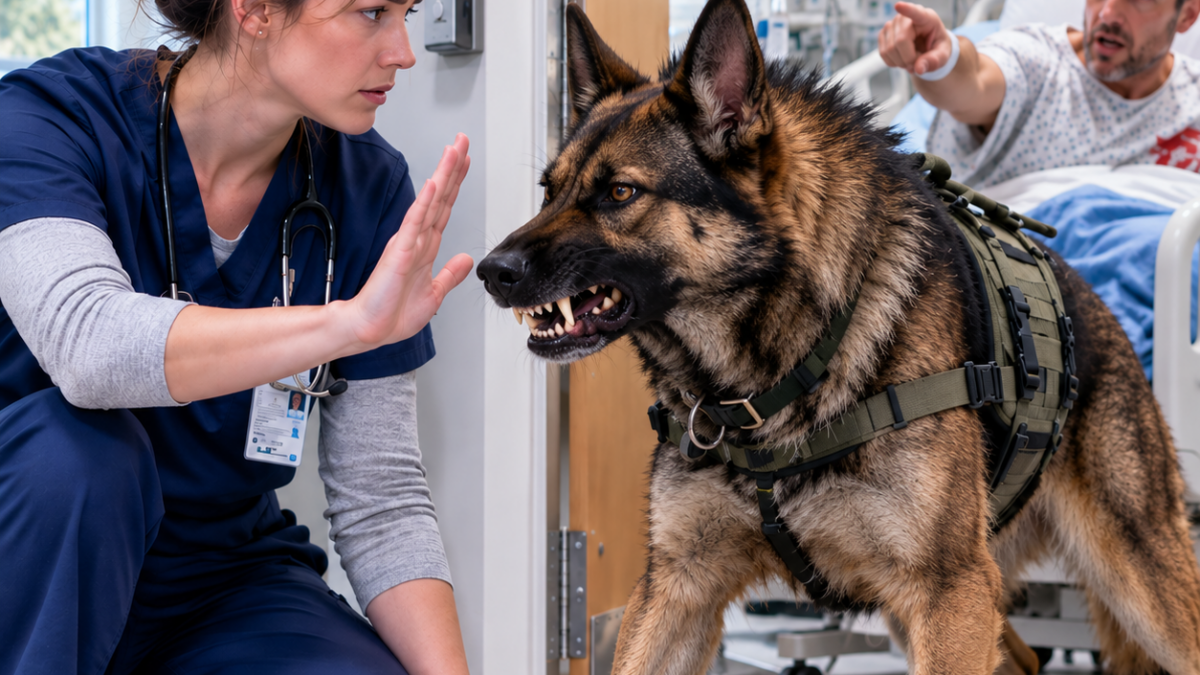
PART3:
His jaw tightened, not with anger this time.
With worry.
Megan glanced toward the nurse’s station, where another call light had started blinking.
“Clare, leave the meds with me. We’ll sort this out.”
It was reasonable.
I had six other patients on the wing. Ethan’s medication was due, but nobody needed a confrontation with an eighty-pound trained K9 in a recovery ward. The simplest answer was step away, call people with equipment and authority, and let them solve the dog.
I reached for the cart handle.
Rook moved fast.
Megan’s hand went immediately to the phone clipped at her waistband.
I froze.
But the dog had not moved toward me.
He had turned toward Ethan.
“Wait,” I said.
Megan’s hand stayed on the phone.
I looked at Ethan.
“Has he blocked anyone else today?”
Ethan’s eyes flicked toward Rook.
“Physical therapy.”
“Did he bite?”
“No.”
“Lunge?”
“No.”
“Growl?”
“No.”
“Follow them when they backed away?”
Ethan hesitated.
“No.”
I took one slow step backward.
Rook did not follow.
His shoulders remained square to the entrance.
I stopped.
“I’m not entering,” I said.
Some tension left Ethan’s face.
“Good.”
I lifted the medication scanner but kept it outside the room.
“I still need safe access for your scheduled medication.”
Ethan pushed the blanket aside.
“Give me a minute. I’ll crate him.”
Rook abandoned the doorway instantly.
One second, he was facing me.
The next, he was at Ethan’s bedside, shoulder pressed against the mattress.
My eyes went to Ethan’s legs.
“Mr. Cole, stay in bed.”
Ethan had already shifted halfway upright.
“I’ve handled this dog for seven years.”
“I believe you.”
“Then let me handle him.”
“From the bed.”
He stared at me.
“Nurse, Rook is my responsibility.”
“And getting you safely out of that bed is mine.”
“I’m standing up for ten seconds.”
“You’re on assisted mobility tonight.”
“I’m not asking permission to stand in my own room.”
“No,” I said. “You’re asking me to ignore an order because my medication cart is inconvenient.”
Megan’s hand slowly left her phone.
Ethan looked irritated now, which I preferred to that flash of fear.
“So what? We stand here until he decides he likes you?”
“No.”
I watched Rook.
The Malinois stayed beside Ethan while Ethan remained forward on the mattress. His shoulder pressed near Ethan’s thigh. His head angled upward, eyes not on me anymore but on his handler’s body.
When Ethan leaned back against the pillow, Rook waited two seconds.
Then returned to the doorway.
Same position.
Same stillness.
Same attention split between me and the bed.
I set the scanner down.
“When he blocked physical therapy,” I said, “what were you doing?”
Ethan frowned.
“What?”
“When he got between them and you. What were you doing?”
“I was getting up.”
“Already standing?”
“No. Getting ready to.”
Megan stopped checking the clock.
I looked at Rook, then at Ethan’s hand beside his hip.
Rook’s ear turned toward the bed again.
“And just now,” I said.
Ethan’s expression changed slightly.
“You moved to stand. He left me and went to you.”
“He was responding to me.”
“Maybe.”
I looked at the doorway.
“Then when you settled back, he came here again.”
Ethan’s voice hardened.
“What exactly are you saying?”
I stayed outside the yellow line.
That mattered.
I had two observations.
Not an answer.
That distinction mattered even more.
“I’m saying nobody makes you stand.”
Ethan stared at me.
“Because of my dog?”
“No. Because twice the problem changed when you tried to get on your feet. I want to know why before we make it happen a third time.”
Megan looked from me to Ethan.
Her hand stayed away from the security phone.
At the doorway, Rook remained perfectly still.
I did not know what he knew.
I did not need to.
Not yet.
I only knew what everyone else had nearly missed.
The dog had been blocking the nurse.
But the pattern changed when the patient tried to stand.
Another call light blinked at the station.
Megan glanced toward it.
“I still think we need security if he keeps blocking care.”
“Give me thirty seconds,” I said.
“For what?”
I kept my eyes on Ethan.
“When Rook blocked physical therapy, you were getting ready to stand.”
“Yes.”
“What does he normally do when something is wrong with you?”
Ethan rubbed his jaw.
“That’s different.”
“How?”
He looked at Rook.
The Malinois stood across the doorway, but one ear remained angled toward the bed.
“During rehab, he was trained to create space when I had an episode.”
Megan’s hand lowered another inch.
“What kind of episode?”
“Dizziness. Blood pressure drops. Twice, I nearly went down before I realized anything was happening.”
I looked at the monitor beyond Rook’s shoulder.
Heart rate steady.
Oxygen saturation acceptable.
Nothing there justified treating the dog like a diagnostic instrument.
Nothing justified ignoring Ethan either.
“How do you feel now?” I asked.
“Fine.”
I waited.
He exhaled.
“Maybe tired.”
“Dizzy?”
“No.”
“Warm?”
A pause.
“Maybe a little.”
Megan looked at me.
The question was no longer whether Rook was difficult.
It was whether we were about to make a recovering patient stand simply to solve an access problem before checking why his trained dog had reacted to that same movement twice.
I made the choice.
“Don’t get up.”
Ethan’s hand had already reached for the blanket.
He stopped.
“I need to crate him.”
“Not yet.”
“Clare.”
“You told me he creates space around blood pressure drops. I’m not saying that’s what this is. I’m saying you stay in bed until we check.”
I reached for the portable vital sign monitor, then stopped.
Rook still controlled the doorway.
“Megan, what was his last pressure?”
Megan opened Ethan’s chart.
“108 over 68. Less than an hour ago.”
“Within parameters?”
“Yes.”
Ethan frowned.
“That’s low for me.”
Megan scrolled backward.
“What’s normal?”
“120s. Low 130s sometimes.”
Megan checked the previous readings.
“He’s right.”
Rook moved before anyone spoke again.
He left the threshold and went directly to Ethan, pressing his shoulder against the side of the mattress beneath Ethan’s hand.
Ethan’s fingers found the fur behind Rook’s ear automatically, the same place they had settled earlier.
The dog nudged his wrist once.
Ethan stopped rubbing.
“He does that?” I asked.
Ethan looked at me.
“Sometimes before I feel it.”
I did not ask what that meant.
“Lightheaded?”
“No. Maybe a little hot.”
“Nausea?”
“No.”
“Breathing okay?”
“Yeah.”
Ethan drew a deeper breath immediately afterward.
I noticed.
So did Megan.
I picked up the phone on my cart.
“I’m calling Wells.”
Ethan looked toward Rook.
“Because of him?”
“Because your pressure is below your usual trend. You’re reporting a new symptom. Your breathing changed. And standing isn’t necessary until we know more.”
I dialed.
Rook was part of the picture.
I refused to make him the diagnosis.
“Dr. Wells? This is Bennett in recovery. Room 12. I’d like Cole reassessed before routine care or ambulation.”
I gave him the numbers.
The baseline.
The warmth.
The breathing change.
Only then did I explain that Rook had been trained during rehab to create space around physiologic episodes and was now interfering specifically when Ethan prepared to stand.
Wells asked one question.
“Do you think Cole is unstable?”
I looked through the doorway.
Ethan watched me now.
Rook stood beside his bed, no longer interested in the hall.
“I don’t know,” I said. “That’s why I’m asking you to reassess him.”
I hung up.
Megan slipped the phone back onto her waistband.
“I’ll cover the other rooms until Wells gets here. Nobody gets Cole out of bed.”
She walked toward the blinking call light.
I remained outside the yellow line.
Rook returned to the doorway a moment later, placing himself between me and Ethan again.
I did not move toward him.
Ethan rested his hand against the mattress.
“You really think he knows something?”
“I think you told me something worth checking.”
“Those aren’t the same thing.”
“No,” I said. “They aren’t.”
Dr. Aaron Wells arrived three minutes later with one glove half pulled on. He stopped when he saw Rook across the doorway.
“This the access problem?”
“Part of it.”
I handed him Ethan’s chart.
“Last pressure was 108 over 68, below his usual trend. He reported feeling warm and his breathing changed while we were talking. Rook was trained during rehab to create space around blood pressure drops.”
Wells scanned the numbers.
“Dizzy?”
“No.”
“Nausea?”
“No.”
“So we don’t know what the dog is reacting to.”
“Correct.”
I stayed beside the cart.
“But I don’t want Cole standing to secure him before you reassess.”
Wells looked through the doorway.
“Ethan, can you position Rook from bed?”
Ethan lowered his hand.
“Rook. Place.”
The Malinois looked back at him, shifted away from the center of the threshold, then stopped. His body remained angled between the hall and Ethan.
Ethan tried again, quieter.
“Place.”
This time, Rook moved beside the bed but stayed standing.
Wells waited.
Nobody advanced.
After several seconds, Rook lowered himself to the floor, eyes still fixed on Ethan.
Wells glanced at me.
“I’m going in alone.”
I moved my cart farther from the doorway.
“Ethan, keep him with you,” Wells said.
Wells entered without looking directly at Rook.
The dog lifted his head but stayed down.
Wells reached the bedside, fitted the cuff around Ethan’s arm, and started the machine.
98 over 62.
He waited.
Then checked manually.
Same range.
Ethan’s mouth tightened.
“That’s low for you,” Wells said.
“Yes.”
Wells checked his pulse, listened to his lungs, asked him to describe the warmth. Ethan said it had mostly passed. No chest pain. No nausea. No dizziness while lying down. Wells reviewed the medication record on the tablet I had handed him.
“When was this dose last given?”
I answered from the hall.
“2100. Fluids per current order. Intake is documented.”
Wells nodded and finished the exam.
Rook rose when Ethan shifted against the pillow, then settled again when Ethan rested his hand near the dog’s shoulder.
Wells noticed.
He did not comment.
He stepped back into the hall.
“Hold the scheduled medication for now. I want another pressure in fifteen minutes while I review the meds and fluid status.”
“Understood.”
He handed me the tablet.
“Keep him on assisted mobility. No standing until we know where this trend is going.”
Ethan looked toward Rook.
“What about him?”
Wells glanced at the dog, then at me.
“What exactly are we documenting?”
“What he does,” I said. “Not what we think it means.”
Wells waited.
I continued.
“If his position changes when Ethan’s condition or activity changes, we reassess Ethan before treating Rook’s behavior as only an access issue.”
“Good.”
Wells looked at Ethan.
“That doesn’t make him a monitor.”
“I know,” Ethan said.
His hand rested in Rook’s fur.
“But it means nobody’s taking him out.”
“It means nobody needs to remove him while we can care for you safely,” Wells corrected.
Then he turned back to me.
“Coordinate the next set with Cole. One person approaches at a time. If you can’t get safe access, call me rather than improvising.”
He left for the nurse’s station.
I set a fifteen-minute timer on the workstation.
I did not move the cart back toward the room.
Ethan watched me across the threshold.
“You believed me.”
“I believed what you told me was relevant.”
“That’s not the same thing.”
“No.”
I looked at Rook.
The dog had placed his chin across Ethan’s wrist now. His body relaxed enough to rest, but his eyes stayed open.
“You know what he’s trained to do. Wells decides what your numbers mean. I decide whether I can safely get to you.”
Ethan considered that division.
“And Rook?”
I looked at the open doorway between us.
“Rook gets to be observed without somebody deciding what he is before we know what he’s doing.”
The timer began counting down.
Ethan leaned back against the pillow.
“So how do we do the next pressure?”
I pulled the portable cuff from the cart but did not approach yet.
“You tell me how to work around your dog. I’ll tell you what I need for your care.”
When the timer sounded, I stayed beside the medication cart.
“Ready for another pressure?”
Ethan glanced at Rook, resting beside the bed.
“You’re asking me.”
“You know his cues. I know what I need. Tell me how we do both safely.”
I held up the cuff.
Ethan studied the space between us.
“Come in slowly. Don’t walk straight at me. If he stands, stop.”
“Okay.”
He lowered his hand.
“Rook. Place.”
The Malinois remained down.
I crossed the yellow line for the first time that night, moving along the wall instead of directly toward Ethan.
Rook tracked me with his eyes.
One ear came forward.
I stopped.
Ethan noticed and gave a small signal toward the chair.
Rook shifted two feet and settled.
Only then did I step in.
I fitted the cuff, then gave the dog space while the machine cycled.
99 over 64.
Pulse 78.
I watched Ethan.
“Dizzy?”
“No.”
“Warm?”
“Not anymore.”
“Breathing?”
He took an easy breath.
“Normal.”
I recorded the numbers and stepped back across the yellow line.
Ethan watched me.
“That works when it’s you.”
“It worked because you positioned him.”
“Labs come before breakfast. Food service. Physical therapy tomorrow. You planning to teach the whole hospital that little dance?”
“No.”
I pulled a blank communication card from the cart and wrote three lines.
Announce before entering.
Ask Cole to position Rook.
If access becomes unsafe, step out and reassess before proceeding.
“Ethan, read it.”
He did.
“That’s it?”
“That’s enough.”
“You didn’t write unstable.”
I clipped the card outside room 12.
“Unstable tells people what to fear. It doesn’t tell them what to do.”
Twenty minutes later, a lab technician stopped at the doorway and read the card.
“Mr. Cole? Blood draw.”
Ethan glanced toward me at the workstation.
I stayed where I was.
He looked back at Rook.
“Place.”
The Malinois shifted beside the chair.
“Come in.”
The technician entered, completed the draw, and left.
I never approached the doorway.
Ethan watched him disappear down the hall.
The room had worked without me and without anyone overpowering Rook.
That was the first real victory.
It did not last.
Ethan’s call light appeared on my screen.
Room 12.
I approached but stopped outside.
“I need the bathroom,” Ethan said.
I checked his mobility order before crossing the line.
Assisted ambulation remained in effect. His pressure had improved, but it had not returned to baseline. I opened a walker outside the doorway and locked it into position.
Rook was already standing beside Ethan’s left leg.
“He stays on my left when I walk,” Ethan said.
I studied the narrow route between the bed, IV pole, walker, and bathroom.
“The walker needs that side too.”
“I know.”
“Can you position him somewhere else and still use this safely?”
Ethan looked at Rook.
“I can order him somewhere else.”
I waited.
His expression tightened.
“What?”
“That wasn’t my question.”
His frustration surfaced.
“So we solved the doorway and now I can’t walk to my own bathroom.”
“We solved one problem.”
“Doesn’t feel solved.”
“It isn’t.”
Ethan looked toward the bathroom.
“He’s supposed to stay with me.”
“Why?”
His eyes sharpened.
“Because that’s his job.”
“Which part?”
“What?”
I nodded toward Rook.
“Standing on your left, staying close enough to reach you, watching you, following you—all of it?”
“Maybe.”
“But right now, all of it doesn’t fit.”
Ethan looked from Rook to the walker.
“So I move him out of the way.”
“I didn’t say that.”
“Then what are you asking?”
“Whether moving him changes what he’s there to do.”
For the first time that night, Ethan had no immediate command.
Rook looked back at him, waiting.
I left the walker outside the yellow line.
“I’m not asking you to choose between him and your care.”
“Sounds like you are.”
“No. I’m asking you to decide what has to stay the same and what doesn’t.”
Ethan’s hand settled against the mattress.
Rook moved closer.
“Seven years,” Ethan said quietly. “That’s where he works.”
I nodded.
“Then don’t change it because I told you to.”
“What am I supposed to do?”
I looked at Rook, then at the open path to the bathroom.
“Figure out what part of his job matters.”
“The position or the purpose?” Ethan said, almost under his breath.
I waited.
“You really going to leave it at that?”
“He’s your dog.”
He gave a tired breath that was almost a laugh.
“Convenient. Accurate.”
He looked down at Rook, his hand settling behind the dog’s ear.
“His job is to stay with me.”
I said nothing.
Ethan corrected himself.
“No. His job is to keep me safe.”
He studied the room again.
Then he pointed toward the open space near the bathroom wall.
“If he holds there, he can still see me.”
I looked at the path.
“And I can guard your right side without fighting him for the left.”
Ethan nodded slowly.
The decision was his now.
He gave a small hand signal.
“Rook. Forward place.”
The Malinois hesitated.
Ethan’s face tightened.
“Forward place.”
Rook crossed the room and settled against the bathroom wall, eyes still locked on Ethan.
I opened the walker and brought it inside.
Megan remained in the hall, close enough to assist if called.
Ethan noticed her.
“Backup if we need it,” I said.
I locked the walker in front of him.
“Your call when you’re ready.”
Ethan gripped both handles and pushed himself upright.
I guarded his right side without lifting him.
Rook’s head rose.
Ethan stopped automatically.
I did not look at the dog.
“How do you feel?”
“Steady.”
“Dizzy?”
“No.”
“Then decide what you need.”
Ethan looked at Rook.
The dog remained in place.
“One step,” Ethan said. “Then another.”
He moved slowly, testing his balance against the walker.
Halfway across the room, Rook stood.
Ethan stopped.
The Malinois took one step toward him.
I kept my hand near Ethan’s elbow but did not touch him.
“Dizzy?”
“No.”
“Lightheaded?”
“No.”
Rook took another step.
Ethan watched him.
“Rook.”
The dog stopped.
For a second, Ethan looked toward me as though waiting for an answer.
I gave him none.
His eyes returned to Rook.
“Forward place.”
Rook hesitated, then went back to the wall.
Ethan exhaled.
“Still steady?” I asked.
“Yeah.”
“Then keep going.”
They reached the bathroom.
On the return trip, Ethan moved more easily.
Rook lifted his head but stayed where Ethan had placed him.
Only after Ethan was seated safely on the bed did he give the release.
Rook crossed the room immediately and pushed his head beneath Ethan’s hand.
Ethan rubbed the familiar spot behind his ear.
“Seven years on my left.”
“He was still doing his job,” I said.
Ethan looked down at Rook.
“Just from somewhere else.”
“You decided that.”
A tired half smile appeared.
“He’s going to hate rehab.”
“He can file a complaint.”
The smile stayed this time.
I checked Ethan’s pressure after he rested.
Stable.
I documented the assisted walk, then reached for the communication card outside room 12.
Ethan noticed.
“Why are you taking that down?”
“Because it did its job.”
“People still need to know about him.”
“They need to know about you.”
I placed the card beside the chart.
“If that stays on the door long enough, people will start treating three lines I wrote as instructions for Rook.”
“And that’s bad?”
“You’re his handler,” I said. “I shouldn’t become one because I have a pen.”
He was quiet for a moment.
“So what happens when the next person comes in?”
“They ask you.”
“And if Rook won’t move?”
I glanced at the latest pressure reading.
“Then they pay attention before they push past him.”
Megan approached with the handoff sheet. She noticed the empty space where the card had been and stopped herself from commenting. Then she turned toward Ethan.
“What do you need from us?”
Ethan’s fingers remained in Rook’s fur.
He looked briefly at me.
Earlier that night, he had expected me either to obey his warning or solve his dog.
Now I deliberately lowered my eyes to the chart.
Ethan answered for himself.
“Ask before you enter. Give me time to position him.”
Megan wrote it down.
“If he won’t position?”
Ethan looked at Rook.
“Don’t fight him first. Check me first. And if I’m fine, then I handle him.”
Megan nodded.
“Emergency?”
Ethan’s answer came faster this time.
“You do your job. I’ll do mine.”
Megan wrote the last line and continued toward the nurse’s station.
Room 12 remained open.
The problem had not disappeared.
Ethan had simply begun owning his part of it again.
That should have been the end of the lesson.
It wasn’t.
Dr. Wells arrived with a wheelchair and an updated transport order.
“Imaging is ready for him.”
I checked the order.
Ethan’s pressure had improved, though it remained below his usual baseline. Wheelchair transport was appropriate.
Ethan reached for his shoes.
Rook stood beside the bed watching him.
“He comes with me,” Ethan said.
Wells nodded.
“Cleared for transport?”
“Yes.”
“Then make it work.”
I rolled the wheelchair to the doorway and locked the brakes.
Before I could ask, Ethan looked at the space beside the bed.
“I’ll place him until I’m seated. Then he travels beside the chair.”
I checked the path between bed and wheelchair.
“Works for me.”
Ethan lowered his hand.
“Rook. Place.”
The Malinois crossed to the far side of the bed and settled.
I waited for Ethan’s nod before entering.
I helped him sit at the edge of the mattress.
“Dizzy?”
“No.”
“Lightheaded?”
“No.”
I brought the wheelchair into position.
Ethan stood with me guarding his weaker side and transferred without rushing.
Rook stayed down.
Once Ethan was seated, he looked at him.
“Rook. Heel.”
The dog rose and moved beside the wheelchair, clear of Ethan’s legs and my hands.
No discussion.
No correction.
The arrangement simply worked.
I unlocked the brakes and rolled Ethan into the hall.
The transporter waiting near the nurse’s station stepped forward.
“I’ll take him from here.”
I looked at Ethan instead of answering for him.
Ethan indicated Rook’s position.
“Keep this side clear. He travels beside the chair. If he needs repositioning, I handle it.”
“Understood.”
The transporter took the handles.
Wells glanced at Ethan’s latest readings on the chart.
“One more pressure before he leaves the unit.”
I rolled over the portable monitor.
Ethan wrapped the cuff around his own arm.
Rook remained beside the wheelchair.
The machine cycled.
Wells looked at the number.
Lower again.
Ethan glanced at the display.
“I don’t feel anything.”
“Let’s confirm it,” I said.
I picked up the manual cuff.
Ethan repositioned Rook before I reached him.
I repeated the pressure and gave Wells the reading.
Wells studied Ethan.
“Dizzy?”
“No.”
“Warm?”
“No.”
“Breathing?”
“Okay.”
Wells closed the chart halfway.
“Transport waits.”
The transporter immediately released the handles and stepped back.
I locked the wheelchair brakes.
No alarm sounded.
Nobody rushed.
Nobody argued.
The plan simply stopped.
Rook was standing now, attention fixed on Ethan rather than the hallway.
Ethan noticed.
His thumb moved once along the edge of the armrest.
“Seven years,” he said quietly.
I waited.
“I used to know what he was going to do before he did it.”
His eyes stayed on Rook.
“Tonight I keep getting it wrong.”
I did not reassure him.
Sometimes reassurance is only noise.
“Then don’t guess for him.”
Ethan looked up.
“What if he gets between you and me again?”
“I stop.”
“Even if I tell you he’s fine?”
“If I can’t reach you safely, I stop.”
“And if he won’t listen to me?”
I let the question sit.
“You decide what command he gets. You don’t have to decide what his behavior means.”
That answer seemed harder for him than any command.
Wells reopened the chart.
“And neither of you decides whether he’s medically cleared. That part is mine.”
Ethan glanced at him.
Wells tapped the pressure reading.
“You handle Rook. Clare handles safe access. I decide whether you go anywhere. One of those conditions changes, we stop.”
Ethan nodded slowly.
Three responsibilities.
No one needed to own the whole room.
“You hear that?” Ethan murmured.
One of Rook’s ears turned toward him.
This time, Ethan smiled barely.
The transporter waited several feet away instead of reaching for the chair again. Wells returned to the workstation to review the new pressure. I stayed close enough to reach Ethan without crowding him.
For the first time that night, Ethan seemed to trust the process again.
Then Rook rose and looked toward room 12.
Ethan followed his gaze.
Nothing was blocking the doorway.
Not yet.
Wells reviewed the repeat pressure while Ethan remained in the wheelchair.
“Still lower than I want. I want you evaluated downstairs, but not until we get you back into bed and reassess.”
I unlocked the wheelchair.
“Same rules.”
Ethan looked at Rook.
“Place.”
The Malinois moved into room 12 and settled beside the far side of the bed.
I rolled Ethan to the doorway and stopped.
Ethan checked the dog, then nodded.
I brought the wheelchair inside, locked the brakes, and moved to Ethan’s weaker side.
“Ready?”
“Ready.”
Ethan pushed from the armrests.
The instant his weight came forward, Rook rose.
“Place,” Ethan said.
The dog did not move.
Ethan paused halfway up.
“Rook. Place.”
Rook crossed the narrow space and planted himself directly between me and Ethan.
His shoulders filled the path to the wheelchair.
No bark.
No growl.
He simply would not let me through.
I took my hand away from Ethan.
“Sit back down.”
Ethan lowered himself into the chair.
“Rook, move.”
Nothing.
Ethan’s jaw tightened.
“He’s ignoring me.”
His hand started toward the dog’s collar.
Then stopped.
I said nothing.
Ethan looked at me.
The words from minutes earlier still hung between us.
Tonight I keep getting it wrong.
Slowly, he lowered his hand.
“You’re not coming through.”
“No.”
“Even if I tell you he’s fine.”
I stepped backward.
“You handle Rook. I decide whether I can safely reach you.”
Ethan looked at the dog again, but this time he did not repeat the command.
I backed across the yellow line and stopped in the hall.
Rook watched me leave.
Then something changed.
His head turned toward Ethan.
He abandoned the doorway, crossed back to the wheelchair, and pressed his shoulder hard against Ethan’s knee.
Ethan frowned.
“Rook?”
The dog pushed again.
Ethan reached down, fingers finding the familiar place behind Rook’s ear.
His hand stayed there.
I saw the color leave his face.
“Ethan.”
He blinked once.
“Wait.”
His other hand closed around the armrest.
Wells was already moving.
“Cole, look at me. Dizzy?”
Ethan swallowed.
“Yeah.”
“Stay seated.”
Wells reached him from the open side of the chair and checked his pulse.
Ethan’s breathing had shortened.
I stayed outside room 12.
“Chest pain?” Wells asked.
“No.”
“Nausea?”
“No.”
I picked up the portable cuff and held it across the threshold.
Wells took it without asking me to enter.
Rook shifted enough to give him room but remained pressed close to Ethan.
The cuff inflated.
Wells watched the display.
His expression hardened.
“Transport is canceled.”
The transporter stepped back immediately.
“Clare, manual cuff. Medication record.”
I reached for both.
Rook turned at the movement.
Before I reached the yellow line, he moved back across the doorway.
I stopped.
The Malinois stood directly in front of me, exactly where he had been when I first reached room 12 hours earlier.
Ethan looked at him.
He did not give another command.
I did not ask for one.
I held up the cuff.
“Wells.”
The physician extended his hand.
“Pass it over.”
I handed it across the threshold.
Megan arrived behind me, saw Rook blocking the doorway, and stopped.
Her hand never moved toward the phone on her waistband.
“What do you need?” she asked.
I kept my eyes on Ethan.
“Stand down transport. Clear the hall. Give Wells room.”
Megan turned to the transporter.
“You heard her.”
The wheelchair route was cleared in seconds.
No security.
No argument.
Inside room 12, Wells began the reassessment while Ethan remained pale but responsive.
Rook left the threshold only when Wells shifted Ethan safely toward the bed, moving with him instead of toward me.
I stayed outside and opened the medication record.
“Last held dose,” Wells called.
I gave him the time.
“Fluids?”
I read the documented intake.
Wells asked for another number.
I answered.
Care continued through the doorway without me crossing it.
Ethan looked toward me once from beside Rook.
Hours earlier, he had warned me that the K9 was unstable because he could no longer predict what the dog would do.
Now Rook had refused his command at the exact moment Ethan’s condition changed.
I did not name what the dog knew.
Wells did not ask me to.
Megan did not call security.
Rook had stopped the quiet nurse from entering room 12.
This time, everyone checked Ethan first.
Several minutes later, Wells came into the hall.
“Cole stays here. Imaging waits until his pressure stabilizes and I review the medication plan.”
“How often do you want vitals?”
“Every fifteen minutes.”
He glanced back at Rook.
“If the dog changes behavior before then, reassess Cole and call me. Don’t wait for the clock.”
“Understood.”
“And chart what happens with Cole. Rook’s behavior is context, not a clinical finding.”
“Agreed.”
Wells walked toward the nurse’s station.
I pulled my chart against the wall and began documenting.
Inside room 12, Ethan watched me.
Rook had moved away from the threshold.
The doorway stood open.
“You can come in now,” Ethan said.
I looked up.
“Do you need something?”
“No.”
“Then I don’t need to.”
He glanced at the empty space between us.
“You’ve been trying to get into this room all night.”
“I’ve been trying to take care of you.”
I returned to the chart.
“Those aren’t the same thing.”
He said nothing.
His hand settled on Rook’s neck.
When the next fifteen-minute timer sounded, Megan approached room 12. She stopped outside without looking toward me.
“Ethan, ready for another pressure?”
Ethan reached for the cuff.
“Give me a second.”
He looked at Rook.
“Place.”
The Malinois moved beside the chair and settled.
Megan waited for Ethan’s nod before entering.
She placed the monitor within his reach, and Ethan secured the cuff himself.
The machine cycled.
Megan read the number.
“Coming back up.”
“Good,” Ethan said.
“Dizzy?”
“A little if I sit up. Better lying down.”
“Warm?”
“No.”
“Breathing?”
“Okay.”
“Yeah.”
Megan recorded the answers and stepped out.
“Next one in fifteen. Unless something changes.”
I nodded without checking her work.
Megan moved on to another room.
Ethan watched her go.
“Nobody asked you what to do.”
“They didn’t need to.”
He looked down at Rook.
“I called him unstable.”
I stopped typing.
“You couldn’t predict him.”
“Neither could you.”
“No. But I paid attention.”
He rubbed the fur beneath Rook’s collar.
“You still don’t think he knew?”
I considered the question.
“I know he changed what he was doing right when your pressure dropped, and that gave us a reason to check you.”
Ethan waited for more.
I did not give it.
“That’s all you’re going to say?”
“That’s all I know.”
A faint smile touched his face.
“You really don’t like guessing.”
“Not when somebody’s care depends on the answer.”
The next timer sounded while I was reviewing another patient’s chart.
I stayed seated.
Megan was already moving toward room 12.
Ethan reached for the cuff before she arrived.
Rook lifted his head.
“Place,” Ethan said.
The dog moved beside the chair.
Megan stopped at the doorway, waited for Ethan’s nod, then entered.
I watched for only a moment.
Ethan positioned his own cuff.
Megan asked the questions.
Rook settled beside the bed.
No one looked toward me for permission or instruction.
I turned back to the chart in front of me.
Behind me came the ordinary sounds of the ward.
The cuff inflating.
Ethan answering.
Megan entering the reading.
Rook’s tags touching softly against his collar.
Room 12 no longer needed me at its doorway.
That was the real ending.
Not the dramatic moment when Rook blocked the door.
Not the near transport.
Not the canceled imaging.
The ending was a room learning how to function without turning fear into force.
By six in the morning, room 12 looked ordinary again.
The recovery ward remained under dim night-shift lights. Ethan’s breakfast tray rested across his lap. Rook lay beside his chair. His blood pressure had held steady through the last several checks.
I stood at the workstation finishing my notes while Megan handed the chart to Rachel Moore, the day nurse.
“Cole stays on close observation until Wells rounds,” Megan said.
Rachel glanced toward room 12.
“Anything special with the dog?”
“Ask Ethan before you enter. Let him position Rook. If Rook changes behavior, check Cole before you treat it as a handling problem.”
Rachel nodded.
“Got it.”
She took the chart.
A few minutes later, Rachel approached room 12 with the morning medications.
She stopped outside.
“Mr. Cole?”
Ethan looked up from his toast.
“Morning.”
“Meds and vitals. Ready for me?”
Ethan set down his cup.
“Give me a second.”
He looked at Rook.
“Place.”
The Malinois rose, crossed beside the chair, and settled clear of the path.
Rachel waited.
Ethan nodded.
“Come in.”
She entered, checked his wristband against the medication record, then paused at the dose Wells had held overnight.
“This one stays on hold until rounds.”
“Okay.”
Rachel handed Ethan the cuff.
He wrapped it around his own arm while Rook remained down.
The machine cycled.
116 over 70.
Ethan exhaled.
“That sounds more like me.”
“Looks better,” Rachel said. “Dizzy?”
“Not lying down.”
“Warm?”
“No.”
“Breathing?”
“Okay.”
“Yeah.”
She recorded the answers, returned the cuff to the cart, and stepped into the hall.
“I’ll be back for the next check.”
Ethan nodded and reached for his coffee.
Rachel moved on to another room.
I had watched the entire exchange from the workstation.
Neither Rachel nor Ethan had looked toward me once.
I closed my final chart, clipped my badge reel onto my scrub pocket, and picked up my bag.
Ethan noticed.
“You heading out?”
“Shift’s over.”
He glanced toward the open doorway.
“You want to come in before you go?”
I looked at him.
There was no medication waiting in my hand.
No cuff on my cart.
No assessment left for me to complete.
“I’m good here.”
Ethan gave a tired half smile.
“Fair enough.”
I started down the hall.
When I passed room 12, Rook lifted his head.
His eyes followed me for a moment.
I slowed but did not stop.
Rook looked back at Ethan and lowered his chin to his paws.
Ethan reached for his water.
I continued toward the elevator.
Behind me, another set of cart wheels approached room 12.
Rachel’s voice followed.
“Mr. Cole, I need to check your IV before rounds.”
“Rook, place.”
The faint click of tags against a collar carried into the hallway.
Rachel waited.
Ethan said, “Okay.”
The cart rolled across the threshold.
I reached the elevator and pressed the button.
I did not turn around.
The doors opened.
“Nurse Bennett.”
Ethan’s voice stopped me before I stepped inside.
I looked back.
He remained in room 12, one hand resting near Rook’s head.
“Thank you.”
I held his gaze.
There were many things I could have said.
You’re welcome.
He’s a good dog.
You were right to trust him.
I’m glad we checked.
But none of those were exactly true enough.
So I gave him a small nod.
Nothing more.
Rachel was already checking the IV beside him. Rook stayed where Ethan had placed him.
The elevator chimed again.
I stepped inside.
As the doors began to close, I heard Rachel ask, “Where do you want him for the next set?”
Ethan answered without hesitation.
“I’ll position him.”
The doors closed.
Room 12 carried on without me.
That was how I knew we had done it right.
I thought about Rook on the drive home, and then again while I stood in my apartment kitchen with the sunrise leaking through the blinds.
I thought about how close we had come to calling security.
How easy it would have been.
How defensible.
A dog blocked the doorway.
A patient needed medication.
A nurse needed access.
A hospital needed control.
But control is not the same as safety.
Sometimes control makes a room quieter without making anyone safer.
Rook did not need to be conquered that night.
Ethan did not need to be overruled.
I did not need to become the dog expert, the hero nurse, or the person with the answer.
We all needed to stop long enough to ask why the problem changed when it did.
That was all.
The next week, I saw Ethan again during day shift orientation.
He was in the rehabilitation hallway with Rook beside him and a physical therapist walking on his right. Rook was not on Ethan’s left anymore. Not exactly. He was slightly forward, angled where he could see Ethan’s face and the path ahead.
A new position.
Same purpose.
Ethan saw me and lifted two fingers from the walker.
Rook’s ear turned toward me.
Then back to Ethan.
The dog did not move toward me.
Did not block.
Did not warn.
He only watched.
Ethan smiled faintly.
“He filed the complaint,” he said.
“Denied?”
“Still under review.”
The physical therapist laughed.
Rook stayed where Ethan had placed him.
I walked on.
But for the rest of my career, whenever a family member said something that sounded irrelevant, whenever a child kept repeating the same odd detail, whenever a monitor looked fine but a mother looked terrified, whenever someone’s body language contradicted the chart, I remembered room 12.
I remembered an eighty-pound Malinois standing in a doorway.
I remembered the urge to solve the obstacle instead of understand it.
I remembered Ethan saying, “Tonight I keep getting it wrong.”
I remembered that he did not need shame.
He needed a process.
I remembered that the dog everyone feared had noticed a change before the machines forced us to care.
And I remembered the simplest lesson of that night:
When something loyal refuses to move, do not always start by asking how to move it.
Sometimes, ask what it is standing between.








