I Pulled a Tiny Kitten From a Muddy Ditch—Then His Mother Took One Sniff and Walked Away
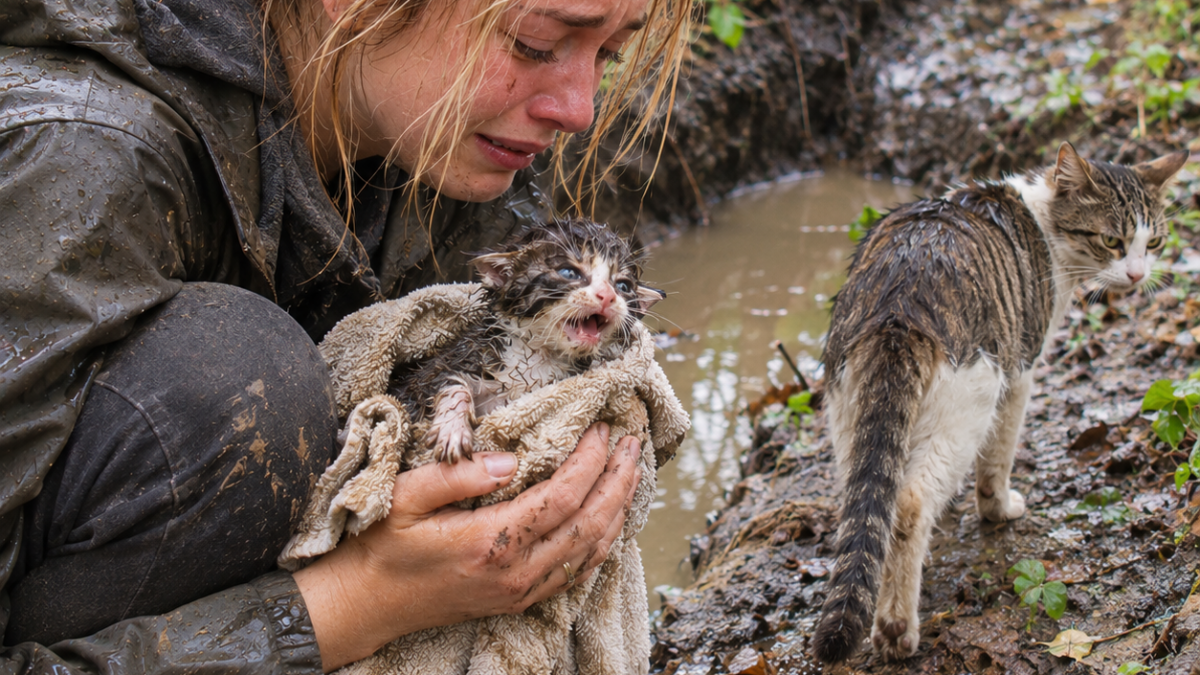
I Pulled a Tiny Kitten From a Muddy Ditch—Then His Mother Took One Sniff and Walked Away
I almost left the tiny kitten beside the park path because his mother was nearby, and everything in me said a baby that small belonged with her, not with a stranger carrying nothing but a phone, a pack of tissues, and my daughter’s toy net.
But after I pulled him from the black ditch water, his mother stepped forward, sniffed the mud-soaked fur that no longer smelled like her baby, hissed, and walked away without looking back.
Then the kitten curled his entire body into the center of my palm, stopped shaking for the first time, and made the decision for me before I was ready to make it myself.
The first thing I heard was crying.
Not loud.
Not the kind of sound that makes everyone in a park turn around.
It was thin.
Repeated.
Almost mechanical.
Meow.
Pause.
Meow.
Pause.
Meow.
At first I thought somebody nearby had a kitten in a carrier.
I looked along the path.
Nobody.
A couple walked past farther ahead.
A man was jogging in the opposite direction.
Some leaves moved in the wind.
Then I heard it again.
Closer.
Under me.
I stopped walking.
The sound came from below the edge of the paved path.
There was a drainage ditch running beneath the side of the park.
I had passed it many times without thinking about it.
Most days it was nothing more than a dark concrete opening hidden behind weeds and fallen leaves.
That day there had been rain.
Water had collected inside.
The entrance was shadowed enough that when I crouched and tried to look down, I could not see anything.
Meow.
My stomach tightened.
“Hello?”
I do not know why I spoke.
Maybe because the sound was so small that answering it felt natural.
Another cry.
I lowered myself onto one knee.
The ground was damp.
I leaned toward the opening.
Pitch black.
I could hear water.
Not rushing.
Just slow movement somewhere below.
I pulled out my phone.
Turned on the flashlight.
PART2:
Reached as far down as I could.
At first the light caught only concrete.
Brown water.
Trash.
A few leaves.
Then something moved.
A tiny head.
Wet fur.
Two little ears flattened against the skull.
The kitten was floating partly against debris in the murky water.
For a second I froze.
He was so small that my brain had trouble accepting that he was alive.
His body looked shorter than my hand.
The fur was plastered flat.
I could not even tell his real color.
Everything looked black and gray beneath the mud.
He opened his mouth.
Meow.
That sound was coming from him.
I looked around.
PART3:
There was nobody with rescue equipment.
No park employee.
No ladder.
No rope.
Just me.
Then I remembered the toy net.
My daughter had been playing with it earlier.
Cheap plastic handle.
Small mesh basket.
Something intended for catching toy fish or leaves in shallow water.
It was lying nearby.
I grabbed it.
The ditch opening was too narrow for me to climb inside safely.
The kitten was too far down for my hand.
The net was my only option.
I stretched flat beside the opening and lowered it.
The kitten saw movement.
He cried harder.
“Come on.”
I moved the net beneath him.
At first he did not understand.
His front paw hit the edge.
Slipped.
I repositioned it.
“Grab it.”
Again, ridiculous thing to say to a kitten.
But he did.
Both front paws caught the mesh.
He pulled himself toward it.
Tiny claws locking through the net.
I lifted.
Too quickly.
That was my mistake.
I was scared he would lose his grip.
So I tried to get him out fast.
The net rose.
A foot.
Two.
He was halfway up.
Then his hind legs slipped.
His body rolled sideways.
His front paws lost the mesh.
He fell.
Back into the ditch.
The sound he made when he hit the water still bothers me.
Not a scream.
Just one frightened cry.
Then silence.
“Oh no.”
I shoved my phone back toward the opening.
Light shaking in my hand.
For a second I could not find him.
Water moved.
Leaves floated.
Nothing.
Then a little face appeared farther down.
He was still alive.
His head barely above the water.
I lowered the net again.
This time I forced myself to slow down.
The kitten was struggling.
His paws scratched at the concrete.
He could not get traction.
The water had soaked his fur until he looked half his actual size.
“Come on, little guy.”
The net reached him.
One front paw.
Then the second.
He grabbed.
I waited.
Let him climb farther onto the mesh.
Then lifted.
Slowly.
A few inches at a time.
The kitten hung on.
His claws were tiny.
But the grip was incredible.
I could see his body shaking as the net rose.
Halfway.
The same place where he had fallen before.
I stopped for a second.
He did not let go.
“Good.”
I lifted again.
Closer.
Closer.
My other hand reached down.
His head appeared above the edge of the ditch.
Then his shoulders.
I caught him around the body.
The moment my fingers closed around him, I felt my entire body relax.
I had not realized how tightly I had been holding my breath.
The kitten weighed almost nothing.
Cold.
Wet.
Trembling violently.
I placed him on a patch of fallen leaves beside the path.
Dirty water ran from his fur.
His legs shook so hard he could barely stay upright.
I could finally see how small he really was.
Shorter than my palm.
A little body made mostly of bones, soaked fur and determination.
Then he began crawling.
Not toward me.
To the right.
I followed his direction.
That was when I saw the mother cat.
She stood several yards away near the bushes.
Stray.
Thin.
Alert.
Watching everything.
Relief hit me.
“Good.”
His mother was here.
That was what he needed.
The kitten kept crawling toward her.
Slowly.
Dragging himself through leaves because his legs were too weak to support him.
He cried.
The mother approached.
I stepped back.
This was the moment I assumed I had simply been helping temporarily.
Get him out.
Return him to his mother.
Walk away.
She stopped in front of him.
Lowered her head.
Sniffed.
Once.
Then again.
The kitten tried moving closer.
She backed away.
Her ears flattened.
Then she hissed.
A sharp warning.
The kitten stopped.
I stared.
She sniffed once more.
The smell of him had changed.
Mud.
Dirty ditch water.
My hands.
Plastic net.
Everything except the scent she recognized.
Maybe that was why.
Maybe there was another reason.
I cannot know exactly what she understood.
What I know is what happened.
She hissed at her own kitten.
Turned.
Walked away.
Not slowly.
Not looking back.
She disappeared through the bushes.
The kitten cried after her.
That was worse than hearing him in the ditch.
He tried following.
Made it only a short distance.
Then collapsed against the leaves.
I waited.
Maybe she would return.
She did not.
The kitten kept calling.
Nothing answered.
I had one small pack of tissues.
That was all.
No towel.
No blanket.
No carrier.
No formula.
No plan.
I tore open the tissues and started wiping him.
The first one turned almost completely black.
Second one too.
Then third.
Mud came from everywhere.
His head.
Neck.
Back.
Belly.
Legs.
I found a plastic bag and spread it on the ground beneath him so he would not sit directly on the wet leaves.
He did not fight.
That worried me.
Healthy kittens resist.
They wiggle.
Claw.
Complain.
He simply stayed where I put him.
I wiped.
Tissue after tissue.
Each one came away brown or black.
As the mud disappeared, little patches of actual fur began appearing.
Dark gray.
Black markings.
Cream around his nose.
White beneath the chin.
I wiped his face.
His eyelids moved.
Then slowly opened.
Tiny blue-gray eyes.
Still young enough that the color had not fully changed.
He looked at me.
I stopped moving for a second.
There are moments when an animal seems impossibly fragile.
Not because it is crying.
Because it stops.
Because it looks at you.
Because suddenly the situation becomes personal.
People walked past us.
Some looked down.
One person slowed.
Nobody stopped.
I cannot blame them.
Most probably assumed I knew what I was doing.
I did not.
I crouched beside that kitten for a long time.
I kept hoping the mother would come back.
I watched the bushes.
Nothing.
The kitten had stopped crawling.
He was still shivering.
I thought:
Maybe I should leave him.
Wild mother cats sometimes return after humans move away.
Maybe she was waiting.
Maybe I was interfering.
Then I looked toward where she had disappeared.
She had not hesitated.
She had smelled him.
Hissed.
Left.
The kitten could barely stand.
Night would come eventually.
The ditch was still beside us.
Cold ground.
Dogs.
Cars.
Other cats.
Rain.
I knew what would happen if I walked away and the mother did not return.
He would probably not survive the night.
I picked him up.
The entire kitten fit in one hand.
When my palm closed around him, he did something tiny.
He pulled his legs inward.
Shrank into the center of my hand.
As if making himself as small as possible.
That movement ended the argument in my head.
“All right.”
He looked up.
“Come home with me.”
He did not understand the words.
Of course he did not.
But as I held him, the shaking slowly became less violent.
I found a bag.
Made a temporary nest.
Put him inside.
Then carried home a kitten I had not planned to meet.
My plan was extremely sophisticated:
Get him warm.
Clean him.
Feed him somehow.
Figure out the rest later.
The first thing I did at home was prepare warm water.
Not hot.
Just warm enough to take the cold from his body.
The moment I placed him into the basin, the water turned yellow-brown.
Immediately.
Mud.
Ditch water.
Whatever else had collected in his coat.
I changed the water.
Second wash.
Still dark.
Third.
Finally clearer.
The kitten did not fight.
He almost went limp in my palm.
That frightened me more than scratching would have.
I held his head above water.
Washed carefully.
Kept talking.
“Stay with me.”
Again, useless words.
Still, I kept saying them.
Afterward I wrapped him in a towel.
Only then did I really see him.
He was not black.
The mud had hidden everything.
Dark gray fur.
Black patches.
Cream-colored nose.
Cream chin.
White belly.
Tiny paws.
He was beautiful in the strange unfinished way very young kittens are beautiful.
Big head.
Small body.
Ears slightly too large.
Legs that did not seem fully coordinated.
I put him down.
He arched his back.
Then began crawling.
Not walking.
Crawling.
His body moved almost like a caterpillar.
Front legs forward.
Back half catching up.
I watched.
“How old are you?”
No answer.
Probably younger than I first guessed.
Still at an age when he should have been nursing from his mother.
That was the biggest problem.
Warmth was one thing.
Food was another.
Then my resident cat appeared.
He had been watching everything from the doorway.
Long-haired tuxedo.
Black and white.
Adult.
Calm most of the time.
But still a cat.
And the creature I had just brought into the house was a tiny unfamiliar kitten.
I became nervous.
I had been so focused on saving the baby that I had not thought much about introductions.
My cat approached.
Slowly.
I kept one hand near the kitten.
Ready.
The adult cat sniffed him.
Head.
Back.
Towel.
Then stepped away.
Sat nearby.
Watched.
No hiss.
No swat.
No chase.
Just observation.
That was enough.
I started drying the kitten.
I held him in one hand while warm air moved over his fur.
He rolled onto his back.
Four paws spread.
White belly exposed.
Resident cat sat below looking up.
The kitten seemed too tired even to care.
Eventually his fur began fluffing.
For the first time, he looked like a real cat instead of something pulled from a drainage pipe.
I wrapped him in a towel.
The transformation was unbelievable.
One hour earlier:
Mud.
Water.
Shaking.
Now:
Tiny face poking from warm fabric.
Still weak.
Still uncertain.
But alive.
I prepared a carrier.
Pee pad on top.
Soft blanket underneath.
A small bed.
The moment I placed him inside, he circled twice.
Then collapsed flat.
No crying.
No exploring.
Just sleep.
My resident cat immediately walked around the carrier.
Sniffed every side.
Pressed his face toward the mesh.
Poked his nose inside.
The kitten did not move.
Then the adult cat sat beside the carrier door.
Back toward me.
I could not tell what that meant.
Guarding?
Sulking?
Accepting?
Cats rarely explain themselves.
He stayed anyway.
I found a small plush toy and placed it beside the kitten.
The kitten shifted.
Rested his chin on it.
His eyes half closed.
Something about that image hurt.
Maybe because he had spent the day searching for another warm body.
His mother.
Anything.
Now a stuffed toy was the closest thing he had.
Feeding was next.
I had never bottle-fed a kitten that small.
That became obvious almost immediately.
I had kitten milk.
A small bottle.
I held him carefully.
Touched the nipple to his mouth.
Nothing.
He sniffed.
Turned away.
I tried again.
He opened his mouth.
Bit sideways.
Milk spilled down his chin.
He did not understand sucking.
Another attempt.
More milk outside than inside.
I wiped his face.
Tried again.
Eventually a little went down.
Then more.
Not much.
Enough.
After feeding, he rolled onto his back.
Four legs moved in the air.
Tiny kicks.
Then he turned onto the blanket.
His front paws began pushing.
Left.
Right.
Left.
Right.
Kneading.
Then biting the fabric.
Kneading harder.
Eyes closed.
He thought the blanket was his mother.
There is no other way I can describe what it looked like.
He buried his face.
Bit.
Pressed his paws.
Searching for milk.
Searching for warmth.
Searching for the body he had been separated from.
I sat beside the carrier and watched.
That was the moment the rescue stopped feeling like:
I found a kitten.
It became:
This baby has lost everything familiar.
The ditch was not the whole problem.
He had survived that.
Now he had to learn how to live without the mother who should have been teaching him everything.
After feeding, he fell asleep against the towel.
His legs twitched.
Tiny movements.
Dreaming perhaps.
I do not know what kittens that age dream about.
Milk.
Warmth.
Littermates.
Whatever he dreamed, he slept deeply.
Three hours later, the quiet ended.
Meow.
Meow.
MEOW.
I went to the carrier.
The kitten was standing against the mesh.
Or trying to.
His face pressed into the door.
Both paws reaching through.
Crying.
Biting the bars.
Suddenly he looked much less fragile.
“Hungry?”
He answered with outrage.
Second feeding went differently.
I offered the bottle.
He latched.
Immediately.
Sucked so hard tiny bubbles moved inside the bottle.
Both front paws reached upward.
One paw against the bottle.
Then the other.
When he lost the nipple, he grabbed my finger.
His claws were microscopic.
Still sharp.
He held my hand.
Pulled himself toward the bottle.
That was the moment I knew he had chosen me.
Maybe “chosen” is too human a word.
He needed food.
Warmth.
Safety.
I was the one providing those things.
But when those tiny paws wrapped around my finger, reasoning did not matter.
He was no longer just the kitten from the ditch.
He was my responsibility.
I finished feeding him.
Wiped his chin.
He looked up.
Round eyes.
Milk on his whiskers.
For the first time, there was strength in his face.
That night I barely slept.
Every few hours:
Bottle.
Wipe.
Check warmth.
Check breathing.
Back to bed.
Then crying.
Again.
The resident cat followed me almost every time.
He would walk past the carrier.
Pause.
Look inside.
Sometimes sit nearby.
He still did not try to touch the kitten.
That was fine.
Tolerance was enough.
The next morning, the kitten was louder.
Much louder.
Apparently recovering energy meant discovering opinions.
He wanted out.
He pushed his face against the carrier.
Paws through the mesh.
Bit the door.
Cried.
When I opened it for feeding, he climbed toward me with surprising determination.
I laughed.
“You were dying yesterday.”
He did not care.
Bottle.
Now.
He wrapped both paws around it.
Drank.
Milk dribbled down his chin.
He had improved at swallowing but still tilted his head strangely, almost chewing the nipple instead of nursing normally.
Afterward, I wiped him.
He objected.
Good.
Complaining was progress.
Over the next two days, everything changed quickly.
The weak kitten who lay motionless in a towel disappeared.
In his place came a tiny creature determined to escape every safe enclosure I created.
He climbed his bed.
Climbed blankets.
Climbed the carrier door.
Cried whenever he saw me.
At first, that worried me.
Then it became funny.
I would walk past.
Meow.
I would step back.
Silence.
Walk away.
Meow.
“You’re manipulating me.”
More crying.
The long-haired tuxedo cat began spending less time watching from a distance.
He sat near the carrier.
Sometimes lay beside it.
Once, when the kitten cried particularly loudly, the adult cat walked over, stared through the mesh, then looked at me.
His expression seemed to say:
Are you going to do something about that?
I was apparently now staff for both of them.
The kitten still needed help learning to eat.
I tried softened kitten food.
At first he sniffed the kibble.
Then bit the bowl.
Not the food.
The bowl.
He chewed the edge.
I repositioned him.
He stepped into the food.
One paw.
Then another.
Now both front paws were standing in the bowl.
He looked proud.
Eventually he discovered one piece of kibble.
Chewed.
Too hard.
Dropped it.
Tried again.
I softened everything more.
He buried his face into the dish.
Food ended up across his nose, cheeks, chin and paws.
But some entered his mouth.
Success.
Afterward he sat in a corner.
Raised one front paw.
Licked.
Then the other.
He cleaned himself with absolute concentration.
One paw.
Face.
Other paw.
Face.
Again.
Tiny kitten taking grooming very seriously.
That was another milestone.
Grooming means energy.
Awareness.
Normal behavior.
The animal I pulled from muddy water had been too weak to do any of it.
Now he seemed offended by crumbs on his whiskers.
His tail began staying slightly raised as he walked.
Not tucked.
Not low.
Up.
A small flagpole.
Confidence.
When I let him out of the carrier, he became cautious again.
The enclosure had become safe.
The larger room was enormous.
He stood on the mat.
Perfectly still.
Ears high.
Watching me.
For a long time.
No crying.
No running.
Just observation.
It looked almost like he was trying to confirm something.
Is this still the place you brought me?
Am I allowed here?
Are you staying?
I sat on the floor.
Did not reach.
Eventually he moved.
One step.
Then another.
Nose down.
He explored the living room.
Hallway.
Edges first.
Always close to walls.
Sniffing everything.
Tail slowly rising again.
Soon he was walking with it straight up.
That tiny posture made me happier than it should have.
He began following smells.
Furniture.
Shoes.
Doorways.
The resident cat watched.
If the kitten got too close, the adult stepped away.
No attack.
No bullying.
Just boundaries.
Exactly what I hoped for.
I offered the kitten a spoonful of soft food.
He took tiny bites.
Serious expression.
Then reached with one paw and tried pulling the spoon toward himself.
I moved it.
He followed.
More bites.
Eventually he could finish half a small container.
His appetite became impressive.
So did his voice.
The kitten I once strained to hear beneath a park path now made sure everybody in the house knew exactly when he wanted something.
Bottle late?
Meow.
Carrier door closed?
Meow.
Human walks past without opening it?
Meow.
Food visible but not immediately served?
MEOW.
The same sound that had saved him from the ditch was now being used for customer complaints.
I did not mind.
Every loud cry was evidence that his lungs had strength.
Every attempt to escape his carrier meant his legs worked.
Every paw in the food bowl meant he had enough energy to create problems.
Problems were wonderful.
I kept thinking about his mother.
Not angrily.
People like to turn animal stories into human morality.
The mother rejected him.
Therefore she was cruel.
I do not think that is fair.
She was a stray cat trying to survive.
Maybe she no longer recognized his scent.
Maybe she was frightened.
Maybe she sensed weakness.
Maybe human contact changed the situation.
Maybe she had other kittens somewhere.
Maybe something happened to her that I never knew.
Animals make decisions through instincts we do not fully understand.
I stopped blaming her.
But I never forgot the kitten crawling toward her.
Or the hiss.
Or the way she walked away.
I wondered whether he remembered.
Probably not in the way I did.
His world changed fast.
Warmth replaced wet leaves.
Bottle replaced nursing.
Blanket replaced mother.
Carrier replaced ditch.
Human hands replaced whatever life he knew before.
That may be one of the strange mercies of being very young.
The past does not need to be explained before a new normal begins.
He simply adapted.
And adapted.
And adapted.
The first week, I kept expecting something to go wrong.
A delayed infection.
Digestive problems.
Weakness.
Something from the dirty water.
Every time he slept deeply, I checked that he was breathing.
Every time he ate less, I worried.
Every time his stool looked different, I analyzed it far more than any normal person wants to admit.
Rescuing a tiny animal turns you into an amateur detective.
Is he warm enough?
Too warm?
Hungry?
Overfed?
Dehydrated?
Why is he quiet?
Why is he loud?
Why is he sleeping?
Why is he awake?
Is that normal?
Eventually I realized something.
He was getting better faster than my anxiety was.
His body had already moved forward.
My mind was still crouched beside that ditch.
I would look at him playing with the blanket and suddenly see the wet face in black water.
He had stopped living there.
I had not.
That changed one afternoon when he attacked the plush toy.
Not seriously.
Tiny kitten attack.
He crouched.
Wiggled.
Pounced about six inches.
Missed.
Rolled sideways.
Got up.
Attacked again.
I laughed so hard the resident cat left the room.
Something shifted.
For the first time, I saw the kitten as a kitten.
Not a rescue case.
Not a fragile thing waiting to die.
A troublemaker.
That was what he needed to become.
He learned to eat better.
Learned the litter area.
Learned that hands could mean food.
Learned that towels were good sleeping places.
Learned that the adult cat was not his mother and had very specific personal-space rules.
Sometimes the kitten approached too boldly.
The resident cat raised one paw.
No claws.
Tiny warning tap.
The kitten froze.
Then tried again thirty seconds later.
Persistence had been his strongest personality trait from the beginning.
It saved him in the ditch.
It made him grab the net twice.
It made him cling while I lifted him.
Now it made him incredibly annoying to a much larger cat.
The resident cat gradually accepted him.
Not instantly.
I did not force cuddles.
Did not place them together for photographs.
I let them decide.
The adult cat began sleeping closer.
Then one day, I found him sitting beside the kitten while the kitten ate.
Another day, the kitten slept near his tail.
The adult cat looked at him.
Did not move.
Progress.
The tiny creature who had rested his chin on a plush toy now had another living animal nearby.
Different from a mother.
Still comforting.
That mattered.
The kitten’s coat changed too.
At first, even after washing, his fur looked thin and uneven.
Within days it became softer.
Fluffier.
Dark gray with black patches became clear.
Cream nose.
Cream chin.
White belly.
I could finally imagine what he might look like grown.
That thought surprised me.
Grown.
On the first day, I had been thinking:
Will he survive tonight?
Now I was thinking:
What will you look like in six months?
That is a huge emotional distance.
The park changed for me afterward.
I passed that path again.
Stopped at the ditch.
Looked down.
Same darkness.
Same murky channel.
Leaves.
Water.
Nothing extraordinary.
If the kitten had not cried when I walked past, I never would have known he was there.
That unsettled me.
How many things happen just out of sight?
How many tiny cries disappear beneath ordinary noise?
You cannot rescue everything.
That is a dangerous expectation.
No person can.
But sometimes life puts one thing directly in front of you.
Not everything.
One.
That day, mine was a kitten under a path.
I still think about the first rescue attempt.
How I pulled too quickly.
How he slipped.
How he fell.
For a second, I had made things worse.
That scared me.
It also taught me something simple.
Urgency and panic are not the same thing.
He needed help urgently.
But rushing nearly cost him.
The second time, I slowed down.
Let him grip.
Lifted steadily.
Waited at the hardest point.
Reached with my other hand.
That is how I got him out.
Sometimes helping well means moving slower than fear wants you to.
The same was true at home.
I wanted him eating immediately.
Walking immediately.
Bonding immediately.
Healthy immediately.
Bodies do not work that way.
Trust does not either.
Warmth first.
Then food.
Then sleep.
Then strength.
Then exploration.
One step at a time.
Three days after rescue, he was already becoming difficult to contain.
He climbed the side of his bed.
Stood against the carrier door.
Reached through holes.
If I put my finger near him, both paws grabbed it.
The claws were still tiny.
His grip was not.
The bottle became the center of his universe.
He learned the sound of preparation.
Before I even reached the carrier, he would begin crying.
Then pacing.
Then pressing his face against the wire.
A tiny wild animal demanding room service.
I joked that perhaps I had rescued a gremlin instead of a kitten.
The resident cat agreed.
His expression said so.
Yet every feeding still contained a little reminder of how small the kitten was.
Both paws around the bottle.
Body barely longer than my hand.
Belly growing round with milk.
Eyes slowly closing as he drank.
Then sudden sleep.
No transition.
One second active.
Next second completely unconscious against the towel.
Baby animals live close to the edge of exhaustion.
Everything is effort.
Eating.
Walking.
Staying warm.
Growing.
He slept so deeply after feeding that sometimes I could reposition the blanket without waking him.
Then three hours later:
Chaos.
His confidence around the house grew.
Living room.
Hall.
Then farther.
He explored with his nose low and tail up.
Every object became important.
Chair leg.
Bag.
Slipper.
Piece of paper.
The adult cat’s tail.
Bad decision.
He learned quickly.
Once he discovered he could climb onto a low cushion, he repeated it constantly.
Up.
Down.
Up.
Down.
As if practicing for some future mountain expedition.
He still had awkward moments.
Legs slipping.
Back arching.
Body moving in that caterpillar way when tired.
But every day looked more coordinated.
I took photographs.
Videos.
Not because I expected the story to matter to anyone else.
I wanted proof for myself.
The ditch kitten.
Wet fur.
Mud.
First bath.
First towel.
Bottle.
Carrier.
Food bowl.
Tiny explorer.
Each image showed a little less fear.
A little more cat.
That progression became important because memory compresses rescue.
Later, you remember:
Found him.
Saved him.
He got better.
But recovery is not one event.
It is hundreds of tiny changes.
The first strong cry.
The first successful bottle feeding.
The first time he grooms himself.
The first time he eats soft food.
The first time his tail rises.
The first time he walks away from you because he is curious instead of clinging because he is afraid.
Those are the real milestones.
One afternoon he walked from the living room into the hall completely by himself.
No hesitation.
I followed several steps behind.
He did not look back.
That made me unexpectedly emotional.
On the first day, he had folded into my palm because he had nowhere else.
Now he was walking away because he knew the house was safe.
That is what rescue should do.
Make you less necessary.
Not more.
I still provided everything.
Food.
Warmth.
Protection.
But he was beginning to own his little life.
The resident cat became part of that.
I noticed the adult cat would often position himself nearby when the kitten explored.
Not necessarily touching.
Just watching.
Once the kitten wandered under a chair.
The adult cat followed and sat at the opening.
Maybe coincidence.
Maybe supervision.
I did not need to turn it into something bigger.
The simple fact was enough.
He was no longer avoiding the kitten.
They had begun sharing space.
The kitten, of course, had no respect for gradual relationship development.
He tried climbing onto the adult.
That was rejected.
Firmly.
One paw.
Tiny kitten rolled sideways.
No claws.
No injury.
Lesson.
He came back anyway.
The adult sighed.
At least that is what I imagined.
Soon the kitten was strong enough that the carrier became less of a hospital and more of a bedroom.
He slept there.
Went in voluntarily sometimes.
The blanket smelled like him.
The plush toy stayed.
He no longer kneaded it desperately after every feeding.
Sometimes he simply slept with his head resting against it.
That difference mattered.
The blanket had stopped being a substitute mother.
It had become familiar bedding.
I thought about the mother cat less often.
Then something would bring the memory back.
A hiss outside.
A stray crossing the street.
The kitten kneading.
And I would see that moment again.
Small muddy baby crawling toward her.
Her nose lowering.
Then rejection.
There is a temptation in rescue stories to say:
He knew she did not want him.
I do not know that.
I do not know what a kitten that young understood.
Maybe he only knew warmth disappeared.
Maybe smell changed.
Maybe instinct sent him forward and instinct met a warning.
Whatever it was, his next hours were defined by replacement.
My hand.
A towel.
Bottle.
Blanket.
Eventually home.
I worried sometimes whether bringing him home had been the right decision.
Could a rescuer have done better?
Could a foster mother cat have accepted him?
Should I have found professional neonatal help faster?
Those are fair questions.
When you care about animals, you should ask what is best for them, not what makes you feel heroic.
I did not do everything perfectly.
I pulled the net too quickly the first time.
I improvised.
I learned while doing.
The important thing was staying willing to adjust.
Warm water instead of cold.
Proper kitten milk.
Frequent feeds.
Safe introduction to resident cat.
Soft food when ready.
Gradual exploration.
No pretending instinct alone made me an expert.
Rescue is responsibility, not performance.
The kitten did not care whether I looked competent.
He cared whether he was warm and fed.
By the end of that first stretch, his whole appearance had changed.
People who saw later videos could hardly believe he was the same animal.
The mud had been so thick that his markings were invisible.
Now his face looked bright.
Eyes open wide.
Ears upright.
Fur soft.
Belly round.
He became expressive.
When curious, head tilted slightly.
When hungry, entire body seemed to turn into one giant mouth.
When tired, eyes disappeared slowly.
When annoyed, tiny tail flicked.
When exploring, tail straight up.
That tail became my favorite sign.
I knew enough to understand that a tail carried high often meant comfort and confidence in kittens.
The first time he walked through the hallway like that, I stopped.
Just watched.
There he was.
The baby who had been shaking too hard to stand.
Walking through my house as though he owned it.
Maybe he did.
I had brought him home “just for tonight.”
That plan had lasted approximately one night.
The real decision happened earlier.
Not at home.
Not during the first bottle.
Not when his paws grabbed my finger.
The real decision happened beside the park path when I picked him up after his mother left.
He folded himself into my palm.
That little movement.
I can still feel it.
Tiny ribs.
Wet fur.
Cold body.
He made himself smaller instead of trying to escape.
I remember thinking:
I cannot put you back down.
Sometimes people imagine rescue decisions as heroic.
They rarely feel that way.
They feel inconvenient.
Confusing.
Poorly timed.
You have plans.
Responsibilities.
Existing animals.
Money.
Sleep.
Then something helpless lands in front of you and suddenly all those practical thoughts have to share space with one simple question:
If I walk away, what happens?
In his case, I knew.
Probably nothing good.
So I did not walk away.
That does not make me special.
It means I was there.
I heard him.
I had a toy net.
And after I saw what would happen if nobody intervened, I could not pretend I had not seen it.
The kitten kept growing stronger.
His world expanded.
Soon the carrier door could stay open while supervised.
He went in and out.
The resident cat became less watchful.
More accepting.
Food became easier.
The bottle was still important, but soft food became real food.
He learned that bowls contained things worth eating rather than things worth standing inside.
Mostly.
Sometimes both paws still went in.
Some habits take time.
He learned grooming.
Learned play.
Learned to stalk objects.
Learned how quickly an adult cat could move when a kitten grabbed his tail.
Important education.
More than anything, he learned that every day ended warm.
That may sound simple.
But for an animal found in cold ditch water, consistency is everything.
Food arrives.
Blanket stays.
No sudden water.
No mother hissing.
No darkness beneath a path.
Maybe kittens do not tell themselves stories about safety.
But their bodies learn.
His body did.
The shaking disappeared.
The crouched crawling disappeared.
His movements opened.
His tail rose.
His appetite grew.
His curiosity became stronger than caution.
That is what safety looks like when it becomes physical.
One evening, he sat on the mat and stared at me again.
Same posture as the first time I let him explore.
Ears high.
Still.
But something was different.
The first time, the stillness had been fear.
This time, he looked like he was simply studying me.
Then he walked forward.
Climbed onto my foot.
Sat there.
I smiled.
“You’re getting brave.”
He started biting my shoelace.
Very brave.
Very annoying.
The resident cat watched from nearby.
No concern.
This was normal now.
That word meant everything.
Normal.
A warm home.
Meals.
A cat watching him.
A human he could yell at.
A blanket.
A plush toy.
Soft food.
Hallway adventures.
Naps.
The ditch became something that had happened.
Not the place defining every second of his life.
That was the real ending I wanted for him.
Not dramatic gratitude.
Not a miracle.
Just normal.
People sometimes say rescued animals understand that you saved them.
Maybe some do in some way.
I cannot know.
I do not need the kitten to understand what I did.
He does not owe me gratitude.
He does not need to remember the ditch.
If anything, I hope he forgets.
I remember enough for both of us.
I remember the sound under the path.
The black water.
The first failed lift.
The second attempt.
Those tiny paws gripping the net.
The mother turning away.
Black tissues piling up beside me.
Blue-gray eyes opening.
His body shrinking into my palm.
The first warm bath.
The first bottle.
The first time he grabbed my finger.
The first time he walked with his tail up.
He only needs to keep doing what he is doing now.
Eating.
Growing.
Exploring.
Sleeping somewhere warm.
Causing trouble.
Becoming a cat.
He no longer has to think about murky water.
He no longer has to cry beneath a path hoping somebody hears.
He no longer has to crawl toward a mother who will not take him back.
He has a bed.
Food.
Warmth.
And a resident cat who once watched him suspiciously from across the room and now barely reacts when the little troublemaker wanders past.
Sometimes I look at the carrier where he used to lie flat and motionless.
Now he climbs all over it.
Pushes at the door.
Looks through the mesh.
Paces.
Demands release.
The image through the mesh is often blurry because he will not stay still.
I love that blur.
The first day, stillness scared me.
Now motion is everywhere.
That is recovery.
Not one beautiful photograph.
Movement.
Noise.
Mess.
Appetite.
A kitten becoming too difficult to photograph because he refuses to stop exploring.
I think about the toy net too.
My daughter’s little net.
Cheap.
Plastic.
Probably never designed to hold anything heavier than bath toys.
That day it became the bridge between one life and another.
The kitten grabbed it once.
Fell.
Grabbed it again.
Held on.
That is the part people sometimes miss when I tell the story.
I pulled him out.
Yes.
But he helped.
He held on.
Tiny animal.
Exhausted.
Cold.
Wet.
He still grabbed the mesh a second time.
And he did not let go.
Maybe that tells you everything about him.
He was never a passive little thing waiting to be saved.
Even in the ditch, he was fighting.
I only gave him something to hold.
Then I lifted slowly enough the second time.
Sometimes rescue is exactly that.
Not carrying someone the entire way.
Giving them one thing they can grab.
Keeping it steady.
And refusing to let go before they reach solid ground.
When I remember that afternoon now, the strongest memory is not the mud.
It is not even the mother leaving.
It is the moment his head came above the edge.
My hand reaching.
His body landing in my palm.
The sudden release in my chest.
He was out.
That was the first victory.
Everything after came one tiny victory at a time.
Warm.
Clean.
Fed.
Sleeping.
Standing.
Walking.
Eating.
Grooming.
Exploring.
Trusting.
Home.
Today, he can finish half a container of soft food.
He can wander from the living room into the hall by himself.
He can clean his own paws with ridiculous seriousness.
He can cry loudly enough that nobody in the house can pretend not to hear him.
He can stand with both ears high and his tail raised like he owns the place.
And when I watch him explore, I sometimes remember the kitten whose wet fur floated in black water below the park path.
Same animal.
Different world.
People may say I saved him.
Maybe.
But that little kitten did something too.
He cried when it would have been easier to stop.
He grabbed the net after falling once.
He held on.
He drank when he finally figured out how.
He learned the bottle.
Learned food.
Learned the house.
Learned that not every larger cat would reject him.
Learned that hands could mean warmth instead of danger.
He kept choosing the next thing.
I simply kept making sure there was a next thing available.
That is enough for me.
The mother cat disappeared that afternoon and never came back.
I cannot change that.
I cannot change the ditch.
I cannot change the first failed rescue attempt.
But I could change what happened after.
So I carried him home.
And now, whenever that little gray-and-black kitten walks down my hallway with his tail held high, there is nothing about him that looks like something abandoned.
He looks exactly like what he has finally become.
A kitten who knows he is safe.








