I Paid €200 to Rescue a Kitten Being Tossed Around Like a Toy—Years Later, He Refused to Go Outside Without His Own Personal Elevator
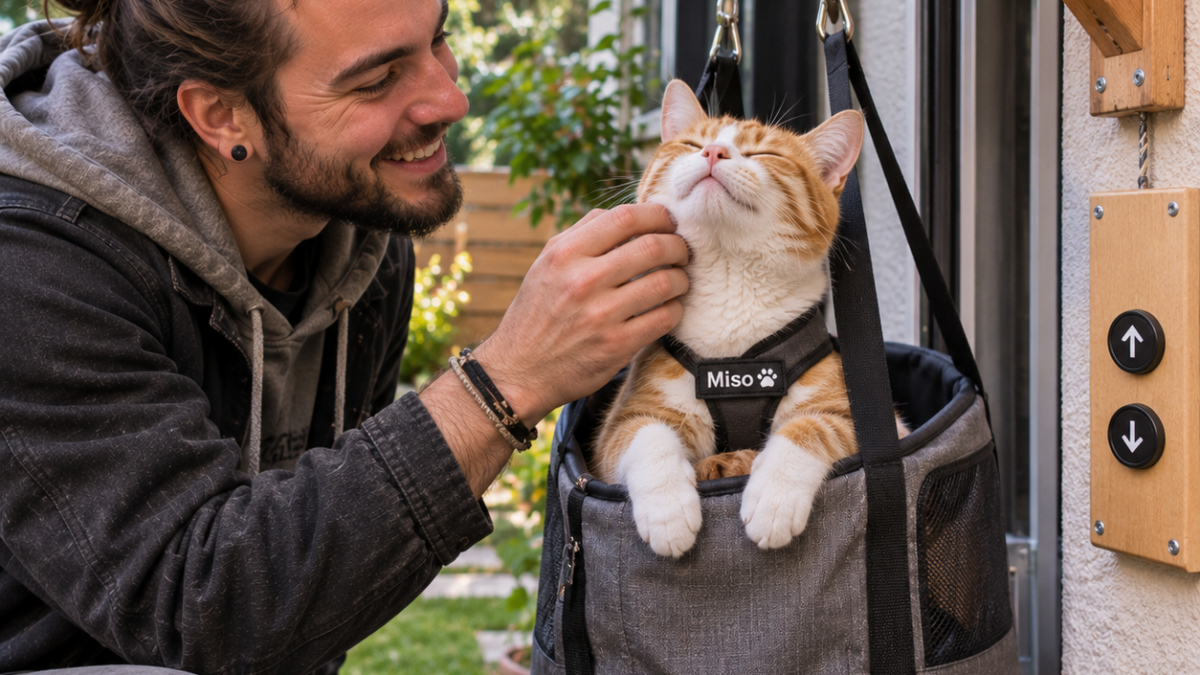
I Paid €200 to Rescue a Kitten Being Tossed Around Like a Toy—Years Later, He Refused to Go Outside Without His Own Personal Elevator
I had always considered myself a dog person, but the day I walked into an apartment and saw two children tossing a tiny kitten named Miso around like a stuffed animal, I handed over €200 without even calling my roommates and carried him straight to my car because I knew I could not leave him there.
For weeks afterward, Miso flinched whenever a human reached toward him because he had learned that hands meant being grabbed, lifted, and thrown—but once he realized my touch would never hurt him, the frightened kitten became a confident, bossy little shadow who fetched socks, answered when I talked to him, climbed anything he could find, and followed me on walks like a dog.
Then Miso became so obsessed with outdoor adventures that living several floors above the ground created a ridiculous problem, and the solution eventually became the strangest ritual in our neighborhood: every morning he climbed willingly into a sports bag, I attached it to a rope, and my cat rode his own private elevator down to the world below.
Before Miso, I would have told you without hesitation that I was a dog person.
Cats were fine.
I liked them.
I had nothing against them.
But if you had asked me to picture my future pet, I would have pictured a dog following me around, going on walks, wanting to participate in everything I did.
I would not have pictured a cat.
And I definitely would not have pictured a cat who would eventually behave so much like a dog that people would ask me whether I had somehow forgotten which species I adopted.
At the time, I wasn’t even looking for a cat.
I was looking online because I was considering whether there were any dogs nearby that needed someone to take care of them.
That was the plan.
Browse.
Maybe find a dog.
Think about whether it would work with my schedule.
Talk to my roommates.
Make a responsible decision.
Then I saw Miso.
Tiny.
Very young.
One photograph.
That was all it took to interrupt the plan.
There was something about him that made me stop scrolling.
He was ridiculously cute.
Small face.
Big eyes.
Still at that age where kittens look like they have not completely grown into their ears, paws, or opinions yet.
The listing said they needed to get rid of him quickly.
That immediately bothered me.
Not rehome him carefully.
Not find the right person.
Get rid of him.
Fast.
The location was close to my work.
I told myself I would only go look.
That was the first lie.
People who say they are “just going to look” at an animal who needs help are often already in trouble.
I drove over.
I had not spoken to my roommates.
I had not purchased anything for a cat.
I did not have a carrier ready.
I had no plan for how a kitten would fit into our apartment.
I simply wanted to see what was happening.
Then the apartment door opened.
PART2:
And everything became very simple.
There were two kids inside.
And they were handling Miso like he was a puppet.
Not like a young animal with a body that could be hurt.
Like an object.
Picking him up.
Tossing him.
Passing him around.
The first thought that hit me was not polite.
It was basically:
Oh my God.
Give me that cat.
I’m leaving.
There was no discussion inside my head anymore about whether I was a dog person.
No careful analysis.
No roommate vote.
No five-year pet ownership plan.
Just:
That kitten is not staying here.
I took him.
The family gave me some food and a few cat-related things.
Then they asked for €200.
I remember thinking how absurd the entire situation felt.
They wanted him gone immediately.
The kitten was clearly being handled badly.
And I was paying them.
But I also knew exactly what would happen if I argued and walked away.
Miso would still be there.
So I paid.
I told myself:
PART3:
Fine.
Whatever.
I cannot leave him here.
I carried him to my car.
He was so small.
Too small, I would later realize.
He had been separated from his mother much earlier than he should have been.
That explained some of the behavior we would see later.
But in that first moment, I mostly saw fear.
Not the kind of fear that makes an animal noisy.
Miso did not scream.
He did not explode into aggression.
He looked unsure about everything.
Every movement.
Every hand.
Every new person.
I got him into the car.
Then reality finally caught up with me.
I had a cat.
Not theoretically.
Not maybe.
A real kitten.
In my car.
Going home with me.
I drove back to the apartment.
Opened the door.
My roommates looked at me.
I told them:
“We got a cat now.”
That was more or less the entire announcement.
They had not voted.
They had not been consulted.
There was no group chat discussion.
No pros-and-cons list.
I had simply gone to work as a person without a cat and returned as a person with a kitten.
Fortunately, my roommates were far more flexible than I deserved.
We looked at Miso.
Then at each other.
Okay.
We would manage.
That became our attitude from the beginning.
We are going to manage.
But those first days made it obvious that Miso had not come from an environment where human touch meant safety.
Every time a person approached, his body reacted.
He expected to be picked up.
And not gently.
That was what was heartbreaking.
You could see the association already forming in a kitten who should have still been with his mother.
Hand comes toward me.
Something unpleasant happens.
Body lifted.
Control lost.
Maybe tossed.
Maybe squeezed.
Maybe grabbed because somebody wants entertainment.
So in the beginning, he sat mostly in his bed.
Small.
Watching.
He had a space that belonged to him.
We made sure people were around because he had been separated from his mother far too young.
That was one of the first things I became really concerned about.
A kitten that young should still have feline comfort.
Warmth.
Physical contact.
Social learning.
Instead, he suddenly had three human roommates who had no idea what they were doing but were determined to figure it out.
We arranged our schedules so that at least one of us was home with him as much as possible.
Someone would sit nearby.
Talk to him.
Play.
Feed him.
But the rule was simple.
Nobody grabbed Miso for fun.
Nobody picked him up because we wanted cuddles.
If he wanted to come closer, good.
If he did not, also good.
That sounds obvious now.
At the time, I think Miso needed to experience the same message hundreds of times.
A hand appears.
Nothing bad happens.
A person walks near him.
He stays on the ground.
Someone touches him.
The touch ends when he wants.
Again.
Again.
Again.
Trust rarely comes from one dramatic moment.
It comes from boring repetition.
And Miso needed boring.
He had already had enough excitement.
I remember the first changes were small.
Instead of immediately shrinking back when I reached toward him, he would pause.
Then sniff.
Then maybe stay.
Eventually I could touch him and feel his body remain soft rather than tighten.
That meant more than any purr.
He was learning:
This hand is different.
I am not going to throw you.
I am not going to pick you up like a toy.
You do not exist for my amusement.
You are an animal.
You have a choice.
Once he understood that, everything about him began expanding.
Play became huge.
I wanted Miso to learn that people could interact with him without using his body as the object.
So instead of playing with Miso, we gave Miso things to play with.
That distinction mattered.
Toys.
Strings.
Little balls.
Fabric.
Whatever interested him.
He loved ridiculous things.
At one point he became obsessed with hanging from the side of a mattress.
He would hook himself onto it and cling there like Spider-Man.
I would look over and Miso would just be suspended sideways, absolutely convinced this was normal cat behavior.
That became one of the first moments where I thought:
Okay.
There is a personality hiding in here.
A weird one.
But definitely a personality.
The frightened kitten began turning into a confident little athlete.
And the more confidence he gained, the more dog-like he became.
That was funny considering how the whole story started.
I had been looking for a dog.
Apparently the universe decided:
Fine.
Here is your dog.
He is a cat.
Miso wanted to participate in everything.
If I was doing something, he needed to know what.
If I moved something across the apartment:
Interesting.
Miso investigated.
If I opened something:
Important development.
Miso appeared.
If I walked from one room to another:
Where are we going?
It reminded me of dogs I had known.
That sense that your activity automatically becomes their activity.
You are not allowed to have an independent project.
The animal is now part of the team.
One of my favorite games started with socks.
Small rolled-up socks.
Nothing expensive.
Nothing designed by a pet company.
I would throw one down the hallway.
Miso would run after it.
Pick it up.
Then bring it back.
The first time he did it, I thought it was luck.
I threw it again.
He chased it.
Returned.
Again.
Returned.
I stared at him.
“You are a cat.”
Miso did not care about species stereotypes.
Fetch became part of our life.
Throw sock.
Miso runs.
Miso returns.
Throw again.
Sometimes I think people assume animals fit neat categories.
Dogs do this.
Cats do that.
Then you live with Miso.
Miso does whatever Miso wants.
That confidence began showing in the way he walked too.
He developed this slow, bossy walk.
Not rushed.
Not uncertain.
Like he owned the apartment and had important administrative responsibilities.
He would enter a room and you could almost hear:
Yes.
I am here now.
Everything can continue.
This was the same animal who had once flinched because humans approached him.
That transformation taught me something early.
Confidence was not something I gave him.
It was something he already had the capacity for.
Safety allowed it to appear.
That is different.
I did not turn Miso into a confident cat.
I removed some reasons for him to be afraid.
Then Miso emerged.
He loved high places.
Anything elevated became a target.
Shelf.
Furniture.
Mattress.
Structure.
If there was a way up, Miso would find it.
Sometimes if there was not a way up, Miso would invent one.
Cats like height because height gives control.
You can observe.
You can see the room.
You have fewer things approaching from behind.
For Miso, I sometimes wondered whether that preference was partly connected to the control he had lacked as a kitten.
But I try not to make every behavior a trauma symbol.
Cats also just like being high.
Maybe the answer was simpler:
Miso liked being king.
And from higher positions, kings see everything.
Once trust became strong, his affection changed too.
Miso was not the kind of cat who simply sat quietly across the room.
He had his own love language.
Sometimes he would climb onto my stomach.
Then the paws would start.
Kneading.
Cookies.
Biscuits.
Whatever you want to call it.
Press.
Release.
Press.
Release.
Purring.
That became one way he showed affection.
Another was conversation.
Miso talks.
Not in one random meow.
Actual back-and-forth.
I would say:
“Hey, Miso. How are you doing?”
Miso:
“Meow.”
“Did you sleep okay?”
Another answer.
Different sound.
Maybe people imagine meaning because humans cannot resist turning animal sounds into language.
But if you live with a vocal cat long enough, you absolutely recognize patterns.
Question.
Response.
Tone.
Complaint.
Greeting.
Demand.
Miso had a lot to say.
Especially once he trusted you.
That part was important.
He did not behave the same way with everybody.
His deepest affection required full trust.
When Miso trusted someone, he did not simply tolerate them.
He accepted them into his world.
He watched what they did.
Copied routines.
Joined.
He wanted proximity, but not in a helpless way.
Miso was never a cat who wanted to become somebody’s baby forever.
He wanted to become somebody’s partner.
That is the best description.
If I did something, Miso wanted to participate.
If I went somewhere, Miso wanted to know whether he could come.
That eventually brought us to the biggest difference between Miso and many indoor cats.
He desperately wanted outside.
I have always believed animals should have as much freedom as we can safely give them.
Not reckless freedom.
Not simply opening a door and hoping nothing happens.
But I could see that Miso was fascinated by the outside world.
He wanted smells.
Movement.
Air.
Space.
New places.
Adventure.
So I began walking with him.
Slowly.
At first, it was not some perfect cat-walking relationship.
We learned.
Miso learned the environment.
I learned how he responded.
Within weeks, something remarkable happened.
He began following me.
Actually following.
Walking along as if we had always done this.
Again:
Dog-cat.
I would move.
Miso came.
If I stopped to look at something, Miso investigated too.
If I found something interesting, he seemed to assume it must be worth seeing.
Our walks became shared exploration.
He loved it.
That was obvious.
Outside changed his whole energy.
Every smell mattered.
Every corner needed inspection.
Every object could be climbed.
Miso would scan the area the moment he got outside.
That was his first ritual.
Exit.
Stop.
Look.
Assess.
Then adventure.
The more time we spent outside together, the more confident he became.
I could see that this was not some passing interest.
Freedom mattered to him.
He needed the outdoor stimulation.
And I wanted to give it to him.
There was just one problem.
Where I lived, getting outside was not as simple as opening a back door.
We were several floors up.
Miso could not independently walk from the apartment to the street whenever he wanted.
If I wanted him outside, I had to take him.
If he wanted back in, I had to be available.
At first, that was manageable.
I would go downstairs with him.
Go outside.
Walk.
Return.
But Miso’s appetite for adventure kept growing.
This cat had opinions about when outdoor time should happen.
He would come to me in the morning.
The message was obvious.
Get me out.
Now.
Not later.
Not after coffee.
Now.
He had effectively developed a commuting schedule.
I started thinking:
There has to be another way.
How can I safely move him between the apartment and the ground without physically walking the stairs every single time?
That is the kind of question that leads either to an engineering solution or to a story people later describe as:
You did what?
The answer came from a sports bag.
Miso already loved getting into bags and boxes.
Cats love containers.
That was useful.
I did not suddenly take a cat, throw him into a random bag, tie it to a rope, and lower him out a window.
That would have been insane.
The process started indoors.
Slow.
Play.
The sports bag existed first as an object Miso already liked.
He would climb inside.
Sit.
Explore.
I began moving it gently while he was in it.
Small wiggle.
Nothing bad happened.
Again.
More movement.
Miso stayed.
I watched his body language constantly.
If he had panicked, the idea would have ended.
I was not trying to force him into a trick.
I needed him to be genuinely comfortable.
The bag had to become a safe container.
Not a trap.
Not another experience where a human controlled his body without permission.
That mattered especially because of where he came from.
We practiced.
Miso inside.
Move bag.
Stop.
Reward.
Play.
Eventually movement became normal.
Then I attached the bag to a rope.
Still indoors at first.
More controlled movement.
More familiarity.
Miso did not jump out.
He seemed completely unbothered.
At first, when I actually used the system, I zipped the bag closed so there was no chance he could leap out during movement.
Safety first.
I would lower him carefully.
Then I would go downstairs.
Open the bag.
Miso came out.
And the second he touched ground, the routine began.
Scan.
Look left.
Look right.
Adventure.
That was the birth of Miso’s personal elevator.
Most cats have doors.
Miso had a bag attached to a rope.
The phrase sounds ridiculous.
The reality became incredibly normal to us.
Morning.
“Miso, where are you?”
He would appear.
He knew what was happening.
Bag.
In.
Down.
Outside.
I remember the first few times being hyperfocused on everything.
Rope.
Connection.
Bag position.
Weight.
Distance.
Miso’s body language.
Nothing rushed.
Nothing improvised in the moment.
People later saw clips online and reacted strongly.
Some thought it was the funniest thing they had ever seen.
Others immediately asked:
Is that safe?
That question was fair.
Anything involving height and an animal deserves scrutiny.
I understood why people worried.
What they did not see in a short clip were all the training steps before.
Miso was deeply familiar with the bag.
Familiar with movement.
Familiar with the procedure.
It was not some surprise stunt.
There was never an accident where the bag dropped.
Never a situation where Miso was hanging halfway out.
Never a moment where he panicked and tried to escape.
The setup worked because we did not start with the final version.
We built familiarity.
Miso knew what was happening.
That was the entire reason I was comfortable continuing.
If he had shown fear, we would have stopped.
His behavior told me the opposite.
He would come for it.
He wanted outside.
The elevator was simply transportation.
The funniest part was that after all the complicated effort to create this system, Miso remained completely in charge of whether he actually wanted to use it.
Cats preserve their dignity like that.
I could call him.
“Come here.”
Miso would approach the bag.
Look at it.
Then decide:
Not yet.
Walk away.
Five minutes later:
Maybe.
No.
Still no.
Then eventually:
Fine.
Now.
You cannot schedule a cat the way you schedule a train.
Even when the cat has private transportation.
Sometimes he stood there looking at me as if the service was inadequate.
Miso has always been demanding.
That confidence I worked so hard to help him develop?
It succeeded.
Maybe too successfully.
The frightened kitten became upper management.
And weather became one of his biggest complaints.
Rain?
Human, fix it.
Cold?
Why did you allow this?
Wind?
Unacceptable.
Miso would stand at the window or near his elevator route and look at me like:
Please change the weather.
I would explain:
“I don’t control weather.”
He did not accept this limitation.
Sometimes he insisted on going out anyway.
Fine.
Down he went.
Ten minutes later:
Complaint.
He wanted back.
I would bring him in.
Then shortly afterward, he would want to go outside again.
Weather still bad.
Miso:
How have you not fixed this yet?
The entitlement was impressive.
There were mornings when I felt less like a pet owner and more like an underqualified hotel employee.
Outside experience:
Poor.
Weather:
Unacceptable.
Management:
Unresponsive.
One star.
Would still use elevator again.
And he did.
Again and again.
Miso’s outdoor life became one of the biggest sources of joy for both of us.
Watching him explore was different from watching him play inside.
He had this confidence.
Slow walk.
Tail.
Attention.
He would climb things.
Investigate.
Sometimes follow me.
Sometimes decide his own route mattered more.
He knew the area increasingly well.
That was important.
Freedom works better when familiarity grows.
I wanted him engaged with his environment, not simply dropped into an unknown place.
Over time, the routine felt almost like having a dog who wanted walks.
Except my dog could climb walls, ignore me selectively, and required a rope elevator.
People started recognizing him.
Of course they did.
You do not lower a cat in a sports bag from an apartment building repeatedly without becoming memorable.
Questions came.
Does he like it?
Yes.
Is he scared?
No.
Did you train him?
Absolutely.
Why?
Because he wanted outside and this was the system that worked for us.
Would every cat enjoy this?
Obviously not.
That was something I always tried to make clear.
Miso is Miso.
He is unusually confident.
Curious.
Adaptable.
He likes being involved in whatever I do.
The system worked because it matched his personality.
You cannot take a nervous cat who hates enclosed bags and decide:
Great, private elevator.
The animal decides what is acceptable through behavior.
Miso told us constantly.
He would climb into the bag.
He would wait.
He would emerge downstairs and immediately begin exploring.
No shutdown.
No panic.
No avoidance afterward.
That gave me confidence.
There is something funny about how completely our relationship inverted.
When I first met him, humans reaching toward him meant loss of control.
Years later, he was voluntarily climbing into a bag I controlled because he trusted me to transport him safely.
That is not a trick.
That is trust.
He had no way to understand ropes, physics, load safety, or my reasoning.
What he understood was simpler.
This human has done this before.
I get in.
I arrive outside.
Nothing bad happens.
That is how trust lives in animals.
Not in explanation.
In history.
The same history we built when he was a kitten.
Hand touches.
Nothing bad.
Toy moves.
Play happens.
Roommate approaches.
Safe.
Bag moves.
Safe.
Walk begins.
Fun.
The entire relationship was one long sequence of experiences teaching Miso that he could choose connection without surrendering safety.
That makes the elevator funny and emotional at the same time.
People see a cat in a bag.
I see years of trust condensed into one image.
Eventually, life changed again.
I moved back to my hometown.
The new environment was completely different.
No need for the old elevator routine.
There was a large garden.
Direct outdoor access.
More space.
Miso could go outside and inside much more freely.
For another cat, losing a bizarre private elevator might have been a downgrade.
For Miso, it was liberation.
He loved the garden.
Absolutely loved it.
The cat who had once needed me to lower him toward adventure now had adventure waiting outside the door.
He could go.
Explore.
Return.
Go again.
I put a GPS tracker on him.
That gave me some peace of mind.
And it also gave me a fascinating look at just how much Miso moved when left to his own schedule.
The tracker map told the truth.
Miso was constantly going somewhere.
This cat did not believe in sitting inside politely all day.
Most of his life, especially in good weather, happened outside.
Ninety-five percent sometimes.
He would come inside for what I jokingly called refueling.
Food.
Maybe affection.
Maybe a nap if the weather failed his standards.
Then back out.
The garden became his base.
And even with all that freedom, Miso still wanted something else.
Company.
He had learned walking with me as part of outdoor life.
So sometimes he would complain if I was not joining.
He had a whole garden.
Could explore.
Had GPS-monitored freedom.
Still:
Why are you not coming?
That was classic Miso.
Freedom did not replace relationship.
He wanted both.
Autonomy and a buddy.
So I still went on walks with him.
People who saw us would sometimes look twice.
A man walking.
Cat walking nearby.
No dog.
No normal pet logic.
Just Miso.
He followed.
Stopped.
Investigated.
Moved.
Sometimes acted like he was leading me.
Probably believed he was.
I started describing him as a mix between a well-trained dog and a very confident cat.
That is still the most accurate summary.
The dog side:
Follows me.
Fetches.
Participates.
Wants walks.
Responds to conversation.
The cat side:
Ignores me when convenient.
Climbs everything.
Controls schedule.
Demands weather changes I cannot perform.
Believes all high surfaces are legally his.
Miso did not cross species.
He simply taught me that animals are more individual than categories allow.
I had been a dog person because I associated certain qualities with dogs.
Interactive.
Adventurous.
Social.
Trainable.
Companion-oriented.
Then a cat arrived who had all of them.
Maybe I was not a dog person.
Maybe I was a Miso person.
That is different.
He taught me cats could build relationships in ways I had not expected.
Not less deep.
Different.
Miso’s affection is often participation.
If he trusts you, he wants to be part of what you are doing.
He may imitate.
Follow.
Talk.
Sit nearby.
Climb onto your stomach and make biscuits.
That is how he says:
You are mine.
Or perhaps:
I permit you to be part of my organization.
Hard to know.
Either way, I feel lucky.
I think often about the first apartment where I found him.
Two kids throwing him around.
A family wanting him gone quickly.
A kitten far too young to be separated from his mother.
I do not enjoy replaying that image.
But sometimes it appears when Miso is doing something especially confident.
He will be standing high on something, surveying the garden like a lion.
Or walking beside me outside.
Or refusing to enter his bag because I called him thirty seconds before he personally decided it was time.
And I think:
Look at you.
The kitten who once had no control over whether he was picked up now controls absolutely everything.
That is healing in a very Miso way.
Some rescued animals become gentle and cautious.
Miso became management.
I am proud of that.
Confidence is not always convenient.
Sometimes it wakes you up.
Sometimes it complains.
Sometimes it jumps where it should not.
Sometimes it ignores your schedule.
But I would rather have a cat who feels entitled to express himself than a kitten who flinches when a hand appears.
Every complaint is evidence that he expects to be heard.
That matters.
He knows his environment responds.
Want outside?
He asks.
Want inside?
He asks.
Weather unacceptable?
He files a grievance.
Want attention?
He approaches.
Want space?
He leaves.
He has choice.
That is the thing he was missing when I met him.
Choice.
People were handling him because they wanted to.
He could not stop them.
Now Miso’s life is built around options.
Inside.
Outside.
Garden.
Walk.
High perch.
Bed.
Human company.
Alone.
He chooses.
That freedom is something I value deeply.
It is also why I worked so hard to make his outdoor life possible.
Some people believe cats should always remain indoors.
Others believe cats should roam completely freely.
I understand both concerns.
Safety matters.
So does enrichment.
With Miso, I tried to build something appropriate for him.
At first:
Walks together.
Then his trained elevator system.
Later:
A large garden.
GPS tracking.
Environment he knows.
There is no one universal model.
You look at the animal.
The location.
The risks.
The personality.
Then make the safest reasonable decision you can.
For Miso, outdoor exploration clearly contributes to his quality of life.
You see it in him.
Body language.
Energy.
Curiosity.
The way he moves through the garden.
The way he complains when I don’t come on a walk.
He is engaged.
That matters.
I still monitor.
GPS.
Routine.
Where he travels.
When he returns.
Freedom does not mean indifference.
Actually, responsible freedom requires more attention.
The tracker made me realize how much territory Miso covers.
I would open the map.
There he goes.
Again.
He is not sitting under one bush for six hours.
He has business.
Apparently.
Important cat business.
Patrol.
Exploration.
Neighborhood supervision.
I like imagining it.
Then he comes home.
Eats.
Refuels.
Maybe talks to me.
Then out again.
That cycle feels natural to him now.
The elevator years seem almost unbelievable even though they were normal at the time.
I still get messages about it.
People remember Miso as “the elevator cat.”
That makes sense.
It is an unforgettable image.
But to me, the elevator is only one part of his story.
The more important part is how we reached a level of trust where it could exist.
A bag attached to a rope is not interesting without that.
A frightened kitten learned that I would not hurt him.
Then he learned that play with humans could be fun.
Then that following me could lead to adventure.
Then that a bag could move safely.
Then that being lowered meant access to something he loved.
Every step built the next.
That is how training works best.
Not command first.
Relationship first.
People sometimes ask how I taught Miso unusual things.
I think the answer is that I paid attention to what he already wanted.
Miso liked bags.
Good.
Use bag.
Miso liked outside.
Good.
Outside becomes reward.
Miso liked participation.
Good.
Make the process interactive.
Miso liked fetch.
I did not teach him from nothing.
I noticed what he offered and repeated it.
Training animals becomes much easier when you stop trying to force your idea onto them and start using their interests.
That was another lesson Miso gave me.
He was always communicating.
I just had to notice.
When he was tiny:
Do not grab me.
Later:
Play with me.
Then:
Throw sock again.
Then:
Take me outside.
Then:
The weather is unacceptable.
Then:
Come with me.
Miso has never been subtle.
That helps.
His communication became so clear because I learned his patterns.
I know his complaint voice.
Greeting voice.
Demand voice.
I know the look that means he is about to ignore me.
The look that means he wants the door.
The body language that says:
Yes, I’m coming.
Versus:
You can keep waiting.
Living with an animal long enough creates a private language.
Not magical.
Pattern recognition.
The relationship becomes full of cues.
Maybe that is why I laugh when somebody says cats are aloof.
Some are.
Miso is not.
He has been expressing opinions since he discovered he was allowed to have them.
And he expects responses.
If I ask:
“Miso, did you have a good sleep?”
He answers.
If I tell him:
“Come here.”
Maybe.
If he asks me to go walking?
Apparently I am expected to obey immediately.
Power imbalance.
Very unfair.
I accept it.
There is a photograph of Miso as a tiny kitten that still affects me.
That was the picture I first saw online.
The one that pulled me into the apartment.
If I had scrolled past, his life would have gone somewhere else.
Maybe another person would have taken him.
Maybe things would have improved.
Maybe not.
That uncertainty bothers me if I think too long.
So I don’t.
We live in the version that happened.
I saw the photo.
I went.
I took him.
Paid €200.
Went home without roommate approval.
Said:
“We got a cat now.”
Some decisions look irresponsible from the outside and turn out to be exactly right.
I still would not recommend bringing animals home without thinking.
I got lucky that my roommates were willing to adapt.
I got lucky we could arrange our schedules.
I got lucky Miso was healthy enough to recover from being separated too early.
But there are moments when waiting for perfect logistics would mean leaving an animal somewhere you know is wrong.
That day, I chose Miso first and figured out logistics second.
I have never regretted it.
My roommates became part of his early safety network.
At least one person being home helped.
Miso had constant social availability without constant forced handling.
That combination mattered.
He could approach.
Retreat.
Watch.
Play.
Humans existed around him but did not use him.
That was exactly what he needed to learn.
People can be near me without taking control of me.
Trust grows in that space.
Eventually, Miso did not simply tolerate touch.
He sought it.
He would climb onto my stomach.
Knead.
Cuddle.
That was one of the strongest signs that his relationship with human contact had changed.
The thing he once feared became one of his ways of bonding.
But again, because he chose it.
That distinction is everything.
A cat who climbs onto you is not the same as a cat who is repeatedly picked up against his wishes.
Consent is not a word everyone associates with pets, but I think the principle matters.
Animals communicate yes and no through bodies.
Move toward.
Move away.
Relax.
Tense.
Lean.
Hide.
Humans should listen.
Miso learned he could say no.
That is probably one reason his yes became so strong.
He trusted that affection would not trap him.
He could leave.
So he stayed.
That is a beautiful kind of trust.
The same thing applied to the sports bag.
Because I respected his hesitation, the bag remained his choice.
Sometimes he approached.
Then walked away.
I did not force him inside because the schedule said outdoor time.
That would have destroyed the entire system.
Instead:
Not now?
Fine.
Come back when ready.
Five minutes later:
Maybe.
Another no.
Fine.
Eventually:
Okay.
Miso climbed in.
The elevator worked because Miso remained a participant.
Not cargo.
That is another reason the internet clips never fully captured it.
They showed movement.
Not decision.
People saw:
Cat being lowered.
I saw:
Cat who just spent ten minutes choosing when his transportation would depart.
Very different.
He had more control than it looked like.
Maybe too much control.
Again:
Upper management.
I remember one bad-weather day particularly well.
Miso wanted outside.
I opened access.
He looked.
The expression said:
Absolutely not.
Then he looked at me.
As though I had personally approved the rain.
“Sorry.”
Miso complained.
“I can’t change it.”
Another complaint.
He still eventually went out.
Returned soon after.
Cried to come back in.
Then later wanted out again.
Weather unchanged.
His faith in my climate-control abilities remained unreasonable.
I started joking that Miso believed my job description included:
Food.
Doors.
Elevator.
Weather.
Walks.
Cuddles.
I succeeded at four out of five.
Not enough for him.
That demanding streak is one of my favorite things because it represents such a complete reversal from his beginning.
The kitten who expected humans to decide everything now expects humans to meet his standards.
He is not afraid to complain.
He knows complaining is safe.
That is wonderful.
People sometimes think rescued animals should be endlessly grateful.
I dislike that idea.
Miso does not owe me gratitude because I removed him from a bad situation.
He gets to be annoying.
He gets to dislike rain.
He gets to demand walks.
He gets to be picky.
He gets to ignore me.
That is what a safe life allows.
Ordinary inconvenience.
I did not rescue him so he could spend every day proving I am a hero.
I rescued him so he could become a cat.
Miso happens to be a very weird cat.
Perfect.
Years passed, and I became less interested in the story of what happened before and more interested in the daily animal in front of me.
That is healthy.
The rescue is part of his history.
It is not his whole identity.
Miso is not “the cat who was thrown around.”
He is:
The elevator cat.
The fetching cat.
The walking cat.
The GPS explorer.
The weather critic.
The Spider-Man mattress cat.
The biscuit maker.
The conversationalist.
The bossy slow walker.
The garden supervisor.
The cat who thinks my activities are communal property.
That is who he became when fear was no longer the center.
I think good rescue should aim for that.
The trauma becomes less interesting than the life afterward.
Not forgotten.
Just no longer the headline every day.
Sometimes people meet Miso now and cannot imagine him frightened.
They see confidence.
A cat who climbs.
Explores.
Talks.
Makes demands.
That makes me happy.
Because fear was situational.
It did not define his character.
If I had met him during those first days and decided:
This cat is nervous.
That label would have become outdated almost immediately.
Animals change when conditions change.
That lesson has stayed with me.
Behavior is information about an animal and an environment.
Not always a permanent personality diagnosis.
Miso’s early fear said:
Humans have handled me badly.
His later confidence said:
These humans listen.
Both were accurate at the time.
That is why I am careful about judging animals from brief encounters.
The same cat can be entirely different in another setting.
Miso proved it.
The more comfortable he became, the more I saw that his natural personality was almost the opposite of withdrawn.
Bold.
Curious.
Interactive.
Very sure of himself.
The early scared version was the adaptation.
Confidence was what appeared when the adaptation was no longer necessary.
Maybe that is why his story feels so meaningful to me.
I did not teach him courage.
I gave courage somewhere to live.
That sounds poetic, but practically it meant:
Do not throw him.
Do not grab.
Provide toys.
Provide company.
Respond to curiosity.
Give structure.
Let him explore safely.
Trust compounds.
Then one day you realize the cat who used to expect harm is hanging off a mattress like Spider-Man because he has no remaining concern about dignity.
Success.
I also think Miso changed me from being someone who loved animals into someone who understood cats specifically.
Before him, I admired cats.
After him, I understood some of their logic.
Independence is not lack of attachment.
Control matters.
Trust matters.
Participation can be affection.
A cat can love you deeply and still refuse to come when called because your timing is irrelevant.
These contradictions make perfect sense once you stop expecting feline love to look exactly like canine love.
Though Miso does his best to confuse the distinction anyway.
His fetch behavior still makes people laugh.
Throw.
Run.
Bring back.
Again.
He used to do it with socks because socks were available and apparently perfectly engineered for cat retrieval.
There is something about seeing a cat bring an object back that resets people’s expectations.
Dogs fetch.
Cats pretend not to hear you.
Miso:
Why choose?
He lives outside stereotypes.
Maybe that is why a dog person fell in love with him.
He met me halfway.
I got a cat with the interactive qualities I already loved in dogs.
Then I learned to appreciate all the cat qualities too.
Especially altitude.
Miso’s obsession with high places became even more obvious in the garden.
Anything elevated had potential.
Fence.
Wall.
Structure.
Surface.
He wanted perspective.
He always has.
Even inside, he liked getting above us.
I sometimes look up and find him watching.
Slow blink.
Supervisor.
That old bossy walk remains too.
Confidence distilled into movement.
No hurry.
Why hurry when everyone should wait for you?
Miso understands status.
When he enters, other things can pause.
That may be my fault.
Probably.
We reinforced the behavior by finding it funny.
This is how pets train humans.
Do something cute.
Human reacts.
Repeat.
Soon human believes the pet has been trained.
Incorrect.
Miso trained us beautifully.
Morning elevator service?
Human trained.
Weather complaints acknowledged?
Human trained.
Walk companion available?
Human trained.
Sock throwing?
Human trained.
He created a capable staff.
I respect the efficiency.
After moving home, I thought maybe his constant access to the garden would make him less interested in me during outdoor time.
Why follow a person when you can explore alone?
No.
Miso still sometimes wanted company.
He would come back.
Complain.
Wait.
The request was obvious:
Walk.
That was touching in a way I did not expect.
Because it showed me that freedom was not the same as separation.
Miso’s independence had grown because the relationship was secure enough to support it.
He could explore and return.
Go alone and ask for company later.
That balance feels ideal.
I do not want an animal dependent on my physical presence for every moment of comfort.
I want connection strong enough that independence is safe.
Miso has that.
He can spend hours outside.
Then come in.
Refuel.
Talk.
Rest.
Leave again.
No anxiety about whether the home will still be there.
That is perhaps the deepest reversal from his beginning.
As a kitten, he had already been removed from his mother too early.
Then passed into a household that wanted him gone.
Nothing stable.
Now home is the stable part.
He can leave because return is reliable.
That is what security gives.
He does not have to cling to prove attachment.
Though sometimes he still climbs onto my belly and kneads because apparently attachment also requires cookies.
Fine.
I will take both.
There are moments when I watch the GPS map and laugh.
Miso moves.
Stops.
Moves again.
There.
There.
There.
What is he doing?
Important business.
No way to know.
He probably believes we should not be monitoring his professional activity.
But the tracker gives me comfort.
Freedom always contains risk.
Knowing roughly where he travels helps.
I can see patterns.
Know his usual area.
Notice something strange.
Again, responsible freedom is not the absence of supervision.
It is supervision designed not to remove the experience.
Miso gets adventure.
I get information.
Compromise.
Cats do not often agree to compromise, so I value this one.
People continue asking if I would use the elevator system again.
In the right situation?
With Miso specifically, if we lived in that environment again and the setup could be used safely?
Probably.
Because it worked for him.
But I would never call it generic cat advice.
The most important thing was never the bag.
It was the training and the individual animal.
Take away either and the idea becomes unsafe.
Miso was conditioned slowly.
He chose to enter.
He was comfortable.
The equipment had to be secure.
The process was supervised.
There were no shortcuts.
Short videos make unusual things look simple.
Most safe animal handling is boring behind the scenes.
Practice.
Observation.
Adjustment.
Repetition.
That is what people should copy, not necessarily the visible trick.
Learn the animal first.
Miso taught me that from day one.
Day one he taught:
Do not assume touch is welcome.
Later:
Use play.
Later:
Follow curiosity.
Later:
He likes bags.
Later:
He wants outside.
Each stage came from observation.
I never had a grand training plan.
We improvised based on him.
That is probably why it worked.
The relationship was responsive.
I think the funniest part of the entire story is that I originally wanted a dog because I wanted exactly the kind of companionship Miso eventually gave me.
Walks.
Participation.
Interaction.
Communication.
Adventure.
He checked every box.
Then added:
Climbing.
Biscuits.
Cabinet-level confidence.
Private elevator.
GPS patrol.
Weather complaints.
No dog could have prepared me.
Maybe Miso was the animal I was looking for before I knew what I was looking for.
That sounds overly romantic.
But it is true in the practical sense.
I wanted a certain kind of relationship.
Species mattered less than I thought.
Miso gave me the relationship.
That changed how I think about choosing pets.
People often start with category.
Dog person.
Cat person.
Big dog.
Small dog.
Kitten.
Adult cat.
Then personality surprises them.
Maybe better questions are:
What kind of daily relationship do you want?
What kind of animal is this individual?
Does their behavior fit your life?
Miso fit mine in the strangest possible way.
He was not planned.
Still fit.
Sometimes the animals we do not plan teach us the most because there is no script.
You adapt to who they are.
My roommates adapted too.
I still feel grateful they did.
I arrived without permission and announced a new household member.
Not ideal.
But they saw Miso.
Saw why.
Then helped.
Someone home.
Company.
Play.
Routine.
They became part of his recovery from the beginning.
Rescue stories often focus on one person because storytelling likes a central character.
Reality is usually more collaborative.
Miso had multiple people around him teaching the same lesson.
Humans can be safe.
That consistency matters.
Imagine if one person respected him while another kept grabbing him.
Trust would be much harder.
Instead, the household agreed.
Let him choose.
Play appropriately.
Do not treat him like a toy.
Simple.
Powerful.
The difference between toys for Miso and Miso as the toy was probably one of the most important changes in his life.
When I found him, people were playing with his body.
With us, he had objects to chase.
Attack.
Fetch.
Climb.
He controlled play.
That changed everything.
Animals need outlets.
A kitten is not decorative.
They need to chase.
Climb.
Grab.
Run.
Learn.
Miso’s confidence grew because he could use his body for himself.
Spider-Man mattress included.
I still laugh thinking about that image.
Tiny cat attached sideways.
No fear.
No concern.
Just pure weirdness.
Weirdness is a luxury of safety too.
You do not act silly when you are constantly afraid.
You conserve.
Watch.
Protect.
Miso became ridiculous when he relaxed.
That was one of the best signs.
I learned to celebrate weird.
Cabinet?
Fine.
Fetch?
Great.
Talking?
Excellent.
Private elevator?
Apparently.
The more unusual he became, the more I knew his real personality had room.
There were boundaries.
Of course.
Confidence does not mean every choice is safe.
Outdoor exploration required training.
Height required monitoring.
Equipment required care.
Freedom comes with human responsibility.
Miso could decide he wanted to climb somewhere dangerous.
My job was still to prevent avoidable harm.
Trust does not mean never saying no.
It means the no is predictable and not frightening.
That is a difference.
Sometimes Miso wanted something I could not allow.
He complained.
Then moved on.
That was another sign of security.
He could be denied without thinking the relationship disappeared.
The weather was the one refusal he never accepted.
Still working on that.
Maybe someday I will develop meteorological authority.
Until then, Miso remains disappointed.
I sometimes wonder how the family who had him as a kitten would react if they saw him now.
Would they recognize him?
The tiny animal they wanted gone quickly became this enormous personality.
Would they believe he follows a person on walks?
Fetches.
Rides in a private elevator.
Patrols a garden with GPS.
Talks back.
Maybe they would laugh.
Maybe they would feel nothing.
It does not matter.
I do not need their reaction.
Miso’s life moved beyond them.
That is important.
Rescue can trap people emotionally in anger toward whoever failed the animal.
Anger is understandable.
But if you stay there, you keep the animal’s story tied to the person who hurt them.
I would rather talk about Miso.
His confidence.
His adventures.
His bossy walk.
The people who failed him are one paragraph.
His life after is thousands of words.
That is the proportion I want.
He deserves that.
I did not take him so that I could spend years telling everybody how terrible his first family was.
I took him so his next experience would be different.
It was.
That is enough.
There is one moment I remember from those early weeks when Miso finally allowed touch without shrinking.
Nothing visually dramatic.
He was in his bed.
I reached.
Slowly.
Hand on fur.
He stayed.
I think about that sometimes when he climbs onto me now.
The distance between those moments is the entire story.
Then:
Please don’t hurt me.
Now:
Move your hand. I require petting.
Then:
Human hands mean loss of control.
Now:
Human body equals mattress.
Then:
I don’t know whether I am safe.
Now:
Why is my outdoor weather service malfunctioning?
I prefer current Miso.
Even when he is annoying.
Especially then.
Annoying pets are often pets who feel secure enough to make demands.
There is something beautiful about that.
I wish every animal who has been frightened could one day become inconvenient.
Steal the pillow.
Demand breakfast.
Wake somebody early.
Complain about rain.
Normal problems.
Those are good problems.
When Miso got older, his routine did not become less important to me.
If anything, the history made ordinary days sweeter.
I would see him returning from the garden and think:
This cat has lived more freely than I imagined the day I carried him out of that apartment.
He has gone from being treated like an object to having a world.
Home.
Garden.
Routes.
People.
Habits.
Choices.
That is what rescue should create.
Not simply survival.
A world.
He has one.
And I get to be part of it.
Not the center.
That is another thing Miso made very clear.
His world is larger than me.
He has outside interests.
Places.
Smells.
Patrols.
Sun spots.
Weather conflicts.
I like that.
Loving an animal does not require making yourself their entire universe.
A healthy relationship can include separate experiences.
Miso goes out.
I do my work.
He returns.
Then maybe wants a walk together.
Connection by choice.
That feels meaningful.
One evening, I checked the tracker and saw Miso moving through the same general areas he had explored many times.
He returned later.
Walked in.
Ate.
Then looked at me and vocalized.
I answered.
He answered.
Back and forth.
I thought about how strange it was that this had become so normal.
A former dog person having a conversation with a cat who just came home from a GPS-tracked neighborhood expedition.
Life does not follow planned genres.
Good.
Miso made mine better by refusing to behave predictably.
Every day with him feels like a gift.
I do not say that because every day is sentimental.
Some days the gift is:
Miso screaming because weather exists.
Some days:
Mud.
Some days:
He wants a walk when I don’t.
Some days:
He is somewhere high and I need him down.
Some days:
He acts like a dog.
Some days:
He acts like the most cat cat ever created.
The gift is not perfection.
It is presence.
He is here.
That is enough.
I think about how quickly I made the decision.
I saw him.
I thought:
Give me that cat.
I left.
No roommate consultation.
No plan.
That impulsive choice became years of relationship.
Usually, I would tell people not to make lifelong commitments impulsively.
That is responsible advice.
But there are rare moments when your values become clearer than logistics.
The animal in front of me needed out.
I could provide out.
So I acted.
Then I made the responsibility fit.
That second part is important.
Impulse rescued Miso.
Commitment raised him.
Those are not the same thing.
The dramatic moment gets attention.
Taking the kitten.
Paying.
Leaving.
But the real work was after.
Schedules.
Company.
Respectful touch.
Play.
Training.
Veterinary care.
Outdoor safety.
Moving.
GPS.
Years.
Rescue is not the moment you remove an animal from a bad situation.
Rescue is every ordinary choice afterward that proves the new situation is better.
Miso’s confidence was built in those ordinary choices.
Someone stays home.
Someone plays with him.
Someone listens when he backs away.
Someone opens the door to the garden.
Someone walks beside him.
Someone checks the rope.
Someone checks the GPS.
Someone comes when he cries to get back inside because apparently the rain remains unacceptable.
That is the relationship.
That is why I feel proud when I see him move through the world like he owns it.
Because maybe, emotionally, he does.
His life belongs to him now.
That is the best thing I could have given him.
Not a house.
Not toys.
Not an elevator.
Ownership of his own life.
As much as any domestic animal can have.
He chooses where to sit.
When to approach.
Whether to cuddle.
Whether to climb into the bag.
Whether to walk beside me or wander ahead.
He has control.
That control healed something.
I believe that.
Not because I can prove it medically.
Because I watched the fear leave his body as choice increased.
That is enough evidence for me.
Miso is older now than the tiny kitten in that photograph, but sometimes I still see the kitten inside his face.
Especially when he is curious.
That wide-eyed look.
Something new.
I wonder what younger Miso would think if he could see his future.
Probably nothing.
Cats do not imagine autobiographical arcs.
Humans do.
But I do it for him.
Tiny kitten:
You are going to be okay.
You are going to have roommates who rearrange their schedules for you.
You are going to learn that hands can be soft.
You are going to have toys instead of being the toy.
You are going to fetch socks.
You are going to climb everything.
You are going to go on walks.
You are going to have an absurd personal transportation system.
Thousands of strangers will argue about whether your elevator is safe.
You will survive the controversy.
Then you will move somewhere with a huge garden.
You will carry a GPS tracker like a tiny parole officer is monitoring you.
You will spend most of your time outside because apparently indoor life cannot contain your ambitions.
And you will still come home.
That last part is the one that matters.
He comes home.
The cat who was once something a family wanted to get rid of has a place that expects him back.
That sentence still hits me.
Miso has a home.
Not temporary.
Not “until we find somebody.”
Not “we need to get rid of him quickly.”
Home.
That is what I accidentally promised when I told my roommates:
“We got a cat now.”
I did not say:
Maybe.
I did not say:
For a few days.
We got a cat.
Turns out Miso heard the permanence better than I did.
He became family immediately.
The rest of us simply caught up.
When people ask me what I would want them to take away from Miso’s story, I do not think the answer is:
Build your cat an elevator.
Please do not make that the universal lesson.
The elevator was Miso-specific.
The bigger lesson is to look at what happens when an animal is given respect, safety, and meaningful choice.
Miso went from being handled as an object to becoming one of the most self-assured animals I have ever known.
That did not happen because I dominated him.
It happened because I stopped domination from being the basis of human interaction.
We built cooperation.
That is a much better relationship.
Training does not have to mean control.
It can mean communication.
The sports bag worked because Miso participated.
Walks worked because he wanted them.
Fetch worked because the game was fun.
Conversation works because he enjoys responding.
The relationship is reciprocal.
That is why it lasts.
There is also a lesson about labels.
Dog person.
Cat person.
Normal cat.
Weird cat.
Miso destroyed all of them.
He is simply Miso.
Very confident.
Very demanding.
Very adventurous.
Very social.
Occasionally completely unreasonable.
And deeply loved.
I sometimes think that if I had insisted on getting a dog because I believed only a dog could give me this kind of companionship, I might have missed the animal who actually suited me.
Life sent the right personality in the wrong category.
I’m glad I noticed.
Miso still joins me in things.
That behavior never changed.
I begin something.
He looks.
Interesting.
He comes.
That participation is probably my favorite thing about him.
It makes life feel shared.
Even boring tasks.
Walk outside?
Shared.
Move something?
Miso inspection.
Sit down?
Potential cuddle opportunity.
Go into garden?
Miso may accompany.
Maybe that is why every day with him feels like a gift.
He insists on being present.
The frightened kitten disappeared slowly until presence became his defining trait.
He is here.
In everything.
When I think about the private elevator now, I mostly laugh.
It seems like such an absurd engineering answer to such a simple cat demand.
Miso:
I want outside.
Human:
We live too high.
Miso:
Solve it.
Human:
Sports bag?
Miso:
Acceptable.
That really is the whole relationship.
He asks for things I had never imagined.
I figure something out.
Then he behaves as though the solution was obvious.
And perhaps to him it was.
Humans overcomplicate.
Miso sees goal.
Outside.
How we get there is my problem.
Good leadership.
I often say Miso is not a normal cat.
I mean it affectionately.
But maybe he is completely normal and our definitions are too narrow.
Cats are curious.
Some are social.
Some fetch.
Some walk with humans.
Some love height.
Some are vocal.
Some adapt to unusual routines.
Miso just collected every interesting setting into one body.
That makes him seem extraordinary.
He is.
To me.
Every pet becomes extraordinary once enough shared history accumulates.
Somebody else might see a confident cat in a garden.
I see:
The kitten in the apartment.
The €200.
The ride home.
The roommates.
The bed.
The fear.
The first safe touch.
The sock coming back.
Spider-Man on the mattress.
The first walks.
The sports bag.
The rope.
Miso scanning the street after landing.
The bad-weather complaints.
The move home.
The GPS map.
Every version exists inside the current cat for me.
That is what love does.
It adds layers.
You never look at them only as they are today.
You see everything you have survived together.
That is why ordinary mornings matter so much.
Miso walks into the room.
Nothing dramatic.
But I know how improbable this life once was.
He asks to go outside.
I smile.
Because there was a time when a human approaching him caused fear.
Now a human is the person he expects to facilitate adventure.
Trust completely reversed the equation.
I sometimes wish I could explain to him how proud I am.
He would probably answer:
Meow.
Then demand the door.
Good.
He does not need my emotional speech.
He needs breakfast and acceptable weather.
That keeps the relationship grounded.
Animals are wonderful that way.
Humans build symbolism.
Cats want practical outcomes.
Miso’s practical outcome is usually outside.
Sometimes I watch him sitting in the garden and think that this might be the purest ending possible.
Not a rescue anniversary.
Not a dramatic before-and-after photo.
A cat in grass.
Doing nothing.
Free enough to be bored.
Safe enough to complain.
Confident enough to leave.
Secure enough to return.
That is the life I wanted for him before I knew how to describe it.
I did not save Miso so he would spend his life remembering that he had been saved.
I saved him so eventually the rescue would stop being the most important thing that ever happened to him.
I think we achieved that.
Ask Miso what the biggest problem in his life is now.
I guarantee it is weather.
Maybe delayed outdoor service.
Possibly insufficient walk participation.
Those are good problems.
Very good problems.
The elevator became famous because it looked extraordinary.
But if you ask me what the real miracle was, it was much smaller.
A kitten who expected hands to hurt eventually learned to place his whole body near mine without fear.
Everything else came after.
Fetch.
Walks.
Adventure.
Elevator.
Garden.
GPS.
Confidence.
All of it rested on one foundation.
This person will not hurt me.
That is why I protected that trust so carefully.
Trust is difficult to build and easy to break.
Especially in animals who learned the wrong lesson early.
Miso gave humans another chance.
We had an obligation not to waste it.
Sometimes people say animals forgive easily.
I don’t know if that is true.
I think animals learn current patterns.
Miso did not need to forgive humanity as an abstract concept.
He needed to learn me.
My roommates.
Our hands.
Our routines.
Specific people.
Specific experiences.
That is more realistic and more respectful.
He trusts us because we behaved in trustworthy ways.
That should be the standard.
Not expecting an animal to love humans because humans feed them.
Miso’s trust was earned.
Still is.
Every safe choice protects it.
That is why I never regret the €200.
At the time, it felt almost insulting to pay people after seeing how the kitten was being treated.
But money became irrelevant the second Miso entered my car.
What mattered was:
He was out.
If I had to make the same decision again, I would.
No hesitation.
Though perhaps this time I would text my roommates first.
Growth.
Maybe.
Probably not.
If another animal were being thrown around in front of me, I know myself.
“We got another cat now.”
My roommates would be wise to block my number.
Miso might object.
He likes being management.
But I think he would adapt.
He always has.
That is another thing about him.
For all his demands, he is remarkably adaptable when he trusts the person guiding the change.
New routines.
New places.
Elevator.
Move.
Garden.
Tracker.
His world evolved.
Miso moved with it.
That adaptability grew out of security.
When home is not a building but a relationship, moving becomes less threatening.
I think Miso understood that.
Different apartment.
Different garden.
Same person.
Same safety.
Same connection.
Home travels.
That is something I did not understand before pets.
Buildings matter.
Routines matter.
But attachment can carry safety across environments.
Miso moved back to my hometown and did not lose himself.
He expanded.
The big garden fit him even better.
His old elevator life had been a creative solution to limited access.
The new life gave him what he had always wanted directly.
Space.
He took it.
Of course.
Ninety-five percent outside some days.
I should probably be offended.
I rescued this cat.
Raised him.
Built an elevator.
He prefers the garden.
Typical.
Then he comes in.
Eats.
Talks.
Finds me.
And I remember preference for outdoors is not rejection of me.
He simply has more of the world now.
That was the point.
I wanted to give him more.
He uses all of it.
Success.
When he asks me to join a walk, that is enough confirmation that the relationship remains intact.
He does not need me because he cannot function alone.
He wants me there because company adds something.
That is a beautiful form of attachment.
Chosen.
Not dependent.
I treasure it.
I think Miso taught me more about freedom than any dog ever could have.
Dogs often stay close by nature or training.
Cats make proximity feel voluntary.
Miso can leave.
He does.
Then sometimes he returns to ask:
Coming?
That invitation means a lot.
I go when I can.
We walk.
He explores.
I follow his pace.
Sometimes I think back to the sports bag and laugh about how much effort we once needed just to get to ground level.
Now he steps into a garden.
Life improved.
That is the arc I like.
Not because the elevator was bad.
It was clever and worked.
But because eventually Miso got an environment that fit him even better.
Good care changes as circumstances change.
You do not keep doing something unusual simply because it became famous.
The goal is the animal.
When the garden became available, the elevator was no longer needed.
So we stopped.
Miso adapted.
That is another sign the bag was never some obsession or forced ritual.
It was transportation.
Once another option existed, he used that.
Simple.
His love of adventure remained.
Form changed.
Need stayed.
That is how you know you understood the underlying behavior correctly.
Miso did not love being lowered in a bag.
He loved what the bag gave him access to.
Outside.
Once outside became easier, bag irrelevant.
That distinction matters.
Sometimes people focus on the visible tool and miss the motivation.
The motivation was freedom.
Miso told me that for years.
I listened.
That is probably the core of our relationship.
Listening.
Not in some mystical way.
Watching.
His body.
Behavior.
Choices.
He tells me what matters through repetition.
High places.
Adventure.
Participation.
Touch on his terms.
Conversation.
Freedom.
Company.
Those needs stayed remarkably consistent.
When I meet people who think cats are mysterious, I understand.
They can be.
But they are also constantly communicating if you watch long enough.
Miso is especially loud about it.
No subtlety.
Maybe I got an easy one.
Or maybe years together trained me to understand his dialect.
Either way, communication is why so many unusual things worked.
If I did not know what his hesitation looked like, I could not safely train the bag.
If I did not know his excitement, I could not distinguish tolerance from enjoyment.
Relationship creates context.
That is not visible in short clips.
It cannot be.
It takes time.
Miso and I have time.
That may be the biggest gift of all.
When I first carried him out, I did not know what his future would be.
I just knew I could not leave him.
Now I have years of evidence that the choice mattered.
Not because Miso became famous online.
Not because people laugh at the elevator.
Because he became himself.
That is what I am proud of.
The confident walk.
The talking.
The fetch.
The ridiculous attitude.
The independence.
The cuddles.
None of those were visible when I first met him.
All that personality was waiting behind fear.
If I had treated the frightened kitten as the permanent cat, I would have missed everything.
Safety gave me access to the real Miso.
And Miso gave me a relationship I did not even know I wanted.
I went online looking for dogs.
I found a cat.
Paid €200.
Did not ask permission.
Brought him home.
Somehow ended up designing transportation infrastructure for him.
Life is strange.
Good strange.
Sometimes the best decisions begin with:
This makes absolutely no sense, but I cannot walk away.
Then commitment turns chaos into a life.
Miso’s life.
My life with him.
I would choose it again.
Every weird part.
Even the weather complaints.
If there is one image that sums him up now, it is not the private elevator.
It is Miso standing in the garden after a walk, looking back at me.
He has somewhere he could go.
Every direction open.
He is not trapped.
Not being held.
Not waiting for somebody else to decide what happens to his body.
He is free to move.
And sometimes, despite all those options, he chooses to walk back toward me.
That is the part that matters.
Trust means more when leaving is possible.
He can go.
He comes back.
The kitten who once learned that human hands meant losing control eventually learned that one human could give him more control over his world.
I think that is why we work.
I never needed Miso to become obedient.
I needed him to become secure.
Security gave us everything else.
One day, years ago, I opened a website looking for a dog.
Instead, I found a photograph of a kitten somebody wanted gone as quickly as possible.
I drove over.
Saw two children treating him like a puppet.
And I remember the thought exactly:
Give me that cat.
I’m leaving.
I had no idea what I was saying yes to.
A tiny terrified kitten.
A roommate negotiation.
Years of cat hair.
Fetch games.
Mattress climbing.
Morning demands.
Conversations.
Walks.
A private elevator.
Thousands of comments asking whether I had lost my mind.
GPS tracking.
A garden.
A best friend who happened to be a cat.
If somebody had told me all of that at the apartment door, I probably would have thought they were joking.
I would still have taken him.
Because before any of the funny parts, before Miso became confident enough to run the household, there was simply a small animal who needed somebody to stop treating him like an object.
That was enough.
Everything after was bonus.
Now when Miso looks at me with that familiar expression—
Door.
Outside.
Come on.
I laugh.
Sometimes I follow.
Sometimes I tell him I have work.
He complains.
Sometimes it is raining.
He complains more.
Sometimes he goes anyway, discovers I was correct about the weather, comes back ten minutes later, and complains as though I created the problem.
Normal Miso.
Wonderful Miso.
Completely unreasonable Miso.
The cat I almost never planned to have.
Every day with him still feels like a gift.
Not because he behaves perfectly.
Because he is free enough to behave exactly like himself.
And after the way his life began, I cannot think of a better ending than that.








