I Paid a Teen $30 to Move Three Tons of Rock—Then I Saw the Bleeding Cat He Was Trying to Save
PART3:
“I know.”
“You’ll drop dead.”
“I won’t.”
His eyes flicked toward the porch, then back to me.
There was desperation in them.
Not theatrical.
Not begging.
Desperation that had learned to stand straight.
“I really need the work, Mr. Vance.”
There it was.
Need.
Need changes the shape of every bargain.
But I didn’t think about that then.
I thought like the old foreman.
I thought about the pile, my blocked garage, my bad knees, and the fact that some teenager had just offered me a deal no sane adult would offer.
“How much?”
He swallowed.
“Thirty dollars.”
I barked a laugh.
“Thirty bucks?”
He didn’t flinch.
“Yes, sir.”
“You’re telling me you’ll move that entire mountain of landscaping rock from here to the backyard for thirty dollars?”
“I can have it done before sunset.”
I should have stopped right there.
I should have said, no, that is too little, too hot, too much.
I should have asked why.
Instead I stood there with sweat running down my spine and cynicism rising in me like bile.
Kids today don’t know work.
That’s what I thought.
I am ashamed to admit it now, but truth deserves no varnish.
I thought he’d quit after twenty minutes.
I thought he’d load three wheelbarrows, discover that labor was not a motivational poster, and ask for more money.
I thought I was letting him learn.
Old men love calling our convenience a lesson.
“Fine,” I grunted. “But I’m not paying a dime until the driveway is spotless.”
Relief passed across his face so quickly it looked like pain.
“Thank you.”
He turned back toward the driveway, then stopped.
“Sir?”
“What now?”
“Is it okay if I leave this in the shade of your porch?”
He pointed toward the grass.
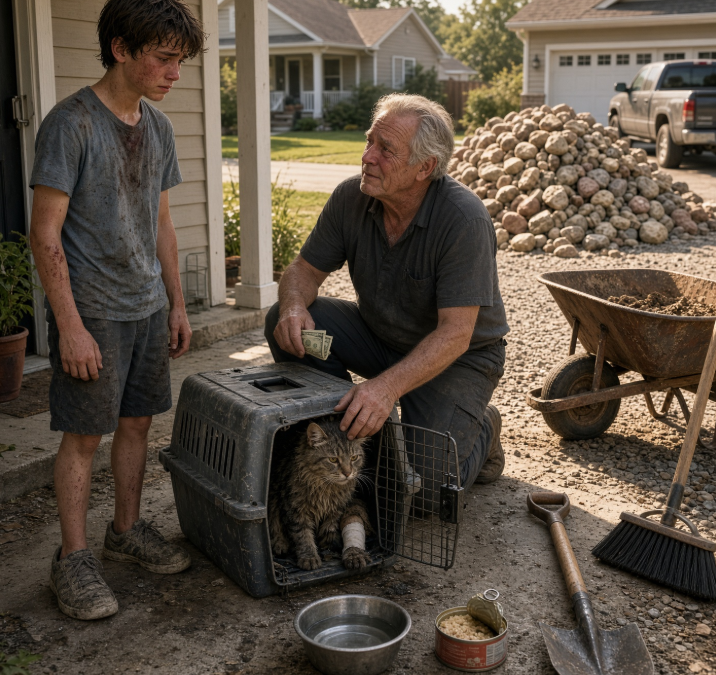
That was when I saw the pet carrier.
It was battered plastic, gray once but yellowed by weather, with a cracked handle and a metal grate door held shut by a twist of wire.
Inside lay an enormous stray cat.
At least, I thought it was enormous.
It was hard to tell beneath all the matted fur.
Gray and brown.
Long-haired.
Maine Coon mix, maybe.
Its coat was tangled with dirt, burrs, and dried blood.
One back leg was wrapped in a crude bandage made from what looked like an old T-shirt.
The cloth had bled through.
The cat’s amber eyes opened halfway.
It breathed with a raspy little sound that made something in my chest tighten before I had given it permission.
“Found him in a drainage ditch this morning,” Kaelen said.
His voice changed when he spoke about the cat.
Softer.
Less guarded.
“He got hit by a car.”
“Animal control?”
He shook his head.
“They said someone could come later.”
“The clinic?”
“Took him.”
“And?”
He looked down.
“They said he needs to be stabilized.”
I should have heard everything in that pause.
I didn’t.
“What’s his name?”
“Gideon.”
“You named a cat you found this morning?”
“He needed one.”
The answer annoyed me because it was good.
“Just keep him out of the way.”
“Yes, sir.”
I went back into the air-conditioning.
That sentence is not easy to write.
I went inside.
Closed the door.
Left a desperate boy and a bleeding cat on my porch while I poured iced tea and told myself I wasn’t responsible for every problem that wandered into my yard.
For the next four hours, I watched through the front window.
Not continuously.
That is what I told myself.
I checked now and then.
That is a lie.
I watched.
Kaelen drove the shovel into the rock pile.
Loaded the rusted wheelbarrow.
Pushed it around the side of the house, up a slight incline, through the gate, and dumped it into the garden bed.
Then back.
Again.
Again.
Again.
The wheelbarrow tire was low.
The handles looked rough.
His sneakers slipped on loose rock.
After twenty minutes his shirt was soaked.
After forty, his face had gone red.
After an hour, he was moving slower, but still moving.
Every thirty minutes he stopped.
Not to rest.
He went to the porch, crouched beside the carrier, opened the wire latch, and dripped water from a sports bottle into Gideon’s mouth.
Sometimes he touched the cat’s head with two fingers.
Sometimes he whispered.
Then he returned to the pile.
I stood in the cool shadow of my living room, holding a glass of iced tea, and watched a teenage boy work harder than any grown man I’d hired in years.
At first, my thoughts defended me.
He made the offer.
He needs the money.
Work is good for boys.
I used to work harder for less.
Then I saw his hands.
Blisters forming.
Then breaking.
He wrapped one palm with a strip torn from his shirt and kept pushing.
The old foreman in me admired him.
The old man in me should have been ashamed sooner.
By the third hour, something cracked.
Not dramatically.
No heavenly music.
No grand revelation.
Just a small sound inside me like an old board giving way.
I went to the kitchen.
Filled a steel bowl with ice water.
Opened the pantry.
Found a can of premium tuna I usually saved for myself.
Marian used to tease me about that.
“You buy better tuna for your sandwiches than some people buy for company.”
“Company doesn’t deserve tuna.”
The memory hurt.
I took the can anyway.
When I stepped onto the porch, the heat hit like a wall.
Kaelen was halfway across the driveway, shoulders bent, arms shaking as he pushed another loaded wheelbarrow.
“Take a break, kid.”
He stopped so abruptly the wheelbarrow nearly tipped.
“I’m okay.”
“I didn’t ask.”
He blinked.
I set the water on the step.
“Drink.”
He came slowly, as if expecting the offer to have a hook in it.
I knelt beside the carrier.
My knees protested loudly.
“Easy,” I muttered.
Gideon opened one amber eye.
I popped the tuna can.
The smell worked faster than prayer.
That cat lifted his heavy head and began weakly lapping at the juice.
I slid the can inside.
Then, carefully, I reached one finger through the grate and touched his ear.
Gideon leaned into the touch.
A low purr started.
Broken.
Soft.
Alive.
Kaelen stood over me, breathing hard.
“He’s a fighter, isn’t he?”
I kept stroking the cat’s ear.
“Yeah.”
My voice came quieter than I expected.
“He is.”
Kaelen drank the ice water.
Not slowly.
Like his body was trying to remember hope.
“Thank you.”
“Sit down five minutes.”
“I need to finish before sunset.”
“Five minutes won’t move the sun.”
He gave me the look teenagers reserve for adults who don’t understand math, urgency, or both.
But he sat.
Just long enough to stop swaying.
Then he went back.
By five o’clock, my driveway was bare.
Not mostly.
Not close enough.
Bare.
He had even swept the rock dust with a push broom he found in my garage.
The garden bed behind the house was filled neatly, stones spread with more care than I would have managed.
Kaelen limped onto the porch.
His face was flushed.
His hands shook.
“It’s done, Mr. Vance.”
I looked at him.
At the pile gone.
At the carrier.
At the boy trying not to look as tired as he was.
I pulled my wallet from my back pocket.
He watched with the tense attention of someone waiting for a verdict.
I did not pull out thirty dollars.
I counted two hundred and fifty.
Crisp bills.
Held them out.
Kaelen stared.
“No, sir.”
“Take it.”
“We agreed on thirty.”
“We agreed before I watched you do the work.”
“I only take what I earn.”
That sentence hit me harder than it should have.
He said it with pride.
But beneath the pride was fear.
Fear that taking more would turn the job into charity.
Fear that charity came with invisible strings.
I had seen that fear in grown men.
In fathers.
In widows.
In workers who would rather limp than admit injury.
I had just never seen it so young.
“A grown man doing four hours of back-breaking labor in this heat, delivering a perfect job, earns more than thirty dollars,” I said.
“I’m not a grown man.”
“You worked like one.”
“But—”
“Take it.”
His eyes moved to Gideon.
Mine followed.
“You need it, don’t you?”
That was the wrong question and the right one.
Kaelen’s face broke.
Not a little.
All at once.
Tears spilled down his sunburned cheeks.
He tried wiping them with his arm, but it only smeared dirt and sweat.
“The clinic,” he said.
His voice collapsed.
“They said it would cost two hundred and forty dollars just to stabilize him and cast his leg.”
My stomach dropped.
“If I didn’t have it by six, they said they’d have to put him to sleep.”
The world became very still.
I looked at the boy.
Then the cat.
Then the money.
He hadn’t been working for shoes.
Not a phone.
Not a game.
Not movie tickets.
He had moved three tons of rock through blistering heat because a stray cat nobody wanted was running out of time.
He had not knocked on doors asking for donations.
He had not cried on the internet.
He had not told me the story first to soften the price.
He had found work.
Hard work.
Too hard.
And I had taken the bargain.
“Get in my truck.”
Kaelen blinked.
“What?”
I grabbed my keys from the hook.
“The clinic closes in an hour. Grab the carrier.”
“Mr. Vance—”
“Move.”
He moved.
We loaded Gideon into my truck.
Kaelen sat in the passenger seat clutching the money like it might evaporate if he relaxed his grip.
Gideon rasped from the carrier between his feet.
I drove faster than a seventy-one-year-old man with bad knees and good insurance should drive.
On the way, Kaelen apologized three times.
For the smell.
For the blood.
For crying.
The third time, I snapped.
“Stop apologizing.”
He froze.
I softened my voice.
“You haven’t done anything wrong.”
He looked out the window.
“People say that before they explain why you did.”
I had no answer.
At Maple Hollow Veterinary Clinic, the receptionist recognized him.
Her face tightened with pity.
I saw Kaelen stiffen.
He hated pity.
I was beginning to understand that.
“We have the money,” he said quickly.
His voice trembled.
“I got it.”
The veterinarian, Dr. Soren, came out.
Forties.
Dark hair.
Kind face worn down by too many impossible choices.
She looked at me.
Then at the carrier.
“We’ll take him back.”
Kaelen dropped to his knees and opened the door.
“Gideon.”
The cat lifted his head.
“You have to fight, okay?”
Dr. Soren and a tech carried the carrier away.
Kaelen watched like they were carrying his own heart.
At the counter, he tried to hand over the bills.
I covered his hand.
“No.”
His head turned.
“What?”
“I’ve got it.”
“No.”
“Yes.”
“No, sir. I earned—”
“You earned that money.”
“Then—”
“You earned it for supplies. Food. Medicine. A bed. Whatever Gideon needs after he comes home.”
He looked furious.
Hurt.
Afraid.
“I’m not asking you for charity.”
“I know.”
“Then don’t make it that.”
“I am choosing to pay the clinic bill.”
“Why?”
Because I was late.
Because I had sat in air-conditioning while he bled.
Because Marian would have been ashamed of me before I became ashamed of myself.
Because a life was on the other side of a counter and I had enough money to open the door.
But those were adult answers.
Too heavy.
So I said:
“Because I can.”
His eyes filled again.
He turned away.
I paid two hundred and forty dollars.
Dr. Soren told us Gideon needed surgery, fluids, antibiotics, pain medication, and stabilization.
“Will he live?” Kaelen asked.
“We’ll do everything we can.”
“That’s not yes.”
“No.”
“Can you try like it might be yes?”
Dr. Soren’s face softened.
“Yes.”
We left without the cat.
That nearly broke the boy.
I drove him home.
Not to his house.
To his grandmother’s.
A small rental on Juniper Street with a chain-link fence and tomato plants in coffee cans.
An older woman came out before we reached the walkway.
Ruth Reed.
Thin.
White hair braided down her back.
Cane in one hand.
Eyes sharp enough to remove paint.
She looked at Kaelen.
Then at me.
“What happened?”
Kaelen held up the receipt.
“Gideon’s in surgery.”
Her face changed.
“You got the money?”
“Mr. Vance paid the bill.”
Her eyes moved to me.
Not gratitude.
Evaluation.
“I paid him for work,” I said quickly. “He earned two-fifty moving rock.”
Ruth looked at his hands.
Then back at me.
“Rock?”
I felt three inches tall.
“Three tons.”
“Heat?”
“Yes, ma’am.”
“How hot?”
“Too hot.”
She stared.
“At least you know.”
Kaelen stepped between us.
“Grandma.”
“No. Don’t grandma me.”
I deserved whatever came next.
But Ruth looked at him instead.
“Wash your hands. Then eat.”
“I’m not hungry.”
“Did I ask?”
“No, ma’am.”
He went inside.
Ruth remained on the porch.
“You the man with the rocks?”
“Yes, ma’am.”
“You the man who got him to the clinic?”
“Yes.”
“You the man who let him nearly cook himself first?”
“Yes.”
She nodded once.
“Come back when you understand all three are true.”
Then she went inside.
I stood there on the walkway holding my keys.
That woman had just summarized me better than I could.
Two days later, Kaelen returned to my porch carrying Gideon wrapped in a faded blue towel.
The cat was alive.
Shaved along one hip.
Bandaged properly.
Drugged.
Furious.
Which, as far as I could tell, meant improving.
Kaelen looked exhausted but cleaner.
His hands were wrapped in cheap adhesive strips.
One had soaked red.
“What are you doing here?” I asked.
“I brought your money.”
He held out an envelope.
I stared.
“What money?”
“The vet money. The two hundred and forty.”
“Put that away.”
“I can pay you back in pieces. I have twenty now.”
“Kaelen.”
“I’m not a charity case.”
There it was.
Steel.
Quiet, but real.
“I didn’t say you were.”
“That’s what people think.”
He looked down at Gideon.
“People help you once, then they talk like you belong to them.”
That shut me up.
I stepped aside.
“Come in.”
He hesitated.
Gideon growled from the towel.
“Well,” I said, “at least one of you has manners.”
That almost got a smile.
Almost.
Kaelen stepped inside carefully.
Too carefully.
He looked around my living room the way poor kids sometimes look in houses where everything seems breakable, expensive, or not meant for them.
Where to stand.
What not to touch.
How small to make himself.
I hated seeing it.
“Sit.”
“I don’t want to get fur on your couch.”
“I had three sons. There is nothing that cat can do to my couch that those boys didn’t do worse.”
He sat on the edge.
Gideon glared at my lamp like it had wronged him personally.
I got the first-aid kit.
Kaelen stiffened when I reached for his hand.
“I can do it.”
“I know. But you’re holding a cat who looks ready to sue somebody.”
“He does that when he likes people.”
“Then I’m honored.”
I cleaned his palms.
He stared at the wall.
Not rude.
Hurting.
Trying not to show it.
There was a bruise near his wrist.
Not fresh enough to demand answers.
Not old enough to ignore forever.
“Where are you staying?” I asked.
“With my grandma.”
“Parents?”
“My mom works nights. She’s around. Just tired.”
He said it too quickly.
I let silence sit.
Sometimes questions are crowbars.
Sometimes they are knives.
I wrapped the last strip of gauze around his palm.
“There.”
“Thank you.”
Then he reached for the envelope again.
I pointed.
“Don’t.”
“Mr. Vance—”
“Listen to me. I am not taking that money because I chose to pay that bill.”
His eyes narrowed.
“Then let me work it off.”
I almost said no.
The word stood ready.
But I stopped.
Because sometimes refusing repayment is not kindness.
Sometimes it is just another way to control the story.
“What kind of work?”
“Anything.”
“No.”
His face fell.
“I mean safe work. Nothing in dangerous heat. Nothing that should take three adults and a machine. Nothing that tears your hands open.”
“I can work hard.”
“I know. That’s the problem.”
He looked at Gideon.
I leaned back.
“Can you paint a fence?”
“Yes, sir.”
“Pull weeds?”
“Yes.”
“Wash windows?”
“Yes.”
“Organize a garage?”
He paused.
“Yes, but people usually change their minds after they see my system.”
There.
A real smile.
Small.
But real.
“Fine,” I said. “You can work it off if your grandmother approves. But I set the wage, hours, and rules.”
“What rules?”
“Water breaks. Gloves. Morning work only in heat. No working alone for strangers. If I tell you to stop, you stop.”
He looked insulted.
“I’m seventy-one,” I said. “I can out-stubborn you in my sleep.”
Kaelen laughed.
Short.
Rusty.
It filled my living room like a window opening.
Then Gideon sneezed on my shirt.
“Wonderful.”
Kaelen laughed harder.
That should have been the happy ending.
It wasn’t.
Happy endings are easy when nobody else gets a vote.
The world always wants one.
That afternoon, my neighbor Howard came over while Kaelen sat on my porch feeding Gideon tiny pieces of soft food.
Howard was not a bad man.
That matters.
Most people who say cruel things are not monsters.
They’re tired.
Scared.
Convinced their bitterness is wisdom.
Howard stopped at the bottom step.
“That the stray everyone’s talking about?”
I frowned.
“Who’s everyone?”
He held up his phone.
“Your doorbell camera caught some of it, didn’t it? The kid hauling rock. Someone posted it on the neighborhood page.”
My stomach sank.
“I didn’t post anything.”
“Maybe the delivery guy. Maybe Stonebrook. It’s everywhere now.”
Kaelen froze.
“What is?”
Howard turned the screen.
I watched color leave the boy’s face.
There he was.
Bent over the shovel.
Sweat-dark shirt.
Raw hands.
Wheelbarrow full of rock.
In the corner, Gideon’s carrier.
Caption:
**Teen boy moves three tons of rock for $30 to save injured stray cat.**
Comments everywhere.
Some kind.
Some cruel.
People called him an angel.
People called me cheap.
People blamed the clinic.
People said a cat wasn’t worth it.
People said teenagers weren’t lazy after all.
People said this was child labor.
People said hard work builds character.
People said he should have left the cat to die.
The internet can turn a bleeding animal into a courtroom before lunch.
Kaelen whispered, “Take it down.”
Howard blinked.
“I didn’t post it.”
“Then tell them.”
His voice cracked.
I stepped between him and the phone.
“That’s enough, Howard.”
“I just thought you should know.”
“Now I know.”
Kaelen stood so fast Gideon hissed.
“I have to go.”
“I’ll drive you.”
“No.”
That word slammed shut.
Then his face filled with shame.
“I’m sorry, sir. I just need to go.”
He picked up the carrier.
Walked down my steps.
Not running.
Not crying.
Worse.
Trying hard not to be seen.
I watched him disappear down the sidewalk and understood I had failed him twice.
That night, I found the post.
I read every comment.
That was my mistake.
The cruel ones hurt.
The sweet ones hurt too.
But the cold proud ones stayed.
**He agreed to thirty. That’s business.**
**No one forced him.**
**Good lesson. Life is hard.**
**Why pay for a stray?**
**Old man got a bargain.**
**Kid should have planned better.**
**Hard work builds character.**
My coffee went cold.
My hands shook.
Not from age.
Anger.
I wrote a reply.
Deleted it.
Too much old foreman.
Too much hammer.
I wrote another.
Deleted that too.
Truth didn’t need shouting.
It needed owning.
Finally, I typed:
**My name is Elias Vance. I am the old man in the story.**
I stared.
Then continued.
**Before anyone calls that boy a hero, you should know something. I failed him first.**
That line cost me.
I kept typing.
I explained that he offered thirty dollars and I accepted.
That I knew it was too hot.
That I knew three tons was too much.
That I knew he was desperate.
That I told myself it was fair because he named the price.
But a desperate kid offering too little for his labor does not make the deal fair.
It makes it convenient for the adult listening.
I wrote:
**He deserved fair pay before I knew his reason.**
That was the line that started the fight.
People did not know what to do with it.
Because it is easy to reward someone after they turn out to be noble.
It is harder to admit we should treat people decently before they prove they have suffered enough to deserve it.
By midnight, the post had been shared across half the county.
By morning, Kaelen was back on my porch.
No Gideon.
Only anger.
“Why did you write that?”
“Because it was true.”
“You made everyone talk more.”
“They were already talking.”
“You said you failed me.”
“I did.”
“You didn’t.”
“Yes.”
His eyes filled.
“You helped Gideon.”
“After I watched you work four hours in dangerous heat.”
“I chose that.”
“You chose it because you had no better option.”
His mouth opened.
Closed.
The anger went out of him all at once.
Truth doesn’t always win arguments.
Sometimes it just makes everyone tired.
He sat on my porch step.
I sat beside him slowly because my knees are traitors.
For a while, we said nothing.
Finally, he whispered, “People are saying I’m stupid.”
“People say a lot when they don’t have to look you in the eye.”
“They’re saying I should’ve let him die.”
“They’re wrong.”
“They’re saying thirty dollars was fair because I agreed.”
“They’re wrong about that too.”
He rubbed his bandaged palms against his jeans.
“Then why did I agree?”
That question deserved honesty.
“Because sometimes people with fewer choices accept smaller crumbs.”
He stared at the porch boards.
“I don’t want crumbs.”
“I know.”
“I want work.”
“I know.”
“I want to pay you back.”
“I know.”
He looked painfully young then.
Not heroic.
Not inspirational.
Young.
Too young to be praised for carrying adult weight.
“Then let’s make a deal.”
“What deal?”
“You work for me this summer. Small jobs. Safe hours. Fair wage. You pay me back if that matters.”
“It does.”
“Fine. You pay me back. But every dollar goes into a fund at the clinic for the next person who walks in with an animal they can’t afford to save.”
He frowned.
“That’s not paying you back.”
“It is to me.”
“You’re weird.”
“I’ve been called worse by better men.”
He almost smiled.
“What if the next person doesn’t deserve it?”
“What?”
“What if they’re lying? Or don’t care? Or just want free help?”
I understood that fear.
Fear of being fooled.
Old people worship that fear.
We call it common sense.
“Then maybe we help one person who didn’t earn it,” I said. “But maybe we save one creature who did nothing wrong.”
Kaelen looked toward the street.
“That sounds risky.”
“Most decent things are.”
He sat with that.
Then nodded.
“All right.”
That was the beginning.
Not of a charity.
Not of a movement.
Just a beginning.
A stubborn old man.
A stubborn teenage boy.
A limping, half-shaved stray cat with the personality of a tax collector.
And a neighborhood that could not stop arguing long enough to realize it was changing.
The first job was my garage.
No heat.
No heavy lifting.
Just chaos.
Coffee cans full of screws.
Old paint trays.
Rusty tools.
Dead Christmas lights.
Boxes I hadn’t opened since Marian died.
Kaelen showed up at eight wearing gloves I’d bought him.
He tried to refuse them.
I told him they came out of his first paycheck.
That satisfied his pride.
He labeled everything.
Sorted everything.
Swept beneath shelves that had not seen daylight in years.
Halfway through, he found an old lunchbox.
He handed it to me gently.
Inside were three notes from Marian.
I had forgotten them.
That’s a lie.
I had buried them.
Marian used to put notes in my lunchbox when I worked construction.
Little things.
**Don’t skip lunch.**
**Call the dentist.**
**Stop arguing with Eddie before your blood pressure wins.**
The last one said:
**Come home soft.**
I sat down hard on an overturned bucket.
Kaelen looked away.
Good boy.
He knew when silence was kinder.
Come home soft.
That was Marian.
She never asked me to be weak.
She asked me not to let the world sand every tender place out of me.
I failed her for a long time.
Kaelen kept sorting nails.
After a while, I said, “She would’ve liked Gideon.”
“Most good people do.”
“She would’ve liked you.”
He froze.
Then kept working.
“Maybe after I finished the garage.”
I laughed.
So did he.
That afternoon, Mrs. Alvarez from three houses down brought lemonade and sandwiches.
“For the crew,” she said.
“It’s one boy and one useless old man.”
“Then the crew needs strength.”
Kaelen thanked her quietly.
She looked at his hands.
Then at me.
“My grandson needs yard work too,” she said. “Morning only. Fair pay.”
Kaelen straightened.
“I can do that, ma’am.”
I pointed at him.
“After I speak to your grandmother.”
His ears reddened.
Mrs. Alvarez smiled.
“Good. Then we do it properly.”
Properly.
That word mattered.
By week’s end, six neighbors had called.
Not because I was special.
Because people wanted to help without embarrassing him.
No pity money.
Work.
Real work.
Safe work.
Fair pay.
Mrs. Alvarez needed weeds pulled.
Mr. Benton needed his shed cleaned.
Miss Carol needed a porch railing painted.
The retired music teacher needed someone to walk her old terrier.
I made a list.
Then called Ruth.
“You the man who paid the vet?”
“Yes, ma’am.”
“You the man who let my grandson nearly cook himself in your driveway?”
“Yes, ma’am.”
“At least you’re consistent.”
“I try.”
“Don’t get clever.”
“No, ma’am.”
She allowed Kaelen to work.
Under conditions.
Morning hours.
No dangerous jobs.
No strangers without approval.
No underpaying.
And if he came home sunburned and bleeding again, Ruth promised to visit me with her cane.
I believed her completely.
The neighborhood page continued fighting.
Naturally.
Nothing makes people angrier than being asked to think.
Someone wrote:
**So now we’re paying teenagers premium wages for chores?**
Someone answered:
**No. We’re paying people fairly for labor.**
Another:
**If he wanted money, he should get a real job.**
A woman replied:
**Half the places want experience for entry-level work and then complain kids don’t work.**
A man wrote:
**No animal is worth human struggle.**
Mrs. Alvarez replied:
**Kindness is not a limited resource unless you make it one.**
I did not know she had that in her.
By then Gideon had become the neighborhood’s unofficial mascot.
Kaelen brought him by after the clinic approved short visits.
The cat wore a cone and behaved like royalty in exile.
He limped across my porch, glared at birds, and knocked over my coffee twice.
People stopped by pretending to talk to me.
They came to see Gideon.
Even Howard came.
“Cat looks better.”
Gideon hissed.
Howard nodded.
“Fair enough.”
Then he looked at Kaelen.
“I said some things online I shouldn’t have.”
Kaelen scratched Gideon’s ear.
Howard shifted.
“I thought thirty dollars was just a lesson. I didn’t think about why you agreed.”
Kaelen said, “You’re not the only one.”
Howard winced.
He deserved it.
Then:
“I’ve got a lawn mower that needs cleaning. I’ll pay twenty-five an hour.”
Kaelen looked at me.
I looked at Howard.
“Morning only.”
“Morning only.”
“Gloves.”
“Gloves.”
“Water.”
Howard sighed.
“I’m not a villain, Elias.”
“No. You’re a neighbor. That means we can still expect things from you.”
He wanted to argue.
Then nodded.
“Fair enough.”
That phrase spread.
Fair enough.
Small surrender.
Small bridge.
Soon I had a corkboard in my garage.
We called it the fair-work board.
No logo.
No organization.
No speeches.
Index cards.
Name.
Task.
Hours.
Pay.
Safety notes.
Kaelen wrote the rules.
Rule one: No pity jobs.
Rule two: Pay before praise.
Rule three: Water is not a bonus.
Rule four: Animals count.
I stared at that last one.
“Animals count?”
He shrugged.
“They do.”
I pinned it up.
By the second week, three more teenagers joined.
Nia, saving for community college books.
Travis, helping his mother fix their washer.
Miles, quiet as fog, but able to repair a bicycle chain faster than I could find my reading glasses.
People argued about them too.
They should volunteer.
They should study.
They should work.
They shouldn’t have to work.
Everybody had an opinion about what young people should do.
Fewer asked what they were carrying.
That became the real fight.
Not money.
Not rocks.
Not even the cat.
The fight was whether adults could respect teenagers before demanding proof of suffering.
One evening, Kaelen and I sat on my porch while Gideon slept between us like a furry bag of bad decisions.
Sunset cooled the street.
Kaelen had painted Miss Carol’s railing and been paid seventy-five dollars plus peach jam.
He held that jar like a trophy.
“You know what’s weird?” he said.
“What?”
“People are nicer when there are rules.”
I looked at him.
“They don’t have to guess how to help,” he said. “And I don’t have to guess if they’re helping or judging.”
That boy could say things that made me proud and ashamed at the same time.
“You’re smart.”
“I failed algebra.”
“Plenty of fools pass algebra.”
He considered.
“Did you?”
“Barely.”
He grinned.
Then got quiet.
“Do you think people can care too much about animals?”
There it was.
The question the comment section had chewed on for days.
I looked at Gideon.
His shaved leg twitched.
“I think some people care loudly about animals because animals are easier than people,” I said. “But I also think some people use that as an excuse to care about neither.”
Kaelen stared at the street.
“My mom said something like that.”
I waited.
“She said if a person can be gentle with something that can’t pay them back, there’s still hope for them.”
I felt that.
“Your mother sounds wise.”
“She’s tired.”
“Those can be the same thing.”
A week later, I met Kaelen’s mother.
Maris Reed.
She came with Ruth, who brought the cane.
Just in case, I think.
Maris had kind eyes with deep shadows under them.
She worked nights at a shipping warehouse and days whenever life required it, which seemed most days.
She shook my hand with both of hers.
“Thank you for what you did for my son.”
“I should’ve done better sooner.”
“Yes,” Ruth said.
Maris gave her a look.
“What?” Ruth said. “He said it first.”
We sat at my kitchen table.
Gideon occupied a chair he had no right to occupy.
Maris read the fair-work board rules.
When she reached **Pay before praise**, she pressed her lips together.
“That one is his,” I said.
Maris looked at Kaelen.
He looked embarrassed.
She squeezed his wrist.
Not the bruised one.
The healed one.
“I know,” she said.
Two words.
A whole history.
We talked safety.
Transportation.
Emergency contacts.
School schedules.
Which neighbors could be trusted.
Which couldn’t.
No drama.
Just adults finally doing what adults are supposed to do.
Building something sturdy enough for young people to stand on.
Then Ruth pointed her cane at me.
“And you?”
“What about me?”
“You running this because you care or because you feel guilty?”
That woman had sniper aim.
“Both,” I wanted to say.
But only one answer would hold.
“I started because I felt guilty. I’m staying because I care.”
Ruth studied me.
“Good enough for now.”
High praise.
The next fight came from the clinic.
Someone posted that Maple Hollow Veterinary Clinic had refused to save a cat without cash.
Not entirely true.
Not entirely false.
That is how most fights begin.
Half a truth dressed like the whole thing.
People flooded the clinic page.
Greedy.
Heartless.
Shameful.
Dr. Soren called me sounding exhausted.
“Mr. Vance, I’m glad Gideon is recovering, but my staff is being attacked.”
“I’m sorry.”
“We are small. We stabilize what we can. We donate what we can. But we cannot absorb every emergency cost.”
“I understand.”
“Do they?”
I had no answer.
People love simple villains.
Especially when real problems are complicated.
A hurt animal.
A poor kid.
An old man with regret.
A clinic with bills.
A neighborhood with opinions.
No single villain.
No easy solution.
That makes people uncomfortable.
So they choose someone to blame.
That night I posted again.
Short.
**Do not harass the clinic. The problem is bigger than one bill, one boy, one cat, or one old man. The clinic saved Gideon. The boy saved Gideon. I helped late. If we want fewer desperate moments, we need steady help before emergencies happen.**
Then I added:
**The fair-work board will set aside voluntary donations for emergency animal care. No one is required. No one will be shamed. If you want to help quietly, you can.**
Comments exploded.
Of course.
Howard: **I was wrong about the boy. I’m in for fifty.**
Mrs. Alvarez: **I’m in for fifty and sandwiches.**
Ruth: **No sandwiches without fruit.**
Kaelen, against my advice, made an account and wrote:
**Gideon votes for tuna.**
That got more likes than anything I wrote.
The cat had better public relations than I did.
By month’s end, we had enough for three emergency cases.
A senior dog with an infected tooth.
A kitten with a broken paw.
A rabbit found by a storm drain.
Small lives.
Small mercies.
Kaelen delivered the first envelope to the clinic himself.
I drove.
Gideon came because Gideon had become unbearable if excluded.
Dr. Soren met us in the lobby.
Kaelen held out the envelope.
“This is from the fair-work board. For someone who needs help before they have to move rocks.”
Dr. Soren’s eyes filled.
“Thank you.”
Kaelen nodded.
“Also, Gideon hates the cone.”
“We know.”
“He wants that in his medical record.”
“I’ll make a note.”
He smiled like the whole room had warmed.
On the ride home, he was quiet.
Finally:
“Do you think it’ll last?”
“The board?”
“Yeah.”
I considered lying.
Old men lie to young people and call it encouragement.
Kaelen had earned better.
“I don’t know.”
He nodded.
“But I know this. Even if it doesn’t last forever, it matters while it does.”
He looked out the window.
“I want things to last.”
“I know.”
“I’m tired of temporary.”
Temporary is the language of people living close to the edge.
Temporary jobs.
Temporary help.
Temporary relief.
Temporary kindness.
Temporary hope.
I gripped the wheel.
“Then we build what we can,” I said. “And teach others how.”
He looked at me.
“You sound like a fortune cookie.”
“I sound like a man who finally made enough mistakes to say something useful.”
He laughed.
I took the win.
Summer rolled forward.
Hot mornings.
Quiet afternoons.
Gideon’s limp became less dramatic, except when food was involved.
Kaelen gained weight.
Not much.
Enough that his cheekbones softened.
His hands healed.
His shoulders changed.
Not from labor.
From standing in rooms where people expected him to be treated fairly.
That changes a person.
Nia bought her books.
Travis fixed the washer.
Miles repaired bikes for half the neighborhood and spoke maybe twelve full sentences in a month, which Ruth called a miracle of modern conversation.
The board became normal.
That was best.
Not viral.
Not dramatic.
Normal.
People still complained, because some folks would complain if a rainbow landed in the wrong yard.
But words changed.
Instead of “kids don’t want to work,” I heard, “Does Kaelen have time Tuesday?”
Instead of “young people are hopeless,” I heard, “Miles fixed that better than the shop.”
Sometimes culture changes because somebody’s gutter gets cleaned by a kid who shows up on time and gets paid fairly.
Then Kaelen brought me the envelope.
Two hundred and forty dollars.
Every cent.
We stood in my garage.
Fair-work board on wall.
Gideon slept under workbench, snoring like a broken engine.
“I paid it back.”
I stared.
“You know where it’s going.”
“I know.”
“You sure?”
“Yes, sir.”
I took it.
Not because I wanted to.
Because he needed me to.
A man should know when refusing a gift is really refusing someone’s dignity.
I wrote on front:
**Gideon Fund — Paid by Kaelen Reed**
He stared.
“You put my last name.”
“Your name belongs on it.”
“Most people don’t use it.”
“Then they can start.”
He looked away quickly.
But I saw his eyes.
That evening, Dr. Soren pinned a note on the clinic community board.
No amount.
No picture.
Just:
**For the next injured stray who needs time.**
Kaelen’s words.
Needs time.
Not deserves rescue.
Not proves worth.
Just needs time.
Sometimes mercy is only that.
A little more time before the world gives up.
At the end of August, Stonebrook Yard Supply sent a man to my house.
The same company that dumped rocks in wrong place.
Clean polo.
Worried expression.
“We heard what happened.”
“I imagine everybody did.”
“We made the original mistake.”
“Yes.”
“The driver had wrong drop point.”
“Yes.”
“We refunded delivery.”
“Yes.”
“It wasn’t enough.”
“No.”
He winced.
Then handed me an envelope.
“We’d like to contribute to the fair-work board.”
Old cynic stirred.
Publicity.
Damage control.
Comment relief.
Maybe all true.
But Gideon didn’t care why tuna arrived.
Only that it did.
“How much?”
“Five hundred.”
I took it.
“No photos.”
“Sorry?”
“No photos. No post about generosity. No using the boy’s story in ads. No making him stand beside your truck with a shovel.”
His face flushed.
“We weren’t going to—”
“Good.”
He nodded.
“Understood.”
I softened.
“You want to do right? Help quietly.”
He looked toward the porch where Kaelen brushed Gideon.
“Fair enough.”
When I told Kaelen, he asked:
“Do we trust it?”
“We don’t have to trust the reason to use the result wisely.”
He nodded.
“That sounds like Ruth.”
“Ruth is terrifyingly quotable.”
“She’s terrifying in general.”
We both looked over our shoulders like she might hear from two miles away.
She probably did.
School started.
Kaelen worked less.
School first.
He hated that rule.
Ruth loved it.
Rule stayed.
Every Wednesday, he came by for two hours.
Sometimes to work.
Sometimes to check the board.
Sometimes to help Miles.
Sometimes to let Gideon patrol my porch.
Sometimes just to sit.
One Wednesday, he brought a school paper.
Slapped it on my kitchen table.
“What is this?”
“Essay.”
“Yours?”
“No, Gideon’s.”
I put on glasses.
Title:
**What My Community Got Wrong About Work**
“Subtle.”
“Teacher said write from experience.”
I read.
Slowly.
He wrote about rocks.
Heat.
Taking low pay because alternative was watching something suffer.
Dignity.
Adults praising struggle after ignoring the conditions that create it.
Gideon.
Then one line stopped me:
**People kept saying I restored their faith in my generation, but I wanted to ask why they had lost it before they knew me.**
I lowered the paper.
“You wrote that?”
He shrugged.
“Too much?”
“No.”
“Too angry?”
“No.”
“Teacher might think it is.”
“Then your teacher needs to sit with it.”
“You think it’s good?”
“I think it’s true.”
His face changed.
Not smile.
Relief.
The essay won a school award.
Small certificate.
Ruth framed it like royal decree.
Maris cried.
Kaelen pretended annoyance.
Gideon tried to eat ribbon.
The local paper printed the essay.
People argued again.
One letter said hardship builds character.
Another said work is good.
A third wrote:
**Maybe the lesson is not that work is bad. Maybe the lesson is that exploitation can hide behind the word opportunity.**
That stayed with me.
Work is not enemy.
Pride is not enemy.
Discipline is not enemy.
The enemy is when adults see desperation and call it a deal.
The enemy is when we only recognize character after someone bleeds for it.
The enemy is when compassion has to pass a test before we let it through the door.
In October, Gideon jumped onto my porch railing.
He was not supposed to.
His leg had healed, but not perfectly.
He wobbled.
Kaelen lunged.
I reached.
Gideon looked at both of us with contempt, balanced perfectly, turned, and knocked my coffee into the bushes.
“Your cat is a menace,” I said.
Kaelen folded his arms.
“He’s your cat too.”
“No, he is not.”
Gideon limped through my open door like he paid property taxes.
Kaelen smiled.
“He disagrees.”
I didn’t admit it then.
But Gideon had started sleeping on my porch.
Then garage.
Then kitchen.
Then, one chilly evening, on Marian’s quilt at foot of my bed.
I told myself temporary.
Everyone knew I was lying.
The day before Thanksgiving, Kaelen arrived with canned goods from a school food drive.
“I’m taking these to the pantry.”
“Good.”
He hesitated.
“What?”
“I used to hate food drives.”
“Why?”
“People hand you a can like they’re handing you their opinion of your life.”
That hit.
“But now?”
He shifted box.
“Maybe it depends how they hand it.”
We added rule five to the board:
**Help should not come with a leash.**
Gideon batted the card down.
We pinned it higher.
On Thanksgiving, my house was not quiet.
That would have shocked anyone who knew me.
Ruth came.
Maris came after night shift.
Kaelen came with Gideon, who had apparently been invited without consulting me.
Mrs. Alvarez brought enough food for a small army.
Howard brought pie and apologized for it, which was justified.
Miles fixed my wobbly chair without being asked.
Nia came with her brother.
Travis came with his mother.
Voices filled every corner.
I hated the noise.
I loved the noise.
Both can be true.
At one point, I stepped onto porch.
Kaelen followed.
“You okay?”
I looked through window.
Ruth correcting Howard’s pie cutting.
Gideon stealing turkey.
Maris smiling tiredly.
Fair-work board visible through garage door.
“No,” I said.
Kaelen looked worried.
“But I’m better than I was.”
He nodded.
“I know what that feels like.”
We stood quietly.
“You ever think about that day?” he asked.
“The rocks?”
“Yeah.”
“Every day.”
“Me too.”
He scratched porch paint.
“I used to think it was the worst day. But if it didn’t happen, Gideon would’ve died. And I wouldn’t have met you.”
I swallowed.
“That supposed to be a compliment?”
“Don’t ruin it.”
“Yes, sir.”
He smiled.
“I still don’t know if I should be glad it happened.”
That was honest.
“You don’t have to be glad bad things happened,” I said. “You can be glad good people showed up afterward.”
He nodded.
Inside, Gideon knocked something over.
Ruth shouted, “That cat is a criminal!”
Kaelen sighed.
“He’s misunderstood.”
“He is a repeat offender.”
He laughed.
And I swear, for a second, Marian’s note returned.
Come home soft.
Maybe I had.
Maybe it had taken a bleeding stray cat, a desperate boy, three tons of rock, and half a neighborhood yelling at one another to drag me there.
But maybe I had.
Later that night, after everyone left, I found Kaelen’s first envelope in my desk.
The one with twenty dollars.
I had kept the envelope, not the money.
On the outside, in shaky handwriting:
**For Mr. Vance. First payment.**
I turned it over and wrote:
**Received in full. Not in cash. In character.**
I put it in Marian’s old lunchbox with her note.
Some things belong together.
By winter, the neighborhood page calmed.
New arguments replaced us.
Holiday lights too bright.
Dog barking.
Someone parking crooked.
Life returned to ordinary madness.
But every so often, someone posted a photo.
No faces without permission.
No hero nonsense.
Just a repaired porch.
A swept garage.
A painted fence.
A rescued animal leaving the clinic.
A handwritten receipt.
A bowl of water on a hot morning.
And under those posts, the same phrase appeared.
**Pay before praise.**
At first, I thought it was slogan.
Then I saw what it did.
It reminded people admiration is cheap after suffering.
It reminded people respect should not depend on a sob story.
It reminded people young workers are not lucky to be underpaid because they are young.
It reminded people kindness without dignity can still leave bruises.
And it reminded me cynicism is not wisdom.
It is often grief that got tired of introducing itself.
I had been calling myself realistic for years.
I was not realistic.
I was guarded.
I expected little from people so I wouldn’t be disappointed.
Kaelen expected more from a dying cat than I expected from my whole neighborhood.
Somehow the boy was right.
Gideon lived.
The board grew.
Neighbors changed.
I changed.
Not completely.
Don’t make me sound better than I am.
I still grumble.
I still complain about music too loud.
I still believe most modern appliances are designed by people who hate fingers.
But I do not look at teenagers the same way.
I do not look at strays the same way.
I do not look at a person offering cheap labor and see a bargain.
I see a question.
Why is that all they think they can ask for?
And what kind of man am I if I take advantage of the answer?
That is what people kept missing.
This was never just a story about a boy and a cat.
It was about every adult who says, “Nobody helped me,” as if that is a reason to help no one.
It was about every neighbor who confuses suspicion with intelligence.
It was about every kid told to work hard, then punished for needing money.
It was about every act of compassion people mock because it does not fit their idea of what matters.
It was about the difference between a handout and a hand held steady.
Kaelen still comes by.
Gideon does too, though “comes by” is generous.
The cat enters like he owns the house, porch, street, and a small portion of my soul.
His limp is barely noticeable now.
Except when he wants sympathy.
Then it becomes theatrical.
Kaelen is doing well in school.
Not perfect.
Good.
Good is better than perfect.
He still works through the fair-work board when he has time.
He refuses pity.
He insists on receipts.
Every time a new kid joins, he tells them the rules.
No pity jobs.
Pay before praise.
Water is not a bonus.
Animals count.
Help should not come with a leash.
I sit in the corner pretending not to be proud.
Nobody believes me.
Last week, a woman came to my door with her twelve-year-old daughter.
They had found an injured dog near a grocery parking lot.
The girl was crying.
The woman was embarrassed.
She said, “I heard maybe you know who can help.”
Years ago, I might have sighed.
Might have said I wasn’t an animal shelter.
Might have said I had enough problems.
Instead, I grabbed my keys.
Kaelen happened to be on the porch with Gideon.
He stood immediately.
“Clinic?”
“Clinic.”
The little girl looked at Gideon.
“Is that your cat?”
Kaelen looked at me.
I looked at Gideon.
Gideon sneezed.
Then Kaelen said, “He’s ours.”
Ours.
Funny word.
Dangerous word.
Beautiful word.
We loaded the little dog into my truck.
The girl sat in back with her mother.
Kaelen sat beside me.
Gideon stayed on porch glaring like a retired general.
As I pulled away, I glanced in the mirror.
The girl stroked the dog’s head, whispering, “You’re okay. You’re okay.”
Kaelen heard it too.
He looked out the window.
I saw his reflection in the glass.
Same boy from my driveway.
But not the same.
Still carrying tenderness.
Still carrying pride.
But no longer carrying it alone.
That is what community is supposed to do.
Not erase weight.
Share it before someone breaks.
So when people ask what happened after the boy saved the stray cat, I tell them truth.
The cat lived.
The boy grew.
The old man learned.
The neighborhood argued.
Then, slowly, it began to care better.
Maybe that is not a perfect ending.
But it is an honest one.
The world does not change all at once.
Sometimes it changes when a teenage boy refuses to let a broken creature die.
Sometimes it changes when an old man admits he was wrong.
Sometimes it changes when a neighborhood stops asking whether someone deserves help long enough to offer it with dignity.
And sometimes, if we are lucky, it changes because a bleeding stray cat in a battered carrier reminds us of something we should never have forgotten.
A life does not have to be useful to matter.
A kid does not have to suffer to be respected.
Compassion is not weakness.
It is the hardest work most people will ever do.
Gideon proved that.
Kaelen proved that.
And I am still trying to prove I learned it in time.








