I Never Told My New Husband I Could Cook—Then His Ranch Hands Started Fighting Not to Miss Supper
I Never Told My New Husband I Could Cook—Then His Ranch Hands Started Fighting Not to Miss Supper
My husband married me for sensible reasons, not knowing I could turn his lonely ranch kitchen into the one place his tired men refused to miss.
I thought supper was only supper, until every quiet thing I noticed at that table began changing the future of his ranch.
Then one loyal hand tried to give up his own chance just because of me, and I learned that even kindness can become a debt if a woman is not careful.
My name is Julia Hartwell Barrett, and when I first stepped into Luke Barrett’s kitchen as his wife, I knew two things with perfect certainty.
The stove was colder than it should have been.
And the men on that ranch had forgotten what it felt like to be fed by someone who was paying attention.
Luke carried my trunk up the porch steps the way he carried everything else in life—quietly, steadily, without ceremony. One task, then the next. He was not a man who wasted motion, nor a man who filled silence because silence made him uncomfortable. If anything, silence seemed to suit him better than speech. He had broad shoulders, weathered hands, and eyes that missed very little but gave away almost nothing.
We had been married the day before in Baker City, before a justice of the peace, with my sister Martha and old Ephraim from the livery standing witness. There had been no flowers. No music. No veil. No trembling declaration that love had conquered loneliness.
Luke and I had not spoken of love.
We had spoken of respect.
Of land.
Of money.
Of expectations.
Of hired help.
Of grief.
Of winter.
Of whether a man who had buried his mother two years earlier and been running a ranch household badly ever since could make room for a wife without treating her like another hired hand.
He asked hard questions.
I answered plainly.
I asked harder ones.
He did not flinch.
That was why I married him.
Not because my heart had leapt at the sight of him, though I would be lying if I said I had not noticed the strength in his hands or the way his voice settled low and even when he was thinking. Not because I imagined a fine romance waiting at the end of a dusty road. I was thirty-one years old. I had lived too much life to mistake need for destiny.
I married Luke because he made sense.
And because when I asked, “If I come to your ranch, will the kitchen be mine to run or yours to criticize?” he looked me straight in the eye and said, “If you know better than I do, I expect to learn.”
That was not poetry.
It was better.
Now I stood in the middle of his kitchen—our kitchen, though the word did not yet feel true—and took in the cold stove, the bare shelf, the flour bin scraped low, the chipped crock of salt, the coffee pot stained black enough to frighten sin from a preacher, and a skillet that had been scrubbed hard but never loved.
Luke set my trunk inside the door.
“I’ll bring the other things after I see to the mare.”
“I’ll manage,” I said.
I meant the kitchen.
I meant the marriage.
I meant myself.
He nodded once and went back out to the barn, because there was always something in the barn.
That was the first rule I learned about ranch life.
There was always something.
A gate gone loose. A horse gone lame. A fence line gone soft. A cow with more stubbornness than judgment. A harness needing oil. A man needing pay. A weather shift no one could stop but everyone had to answer.
I took off my traveling gloves, rolled up my sleeves, and opened every cabinet.
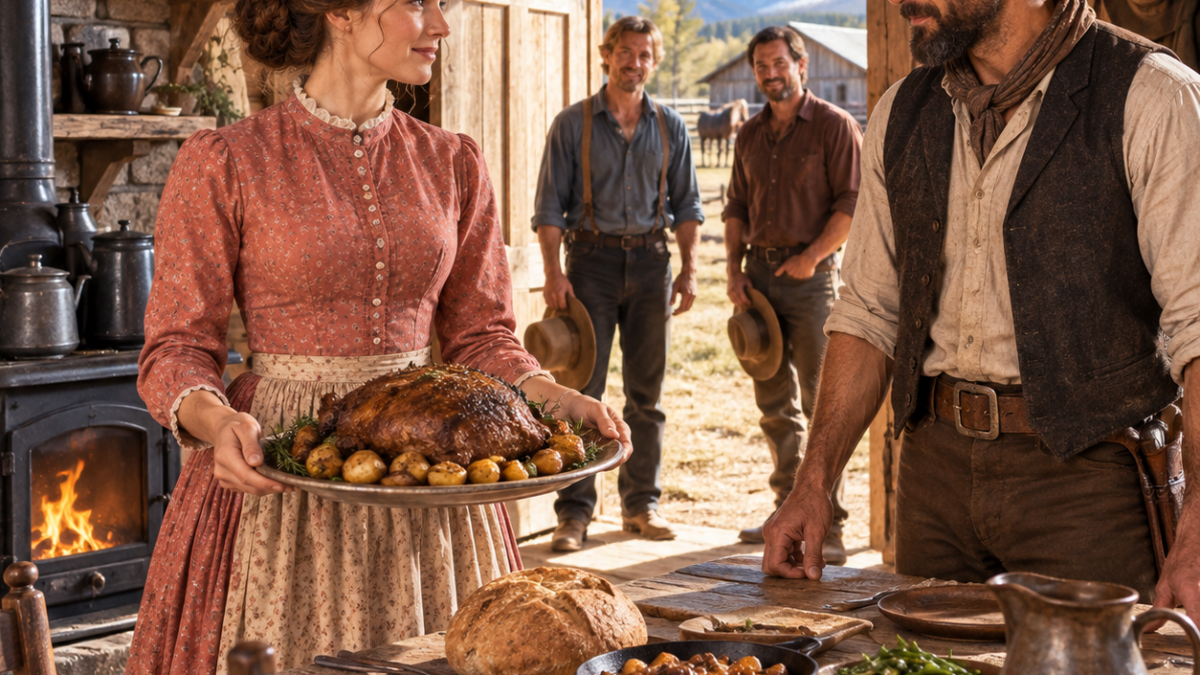
By six o’clock that evening, four ranch hands came in stamping cold from their boots, expecting the plain supper that had become ordinary since Luke’s mother passed. I learned later what ordinary meant on that ranch.
Thin stew.
Biscuits like river stones.
Beans boiled into surrender.
Coffee a man could use to tar a roof.
No one complained because men trained by weather and hunger often confuse endurance with virtue. They sat. They ate. They worked. They made jokes about the food only after enough time had passed to prove they were not asking for better.
That evening, they stopped in the doorway.
All four of them.
Wesley Crane went still with his hat halfway off his head. Wesley was quiet, narrow-faced, and serious, with the kind of eyes that measured before trusting. He looked at the table as if it might vanish if he acknowledged it too quickly.
Ned Parker, twenty-four and always hungry, made a sound low in his throat that was not quite words.
Hugh Lancaster eased one hand against the doorframe, looked at the table for a long moment, then sat down slowly, as a man does when one joint has been arguing with him all day and he has decided not to let anyone hear it.
Frank Dobbs said nothing at all.
From Frank, I would come to understand, silence was its own announcement.
The table held roast beef done properly, potatoes with real butter, carrots glazed in pan drippings, bread that had risen twice, beans that still remembered they had once been alive, and a pie cooling near the stove on only my second night as Mrs. Barrett.
Luke sat at the head of the table and ate slowly.
He did not say much.
PART2:
He had warned me in Baker City that his men took meals with him most nights through winter because the bunkhouse stove was unreliable and because his mother had set that custom years before. He had said it almost apologetically, as if expecting me to object.
I did not object.
Men who work through cold should eat hot when a stove is available.
Halfway through the meal, Luke set his fork down.
Not dramatically.
Not to make a speech.
He set it down the way a man sets down something he is not sure he is allowed to want twice.
I noticed.
I noticed many things that night.
Ned watching the last biscuit as if trying to solve a moral problem.
Hugh taking more gravy than meat and shifting his left leg under the bench to ease his knee.
Wesley eating steadily, thoroughly, as if careful appetite were a form of manners.
Frank saving his pie crust for last, like a man rationing pleasure because he did not quite trust it to return.
“Ma’am,” Ned finally managed, mouth still half full. “Did you cook all this yourself?”
“I did.”
Frank reached for a second helping without asking.
Everyone at the table understood it as a compliment.
Ned eyed the last biscuit again.
I passed him the plate without looking up from my own supper.
He took it with a reverence that nearly made me laugh.
Nobody had told Luke his new wife could cook like that.
He had not asked.
In seven weeks of careful conversation, cooking had never once come up. We had spoken of whether I could keep accounts, sew, read weather well enough not to be foolish, live far from town, and endure the plainness of ranch life. We had spoken of whether I expected finery. Whether he expected obedience. Whether I had debts. Whether he had secrets.
He had chosen me for my mind.
He was only beginning to understand how little of the rest of me he knew.
The weeks that followed took on a rhythm neither of us announced.
I rose before light and worked the kitchen into shape. I coaxed the old stove into a temper I could trust. I learned which damper stuck, which pan scorched too quickly, which shelf stayed warm enough for dough, which corner of the pantry held cold best, which flour needed sifting twice, and which men ate like supper was a promise they feared would be withdrawn.
I learned Wesley never reached first.
I learned Ned always reached too fast and then pretended he had not.
I learned Hugh preferred gravy because chewing tough beef bothered a tooth he did not mention.
I learned Frank hated wasting anything sweet and would take burned edges from a pie before anyone else noticed.
I learned Luke drank coffee too late and then slept badly but would deny both facts under oath if asked.
And Luke learned that quiet did not mean empty.
One evening in the second week, he lingered after the men had gone to the bunkhouse. He stood near the table, turning his hat once in his hands while I dried plates.
“I’ve a fence line east of the lower pasture that keeps needing mending,” he said.
“More than a fence should?”
His eyes lifted.
“Yes.”
“The ground on that side looks wrong after rain.”
He watched me.
“How?”
“Softer. Slower to dry. The grass lies different. I couldn’t say why. I’m no rancher.”
“No,” he said.
I set a plate on the shelf.
PART3:
“You’ve a lot to say for a quiet woman.”
“I say plenty,” I answered. “You simply hadn’t asked.”
He had no answer for that.
Later that week, he rode out after a rain and found standing water exactly where I had described it. The ground was failing beneath the posts, not because the fence was poorly built, but because the land beneath it had changed. He came in after dark with mud to his ankles.
“Ground’s softer than I figured,” he said, hanging his coat.
“That so?”
“Yes.”
I let it pass.
Not everything a woman notices needs to be collected immediately as proof.
But after that, Luke asked more.
Not constantly.
Not carelessly.
He asked when asking made sense.
“What do you make of this buyer’s letter?”
“I wouldn’t know the first thing about spring beef prices.”
He nodded and did not press.
“Does Ned seem restless to you?”
“Yes.”
“Hungry?”
“Always. But not only for food.”
Luke looked at me then for a long moment.
I kept folding a towel.
The trouble came the way most trouble on a ranch comes.
Not as a crisis.
As news carried home from town.
The Marrow outfit, three times the size of Luke’s spread, was taking on experienced hands for the winter. Steady work through spring. Reliable wages. Easier access to town. More horses. Larger crews. A bunkhouse roof that did not leak near the stove.
Frank heard it first at the mercantile and mentioned it at supper the way a man mentions weather.
Luke did not think much of it that first night.
By the following week, three of his four hands had quietly gone to look.
Wesley said little.
Ned said too much, talking about the remuda work Marrow could offer a younger man, work that might actually teach him something instead of just riding fence and being told not to talk so much.
Hugh, older and slower to speak, allowed only that his knee did not take kindly to the long winter rides Luke’s spread required, and Marrow’s closer rounds might suit him better as he got on in years.
Frank alone showed no interest.
He liked knowing a place, he said, and did not see the value in learning a new bunkhouse at his age for the sake of someone else’s beans.
Luke heard all this as one problem requiring one solution.
More wages.
One offer.
Keep the crew whole.
I heard something different.
I was in the kitchen most evenings when the men talked. Present the way furniture is present, useful but not accounted for. Men will say astonishingly honest things in front of a woman they have decided is busy with dishes.
I heard Ned’s voice go quick and embarrassed over wanting responsibility.
I heard Hugh speak carefully and sideways around his knee, as if admitting weakness would cost him manhood.
I heard Wesley say almost nothing, which I was beginning to understand meant more than most men’s speeches.
I noticed the room changing.
Ned stopped whistling around the horses.
Hugh took his coffee black and silent two evenings running without his usual dry word for Frank.
Wesley checked the gate latch three times one night, not twice.
Frank remained Frank, arriving five minutes early while insisting he had not.
“They’re not all wanting the same thing,” I told Luke one night, drying the last of the supper dishes.
He looked up from a harness strap.
“They all want steadier winter work.”
“Ned wants to be trusted with something harder than fence work. Hugh wants less riding, not more money. I don’t know yet what Wesley wants.”
Luke set down the harness.
“You’ve been listening.”
“I’ve been in the room. Same as you. I simply wasn’t doing the talking.”
He did not answer right away.
When he did, it was not the answer I expected.
“What do you think I should offer Hugh?”
It was the first time he asked my opinion on ranch business since the wedding.
I set down the plate in my hand.
“Lighter winter work. Feeding. Fence repair close to the house, not the long rides. It isn’t charity. He’s earned easier rounds after thirty years, and you would be a fool to lose a man who knows this land better than you do.”
Luke thought about that for a long moment.
Then he nodded once and went to find paper.
Without either of us naming it, a habit formed.
He asked.
I answered when I had an answer.
When I did not, I said so plainly.
He tested what I said against what he knew, and more often than not, found I had seen something he missed.
It was not romance.
Not yet.
It was quieter and, in its way, more binding.
The particular trust of two people who had begun to rely on each other’s judgment.
The trouble that mattered came from Wesley.
He found me alone in the kitchen one evening while Luke was out checking stock before the light failed. I was drying the last of the pans. Wesley hung his coat, checked the latch on the door out of habit, and stood a moment longer than the errand required.
“I’ve been thinking on Marrow’s offer,” he said.
Each word was measured, as though it cost him something to spend.
I waited.
“I don’t believe I’ll take it.”
“Why not?”
He turned his hat once in his hands.
“Wouldn’t seem right, ma’am. Not after everything you’ve done for this place. Leaving now after you’ve made it what it is.”
He stopped there, as if the sentence had gotten away from him.
I set down the pan.
In that moment, I understood exactly what was happening and exactly what it would cost me to say so out loud.
Wesley was not staying because Marrow’s offer was weak.
He was staying because he felt he owed me.
And a debt of gratitude is not the same as a reason.
“Wesley,” I said carefully, “is that truly why you’re staying, or is it because you feel you ought to?”
He did not answer right away.
That was answer enough.
“Don’t stay for me.”
His eyes lifted.
“A good supper doesn’t buy a man’s winter,” I said.
Something worked behind his eyes that I could not fully read.
Then he nodded once.
“Thank you, ma’am.”
“For what?”
“For setting the account straight.”
Three days later, he told Luke he would be taking the position at Marrow after all.
I told my husband myself before he could hear it secondhand.
I found him in the barn going over tack by lamplight. The smell of leather and cold hay filled the air. One horse shifted in its stall. Luke looked up when I entered.
“Wesley’s taking the winter position,” I said.
Luke straightened.
“He told you?”
“He told me he meant to stay. I told him not to stay for me.”
Luke set the bridle down slowly.
“You told him to go.”
“I told him not to stay for a reason that wasn’t his own.”
There was a long silence.
Luke looked at me the way he might look at a fence line that had held for years and suddenly had not.
“I wish you’d spoken to me before you said that.”
The words were quiet.
That made them worse.
“That’s a man I needed through winter, Julia. You knew that.”
“I knew it.”
“Then why not tell me first? Let me talk to him myself.”
“I was afraid of what you’d say.”
The words came faster than I meant them to.
Bare once they were in the air.
I did not finish the thought.
I did not need to.
I was afraid you would ask me to use what he felt for my kitchen against him.
I was afraid you would be practical before you were fair.
I was afraid the man I married for respect would ask me to turn kindness into a rope.
Luke went still.
“That’s not—”
He stopped.
To his credit, he did not try again before he knew what would be true.
“You’re right that I should have told you first,” I said. “But I wouldn’t have asked him to stay for me. Not even if you wanted me to.”
“I know,” Luke said.
He looked at me a moment longer than the conversation required.
Then picked up the bridle and said nothing else.
That night at supper, nothing was said in front of the men.
The food was the same.
Luke thanked me the way he always did, but he did not linger after the meal. He sat with the winter roster spread in front of him, working figures by lamplight long after I had gone to bed.
For the first time since the wedding, the easy quiet between us went somewhere I could not follow.
I lay awake listening for his boots on the stairs and did not hear them until well past midnight.
The next morning, I was pouring coffee when Luke came in from checking horses, boots loud on the cold floor, breath still visible when he pulled off his hat. He sat, set a paper on the table, and looked over a separate matter.
“Which of the remaining men should take Wesley’s rounds along the north fence?”
After a moment, without looking up, he added, “What do you think?”
I stood still with the coffee pot in my hand, steam curling between us.
“You still want to know what I think?”
Luke looked up.
“I didn’t say I wanted you to stop thinking. I said I wished you’d told me first.”
Those were two different things.
Fair enough.
I sat across from him and told him what I thought.
He listened the whole way through without interrupting, the way he always did. When I finished, he nodded once and made a note in the margin of the roster.
Neither of us said anything more about the barn, or Wesley, or the long night that had passed between us.
It did not need saying twice.
Wesley left on a clear morning in the second week of November with a handshake from Luke and a nod from me that he returned with something that might have been the ghost of a smile.
“Obliged for the suppers, ma’am,” he said. “Best I’ve had.”
“Take care of yourself, Wesley.”
He rode out toward the Marrow spread without looking back.
The ranch did not fall apart without him.
It simply became a slightly different place.
One man’s absence rearranged the shape of the rest, the way a missing hand at cards changes how the others play.
Hugh took the lighter rounds I had suggested and stopped favoring his knee so visibly, though he never thanked me directly. He only started leaving the good chair by the stove for me without comment, which I understood well enough.
Ned, given more responsibility with the horses, stopped trying so hard to sound older than he was.
Frank found a fresh target for teasing in the boy’s newly serious manner.
Frank remained exactly as he had always been, the fixed point around which smaller adjustments turned.
And between Luke and me, something rearranged itself too.
He sought my opinion now on matters that had nothing to do with staffing.
Whether to sell two calves early or hold them through spring.
Whether the smokehouse roof should be patched before the north shed.
Whether Ned was ready to take a buyer’s horse into Baker City.
I began, in turn, telling him things that were not useful at all.
That I had disliked oatmeal my whole life and only ate it because my mother believed disliking oatmeal was a moral failing.
That I missed a particular church bell from the town where I grew up, a sound I had not thought of in years until one quiet morning on the ranch made me miss it.
That I had learned to cook from my grandmother, who believed a woman could forgive almost anything except underseasoned gravy.
Luke listened to these the way he listened to ranch matters.
Which was itself something.
Once, without being asked, he brought me a jar of wild honey a neighbor had traded him for hay because I had mentioned once, weeks back, that I preferred it to sugar.
I had not expected him to remember.
He set it on the shelf and said, “Thought you might use this.”
That was all.
It was enough to make me stand very still after he left the room.
One evening in late November, with the men gone to the bunkhouse and the kitchen quiet, Luke did not leave the table when the meal was finished.
I noticed before I understood it.
The way he stayed seated a beat too long after his plate was empty. The way his hand rested on the table’s edge instead of reaching for his hat. The way his eyes followed me as I cleared dishes, not with impatience, but with a kind of uncertainty I had never seen in him.
I gave him room to speak or not, the way I had learned to do.
“Leave those a minute,” he said.
I set the last plate down and sat across from him.
The lamp between us threw more shadow than light.
For a moment, neither of us said anything, and the quiet had a different weight than the strained quiet after Wesley. Not tension this time. Something that had not yet found its shape.
“I’ve been turning something over,” Luke said.
Then did not say it.
He looked at his own hands as if the words were written there and he had lost his place.
I waited.
It was, I realized, the first time I had ever seen him uncertain of what to say next.
“I don’t want an arrangement, Julia.”
He said it plainly, the way he said most things, though it cost him more than most things did.
“I want you.”
I did not answer right away.
I was aware of my own pulse.
Aware that this was a moment I had not let myself imagine wanting back when I stood in a stranger’s kitchen and told myself I was only asking for a roof and a fair man.
I reached across the table.
Not dramatically.
Just my hand finding the back of his wrist the way it might find anything familiar in a dark room.
“You asked what I thought the morning after Wesley left,” I said. “Before either of us had smoothed a thing over.”
Luke’s eyes held mine.
“That wasn’t courtesy,” I continued. “Courtesy doesn’t cost a man anything.”
He turned his hand over beneath mine, an unpracticed, almost clumsy motion, as if he was not entirely sure it was permitted.
“I chose you the first time because you made sense,” he said. “I’m choosing you again because I want you at this table whether you make sense or not.”
It was not a fine speech.
He stumbled over the last of it, and the lamp wanted trimming, and outside the wind worried at the kitchen window.
But I did not want a finer one.
“Then choose me knowing I will still say what I think,” I said.
“I’m counting on it.”
“And I will still burn biscuits sometimes.”
“I have survived worse.”
“And I will not keep a man on this ranch with gratitude if his road leads elsewhere.”
“I know.”
“And if you ever call my cooking the reason I belong here, I will serve you oatmeal without mercy.”
Luke almost laughed.
Caught it halfway, the way he often did.
This time, he let it show.
“I’ll deserve it,” he said.
A few days later, Luke had business in Baker City.
Feed orders.
A matter at the bank.
A visit to a buyer who thought he could talk prices down because winter made everyone nervous.
Nothing required more than one pair of hands.
“I’m going in Thursday,” he told me at breakfast, not looking up from his coffee right away. “Thought you might like to come.”
“Do you need me for it?”
“No.”
A pause longer than the question warranted.
“I’d like you there.”
I looked at him, understanding exactly what he was offering and exactly what he was not.
He was not asking for help.
He was asking for company.
“Then I’ll come,” I said.
Word reached the bunkhouse by midmorning that I would be gone through supper.
Ned wondered loudly how the crew would survive an evening without a proper meal.
Frank told him he had managed before October and could manage again, though he was already quietly working out what he would fry instead.
Hugh said nothing, but looked disappointed enough to make me laugh out loud.
Luke was unmoved.
“They’ll manage one supper.”
“Are you sure?”
“No,” he said. “But I’m taking you anyway.”
We left that Thursday morning under a hard blue sky, the wagon creaking over frozen ruts toward Baker City. Luke’s business waited at the other end, but there was no reason for me to be there except that he wanted me beside him.
Neither of us said much on the road.
Neither of us needed to.
I watched the ranch fall behind us, the house, the barn, the smoke rising from the bunkhouse, the yard where men had come in half-starved for more than food and found a table they did not know how to trust at first.
I thought about the woman I had been when I arrived.
A sensible bride.
A quiet woman.
A person chosen for respect, not romance.
I had believed that was enough.
Perhaps it was enough to begin.
But marriage, like bread, cannot live forever on what begins it. It needs tending. Warmth. Patience. Salt. The willingness to notice when something has not risen right and the humility to start again.
Luke glanced at me.
“What are you smiling at?”
“The hands will ruin supper tonight.”
“Likely.”
“Ned will eat whatever Frank burns.”
“Certainly.”
“Hugh will pretend not to mind.”
“Poorly.”
“And Frank will say he prefers it plain.”
“Liar.”
I laughed.
Luke smiled too, openly now.
When we returned the next evening, the ranch hands had survived. Barely, according to Ned. Frank had fried salt pork too hard. Hugh had made coffee strong enough to defend itself. Ned had eaten three helpings and then complained about all of them.
But when I stepped into the kitchen, I found the dishes washed.
Not well.
But washed.
The stove cleaned.
Not thoroughly.
But attempted.
And on the table, beside the flour crock, sat four small items.
A polished button from Ned.
A folded scrap of leather Hugh had cut to wedge beneath the uneven table leg.
A jar of preserved peaches Frank claimed he had “found.”
And from Wesley, sent by a rider from Marrow, a short note.
Ma’am,
Marrow’s cook burns everything but beans. Still the right choice. I thank you for helping me make it.
W. Crane
I read it twice.
Then folded it carefully and put it in my apron pocket.
Luke stood in the doorway watching me.
“You did good,” he said.
“So did he.”
“So did you.”
I looked at the table, at the little offerings from men who did not know how to say they missed being cared for without making it a joke.
“No,” I said softly. “We all did.”
That winter was not easy.
No good ranch winter is.
Storms came hard. A calf was lost. Ned nearly broke two ribs when a horse slipped on ice. Hugh’s knee worsened before it improved. Frank came down with a cough and denied it until I threatened to pour broth into him through a funnel. Luke worked too long, slept too little, and learned very slowly that having a wife did not mean hiding exhaustion more politely.
But the table held.
That was how I measured it.
The table held when money was short.
The table held when Wesley’s absence made the work stretch thin.
The table held when Luke and I disagreed.
The table held when Ned made a mistake with a gate and came in expecting a storm, only to find Luke explaining consequences instead of handing him humiliation.
The table held when Hugh finally admitted his knee needed wrapping, and nobody mocked him.
The table held when Frank told a story about Luke’s mother’s biscuits being just as hard as mine had never been, and Luke laughed until he had to wipe his eyes.
By spring, the ranch had become something it had not been when I arrived.
Not richer.
Not easier.
Not safe from drought, debt, sickness, weather, or foolish cattle.
But steadier.
The men did not stay only because of supper.
That would have made the story smaller than the truth.
They stayed, those who stayed, because Luke learned to hear what each man needed before offering one answer to all of them. Because Hugh’s work changed before his pride broke. Because Ned was trusted with responsibility and grew into it. Because Frank knew the place still knew him. Because Wesley was allowed to leave without being made a villain for choosing his own road.
And because a kitchen became the one room where everyone could put down the day without having it used against them.
As for Luke and me, we learned each other in the ordinary ways that rarely make ballads.
He learned I sang under my breath only when kneading dough.
I learned he counted silently when worried, though he denied it.
He learned I hated being called sensible as if it meant unwomanly.
I learned he feared wanting too much because every person he had loved deeply had either died or left him responsible for more than he knew how to hold.
He learned I would not mistake few words for no feeling.
I learned his quiet could be a shelter when he offered it honestly.
One night in April, after the first warm day softened the yard and made everything smell of mud, animals, and thawing earth, Luke came in carrying a small parcel wrapped in brown paper.
“What’s that?”
“Something.”
“Informative.”
He handed it to me.
Inside was a new apron.
Blue cotton.
Sturdy.
Plain.
With pockets deep enough for a woman who carried string, pencil stubs, folded notes, and occasionally a biscuit for a hungry hand too proud to ask.
I touched the fabric.
“It’s too fine for kitchen work.”
“It’s for kitchen work.”
“It’ll stain.”
“Then it’ll be yours.”
I looked up.
He seemed almost embarrassed.
“I saw it in Baker City,” he said. “Thought of you.”
A year earlier, that might have sounded like a small thing.
Now I knew better.
“You thought of me in a store full of things you had no need for?”
“Yes.”
“How troubling.”
“Very.”
I put the apron on.
Luke looked at me for a long moment.
Then said, “I’m glad you never mentioned you could cook.”
That surprised me.
“Why?”
“If you had, I might have thought I knew what I was getting.”
“And you didn’t?”
“No.”
His eyes moved over my face.
“I got more.”
I tied the apron strings slowly.
“That almost sounds like poetry, Mr. Barrett.”
“Then forget I said it.”
“No.”
He smiled.
This time, he did not hide it.
Years later, when people asked how Luke and I came to love each other, they always wanted the simple version.
They wanted to hear that his quiet bride cooked one fine supper and won the loyalty of the ranch.
They wanted roast beef, biscuits, pie, hungry hands in the doorway, a man setting down his fork like he had discovered grace on a plate.
That did happen.
But it was not the whole of it.
Food opened the door.
Listening kept it open.
Respect furnished the room.
And love came later, not as lightning, but as a table set again and again until everyone who sat there learned what was being offered and what was not.
I did not feed those men to buy their loyalty.
I fed them because hunger is plain and I knew how to answer it.
I did not advise Luke to prove myself useful.
I spoke because I had eyes, ears, and a mind he had promised not to waste.
I did not tell Wesley to go because I cared nothing for the ranch.
I told him because a man’s winter belongs to him, not to the woman who made his supper warm.
And I did not stay with Luke because he needed me.
Need can become a cage if both people let it.
I stayed because, when tested, he still wanted what I thought.
He still listened after disagreement.
He still chose fairness even when fairness cost him a man he needed.
He still asked me to Baker City for no reason except wanting me beside him.
That is how I knew.
Not all at once.
Not in a speech.
Not in the first kiss, though there was one eventually, in the kitchen after midnight with flour on my sleeve and Luke’s hand warm at my waist. That was fine enough, but not the root of it.
The root was deeper.
A question after a hard night.
What do you think?
A man who still asks that when he is hurt is a man worth answering.
The ranch hands never did miss supper after that if they could help it.
Ned once rode through weather so foul that I scolded him for risking his neck over stew.
“It was chicken and dumplings,” he said, offended. “A man has priorities.”
Frank claimed every pie was slightly worse than the last and ate two slices to confirm his judgment.
Hugh began keeping a cushion near his chair and pretending it had appeared by magic.
Wesley returned in spring to help with a drive, leaner, surer, and carrying himself like a man who had learned something of his own road. He shook Luke’s hand first, then mine.
“Marrow still burns beans?” I asked.
“Worse now.”
“Will you stay through the drive?”
“If Luke will have me.”
Luke looked at him.
“On your own reason?”
Wesley’s eyes flicked to me, then back.
“My own reason.”
“Then yes.”
That evening, there were five hands at the table again.
Ned talked too much.
Frank said too little.
Hugh took gravy.
Wesley ate slowly, like a man no longer confusing gratitude with debt.
Luke sat at the head of the table and looked around the room.
His eyes came to mine.
There was no need to speak.
I knew what he saw.
Not just supper.
Not just men fed.
A ranch becoming honest enough to hold the people inside it.
And me, his quiet bride, who had never mentioned she could cook because cooking was only one of the things I knew how to do.
I knew how to read a room.
How to hear hunger beneath talk.
How to make bread rise in a cold kitchen.
How to tell a man no without making it cruelty.
How to let a man come back from being wrong without pretending it had not mattered.
How to choose again, not because the first choice was easy, but because the second one was free.
That was the life Luke and I built.
A ranch of weather, work, hard winters, loud men, quiet understanding, good coffee once I took control of it, and suppers no hand wanted to miss.
And if you ask me now whether I married for love, I will tell you the truth.
Not at first.
At first, I married for respect.
Then I cooked.
Then I listened.
Then Luke asked what I thought even after my answer cost him.
Then he looked across the table one late November night and said he wanted me, not an arrangement.
And somewhere between the first roast beef and the spring mud, between Wesley leaving and Wesley returning, between wild honey and burned salt pork and a blue apron with deep pockets, respect became love without needing to announce the exact hour.
That is often how real things happen.
Quietly.
At the table.
One supper at a time.








