I Left a Starving Pit Bull Puppy on My Mother’s Porch at 5 A.M.—Then She Started Opening the Curtains Again
PART3:
“She told Dad for years they were too old for another dog.”
“She was married then. She had someone to take care of.”
“That’s manipulative.”
“Yes,” Marlene said.
That stopped me.
She did not defend it.
She did not soften it.
Then she said, “So is grief.”
I sat there listening to rain hit the roof of my truck.
Marlene added, “I am not telling you to dump responsibility on your mother. I am telling you to notice whether life places something in front of you that she might answer when she will not answer herself.”
I remembered those exact words later.
Life places something in front of you.
Three days after that call, life did.
I was renovating a duplex in Hazelwood, a half-gutted place with bad wiring, old plaster, and a basement that smelled like mildew and cigarettes. I had a crew of three guys with me that week. We were replacing subfloor in the kitchen and tearing out cabinets when one of my guys, Marcus, came in from the alley with a look on his face I did not like.
“Reuben,” he said. “You need to see this.”
In construction, that sentence can mean anything from black mold to a raccoon in the wall.
I followed him out back.
Behind the duplex was a narrow alley with cracked pavement, overflowing trash cans, and a chain-link fence sagging under old vines. Marcus pointed toward a pile of wet cardboard beside the dumpster.
At first, I thought it was a rag.
Then it moved.
A puppy lifted its head.
Pit Bull mix, maybe ten or eleven weeks old.
Brown and white.
Too thin.
Not skinny.
Starving.
There is a difference.
Skinny means you can count ribs.
Starving means the bones look like they are trying to leave the body.
Her head was too large for her frame, her paws too big, her ears folded unevenly. One eye was crusted shut. Her belly was tight and round from worms. She was shaking so badly the cardboard beneath her rustled.
I crouched.
“Hey, baby.”
She tried to crawl backward and did not have the strength.
Marcus swore under his breath.
“Somebody dumped her.”
I took off my work jacket and wrapped it around her. She weighed almost nothing.
A puppy should never weigh almost nothing.
She made one sound when I lifted her.
Not a bark.
Not even a whine.
A dry little breath that seemed to ask whether being touched meant pain.
“It’s okay,” I said.
I had no idea if that was true.
I put her in my truck and drove her straight to an emergency vet.
The vet tech took one look and moved fast.
Dehydration.
Malnutrition.
Intestinal parasites.
Skin infection.
Respiratory congestion.
No microchip.
No collar.
No sign that anyone was looking for her.
When the veterinarian asked if I was surrendering her to a rescue, I almost said yes.
That would have been the responsible thing.
Rescues know what they are doing.
Rescues have foster networks.
Rescues have forms, protocols, donation pages, and people who do not make major emotional decisions in parking lots.
But the puppy was lying on a heated towel with her head barely raised, looking at me through one half-open eye.
And I heard Marlene.
Something that cannot pretend to be fine.
“What happens if I surrender her?” I asked.
The vet sighed in the way medical people sigh when they are trying to be honest without being cruel.
“She’ll go on a stray hold. Then likely into rescue if we can find placement. But we’re full. Everyone is full. Pit mixes are hard. Medical cases are harder.”
“How long before she’s stable?”
“If she responds well? A few days. But she’ll need deworming, antibiotics, follow-up care, special feeding, warmth, and patience.”
Warmth and patience.
That sounded like my mother before grief swallowed her.
I paid the deposit.
I told myself I was not making a plan.
For three days, I visited the puppy after work.
By the second day, she lifted her head when I entered.
By the third, she ate soft food from a spoon and wagged the very end of her tail like she was afraid too much happiness might be taken as disrespect.
The clinic staff started calling her “Tuesday” because that was the day Marcus found her.
Tuesday.
The name stuck to me.
On Friday afternoon, the vet said she was stable enough to leave with strict instructions.
“Do you have experience with puppies?” she asked.
I thought about my mother, who had raised two children, three family dogs, one injured robin, and a tomato garden that responded to her voice better than I did at sixteen.
“Someone does,” I said.
That night, I bought puppy food, bowls, pee pads, a small crate, a pink collar, a leash, a blanket, deworming medication, antibiotics, and a stuffed lamb that Tuesday immediately tried to chew despite having the energy of a wet tissue.
Then I sat in my truck outside the pet store for twenty minutes and understood I was about to do something insane.
My mother would never agree if I asked.
She would say no because she did not want to be a burden.
She would say no because she was tired.
She would say no because every new attachment is a future grief, and after losing my father, she wanted no more doors that death could walk through.
So I did not ask.
At 4:17 a.m. the following Tuesday, I loaded Tuesday into my truck.
Pittsburgh was still dark. The roads were empty except for delivery trucks and the occasional person driving to an early shift. The puppy slept in a laundry basket lined with blankets on the passenger seat, too weak to object, her tiny body rising and falling under a fleece towel.
I drove to Bethel Park with my stomach in knots.
My mother’s street looked exactly the way it had my whole life.
Small brick houses.
Driveways.
Bare trees.
Porch lights.
My father’s porch swing hanging still in the dark.
I parked half a block away.
I do not know why.
Maybe guilt likes distance.
I carried the puppy up the walk and set the laundry basket on the porch, just beside the door where the grocery deliveries usually went.
Then I placed a note on top of the blanket.
Please help me.
That was all.
Not because I was trying to be dramatic.
Because any more words would have sounded like me.
I rang the doorbell.
Then I ran.
I ran like a coward down my mother’s front walk at five o’clock in the morning, got into my truck, and drove half a block away before pulling over behind an old maple tree where I could see the porch.
For a minute, nothing happened.
Then the porch light came on.
The door opened a few inches.
My mother looked out.
She was smaller than I remembered from two days earlier.
That was how it had been since Dad died. Every time I saw her, she seemed to have surrendered one more ounce of herself.
She looked down.
Her hand went to her chest.
Tuesday lifted her head.
Even from the truck, I saw my mother’s face change.
Not happy.
Not healed.
Startled awake.
She looked up and down the street.
I ducked like an idiot, as if my mother had ever failed to recognize my truck in forty-six years.
When I looked back, she was crouching.
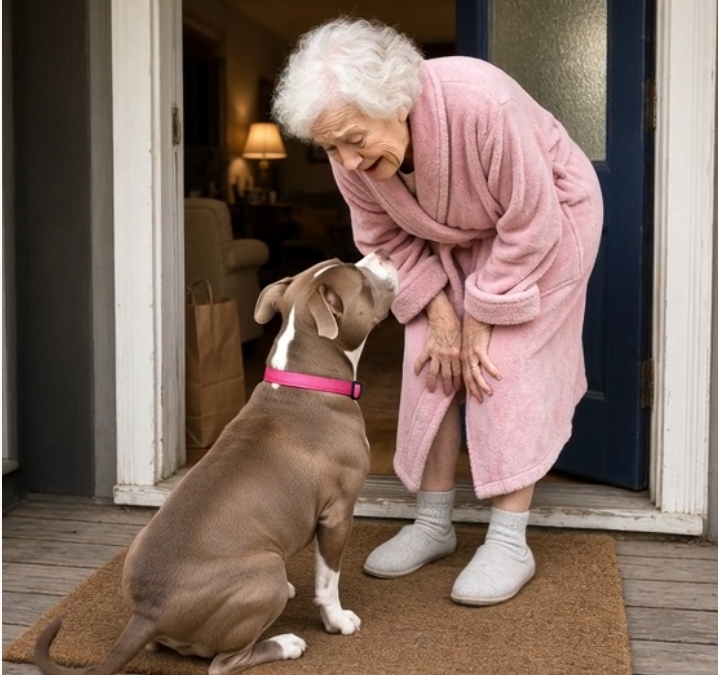
My mother, who had not crossed her own threshold in twelve weeks, stepped onto the porch in slippers and a robe.
She picked up the laundry basket with both hands.
Then she carried the puppy inside.
The door closed.
I sat there with my forehead against the steering wheel and cried so hard I could not drive for ten minutes.
That evening, I called her at the usual time.
She answered on the second ring.
“Hi, sweetheart.”
Her voice sounded different.
Not good.
Not yet.
But different.
“Hi, Mom. How was your day?”
There was a pause.
“Well,” she said, “something happened.”
I closed my eyes.
“What happened?”
“Someone left a puppy on my porch.”
“No kidding?”
“A tiny thing. Skin and bones. Sick as anything.”
“What did you do?”
“What do you think I did?”
I smiled for the first time in what felt like months.
“I assume you brought her in.”
“Of course I brought her in. She was freezing.”
“Are you keeping her?”
“I don’t know.”
That meant yes.
“She needs a vet,” Mom said.
“She probably does.”
“I called Dr. Patel. He can see her tomorrow at nine.”
Tomorrow.
My mother had said tomorrow.
After eight months of living inside one endless yesterday, she had made an appointment for tomorrow.
I gripped the phone harder.
“Do you need me to drive you?”
“No.”
I sat up.
“No?”
“I can drive.”
“You haven’t driven in—”
“I know how long it’s been, Reuben.”
“Mom, I didn’t mean—”
“I know what you meant.”
Her voice softened.
“She’s very small.”
“Yeah?”
“She looked at me like she had already asked everyone else.”
That almost broke me all over again.
“What are you going to call her?” I asked.
“I don’t know yet. She came on a Tuesday.”
I laughed quietly.
“What?”
“Nothing. That’s a good name.”
“Tuesday?”
“I like it.”
She was silent for a moment.
Then she said, “Your father would have said it sounded like an old jazz singer.”
I stopped breathing.
It was the first time in months she had mentioned my father without sounding like she had stepped on glass.
“He would have,” I said.
“He would have sung to her badly.”
“Very badly.”
“And then he would have told everyone she preferred his voice.”
“He told everyone that about all the dogs.”
“Because he was delusional.”
We both laughed.
Only for a second.
But it happened.
The next morning, my mother drove to the vet.
She called me afterward with a full report, more detailed than most project bids I had submitted in my career.
Tuesday weighed eight pounds.
She should have weighed twelve.
She had worms, a respiratory infection, a skin condition, and “the saddest little knees,” according to my mother.
Dr. Patel had prescribed medication, a feeding schedule, and follow-up visits.
“She needs to eat four small meals a day,” Mom said.
“That’s a lot.”
“She can’t handle too much at once.”
“Right.”
“And she has to go outside every two hours.”
“That sounds exhausting.”
“She’s a baby.”
There it was.
Not a puppy.
Not a problem.
A baby.
By the end of the first week, my mother had opened the curtains in the living room because “Tuesday needs sunlight.”
By the second week, she had moved Dad’s chair two feet to the left because “the crate fits better by the window.”
By the third week, she had called me to ask whether I still had the baby gate from when my daughter was little.
By the fourth week, she had walked to the mailbox with Tuesday tucked inside her coat.
The neighbors noticed.
Of course they did.
Mrs. Russo from across the street called me.
“I saw your mother outside.”
I pretended surprise.
“Really?”
“With a puppy.”
“That so?”
“Don’t play dumb with me, Reuben.”
I nearly swallowed my tongue.
“What do you mean?”
“I mean I’ve known you since you were twelve, and that dog did not arrive from heaven.”
I said nothing.
Mrs. Russo sighed.
“I’m not asking. I’m telling you she smiled at me today. First time since Walter’s funeral.”
My throat closed.
“Thank you for telling me.”
“She’s going to figure it out eventually.”
“I know.”
“Maybe let her have it for now.”
That became the rule.
Let her have it.
Let her have the stranger.
Let her have the miracle.
Let her have the story of some desperate person choosing her porch out of all the porches in Bethel Park.
Let her believe life had knocked on her door because it needed her, not because her son had staged an intervention with a malnourished Pit Bull puppy and a laundry basket.
Spring came slowly.
Tuesday grew faster.
The antibiotics worked. The worms cleared. Her coat filled in soft and glossy. Her eyes brightened. Her legs became sturdy, then clumsy, then powerful. She developed one white patch on her chest shaped vaguely like Pennsylvania if you were generous and emotional, which my mother was.
By April, Mom was walking her to the end of the driveway.
By May, to the corner.
By June, around the block.
By July, she was complaining that Tuesday had too much energy and I should come over to help install a better latch on the backyard gate.
“You could hire someone,” I said.
“You are someone.”
That was the most normal thing she had said to me in a year.
I drove over with my tools.
When I got there, the blinds were open.
All of them.
Sunlight filled the living room.
Dad’s chair was still there, but my mother was not sitting in it.
She was in the kitchen, cutting chicken into tiny pieces while Tuesday sat at her feet vibrating with hope.
“You’re making her spoiled,” I said.
“I am making her trained.”
“She’s drooling on your slipper.”
“That’s enthusiasm.”
Tuesday saw me and lost her mind.
She had no idea I was the reason she was there. To her, I was simply Uncle Reuben, occasional bringer of treats, installer of gates, thrower of balls, and useful tall person.
She launched herself at me.
I knelt and let her climb into my lap even though she was no longer lap-sized.
My mother watched us.
“She likes you.”
“I’m likable.”
“She doesn’t act like that with everybody.”
I kept my face neutral.
“Dogs have good taste.”
Mom smiled.
A real smile.
The kind that reached the corners of her eyes.
That summer, Tuesday saved my mother in ordinary ways.
Not dramatic ways.
Ordinary ones are more powerful.
She needed breakfast, so Mom got out of bed.
She needed walks, so Mom opened the door.
She needed medication, then training, then toys, then boundaries.
She needed the vet, the groomer, the park, the pet store.
She needed Mom to speak to neighbors, to ask other dog owners questions, to schedule appointments, to buy poop bags, to laugh when Tuesday discovered sprinklers and lost the battle.
By August, my mother was going back to church.
Not every Sunday.
But some.
Tuesday could not come inside, of course, so Mom went to the early service and told Tuesday she would “be right back,” as if the dog understood liturgy and punctuality.
By September, Mom joined a puppy obedience class even though Tuesday was technically too old for the beginner group and strong enough to drag her if she wanted.
“She listens to me,” Mom said.
“She does.”
“She has manners.”
“She ate an entire paper towel roll last week.”
“She’s a work in progress.”
So was my mother.
So were all of us.
Lena flew in from San Diego in October.
She knew the truth because I told her from the beginning, mostly because siblings are for judging you accurately and then helping anyway.
“You did what?” she had said on the phone.
“I left a puppy on Mom’s porch.”
“You’re insane.”
“Probably.”
“Did it work?”
“Yes.”
“Then I support the insanity.”
When Lena saw Mom and Tuesday together, she cried in the driveway before even ringing the bell.
Mom opened the door and said, “Oh, for heaven’s sake, Lena, don’t start. You’ll excite the dog.”
Then she hugged her daughter for so long Tuesday sat down and waited politely, which lasted twelve seconds before she inserted herself between them like an emotional referee.
Thanksgiving came.
Our first without Dad.
I had dreaded it for months.
The empty chair.
The missing voice.
The way he used to carve turkey badly and insist the electric knife was “for quitters.”
But Mom handled it differently than I expected.
She cried in the morning.
Then she made stuffing.
She set Dad’s favorite mug on the counter, not at the table.
“He doesn’t need a place setting,” she said when I looked at it. “But I’m not putting the mug away yet.”
No one argued.
Tuesday stole a roll and hid under the dining room table like a criminal genius.
My mother laughed until she had to sit down.
At Christmas, Mom put lights on the porch again.
Not many.
Just a strand around the railing.
She said Tuesday liked them.
We all pretended to believe this was for the dog.
On Christmas Eve, after Lena and I left for the night, my mother called me.
“Reuben?”
“Yeah, Mom?”
“I was thinking about the person who left Tuesday.”
My chest tightened.
“Oh?”
“I hope they know she’s safe.”
I closed my eyes.
“Maybe they do.”
“Sometimes I wonder if they were watching.”
I did not speak.
“I hope they were,” she said. “I hope they saw me take her in. I hope they know I didn’t leave her out there.”
“They know.”
The words came out too fast.
My mother was quiet.
“How could you know that?”
I stared at my kitchen wall.
My wife was wrapping gifts in the next room. My kids were upstairs arguing over who got the bigger stocking. Life had continued in ways I was grateful for and guilty about all at once.
“I mean,” I said carefully, “anyone could see you’d help her.”
My mother exhaled.
“Yes. I suppose so.”
She let me have the lie.
For a little longer.
The truth came out in March.
One year to the week after I left Tuesday on the porch.
It was not planned.
Not really.
I went to Mom’s house to fix a loose handrail by the back steps. Tuesday, now healthy, muscular, ridiculous, and convinced every visitor had come solely to admire her, greeted me by slamming a rope toy into my shin.
Mom made coffee.
The house smelled like lemon cleaner and dog biscuits.
The curtains were open.
Dad’s chair had a folded quilt on it now, and sometimes Mom sat there, but not all day. Never all day.
I fixed the rail while Mom sat at the kitchen table going through old photos for a church memorial project. Tuesday sprawled under the table, snoring.
When I came back in, Mom had a photograph in her hand.
It was my father in 1979, standing on the porch beside the swing he had just hung. He was young, shirtless, laughing, with a hammer in one hand and my mother looking at him like he had personally invented summer.
“He would have loved this dog,” she said.
I sat across from her.
“Yeah. He would have.”
“He would have pretended not to.”
“Definitely.”
“He would have said Pit Bulls are too much dog.”
“And then shared his sandwich with her.”
Mom smiled.
Then she looked down at Tuesday.
“She came when I needed her.”
My mouth went dry.
“Yes.”
“I think about that all the time.”
I looked at my hands.
They were rough, scarred in little ways from work. My father’s hands had looked like mine by the end.
“Mom.”
She looked up.
Something in my voice warned her.
“What is it?”
I could have lied again.
I had gotten good at it.
Small lies.
Protective lies.
Lies that kept the story intact.
But grief had taught me that even kind lies gather weight.
And my mother, who had stepped back into the world because a puppy needed her, deserved the truth of how she had been loved.
“It wasn’t a stranger.”
She stared at me.
“What?”
“The person who left Tuesday on your porch.”
The room went silent except for Tuesday’s snoring.
Mom’s face changed slowly.
Like a door opening in a house long closed.
“It was you?”
I nodded.
“I found her behind a job site. She was starving. I took her to a vet. I kept her there a few days until she was stable.”
My mother’s hand rose to her mouth.
“I called Marlene,” I said. “Before that. I didn’t know what to do. You weren’t leaving the house. You weren’t eating. You kept saying you were fine, and I knew you weren’t.”
Her eyes filled.
“Marlene told me I couldn’t talk you back into wanting tomorrow. She said you needed something that couldn’t pretend to be fine.”
Mom looked down at Tuesday.
“I knew if I asked, you’d say no,” I continued. “So I left her. I rang the bell and drove down the street and watched until you opened the door.”
My voice broke.
“I’m sorry.”
That was when my mother stood.
For one terrible second, I thought she was going to slap me.
I would have let her.
Instead, she took one step, then another, then seemed to lose the strength in her legs. She lowered herself onto the kitchen floor beside Tuesday and began to cry.
Not the quiet crying she had done at the funeral.
Not the polite crying people do when others bring casseroles.
This was deep, full-body grief.
The kind that had been waiting a year for a safe place to land.
Tuesday woke immediately and crawled into her lap, too big for it now, but completely unconcerned with physics. Mom wrapped both arms around the dog and sobbed into her neck.
I sat on the floor too.
I did not touch her at first.
I did not know if I had the right.
After a while, she reached for my hand without looking.
I took it.
She cried for forty-five minutes.
I know because the clock over the stove ticked through every one of them.
When she finally spoke, her voice was ruined.
“You gave me something to love that didn’t know I was broken.”
That was the sentence.
Not thank you.
Not I forgive you.
Not how could you.
You gave me something to love that didn’t know I was broken.
I lowered my head and cried then too.
“I was scared,” I said.
“I know.”
“I thought I was losing you.”
“You were.”
That honesty hurt.
But it also felt like light entering a room.
Mom stroked Tuesday’s back.
“She needed me.”
“Yes.”
“And I needed her needing me.”
“Yes.”
She looked at me then.
“I wish you had told me.”
“I know.”
“I also understand why you didn’t.”
I wiped my face.
“I’m sorry.”
“I’m not angry.”
“You’re not?”
She gave a wet little laugh.
“I might be later. Grief likes delayed reactions.”
That sounded like my mother again.
Tuesday licked her chin.
Mom looked down at her.
“You knew him first, didn’t you?”
Tuesday wagged her tail.
“She was terrible at keeping secrets,” I said.
“She still is.”
After that day, the story changed.
Not badly.
Just honestly.
My mother told everyone Tuesday had been found by my son and delivered by God through questionable methods.
At church, people laughed.
Marlene said, “Questionable methods are often the only ones grief respects.”
I did not argue.
My mother kept getting better.
Not cured.
That is not the word.
People do not recover from losing a spouse of fifty-three years the way someone recovers from the flu. My father did not become less dead because a dog slept at her feet. Some mornings still hurt. Some anniversaries knocked her down. Some songs made her leave the room.
But she opened the curtains.
She walked the dog.
She planted tomatoes again.
The first spring after Tuesday arrived, Mom stood in the backyard with a trowel in one hand and my father’s old gardening gloves on.
Tuesday dug a hole beside her.
Mom said, “She’s helping.”
“She’s destroying your basil.”
“She’s learning.”
“You say that about both of us.”
“Because it’s true.”
That summer, she painted the porch swing.
Blue.
The same shade Dad had painted it in 1979.
I helped sand it.
Tuesday supervised from the lawn, chewing a stick like she was head of quality control.
When we finished, Mom sat on the swing for the first time since Dad died.
Tuesday jumped up beside her and put her head in Mom’s lap.
Mom looked at me.
“I thought sitting here would feel like losing him again.”
“Does it?”
She looked toward the yard.
“No. It feels like remembering him where he belongs.”
That is what Tuesday gave her.
Not replacement.
Not distraction.
A bridge.
From the chair to the porch.
From the porch to the sidewalk.
From the sidewalk to the church.
From survival to life.
People like to say a dog saved someone, and sometimes that is true.
But I think Tuesday did something more specific.
She gave my mother a reason to perform love again.
Grief had trapped Mom in receiving love.
Our calls.
Our visits.
Our flowers.
Our worry.
She accepted all of it from the chair, grateful but unmoved.
Tuesday required love to become action.
Pour the food.
Measure the medicine.
Open the door.
Clip the leash.
Step outside.
Again.
Again.
Again.
That repetition became a path.
And my mother followed it back to herself.
It has been two years now.
Mom is seventy-six.
Tuesday is a healthy, spoiled, broad-headed clown of a dog who believes squirrels are a personal insult and that my mother’s lap remains available despite all evidence to the contrary.
Every morning, Mom walks her six blocks unless the weather is dangerous.
Every Wednesday, she goes to church lunch.
Every Friday, she drives to the pet store because Tuesday “likes to choose her own treats,” which means Tuesday sniffs the lower shelves while Mom buys the same ones every time.
Lena visits more often.
I still call every evening.
The calls last longer now.
Mom tells me about the neighbor’s new fence, church gossip, tomato problems, Tuesday’s latest offense, and sometimes Dad.
More and more, Dad comes back into conversation as a person instead of a wound.
That feels like grace.
A few months ago, I asked Mom if she ever wished I had handled it differently.
We were sitting on the porch swing.
Tuesday was asleep across both our feet.
Mom thought about it.
“Yes,” she said.
My stomach tightened.
Then she continued.
“I wish the world were built so people in grief could say what they need before someone has to trick them into living.”
I sat with that.
Then she touched my arm.
“But the world is not built that way.”
“No.”
“And you knew I would open the door for her.”
“I hoped.”
“No,” she said. “You knew.”
I looked at Tuesday.
“Yeah. I knew.”
Mom smiled.
“That means some part of you still recognized me when I didn’t.”
That may be the truest thing anyone has ever said about what love is.
Recognizing someone underneath what grief has done to them.
Holding on to the person they were without demanding they become that person immediately.
Leaving a starving puppy on the porch at 5 a.m. because every gentle, reasonable, respectful option has failed, and because the part of your mother that raised you is still in there, waiting for something small enough and helpless enough to call her back.
I am not saying everyone should do what I did.
I lied.
I interfered.
I made a decision for my mother that she did not consent to.
I know that.
I carry it.
But I also know this.
On a Tuesday morning in March, my mother opened her front door for the first time in weeks because someone needed her more urgently than her grief did.
She stepped onto the porch.
She lifted a starving puppy.
She brought her inside.
And one year later, sitting on the kitchen floor with that same dog in her arms, she told me I had given her something to love that did not know she was broken.
That is the sentence I keep.
Not because it makes what I did simple.
It does not.
Because it reminds me that love is sometimes clumsy and desperate and morally imperfect and still, somehow, life-giving.
My father used to say the porch swing was the best thing he ever built.
He was wrong.
The best thing he ever built was the woman who could survive losing him, even when she did not believe it.
Tuesday sleeps on that porch swing now beside my mother on warm evenings.
The blue paint is already scratched from her paws.
Mom says she likes it better that way.
“Things should look lived in,” she told me last week.
Then she ran one hand over Tuesday’s head and looked out at the tomatoes growing in the yard.
For a moment, I saw her as she had been before grief.
Then as she was inside grief.
Then as she is now.
Not the same.
Not untouched.
But here.
The curtains open.
The dog breathing beside her.
Tomorrow waiting, and my mother willing to meet it.








