I knew I was dying the morning she bought the expensive cat litter and tried not to cry in the checkout line.
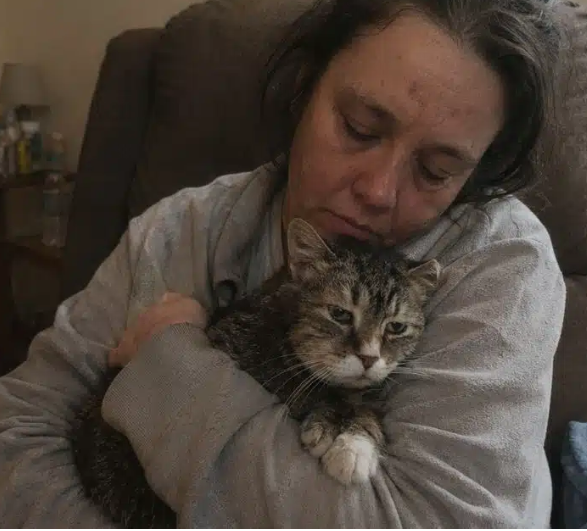
I knew I was dying the morning she bought the expensive cat litter and tried not to cry in the checkout line.
Cats know things.
We know when a house is angry.
We know when a person is lonely.
And we know when someone is trying so hard to be gentle because they are about to lose the last thing that still knows all their old versions.
She found me twelve years earlier in a place that smelled like bleach, wet newspaper, and fear.
I was not the kitten anybody wanted.
I was already half-grown, skinny, patched with rough fur, and missing a little piece of my left ear. I had a face people called “grumpy” even when I was just tired. Families stopped in front of the fluffy babies. Children pointed at younger cats with pink noses and bright eyes.
Nobody pointed at me.
Then she came in.
She was young, but not the shiny kind of young. She looked worn out already. Oversized sweatshirt. Cheap sneakers. Dark circles under her eyes. She held a paper coffee cup like it was the only warm thing she owned.
She crouched in front of my cage and looked at me for a long time.
Not through me.
At me.
Then she said, “Well… you look like you’ve had a week.”
Her voice was soft and cracked around the edges.
I walked over and pressed my face against the bars.
She laughed once, real quick, like the sound surprised her.
“I think we both need a place to land,” she whispered.
That was how I got chosen.
Her apartment was small enough that I could sit in the hallway and see almost the whole thing. The heater clanked. The windows leaked cold air in winter. The couch smelled like it had belonged to three different strangers before it belonged to us.
My first food bowl was an old cereal dish.
My first bed was a folded towel.
My first night there, she slept on the couch with one hand hanging down so I could sniff her fingers whenever I got scared.
That was the thing about her.
She never had much, but she made room for me inside whatever little she had.
She worked long hours. I learned the sound of her key in the lock. I learned the tired drag of her feet after a bad shift and the lighter step when somebody had been kind to her that day. I waited by the door every evening like it was my job.
Maybe it was.
Some nights she ate noodles from a paper cup and said, “Don’t judge me.”
I judged her a little.
But I loved her.
She talked to me while she paid bills at the table. She talked to me while folding clothes. She talked to me when the apartment felt too quiet. I think I became the place where all her unsaid things went.
For a while, she seemed almost happy.
Then one winter, another smell came into the apartment.
Not a person.
The absence of one.
Cardboard boxes. A jacket that disappeared from the hook. A framed photo turned facedown. She sat on the kitchen floor in the middle of it all and cried so hard she scared me.
I did not understand heartbreak.
I understood grief.
There is a difference, but not much to the body.
After that, the apartment changed.
She stopped singing along to the radio.
She slept too much on weekends.
Sometimes she stared at the TV without turning it on.
One night she picked me up, pressed her face into my side, and said, “Please don’t leave me too.”
I didn’t know what “too” meant.
I only knew she was shaking.
So I stayed.
I scratched at her bedroom door when she shut herself in too long.
I walked across her chest at dawn when she forgot there was still morning left to live.
I sat on her paperwork.
I yelled at her from the bathroom sink.
I lay beside her when she cried and beside her when she didn’t.
Years passed like that.
Slowly, she came back.
She laughed more.
Opened the curtains.
Bought a better couch.
Started cooking real food sometimes, the kind that smelled like garlic and onions and hope.
She still called me her rescue.
That always amused me.
She thought she had saved me because she signed the papers and paid the fee and carried me home in a cardboard box.
But I was there for the nights nobody saw.
I was there when she learned how to live without begging the world to choose her.
We grew older together.
Her face changed first in small ways. Tiny lines near her eyes. A calmness in her hands. She became steadier.
I changed all at once.
My muzzle turned white.
My legs got stiff.
I stopped jumping onto the windowsill I had ruled for years.
Sometimes I missed the litter box by a few inches and looked away in shame.
She never got mad.
Not once.
She cleaned the floor and said, “It’s okay, old man. I’ve got you.”
When eating became hard, she bought softer food.
When stairs became trouble, she moved my bed closer to hers.
When I cried at night, she woke up every time.
And that morning, with the expensive litter in the bag and the sadness all over her face, I understood.
This was the last chapter.
She held me that evening in the faded recliner by the window.
The apartment was quieter now than the first one, warmer too. Outside, somebody’s dog barked. A car door slammed. Somewhere a child laughed.
Regular life.
The world going on.
Her heart beat against my side, slow and heavy.
“You saved me,” she whispered.
No.
That wasn’t the whole truth.
She gave me home.
I gave her company.
She gave me safety.
I gave her a reason to get out of bed.
She thought she picked me because nobody else wanted me.
Maybe I picked her for the same reason.
If I could have spoken in words she understood, I would have told her this:
The best thing that ever happened to me was not being adopted.
It was being loved by someone who was breaking, and staying long enough to watch her become whole again.
Part 2 — She Thought Letting Him Go Was the End But Love Stayed Behind.
She thought the hardest part of loving me was keeping me alive.
It wasn’t. It was loving me enough to let me go before my pain became proof of her guilt.
That night, she did not put me down right away.
She stayed in the recliner by the window with me curled against her chest, one hand under my ribs like she was afraid the world might tug me away if she loosened her grip.
The room smelled like dust, laundry soap, and the broth she had warmed for me and pretended not to notice when I barely touched it.
I heard her crying before I felt it.
Humans always think tears start in the eyes.
They do not.
They start in the throat, in the chest, in the part of the body where a person is trying to hold back a truth that has already arrived.
She pressed her mouth to the top of my head.
Not kissing.
Just resting there.
Like she was memorizing me.
“You don’t have to do anything tonight,” she whispered. “You just rest.”
I wanted to tell her I had been resting for days.
That was the problem.
I was tired in a way sleep could not fix.
My bones hurt.
My stomach hurt.
Even my fur felt heavy.
Old age is not one big collapse.
It is a hundred little betrayals.
The jump you do not quite make.
The meal you want but cannot finish.
The water bowl you stare at because bending your neck suddenly feels like work meant for younger creatures.
People say animals hide pain.
That is true.
Not because we are brave.
Because pain in the wild is an announcement.
Pain says, here I am, slow enough to be taken.
So even in warm apartments with food bowls and soft blankets, some old animal part of us still tries to move with dignity long after dignity has become expensive.
I had been trying for her.
That is another truth people do not like.
Love can keep a body going long after comfort has packed its bags.
I think she knew that.
I think that was why her sadness looked so ashamed in the checkout line.
Not because she had failed me.
Because she feared she had waited too long.
That night, she made a bed for me beside hers.
Not my usual one.
A nest.
Two folded blankets, the old blue towel from our first apartment, and one of her shirts that smelled like her skin and the lotion she put on her hands before sleep.
She lay on the floor next to me instead of in bed.
I watched her in the dark.
Humans look youngest when they sleep and oldest when they watch something they love suffer.
She looked both.
At some point in the night, she said, “I’m sorry.”
I did not know which sorrow she meant.
Sorry for the needles and the car rides and the hidden pills tucked into fish.
Sorry for the times she had been late coming home.
Sorry for every irritation she ever felt when I woke her up at dawn, years before dawn became a thing she begged to return.
Humans fold all their sorrows together at the end.
They make one blanket out of a thousand loose threads and call it guilt.
If I could have lifted a paw and set it on her face, I would have.
Not to comfort her.
To interrupt her.
To say, enough.
You do not owe perfection to the ones you love.
You owe presence.
And she had been present for me in ways this world rarely rewards.
The next morning, the light came in pale and careful through the curtains.
I could hear the neighborhood waking up.
A truck backing up somewhere.
A gate creaking open.
Somebody coughing on a porch.
Ordinary noises.
That is what is strange about endings.
The world does not dim the lights for them.
Your heart is breaking on the kitchen floor and somewhere two houses down a man is arguing with a leaf blower.
She made coffee and forgot to drink it.
She stood at the counter staring at her phone for a long time before pressing call.
Her voice was steady in the way voices get when a person has cried so much there is no room left for shaking.
“Yes,” she said. “Today, if possible.”
Then quieter: “I don’t want him scared.”
She listened.
Nodded, though no one could see it.
“Thank you,” she said. “At home would be better.”
At home.
Good.
I did not want the cold table.
I did not want the smell of bleach and sharp metal and other animals’ fear.
I had started in a cage.
It felt right that I would end in sunlight.
She spent the next few hours doing small, useless things.
That is how humans survive what they cannot stop.
They wipe counters that are already clean.
They fold blankets.
They open drawers and close them again.
They move grief around with their hands because grief is too big to hold in one place.
She brushed me slowly.
Even the place near my spine that had become tender.
Even the ragged notch in my ear.
“Handsome boy,” she said.
I had never been handsome.
That was one of the things I trusted most about her.
She did not love me by mistake.
She loved me with full awareness of my face.
Around noon, she opened the window a crack so I could smell spring.
Dirt warming in the sun.
Grass.
A hint of rain somewhere not yet here.
The passing trace of a dog who had opinions about fences.
I had spent years judging the outside world from windowsills, heating vents, and the back of the couch.
That day, it came to say goodbye.
She brought me to the patch of sunlight near the window and sat with her legs crossed beside me.
For a while, neither of us performed sadness.
We just sat there.
That is something people forget.
Grief is not only crying.
Sometimes grief is silence so full it feels like another person in the room.
She started talking after a while.
Not the way people talk when they want a response.
The way they talk when they are laying memory out in pieces so they do not drown in it.
She reminded me of the first apartment.
The heater that sounded like it was trying to escape the wall.
The time I stole half a sandwich and dragged it under the couch like a criminal mastermind.
The winter the power went out and we slept under three blankets while she laughed every time my tail smacked her face.
“The landlord would have hated you,” she said softly. “You scratched every ugly cabinet in that place.”
I had.
No regrets.
Then her voice changed.
Smaller.
“Do you know,” she said, “I almost didn’t go to the shelter that day?”
I looked at her.
She rubbed her thumb over my cheek.
“I had twenty dollars in my account. I had just gotten off a terrible shift. I was tired. I thought getting a pet would be irresponsible.”
She laughed once, but it broke halfway through.
“I was trying so hard to be practical.”
That word again.
Humans love words like practical and reasonable and responsible.
They use them when what they mean is: I was afraid to need something that might leave.
But she had needed me.
And I had needed her.
That was the whole miracle.
Not that one of us saved the other.
That two discarded things found enough warmth between them to become a home.
The woman came in the afternoon.
Soft shoes.
Gentle hands.
A quiet bag set near the door.
She smelled like soap, paper, and many endings.
Not rushed.
Not cold.
Just familiar with sorrow.
I liked her immediately, which annoyed me a little.
Loyalty should have made that harder.
She knelt beside me first, not speaking to my person, but to me.
That matters.
Animals know when they are being treated like furniture in a family tragedy.
She looked at my face.
At the effort it took me to breathe comfortably.
At the way my hips had sharpened.
At the exhaustion I could no longer hide with grooming and stubbornness.
Then she looked at my person and asked, “Are you sure?”
This is a question people think is merciful.
Sometimes it is.
Sometimes it is a knife.
Because what they are really asking is: can you carry the weight of this choice without breaking under what others might think of you?
My person closed her eyes for one second.
Just one.
Then opened them.
“No,” she said honestly. “But I know he’s tired.”
That was the bravest thing I had ever heard her say.
Not yes.
Not no.
Just the truth.
Love is not certainty.
Love is often standing in a room you never wanted to enter and saying the least selfish thing out loud.
The woman explained everything gently.
There would be one injection to help me relax.
Then another.
I would not be alone.
I would not be frightened.
I would not hurt.
My person nodded through tears.
But before anything happened, she asked for a few more minutes.
The woman stepped back.
And then it was just us again.
My person lifted me into her lap one last time.
Not because it was easy.
Because it wasn’t.
I could feel her trying to keep her breathing even so I would not take my cues from panic.
Humans don’t understand how loud their fear is to us.
I heard every beat of it.
Every plea she did not say.
Every bargain.
Every savage, selfish wish that love could sometimes be measured by refusal.
“Listen to me,” she whispered, forehead against mine. “You have never been too much trouble. Not once. Not ever.”
She said it like she was confessing something.
Maybe she was.
Maybe this was not only for me.
Maybe somewhere inside her still lived the young woman in the shelter with the paper cup and the tired eyes, the one who thought being loved had to be earned by being easy.
Humans do that.
They speak to an old animal, and half the time they are finally telling themselves the truth.
“You were the best part of every place I ever lived,” she said.
I believed her.
Then she said the thing that tore through me, even then.
“You can go. I’ll be sad. But you can go.”
There it was.
Permission.
The final gift.
People talk a great deal about fighting.
About holding on.
About not giving up.
Sometimes I think this country worships struggle so much it forgets mercy.
It turns suffering into a test of character.
It confuses keeping someone here with loving them well.
People will judge a person for letting an animal go on a gentle afternoon.
They will say, I would have taken one more day.
One more treatment.
One more chance.
But those people are almost never the ones up at 3:17 in the morning cleaning the floor.
They are not the ones counting breaths.
They are not the ones watching pride turn into pain in the body of a creature who once raced the hallway at midnight for no reason except joy.
They call it giving up because they do not want to admit that sometimes love looks like stopping.
I want this said plainly.
Keeping someone alive is not always kindness.
Wanting more time is not the same thing as being able to offer more peace.
And guilt is one of the cruelest reasons to ask a body to stay.
The first medicine made the room softer around the edges.
The pain stepped back a little.
Not gone.
Just no longer in charge.
I could hear her voice like it was coming through warm water.
She kept talking to me.
Told me about the bird feeder she never bought because she said I would turn into a window tyrant.
Told me about the time I sat in wet paint and tracked tiny white footprints across the hallway.
Told me that after the breakup, after the nights on the kitchen floor, after all the heavy lonely years, I had been the reason she kept opening the door and coming home.
“That sounds dramatic,” she said with a shaky laugh. “But it’s true.”
No.
It sounded exact.
The second medicine came after that.
I did not fear it.
I was in her lap.
Her hand was on my side.
The sun was warm.
There are worse ways to leave a life.
My last clear feeling was not pain.
It was her thumb rubbing the old place between my ears.
The spot that had always made me lean, no matter how dignified I was trying to be.
The last thing I heard was my name in her mouth, over and over, softer each time, until it sounded less like a word and more like home.
Then the heaviness went.
Not all at once.
Like a knot loosening.
Like a room opening.
Like setting down something I had been carrying so long I had forgotten it was there.
After that, I cannot explain things in ways humans find satisfying.
I cannot give you a map.
I cannot argue doctrine.
I only know this:
Love does not end where breathing does.
I know she stayed with me for a long time after.
I know she cried into my fur.
I know the quiet in that room changed shape and became the kind of silence that follows impact.
I know when the woman finally left, my person walked her to the door like someone twice her age.
Not weak.
Just altered.
Grief ages people fast in the first hour.
Then, because humans are strange and heartbreak does not cancel habit, she washed my bowl.
She folded the towel.
She picked up the expensive litter bag from where it leaned by the wall and stared at it with a face so shattered that for one terrible second I thought it might finish breaking her.
Then she sat on the kitchen floor.
Right there between the counter and the table.
Exactly where she had sat years before when another leaving ripped her open.
Only this time no one was leaving her behind.
This time she had done the leaving.
That is a different wound.
Maybe a worse one.
She held the unopened litter in her lap and cried like she was apologizing to the whole apartment.
Then evening came.
Because it always does.
Because the sun is rude that way.
It keeps setting and rising no matter whose world has stopped.
The next morning she woke up before the alarm.
Reached toward the place where my bed had been.
Found air.
That is how grief begins its real work.
Not with the grand sob.
With the stupid little absences.
The untouched corner of the couch.
The quiet at the bathroom door.
The fact that nobody is waiting by the sound of the can opener.
She moved through the apartment like a person learning stairs after an injury.
Carefully.
One hand on everything.
She almost called my name twice.
Then stopped herself both times, as if speaking it might make the emptiness more official.
For a week, she left my water bowl down.
For two weeks, she slept with the old blue towel beside her pillow.
For three weeks, she cried in the pet food aisle and abandoned her basket in the middle of the store.
Humans are embarrassed by grief.
Especially public grief for animals.
As if love becomes less legitimate when the one you lost had fur and a tail instead of a résumé.
People will say, “He was just a cat.”
Just.
What a small word people use when they are terrified of the size of someone else’s sorrow.
I was not just anything.
I was the witness to her becoming.
I was there when her life fit in one room and a cereal bowl.
I was there when she stopped choosing people who mistook her softness for weakness.
I was there when she learned the difference between being wanted and being cherished.
And she was there when I got old.
When my body became inconvenient.
When my care became expensive, messy, unglamorous, and repetitive.
That is love too.
Maybe especially that.
Months later, she went back to the shelter.
Not because she was over me.
You do not get over a life that shaped yours.
She went because grief, if it softens instead of hardens, eventually turns into shelter.
She stood in front of a cage holding an older cat with one cloudy eye and a coat the color of dust.
Nobody else was stopping.
Families drifted past to prettier stories.
The cat looked tired.
Unmarketable.
A little offended by existence.
My kind of face.
She laughed and cried at the same time.
Then crouched down and said, “Well… you look like you’ve had a week.”
Some people will say that was too soon.
Some will say it was betrayal.
Some people think loyalty means building a shrine and never letting another beating heart into the room.
I think that is fear dressed up as devotion.
Love is not replaced.
It expands.
It makes room.
That was always her gift.
And maybe, in the end, mine too.
So here is the truth I would leave behind, if any old shelter cat gets to leave truths behind:
Do not wait for beauty to choose what deserves love.
Do not confuse suffering with loyalty.
Do not make the ones who depend on you carry your fear of goodbye.
And do not let anybody shame you for grieving an animal like family.
Some of us were the reason you survived years nobody clapped for.
Some of us were there for the version of you the world never noticed was disappearing.
That counts.
It counts more than people think.
Maybe the real measure of love is not how desperately you hold on.
Maybe it is whether you stayed.
Through the cheap apartments.
Through the breakups.
Through the middle-of-the-night messes.
Through the medicine.
Through the terrible decision.
Through the silence afterward.
She stayed.
So did I.
And for two creatures nobody would have picked first, that turned out to be a whole life.








