I Heard a Faint Scratch Inside Locker 142—Then I Found the Cat Who Had Been Trapped There Since the Last Day of School
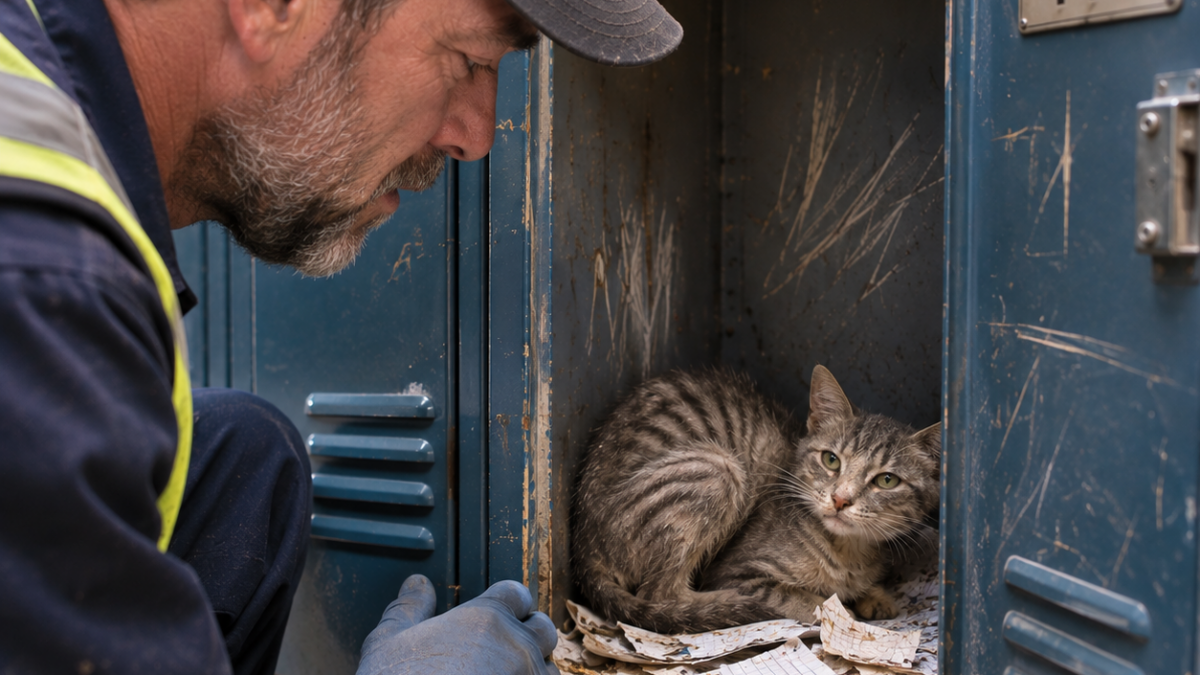
I Heard a Faint Scratch Inside Locker 142—Then I Found the Cat Who Had Been Trapped There Since the Last Day of School.
For three weeks, I had mopped the same empty middle-school hallway at night, passing within ten feet of Locker 142 without knowing a starving gray cat was sealed inside, surviving on condensation and pieces of notebook paper.
When I finally opened the metal door, she weighed barely four pounds, her claws had been worn nearly flat from trying to escape, and the inside of the locker was covered with scratches she had made while nobody was there to hear her.
But after the veterinarian told me how close she had come to dying, I could not stop thinking about the nine nights I had walked past that locker—and the single tiny sound she somehow still found the strength to make on the one night I finally heard her.
I have worked nights at Jefferson Ridge Middle School for eleven years.
That sounds longer when I say it out loud.
Eleven years of classrooms after children leave them.
Eleven years of gum under desks.
Broken pencils.
Forgotten jackets.
Bathroom graffiti.
Mystery stains nobody wants explained.
Eleven years of learning that a school feels completely different after dark.
During the day, Jefferson Ridge is loud.
Almost aggressively loud.
Lockers slamming.
Sneakers squeaking.
Teachers calling names.
Announcements.
Band practice.
Basketballs hitting gym floors.
Kids laughing so hard in hallways that somebody always has to tell them to move along.
Then three-thirty comes.
Buses leave.
Teachers slowly disappear.
The building exhales.
By six in the evening, especially during summer, it becomes another place entirely.
Empty corridors.
Fluorescent lights humming.
Air-conditioning cycling on and off.
Your own footsteps coming back at you from the walls.
I like it.
Most people find empty schools unsettling.
I find them peaceful.
My name is Tom Keller.
I am forty-nine years old.
I have a wife named Linda.
A thirteen-year-old daughter named Sophie.
And a job that pays sixteen dollars an hour to make sure several hundred children return every morning to a building that looks slightly less destroyed than the one they left the day before.
During the school year, I work five nights a week.
Summer is different.
Three nights.
Mostly deep cleaning.
Wax floors.
Strip old polish.
PART2:
Clean baseboards nobody notices during the year.
Empty forgotten lockers.
Wash walls.
Repair things small enough that maintenance does not need to be called.
The last day of school that year had been June 6.
I remember because every school employee remembers the last day.
Teachers count toward it.
Students count toward it.
Custodians count toward it for completely different reasons.
The final bell rings and suddenly the building contains the accumulated debris of nine months.
Broken binders.
Half-empty water bottles.
Old worksheets.
Sweatshirts.
Sports equipment.
Food children had apparently been storing for archaeological purposes.
By June 9, I had started summer cleaning.
The fifth-grade hallway was one of my regular sections.
Long corridor.
Classrooms on one side.
Rows of blue metal lockers on the other.
PART3:
I had cleaned that hallway nine times by the night I heard the noise.
Nine.
I know because afterward I checked my work logs.
June 9.
June 12.
June 16.
June 19.
June 23.
June 26.
June 30.
July 3.
Then July 7.
Nine nights.
Same hallway.
Same mop bucket.
Same lockers.
Same route.
I usually wore one earbud.
Not both.
School policy.
You need to hear alarms.
Doors.
Anything unusual.
That night I was listening to an old podcast about baseball while mopping near the fifth-grade lockers.
It was around 9:40.
The building was otherwise empty.
I had already cleaned the science wing.
The gym restrooms.
Two stairwells.
I was tired.
Thinking about going home.
Linda had texted asking whether I wanted leftover meatloaf.
I had answered:
YES IF SOPHIE HASN’T EATEN IT.
Sophie had replied from Linda’s phone:
RUDE.
Normal night.
I pushed the mop forward.
Pulled it back.
Then heard:
Tick.
Very faint.
Metal against metal.
I stopped.
Took out the earbud.
Listened.
Nothing.
Schools make noises.
People do not realize how many.
Pipes contract.
Air ducts pop.
Metal doors settle.
Ice machines dump.
Refrigerators cycle.
Old buildings have opinions.
I assumed it was one of those.
Put the earbud back.
Moved another few feet.
Then:
Scratch.
I stopped again.
Different sound.
Not building.
Not pipe.
A dragging sound.
Short.
Weak.
Coming from the lockers.
I turned.
Rows of blue doors.
Nothing moving.
“Hello?”
That was stupid.
I knew nobody should be inside.
Still, I said it.
No answer.
I walked closer.
Another sound.
Barely there.
Scrape.
I set the mop against the wall.
Now I was listening carefully.
The noise came from low down.
Bottom row.
I crouched.
Locker 142.
I remember the number because I do not think I will ever forget it.
The paint around the handle was scratched.
At the time I did not understand why.
I put my ear against the door.
Nothing.
Waited.
Then felt something.
Not heard.
Felt.
A tiny vibration through the metal.
Tap.
I jumped back.
Something living was inside.
My first thought was mouse.
Then raccoon somehow.
Which makes no sense, but your brain gets creative when you are alone in an empty school after nine at night.
I said, “Okay.”
As if whatever was inside needed reassurance.
“I’m opening it.”
Locker 142 was locked.
Students had cleared out weeks earlier, but many lockers were still secured.
Some combinations had been reset.
Some had school-issued locks.
I went to the administrative office for the master key.
The walk took less than two minutes.
It felt longer.
By then I had convinced myself I might open the door and find something dead.
Or badly injured.
Or angry.
I returned.
Crouched.
Unlocked the latch.
The door stuck.
I pulled.
Nothing.
Pulled harder.
It opened about an inch.
An odor hit me immediately.
I pulled my head back.
There are smells you identify instantly.
Waste.
Urine.
Something sour.
Something sick.
Something trapped.
I covered my nose with my sleeve.
Then opened the locker.
And saw eyes.
A cat.
Small.
Gray.
Lying on her side against the back wall.
For several seconds I could not understand what I was looking at.
A cat in a locker.
My brain kept trying to rearrange the image into something reasonable.
Stuffed animal.
Sweatshirt.
Anything.
Then she lifted her head.
Barely.
And looked at me.
No meow.
No hiss.
No attempt to move.
Just eyes.
Huge because the rest of her face had become so thin.
“Oh, God.”
I knelt.
The locker floor was covered with shredded paper.
Notebook pages.
Pieces of worksheets.
A torn folder.
Some paper had been chewed into pulp.
There was feces in one corner.
Urine stains.
Gray fur stuck to the metal.
Deep scratches along the inside of the locker door.
Not surface marks.
Long grooves.
Repeated.
Vertical.
Diagonal.
Hundreds.
Her claws had done that.
I looked at her front paws.
Some nails were broken.
Others worn nearly flat.
The pads looked raw.
My stomach turned.
“How long have you been in here?”
Of course she did not answer.
But I already knew.
The school had been closed three weeks.
I thought there was no possibility she could have been there the entire time.
That was too long.
No food.
No water.
Hot July.
Metal locker.
Impossible.
Then I looked again.
She was not simply thin.
She was almost gone.
Her hip bones stood out.
Every rib visible.
Her neck looked too narrow to support her head.
The fur along her sides had begun thinning in patches.
Her eyes were sunken.
When she tried to shift, her legs trembled.
I reached in slowly.
“Easy.”
No reaction.
That scared me more.
Healthy frightened cats fight.
Even injured cats often defend themselves.
She did nothing.
I slid one hand beneath her chest.
Another beneath her rear body.
Lifted.
She felt like a bundle of sticks inside fur.
I have held kittens that weighed more.
She did not resist.
Her head rested against my wrist.
I stood.
The locker behind her looked enormous after she was removed.
That is one thing I still remember.
How small she looked.
How large the box that had held her looked once she was no longer inside.
I wrapped her in my work sweatshirt.
Then called Linda.
She answered immediately.
“Tom?”
“I found a cat.”
Pause.
“At school?”
“In a locker.”
Longer pause.
“What?”
“She’s alive.”
That was apparently all Linda needed.
“Do you need me to come?”
“I’m taking her to emergency vet.”
“I’ll meet you there.”
I called the emergency clinic twenty minutes away.
Told them what I knew.
Female cat.
Extreme weight loss.
Possible prolonged confinement.
Barely responsive.
The woman on the phone said:
“Bring her now.”
I left my mop bucket in the hallway.
Did not clock out.
Did not shut down half the lights I was supposed to.
I just carried the cat to my truck.
She weighed almost nothing.
I put her on a folded towel on the passenger seat.
Then reconsidered and placed the towel inside a shallow box so she would not slide.
She did not try to climb out.
That frightened me.
I kept one hand near her at stoplights.
“Stay with me.”
Nothing.
“You made it this far.”
Her eyes opened once.
Closed.
“Come on.”
The clinic parking lot was nearly empty.
A technician met me at the door.
The second she saw the cat, she stopped asking routine questions.
“We need her back now.”
“What do you need from me?”
“Name?”
“I don’t know.”
“Owner?”
“I don’t know.”
“Age?”
“I don’t know.”
“Where did you find her?”
“In a school locker.”
She looked up.
“You mean near a locker?”
“No.”
I pointed.
“Inside.”
Her expression changed.
“How long?”
“Maybe three weeks.”
She stared.
Then took the box.
The cat disappeared through swinging doors.
I sat in the waiting room.
Linda arrived ten minutes later wearing sandals and one of my old sweatshirts.
She saw my face.
“How bad?”
“I don’t know.”
“Where was she?”
I explained.
Locker 142.
Bottom row.
Scratches.
Paper.
No water.
Linda sat beside me.
“Three weeks?”
“I don’t see how.”
“You cleaned that hallway.”
That hurt immediately.
“Yeah.”
“How many times?”
“I don’t know.”
At the time I did not.
Later:
Nine.
We waited forty minutes.
Maybe fifty.
Time in emergency veterinary waiting rooms is strange.
Everything matters intensely.
Nothing happens visibly.
People come through carrying animals.
A dog limping.
A cat in a carrier.
Someone crying quietly near the vending machine.
Phones ringing.
Doors opening.
You wait for a stranger to tell you whether something you met less than an hour ago is going to live.
Finally, the veterinarian came out.
Dr. Melissa Price.
She looked tired.
Not from us.
From the kind of job where every hour contains somebody’s emergency.
“You brought the gray female?”
“Yes.”
“She’s stable right now.”
I exhaled.
Linda squeezed my hand.
“But she’s in very poor condition.”
“How poor?”
Dr. Price sat.
“She weighs four pounds.”
I looked at Linda.
“What should she weigh?”
“For her frame? Nine to ten.”
Half.
Less than half.
“She’s severely dehydrated.”
“I figured.”
“Muscle wasting. Malnutrition. Pressure sores beginning over bony areas. Broken claws. Some skin irritation from urine exposure.”
I swallowed.
“Can she survive?”
“Yes.”
The word came quickly enough that I nearly missed it.
“Yes?”
“I think she has a real chance.”
Linda covered her mouth.
“What does she need?”
“Fluids first. Slowly.”
“Food?”
“Also slowly.”
“Why slowly?”
Dr. Price explained refeeding syndrome.
After severe starvation, feeding too aggressively can create dangerous electrolyte changes.
I had never heard of it.
The idea that even food could hurt a starving animal seemed unfair.
“So you can’t just feed her?”
“We can. Carefully.”
“How long has she been without food?”
“That’s what I was going to ask you.”
I told her.
School ended June 6.
Cat discovered July 7.
Twenty-one days if she had been placed there on the last day.
Dr. Price stared.
“That’s extremely long.”
“She was eating paper.”
“What?”
I described the torn notebook pages.
Chewed edges.
Paper pulp.
“She may have ingested some.”
“Would that keep her alive?”
“No.”
“So how?”
“That’s the part I don’t understand.”
“Water?”
“There was none.”
“Could she survive three weeks without water?”
“No.”
Simple.
Immediate.
“No cat survives twenty-one days with no water.”
I thought about the locker.
Metal.
Summer.
Air-conditioning.
Something clicked.
“Condensation.”
Dr. Price looked at me.
“What?”
“The lockers sweat sometimes.”
She waited.
“The building AC stays on during summer.”
“Temperature?”
“About seventy-eight.”
“Okay.”
“Overnight, those metal lockers get cold.”
I had seen it before.
Especially in humid weather.
Tiny droplets forming along metal surfaces near conditioned interior walls.
Not enough to matter normally.
Barely visible.
“I’ve wiped condensation off those doors.”
Dr. Price became very still.
“Inside too?”
“Could be.”
She leaned back.
“That may be it.”
“You mean she drank that?”
“If moisture formed inside and she licked it…”
“Enough to live?”
“Not enough to stay healthy.”
She looked toward the treatment area.
“But perhaps enough not to die.”
That sentence stayed with me.
Enough not to die.
Not enough to live well.
Not enough to be safe.
Not enough to prevent her body from consuming itself.
Just enough to keep her heart beating.
Tiny droplets on metal.
I thought of the locker differently.
All that steel.
All that darkness.
And every night perhaps a thin film of water forming.
A cat licking the door.
Again.
Again.
Again.
Whatever formed.
Whatever she could reach.
“That’s how she’s alive,” Dr. Price said.
Then she asked about the paper.
I explained again.
Dr. Price said starving animals sometimes chew nonfood items.
Cardboard.
Grass.
Fabric.
“Paper gives no usable nutrition to a cat.”
“Then why eat it?”
“Hunger.”
One word.
She paused.
“Chewing something can also produce saliva, occupy the stomach briefly, maybe reduce the sensation a little.”
Linda looked away.
I stared at the floor.
Three weeks.
Twenty-one days.
I started doing the calculation.
Because that is what people do when a number is too large emotionally.
They turn it into smaller numbers.
504 hours.
30,240 minutes.
Nine times I had cleaned that hallway.
Nine.
I had been ten feet away.
Sometimes closer.
Mopping.
Listening to podcasts.
Thinking about meatloaf.
Thinking about bills.
Thinking about going home.
While she scratched the inside of a metal door.
I said, “I walked past her.”
Dr. Price looked at me.
“What?”
“Nine times.”
She waited.
“I cleaned that hallway nine times.”
Linda touched my arm.
“I never heard her.”
“Tom—”
“I had headphones.”
“One earbud.”
“Still.”
“Tom.”
“She was right there.”
Dr. Price interrupted gently.
“You did not put her there.”
“I know.”
“You did not know.”
“I know.”
“You heard her when she had enough strength to make a sound you could hear.”
I hated that sentence.
Enough strength.
How many times had she scratched before that?
How many meows on the first day?
The second?
The fifth?
How loud had she been when the building was empty?
Had anyone been there?
By the third week, apparently almost nothing remained.
One scrape.
One tap.
That was all.
Dr. Price said, “If you hadn’t heard her that night, I doubt she had much time left.”
Linda started crying.
I did not.
Not yet.
I think guilt delayed it.
We authorized treatment.
The estimate was $340 to start.
Fluids.
Bloodwork.
Monitoring.
Nutrition.
Possible overnight hospitalization.
I make sixteen dollars an hour.
Three hundred forty dollars is not nothing in our house.
It is groceries.
Electric bill.
Car insurance.
A chunk of our monthly budget.
I looked at Linda.
She looked at the estimate.
Then toward the treatment doors.
“She lived three weeks in a locker.”
I waited.
Linda handed the clipboard back.
“She’s worth three hundred forty dollars.”
That was the entire financial discussion.
I loved her more in that moment than I knew how to say.
We went home after midnight.
Without the cat.
The clinic kept her.
I slept badly.
Every time I closed my eyes, I saw locker scratches.
At three in the morning, I got up.
Made coffee.
Then did something irrational.
I drove back to the school.
I had no shift.
I had keys.
I went inside.
Dark hallway.
Fifth-grade wing.
Locker 142.
Still open because I had never closed it.
The smell remained.
I turned on the hall lights.
Then stood there.
The inside was worse now that I knew what every mark meant.
Scratch lines from near the bottom all the way halfway up.
Some repeated in the same places until paint had worn away.
Pages from a spiral notebook torn into pieces.
Chewed corners.
Tiny teeth marks.
There were places on the inner door where the metal looked duller.
Possibly from licking.
Possibly from condensation.
I touched one.
Cold.
That was when I cried.
Not politely.
Not the silent adult version.
I sat on the floor of an empty middle school at three-thirty in the morning and cried beside Locker 142.
Because the silence was unbearable.
During the day, a school exists to contain children.
Noise.
Movement.
Life.
But that hallway had been empty for weeks.
No students.
No teachers.
No reason for anybody to open a fifth-grade locker.
The building was designed to hold things securely.
That is what the locker had done.
Too well.
I kept thinking about the first day.
Whoever put her there.
Was she already scared?
Did she scratch immediately?
Was she someone’s pet?
Did she trust the person carrying her?
Had they put her inside as a joke?
Punishment?
Cruelty?
Had another child intended to return?
Did someone close the locker accidentally after she climbed inside?
The condition of the door made me doubt that last possibility.
But I did not know.
That mattered.
I did not know.
Anger loves certainty.
We had none yet.
At six that morning, I called the school principal.
Mr. Wallace.
He answered sounding half asleep.
“Tom?”
“Sorry.”
“What happened?”
“I found a cat in a student locker last night.”
Silence.
Then:
“A live cat?”
“Barely.”
“What locker?”
“142.”
He was awake now.
“How did a cat get inside?”
“That’s what I want to know.”
By eight, the school administration was involved.
Locker records showed 142 had been assigned to a fifth-grade student named Mason Reed.
The family was called.
His mother sounded horrified.
They did not own a cat.
Never had.
Mason said he knew nothing.
His parents brought him to the school anyway.
I was not there for the first interview.
Mr. Wallace later told me the boy cried when he heard what had happened.
That did not prove anything.
But nobody found evidence linking his family to the animal.
The hallway camera should have helped.
It did not.
The camera covering the fifth-grade lockers had stopped recording in April.
Maintenance ticket existed.
Replacement had been delayed.
That made me furious for about ten minutes.
Then I remembered nobody could reasonably predict this.
Other cameras showed students entering and leaving adjacent halls on the last day.
Hundreds of them.
No clear view of Locker 142.
No one came forward.
The school sent a message to families asking anyone with information about an animal brought onto campus June 6 to contact administration.
Nothing.
No missing-cat report matched her.
No microchip.
No collar.
No tag.
She had entered the building somehow.
Then a locker had closed.
And twenty-one days disappeared.
The veterinary clinic called around ten.
“She ate.”
That was the first update.
Two tablespoons of wet food.
Slowly.
Kept it down.
I smiled for the first time in twelve hours.
“How is she?”
“Still critical, but better.”
“When can I see her?”
“This afternoon.”
I went with Sophie.
My daughter had been furious since Linda explained what happened.
Thirteen-year-olds possess an extremely clear moral universe.
Someone hurt cat.
Someone bad.
Case closed.
She wanted the culprit expelled forever.
Then arrested.
Then “put in a locker for three weeks.”
Linda told her that was not how justice worked.
Sophie said maybe justice needed improvement.
At the clinic, Dr. Price led us into a small room.
The cat was inside a kennel.
IV line attached.
Blanket beneath her.
Food dish nearby.
She looked even smaller in clean light.
But different.
Eyes brighter.
Head up.
When Sophie saw her, she stopped.
“Oh.”
All the anger left her face.
She crouched.
“Hi.”
The cat watched.
Sophie put one finger through the bars.
The cat smelled it.
Then touched her nose to it.
My daughter started crying immediately.
“I hate people.”
I sat beside her.
“Some people.”
“Whoever did this.”
“Yes.”
She looked at the cat.
“What’s her name?”
“She doesn’t have one.”
“We need one.”
“Your mother suggested Graycie.”
Sophie made a face.
“Absolutely not.”
“Agreed.”
“What locker?”
“142.”
“Call her Locker.”
I laughed.
“That is terrible.”
“It’s accurate.”
“Your mother will hate it.”
“Good.”
Locker.
It started as a joke.
Then stuck.
At home that night, Sophie announced the name.
Linda stared.
“You named a traumatized cat after the thing that almost killed her?”
“That’s what Dad said.”
“I said it was terrible.”
“Do you have better?”
Linda thought.
“Lucky.”
Sophie groaned.
I laughed.
“What?”
“Nothing about what happened to her was lucky.”
Sophie looked at me.
“She got heard.”
I stopped.
“What?”
“She got lucky you finally heard her.”
That silenced all three of us.
“Lucky” and “Locker” competed for two days.
Locker won.
Mostly because veterinary staff had already started using it.
LOCKER ate.
LOCKER gained 3 ounces.
LOCKER used litter box.
By day five, she had gained nearly a pound.
One pound.
On a cat who had weighed four.
That is enormous.
Her body was taking everything it could safely receive.
She ate small meals.
Slept.
Drank.
Slept.
Ate again.
She began grooming.
That was apparently important.
Dr. Price said sick cats often stop grooming.
The first time Locker licked one front paw and wiped her face, a technician sent me a picture.
Caption:
SHE’S FEELING LIKE A CAT AGAIN.
I showed Linda.
Then Sophie.
Sophie saved it as her phone background.
On day six, Locker came home.
Technically foster-to-adopt.
The rescue connected to the clinic wanted paperwork.
I signed whatever they put in front of me.
Our house was not prepared for a cat.
We had never owned one.
Sophie had begged when she was seven.
Then eight.
Then nine.
I had always said no.
Too much work.
Litter.
Vet bills.
Travel.
Furniture.
Responsibility.
Apparently discovering a half-dead cat inside your workplace changes a man’s pet policy faster than six years of parental negotiation.
We set up the guest room.
Food.
Water.
Litter box.
Soft bed.
Low hiding place.
Locker came out of the carrier.
Took three steps.
Stopped.
Then walked under the bed.
Stayed there four hours.
Sophie lay on the floor reading a book.
Not reaching.
Not calling.
Just existing nearby.
Around dinner, Locker came out.
Slow.
She went directly to Sophie.
Smelled her hand.
Then climbed onto the blanket beside her.
Sophie looked toward me.
Did not move.
Her eyes filled again.
I whispered:
“Don’t scare her.”
“I’m not.”
Locker curled up.
Slept.
That first week, she ate more than I thought possible for an animal her size.
Small meals.
Frequent.
She would hear the can open from across the house.
Come running.
Then stop halfway.
As if remembering she was allowed.
That broke something in me every time.
At first she ate too fast.
Dr. Price warned us.
So we used small portions.
Slow feeding.
Locker would finish.
Then lick the bowl.
Then continue licking for several minutes after nothing remained.
Sophie said, “She thinks it might come back.”
Maybe.
Or maybe she simply liked food.
Again, we had to be careful not to turn every cat behavior into a human trauma metaphor.
But some things were hard not to notice.
Closed doors bothered her.
Badly.
If someone shut a door while she was on the other side, she scratched immediately.
Not normal casual scratching.
Panic.
Rapid.
Hard.
The first time Sophie accidentally closed her bedroom door with Locker in the hallway, the cat threw herself at it.
Sophie opened it immediately.
Locker ran inside.
Then hid under the bed.
For an hour.
After that, every interior door in our house remained cracked open.
Bathroom included.
Privacy became negotiable.
The first night Locker slept on Sophie’s bed, my daughter texted me from across the hall:
SHE’S ON MY FEET.
I replied:
GO TO SLEEP.
Ten seconds later:
I CAN’T MOVE.
Then:
WHAT IF I WAKE HER?
I wrote:
WELCOME TO PET OWNERSHIP.
Locker gained weight.
Four pounds became five.
Then five and a half.
Fur began growing back.
Eyes looked less sunken.
Her ribs softened beneath muscle.
Broken claws slowly regrew.
At six pounds, she discovered something called running.
The first time she sprinted down our hallway, all three of us stopped.
Locker tore from the kitchen to Sophie’s room.
Turned.
Ran back.
Skidded on hardwood.
Nearly hit the couch.
Then did it again.
Sophie screamed:
“She has zoomies!”
I did not know what zoomies were.
I learned.
Locker was younger than we originally thought.
Maybe two.
Possibly three.
Starvation had aged her appearance.
Once healthy, she looked like a young cat.
That made what happened harder to understand.
Someone had confined an animal with years of life ahead of her.
Why?
We never found out.
The school investigation eventually ended without an answer.
Rumors appeared.
One student said another kid brought a cat inside as a prank.
Another claimed older boys found her outside.
Someone said a student wanted to hide the cat until after school and take her home.
No story held together.
No evidence.
No confession.
At first I hated that.
I wanted a person.
A name.
A consequence.
I wanted to know who closed the door.
Then Dr. Price told me something.
“You’re spending a lot of time on the person who put her in.”
“How do you know?”
“Because you ask every visit.”
I looked at Locker in the carrier.
“So?”
“Maybe someday you’ll know.”
“And if I don’t?”
She shrugged.
“Then they still don’t get the rest of her life.”
I stared at her.
“What?”
“The person responsible owns one part of this story.”
She pointed toward Locker.
“They don’t own what comes next.”
That helped.
Not immediately.
But eventually.
The school replaced the hallway camera.
Mr. Wallace also changed summer procedures.
Every locker had to be opened and physically inspected before the building closed for break.
Not just checked for belongings.
Opened.
Looked inside.
No exceptions.
The district added it to end-of-year maintenance protocol.
It sounded ridiculous on paper.
CHECK ALL LOCKERS FOR ANIMALS.
Then you saw Locker’s photograph.
Not ridiculous anymore.
Teachers started checking storage cabinets too.
Coaches checked equipment bins.
Custodians checked mechanical spaces.
Once is enough to change procedure.
I became obsessive about Locker 142.
Every summer shift, I left it open.
The first night after she came home, I returned to work.
Same hallway.
Same mop.
Same blue lockers.
142 stood open.
Mr. Wallace had left it that way after investigators finished.
I mopped around it.
Then reached for the door.
I could not close it.
Physically I could.
Emotionally?
No.
I pushed it halfway.
Stopped.
Opened it again.
Ridiculous.
A metal box.
Empty.
Cleaned.
Disinfected.
No animal.
No danger.
Still, I left it open.
Next shift:
Open.
Next:
Open.
Nobody mentioned it.
One evening, a teacher working late saw me pass it.
She asked, “You leave that one open?”
“Yeah.”
She looked.
Then nodded.
“Okay.”
No explanation needed.
Everybody knew.
By August, students were preparing to return.
That complicated things.
Lockers needed to function.
142 was technically assigned space.
Mr. Wallace called me into his office.
“We need to talk about the locker.”
I knew.
“I’ll close it.”
He shook his head.
“No.”
“What?”
“We’re retiring it.”
I stared.
“You can retire a locker?”
“Apparently.”
“What does that mean?”
“Not assigning it.”
He smiled slightly.
“We’re putting a small plate inside.”
“Plate?”
“Open the door.”
He showed me.
A simple engraved metal plaque.
PLEASE CHECK BEFORE CLOSING.
That was all.
No graphic details.
No accusation.
No cat name.
Just:
PLEASE CHECK BEFORE CLOSING.
I swallowed.
“Who thought of this?”
“Your daughter.”
Of course.
Sophie had apparently emailed the principal.
Without telling me.
Mr. Wallace said, “She has opinions.”
“You have no idea.”
Locker 142 remained unassigned.
Door usually open after school.
During daytime, closed sometimes because students bumped into it.
But never locked.
Never again.
Locker herself adapted to home faster than I expected.
Some fears stayed.
Closed doors.
Metal clangs.
The sound of keys sometimes.
But many faded.
She became obsessed with windows.
Every morning, she sat in the kitchen sun.
Maybe because she had spent three weeks in darkness.
Maybe because cats love windows.
Again, we tried not to overinterpret.
But Sophie said:
“She gets to look out whenever she wants now.”
Hard to argue with that.
Locker also loved paper.
Not eating it anymore.
Destroying it.
Any notebook left open became prey.
Homework.
Receipts.
Mail.
Sophie’s school worksheets.
The irony was almost offensive.
One evening I found Locker shredding a math assignment.
I said, “You survived on paper. You don’t need to eat algebra.”
Sophie yelled from the other room:
“LET HER FINISH.”
Locker became nine pounds.
Healthy weight.
Then nine and a half.
Dr. Price said:
“Careful.”
“What?”
“She’s getting comfortable.”
“Is that bad?”
“It becomes fat.”
Sophie gasped.
“You cannot fat-shame a survivor.”
Dr. Price laughed so hard she had to take off her glasses.
We reduced treats.
Sophie objected.
Locker objected louder.
Life became normal.
That was the best part.
Not the dramatic rescue.
Normal.
Cat hair.
Litter tracking.
Vet appointments.
Arguments about whether she should be allowed on the kitchen counter.
She should not.
She disagreed.
Linda bought her a cat tree.
Sophie bought toys.
I bought nothing.
Then I bought a heated bed.
Then a window hammock.
Then an automatic water fountain.
Linda noticed.
“I thought you didn’t want a cat.”
“I don’t.”
Locker was asleep on my lap.
Linda looked at her.
Then at me.
“Clearly.”
The first anniversary of finding her came unexpectedly.
July 7.
I was at work.
9:40 p.m.
Almost exactly the same time.
I entered the fifth-grade hallway.
Locker 142 open.
I stopped.
One year.
I could still hear that tap if I let myself.
Metal.
Tiny.
Nearly missed.
I crouched beside the locker.
Inside was clean.
Empty.
Plaque visible.
PLEASE CHECK BEFORE CLOSING.
I took a photograph.
Sent it to Sophie.
She responded:
BRING HER TO VISIT.
Absolutely not.
Then:
PLEASE.
We eventually did.
Not while students were present.
One Saturday before school started.
Sophie carried Locker into the building in a secure carrier.
Mr. Wallace met us.
Several staff came too.
It felt weirdly ceremonial.
We did not force Locker anywhere near 142.
That mattered to me.
We simply set the carrier in the hallway.
Opened it.
Let her choose.
She came out slowly.
Smelled the floor.
Looked around.
Then walked.
Past classrooms.
Past lockers.
Near 142.
She stopped several feet away.
I held my breath.
Locker smelled the air.
Then turned.
Walked toward Sophie.
Rubbed against her leg.
That was all.
No dramatic reaction.
No panic.
No recognition we could prove.
Just a cat in a hallway.
I was relieved.
I had worried she would become terrified.
Instead, the place that haunted me appeared to mean nothing special to her anymore.
Maybe that was better.
Sophie crouched.
“Want to go home?”
Locker rubbed against her again.
We went home.
That night, she slept stretched across Sophie’s bed.
Door open.
Always.
Years passed.
I remained at Jefferson Ridge.
Locker remained with us.
Sophie went from middle school to high school.
Then college applications.
The child who had insisted “Lucky” was the better name eventually admitted Locker was fine.
Although she claimed she had always liked it.
Revisionist history.
Locker became part of school culture in a strange way.
Not publicly famous.
But staff knew.
New custodians were told the story during summer training.
“Why do we open every locker?”
“Locker 142.”
“What happened?”
Then somebody told them.
Students occasionally heard versions.
By the time the real story filtered down, Locker had become approximately twenty pounds, had survived forty days, and had fought a janitor.
None of which was true.
I corrected what I could.
The actual story was enough.
She survived twenty-one days.
Not because she was magical.
Because enough moisture formed for her to lick.
Because her body slowed.
Because starvation did not kill her quite fast enough.
Because one night she made one sound.
That is more than enough.
The part people often got wrong was calling her “lucky.”
Sophie still did.
I resisted.
For years.
“What happened to her was not luck.”
Sophie would say:
“No. What happened after was.”
That argument continued until she was seventeen.
Then one night, we were sitting at the kitchen table.
Locker asleep in a chair.
Sophie filling out college applications.
She asked:
“Do you still feel guilty?”
I knew immediately what she meant.
“About what?”
“Walking past her.”
I looked at Locker.
“Sometimes.”
“Why?”
“Nine times.”
“She didn’t make noise.”
“Maybe she did.”
“You didn’t hear.”
“Exactly.”
Sophie put down her pen.
“Dad.”
“What?”
“You were working.”
“I know.”
“You didn’t know.”
“I know.”
“You heard her eventually.”
“Eventually.”
“She’s alive.”
“Yeah.”
“She sleeps on your pillow even though you pretend she doesn’t.”
“Different issue.”
Sophie smiled.
Then said:
“If you had found her the first night, would you have kept her?”
I laughed.
“Absolutely not.”
“You hated cats.”
“I did not hate cats.”
“You said they were ‘furniture with opinions.’”
“That is accurate.”
“You said no pets.”
“Yes.”
“You said vet bills were ridiculous.”
“They are.”
She pointed at Locker.
“You spent four hundred dollars last month on dental work.”
“That is unrelated.”
Sophie smiled.
“Maybe she had to wait until you were ready.”
“No.”
I answered too quickly.
I did not like the idea.
It made suffering sound necessary.
It wasn’t.
“No,” I said again.
“She should have been found immediately.”
Sophie nodded.
“Okay.”
Then:
“But when you did find her, you were ready.”
That I could accept.
Maybe.
Not destiny.
Not a reason for what happened.
Simply timing after something terrible.
We cannot make suffering good by giving it meaning afterward.
But we can decide what we do once we see it.
That mattered.
Locker grew older.
Gray fur gained more gray.
She slowed.
Still hated closed doors.
Still shredded paper.
Still slept on beds.
Still came running when a can opened.
We never fully broke her habit of licking empty bowls long after food was gone.
That one stayed.
Every time I saw it, I remembered.
So I always added a spoonful more.
Dr. Price hated that.
“Tom.”
“She was starved.”
“Eight years ago.”
“She remembers.”
“You remember.”
Fair.
Sophie left for college.
Locker took it badly.
Or we thought she did.
For two weeks, she slept in Sophie’s empty room.
Then moved to our bed.
Linda said:
“She upgraded.”
Sophie came home every few weekends.
Locker always ran toward her.
That was one of the happiest things in our house.
Years earlier, my daughter had put one finger through a veterinary cage.
Now an old gray cat recognized the sound of her car.
Sophie studied social work.
Not veterinary medicine.
That surprised people who knew the story.
She said:
“I like animals. I want to work with kids.”
Fair.
Maybe growing up around a school custodian had influenced her too.
Maybe not.
One summer during college, Sophie worked at a youth shelter.
She called me after a difficult shift.
“Dad.”
“What happened?”
“I can’t tell you details.”
“Okay.”
“There’s a kid who keeps food.”
“What?”
“Like hoards snacks.”
I stayed quiet.
“They get meals. Plenty. But he hides food.”
“Okay.”
“I wanted to tell him he doesn’t need to.”
“Did you?”
“No.”
“Good.”
She sighed.
“I thought about Locker.”
I understood.
A body learns scarcity.
Sometimes long after scarcity ends.
Maybe cats too.
Maybe people more.
“You can’t argue fear out of someone,” I said.
“Did you learn that from your cat?”
“Unfortunately.”
She laughed.
That was when I realized Locker had become more than a pet story in our family.
Not a symbol exactly.
But a reference point.
What does safety look like after confinement?
What does abundance look like after hunger?
What behaviors deserve patience because they once made sense?
Locker did not know she was teaching any of that.
She mostly wanted chicken.
That was enough.
At age eleven or twelve—our estimate—she developed kidney disease.
Manageable initially.
Special food.
Medication.
More water.
She hated the special food.
Loved everything she was not supposed to eat.
Typical.
I had retired from Jefferson Ridge by then.
Thirty? No.
Not thirty.
Fourteen years total.
Long enough.
My knees hurt.
Night work got harder.
A younger custodian named Marcus took over much of my route.
Before I left, I walked him through the building.
Science wing.
Gym.
Mechanical room.
Storage.
Fifth-grade hall.
Locker 142.
Still unassigned.
Still the plaque.
PLEASE CHECK BEFORE CLOSING.
Marcus had heard the story.
“That’s the one?”
“Yeah.”
He opened it.
Looked inside.
Deep scratches were still visible beneath the repainted surface.
We had intentionally left some.
Not all.
Enough.
Marcus ran a finger over them.
“She did that?”
“Yeah.”
He became quiet.
Then closed the door gently.
Not latched.
I noticed.
Did not say anything.
On my last night, I cleaned that hallway alone.
For old time’s sake.
Same mop.
Different knees.
I stopped at 142.
Opened it.
Stood there.
I thought I would feel triumphant.
We saved her.
She lived.
Good ending.
Instead I felt sad for the cat who had once been inside.
Not Locker as she existed then.
The unknown cat.
Before name.
Before bed.
Before Sophie.
Before us.
The animal scratching because nobody came.
Rescue does not erase that version.
It simply makes sure the suffering is not the final version.
I touched the locker door.
“Sorry it took me so long.”
Then left it open.
Went home.
Locker was waiting on the couch.
She looked at me.
Meowed.
Demanding dinner.
I laughed.
“Yeah, yeah.”
That was enough.
Her kidney disease progressed slowly.
Then quickly.
Anyone who has loved an old animal knows that shift.
Months of manageable.
Then suddenly:
Different.
Less appetite.
Weight loss.
More sleep.
Weakness.
Dr. Price was still practicing, older now.
She examined Locker.
Looked at the labs.
Then at me.
“We’re getting close.”
I hated her for being right.
“I know.”
“Quality of life.”
“I know.”
“You don’t need me to explain.”
“I know.”
That is the curse of having years with an animal.
You learn the language of decline.
One morning, Locker stopped eating.
Not picky.
Stopped.
She drank.
Then lay down.
Sophie drove home from college.
Three hours.
She arrived before dark.
Locker was on her bed.
Of course.
Sophie lay beside her.
No words for a while.
Then:
“She’s still so small.”
Locker weighed six pounds again.
Not four.
But close enough that I remembered the first night.
I sat in the doorway.
Linda beside me.
Sophie stroked Locker’s head.
“Remember when I wanted to name you Lucky?”
Locker closed her eyes.
“I was right.”
I almost corrected her.
Did not.
Maybe both names had earned their place.
We scheduled a home visit for the next morning.
That night, nobody slept much.
Locker moved between Sophie’s bed and the heated pad we had bought years earlier.
Around two, I woke and found her near the bedroom door.
Open door.
Always open.
I crouched.
She looked at me.
“Want water?”
No.
“Food?”
No.
I sat on the floor.
She moved closer.
Rested against my leg.
There are moments when time folds.
I could feel the weight of her healthy body against me.
And remember four pounds in my hands.
Same animal.
One life.
She had survived twenty-one days in a locker.
Then lived more than a decade outside it.
That was the victory.
Not merely that she survived the box.
That the box became a small fraction of her life.
There were years afterward.
Thousands of meals.
Thousands of naps.
Sunlight.
Christmas trees.
Vet appointments.
Paper destroyed.
Doors left open.
A child becoming an adult.
A marriage continuing.
A home changing around one gray cat.
The locker had twenty-one days.
We had the rest.
I liked that math better.
The veterinarian arrived at nine.
Sophie held Locker.
Linda sat beside her.
I touched the cat’s back.
Locker was calm.
Tired.
Dr. Price had once told me starvation had slowed her body almost to death.
Now age and disease were doing something quieter.
I whispered:
“You don’t have to make any noise this time.”
I did not plan to say it.
Sophie started crying immediately.
So did I.
“You don’t have to scratch.”
Locker’s eyes opened.
“You don’t have to get anybody’s attention.”
My voice broke.
“We’re already here.”
That was all I could say.
We’re already here.
The medication relaxed her.
Her breathing slowed.
Then stopped.
No metal.
No darkness.
No hunger.
No need to fight a door.
Just Sophie’s blanket.
Warm hands.
People who knew exactly where she was.
Afterward, Sophie asked if we could keep Locker’s collar beside the plaque photograph.
We did.
Her ashes sit in our living room now.
Not near a locker.
Near the window she loved.
The school sent me something after she died.
Marcus had told Mr. Wallace.
A package arrived.
Inside was the small plaque from Locker 142.
PLEASE CHECK BEFORE CLOSING.
They had replaced it with a newer one.
The original came to me.
There was a note:
Locker 142 remains unassigned.
It always will.
I sat at the kitchen table holding that little piece of metal.
Linda cried.
I did too.
Sophie called that night.
I showed her over video.
She said:
“Put it by her.”
So now it sits near the wooden box.
Collar.
Photograph.
Plaque.
A life reduced to objects after death, as lives eventually are.
But memories are not small.
Sometimes I still visit Jefferson Ridge.
School events.
Retirement dinners.
Once to see Marcus.
The building has changed.
New paint.
New security system.
Different students.
Some teachers gone.
Locker 142 remains.
Door open whenever practical.
No lock assigned.
The scratches are still faintly visible.
New students have no idea why.
That seems okay.
Not everything needs explanation to remain meaningful.
The staff knows.
The procedure remains.
Every summer:
Open every locker.
Look inside.
Check storage.
Check cabinets.
Check equipment bins.
Listen.
It sounds obvious now.
It was not before.
That is how safety rules are born.
Somebody survives what nobody anticipated.
Then everyone changes.
I still think about the nine nights.
Probably always will.
Nine times.
Mop water.
Hallway lights.
Earbud.
Locker ten feet away.
I replay them sometimes.
Could I have heard?
If I removed the earbud?
If I stopped?
If I listened?
Maybe.
Or maybe she was silent.
Maybe she had used all her energy scratching during the first days.
Maybe by the time I began summer shifts, she had already learned that sound did not bring anyone.
That thought hurts most.
Not the hunger.
Not even the scratches.
The possibility that she stopped calling because nobody came.
Then, on the ninth night, something moved.
A paw.
A shoulder.
Maybe accidental.
Maybe intentional.
Metal tapped metal.
I heard.
One sound.
That was enough.
Not enough to undo twenty-one days.
Enough to create eleven more years.
That distinction matters.
We rarely get to undo the terrible thing.
We get to decide whether it remains the ending.
Locker’s story did not end in locker 142.
That was simply where I met her.
She went from four pounds to almost ten.
From paper to salmon pâté she was absolutely not supposed to eat.
From scratched metal to Sophie’s bed.
From licking condensation to refusing water unless it came from an overpriced fountain.
From darkness to sleeping in windows.
From no name to a name everyone in our family knew.
From being hidden inside a school to becoming the reason an entire district changed how it closed buildings for summer.
That is a lot of life from one faint scratch.
People sometimes call me her rescuer.
I do not love that word.
I opened a door.
The veterinarian kept her alive.
Linda paid the bill without hesitation.
Sophie taught her our house was safe.
Locker did the surviving.
For twenty-one days.
Then for eleven years.
She did the difficult part.
I just finally listened.
Maybe that is why I never closed 142 again.
Not because I thought another cat would appear.
Not because I believed the locker itself was evil.
It was metal.
A box.
An object.
But leaving it open reminded me of something.
Closed things hide suffering.
Sometimes literally.
Sometimes not.
A locker.
A room.
A child who stops talking.
A person who says they are fine.
An animal behind a wall.
We move past closed doors every day.
Most contain nothing we need to know.
Some do.
You cannot open every door in the world.
But when you hear something?
Even faint.
Even inconvenient.
Even when you are tired.
Stop.
Listen again.
That is what I learned.
I almost kept mopping.
That is the part I admit because it matters.
The first sound came.
I stopped.
Heard nothing.
Then almost convinced myself it was the building.
I started moving again.
If the second scratch had not come—
I do not finish that sentence anymore.
Because it did.
The sound came.
I turned.
Locker lived.
Sometimes life gives you a second sound.
Not always.
When it does, listen.
The last photograph I have of Locker was taken a week before she died.
She is lying on Sophie’s old bed.
Sunlight across her back.
One paw extended.
Eyes half closed.
If you saw the picture without knowing the story, you would see nothing unusual.
Just an old gray cat sleeping.
I love that.
More than the rescue photograph.
More than the clinic picture.
More than the dramatic before-and-after comparison people always want.
Just a cat sleeping.
Ordinary.
Safe.
That is what the whole rescue was for.
Not so she could become inspirational.
So she could become ordinary.
So she could be hungry because dinner was ten minutes late instead of because no food existed.
So she could scratch a door because she wanted into a bedroom instead of because she was fighting for her life.
So she could tear paper because it was fun instead of because her stomach was empty.
So she could sleep without needing to conserve enough strength to survive another day.
That is what being saved should eventually look like.
Boring.
Comfortable.
A little spoiled.
Loved long enough that the worst thing that happened becomes one chapter instead of the whole book.
Locker got that.
The person who shut that metal door gave her twenty-one terrible days.
They do not get the rest.
We do.
She did.
And every time I think about that hallway, I no longer picture only the closed blue locker.
I picture it open.
I picture the sunlight from the classroom windows reaching across the floor.
I picture the empty space inside.
Nothing trapped.
Nothing scratching.
Nothing waiting to be heard.
Just an open door.
Exactly the way I left it.








