I had stopped calling my missing cat’s name, not because I stopped loving him, but because hope had started to hurt too much.
I had stopped calling my missing cat’s name, not because I stopped loving him, but because hope had started to hurt too much.
I had stopped calling my missing cat’s name, not because I stopped loving him, but because hope had started to hurt too much.
Leo had been gone for one full year.
Not almost a year.
Not a few hard months.
A year.
He slipped out on a Monday afternoon, the kind of day nobody remembers until it becomes the day everything changes.
I was bringing groceries in from the car. Emma was doing homework at the kitchen table. The back door did not slam. Nothing broke. There was no big dramatic moment.
Just one small opening.
And then Leo was gone.
At first, I did what every pet owner tells themselves they would do.
I searched like a crazy person.
I walked the neighborhood until my feet hurt. I taped flyers to light poles, gas station windows, and the bulletin board outside the little grocery store. I called shelters. I checked porches. I shook a bag of treats in alleys and behind garages.
Every orange tabby I saw made my heart jump.
Every phone call made my hands shake.
But it was never him.
Emma was twelve then, old enough to understand loss, but young enough to still believe love should be able to bring something home.
For weeks, she kept Leo’s water bowl by the back door.
Every morning before school, she would look at it.
Every night before bed, she would ask, “What if he comes back and it’s empty?”
So I kept filling it.
Even when the water stayed untouched.
Even when dust collected around the base.
Even when the neighbors stopped asking if we had found him.
The hardest part was not the missing.
It was the changing.
At first, we said, “When Leo comes home.”
Then one day, Emma said, “If Leo comes home.”
She said it quietly while putting away dishes.
I heard it.
I pretended I didn’t.
Because sometimes a mother can survive her own grief, but not her child’s.
Months passed.
The house learned to be quiet.
There were no little paws tapping across the kitchen floor. No orange tail curling around the chair legs. No warm weight jumping onto my lap the second I sat down.
I used to complain that Leo always wanted attention.
After he vanished, I would have given anything to feel one claw pull at my sweater.
On Emma’s birthday, I asked what she wanted.
She shrugged and said, “I just want to know if he’s cold.”
I had to walk into the laundry room and shut the door.
I did not want her to see me fall apart.
By the time a year passed, we had stopped searching every day. Not because we had given up completely, but because life has a cruel way of making you keep going.
Bills still came.
School still started at 7:40.
Dishes still filled the sink.
Subscribe for New Story Updates!
Sign up to get updates on the latest chapters, sequels, and exclusive content.
Website
Your Email…
Subscribe
We use your personal data for interest-based advertising, as outlined in our Privacy Notice.
But there was always a Leo-shaped silence in the house.
Then came that afternoon.
It was warm, ordinary, and forgettable.
Emma and I decided to ride our bikes through a neighborhood a few miles over. We had not planned it. We were just trying to get out of the house and breathe a little.
She rode ahead of me, her ponytail bouncing under her helmet.
I was slow, distracted, thinking about nothing in particular.
Then I saw a cat near an old wooden fence.
Thin.
Dirty.
Careful in the way it moved.
My mind told me not to do it.
My heart did it anyway.
“Leo!”
The cat stopped.
Everything around me seemed to go quiet.
Emma hit her brakes so fast her back tire skidded.
The cat turned his head.
I saw one bent ear.
A patch of white under his chin.
That tired little face I had loved for years.
Then he opened his mouth.
The sound that came out was rough and broken, like he had spent a year saving it.
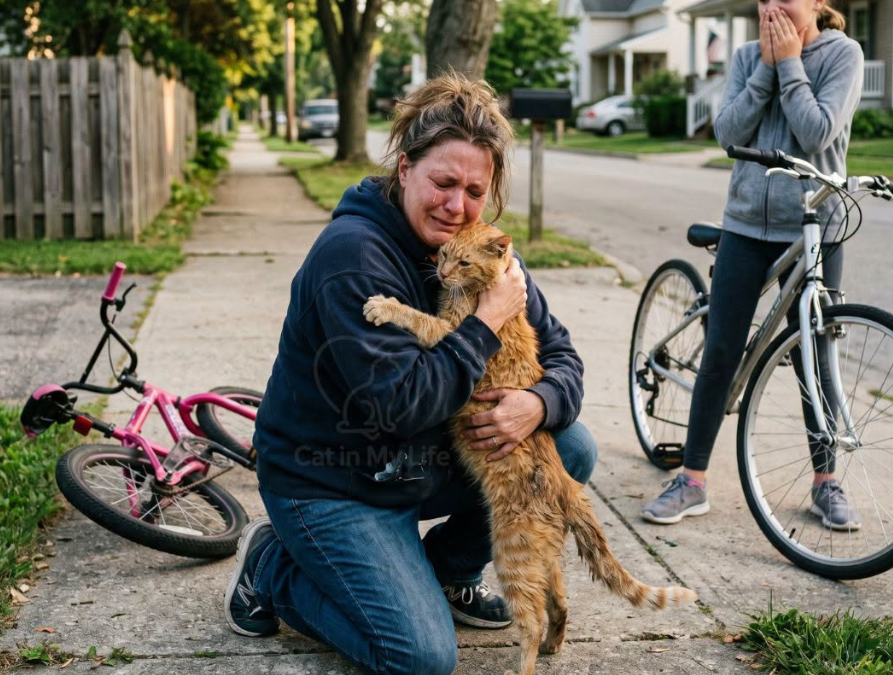
I dropped my bike right there on the sidewalk.
“Leo,” I said again, but this time it came out like a sob.
He ran.
Not walked.
Not wandered.
Ran.
Straight to me.
I fell to my knees before he reached me, and he jumped into my arms like he had done it yesterday.
His claws caught my jacket.
His whole body shook.
He pushed his face into my chest so hard it almost hurt.
He was purring and crying at the same time, and so was I.
Emma stood beside us with both hands over her mouth.
Then she whispered, “He remembers us.”
That was when I broke.
Because I had been so afraid that a year outside had changed everything.
That maybe he had forgotten our voices.
Forgotten the house.
Forgotten the girl who used to sneak him pieces of chicken when she thought I wasn’t looking.
But Leo had not forgotten.
His body was thinner.
His fur was rough.
His meow was not the same.
But his love was.
When I held him close, I felt something scratchy under my fingers.
His old collar.
It was faded, dirty, and barely hanging on.
On the back of the little tag was one word Emma had written with a marker long ago.
Home.
I stared at it until the letters blurred.
For one whole year, he had been carrying that word around his neck.
Maybe he slept under porches.
Maybe he hid from storms.
Maybe strangers walked past him and never knew he belonged to somebody who still whispered his name in the dark.
But somehow, Leo had carried home with him.
I did not ride my bike back.
I carried him.
Emma pushed both bikes beside us, crying and laughing every few steps.
Leo never tried to get down.
He kept his face tucked against my neck, one paw hooked into my shirt like he was making sure I could not disappear.
When we reached our house, I opened the back door.
Leo lifted his head.
Then he walked straight to the kitchen.
Straight to the corner where his old water bowl used to sit.
I had not thrown it away.
I had only pushed it behind a basket because I could not bear to see it.
Emma pulled it out, washed it, and filled it with fresh water.
Leo drank for a long time.
Then he curled up on the rug by the back door and closed his eyes.
Like he had finally finished a journey none of us would ever fully understand.
That night, he slept between Emma and me on the couch.
Every time I moved, he placed one paw on my hand.
Just one small paw.
Just enough to check that I was still there.
People say animals move on because they do not understand time the way we do.
Maybe that is true.
But I know what I saw on that sidewalk.
A year had passed.
Life had changed.
Hope had almost gone quiet.
And still, when love heard its name, it turned around.
If you have ever loved an animal like family, you already know this.
Sometimes the smallest heartbeat coming home can make an entire house feel alive again.
Part 2 — Our Missing Cat Came Home, But Another Child Had Been Waiting Too.
I thought finding Leo was the ending.
I thought the hard part was over the second he ran into my arms.
I did not know that bringing him home would open a door I never expected.
And I did not know that someone else had been loving him while we were grieving him.
For the first twenty-four hours, I barely let him out of my sight.
Leo slept like an old man after a war.
He ate a little, drank a lot, then curled himself into the smallest ball on the couch between Emma and me.
Every few minutes, one of us touched him.
Just to check.
Just to make sure he was real.
His fur smelled like dust, grass, and something lonely.
There were tiny burrs tangled near his tail.
One of his paws had a small healed scar.
His ribs showed more than they should have.
But when I whispered his name, his tail moved.
That small movement felt like a miracle.
Emma missed school the next morning.
I called the office and said she was not feeling well.
It was not exactly a lie.
Her heart had been through too much to sit in math class like nothing had happened.
She spent the morning beside Leo on the living room floor.
She made a nest with her old blue blanket and one of my sweaters.
Leo tucked himself into it and closed his eyes.
Emma sat next to him with one hand on his back.
She did not even turn on the television.
She just watched him breathe.
Every time he shifted, she leaned closer.
Every time he opened his eyes, she smiled like he had come home all over again.
That afternoon, I took him to a small local animal clinic.
I carried him in a laundry basket lined with towels because his old carrier had been in the basement for months.
The young woman at the front desk looked at him, then at me.
“Long story?” she asked softly.
I nodded.
“A year long.”
They checked him over.
He was thin.
A little dehydrated.
His teeth were worse.
His ear was scarred.
But his heart sounded strong.
When the vet said that, I had to look away.
Because I had spent one full year imagining the opposite.
The vet scanned him for his chip.
The little machine beeped.
My name came up.
My address.
My phone number.
Proof that he was ours.
Proof that he had always been ours.
I should have felt relief.
Instead, I felt something more complicated.
Because proof does not erase pain.
And it does not explain where an animal has slept for three hundred sixty-five nights.
On the drive home, Emma kept one hand inside the basket.
Leo pressed his head against her fingers.
“He’s still our cat,” she said.
I looked at her in the rearview mirror.
“Of course he is.”
She stared out the window.
“Even if he changed?”
My throat tightened.
“Especially then.”
That night, after Emma went to bed, I sat at the kitchen table with my phone.
For one year, I had posted missing notices in every local group I could find.
Every few weeks, I had updated the same picture.
Orange tabby.
Bent ear.
White patch under chin.
Answers to Leo.
Loved and missed.
At some point, I had stopped posting.
Not because I stopped hoping.
Because every time nobody answered, it felt like losing him again.
Now my hands shook as I typed a new update.
Found.
One word.
Then I deleted it.
It looked too small for what had happened.
I tried again.
After one full year, Leo is home.
Then I added the photo Emma had taken on the couch.
Leo wrapped in the blue blanket.
His eyes half closed.
One paw resting on Emma’s wrist.
I stared at the screen for a long time before I posted it.
For the first few minutes, the comments were beautiful.
People wrote that they were crying.
People said they remembered his flyer.
A woman from two streets over said she had prayed for him.
An older man wrote, “This made my whole week.”
I read every word.
I let myself feel proud of hope.
Then one message came through privately.
It was from a woman named Marissa.
Her profile picture showed a tired woman with brown hair and kind eyes.
Her message was short.
Too short.
Is this cat missing part of the tip of one ear?
I sat up straighter.
Yes, I wrote.
A few seconds passed.
Then she sent another message.
Does he have a little white patch under his chin, almost shaped like a thumbprint?
My stomach dropped.
Yes.
The typing bubbles appeared.
Disappeared.
Appeared again.
Then came the sentence that changed everything.
My son has been feeding him under our porch for eight months.
I stared at the words.
Eight months.
Not one week.
Not one random sighting.
Eight months.
I did not answer right away.
I looked across the room.
Leo was asleep on the couch.
His body rose and fell under Emma’s blanket.
He looked so peaceful.
So finally safe.
Then my phone buzzed again.
We called him Milo.
I put the phone face down on the table.
I suddenly felt like someone had walked into my house and touched something fragile without asking.
Milo.
Not Leo.
Another name.
Another life.
Another child.
I wanted to be grateful.
I wanted to type, “Thank you for helping him.”
That would have been the good thing.
The mature thing.
The thing people tell themselves they would do.
Instead, all I felt at first was fear.
A hard, selfish fear.
The kind that says, no.
No, you do not get to enter this miracle.
No, you do not get to ask for a piece of him.
No, we just got him back.
I left the message unanswered until morning.
I barely slept.
Every time I closed my eyes, I saw Leo under somebody else’s porch.
Eating from somebody else’s bowl.
Answering to somebody else’s voice.
By breakfast, Emma knew something was wrong.
She sat at the table in her pajamas, watching Leo eat small bites from a shallow dish.
“What?” she asked.
“Nothing.”
She gave me the look children give adults when adults forget children are not stupid.
“Mom.”
I sat down across from her.
“There’s a woman who messaged me.”
Emma froze.
“What woman?”
“She says her son has been feeding Leo for months.”
Emma’s face changed.
Not all at once.
First confusion.
Then hurt.
Then something sharp.
“Feeding him where?”
“A few miles over. Near where we found him.”
Emma looked at Leo.
Leo licked his mouth and bumped his head against the cabinet like the conversation did not involve him at all.
“They knew he was lost?”
“I don’t know.”
“Did they see his collar?”
“I don’t know.”
“Did they try to find us?”
“I don’t know, sweetheart.”
Her eyes filled.
“But we were looking.”
“I know.”
“We had flyers.”
“I know.”
“We kept his bowl.”
I reached across the table for her hand.
She pulled it back.
That hurt more than I expected.
“Are they asking for him?” she whispered.
I hesitated.
“I haven’t answered yet.”
“But are they?”
I looked down.
“She said they called him Milo.”
Emma stood so fast her chair scraped the floor.
“He’s not Milo.”
“Emma.”
“He’s Leo.”
“I know.”
“He’s ours.”
“I know.”
“He came to us.”
“I know.”
But the truth was already sitting between us.
He had come to us.
But he had survived because someone else had opened a door too.
That afternoon, I answered Marissa.
I kept the message polite.
Careful.
Small.
Thank you for feeding him. We are so grateful. He has been our cat for years. My daughter has missed him terribly. He is home with us now.
I thought that would be enough.
A clean ending.
A kind ending.
Then Marissa replied.
I understand. I really do. I’m not trying to be cruel. But my son is nine, and this cat has been coming every evening since last fall. He waited for him by the porch steps every night. He saved part of his dinner for him. He called him Milo because he didn’t know his real name.
I read it twice.
Then a third time.
Another message came.
When Milo didn’t come last night, my son cried himself sick. I saw your post this morning. I’m glad he’s safe. But I need you to understand that your happy ending is also my child’s heartbreak.
I hated that sentence.
Not because it was mean.
Because it was true.
I wanted Marissa to be wrong.
I wanted her to be careless.
I wanted her to be the kind of person I could be angry at without guilt.
But she was not.
She was a mother.
Just like me.
And that made everything harder.
I did not tell Emma about the second message right away.
I told myself I was protecting her.
Maybe I was protecting myself.
That evening, I sat on the back steps while Leo sniffed the air through the screen door.
We were not letting him outside.
Not after a year.
Not after getting him back from the edge of the impossible.
He pressed his nose against the mesh and gave one quiet, rough meow.
“Don’t start,” I whispered.
He looked at me with those tired green eyes.
Then he meowed again.
I laughed, but it came out wrong.
“You are not going anywhere, mister.”
He lowered himself beside the door.
His body was home.
But some part of him was still listening for the world.
Later that night, while Emma slept, I opened the community page again.
The post had grown.
Hundreds of comments.
Most were kind.
But then someone had shared it into another local pet group.
And the story had changed shape.
That is how stories do when strangers touch them.
Some people said, “The original family should keep him. End of story.”
Some people said, “If another family cared for him for eight months, they deserve a say.”
Some said, “A chip proves ownership.”
Some said, “Love is not paperwork.”
Some said, “That poor little girl.”
Others said, “That poor little boy.”
One person wrote, “The cat should choose.”
I stared at that one for a long time.
The cat should choose.
It sounded simple.
People love simple answers when they are not the ones who have to live with them.
How exactly does a cat choose?
By walking to one child first?
By sleeping on one blanket?
By remembering one name but answering to another?
Leo could not explain where he had been.
He could not tell us if Marissa’s porch had saved him.
He could not tell us if Noah, the boy, had waited in the cold with a bowl of food.
He could only look at us with that same old face and ask to be loved.
The next morning, Marissa asked if she and her son could come by.
Not to take him, she wrote.
Just to see him.
Just so Noah knows he is okay.
I read the message while standing at the sink.
The coffee had gone cold beside me.
Emma was upstairs getting dressed.
Leo was sitting on the kitchen rug, washing one paw like a king who had no idea he was causing a neighborhood debate.
My first answer was no.
It rose up in me fast.
No.
No visits.
No confusion.
No chance for another child to cry in my living room and make my daughter feel like she had stolen back her own cat.
Then I thought of Emma on her birthday.
“I just want to know if he’s cold.”
And I thought of a nine-year-old boy somewhere a few miles over, asking the same question in a different way.
Is Milo safe?
Is he hungry?
Did he leave because he didn’t love me?
I put my phone down.
I went upstairs.
Emma was sitting on her bed, tying her shoes.
“Marissa asked if she and her son can come see Leo,” I said.
Her hands stopped moving.
“No.”
I sat beside her.
“She said not to take him.”
“No.”
“Just to see he’s okay.”
“No, Mom.”
Her voice cracked on the last word.
I wanted to gather her up.
I wanted to say, “Fine. Nobody comes. Nobody gets near him.”
But motherhood is sometimes standing in the doorway between your child’s pain and another child’s pain.
And knowing you cannot block both.
“Emma,” I said gently, “that boy may have loved him too.”
She looked at me.
Her eyes were red already.
“He had him for months. I lost him for a year.”
“I know.”
“So why does his hurt matter more?”
“It doesn’t.”
“Then why are you acting like it does?”
That sentence landed hard.
I did not answer fast enough.
Emma wiped her face with her sleeve.
“You want to be nice.”
“No, sweetheart. I want to be fair.”
“To who?”
I looked at her.
“To everyone who loved him when he was lost.”
She shook her head.
“That’s not fair to me.”
She was right.
And Marissa was right.
And that was the terrible part.
Sometimes life does not give you a good choice and a bad choice.
Sometimes it gives you two good hearts and one impossible situation.
I told Marissa we needed time.
She answered with only three words.
I understand. Thank you.
That made me feel worse.
For two days, we tried to pretend nothing had changed.
Leo grew stronger.
He started following me from room to room.
He remembered where the sunny spot appeared on the living room floor at noon.
He remembered the sound of the treat bag.
He remembered that Emma left her closet door open and that he could sleep in the laundry basket if he was quick.
But he had new habits too.
At dusk, he went to the back door.
Every evening.
Always around the same time.
He sat there and stared out.
Not restless exactly.
But waiting.
The first night, I thought he wanted to go outside.
The second night, I wondered if he was waiting for whatever time he used to walk to Marissa’s porch.
The third night, Emma noticed.
“He’s waiting for them, isn’t he?”
I did not lie.
“Maybe.”
She crossed her arms.
“He can miss them and still love you.”
“I don’t want him to miss them.”
“I know.”
“That sounds mean.”
“It sounds human.”
She sat on the floor beside him.
Leo leaned against her knee.
Emma looked down at him.
“Did you have another family?” she whispered.
Leo blinked.
Then he put his paw on her sock.
Emma’s face crumpled.
“I hate this,” she said.
“I know.”
“I hate that they were kind.”
I sat beside her.
That was the sentence I had not been brave enough to say.
It would have been easier if Marissa had been careless.
It would have been easier if Noah had not loved him.
It would have been easier if we could point to a villain.
But there was no villain.
Only a lost cat.
Two children.
And a year that had hurt everyone in different ways.
On Saturday morning, Emma came into the kitchen holding Leo.
He looked half asleep in her arms.
His head rested under her chin.
“She can come,” Emma said.
I turned from the sink.
“What?”
“The woman. And her son.”
I dried my hands slowly.
“Are you sure?”
“No.”
I waited.
Emma looked down at Leo.
“But if I didn’t know where he was, and someone could show me he was safe, I’d need that.”
My eyes burned.
“You don’t have to do this.”
“I know.”
She swallowed.
“But I don’t want to be the reason another kid keeps wondering.”
There are moments when your child teaches you the kind of person you hoped you were raising.
And it hurts.
Because goodness is expensive.
I messaged Marissa.
She arrived that afternoon in a small gray car with a cracked bumper and a booster seat in the back.
Noah stepped out first.
He was smaller than I expected.
Skinny arms.
Big eyes.
A sweatshirt with one sleeve stretched out at the cuff.
He held a small stuffed mouse in one hand.
Marissa stood beside him with her purse clutched to her chest.
She looked nervous.
Not demanding.
Not angry.
Nervous.
Like she already knew some people in the neighborhood thought she was wrong just for showing up.
I opened the door before they knocked.
For a second, none of us said anything.
Then Marissa gave me a tired smile.
“Thank you.”
I nodded.
Emma stood behind me.
Leo was in the living room.
I had not put him in her arms.
I had not locked him in a bedroom.
I told myself that was brave.
Really, it was terrifying.
Noah wiped his shoes carefully before stepping inside.
That small gesture almost broke me.
He looked around like he was entering a church.
“Is he here?” he whispered.
Emma’s hand slipped into mine.
“Yes,” I said.
Leo was sitting near the couch.
He looked at the strangers.
Then his ears lifted.
Noah made a sound so small I almost missed it.
“Milo?”
Leo stood.
Emma’s fingers tightened around mine.
Noah did not run to him.
He did not grab.
He did not cry loudly.
He just sank to his knees right there on the rug and held out one trembling hand.
“Milo,” he whispered again.
Leo walked to him.
Slowly at first.
Then faster.
He pressed his forehead into Noah’s palm.
Noah closed his eyes.
His whole face folded.
Not like a child throwing a fit.
Like a child trying very hard not to fall apart in someone else’s house.
Emma made a sound beside me.
I looked down.
Tears were running down her cheeks.
Leo rubbed against Noah’s knees.
Then he turned and came back to Emma.
He bumped her leg.
Then he went back to Noah.
Back and forth.
Back and forth.
As if he were stitching the room together with his small tired body.
No one spoke.
Because what could any of us say?
Finally, Noah looked at Emma.
“His real name is Leo?”
Emma nodded.
Noah looked down.
“I didn’t know.”
“I know,” Emma said.
Her voice was very quiet.
“I called him Milo because he came when I said it,” Noah said.
Emma wiped her face.
“He comes when people love him.”
That was the moment Marissa covered her mouth.
I had to look away.
Noah held out the stuffed mouse.
“I brought this. It was his.”
Emma looked at it.
The toy was worn flat on one side.
One ear was missing.
“You can keep it,” Noah said quickly. “I mean, he can keep it. I don’t need it.”
Leo sniffed the toy.
Then he rubbed his cheek against it.
Emma knelt down too.
For a few minutes, the two children sat on the floor with the cat between them.
Two names.
Two stories.
One small orange body that had survived more than any of us understood.
Marissa and I stood near the doorway like women afraid of breaking glass.
After a while, she said softly, “I’m sorry.”
I turned to her.
“For what?”
“For not doing more.”
I did not answer.
She looked at Leo.
“He came to our porch in October. He was dirty and scared. No collar that I could see at first. His fur was matted around his neck. I thought he was stray.”
I folded my arms because I needed something to hold.
“Then later I saw the collar,” she said.
My chest tightened.
She nodded like she deserved that look.
“I tried to read the tag. The front was scratched so badly I couldn’t make out the number. I didn’t see the word on the back until today, in your picture. I should have taken him somewhere to be scanned.”
“Why didn’t you?”
It came out sharper than I meant it to.
Marissa accepted it.
“I tried to get him in a carrier twice. He panicked. Clawed right through my sleeve. After that, he would only come for food if we left the door open and backed away.”
She looked at Noah.
“And honestly? My son got attached. I told myself feeding him was enough until I could figure it out. Then winter came. Then he started sleeping in a box with blankets under the porch. Then it just became… our routine.”
I hated how much I understood that.
Not agreed.
Understood.
Life does not always make room for perfect choices.
Sometimes people do half-good things because the full-good thing feels too hard.
Marissa wiped under one eye.
“I saw old flyers once, months ago, outside the little grocery. But the picture was faded. I thought, maybe. Then I thought, lots of orange cats look alike. And I think part of me didn’t want it to be him.”
That was the first honest thing either of us had said out loud.
I looked at her.
She looked ashamed.
Not because she had meant harm.
Because she had let love make her slow.
I knew something about that too.
“How could you not want him to be Leo?” I asked.
Her eyes moved to Noah.
“Because my boy had already lost enough that year.”
She did not explain more.
She did not need to.
Some sadness has a shape even when nobody gives you the details.
In the living room, Noah was showing Emma how Leo used to wait on the third porch step.
Emma told Noah how Leo used to steal chicken off her plate.
They were still crying.
But they were talking.
That felt like the first small bridge.
Then Noah asked the question I had been dreading.
“Can he come visit sometimes?”
Emma went still.
Marissa closed her eyes.
“Noah,” she said softly.
“I don’t mean forever,” he said quickly. “Just sometimes. So he knows I didn’t leave him.”
Emma looked at me.
There it was.
The impossible thing.
Not a demand.
Not a fight.
A child asking not to be erased.
I wanted to say yes.
I wanted to say no.
I wanted to go back to the sidewalk where Leo had run into my arms and freeze time before anybody else entered the picture.
But life had moved.
And Leo had moved through other hearts while he was missing from ours.
“I don’t know,” I said.
It was the only honest answer I had.
Noah nodded like he had expected worse.
Emma looked down at Leo.
“He can’t sleep anywhere else,” she said.
Her voice shook, but she did not look away.
“He came home.”
Noah nodded again.
“I know.”
“He has to stay here.”
“I know.”
“But…”
Emma swallowed.
“But maybe you can visit him here.”
Noah looked up.
“Really?”
Emma looked at me.
I nodded slowly.
“If that feels okay for everyone.”
Marissa started to cry then.
Quietly.
The kind of crying adults do when they are trying not to make children comfort them.
Noah did not smile.
Not exactly.
He looked relieved and heartbroken at the same time.
That is a lot for a child’s face to carry.
The visit lasted one hour.
When Marissa said they should go, Noah placed the stuffed mouse beside Leo’s blanket.
Leo put one paw over it.
Noah pressed his lips together.
“Bye, Milo,” he whispered.
Then he looked at Emma.
“I mean Leo.”
Emma shook her head.
“You can call him Milo if you want.”
Noah’s eyes filled again.
“Are you sure?”
Emma nodded.
“He knows both.”
After they left, Emma stood at the front window until their car disappeared.
I waited for her to say she regretted it.
I waited for her to get angry.
I waited for all the feelings she had swallowed to come pouring out.
Instead, she whispered, “I wish he had been mean.”
“Who?”
“Noah.”
I put my arm around her.
“I know.”
“Then it would be easier.”
“Yes.”
She leaned into me.
“Why does doing the right thing sometimes feel awful?”
I kissed the top of her head.
“Because sometimes the right thing still costs something.”
That night, Leo slept with the stuffed mouse under his chin.
Emma saw it and cried again.
Not loud.
Just one hand over her mouth.
I almost moved the toy.
Then I stopped myself.
Love is not made smaller because it has more witnesses.
But try telling that to a hurting child.
For the next few weeks, our house became quieter in a different way.
Not empty.
Careful.
Emma loved Leo fiercely.
Too fiercely sometimes.
She checked the doors three times.
She got upset if I opened a window more than a few inches.
She cried once because Leo hid behind the dryer and did not come out when she called.
“It’s happening again,” she said.
I lay flat on the laundry room floor until I could see his eyes glowing in the dark.
“He’s just being a cat.”
“That’s what we thought last time.”
I had no answer.
Because she was right.
Love after loss becomes watchful.
It counts exits.
It hears every door.
It turns ordinary silence into alarms.
Leo gained weight.
His fur softened.
His meow stayed rough.
Sometimes, when he slept, his paws twitched like he was running.
I wondered where he went in his dreams.
Back alleys?
Porches?
Storm drains?
The old wooden fence where we found him?
Or maybe he was running to us again.
I hoped it was that.
Marissa and Noah visited every other Sunday at first.
I thought it would get easier.
In some ways, it did.
Noah never asked to take Leo.
Marissa never pushed.
She brought a small bag of the food Leo had liked under their porch and said, “Just in case he still wants it.”
Emma rolled her eyes after they left.
But I found her later pouring a little into Leo’s bowl.
Once, Noah brought a photo.
It showed Leo under a porch light, thinner and dirtier, sitting in a cardboard box with a towel inside.
On the back, in a child’s writing, it said Milo, winter.
Emma held that photo for a long time.
Then she asked if she could keep a copy.
Noah said yes.
They made two.
One for his room.
One for hers.
That photo changed something in me.
Until then, I had imagined Leo’s missing year as one long darkness.
Cold.
Hunger.
Fear.
Loneliness.
And yes, some of it must have been that.
But not all.
There had been a porch light.
A towel.
A boy saving bits of dinner.
A mother putting out warm water when the nights froze.
The year had not only taken from him.
It had also held him in places I never knew to thank.
That was hard to accept.
Because grief can become possessive.
It says, I suffered, so the story belongs to me.
But Leo’s story did not belong only to us anymore.
It belonged to everyone who had helped him survive long enough to hear his name on that sidewalk.
One Thursday evening, almost a month after his return, Leo slipped out again.
It was my fault.
I will say that before anyone else does.
I was bringing in a laundry basket from the garage.
Emma was upstairs.
The side door stuck, like it always did.
I pulled hard.
The basket tilted.
A towel fell.
Leo shot past my ankles like a flash of orange.
For one second, I froze.
Then my body remembered the worst year of my life.
“Leo!”
He ran across the driveway.
I dropped the basket.
Towels spilled everywhere.
“Leo!”
Emma appeared at the top of the stairs.
Her face went white.
“No.”
I ran outside barefoot.
The driveway burned under my feet.
Leo reached the hedge.
Then he disappeared.
Emma screamed.
Not a big dramatic scream.
A broken one.
The sound of a child being handed the same nightmare twice.
Neighbors came out.
I called his name until my throat hurt.
Emma stood in the yard shaking so hard I wrapped my arms around her from behind.
“I can’t do it again,” she kept saying.
“I can’t do it again.”
Neither could I.
But the world did not care what we could do.
The sun went down.
Leo did not come back.
At 9:17 that night, my phone rang.
Marissa.
I answered with hands so numb I nearly dropped it.
“He’s here,” she said.
For a moment, I could not understand the words.
Then I heard Noah in the background.
“He came back, Mom. He came back.”
I closed my eyes.
My knees almost gave out.
Emma grabbed my arm.
“What? What is it?”
“He’s at Marissa’s.”
Her face crumpled in a way I will never forget.
Relief and betrayal can look almost the same when they hit at once.
We drove there in silence.
No music.
No talking.
Just Emma breathing hard beside me.
When we pulled up, Leo was on Marissa’s porch.
Sitting on the third step.
Exactly where Noah had said he used to wait.
Noah sat just inside the open door, still in pajamas.
Marissa stood behind him.
No one touched Leo.
No one picked him up.
They waited for us.
That mattered.
It mattered more than I knew how to say.
Emma got out of the car slowly.
Leo saw her.
His tail lifted.
He ran to her.
She dropped to her knees on the walkway and gathered him against her chest.
“You scared me,” she sobbed into his fur.
Leo pushed his head under her chin.
Then, after a moment, he wriggled down.
He walked back to the porch.
He rubbed against Noah’s leg.
Then he walked back to Emma.
Again, that stitching.
Back and forth.
Back and forth.
Two homes sewn together by one stubborn cat.
Emma looked at me with wet, angry eyes.
“He chose both.”
I did not say anything.
Because she was right.
On the drive home, Leo was in the carrier this time.
Emma had insisted.
She sat beside it, one hand pressed to the little door.
“He went there on purpose,” she said.
“Yes.”
“So what now?”
“I don’t know.”
“He can’t keep doing that.”
“No.”
“But we can’t pretend he doesn’t love them.”
“No.”
She stared at Leo through the carrier door.
Her voice was barely a whisper.
“I hate that love can be so messy.”
I reached over and squeezed her hand.
“So do I.”
After that night, the comments online became louder.
I should not have read them.
But I did.
Some people said I was irresponsible for letting him slip out.
They were not wrong.
Some said Marissa should have brought him back herself the first time she saw the post.
They were not wrong either.
Some said Noah deserved visits.
Some said Emma deserved peace.
Some said a pet is family, not property.
Some said a pet needs one stable home, not emotional confusion.
People argued like they knew us.
Like they knew our kitchen.
Our porch.
Our children’s tears.
They did not.
But I understood why the story made people choose sides.
Because everyone saw their own fear in it.
The fear of losing what you love.
The fear of loving something that was never fully yours.
The fear of being kind and still being blamed.
The fear that doing your best will not be enough.
I stopped reading after one woman wrote, “The cat belongs where he was missed first.”
Then another replied, “No, the cat belongs where he was safe when missing him wasn’t enough.”
I put the phone down.
Both sentences hurt.
For days, I thought about what home means.
Is it the place you started?
The place that kept your bowl?
The place that fed you when you were starving?
The place that has your name on a tag?
Or the place where someone opens the door and says, “There you are,” like your absence has been sitting at the table the whole time?
I wanted one answer.
I did not get one.
So we made our own.
Leo stayed with us.
That was never really in question.
He slept in Emma’s room.
His chip had my name.
His old life was here.
His water bowl was here.
His girl was here.
But we did not cut Marissa and Noah out.
Not after the porch.
Not after seeing him run to them.
Not after knowing that, for part of the worst year of our lives, they had been the reason he was not alone.
We made a routine.
Every other Sunday, Marissa and Noah came over.
Sometimes they stayed thirty minutes.
Sometimes an hour.
Noah brought homework once and did it on our living room floor while Leo slept on his backpack.
Emma pretended not to care.
Then she corrected his spelling on three words.
After that, they became something like friends.
Not quickly.
Not perfectly.
But slowly, in the way children can build bridges adults keep overthinking.
They argued about what Leo liked best.
Emma said chicken.
Noah said tuna.
Leo chose both and proved everyone right.
They made a little scrapbook together.
Emma titled one section “Before.”
Noah titled another “Porch Days.”
I watched them glue photos side by side.
Leo as a fat younger cat sleeping in Emma’s laundry basket.
Leo as a dirty winter porch cat curled in a box.
Leo on the couch after coming home.
Leo between both children, looking mildly annoyed that anyone had ever doubted his importance.
Marissa and I talked more too.
At first, only about Leo.
Then about work.
School.
Groceries.
Broken fences.
How expensive everything had become.
How tired everyone seemed.
How many people were quietly carrying more than they posted.
She told me she had almost messaged me the day she first suspected Milo might be Leo.
Then Noah had come home from school crying because kids had been talking about father-child breakfast and his father lived three hours away.
“So I told myself one more week,” she said.
We were sitting on the porch while the kids played with Leo inside.
“One more week became two,” she said. “Then I felt ashamed. Then shame made me avoid it. That’s not an excuse.”
“No,” I said.
“It’s just the truth.”
I looked at her.
“Thank you for telling it.”
She nodded.
Then I said the thing I had been carrying.
“I hated you at first.”
She gave a small sad laugh.
“I know.”
“I wanted you to be the bad guy.”
“I know that too.”
“You weren’t.”
She looked toward the window.
“Neither were you.”
It is strange how healing can arrive without anyone winning.
No apology fixed the year.
No compromise erased the fear.
No visit gave Noah what he had lost.
No routine gave Emma back the version of herself who believed love always returned untouched.
But something softer began to grow around the broken parts.
Not the same as before.
Not simple.
Still real.
One night, near the beginning of summer, Emma came into my room holding Leo’s old collar.
We had taken it off after the vet visit because it was frayed and dirty.
I had planned to throw it away.
I could not.
So it sat in my dresser drawer with the little tag still attached.
Home.
Emma held it like a relic.
“Can we put it in a frame?” she asked.
“Of course.”
“With the porch photo too?”
I looked at her.
“The one Noah took?”
She nodded.
“And the picture from the day we found him.”
I smiled softly.
“That sounds perfect.”
She sat on the edge of my bed.
“I used to think home meant us.”
I waited.
She rubbed the tag with her thumb.
“I still think that.”
I nodded.
“But maybe when he was lost, home was anything that helped him stay alive long enough to come back.”
That sentence stayed with me.
I think it will stay with me forever.
We framed the collar.
The tag sits in the center.
On one side is Emma’s old photo of Leo as a round, spoiled house cat lying upside down in a patch of sun.
On the other side is Noah’s photo of him under the porch light, thin but safe in a cardboard box.
Below it is the sidewalk picture from the day he came home.
Emma took it after I had finally stopped crying enough to stand.
Leo is in my arms.
His face is pressed into my neck.
You can see Emma’s hand touching his back.
You can also see, if you look closely, the old collar still around his neck.
That frame hangs near our back door now.
Not as decoration.
As a reminder.
Love is not always clean.
Sometimes it comes home dirty.
Thin.
Changed.
Carrying another name.
Carrying another child’s tears.
Carrying a story you did not write.
And you have to decide whether love is only real when it belongs to you alone.
Or whether it can be big enough to admit that someone else kept it alive.
People still ask me what I would do if it happened again.
Would I let the other family visit?
Would I answer the message?
Would I share the cat who had finally come home?
I wish I could say yes without hesitation.
That would make me sound better than I am.
The truth is, I do not know.
I know what I did after many tears.
I know what Emma did when her heart was bigger than her fear.
I know what Noah did when he loved Leo enough not to demand him.
I know what Marissa did when she stood on her porch and waited for us instead of closing the door.
And I know what Leo did.
He came home.
Then he showed us that home had more than one doorway.
Now, every evening, he still goes to the back door at dusk.
But he does not cry to leave.
He just sits there.
Sometimes Emma sits beside him.
Sometimes I do.
Sometimes, on visiting Sundays, Noah sits on the other side of him with the stuffed mouse in his lap.
Leo looks between them like he is keeping watch over both.
His fur has grown soft again.
His ribs no longer show.
His meow is still rough.
It probably always will be.
Emma says it makes him sound like he has secrets.
Maybe he does.
Maybe every animal who finds their way back carries a world we never get to hear.
We only get the ending they can give us.
A paw on the hand.
A head against the chest.
A body sleeping without fear.
Last week, Emma filled Leo’s water bowl before school.
She does it every morning now.
Not because she is afraid it will be empty if he returns.
But because he is here to drink it.
She set it down, looked at me, and smiled.
A real smile.
The kind I had not seen in a year.
Then she said, “I’m glad Noah fed him.”
I had to grip the counter.
“Me too.”
She picked up her backpack.
Then she paused at the door.
“But I’m still glad he came to us when you called.”
I looked at Leo, sitting in the morning light with one paw over that ruined stuffed mouse.
“So am I,” I said.
“So am I.”
Because when I close my eyes, I can still see that sidewalk.
The old wooden fence.
The thin orange cat stopping when he heard his name.
That moment before he turned around.
That tiny space between loss and miracle.
I used to think the most beautiful part was that Leo remembered us.
Now I think the most beautiful part is that he survived long enough to prove love can remember more than one place.
He remembered the girl who kept his bowl.
He remembered the boy who fed him under a porch.
He remembered my voice.
He remembered his way home.
And maybe that is the lesson I did not ask for.
Maybe family is not always a straight line.
Sometimes it is a circle drawn around everyone who showed up when it mattered.
Sometimes the thing you prayed to get back comes back changed.
And then it changes you too.
Leo is asleep beside me as I write this.
His paw is resting on my sleeve.
Just enough pressure to remind me he is here.
Just enough to remind me that for one whole year, love was not gone.
It was traveling.
It was hiding under porches.
It was waiting under a fence.
It was answering to Milo.
It was remembering Leo.
It was carrying the word Home around its neck until the day someone called its name and it finally turned around.
So if you are reading this and you have ever lost an animal, I will not tell you to stop hoping.
I will not tell you every story ends this way.
They do not.
I know that.
But I will tell you this.
Sometimes love takes the long road.
Sometimes it comes back with scars.
Sometimes it brings other people with it.
And sometimes the hardest part is not opening the door when it returns.
Sometimes the hardest part is opening your heart wide enough for the whole story.
Not just the part that belongs to you.








