I Had 48 Hours to Return Two Terrified Shelter Kittens—Then I Realized They Weren’t Hiding From Me, They Were Waiting to See If I’d Leave Too
PART2:
That was the word written on the card clipped to their kennel.
BONDED SIBLINGS.
APPROX. 4 MONTHS.
QUIET.
BEST IN A CALM HOME.
The volunteer at the adoption desk had smiled when I asked what quiet meant.
“Just shy,” she had said.
Her name was Hannah.
I remembered because she wore a silver necklace shaped like a little crescent moon, and she kept touching it when she talked.
“They’ve been through a lot of change.”
“How much change?”
She hesitated.
Not long.
Maybe one second.
But I would remember that second later.
“They were found as strays.”
That was what she said.
I believed her.
Why wouldn’t I?
I had gone to Triangle Haven Animal Rescue on a Saturday because my apartment had become too silent.
That is the simplest version.
The more honest version is that my fiancé had moved out four months earlier.
His name was Ryan.
We had been together five years.
Engaged for eleven months.
One Thursday night, while I was reheating leftover Thai food, he told me he didn’t think he wanted the life we were building.
He said it calmly.
No affair.
No screaming.
No plate thrown against the wall.
Some betrayals arrive politely.
PART3:
He said he loved me but had “started feeling trapped by the future.”
The future, apparently, was me.
By Sunday, half the closet was empty.
By Tuesday, his coffee mug was gone.
A week later, I discovered he had already signed a lease with a friend across town before he ever told me he wanted to leave.
That detail mattered more than I wanted it to.
It meant the conversation I thought had changed our future had actually happened after he had already changed it.
I was just the last person informed.
For months afterward, I told everyone I was fine.
I worked remotely in payroll compliance for a medical equipment company.
I made decent money.
I paid my bills.
I went running.
I met friends for brunch.
I answered my mother’s calls.
I kept my plants alive.
From the outside, there was no emergency.
But there is a particular kind of loneliness that comes from continuing to live in a place that had been arranged for two people.
Two coffee cups on the shelf.
Two hooks beside the door.
His dent in the couch cushion slowly disappearing.
The bedroom suddenly too large.
The bathroom suddenly organized.
Every improvement felt like evidence.
So when my friend Keisha texted me one Friday night and said, You need a cat, I laughed.
She sent back, I’m serious.
I replied, I can barely manage basil.
She wrote, Cats don’t die because you forget to water them.
That was how it started.
I went to the shelter “just to look.”
Then I saw the siblings.
They were sitting at the back of their kennel while every other kitten reached paws through bars or climbed wire doors or shouted tiny demands at passing strangers.
The tabby sat in front.
The tuxedo sat behind him.
Both perfectly still.
A little girl pressed her face against the enclosure.
“They’re boring,” she announced.
Her father guided her toward three orange kittens wrestling over a stuffed mouse.
I remained.
The tabby looked at me once.
Then away.
Something about that stayed with me.
Maybe because I knew what it was like to watch somebody leave before they had even really arrived.
Maybe because I mistook my own sadness for compatibility.
Maybe because I wanted to rescue something quiet enough that nobody else seemed to notice it.
Whatever the reason, three hours later I was signing papers.
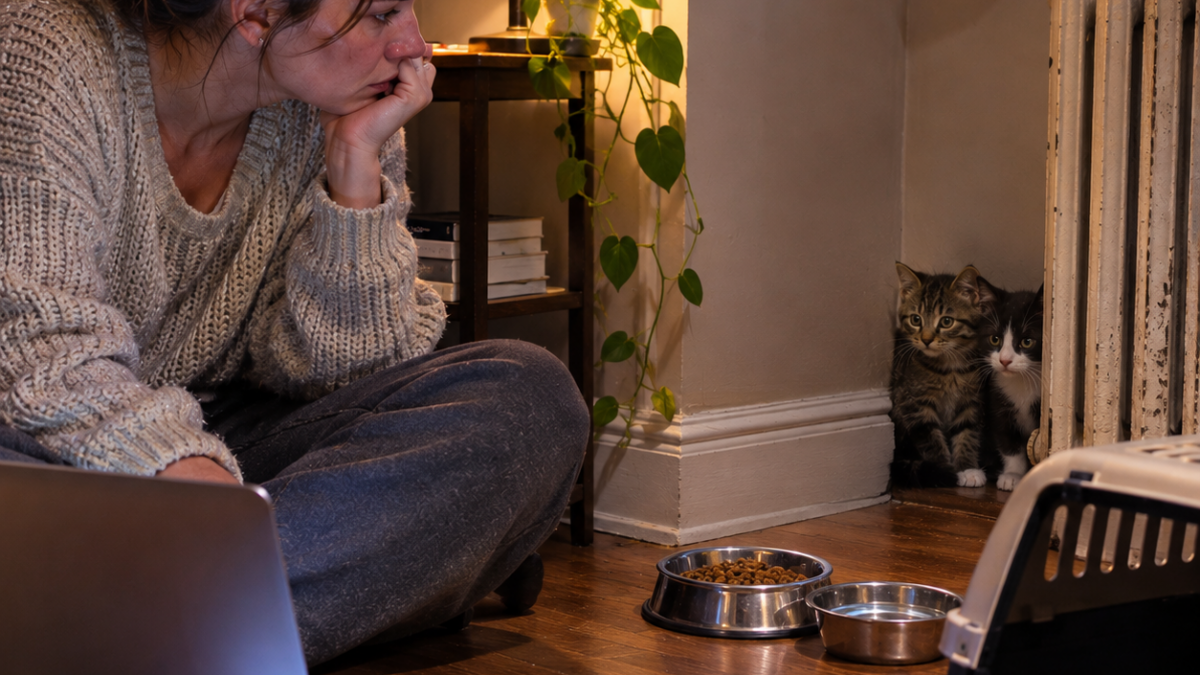
Forty minutes after that, I was sitting on my living-room floor while both kittens hid behind my radiator and refused to acknowledge my existence.
I stayed there almost an hour.
Eventually my left leg went numb.
I whispered nonsense.
“You don’t have to come out.”
Nothing.
“I’m not going to touch you.”
Nothing.
“I bought you an embarrassing amount of stuff.”
Nothing.
“I also realize you don’t understand English, so this is mostly for me.”
One ear moved.
The tuxedo’s.
Just once.
It was enough to make me smile.
I stood slowly.
Both bodies tightened.
I stopped.
They didn’t run because there was nowhere farther to go.
That realization hurt.
I left food and water several feet from the radiator.
Then I went to the kitchen and pretended not to watch.
Hours passed.
The bowls remained untouched.
At nine that night, I moved them closer.
At eleven, closer again.
At midnight, I turned off every light except the lamp beside the couch.
I went to bed.
I slept badly.
At 5:42 the next morning, I walked into the living room expecting empty bowls.
The food looked untouched.
So did the water.
My stomach dropped.
I crouched beside the radiator.
Four eyes.
Same positions.
Same silence.
“Okay,” I whispered. “Okay, guys.”
I had already started calling them guys because I still hadn’t decided whether to keep their shelter names.
The tabby had been listed as Maple.
The tuxedo was Pepper.
Neither name seemed to belong to them.
But renaming felt presumptuous when they looked at me as if I were an immigration checkpoint.
At noon my phone buzzed.
Triangle Haven Animal Rescue.
A text.
Hi Mara! Just checking in on Maple & Pepper. Remember, adopters have a 48-hour adjustment window. If it doesn’t seem like a fit, it’s usually better to bring them back sooner rather than later so we can reassess placement. Let us know if you need anything!
I read it twice.
There was nothing cruel in the message.
Nothing technically unreasonable.
In fact, it sounded responsible.
But the phrase forty-eight-hour adjustment window seemed to transform my apartment.
Suddenly there was a clock in the room.
I looked toward the radiator.
Same two shapes.
Same distance between them.
Same watchful eyes.
“Apparently we’re on a deadline,” I said.
Neither reacted.
I spent most of that Saturday on the floor.
My laptop beside me.
Coffee going cold.
I answered work emails I didn’t need to answer because it gave my hands something to do.
Sometimes I read aloud.
Not to them exactly.
Just near them.
A news article.
Part of a novel.
An email from Keisha asking whether I was officially a cat lady.
Every time I shifted too quickly, both kittens flattened at the same moment.
Not one, then the other.
Together.
That struck me.
Most animals startle independently.
One sees danger.
The other reacts.
These two seemed wired into the same alarm.
If my elbow moved suddenly, two bodies tightened.
If the refrigerator compressor kicked on, two heads lifted.
If somebody walked past in the hallway, two kittens pressed into the wall.
They were not simply siblings.
They had learned fear together.
By late afternoon, I started Googling.
Shy adopted kittens won’t eat.
Bonded kittens hiding.
Cat won’t drink first day.
How long before kitten comes out from hiding?
Some answers reassured me.
Twenty-four hours could be normal.
Forty-eight could be normal.
Some frightened cats took weeks.
Then I found articles about learned avoidance.
About animals who had been repeatedly moved.
About cats that stopped exploring because exploration had never resulted in stability.
I stared at that phrase.
Repeatedly moved.
I remembered Hannah’s hesitation.
They’ve been through a lot of change.
I picked up my phone and called the shelter.
A woman answered after four rings.
“Triangle Haven, this is Lydia.”
Her voice was bright and efficient.
I told her my name.
“Oh, yes. Maple and Pepper.”
Something about the speed with which she recognized them surprised me.
“They haven’t eaten much,” I said.
“Have you actually seen them not eat, or are you just not seeing them eat?”
I paused.
“I guess I haven’t watched them the entire time.”
“They may be eating overnight.”
“The bowls look the same.”
“Some kittens take time.”
“I know. I’m just wondering if there’s anything specific in their history that might help.”
Silence.
A tiny silence.
Then, “Their history?”
“Yeah. Foster notes. Previous environment. Anything they were afraid of.”
“They were strays.”
That answer came too quickly.
“Where were they found?”
“I’d have to pull the intake record.”
“Could you?”
Another pause.
Then a gentle laugh.
Not warm.
Deflecting.
“Mara, I think you’re overthinking this. First-time adopters sometimes do that.”
My face warmed.
“I’m just trying to understand them.”
“And that’s great. But if they’re causing you stress, there is absolutely no shame in returning them. We’d rather have that happen quickly than let a bad match drag on.”
A bad match.
They had been in my apartment less than twenty-four hours.
“I didn’t say they were causing me stress.”
“You sound stressed.”
That embarrassed me more than it should have.
Maybe because she was right.
Maybe because I suddenly felt like a child being told I had chosen the advanced version of something I didn’t understand.
“What happens if I bring them back?”
“We reassess.”
“And then?”
“We find a more suitable placement.”
“More experienced?”
“Possibly.”
I looked at the radiator.
The tuxedo’s eyes disappeared for a moment.
Then returned.
“What does experienced mean?”
“Someone comfortable with undersocialized kittens.”
There it was.
I sat straighter.
“Undersocialized?”
“That may be part of what you’re seeing.”
“Hannah told me they were shy.”
“Shy, undersocialized—those descriptions can overlap.”
“But that isn’t what I was told.”
Lydia’s voice changed.
Only slightly.
The warmth disappeared.
“Mara, nobody misled you.”
“I didn’t say—”
“You adopted two kittens who were described as quiet and needing a calm home. If you no longer feel comfortable, bring them back.”
“I’m asking for information.”
“And I’m giving it to you.”
The conversation ended three minutes later.
I sat there holding my phone.
The kittens hadn’t moved.
For the first time, the idea of returning them felt easier than keeping them.
Not because I didn’t care.
Because I suddenly suspected I had taken on something I didn’t know how to do.
What if keeping them was selfish?
What if somebody else could help them faster?
What if my inexperience prolonged their fear?
I spent another hour searching.
Then I opened the shelter website.
RETURN/PLACEMENT CONCERN FORM.
It was easy.
Too easy.
Name.
Adoption date.
Animal ID.
Reason for return.
Behavioral concerns.
I typed:
Won’t come out. Not eating. Extremely fearful.
I stared at the words.
They looked accusatory.
As if the kittens were defective appliances.
I deleted extremely fearful.
Typed adjusting poorly.
Deleted that too.
I had just reached the field asking for preferred return time when I heard something.
Crunch.
I froze.
Crunch.
A tiny scrape against ceramic.
I did not turn my head.
Another crunch.
Then two.
They were eating.
My eyes burned unexpectedly.
I stayed absolutely still.
The sound continued.
Fast.
Too fast.
Not relaxed chewing.
Urgent.
The way somebody eats when they believe the plate might be taken away.
I looked sideways.
Both kittens were at the bowl.
Shoulder to shoulder.
The tabby took three bites, lifted his head, scanned the room.
The tuxedo ate while he watched.
Then they switched.
One eating.
One watching.
My stomach tightened.
That wasn’t shyness.
That looked like a system.
I shifted my foot.
Both kittens vanished.
Instantly.
One second they were eating.
The next there was only an abandoned bowl rocking slightly on the floor.
I looked back at my laptop.
The return form was still open.
Reason for return.
The cursor blinked.
I imagined carrying them back through the shelter doors.
I imagined the radiator empty.
I imagined Lydia saying, We understand.
I imagined another carrier.
Another room.
Another stranger.
Another forty-eight-hour window.
And for the first time, I wondered whether they knew exactly what the carrier meant.
I closed the form.
No heroic decision.
No music.
No promise.
Just one click.
Then I moved the food bowl slightly closer to their hiding place.
“I don’t know what I’m doing,” I told the darkness.
One pair of eyes blinked.
“But I’m not taking you anywhere today.”
The second day was harder.
Knowing you have decided to stay does not magically tell you how to help.
I rearranged the living room.
Not dramatically.
I moved the couch six inches away from the wall so there was a narrow protected path behind it.
I pulled a side table closer to the radiator to create cover.
I turned an empty cardboard box onto its side.
I draped a blanket over a chair.
I stopped thinking about making the room attractive and started thinking about making it navigable for something that feared open space.
That night they ate again.
The tuxedo came out first.
Then the tabby.
I pretended to work.
At some point I whispered, “Good job.”
Both froze.
I shut my mouth.
“Right,” I whispered even softer. “Too much.”
The next morning, one bowl was empty.
The water level had dropped.
That tiny difference felt like winning something.
At 10:16, the shelter called again.
This time it was Hannah.
“Mara?”
Her voice was lower than I remembered.
“Hi.”
“How are they?”
“They ate.”
“Oh.”
Not polite-oh.
Relieved-oh.
I heard it immediately.
“They ate last night.”
“That’s good.”
“Is it unusual?”
“No.”
But she said it like yes.
I waited.
“Hannah, can I ask you something?”
“Sure.”
“Have they been adopted before?”
Nothing.
I looked at my phone to make sure the call hadn’t dropped.
“Hannah?”
“I’m here.”
“Have they?”
“I’m not supposed to discuss internal records.”
The room seemed to narrow.
“That isn’t an answer.”
“I know.”
“How many homes?”
“Mara—”
“How many?”
Her breath came through the phone.
“I really can’t.”
“Lydia said they were strays.”
“They were originally.”
“Originally?”
Another silence.
Then Hannah said something I would remember word for word.
“Please don’t bring them back today.”
My hand tightened around the phone.
“What?”
“If you can safely keep them another few days, please do.”
“Why?”
“I can’t explain this on the shelter line.”
My skin prickled.
“What does that mean?”
“I’m sorry.”
“Hannah.”
“I have to go.”
She ended the call.
For several seconds, I just stared at the screen.
Then I looked at the radiator.
Two pairs of eyes.
I whispered, “What happened to you?”
The tabby lowered his head.
That afternoon, I received an email from Lydia.
Mara,
Following our conversation, I wanted to remind you that the complimentary 48-hour return period expires tomorrow at 2:00 p.m. After that point, behavioral returns require an evaluation appointment and may be subject to standard surrender procedures.
Please let us know your intentions so we can plan appropriately.
Best,
Lydia Mercer
Executive Director
Triangle Haven Animal Rescue
Complimentary return period.
Standard surrender procedures.
The language made my jaw tighten.
They were living animals, not shoes.
I replied with one sentence.
I will not be returning them tomorrow.
Her answer arrived eleven minutes later.
Understood. Please note this decision for your records.
That phrase bothered me.
For your records.
As if we were beginning a disagreement neither of us had admitted existed.
That night, the kittens came out while I was still awake.
Not all the way.
The tuxedo placed his front paws beyond the radiator.
Stopped.
The tabby followed.
I did not look directly at them.
They stayed for maybe seven seconds.
Then my knee shifted against the floor.
Both disappeared.
But something felt different.
They had come out knowing I was there.
That mattered.
The next morning, I named them.
Not officially.
Just to myself.
The tabby became June.
The tuxedo became Milo.
June because I had always loved the name and because he had a thin warm stripe between his eyes the color of late afternoon.
Milo because the tuxedo looked solemn enough to deserve a name that sounded slightly ridiculous.
I didn’t say the names out loud for two more days.
By the end of the first week, they were moving through the apartment after dark.
I could hear them.
Tiny paws.
The rolling bell inside a toy mouse.
The scratching post finally being used.
Once, at 2:00 a.m., something crashed in the kitchen.
I sat bolt upright.
Then I heard the unmistakable sound of two kittens sprinting away from the scene of a crime.
I laughed for the first time since bringing them home.
Real laughter.
The kind that surprises you.
The next morning, a wooden spoon was on the floor.
I left it there until lunch because somehow it felt important.
Proof that they had done something reckless.
Ordinary.
Kitten-like.
But the progress was uneven.
A delivery driver knocked and both vanished for six hours.
A neighbor dropped something in the hallway and June refused breakfast.
When I carried a laundry basket into the living room, Milo flattened against the floor so violently that I dropped it.
But the worst reaction came on a Wednesday afternoon.
I was cleaning the kitchen.
I picked up a blue spray bottle of countertop cleaner.
The instant I raised it, both kittens panicked.
Not startled.
Panicked.
Milo slammed himself against the side of the radiator trying to get behind it.
June scrambled across the floor, lost traction, hit the baseboard, and tried to climb the wall.
I dropped the bottle.
“Hey! Hey, no, no, no.”
Wrong.
My voice made it worse.
June squeezed beneath the couch.
Milo disappeared behind the radiator.
Neither came out for the rest of the day.
I sat on the kitchen floor staring at that blue bottle.
The nozzle.
The trigger.
I remembered something from one of the behavioral articles.
Punishment spraying.
Some people sprayed cats with water.
I felt sick.
The next morning I called Hannah from my personal phone.
She answered on the third ring.
“Hello?”
“It’s Mara.”
Silence.
“Sorry,” I said. “I know you probably shouldn’t talk to me.”
“How did you get this number?”
“It was on the volunteer flyer in my adoption folder.”
“Oh.”
“I need to ask you one thing.”
She exhaled.
“What?”
“Were they sprayed with something?”
No answer.
“Hannah.”
“I didn’t see it happen.”
“But?”
“I saw the bottle.”
My hand went cold.
“Where?”
“At a foster house.”
“Which foster house?”
“I can’t—”
“Stop protecting them.”
“I’m not protecting anybody.”
“It feels like you are.”
“You don’t understand.”
“Then help me.”
Her voice cracked.
That changed everything.
“I have a job there, Mara.”
“I know.”
“No. You don’t. I need that job. My mother lives with me. She’s on disability. Triangle Haven pays badly, but it’s the only animal-care position I could find that gives me enough hours.”
“I’m not asking you to lose your job.”
“You’re asking questions that can get me fired.”
I closed my eyes.
“I’m sorry.”
She was quiet.
Then she said, “They were moved a lot.”
“How many times?”
“I don’t know exactly.”
“Yes, you do.”
Another long breath.
“Four foster placements.”
My eyes opened.
“Four?”
“And two trial adoptions.”
I couldn’t speak.
“They’re four months old.”
“I know.”
“Six homes?”
“Not including intake.”
I sat down.
The kittens were behind the couch.
I could see Milo’s white paw.
“Why?”
“Because they wouldn’t perform.”
I thought I had misheard.
“What?”
“That’s what Lydia called it.”
“Perform?”
“For adopters. Events. Photos. Meet-and-greets.”
“They’re cats.”
“I know.”
Hannah sounded exhausted.
“The shelter has had funding problems for a year. Lydia started pushing adoption numbers hard. Younger animals move faster, so every empty kitten kennel looks good on monthly reports. Those two were cute, bonded, healthy. On paper, they should have been easy placements.”
“But they weren’t.”
“They shut down.”
“Why?”
“I think the first foster home was bad.”
“Think?”
Hannah lowered her voice.
“The foster was Lydia’s friend.”
I waited.
“Her name is Candace Voss. She runs a lifestyle account online. Rescue videos, home renovation, parenting stuff. She started fostering because the shelter’s sponsors liked the visibility.”
My stomach turned.
“What happened?”
“I only know what I saw afterward.”
“Tell me.”
“When June and Milo came back, they smelled like perfume and cleaning spray. June had a small bald patch near his tail. Milo had a cut above one eye. Candace said they were destructive.”
“Did anyone report it?”
“I wrote notes.”
“What notes?”
“Behavior notes. Condition notes. I put everything in the system.”
“And?”
“They disappeared.”
I stared at the floor.
“What do you mean disappeared?”
“Edited.”
“By Lydia?”
“I don’t know.”
“You do.”
“Mara.”
“You called me and told me not to return them.”
Hannah went silent.
“You knew something was wrong.”
“Yes.”
“Then tell me the truth.”
Her next words came so quietly I almost missed them.
“Candace sprayed them to get them out from under furniture when she filmed.”
I felt my throat close.
“What?”
“She said viewers couldn’t see them if they hid.”
For several seconds, all I could hear was my own breathing.
“She sprayed them?”
“With water at first. Maybe cleaner once. I don’t know. There was an incident.”
“What incident?”
“A live video.”
“Is it still online?”
“No.”
“Hannah.”
“Someone might have saved it.”
I stood.
“Who?”
“There was a volunteer named Trevor. He quit two months ago.”
“Why?”
“Because Lydia told him to stop questioning foster partners.”
“Can I have his number?”
“No.”
“Hannah.”
“I can’t give you private employee information.”
“Then give him mine.”
Silence.
“Please.”
She whispered, “Okay.”
Trevor called me that evening.
His last name was Price.
He was thirty-four, a high-school science teacher who had volunteered at Triangle Haven on weekends for three years.
He didn’t waste time.
“Hannah said you have Maple and Pepper.”
“June and Milo now.”
A pause.
“Good.”
That single word carried more emotion than I expected.
“You know them?”
“I transported them twice.”
“From Candace’s house?”
“Yes.”
“What happened there?”
Trevor sighed.
“You should probably sit down.”
“I am.”
I wasn’t.
I sat.
He told me the first foster placement had lasted nine days.
Candace Voss had nearly eighty thousand followers across several social platforms and had built a small local brand around “beautiful intentional living.”
Her feed was beige furniture, smiling children, rescue animals, seasonal decorations, and carefully framed vulnerability.
She had approached Triangle Haven after one of her dog-foster videos went viral.
The shelter gained followers.
Donations increased.
A pet-food company sent pallets of supplies.
Lydia loved her.
When June and Milo arrived as six-week-old strays from a condemned duplex on the south side of Raleigh, Candace volunteered to foster them.
At first, the videos were popular.
Two tiny kittens.
Brother and sister.
“Learning to trust.”
That was the phrase Candace used.
The problem was that they didn’t want to be filmed.
“They hid,” Trevor told me. “Normal kittens in a new house. Especially kittens that came from a rough environment.”
“So she forced them out.”
“Eventually.”
“How?”
“Treats. Toys. Then noise. Then spray bottles.”
My nails pressed into my palm.
“There was one live stream where Milo ran behind a cabinet. She laughed and sprayed water under there. When he still wouldn’t come out, she moved the camera, grabbed something from the counter, and sprayed again.”
“Cleaner?”
“We think diluted cleaner.”
I stood so quickly the room tilted.
“She sprayed cleaning solution at a kitten?”
“Near him. Maybe on him. People in the comments started asking what was in the bottle. She ended the live.”
“Did anyone save it?”
“I did.”
My heart started pounding.
“You have the video?”
“Yes.”
“Send it to me.”
Trevor hesitated.
“Why?”
The question stopped me.
What exactly was I doing?
I looked toward the living room.
June was watching me from beneath the coffee table.
He didn’t run.
“I don’t know yet,” I said. “But I need to understand what happened to them.”
Trevor sent three files.
The first was a screen recording.
I watched seven seconds and had to stop.
Candace appeared cheerful and polished, wearing a cream sweater.
June—still tiny enough to fit in one hand—was under a console table.
“Maple is being antisocial again,” Candace told the camera with a laugh.
She picked up a clear spray bottle.
June flattened.
She sprayed beneath the table.
He scrambled backward.
The comments moved quickly up the screen.
Is that water?
Poor baby 🙁
Don’t spray him!
Candace laughed.
“Oh, relax. He’s dramatic.”
She sprayed again.
The video ended.
The second clip showed Milo being pulled from beneath a chair by one back leg.
Not hard enough to cause visible injury.
But carelessly.
Impatiently.
His body twisted.
He cried.
Candace said, “Pepper, you have to learn.”
The third file wasn’t video.
It was a photograph.
A screenshot of internal shelter notes.
MAPLE/PEPPER RETURNED FROM VOSS FOSTER.
M highly reactive to spray bottles/raised hands.
P freezes when restrained.
Both refusing food while observed.
Recommend quiet foster, minimal handling, NO FORCED SOCIALIZATION.
Entered by: Hannah Ruiz.
Below the note was a red edit marker.
STATUS: ARCHIVED BY ADMIN.
I stared at it for a long time.
Then I looked at June.
He was still beneath the coffee table.
I lowered myself slowly to the floor.
“You weren’t difficult,” I whispered.
He blinked.
“You were telling them.”
That night I cried.
Not dramatically.
No sobbing collapse.
I sat against my couch at one in the morning while two kittens moved quietly somewhere behind me, and tears rolled down my face because I suddenly understood the pattern.
The synchronized freezing.
The urgent eating.
The fear of bottles.
The way they waited for rooms to empty before acting alive.
They had learned that visibility brought consequences.
And every time they failed to behave like somebody’s idea of a grateful rescue animal, they were moved again.
The next morning I emailed Lydia.
I kept it simple.
I would like complete copies of June and Milo’s intake, foster, veterinary, behavioral, and adoption records.
Her reply came two hours later.
We do not release confidential foster documentation. Your adoption packet contains all relevant medical information.
I wrote back.
I am requesting the kittens’ behavioral history, including previous returns and known triggers that affect their welfare.
Thirty minutes.
No answer.
Two hours.
Nothing.
At 4:11 p.m., my phone rang.
Lydia.
I recorded the call.
North Carolina is a one-party consent state.
I knew that because payroll compliance had taught me the value of knowing exactly which rules applied before somebody tried to intimidate you with vague language.
“Mara, I received your email.”
“Okay.”
“I’m concerned about the tone.”
“What tone?”
“The implication that information was withheld.”
“Was it?”
“Again, all relevant information was provided.”
“Were June and Milo placed with six different homes before mine?”
Silence.
Then, “Where did you hear that?”
“Is it true?”
“Mara, foster placements are not adoptions.”
“I didn’t ask what you call them.”
Her voice hardened.
“They experienced several temporary placements.”
“How many?”
“I don’t have the file in front of me.”
“You knew their names immediately when I called Saturday.”
“That’s irrelevant.”
“Did one foster spray them?”
“You need to be very careful about repeating accusations.”
“I’m asking you.”
“And I’m telling you that social media clips don’t always show context.”
There it was.
She knew.
“You’ve seen the videos.”
“I’m not discussing a former foster volunteer with you.”
“Candace still works with the shelter.”
“She supports our organization.”
“Does she foster?”
“That is none of your concern.”
“It became my concern when you gave me two animals she frightened and didn’t tell me why they panic when I pick up a spray bottle.”
Lydia went silent.
I could hear office noise in the background.
Then her voice dropped.
“If these kittens are beyond your ability, return them.”
My jaw tightened.
“You keep saying that.”
“Because you sound overwhelmed.”
“No. I sound angry.”
“Mara—”
“You had behavioral notes.”
“I’m ending this call.”
“Did you delete Hannah’s note?”
Click.
The line went dead.
I sat motionless.
Then my phone buzzed.
A text from Hannah.
She knows you have the screenshots.
I typed, How?
Three dots.
Then:
She called staff meeting. Told us anyone sharing records will be terminated.
I stared at the message.
A second one arrived.
Please don’t use my name.
I replied:
I won’t.
I meant it.
At least then.
For the next two weeks, I did nothing publicly.
That surprised Trevor.
He called twice.
The second time he said, “You have enough to put her on blast.”
“I don’t want to put anyone on blast.”
“Why?”
“Because the kittens don’t care about internet revenge.”
He laughed softly.
“That’s fair.”
“I want records corrected.”
“And Candace?”
“I want her nowhere near another frightened animal.”
“And Lydia?”
“I want to know how many others there are.”
That was the question that changed everything.
How many others?
Trevor knew of three.
A senior beagle returned twice after being labeled “clingy.”
A black cat called Orbit whose bite history had supposedly appeared only after adoption, though volunteers knew he panicked when cornered.
A hound mix named Daisy transferred out after five foster moves.
Hannah knew more.
She couldn’t send records.
But she gave me dates.
Animal ID numbers.
Names.
I contacted former adopters.
Not all responded.
Some thought I was scamming them.
Two told me to stop contacting them.
One woman named Sheila Marks called me at 8:30 on a Sunday morning.
“You’re asking about Daisy?”
“Yes.”
“Why?”
I explained.
She stayed quiet.
Then she said, “They made me feel like a monster.”
Sheila had adopted Daisy the previous year.
The dog paced constantly, destroyed blinds, and urinated whenever Sheila picked up her purse.
“She panicked when I left the house,” Sheila told me. “I called the shelter and asked whether she’d had separation problems before. Lydia told me no. She said Daisy had been perfectly stable in foster care.”
“Was that true?”
“No.”
“How did you find out?”
“Her old foster found me on Facebook.”
Daisy had been transferred between five homes in seven weeks.
In two, she had been left alone more than ten hours a day.
In another, she had broken through a screen door after being shut in a laundry room.
None of it appeared in Sheila’s paperwork.
“I took her back,” Sheila said.
Her voice changed.
“I still hate myself for it.”
“You didn’t know.”
“I should’ve tried longer.”
“You asked for help.”
“They told me she was reacting to my anxiety.”
My stomach tightened.
“They said that?”
“Lydia did.”
Sheila began crying.
“She said, ‘Dogs pick up on instability.’ I had just gone through a divorce. I told her that when I adopted Daisy. She used it against me.”
I closed my eyes.
“Where is Daisy now?”
“Virginia.”
“What?”
“The former foster helped me track her. Another rescue took her. She lives with a retired couple.”
“Is she okay?”
“She sleeps on their couch.”
Sheila laughed through tears.
“She has a yard. Another dog. They hired a trainer. She’s okay.”
That conversation changed the purpose of my anger.
This wasn’t simply about June and Milo.
It wasn’t even mostly about Candace.
It was a system built around protecting numbers.
Adoptions.
Returns.
Donor confidence.
Social media.
The shelter wanted animals to appear easy because easy animals moved quickly.
When they weren’t easy, the inconvenient details disappeared.
Then adopters blamed themselves.
Animals got returned.
And every return became evidence that the animal was the problem.
I began building a spreadsheet.
That was what I knew how to do.
Dates.
Names.
Animal IDs.
Placement counts.
Behavior disclosures.
Returned placement.
Internal note.
Public listing.
Contradictions.
I color-coded nothing.
I wanted facts, not drama.
By the end of three weeks, I had nineteen animals.
Seven adopters willing to speak.
Four former volunteers.
Two foster families.
Three screenshots showing internal notes later missing from adoption files.
And one video of Candace Voss spraying a terrified kitten because he wouldn’t come out for her audience.
Meanwhile, June and Milo were changing.
Slowly.
Quietly.
Almost invisibly.
June came out during daylight first.
He chose the window.
Every afternoon, sunlight moved across the hardwood floor around three o’clock.
One day he followed it.
I was sitting at my desk.
I looked up and there he was.
Fully exposed.
Ten feet from the radiator.
His body low but not flattened.
He stood in the warm rectangle of light.
Then sat.
I kept typing.
He stayed twenty-three minutes.
The next afternoon, Milo joined him.
A week later, I dropped a spoon.
The sharp crack against the kitchen floor sent both kittens running.
My heart sank.
But they stopped halfway to the radiator.
That had never happened.
June turned.
Looked at the spoon.
Then at me.
Milo stayed behind him.
I didn’t move.
June took one step forward.
Not toward me.
Not exactly.
But not away.
I felt my throat tighten.
“Okay,” I whispered.
Milo’s ears moved.
Neither ran.
That was when I understood trust differently.
I had thought trust was something I would build.
As if I could stack enough quiet evenings and full bowls and careful movements until they owed me confidence.
But that wasn’t it.
Trust belonged to them.
They gave it.
Or didn’t.
My job was simply to stop making them pay for uncertainty.
Some nights, that lesson hurt because it applied to more than kittens.
I thought about Ryan.
About how hard I had worked after he left to identify the exact moment I had failed.
Had I been too focused on marriage?
Too comfortable?
Too demanding?
Too boring?
It had taken me months to understand that his decision to plan an exit secretly was not evidence that I had failed to make our relationship safe enough for honesty.
Sometimes somebody leaves because they leave.
Sometimes somebody hides because hiding once protected them.
The two truths do not cancel each other.
One evening, while I sat on the floor reading, Milo walked within three feet of me.
I didn’t react.
Two feet.
One.
He sat beside my left leg.
Not touching.
June watched from near the couch.
I turned a page.
Milo stayed.
My eyes blurred.
I kept reading.
Five minutes later, his side touched my jeans.
Barely.
A little brush of fur.
I froze.
He froze.
Neither of us moved.
Then he leaned.
Not much.
Maybe half an ounce of pressure.
But deliberate.
Something inside me broke open.
I wanted to reach down.
I wanted to scoop him into my arms.
I wanted to tell him I understood.
I did none of those things.
I let him decide.
After thirty seconds, he walked away.
I cried into my book.
Two days later, Hannah was fired.
She called me from her car.
I knew before she said it.
Her breathing was ragged.
“What happened?”
“They checked login history.”
My stomach dropped.
“Because of me?”
“No.”
“Hannah—”
“I chose to send Trevor screenshots months ago.”
“You did?”
“He didn’t tell you?”
“No.”
“He was protecting me.”
She sniffed.
“They said I violated confidentiality policies.”
“I’m sorry.”
“Don’t be.”
“But your mother—”
“I’ll figure it out.”
I stood in my kitchen feeling useless.
“What did Lydia say?”
“That I created liability for the shelter.”
“Not that you lied?”
“No.”
“Not that the records were wrong?”
“No.”
“What exactly did she accuse you of?”
“Sharing internal information.”
I sat down.
“Hannah.”
“Yeah?”
“Would you be willing to say that publicly?”
Silence.
Long enough that I almost apologized.
Then she said, “I’m done being scared of her.”
The county animal services department had oversight authority for certain shelter operations, but Triangle Haven was a private nonprofit.
That complicated things.
Still, animal welfare regulations mattered.
Recordkeeping mattered.
Foster standards mattered.
So did donor representations.
Trevor helped us contact a local attorney who volunteered with an animal advocacy group.
Her name was Rebecca Sloan.
She was sixty-two, wore red glasses, and had the unnerving habit of reading documents without making any facial expression.
We met in the back booth of a coffee shop.
I brought my laptop.
Hannah brought printed notes.
Trevor brought old emails.
Rebecca reviewed everything for nearly two hours.
Then she removed her glasses.
“Do you want my emotional reaction or my legal reaction?”
“Legal,” I said.
“Good.”
Hannah almost smiled.
Rebecca tapped the table.
“Candace’s conduct is ugly. Depending on what was in the bottle and whether injury occurred, it may or may not rise to statutory cruelty. I would not build your entire complaint around that video.”
My heart sank.
She raised a hand.
“I said entire complaint.”
“Okay.”
“The stronger issue is institutional.”
She pointed toward the spreadsheets.
“Repeated material behavior information appears to have been removed from adoption disclosures.”
“Is that illegal?”
“Potentially. Depends on representation, contracts, injuries, state rules, consumer claims, and what the organization knew.”
Trevor leaned forward.
“What about falsifying records?”
“Editing is not automatically falsification.”
“It was hiding information.”
“Then prove intent.”
Rebecca looked at Hannah.
“Can you?”
Hannah swallowed.
“Yes.”
“How?”
“There was a meeting.”
“What meeting?”
“March ninth.”
My head turned.
“You never told me about that.”
“I didn’t think it mattered.”
Rebecca said, “Tell us.”
Triangle Haven had missed adoption targets for three consecutive months.
Sponsor renewals were approaching.
Lydia held a staff meeting.
“She said we were over-documenting behavior,” Hannah explained.
Rebecca became very still.
“Exact words?”
“Something like, ‘We are writing animals into permanent kennels.’”
“Who was present?”
“Eight people.”
“Any minutes?”
“No.”
“Emails?”
“Afterward Lydia sent a message about using ‘adopter-friendly language.’”
Trevor opened his laptop.
“I have that.”
He found it.
Rebecca read.
Her eyebrow lifted.
The email instructed staff to avoid “unnecessarily alarming descriptors,” including trauma, aggression, panic, bite risk unless “clinically verified,” and to use phrases such as needs patience, adjusting, energetic, sensitive, and prefers routine.
“That could be defensible,” Rebecca said.
Hannah shook her head.
“That wasn’t how it was used.”
“Then show me.”
We did.
Orbit’s known cornering bites became “prefers space.”
Daisy’s destructive separation panic became “loves companionship.”
June and Milo’s forced-socialization history became “quiet bonded siblings.”
Rebecca leaned back.
“There’s your pattern.”
“What happens now?” I asked.
“You file complaints.”
“With whom?”
“County animal welfare. State charitable solicitation regulators if fundraising representations are misleading. The board of directors. Potentially sponsors. And if any adopter suffered injury after known behavioral risk was withheld, they should speak with counsel.”
Hannah looked nervous.
“Lydia controls the board.”
“No,” Rebecca said. “She may influence the board. That is not the same thing.”
Trevor asked, “What about media?”
Rebecca looked at me.
“What do you want?”
I thought about it.
“Change.”
“That’s vague.”
“I want the records fixed. I want foster homes reviewed. I want people told the truth before they adopt. I want Candace out. I want Hannah’s firing investigated.”
“And Lydia?”
I hesitated.
“I want her to answer for what she did.”
Rebecca nodded.
“Then do this in the correct order. Facts first. Noise later.”
We filed the first complaint on a Tuesday.
By Friday, Triangle Haven’s board had acknowledged receipt.
By the following Monday, Lydia knew.
I knew she knew because she called me.
I didn’t answer.
She left a voicemail.
“Mara, this is Lydia Mercer. I’m disappointed that you’ve chosen to escalate misunderstandings rather than communicate directly. I strongly encourage you to consider the damage these allegations could cause to animals currently depending on Triangle Haven for care.”
I played it twice.
Then sent it to Rebecca.
She replied with three words.
Do not respond.
The shelter’s social media page posted a statement two days later.
Recently, misinformation has circulated concerning our foster and adoption practices. Triangle Haven remains committed to transparency, compassion, and evidence-based animal welfare. Unfortunately, rescue work sometimes attracts individuals who misunderstand the difficult decisions required in high-volume shelter environments.
I read the phrase individuals who misunderstand three times.
Hannah called me furious.
“She’s talking about us.”
“I know.”
“She’s making it sound like we’re attacking rescue.”
“I know.”
“She fired me.”
“I know.”
“How are you this calm?”
I looked across the room.
Milo was asleep on the couch.
Not beneath it.
On it.
His paws tucked beneath his chest.
June was at the window.
“I’ve spent six weeks learning not to react just because somebody wants me scared.”
Hannah went quiet.
Then laughed.
“Your cats are turning you dangerous.”
“Apparently.”
The investigation took time.
Real investigations do.
They are less cinematic than stories make them look.
There are emails.
Forms.
Requests.
Delays.
Interviews rescheduled because somebody is sick.
People who swear they remember something and then become uncertain when asked to sign their name beneath it.
Two former volunteers backed out.
One adopter decided she didn’t want conflict.
A foster family stopped returning calls.
That hurt.
But others stepped forward.
A man named Curtis Bell had adopted Orbit.
Orbit bit him badly enough to require stitches three days after adoption.
Curtis had specifically asked whether the cat had any bite history because his eleven-year-old daughter lived with him.
The shelter had told him no.
After our complaint became known, a former volunteer contacted him with an internal note documenting two prior bites.
Curtis was furious.
Not because he hated Orbit.
He still had Orbit.
That mattered.
“He’s a good cat,” Curtis told the county investigator. “But you cannot lie to people about what an animal needs. My kid could’ve been hurt because somebody wanted an adoption number.”
His testimony mattered.
So did Sheila’s.
So did Hannah’s.
Then Candace made our case stronger without our help.
She posted a video.
That was her mistake.
She sat in a bright kitchen with flowers behind her.
Perfect makeup.
Soft music.
She said she had remained silent because she did not want to “feed negativity.”
Then she described herself as a foster parent being targeted by “people who don’t understand behavioral correction.”
She claimed the spray bottle contained water.
She said clips had been edited.
Then she said:
“Some animals, especially feral kittens, need firm boundaries. If we treat every fearful response like trauma, we actually teach instability.”
I watched that sentence twice.
Trevor texted me immediately.
She’s finished.
I wasn’t sure.
People defended her.
Hundreds of comments.
You’re amazing.
Rescue is hard.
People judge what they don’t understand.
Thank you for saving animals.
But then somebody reposted the original live clip.
Full length.
Not seven seconds.
Three minutes.
The bottle was visible.
The label was visible.
MULTI-SURFACE DISINFECTANT.
Candace had diluted it.
Maybe heavily.
That didn’t matter emotionally.
She had aimed it beneath furniture at a six-week-old kitten while laughing at viewers who asked her to stop.
Then another old video surfaced.
Milo being pulled from hiding.
Then a third.
Candace shaking treats while saying, “If they don’t come out today, I’m sending them back because I cannot work with animals that don’t engage.”
The internet did what the internet does.
Too much.
Too fast.
I disliked parts of it.
People called her names.
Threatened her family.
Found her home address.
Rebecca told us to condemn that immediately.
We did.
I posted one public statement under my own name.
No animal welfare concern justifies threats or harassment toward any person or family. The issue is simple: animals deserve accurate records, safe handling, and adopters deserve truthful disclosure. Please keep attention on documented practices, not personal attacks.
It was the only public statement I made for weeks.
The county issued preliminary findings in December.
Triangle Haven had inadequate foster oversight.
Behavioral documentation was inconsistent.
Records had been altered without adequate audit explanation.
At least four animals had material behavior history omitted from adopter-facing records.
The shelter was ordered to submit a corrective plan.
That alone would have been enough for me.
But the board scheduled an emergency public meeting.
That was where everything finally broke.
Triangle Haven rented a community hall near downtown Raleigh.
I arrived with Hannah, Trevor, Rebecca, Sheila, and Curtis.
I almost didn’t go.
Crowds made me nervous.
Conflict made me more nervous.
I had spent most of my adult life avoiding public confrontation.
Ryan used to say that about me.
“You’d apologize to somebody who stepped on your foot.”
He wasn’t entirely wrong.
But that evening I carried a binder beneath my arm and walked into a room with nearly two hundred people.
Volunteers.
Donors.
Adopters.
Local reporters.
Board members.
Candace sat in the second row.
Lydia sat at a long table in front.
She wore navy blue.
Pearl earrings.
Perfect posture.
For the first twenty minutes, the board chair discussed policy.
Then Lydia spoke.
She was good.
That deserves to be said.
People like Lydia do not keep authority by being obviously monstrous.
She spoke about limited resources.
Hundreds of animals saved.
Difficult choices.
The emotional burden of rescue.
She acknowledged “documentation gaps.”
She denied deception.
She described staff as overworked.
She praised foster partners.
Then she said something I had not expected.
“Unfortunately, one recent adopter became unusually fixated on the adjustment behavior of two kittens and initiated a campaign based on incomplete information.”
The room shifted.
Hannah whispered, “Oh my God.”
My face burned.
Lydia continued.
“She was offered the opportunity to return the animals without judgment but declined. Rather than allow our trained team to provide support, she began contacting former staff and adopters, creating a narrative of institutional wrongdoing.”
Every eye seemed to turn toward me.
I wanted to disappear.
For one terrible second, I understood exactly why June and Milo had spent their lives against walls.
Visibility was dangerous.
My hands started shaking.
Rebecca leaned toward me.
“You do not have to respond.”
Then Lydia said, “We must be cautious when personal emotional needs are projected onto animals.”
Something inside me became still.
Personal emotional needs.
She knew about Ryan.
I had mentioned my breakup on the adoption application.
Reason for adopting: companionship after household change.
She had read my file.
And now she was using it.
Publicly.
The board chair looked uncomfortable.
“Ms. Mercer—”
But Lydia kept going.
“Loneliness can cause adopters to overinterpret normal animal behavior.”
Sheila whispered a curse.
I stood.
I don’t remember deciding.
I just stood.
The board chair looked at me.
“Ma’am, public comment will—”
“She’s talking about me.”
Silence.
My voice shook.
I hated that.
But I kept speaking.
“My name is Mara Ellison. I adopted the kittens she’s referring to.”
The room went completely quiet.
Lydia folded her hands.
I walked toward the microphone.
Every instinct told me to sit down.
I thought of June stepping into sunlight.
I thought of Milo leaning against my leg.
I kept walking.
At the microphone, I looked at Lydia.
“You’re right about one thing.”
Her expression didn’t move.
“I was lonely when I adopted them.”
A murmur moved through the room.
“My fiancé left four months earlier. I wrote that on my application because I thought honesty mattered.”
Lydia’s jaw tightened.
“I did not know much about traumatized animals. I had never rehabilitated a fearful kitten. I probably asked too many questions. I probably sounded anxious.”
I opened my binder.
“But none of that changes dates.”
I held up the first page.
“June and Milo were moved through four foster homes and two trial placements before mine.”
Lydia said, “Those records—”
I looked at the board.
“May I finish?”
The chair nodded.
I continued.
“They had documented reactions to spray bottles, forced handling, food insecurity, and restraint. Those notes existed.”
I held up Hannah’s screenshot.
“They were removed from adopter-facing records.”
Lydia leaned toward her microphone.
“That document was obtained improperly.”
I looked at her.
“You didn’t say it was false.”
The room erupted.
The board chair struck the table.
“Please.”
Lydia’s face changed.
Just slightly.
For the first time, she looked angry rather than concerned.
I continued.
“One foster was a social media partner named Candace Voss.”
Candace stood.
“This is defamation.”
Rebecca rose behind me.
“No, it isn’t.”
Candace turned.
Rebecca calmly said, “Sit down.”
She did.
I played no videos.
I didn’t need to.
Everybody had seen them.
Instead I talked about the kittens.
I described the first night.
The untouched water.
The synchronized freezing.
The way they ate only when the room seemed empty.
The blue spray bottle.
The panic.
Then I said, “I thought they were refusing to adjust to my home.”
My voice cracked.
I swallowed.
“But they weren’t refusing anything. They were waiting.”
Nobody moved.
“They were waiting to find out how long I lasted.”
Hannah began crying.
I looked at Lydia.
“Every time they hid, somebody called them difficult.”
I turned toward the board.
“Every time they failed to behave quickly enough, they were moved.”
My hands had stopped shaking.
“They weren’t learning that homes were safe. They were learning that homes expired.”
Silence.
“And then I got forty-eight hours.”
Somebody in the audience whispered, “Jesus.”
I continued.
“I nearly returned them.”
That was the hardest sentence.
“I filled out the form.”
My throat tightened.
“I almost clicked submit because your organization made me believe their fear meant I was the wrong person.”
I looked at Hannah.
“She told me to wait.”
Then Trevor.
“He helped me find records.”
Then Sheila.
“Other adopters had the same experience.”
Curtis stood.
“She’s right.”
The board chair tried to maintain order.
Curtis remained standing.
“I was told my cat had never bitten anyone.”
He raised his right hand.
A pale scar crossed the base of his thumb.
“He had.”
Sheila stood.
“I was told Daisy had no separation history.”
Another voice from the back.
“My dog’s record was changed too.”
Lydia looked around the room.
That was the moment she lost control.
Not when I spoke.
Not when the videos surfaced.
When people stopped believing they were isolated failures.
Lydia reached for her microphone.
“These anecdotes do not represent—”
Hannah stood.
“They’re not anecdotes.”
Everything changed.
Lydia stared at her.
Hannah walked toward the front.
Her face was pale.
Her hands trembled.
But her voice was clear.
“I entered the original behavioral notes for Maple and Pepper.”
Lydia said, “Hannah, you are bound by—”
“I’m not your employee anymore.”
Applause exploded.
The board chair called for quiet.
Hannah reached the microphone.
“I documented their condition after Candace’s foster placement. I documented their fear responses. I recommended no forced socialization.”
She looked at the board.
“My notes were archived.”
“By whom?” a board member asked.
Hannah looked at Lydia.
“Administrative credentials.”
Lydia shook her head.
“That does not identify a person.”
Trevor stood.
“I have audit exports.”
Lydia’s face drained.
I turned toward him.
That was new.
He opened his laptop.
“Before I resigned, I exported change logs on twenty-three animal records.”
Rebecca closed her eyes briefly.
Later she told him he should have mentioned that earlier.
At the time, it felt like a thunderclap.
Trevor continued.
“The edits came from Lydia Mercer’s administrator account.”
The room erupted again.
Lydia pushed back from the table.
“That account is used by multiple senior staff.”
A board member said, “It shouldn’t be.”
Another said, “Who has access?”
Lydia looked trapped.
Then Candace made the second biggest mistake of the night.
She stood again.
“This whole thing is insane.”
The room quieted.
Her face was red.
“I fostered those kittens for free.”
Nobody answered.
“I used my platform to raise thousands of dollars for this shelter.”
Still nothing.
“And now everyone is acting like spraying a cat with diluted cleaner is animal torture?”
There are moments when a person destroys themselves so completely that nobody else needs to help.
Candace realized what she had admitted about two seconds too late.
A reporter in the aisle lifted his phone.
The board chair stared at her.
“You sprayed them with cleaner?”
Candace opened her mouth.
“No. That’s not—”
“You just said you did.”
“I said diluted.”
A sound went through the room.
Not outrage exactly.
Disgust.
Candace looked at Lydia.
That was the final betrayal.
Because Lydia looked away.
Candace saw it.
“So now you’re going to pretend you didn’t know?”
Lydia’s head snapped toward her.
“Candace.”
“You watched the video.”
“Stop talking.”
“You told me to delete it!”
The room exploded.
Lydia stood.
“Candace, stop.”
“You said people were overreacting!”
The board chair shouted for order.
Candace was crying now.
Furious, humiliated tears.
“You told me those kittens had to get used to people if they were ever going to be adoptable!”
Lydia’s face had gone gray.
“I never instructed you to mistreat an animal.”
“I didn’t mistreat them!”
“Enough!”
The board chair cut both microphones.
That was the end.
Not officially.
But emotionally, everyone knew.
The meeting lasted another hour.
The board voted that night to place Lydia on administrative leave.
Candace’s foster authorization was suspended immediately.
Hannah’s termination was referred for independent review.
A third-party animal welfare consultant was hired.
Triangle Haven’s biggest corporate sponsor announced the following morning that funding would be paused pending reforms.
Three board members resigned within a month.
Lydia resigned six weeks later before the final internal report was published.
The report found that she had repeatedly encouraged staff to soften or omit behavioral information considered likely to reduce adoption rates.
It also found that foster oversight for high-profile partners had been “materially compromised by donor and publicity considerations.”
That sentence appeared in the newspaper.
Candace lost her foster privileges permanently with Triangle Haven and two partner organizations.
County animal welfare issued citations related to improper care practices, though the legal consequences were far less dramatic than people online wanted.
No jail.
No handcuffs.
No cinematic courtroom.
Real justice is often paperwork.
Restrictions.
Loss of authority.
Policies rewritten because somebody can no longer pretend a problem didn’t exist.
Hannah got her job back.
She declined it.
Instead, one of the county-affiliated shelters offered her a behavioral support position.
Better pay.
Better hours.
Her first week, she sent me a picture of a nervous orange cat sitting inside a cardboard box.
Caption:
Nobody gets a deadline here.
I cried when I saw it.
Trevor eventually joined Triangle Haven’s new advisory committee.
Sheila began volunteering with a foster network for dogs with separation anxiety.
Curtis still has Orbit.
His daughter named the cat Professor Bitey.
Orbit sleeps on her bed.
And Triangle Haven changed.
Not overnight.
Organizations are not redeemed because one person leaves.
But the new director created permanent audit histories for behavioral notes.
No record could be deleted without documentation.
Previous returns had to be disclosed.
Known triggers had to be discussed.
Foster homes received training.
Adopters were offered decompression plans instead of forty-eight-hour pressure.
The phrase “complimentary return window” disappeared from the paperwork.
Six months later, the new director emailed me.
Her name was Dr. Camille Norris.
She asked whether I would come speak at volunteer orientation.
I almost said no.
Then I looked at June.
He was asleep on the windowsill.
Milo was on the couch beside me.
Not touching.
Just close.
I said yes.
I didn’t tell volunteers how to save frightened animals.
I wasn’t qualified.
I told them something simpler.
“Silence is information.”
A young volunteer in the front row wrote that down.
I continued.
“When an animal hides, freezes, refuses food, backs away, or avoids being touched, we tend to ask, ‘How do we make them stop doing that?’”
The room was quiet.
“Sometimes the better question is, ‘What happened that made this behavior useful?’”
I thought of the spray bottle.
The carrier.
The blinking return form.
“Fear is not bad behavior.”
Nobody moved.
“And trust is not obedience.”
That sentence became part of the shelter’s new foster handbook.
I didn’t know that until months later.
By then, June and Milo had been with me almost a year.
If you had walked into my apartment then, you would never have believed they were the same cats.
June became fearless about windows.
Birds infuriated him.
Every morning he sat behind the glass making tiny clicking sounds at squirrels as if filing formal complaints.
Milo became my shadow at a respectful distance.
If I worked at my desk, he slept behind my chair.
If I cooked, he sat at the kitchen entrance.
If I showered, he waited outside the bathroom and pretended this had nothing to do with me.
He still disliked being picked up.
So I didn’t pick him up.
That surprised people.
Friends would reach toward him and say, “Doesn’t he let you hold him yet?”
Yet.
Such a small word.
Such a loaded one.
As if affection were a staircase and the highest step was human convenience.
“He doesn’t like it,” I would say.
“But you’re his person.”
“Yes.”
“Shouldn’t he trust you?”
“He does.”
They looked confused.
I learned not to explain.
Trust is not permission to ignore somebody’s boundaries.
June allowed petting first.
One rainy afternoon, fourteen months after I adopted them, he walked across the couch and pushed his forehead against my hand.
I nearly stopped breathing.
He did it again.
So I touched him.
One finger between the ears.
He closed his eyes.
That was all.
Three seconds.
Then he walked away.
I sat there smiling like an idiot.
Milo watched from the floor.
Three weeks later, he climbed onto the couch beside me.
He had done that many times.
But that night he placed one paw on my thigh.
Then another.
I stayed still.
He climbed into my lap.
I started crying immediately.
Silent tears.
I was terrified my breathing would scare him.
He circled once.
Lay down.
And slept.
Twenty minutes.
I know because I stared at the clock the entire time.
When he finally got up, my legs were numb.
I didn’t care.
I texted Hannah.
HE SAT ON ME.
She replied:
WHO?
MILO.
Her answer arrived in capital letters.
OH MY GOD.
Then:
Do not move ever again.
I laughed so hard Milo ran away.
Progress is not linear.
That remained true.
A year after adoption, a maintenance worker entered unexpectedly.
Both cats disappeared behind the radiator.
My heart cracked.
For an hour, I felt as if everything had been erased.
Then June came out.
Milo followed ten minutes later.
By dinner, they were normal.
That taught me something else.
Healing is not the absence of old reactions.
Healing is returning faster.
It is remembering where you are.
It is fear arriving and no longer owning the entire day.
I needed that lesson too.
Ryan contacted me once.
Almost eighteen months after he left.
He sent a text on a Sunday afternoon.
Hey. Been thinking about you. Would you ever want to get coffee?
I stared at it.
Once, that message would have rearranged my entire body.
Heart racing.
Hands cold.
Hope appearing before reason.
But I looked around my apartment.
June on the window ledge.
Milo asleep against my hip.
Two ceramic bowls with tiny gold fish.
A scratched couch.
A cardboard box I had been forbidden by feline law from throwing away.
The room no longer felt like something abandoned.
It was full.
Not loud.
Full.
I replied:
I hope you’re doing well, but no. Take care.
Then I put my phone down.
No dramatic satisfaction.
No revenge.
Just peace.
That night, Milo slept beside me.
By April 2026, more than two years after the forty-eight-hour deadline, the corner behind the radiator had become ordinary again.
That might sound small.
It wasn’t.
For months, I had treated that corner like sacred ground.
The place where fear lived.
The place where I first understood them.
Eventually I stopped looking at it.
Then one afternoon I noticed a toy mouse behind the radiator.
I reached in and pulled it out.
No cats.
No frightened eyes.
Just dust.
I sat on the floor for a moment holding that stupid toy.
June walked past me without concern.
Milo stopped, sniffed my knee, and continued toward the kitchen.
Neither cared that I was near the radiator.
I started laughing.
Then crying.
Again.
I apparently cry a lot more than I used to.
Hannah says it’s because the cats softened me.
I tell her I was already soft.
I had just confused softness with weakness.
There is a difference.
The final Triangle Haven report sits in a folder on my laptop.
I rarely open it.
The videos too.
I watched them enough.
June and Milo do not know Lydia’s name.
They do not know Candace’s.
They do not understand investigations or sponsors or board meetings or public apologies.
They do not know that strangers argued about them online.
They do not care.
Their justice is smaller.
Morning sun.
Food that remains available.
Hands that stop when they pull away.
Doors that reopen.
People who come home.
That last one matters most.
Sometimes when I leave for groceries, Milo still sits near the door.
When I return, he is often there.
He doesn’t run toward me.
He doesn’t cry.
He simply watches.
For a long time, I wondered what he was thinking.
Now I think I know.
You came back.
Not excitement.
Confirmation.
You came back.
There are evenings when June sleeps in the center of the living-room floor.
Completely exposed.
Belly turned slightly upward.
Paws loose.
No wall behind him.
No furniture overhead.
Nothing protecting him except certainty.
I find myself stopping when I see it.
Because I remember the kitten pressed against plaster behind a radiator, trying to become smaller than fear.
Milo sometimes sleeps several feet away.
They are still bonded.
But they no longer have to touch constantly.
They learned something separately.
Safety does not disappear just because you are not holding onto each other.
That may be the most beautiful change of all.
People sometimes ask whether adopting them saved me after my breakup.
I don’t like that version.
It turns them into medicine.
They were not sent to repair me.
I was not sent to repair them.
We were three nervous creatures living in the same apartment, each carrying a different understanding of what it meant when somebody left.
We learned something together.
Staying is not a speech.
It is repetition.
Morning.
Night.
Food.
Quiet.
A door opening.
A door closing.
A door opening again.
It is not demanding gratitude every time you choose not to abandon someone.
It is not reminding them how lucky they are.
It is making safety so ordinary that eventually nobody has to think about it.
I almost returned June and Milo because I thought nothing was happening.
That part still frightens me.
Because something was happening.
It was simply happening in a language I didn’t understand yet.
Every minute I sat on the floor without reaching for them mattered.
Every time I walked past their hiding place without pulling them out mattered.
Every meal that remained available mattered.
Every night that ended without a carrier appearing mattered.
They were counting.
Not hours.
Evidence.
Does she shout?
No.
Does she grab?
No.
Does food disappear?
No.
Does the bottle hurt?
No.
Does the door mean we’re leaving?
No.
Does she come back?
Yes.
Again?
Yes.
Again?
Yes.
Again?
Yes.
That is how a home was built.
Not when I signed the adoption paper.
Not when I bought the bowls.
Not when I closed the return form.
Home arrived in hundreds of tiny confirmations.
And I think love often does.
The world celebrates dramatic rescue.
The person who kicks down the door.
The hand reaching into floodwater.
The animal carried from a burning building.
Those stories deserve to be celebrated.
But there is another kind of rescue nobody photographs.
It looks like nothing.
It is sitting on a floor.
Lowering your voice.
Moving a bowl six inches.
Not touching.
Not demanding.
Not quitting.
It is giving somebody enough uneventful days that fear finally becomes bored.
That was what June and Milo needed.
Time that did not expire.
Two years after I adopted them, Triangle Haven invited me to an anniversary event celebrating the shelter’s reforms.
I almost declined.
Then Hannah convinced me.
“You have to see something,” she said.
So I went.
The building looked different.
Same brick exterior.
Same glass entrance.
Different feeling.
Kennel cards no longer said EASY, DIFFICULT, FRIENDLY, SHY.
They included specific information.
Needs slow introductions.
Startles at loud noises.
Enjoys play after warming up.
Does not like being picked up.
Has history of guarding food.
Needs home without small children.
Clear.
Respectful.
Useful.
I stopped in front of one enclosure.
Two kittens sat at the back.
Sisters.
One tortoiseshell.
One gray.
A family stood nearby.
A little boy asked, “Why won’t they come say hi?”
His mother read the card.
“They’re still learning.”
“How long?”
She shrugged.
“As long as they need.”
I turned away because my eyes had filled.
Hannah found me five minutes later.
“You okay?”
“Yeah.”
“You’re crying.”
“I’m aware.”
She laughed.
Then pointed toward a framed sign on the wall.
I walked over.
It said:
FEAR IS INFORMATION, NOT FAILURE.
TRUST IS A CHOICE, NOT A DEADLINE.
I stared at it.
“They stole my line.”
“Yep.”
“I should invoice them.”
“Absolutely.”
We stood there smiling.
Then Dr. Norris approached.
She handed me a small envelope.
“What’s this?”
“Something I thought you should have.”
Inside were copies of June and Milo’s original intake photographs.
I had never seen them.
They were tiny.
Maybe six weeks old.
Found beneath the back porch of a condemned duplex.
June stood in front.
Milo behind him.
Already touching.
Already watching.
But there was another photo.
Both kittens asleep inside a shelter crate.
Milo’s face pressed against June’s neck.
June’s paw over Milo’s back.
I covered my mouth.
Dr. Norris said, “They had each other from the beginning.”
I nodded.
“Yes.”
She hesitated.
“And then they had you.”
That sentence should have made me proud.
Instead I thought of the return form.
The blinking cursor.
How close I had come.
“They almost didn’t.”
“But they did.”
I looked at the photograph again.
Maybe that was enough.
That night, when I returned home, June was waiting near the window.
Milo sat three feet from the door.
I placed my bag down.
“Hey, guys.”
June stretched.
Milo blinked.
I took out the old intake photograph.
“This is embarrassing,” I told them.
Neither cared.
“You were ridiculously small.”
Milo walked toward me.
Not hurried.
No crouch.
He sniffed the photograph.
Then head-butted my hand.
I laughed.
“Yeah. That’s you.”
He leaned harder.
June approached.
For one strange second, both cats stood beside me while I held the photograph of who they had been.
Six-week-old kittens clinging to each other because nothing else was reliable.
I set the picture on the table.
Then sat on the floor.
I still do that sometimes.
Old habit.
Milo climbed into my lap.
June stretched beside my leg.
Outside, rain tapped against the window.
A car door slammed somewhere in the parking lot.
June’s head lifted.
Milo’s ears turned.
For half a second, both bodies tightened.
Then June lowered his head.
Milo settled deeper against me.
The sound passed.
That was all.
No hiding.
No disappearance.
No six-hour recovery.
Just an old memory moving through two small bodies and continuing on its way.
I rested my hand beside Milo.
Not on him.
Beside him.
He reached one paw over and placed it across my fingers.
I stared at it.
Sometimes the biggest moments are so quiet nobody else would notice them.
That first weekend, I believed the important decision was whether I would keep two frightened kittens.
I was wrong.
They were making a decision too.
Every day.
Every hour.
Every movement.
They were deciding whether this person would become another temporary room.
Whether food would vanish.
Whether hands would grab.
Whether fear would be punished.
Whether hiding would make them disposable.
Whether love had an expiration date.
Forty-eight hours after they arrived, I thought I was giving them another chance.
Years later, I understand it differently.
They were giving me one.
A chance to become somebody who stayed.
And when I finally proved it—not with promises, not with paperwork, but with ordinary days stacked one after another—they came out.
Not all at once.
Not dramatically.
One paw.
Then another.
A few feet into the room.
A patch of sunlight.
A place beside my leg.
A paw across my fingers.
Until one day there was nowhere left in my home that belonged to fear alone.
The radiator is still there.
The corner is still there.
The carrier is still in the closet.
But none of those things mean what they used to.
Now June sleeps wherever the sun lands.
Milo waits beside my desk while I work.
And every night, before I turn off the lights, I hear them moving freely through the apartment they once believed would disappear.
I had forty-eight hours to return them.
What I didn’t understand was that they had spent their whole short lives being returned.
They didn’t need me to rescue them quickly.
They didn’t need me to fix their fear.
They didn’t even need me to convince them that I was different.
They needed the one thing nobody before me had given them long enough to believe in.
They needed time.
And they needed somebody who would still be there when it ran out.








