I Gave a Hells Angel My Last Coffee Money—Then He Brought an Army to Save My Home
PART3:
A home built one paycheck at a time.
And it all came down to four dollars and fifty cents in my palm.
My bank account was frozen. My pension had been drained by fees. My truck had been sold the year before. I had no children. My only sister lived in Ohio with dementia so advanced she sometimes thought I was our father.
I packed one black garbage bag.
Not clothes, not really.
Just the things that mattered.
My dog tags.
One pair of socks.
Martha’s favorite knitted scarf.
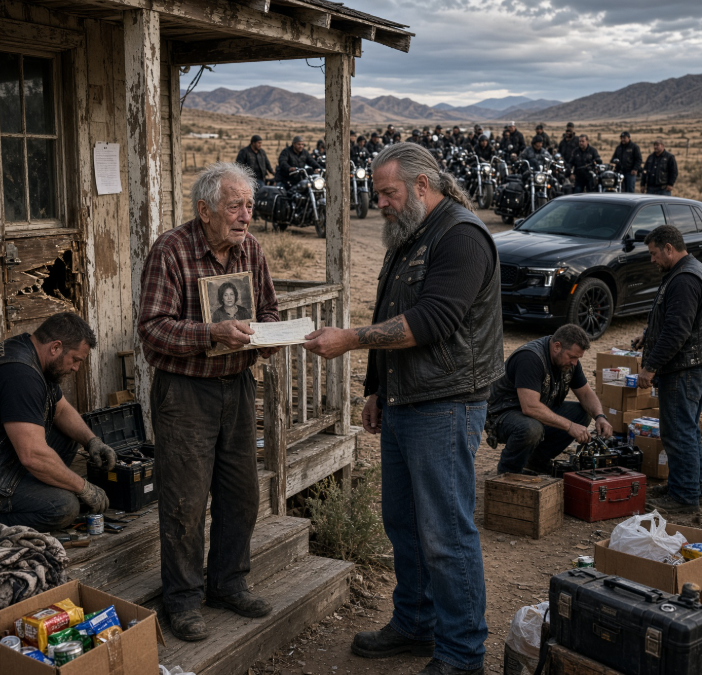
A framed wedding photograph of the two of us standing outside the courthouse in 1969, both of us laughing because the wind had almost taken her veil down Main Street.
I set the bag by the door.
Then I stood in the middle of the living room and listened to the house.
Old houses make sounds.
Pipes shifting.
Floorboards settling.
Wind under the eaves.
For decades, those sounds had meant home.
That morning, they sounded like goodbye.
I had an hour before the sheriff came.
I could not sit there waiting to be removed from my own life.
So I put on my faded olive drab field jacket, zipped it against the cold, and walked down the dusty highway toward Rusty’s Kettle.
Rusty’s Kettle was a twenty-four-hour diner on the edge of Route 66, the kind of place that survived because truckers knew where to find bad coffee before sunrise.
The sky was bruised purple, promising freezing rain.
The desert wind cut through my jacket and made my hands ache.
When I pushed open the diner door, the bell jingled cheerfully, which felt almost cruel.
Inside, the place smelled of burned coffee, old grease, and fried onions.
Only two booths were occupied.
Gregory Yates, the owner, sat behind the register pretending to read a newspaper. Gregory had always been a sour man, bald and narrow-mouthed, the kind who counted sugar packets as if customers were plotting against him.
Betty, the waitress, saw me and her face changed.
Pity.
I hated pity.
Word travels fast in a small desert town.
She slid a thick ceramic mug in front of my usual stool and poured coffee.
“On the house today, Artie,” she whispered.
I reached into my wallet and placed two of my dollars on the counter.
“I pay my way.”
“Arthur—”
“Always have.”
Her eyes filled.
She did not argue.
I wrapped both hands around the mug and breathed in the steam. It was not good coffee, but it was hot, and sometimes hot is enough.
Then the diner door slammed open.
The bell nearly broke itself against the glass.
A man stepped inside who looked like he had brought the highway in with him.
He was huge.
Six-foot-four at least, maybe more, with shoulders like a doorframe and arms thick beneath a soaked denim shirt. His beard was gray, jagged, and wet from the freezing rain. A scar cut through it. His boots were caked with mud.
Over everything, he wore a leather cut.
The patch on the back was impossible to miss.
Hells Angels.
Berdoo.
The diner went silent.
Gregory dropped his newspaper.
The biker did not look around.
He stomped to a corner booth, sat down heavily, and slapped one massive hand on the table.
“Black coffee,” he growled. “Two cheeseburgers. Fast.”
Betty moved like a woman trying not to shake.
For twenty minutes, the only sounds in Rusty’s Kettle were the ticking wall clock, rain against the glass, and the biker eating like a man who had not seen food in days.
When he finished, he stood and walked to the register.
Gregory wiped his hands on his apron even though they were dry.
“That’ll be eighteen fifty,” he stammered.
The biker reached into his leather vest.
Then frowned.
He checked another pocket.
Then his jeans.
His jaw tightened.
“Left my roll in my saddlebag,” he muttered. “Bike threw a chain a mile back. Had to walk through freezing mud. I’ll go get it.”
Gregory’s fear suddenly turned into bravery, the cheap kind men discover when they think they have someone cornered.
“Oh, no, you don’t.”
The biker’s eyes lifted.
Gregory grabbed the landline phone from under the counter.
“I know how you gangbangers work. You eat, you leave, and I never see you again. You pay now or I’m calling highway patrol.”
The biker leaned across the counter.
The room seemed to shrink.
“Listen to me, little man,” he said softly. “My name is Brick Dawson. I am sergeant-at-arms of the Berdoo charter. I don’t steal cheeseburgers. I said I’ll get my money.”
“I’m dialing,” Gregory snapped, though his voice cracked. “I want my eighteen dollars.”
The tension in that diner stretched so tight I could feel it in my teeth.
Brick Dawson’s fists closed.
I knew what was coming.
Men have tones before violence. I had heard them in Vietnam. I had heard them in steel mill bars after payday. I had heard them in hospital hallways when grief turned people into strangers.
I slid off my stool.
My knees popped.
“Put the phone down, Gregory.”
Every head turned.
I walked to the register and reached into my wallet.
I pulled out the last two one-dollar bills.
Then the two quarters.
I placed them on the counter beside the two dollars I had already paid for my coffee.
Six dollars and fifty cents.
Everything.
“It’s not enough,” I said. “But take it as a down payment. Let the man go get his wallet.”
Gregory stared at the money.
Then at me.
“Arthur, you’re getting evicted today. You don’t have a pot to piss in, and you’re paying for this criminal?”
I looked at Brick.
Then back at Gregory.
“He’s a hungry man on a cold day.”
“He’s a Hells Angel.”
“He is still a hungry man on a cold day.”
Gregory shook his head.
“You’re a fool.”
“Maybe.”
I pushed the money closer.
“I know what it feels like to be treated like you’re invisible when you’re down on your luck. Take the money. Don’t call the cops.”
Brick Dawson stood frozen.
He looked at the dollars.
Then at me.
I saw the anger fade from his eyes, replaced by something heavier.
Not softness.
Recognition.
He reached out and pushed the money back toward me.
“Keep your money, Pops. I don’t need charity.”
“It’s not charity,” I said.
My voice was steadier than my hands.
“It’s respect between men who know what a hard road feels like.”
He stared at me.
“Now go fix your motorcycle.”
For a long moment, nobody moved.
Then Brick gave me one sharp nod.
No thank you.
No speech.
Just that nod.
He turned and pushed his way out into the freezing rain.
The bell rattled behind him.
Gregory scooped the money into the register.
“He’s never coming back.”
“I know,” I said.
And I did know.
I had not done it because I expected repayment.
I had done it because I had spent my whole life trying not to become the kind of man who sees someone hurting and looks away.
I zipped up my thin field jacket and stepped out into the storm.
It was time to lose my home.
By the time I reached Elm Street again, freezing rain had soaked through my jacket. My knees hurt. My lungs burned.
Then I turned the corner and stopped.
The sheriff’s cruiser was already in my driveway.
It was not noon.
It was not even eleven-thirty.
Behind the cruiser sat a sleek black Mercedes SUV.
Leaning against the hood beneath an umbrella held by an assistant was Richard Croft.
Charcoal suit.
Gold watch.
Dry shoes.
Two locksmiths were drilling out my front deadbolt.
“You’re early,” I said, hurrying up the walkway. “Notice said noon.”
Croft checked his watch like I was late to inconvenience him.
“The bank took possession at nine, Mr. Higgins. I had a busy afternoon, so I expedited the lockout.”
“My things,” I said.
My voice broke on the word.
“I have a bag inside. Clothes. My wife’s photo. Please.”
Croft gave a bored nod to the deputy.
The young man looked miserable. Too young for the uniform, or maybe just too human for the job.
He stepped out carrying my black garbage bag and set it on the wet grass.
“The rest of the property now belongs to Croft Holdings to offset outstanding debt,” Croft said. “Furniture. Appliances. Tools. All remaining assets.”
“My tools?”
“Consider your account settled.”
I stared at him.
My tools had been in that garage for thirty years.
Martha’s dining table was inside.
Her quilt.
Her books.
The yellow mixing bowl she used every Sunday.
Croft’s expression did not change.
“I’d advise you to vacate before you’re cited for trespassing.”
Trespassing.
At my own home.
The deputy could not meet my eyes.
I looked at the porch swing where Martha and I used to drink lemonade. The rose bushes she had planted were brown from neglect, but still there. The curtains in the front window were ones she had chosen.
For one second, I thought I might drop dead from the pain of it.
Instead, I bent down.
Picked up the garbage bag.
And walked away.
I did not look back.
The first night of homelessness is something no one can understand until the world stops having a door for you.
All day, I wandered.
Not because I had somewhere to go.
Because stopping meant admitting there was nowhere.
The rain turned meaner as daylight faded. The temperature fell into the low thirties. My jacket had never fully dried. My socks were wet. My fingers ached around the garbage bag.
People I had seen in grocery stores for years looked away when they recognized me.
Some crossed the street.
I learned that homelessness settles on a man faster than dust.
One moment you are Arthur Higgins, veteran, widower, retired millworker.
The next you are something people avoid with their eyes.
Around ten that night, exhausted and shivering, I found an alley behind an abandoned auto parts store.
There was a large cardboard appliance box shoved behind a dumpster.
It was not shelter.
But it blocked some wind.
I crawled inside, wrapped Martha’s scarf around my neck, and pulled the framed wedding photo from the garbage bag.
The glass was fogged from cold.
Martha smiled through it anyway.
I held the frame against my chest and tried to sleep.
I prayed for warmth.
Then, because I was too tired to lie to God, I prayed I would not wake up.
Just after midnight, laughter woke me.
Harsh.
Young.
Wrong.
Glass crunched near the dumpster.
I froze inside the box.
Two shadows moved in the alley.
Men, though barely more than boys.
Jittery.
Desperate.
The kind of desperate that turns cruel when it needs money.
One kicked the box.
“Hey. We got a squatter.”
A hand grabbed my collar and dragged me into the cold.
My shoulder hit concrete.
Pain shot through me.
“Empty your pockets, old man.”
“I don’t have anything,” I gasped.
Hands patted me down.
Rough.
Impatient.
“There’s nothing,” one snapped.
The other tugged at my field jacket.
“This is military issue. Vintage. We can get forty bucks at surplus pawn.”
“No,” I said, trying to hold the zipper. “Please. Not the jacket.”
They yanked me up.
I was too old.
Too cold.
Too weak.
The jacket came off.
In the struggle, the garbage bag tore open.
My socks, dog tags, and Martha’s framed photograph spilled onto the wet concrete.
One of the men stepped backward.
His boot came down on the frame.
Glass shattered.
The sound went through me like a bullet.
“No!”
I lunged.
A boot caught my ribs.
I fell into mud.
“Keep quiet, grandpa.”
They ran, laughing, my jacket disappearing into the rain with them.
For a while, I could not move.
Not because of the pain.
Because something inside me had gone very still.
I crawled toward the broken frame.
My fingers shook as I picked through glass shards.
The photograph was bent, wet, smeared with dirt, but Martha’s face was still there.
I pressed it against my chest.
I sobbed.
Not politely.
Not quietly.
Like a man whose last wall had fallen.
I was seventy-eight years old.
Freezing.
Homeless.
Beaten.
Without money.
Without a coat.
Without the house I had promised Martha I would keep.
A numbness started in my feet.
Then my legs.
My jaw locked with shivering.
Somewhere in the back of my mind, a soldier remembered the word.
Hypothermia.
I closed my eyes.
“I’m coming, Martha,” I whispered, though I do not know if the words left my mouth. “I’m so tired.”
The wind moved through the alley like a hand smoothing a bedsheet.
The darkness began to pull me under.
Then the ground vibrated.
At first, I thought it was thunder.
A low hum through wet asphalt beneath my cheek.
Then it grew.
Deepened.
Multiplied.
The alley walls shook.
A dozen engines roared into the night, loud enough to wake the dead and maybe stubborn enough to keep one old man alive.
White headlights cut into the alley.
I forced my eyes open.
The light hurt.
Engines cut off in unison.
Boots hit pavement.
Shadows moved toward me.
Huge silhouettes in leather, framed by halogen light and rain.
At the front was a massive man.
He stepped beneath a streetlamp, and I saw the patches.
Hells Angels.
Berdoo.
Brick Dawson.
He knelt in the mud beside me.
“Well, I’ll be damned,” he said. “It’s the old man from the diner.”
I tried to speak.
My lips would not work.
My fingers clutched Martha’s photograph so tightly they had gone stiff.
Brick’s face changed.
He stripped off his heavy leather vest and draped it over my shoulders. It was warm from his body and smelled of rain, smoke, leather, and road dust.
To me, it smelled like survival.
“Iron Butt!” Brick barked without looking away from me. “Get the chase van up here. Now. Chopper, heat in the back. We’re losing him.”
Men moved.
Fast.
A black cargo van reversed down the alley, tires hissing over wet pavement. The rear doors opened to reveal blankets, a cot, orange heater glow, and men who looked far too dangerous to be so careful.
Brick slid his arms beneath me and lifted me like I weighed nothing.
I wanted to protest.
I wanted to say I could walk.
I could not.
He carried me into the van and laid me on a wool-lined cot.
Someone pushed a thermos of hot coffee into my hands. Someone else wrapped three blankets over me. Heat stabbed into my fingers and toes like needles as feeling returned.
I groaned.
“Hurts,” I managed.
“Good,” Brick said. “Means you’re alive.”
As my vision cleared, I saw the circle of men around me.
Hard men.
Scarred men.
Men the rest of the world crossed streets to avoid.
They watched me with a kind of protective anger that frightened and comforted me at the same time.
Brick sat on a metal crate near the cot.
He gently took Martha’s photograph from my hand.
Not snatched.
Took.
Carefully.
He wiped mud from her face with his thumb.
“She’s beautiful, Pops.”
Fresh tears burned my eyes.
“She was everything.”
His jaw tightened.
Then his gaze dropped to my shirt.
No jacket.
Bruised ribs.
Scraped cheek.
Mud on my hands.
“Who did this to you?”
“Two boys,” I said. “They jumped me. Took my military coat. Broke the frame.”
I swallowed.
“It was all I had left.”
The air in the van changed.
Not loud.
Worse.
Quiet rage settled over those men like weather.
Brick looked to a wiry biker near the doors.
“Dallas.”
The man straightened.
“Take four guys. Pawn shops. Drug dens on Fourth Street. Alleys. Find the coat.”
Dallas smiled without joy.
“And the boys?”
Brick’s voice dropped.
“Find them too.”
Five motorcycles roared away.
Brick turned back to me.
“You’re coming to the clubhouse. You need food, a hot shower, and a bed. Tomorrow you’re going to tell me how a man your age ends up dying in a cardboard box.”
I closed my eyes.
I was too tired to argue.
The Berdoo clubhouse sat on the edge of town behind fences, cameras, and a gate that looked like it belonged to a prison.
Inside, it was warmer than I expected.
Wood smoke.
Roasted meat.
Motor oil.
Men’s voices low in the background.
They gave me a private room in the back, a hot shower, and clothes that were too big but dry. Someone brought steak and eggs. Someone else taped Martha’s photograph between two pieces of clear plastic because the frame was gone.
I slept for twelve hours.
The kind of sleep that feels less like rest and more like being turned off.
When I woke, morning light came through a high barred window.
For several seconds, I did not know where I was.
Then I remembered.
The diner.
The house.
The alley.
Brick’s vest.
I walked slowly into the main room.
The clubhouse was quiet.
Brick sat at a massive oak table, polishing a knife with steady hands.
Beside him, neatly folded, lay my olive drab field jacket.
I stopped breathing.
“How?”
Brick did not look up.
“Dallas has persuasive manners.”
I rushed forward and touched the canvas.
It was damp but whole.
My name was still written inside the collar in Martha’s careful handwriting.
A. Higgins.
I pressed the jacket to my face.
Brick said, “The two boys who took it won’t bother anyone for a while.”
I did not ask for details.
I did not want them.
I slid the jacket on.
It felt like an embrace from an old friend.
“I don’t know how to repay you.”
Brick slammed the knife into its sheath.
“You don’t owe me a damn thing.”
He stood.
“But a man does owe you.”
I looked up.
“Tell me about Richard Croft.”
Over coffee strong enough to wake my younger self, I told him everything.
Martha’s cancer.
The denied treatments.
The reverse mortgage.
The missed payment.
The legal fees.
The eviction notice.
The sheriff arriving early.
The bag on the lawn.
Croft taking my tools, my furniture, my wife’s belongings, and calling it settlement.
Brick listened without interrupting.
A few other men gathered.
One of them wore glasses and a dress shirt beneath his leather cut. He looked less like a biker and more like a professor who had made several alarming life choices.
His name was Donovan.
When I mentioned the acceleration clause in Croft’s paperwork, Donovan’s eyes sharpened.
“Do you still have copies?”
“In the garbage bag,” I said. “If they didn’t get wet.”
“They’ll do.”
By the time I finished, Brick was smiling.
Not kindly.
“Legality is a funny thing, Arthur.”
I frowned.
“It didn’t feel funny yesterday.”
“That’s because men like Croft count on everyone thinking legal means right. It doesn’t. Legal just means someone wrote it down and dared you to fight.”
Donovan adjusted his glasses.
“And sometimes,” he added, “they write it down badly.”
Brick stood.
“Get your boots on, Pops.”
“Where are we going?”
“For a ride.”
Richard Croft’s office occupied the top floor of a glass building downtown.
I had been there once before, when I signed the papers.
That day, I had felt small in the elevator, small in the lobby, small in front of Croft’s desk.
This time, thirty motorcycles surrounded the building.
People stopped on the sidewalk.
Security guards spoke into radios and then wisely stepped back.
I rode in the chase van because Brick said if I fell off a motorcycle at seventy-eight, he was not explaining it to anyone.
We entered Croft’s building like a storm wearing boots.
The receptionist tried to stop us.
One look at Brick changed her mind.
By the time we reached the top floor, alarms had started somewhere, though I could not tell if they were security alarms or simply people panicking loudly.
Croft’s mahogany office door did not open so much as surrender.
Brick filled the frame.
Behind him were half a dozen bikers.
I stood in the middle of them, frail but upright.
Croft shot to his feet behind his polished desk.
He looked at me first.
Then the leather.
Then Brick.
“I’m calling the authorities.”
“Call them,” Donovan said smoothly.
He stepped forward and dropped a leather briefcase onto Croft’s desk.
The sound cracked through the office.
Donovan opened the case and pulled out files.
Lots of them.
“I reviewed your reverse mortgage contracts, Mr. Croft.”
Croft’s face tightened.
“Who are you?”
“A man who used to get paid far too much to destroy people like you in court.”
Donovan placed one document on the desk.
“You’ve been using an illegal acceleration clause buried in the fine print. It violates the State Elder Protection Act.”
Croft scoffed.
“That is an absurd interpretation.”
“No,” Donovan said. “It is a prosecutable one.”
He laid down another file.
“And Arthur Higgins is not your only victim. Twenty-three seniors. Same structure. Same clause. Same pattern. Missed balloon payments triggered under improper notice. Inflated legal fees. Asset seizure language exceeding statutory limits.”
Croft went pale.
“I don’t know what you think—”
“Wire fraud,” Donovan continued. “Mail fraud. Elder abuse. Predatory lending violations. Fraudulent conversion of personal property.”
Brick leaned over the desk.
The expensive room suddenly looked too small for him.
“Here’s what happens now.”
Croft’s mouth opened.
Brick kept talking.
“Option one. We wait outside your gated community. We follow your car. We stand across from every restaurant you eat in, every golf course you play, every fundraiser where you smile for pictures. And one day, when paperwork has failed everybody else, we have a very private conversation about respect.”
Croft gripped the edge of the desk.
Donovan cleared his throat.
“Or option two.”
He slid a document forward.
“You sign 442 Elm Street back to Arthur Higgins, free and clear. You return or compensate the personal property wrongfully retained. You write a fifty-thousand-dollar check for emotional distress and unlawful lockout conduct. Then you prepare for the Attorney General’s office, because that file has already been sent.”
Croft stared at the paper.
“This is extortion.”
Donovan smiled.
“No. This is settlement under pressure of evidence. You should know the difference.”
Brick leaned closer.
“If you ever foreclose on another senior with crooked paper,” he said softly, “I won’t bring Donovan next time.”
Croft signed.
His hand shook so badly the first signature looked like a lie detector test.
But he signed.
Deed transfer.
Settlement agreement.
Check.
Donovan inspected each page.
Then handed the papers to me.
I looked down at my name.
Arthur Higgins.
Owner.
Again.
My eyes blurred.
I tried to speak.
Could not.
Brick slapped one hand onto Croft’s desk.
“Look at him.”
Croft hesitated.
Brick’s voice hardened.
“Look at him.”
Croft looked at me.
“This man went to war before you were born,” Brick said. “He worked thirty-five years with hands you wouldn’t last one shift using. He loved his wife until the end. And you tried to take his last photograph, his tools, his house, and call it business.”
Croft swallowed.
I thought Brick would say more.
He did not.
Maybe some men are not worth complete sentences.
That afternoon, a thirty-motorcycle convoy escorted me home.
Home.
The word felt too large to trust.
The sheriff’s locks were still on the door.
Big Jim, who I had not met until that day, removed them with bolt cutters so large they looked theatrical.
Tommy, another biker, installed reinforced steel deadbolts before sunset.
Someone repaired the porch step.
Someone found my tools in a storage truck and carried them back into the garage.
Two men brought in groceries.
Real groceries.
Eggs.
Coffee.
Bread.
Soup.
Bacon.
Oranges.
A whole roasted chicken.
One biker fixed the heater.
Another cleaned mud off the porch swing.
Donovan taped a copy of the deed to my kitchen table and said, “Do not lose this.”
I said, “Yes, sir,” because old habits die hard around men with folders.
At dusk, I stood on the porch holding Martha’s photograph, now taped inside a simple new frame someone had bought from a dollar store.
Not the old frame.
But her smile survived.
Brick leaned against his motorcycle, smoking a cigarette.
His leather vest was back on his shoulders.
I walked down the steps slowly.
“I spent my last money on you,” I said.
He blew smoke away from me.
“You spent your last money like a man.”
“I thought you’d never come back.”
“I did come back,” he said. “You were gone.”
I looked at him.
He looked uncomfortable for the first time.
“Went back to the diner with my wallet. Gregory told me you’d been evicted. Betty told me where you lived. Saw Croft’s locks on the door. Figured I’d ask around.”
“You found me in an alley.”
His jaw tightened.
“Almost too late.”
I nodded.
“But not too late.”
“No,” he said. “Not too late.”
For a while, neither of us spoke.
Then I asked, “Why?”
Brick frowned.
“Why what?”
“Why do all this for me?”
He looked toward my house.
My little old house with the porch swing, the roses, the bad paint, the memories.
Then back at me.
“Because you had nothing,” he said. “And you still acted like a man with something to give.”
That undid me.
I sat down on the porch step before my knees could fail.
Brick let me cry without saying a word.
The next weeks passed strangely.
News traveled.
Of course it did.
A convoy of Hells Angels escorting an evicted veteran back into his home is not the kind of thing a desert town keeps quiet.
Some people called it justice.
Some called it intimidation.
A few called it dangerous.
I called it breakfast.
Because that is where it started.
With coffee.
Cheeseburgers.
Six dollars and fifty cents.
Respect between men who knew hard roads.
Croft Holdings became the subject of investigations. Donovan’s file did its work. Other seniors came forward. Some got homes back. Others received settlements. Not all. The world is rarely that clean. But enough.
Enough to matter.
Betty visited me the following Sunday with a pie from the diner and tears in her eyes.
Gregory sent nothing.
That was fine.
I did not want his pie.
The Hells Angels did not disappear from my life.
Brick stopped by sometimes.
Never announced.
Just the rumble of a motorcycle outside, then his boots on my porch.
He fixed my fence once without asking.
Another time he brought a space heater and claimed it had been “taking up room” at the clubhouse.
At Christmas, three bikers arrived with firewood stacked in a pickup truck.
“I didn’t order this,” I said.
One shrugged.
“Wrong address then.”
They unloaded it anyway.
When my eighty-first birthday came, I woke to the sound of engines.
I opened the front door and found thirty motorcycles lining Elm Street.
Brick stood on the porch holding a cake.
It said:
HAPPY BIRTHDAY POPS
The frosting motorcycle on top looked terrible.
I pointed at it.
“Who decorated that?”
“Dallas.”
“Tell him not to quit crime for pastry.”
Brick laughed so hard Martha’s rose bushes seemed to shake.
I never became a biker.
I never wanted to.
I was an old widower who liked quiet mornings, weak knees, and strong coffee.
But somehow, those men became part of my life.
They called before big storms.
They checked the roof.
They put my trash cans back when wind blew them over.
When my doctor told me I needed someone to drive me home after a procedure, Brick appeared in a pickup truck and said, “Don’t make it weird.”
I made it weird by thanking him six times.
He hated that.
The strangest thing about being saved is that life afterward becomes ordinary again.
That is the gift.
Not drama.
Not headlines.
Ordinary.
I got to wake up in my own bed.
Make coffee in my own kitchen.
Sit on the porch swing Martha loved.
Trim roses badly.
Yell at the television.
Fold laundry.
Pay the electric bill.
Complain about my hip.
Look at the wedding photo without fearing it was the last thing I had left.
People think miracles should glow.
Mine sounded like motorcycles and smelled like coffee.
A year after the eviction, I walked to Rusty’s Kettle again.
Not because I had nowhere else to go.
Because I wanted to.
The bell jingled.
Betty looked up and smiled.
Gregory looked older.
Maybe guilt ages a man.
Maybe business taxes.
I sat at my usual stool.
Betty poured coffee.
“On the house, Artie.”
I placed two dollars on the counter.
“I pay my way.”
She smiled.
“I know.”
A few minutes later, the door opened.
Brick stepped in.
Same boots.
Same vest.
Same scarred beard.
He sat beside me at the counter.
Gregory went pale.
Brick looked at him.
“Black coffee. Two cheeseburgers.”
Gregory nodded so fast I thought his head might come loose.
Brick leaned toward me.
“You paying this time too, Pops?”
I sipped my coffee.
“Depends. You leave your roll in your saddlebag again?”
He smiled.
It changed his whole face.
“No. But I did bring something.”
He reached into his vest and placed something on the counter.
A small framed photograph.
My old wedding picture.
The original frame had been destroyed, but the photo had been cleaned, flattened, and placed behind new glass in a polished wooden frame.
I stared at it.
“Martha deserved better than dollar-store plastic,” Brick said.
I ran one finger over the frame.
“You didn’t have to.”
“I know.”
That was the closest he usually came to saying feelings.
It was enough.
I brought that frame home and placed it on the mantle.
Sometimes I still talk to Martha.
I tell her about the neighborhood.
About Brick.
About how the roses are still trying.
About how I almost came to her that night in the alley, and how a pack of men the world feared arrived instead.
I think she would have liked them.
Not all at once.
Martha was sensible.
She would have hidden the good towels first.
But eventually, she would have poured coffee and asked who wanted eggs.
And they would have loved her.
Everyone did.
I am eighty-four now.
My knees are worse.
My hands shake more.
The house needs paint again.
The porch swing creaks in a way that suggests it may be considering retirement.
But I am still here.
That matters more than I can say.
Richard Croft thought he could erase an old man with paperwork.
He thought a house was just an asset.
He thought grief made me weak.
Maybe it did.
For a while.
But grief also taught me the value of small mercies.
A scarf.
A photograph.
A cup of coffee.
Six dollars and fifty cents.
A man can be almost empty and still choose to give.
That choice saved my life.
Not because I knew it would.
Because I did not know.
That is the point.
Kindness is only kindness when you release it without a receipt.
I gave a Hells Angel my last coffee money because he was hungry, cold, and being treated like a criminal before he had done anything wrong.
I did not know his name would become my protection.
I did not know his brothers would drag me back from the edge of death.
I did not know they would return my jacket, my home, my dignity, and a future I had already surrendered.
All I knew was that he needed help in a hard moment.
So I helped.
And when my hard moment came, thunder came with it.
If you ever pass through Barstow and see an old man sitting on a porch at 442 Elm Street, drinking coffee beside rose bushes that refuse to die, that might be me.
If you see motorcycles parked outside now and then, do not worry.
They are not trouble.
They are family.
And if one of them asks for coffee, pour it strong.
You never know who the road has brought to your door.
You never know when the man everyone else fears is the one who will stand between you and the wolves.
And you never know how far one small act of respect can travel when it rides away on two wheels and remembers your name.








