I Gave a Bleeding Biker a Ride—Months Later, Sixty Hells Angels Came Back for My Daughter
PART3:
“Name’s Leonard Hayes. They call me Bull. You open that passenger door or you drive away right now and forget you ever saw me. But if you stay, we move now.”
Before I could answer, light flashed in my rearview mirror.
Headlights.
Far back.
Coming fast.
Too fast for a casual driver on an empty road.
Bull saw them too.
“They’re coming.”
That should have been the moment I floored it and left him.
Instead, my hand reached across the cab before my brain finished arguing.
I popped the passenger door.
“Get in.”
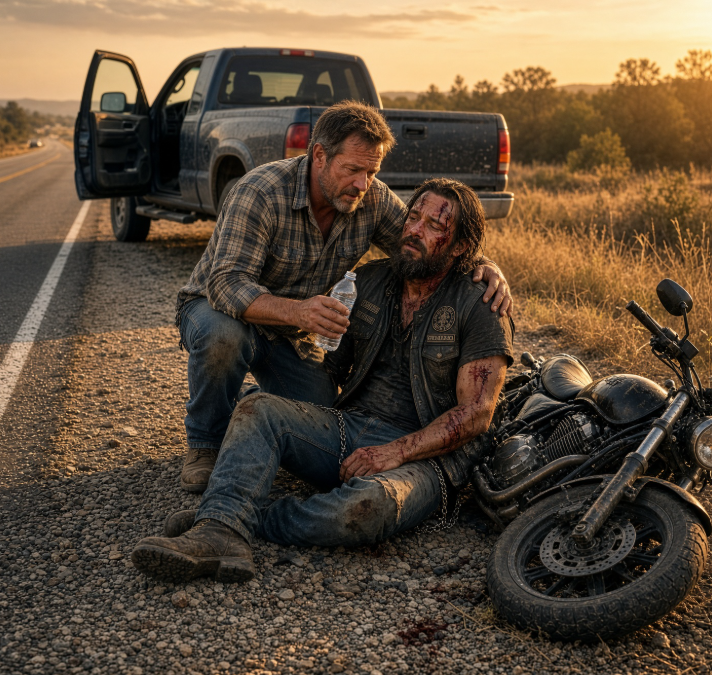
Bull climbed into my truck with a grunt, bringing the smell of leather, motor oil, gunpowder, and blood with him. The whole Silverado dipped under his weight.
The door slammed.
I threw the truck into drive and hit the gas.
The old V8 roared like I had woken it with a cattle prod. Gravel sprayed behind us as we shot back onto the highway.
My heart pounded so hard I could hear it over the engine.
“Who’s following us?” I asked.
“Mongols.”
I looked over.
He pressed one gloved hand to his side.
“They ambushed me at a gas station back in Verdi. Thought I lost them in the canyon.”
In the mirror, the headlights grew larger.
I could see the shape now.
A dark heavy-duty SUV.
Built like something that could run a man off the road and keep going.
“My truck isn’t built for a high-speed chase,” I said.
Bull reached into his waistband and pulled out a matte black pistol, resting it on his thigh.
“Then don’t run.”
That answer did not comfort me.
But fear has a strange way of sharpening memory.
I knew that highway.
Sarah and I used to drive out there years ago to watch meteor showers. There was an old mining access road about a mile ahead, half-hidden behind a broken wooden sign and a cluster of dead Joshua trees.
If you did not know it was there, you would miss it.
I looked at the mirror.
The SUV was closing fast.
“There’s an access road ahead,” I said. “If I kill the lights and turn hard, they might blow right past us.”
Bull looked at me.
“Do it.”
My hands tightened around the wheel.
The sign appeared.
Barely.
A leaning shadow in the dark.
“Hold on.”
I killed the headlights.
The cab plunged into black.
Then I ripped the steering wheel right.
The Silverado left the asphalt like a kicked animal. Tires hit dirt, slid, caught, and bounced hard enough to slam my shoulder into the door. Bull grunted but did not cry out. The truck bucked over ruts and loose stone. For one terrifying second, I thought we were going into a dry wash.
I fought the wheel.
The truck fishtailed.
Then the rock outcropping appeared.
I steered behind it, past the dead Joshua trees, threw the truck into park, and killed the engine.
Silence crashed over us.
No headlights.
No engine.
No breathing except ours.
The hot metal ticked beneath the hood.
A few seconds later, the SUV thundered down the highway.
It blew past the access road without slowing.
Red taillights vanished into the dark.
I exhaled so hard my whole body shook.
My hands would not stop trembling.
Bull chuckled.
It sounded painful.
“You drive like a madman.”
I leaned my forehead against the steering wheel.
“I’m a mechanic.”
“Could’ve fooled me.”
“Are they gone?”
“For now.”
He pressed harder against his wound.
“What’s your name?”
“Arlen.”
“Full name.”
I looked at him. “Arlen Gable.”
Bull nodded once.
“Well, Arlen Gable, you just saved my life.”
I did not know what to say to that.
For the next thirty minutes, we moved through desert backroads under moonlight. Bull gave directions in short sentences. Turn left. Slow down. Kill the lights near the ridge. Keep going. Stop at the gate.
The place he led me to sat outside the county line.
A fortified compound.
Heavy iron gates.
Security cameras.
A dozen custom choppers parked out front.
Two armed men stepped from the shadows as I rolled up.
I nearly lifted both hands from the steering wheel.
Bull rolled down the passenger window and gave one short nod.
The men lowered their weapons immediately.
The gate opened.
I drove inside slowly, feeling like I had crossed into a world I was not supposed to see.
Bull opened the door and climbed out with a grunt. Two men hurried toward him, but he waved them off long enough to turn back to me.
He reached into his vest and pulled out a battered, grease-stained business card.
The front was blank.
On the back, written in thick black marker, was a phone number.
“The club takes care of its own, Arlen,” he said.
“I’m not your own.”
“You are now.”
I stared at him.
“You didn’t see anything tonight,” Bull continued. “But you did something big. If you ever find yourself in a corner you can’t fight out of, you call this number. You ask for Bull.”
I took the card.
“I understand.”
His eyes held mine.
“No. You don’t. Not yet. But keep it safe.”
He slammed the door.
The gate opened behind me.
I drove away shaking, convinced I would never see Leonard “Bull” Hayes or the Hells Angels again.
I was wrong.
Six months passed.
Winter thawed into a brutal Nevada summer, and my life did not get easier.
The bank was still circling.
The shop was barely surviving.
Lacy was talking about colleges in a careful way, like she did not want to want anything too expensive.
But money stopped being my worst problem when Vanguard Holdings came to town.
At first, Vanguard looked like progress.
That was how the city council sold it.
A luxury casino and resort complex. Jobs. Tourism. Renovation. Investment. New roads. New restaurants. New life for a town that had been drying up one business at a time.
That was the story told at public meetings.
The truth had a name.
Harrison Cole.
Cole was Vanguard’s local acquisitions director, a slick man in tailored suits who smiled like he had practiced in mirrors. He had perfect hair, perfect shoes, and eyes that never warmed no matter how friendly his mouth became.
To him, people were not people.
They were parcels.
Obstacles.
Numbers waiting to be erased.
My shop sat directly where Vanguard wanted the grand entrance to its casino complex.
They needed my land.
At first, the offer looked generous.
Cole came to my shop himself, stepping carefully around oil stains as if poverty might splash onto his shoes.
“Mr. Gable,” he said, placing a folder on my desk. “This is a very strong offer.”
I opened it.
The number made my breath catch.
For five seconds, I imagined saying yes.
No more debt.
No more calls.
No more lying awake wondering which bill could wait.
Then reality settled.
It was not enough to start over.
Not enough to buy another shop.
Not enough to pay everything, move everything, rebuild everything, and keep Lacy secure.
More than that, this shop was the last physical place Sarah and I had built together.
I closed the folder.
“I appreciate the offer,” I said. “But I’m not selling.”
Cole’s smile stayed.
His eyes changed.
“Think carefully.”
“I have.”
He stood.
“Most people regret standing in the way of progress.”
I thought that was just something men like him said when they did not get what they wanted.
It was not.
It was a warning.
The harassment started small.
A customer’s tires punctured overnight.
A fake complaint brought the fire marshal, who suddenly discovered thousands of dollars in code violations that had not existed during inspection season.
Then another complaint.
Then suppliers delayed orders.
Then two regular customers quietly told me someone had warned them that bringing vehicles to my shop could become “unfortunate.”
I went to the police.
Detective Jenkins sat across from me, a man I had known for ten years, and refused to look me in the eye.
“Arlen,” he said, sliding the photos back toward me, “without camera footage, this is hard to prove.”
“These aren’t kids.”
“I didn’t say they were.”
“You know who Knox is.”
His face tightened.
Everybody knew Knox.
Local thug.
Street gang leader.
A man Vanguard did not officially know but somehow always benefited from.
Jenkins sighed.
“Maybe you should consider taking Cole’s offer.”
That was when I understood.
The law was not coming.
Maybe not because every cop was corrupt.
Maybe because money had made them cautious.
Maybe because Cole knew which people to pressure.
It did not matter.
The result was the same.
I was alone.
Then they crossed the line from property to blood.
I was at the shop late, trying to rebuild a transmission by hand because I needed the money badly enough to ignore my exhaustion. Lacy was home, supposedly safe.
My phone buzzed.
Unknown number.
I answered with grease on my hands.
“Arlen Gable?”
The voice was cold and amused.
I recognized it immediately.
Knox.
“What do you want?”
“Just admiring your home decor, Artie.”
My stomach dropped.
“What did you say?”
“Your daughter’s name is Lacy, right? Pretty girl. Looks like her mom.”
I stood so fast the stool behind me fell.
“Where are you?”
“In your neighborhood. Nice kitchen. She making tea? Left window’s unlocked, by the way.”
My blood turned to ice.
“If you touch her—”
“Relax. I’m not touching her tonight.”
Tonight.
That word split me open.
“I left a message on your porch. You have forty-eight hours to sign Vanguard’s paperwork. If you don’t, next time I won’t just look through the window.”
His voice dropped.
“I’ll burn the house down with both of you inside.”
The line went dead.
I ran.
I do not remember grabbing my keys.
I barely remember the drive.
I broke every speed limit in town, heart hammering, mind filled with every horrible image a father can imagine in the time it takes to cross a city.
When I skidded into the driveway, I nearly tore the truck door off getting out.
“Lacy!”
She met me in the hallway, confused and frightened.
“Dad? What happened?”
I grabbed her shoulders.
“Are you hurt?”
“No. What are you talking about?”
I pulled her into my arms so hard she made a little sound of surprise.
Then I saw the front door.
Something was nailed to it.
At first, my brain refused to understand what I was seeing.
A dog collar.
The collar belonged to a neighborhood stray Lacy had been feeding for months. A sweet old mutt she called Rusty because of his coat.
The collar was soaked in blood.
Pinned beneath it was the final Vanguard purchase contract.
Lacy screamed.
I moved her away before she saw more.
That night, I did not sleep.
I sat in the dark living room with a hunting rifle across my lap while Lacy slept behind a locked bedroom door. Every passing car made my muscles tighten. Every creak of the house sounded like a footstep.
I was a mechanic.
A father.
A widower.
I was not a killer.
I had no money.
No army.
No police.
Harrison Cole and Knox held every card.
By dawn, I knew I was going to have to sign.
I had lost.
The thought broke something in me.
I sat there with tears sliding down my face, dropping onto the cold steel of the rifle barrel, ashamed not because I was crying but because I could not protect the only person left who mattered.
Then a memory rose from the dark.
Bull’s voice.
The club takes care of its own.
I stood as if someone had pulled me by a wire.
I went to the hall closet and dug through the winter jacket I had not worn in months. My hands shook as I searched the inside pocket.
There it was.
The battered card.
Blank front.
Black number on the back.
I stared at it for a long time.
Calling it was madness.
I would be inviting violent men into my life.
But I looked at the bloodstained contract still pinned to my front door and realized something.
Monsters were already in my life.
I just needed bigger ones.
I dialed.
The phone rang three times.
“Yeah.”
“I need to speak to Bull,” I said. My voice sounded thin and strange. “Tell him it’s Arlen Gable from the highway.”
Silence.
Then muffled voices.
A minute later, the voice came on.
Gravel over concrete.
“Arlen.”
I closed my eyes.
“Bull.”
“You took your time.”
I tried to speak.
Couldn’t.
The fear and exhaustion finally caught up to me.
“I’m in a corner,” I said.
His voice changed.
No jokes.
No warmth.
Only focus.
“What happened?”
“They’re coming for my daughter.”
On the other end, everything went still.
“Where are you?”
Thirty minutes later, three heavy knocks rattled the reinforced door of my shop.
I had locked Lacy in the back office with strict orders not to open the door for anyone but me. She argued. I ordered. She cried. I hated myself.
I gripped a tire iron and opened the shop door.
Bull stood outside.
He looked healthier than he had on the highway. Bigger somehow. Like a wall wearing leather.
Beside him stood a younger biker with a scar along his jaw. He introduced himself only as Jackson.
They stepped inside.
I told them everything.
The offers.
The threats.
The vandalism.
The police.
Cole.
Knox.
The call about Lacy.
The bloody collar.
When I slid the collar and the contract across the workbench, Bull stared at them for a long time.
He did not flinch.
Did not swear.
Did not perform outrage.
His eyes simply went cold.
“They targeted your little girl,” he said.
Not a question.
A line being drawn.
“Knox gave me forty-eight hours,” I said. “Deadline is tomorrow at noon. Cole wants to bulldoze this place by Monday. They have the money, the cops, and the muscle. I don’t know how to stop them.”
Jackson gave a humorless laugh.
Bull picked up the contract, folded it carefully, and tucked it inside his cut.
“You did me a solid when the whole world would’ve driven past,” he said. “You saved my life.”
“I just gave you a ride.”
“No,” Bull said. “You stopped when stopping could have killed you. That matters.”
I swallowed.
“What do we do?”
“Tomorrow morning, you open your shop at eight like you always do.”
I stared at him.
“What?”
“You make coffee. You keep Lacy in the back office. You do not sign anything. When Knox and Cole show up, let them talk.”
“That’s your plan?”
“No,” Bull said. “That’s your part.”
“And then?”
For the first time that night, Bull smiled.
It was a terrible smile.
“Then you let us handle negotiations.”
Friday morning came hot enough to make the asphalt shimmer.
I opened the shop at eight.
I made coffee.
I checked every lock twice.
I put Lacy in the reinforced back office with water, snacks, her phone, and instructions not to come out no matter what she heard.
She stood in the doorway, pale and angry.
“Dad, tell me what’s happening.”
“I’m handling it.”
“You always say that when you’re scared.”
I did not have an answer.
She stepped forward and hugged me.
“Don’t die,” she whispered.
That did something to my knees.
“I’m going to do my best.”
“That’s not funny.”
“I know.”
I closed the door and locked it from the outside.
Noon approached slowly.
Every tick of the wall clock sounded like a hammer.
I stood near the open bay doors with a wrench in my hand, sweating through my work shirt, trying to believe Bull would come.
Eleven fifty-eight.
Nothing.
Eleven fifty-nine.
Dust rose at the edge of the road.
Three matte black utility vans turned into my lot and came in fast.
Behind them was a silver Mercedes-Benz S-Class, polished so bright it looked obscene against the dirt.
The vehicles stopped in a semicircle, blocking my exits.
The van doors slid open.
Knox stepped out first, baseball bat in one hand, grin on his face.
A dozen men followed with chains, crowbars, aluminum bats, and the loose posture of men who enjoy scaring people who cannot fight back.
Then Harrison Cole stepped out of the Mercedes.
Navy suit.
Perfect shoes.
Smug smile.
Like he had come to watch paperwork sign itself.
Knox swaggered forward.
“Noon, Artie. Time’s up.”
“My name is Arlen.”
He tapped the bat into his palm.
“Don’t care.”
Cole leaned against his car.
“Mr. Gable,” he called. “Let’s not make this ugly.”
I almost laughed.
The bloody collar flashed in my mind.
Lacy behind the office door.
Sarah’s handwriting in the old files.
The shop sign she painted.
My fear did not leave.
But something rose beside it.
“I’m not selling,” I said.
Knox’s smile disappeared.
Cole’s face hardened.
“This is your final chance,” Cole said.
“No.”
Knox spit on the ground.
“Wrong answer, old man.”
He lifted one hand.
His men tightened around their weapons.
“Tear this place down,” Knox barked. “And drag the kid out of the back.”
I raised the wrench.
It was stupid.
A wrench against a dozen men.
But there are moments when a man stops calculating and simply stands where he must.
If they wanted Lacy, they would have to walk over me.
The first thug stepped forward.
Then the ground began to tremble.
At first, I thought I imagined it.
A low vibration through the soles of my boots.
Knox paused.
His men looked toward the road.
The sound grew.
Deep.
Mechanical.
Rolling.
A thunder that did not belong to weather.
Then they came over the hill.
Motorcycles.
Not three.
Not ten.
A full column of them.
Chrome flashing in the sun.
Black leather.
Death head patches.
Engines roaring so loud the air itself seemed to tear open.
Sixty Hells Angels rode in formation down the two-lane highway toward my shop.
The noise swallowed everything.
Knox tried to shout.
Nobody heard him.
The bikes turned into my lot like a black wave.
They did not park politely.
They swarmed.
Engines roaring.
Dust rising.
They circled the vans and the Mercedes, corralling Knox, his thugs, and Cole into the center of my own lot until the men who had come to trap me realized they were trapped instead.
Then, all at once, sixty engines cut off.
The silence that followed was worse.
Dust drifted through the heat.
A wall of men in black leather surrounded the hired muscle.
Nobody moved.
From the front of the pack, Bull stepped off his motorcycle.
He ignored Knox.
Ignored Cole.
Ignored the bats and chains.
He walked straight to me as if we were meeting for coffee.
“Having pest control issues, Arlen?”
A laugh broke out of me.
Not because it was funny.
Because the alternative was collapsing.
“Something like that.”
He clapped a heavy hand on my shoulder.
“You’re doing fine.”
Knox took one step forward, trying to save face.
“Hey! This ain’t your business, Angels. We’re doing corporate eviction work. Back off before you get yourselves in trouble.”
Bull turned slowly.
His expression changed.
The warmth vanished.
“This man,” Bull said, voice carrying across the silent lot, “is under the protection of the Hells Angels Motorcycle Club.”
Knox swallowed.
“This shop is our shop now,” Bull continued. “You touch one blade of grass on this property, we bury you under it.”
Nobody laughed.
That made it worse.
Cole pushed away from the Mercedes, trying to recover the voice that had probably bullied half the town.
“Do you people have any idea who I represent?”
Another biker stepped forward.
He did not look like the others at first glance.
Gray suit beneath the leather cut.
Clean shoes.
Silver watch.
Briefcase in one hand.
Bull leaned toward me.
“That’s Wyatt Sinclair. Don’t let the suit fool you. Meanest man here.”
Wyatt walked to the Mercedes and tapped politely on the window.
Cole hesitated.
Then lowered it.
“Harrison Cole,” Wyatt said pleasantly. “My club does a lot of networking.”
He opened the briefcase and removed a thick manila folder.
Then he dropped it into Cole’s lap.
“We have friends in banking. Friends in real estate. Friends in places where documents go when men like you think they’ve buried them.”
Cole opened the folder.
The color left his face.
Wyatt continued in the same pleasant tone.
“Offshore shells. False acquisition invoices. Payments to city officials. Illegal pressure tactics. Bribes tied to inspection schedules. Interesting reading.”
Cole’s mouth opened.
Nothing came out.
“One copy is waiting at the FBI field office,” Wyatt said. “Another is addressed to Vanguard’s board in New York. A third goes to three journalists who hate each other enough to race to publication.”
Cole looked at Bull.
Then at the sixty bikers.
“What do you want?”
Wyatt smiled.
“Clarity.”
He handed Cole another document.
“Vanguard will announce immediate suspension of the Reno resort project pending internal review. You will sign a non-interference agreement regarding Arlen Gable, Lacy Gable, Gable Auto & Repair, and this property. You will not contact him, threaten him, inspect him, sue him, vandalize him, pressure him, or send any more discount goblins to wave baseball bats at him.”
One of Knox’s men looked down at his bat.
Wyatt’s smile widened.
“If Mr. Gable gets a flat tire he did not cause himself, I make the phone call. If his daughter receives one strange text, I make the phone call. If someone sneezes aggressively near his mailbox, I make the phone call.”
Cole’s hands shook.
“You can’t—”
Wyatt leaned closer.
“I can.”
Bull spoke from behind him.
“And if the law takes too long, we’ll still be here.”
Knox looked around at the circle of Hells Angels.
His confidence was draining by the second.
Cole turned on him.
“Get your men out of here.”
Knox stared.
“What?”
“Now!”
The retreat was ugly.
Bats were lowered.
Chains disappeared.
Thugs scrambled back into vans, suddenly fascinated by not dying on a mechanic’s gravel lot.
Cole reversed his Mercedes so fast he nearly clipped one of his own vehicles.
Within minutes, the men who had come to destroy my life were gone in a cloud of dust.
I stood in the middle of the lot, wrench still in my hand, unable to move.
The pressure that had been crushing me for months lifted so suddenly I almost did not know how to breathe without it.
Bull stepped in front of me.
I tried to speak.
Nothing came out.
Then tears filled my eyes.
“I don’t know how to repay you.”
Bull pulled me into a hug so hard my ribs complained.
“You already paid your tab on the highway.”
“I saved one man.”
“Exactly,” he said. “And good men shouldn’t have to fight wolves alone.”
The back office door opened.
Lacy stood there, white-faced, eyes wide.
She looked at the motorcycles.
The leather.
The men.
Then me.
“Dad?”
I went to her immediately.
“You okay?”
She nodded, though she was shaking.
“What just happened?”
I looked at Bull.
Bull looked at the lot full of bikers.
“Pest control,” he said.
For the first time in days, Lacy laughed.
It came out half-hysterical, half-relieved, but it was laughter, and I would have paid anything to hear it.
The Hells Angels did not leave.
That was the part no one expected.
They stayed.
Not to drink.
Not to threaten.
Not to posture.
They unpacked tools.
Real tools.
Impact drivers.
Paint sprayers.
Welding gear.
Electrical testers.
Replacement hardware.
Someone made a supply run. Someone else ordered food. Two bikers inspected the damaged bay doors. Another group started cleaning graffiti off the wall. Wyatt sat in my office making phone calls that sounded too polite to be legal and too effective to question.
I watched sixty men in leather cuts repair my shop like they had been sent by some strange, loud, tattooed church.
They fixed the bay doors Knox’s men had damaged.
Repainted the vandalized walls.
Rewired the security cameras.
Reinforced the back office door.
Replaced smashed diagnostic equipment with money collected from men who did not look like they carried receipts.
I tried to argue.
Bull shut that down immediately.
“You insulting my brothers?”
“No.”
“Then let them work.”
By Saturday afternoon, Lacy had stopped hiding in the office.
At first, she stayed close to me.
Then one of the bikers, a massive man named Tiny because apparently irony was a club requirement, asked if she wanted to sit on his bike.
She looked at me.
I looked at Tiny.
Tiny held up both hands.
“Engine cold. Kickstand down. No funny business.”
Lacy climbed on.
For the first time since Sarah died, I saw my daughter look like a kid instead of a child trying not to worry her father.
Someone took a photo.
Lacy smiled.
I had to walk into the office for a minute after that.
Not because I was sad.
Because relief can hit as hard as grief when you have been carrying fear too long.
Sunday afternoon, the shop looked better than it had in years.
Fresh paint.
Working cameras.
Repaired doors.
New equipment.
A line of Harleys outside like a steel fence.
The men sat on the garage floor eating pizza from boxes spread across a workbench.
Lacy sat between Bull and Jackson, telling them about school while Bull carefully handed her the best slice from a new box like he was presenting something sacred.
I stood by the office door and watched.
Sarah should have been there.
That thought came suddenly and hurt the way it always did.
But for once, it did not come alone.
I could almost hear her voice.
Look at this, Arlen. You collect strays too.
Bull noticed me watching and stood.
He walked over.
“You all right?”
“No,” I said honestly. “But better.”
He nodded.
“That counts.”
I looked around the shop.
“My wife would’ve liked this.”
“The paint?”
“The noise.”
Bull smiled.
“Good woman.”
“The best.”
We stood in silence for a while.
Then he said, “Cole won’t bother you again.”
“You sure?”
“Wyatt is sure. That’s worse.”
“What about Knox?”
Bull glanced toward the road.
“Knox discovered retirement.”
I decided not to ask.
A week later, Vanguard publicly suspended the resort project.
Two city officials resigned within a month.
Detective Jenkins took early retirement.
Harrison Cole disappeared from local business circles and reappeared later in an article with the word investigation in the headline.
Wyatt mailed me a copy of the non-interference agreement in a folder so thick it barely fit in my desk drawer.
Lacy taped a photo of herself on Tiny’s motorcycle above the office coffee machine.
The shop survived.
Not easily.
Nothing good ever comes easily.
But customers came back. Then more came after word spread that Gable Auto was “protected.” I hated that wording at first. Then I learned not to argue with full appointment books.
The Hells Angels became a strange part of our lives.
Not daily.
Not normal.
But present.
Bull stopped by sometimes for oil changes he clearly did not need.
Jackson brought bikes in with mysterious “engine noises” that disappeared whenever Lacy made coffee.
Tiny showed up every Christmas with a box of toys for the charity drive and one ridiculous ornament for our shop tree.
Wyatt sent legal reminders twice a year, each beginning with “Arlen, stop signing things without reading them.”
I never did figure out whether the club considered me a friend, a debt repaid, or a stray dog they had decided to keep.
Maybe all three.
Years later, people still ask me if I regret stopping that night on I-80.
They ask because of the danger.
Because of the blood.
Because of the Hells Angels patch.
Because decent people are taught to fear men who look like Bull.
I understand that.
Fear has kept plenty of people alive.
But so has stopping.
That is the part we forget.
Sometimes mercy looks foolish until the day it returns with engines loud enough to shake the ground.
Sometimes the man bleeding on the roadside becomes the only reason your daughter sleeps safely months later.
Sometimes a single choice made in the dark becomes a bridge you do not know you are building until you have to cross it.
I still have the business card.
The blank front.
The number in black marker.
It sits in the top drawer of my desk beside Sarah’s old mug and the first dollar the shop ever made.
I do not need to call it anymore.
That is not why I keep it.
I keep it to remember the night I almost kept driving.
The night I almost let fear make the decision.
The night a wounded stranger climbed into my truck and brought a brotherhood into my life.
People think the favor was repaid when sixty motorcycles rolled into my lot.
But that is not the full truth.
Bull did not just save my shop.
He reminded me that I was not as alone as grief and money and fear had made me believe.
He reminded me that good men sometimes come wearing the wrong uniforms.
And that wolves are not nearly as brave when the sheep they cornered suddenly have an army.
So, yes, I gave a stranded biker a ride.
Months later, sixty Hells Angels returned the favor.
But the real story is simpler than that.
One night, I stopped for a man everyone else would have passed.
And when my whole world was about to be taken from me, he came back to prove he had never forgotten.








