I Found Six German Shepherds Collapsed Outside My Cabin—Then the Tag Beneath the Oldest Dog’s Collar Led Back to the Marine I Couldn’t Save
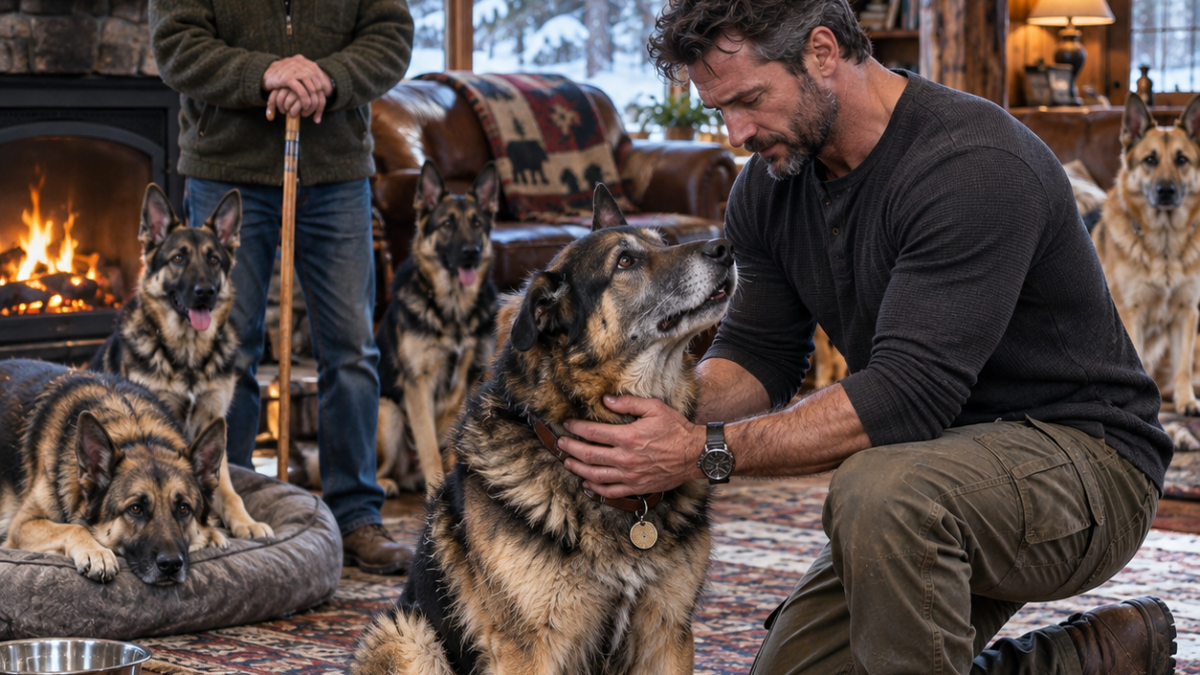
I Found Six German Shepherds Collapsed Outside My Cabin—Then the Tag Beneath the Oldest Dog’s Collar Led Back to the Marine I Couldn’t Save.
Six starving German Shepherds appeared outside my isolated Montana cabin after the worst snowstorm in years, and the oldest one nearly died protecting the others before he would let me touch him.
When I cleaned the ice from beneath his collar, I found a search-and-rescue number connected to a dead Marine, a missing military dog program, and a secret somebody had spent years making sure I never discovered.
But the worst part wasn’t learning where the dogs had come from—it was realizing the man whose name was hidden in their records was the same friend I had spent three years believing I had failed.
The oldest dog dragged himself upright when I opened the cabin door.
Five German Shepherds lay behind him in the snow.
He could barely stand.
His legs trembled, ice clung to his belly, and one ear leaned sideways. But he stepped between me and the others as though whatever strength he had left belonged to them.
I stopped on the porch.
“Easy,” I said.
He didn’t growl.
That worried me more than growling would have.
A healthy dog could warn me away.
This one was spending everything he had simply staying on his feet.
Beyond my cabin, the Montana woods stood beneath two feet of fresh snow. The road down to Red Lodge had disappeared. The storm had moved east before dawn, leaving a silence so complete I could hear water dripping from the porch roof.
I had chosen this place for that silence.
Three years after leaving the Marines, I still found people harder to manage than broken machinery.
A generator could be repaired.
A roof leak could be located.
People asked questions I didn’t know how to answer, then looked hurt when I gave them nothing.
My name was Cole Barrett.
I was forty-four, divorced, and living alone in a cabin that contained one bedroom, one workshop, and exactly enough dishes for a man who expected nobody.
My daughter, Emily, hadn’t visited in six months.
There were three unread messages from her on my phone.
I had told myself I would answer when I knew what to say.
Outside, the old shepherd swayed.
“All right,” I whispered. “You win.”
I went inside for food and water.
The cabin seemed colder after what I had seen, though the woodstove was burning steadily.
My boots stood beneath the hallway bench.
Tools hung in straight rows.
A framed photograph lay facedown on a shelf.
Emily at seventeen, beside me in Yellowstone.
I knew the picture without turning it over.
She was nineteen now.
Old enough to make decisions I couldn’t stop.
Young enough that every mile between us still felt dangerous to me.
PART2:
I filled bowls with water and gathered plain cooked chicken and rice from the refrigerator.
When I returned, the old dog was still standing.
I set a bowl within reach.
He looked at it.
Then he looked behind him.
A sable female had curled around two younger dogs, using her body to shelter them.
Farther away, a dark-faced male lay with an old wrap around one rear leg.
The oldest dog didn’t eat.
I moved the first bowl toward the female.
She raised her head cautiously and began.
The injured dog tried to stand.
His front legs lifted him, but his rear leg failed, and he sank back into the snow.
Something tightened inside my chest.
“Don’t,” I told him. “I’ll come to you.”
I set another bowl beside him.
Only after the others had food did the oldest dog lower his head.
“You waited,” I said.
He ate without looking at me.
I stood there longer than necessary.
Then I went for blankets.
The woodshed beside the cabin had insulated walls and a safe wall heater I used when repairing equipment in winter.
I cleared the floor, moved tools, and laid down every spare blanket I owned.
“One night,” I told the empty room.
It sounded reasonable.
It also sounded exactly like the kind of lie a man told before his life changed.
Getting them inside took half an hour.
The sable female followed the food.
PART3:
A broad-chested young male followed her.
A narrow-faced reddish female came next, watching every movement.
The smallest dog, all legs and oversized ears, followed whichever animal moved first.
The injured one couldn’t manage it.
I crouched several feet away and let him study me.
“I know,” I said quietly. “Nobody asked your opinion about this.”
I slid my arms beneath him and lifted carefully.
He tensed but didn’t fight.
He was lighter than he should have been.
I carried him into the shed and laid him on the thickest blanket.
When I came back out, the oldest shepherd remained in the yard.
“Your turn.”
He stared at me.
I raised one hand.
“Stay.”
His body changed immediately.
The trembling didn’t stop, but his attention sharpened.
He held position with a precision I recognized.
I lowered my hand.
“Somebody taught you that.”
Snow had packed around an old leather collar.
I brushed it away and found a worn metal plate beneath the buckle.
Most of the markings were scratched almost smooth.
Two letters remained legible.
SR.
Search and rescue, perhaps.
A small registration number lay below them.
I leaned closer, trying to read it.
The dog lowered his head beneath my hand.
My fingers settled against the warm fur behind his ear.
For a few seconds, neither of us moved.
Then he took one careful step toward the shed.
I held the door open.
Inside, the others shifted to make room.
He checked each of them before lying down.
That evening, my neighbor Frank called.
“You alive?”
“Unfortunately.”
“Road’s buried.”
“I noticed.”
“You need anything?”
Through the window, I could see six shapes beneath my blankets.
“No.”
Frank went quiet.
That meant he didn’t believe me.
“You sure?”
“Yes.”
“Call if that changes.”
Afterward, I stood beside the kitchen counter, touching the faded bracelet around my wrist.
Tyler Grant’s name had once been stitched into it clearly.
Time had worn the letters down.
Tyler had been a Marine, a friend, and the loudest man in any room he entered.
I still sometimes heard him in the moment before a sharp noise became something else in my head.
I stopped touching the bracelet.
My phone lit up.
Emily again.
Dad, can you please answer me?
I looked toward the shed.
The oldest dog raised his head, watching through the open connecting doorway.
I set the phone down.
Then, ashamed of myself, I picked it up again.
I typed:
I’m here.
For the first time in months, I sent the message before deciding it wasn’t enough.
Her reply came almost immediately.
I know you’re there. That isn’t what I meant.
I stared at it.
Then another message appeared.
Are you okay?
My instinct was to write yes.
I had written yes after the divorce.
Yes when I left the Corps.
Yes after Tyler’s funeral.
Yes when Emily asked if she had done something wrong.
Yes was the word men like me used when the truthful answer required too many pieces.
From the woodshed came a soft scrape.
The old dog had gotten to his feet.
He stood in the doorway staring at me.
I typed:
Not really.
Three dots appeared.
Then disappeared.
Then returned.
Emily wrote:
Thank you for telling me.
I sat down at the kitchen table.
For reasons I couldn’t explain, those four words hurt more than an accusation would have.
The old shepherd remained in the doorway.
“You’re causing problems,” I told him.
His good ear lifted.
The next morning, the mountain road was still impassable.
The dogs were warmer.
That was the good news.
The injured male’s leg was worse.
That was the bad news.
The wrap around it wasn’t veterinary gauze.
It was a strip of torn canvas tied with parachute cord.
The knot caught my attention immediately.
Square knot.
Secured flat.
Military habit.
Someone who knew field medicine had done it.
I cut the fabric away carefully.
The rear leg was swollen from the hock upward.
No open fracture.
Maybe a torn ligament.
Maybe worse.
The dog watched me but never snapped.
The old shepherd watched harder.
Every time I touched the injured dog, his body went rigid.
“I’m helping him.”
The old shepherd didn’t look convinced.
I found an old veterinary thermometer from the years when my ex-wife, Rachel, had kept horses.
The injured dog had a fever.
I swore.
There was no cell signal strong enough for video, but eventually I got a call through to Red Lodge.
Dr. Leah Morrison had the kind of voice that sounded impatient even when she was being kind.
“Six dogs?”
“Yes.”
“All shepherds?”
“Yes.”
“You suddenly running a kennel, Barrett?”
“No.”
“You steal them?”
“They arrived.”
“Dogs don’t just arrive six at a time in a blizzard.”
“These did.”
There was a pause.
“What condition?”
I described each one.
When I mentioned the fever, her tone changed.
“You need to get that male in.”
“The road’s buried.”
“County plow should reach your turnoff by afternoon.”
“He may not have until afternoon.”
“Do you have amoxicillin?”
“For livestock.”
“Don’t improvise dosage.”
“I wasn’t going to.”
“Cole.”
“I said I wasn’t.”
“You also once glued your own hand wound shut because you didn’t want to drive twenty minutes.”
“That worked.”
“It got infected.”
“Eventually.”
She sighed.
“I’m texting dosage based on estimated weight. Temporary only. The second that road opens, bring all six.”
“All six?”
“Yes, all six.”
“I have one truck.”
“It has a bed.”
“It’s January.”
“You have a topper.”
I hated when people remembered details about my life.
It made refusing them more difficult.
She sent the instructions.
By noon, the injured dog had taken the first dose hidden in chicken.
The smallest shepherd had decided my workshop broom was an enemy.
The broad-chested male discovered that water bowls could be overturned.
The sable female seemed exhausted beyond ordinary hunger.
She slept constantly, waking only when one of the younger dogs moved.
The reddish female never fully relaxed.
She remained near the wall with her eyes on every entrance.
The old shepherd followed me with his gaze.
I started assigning names because saying “the old one” and “the injured one” got ridiculous.
I called the oldest Ranger.
Not because I thought he had been one.
The name just fit.
The sable female became June.
The injured male became Moose because he was huge even underweight.
The broad young male became Boone.
The reddish female became Ember.
The smallest became Scout.
I didn’t ask permission.
None of them objected.
At two in the afternoon, I heard an engine.
Frank’s old Ford appeared through the trees behind a snow blade mounted crooked across the front.
He climbed out wearing insulated coveralls and a trapper hat.
“You said you didn’t need anything.”
“I lied.”
“I know.”
Then he saw the dogs.
He stopped.
“Well.”
“Don’t start.”
“I wasn’t going to.”
“You were.”
“Probably.”
Scout barked.
Frank crouched.
“Hello, little terrorist.”
Ranger rose instantly.
Frank froze.
I lifted a hand.
“Don’t move.”
“I wasn’t planning to.”
Ranger crossed the room and positioned himself between Frank and the others.
No growl.
No bark.
Just presence.
Frank’s expression changed.
“That dog’s trained.”
“I know.”
“Military?”
“Maybe.”
Frank had spent twenty-two years with the Carbon County Sheriff’s Office before retiring.
He knew dogs too.
He crouched slowly.
Ranger’s eyes tracked him.
Frank pointed at the collar.
“You check the tag?”
“Partly unreadable.”
“Could run the number.”
“That’s what I was thinking.”
Frank looked at me.
“You sound unhappy about that.”
“I’m not unhappy.”
“You’re touching Grant’s bracelet.”
I looked down.
My thumb was rubbing the faded fabric again.
I stopped.
Frank was one of only three people in Montana who knew much about Tyler.
He never asked questions.
That was why I tolerated him.
“Coincidence,” I said.
“Usually is.”
He said it in a way that meant he did not believe in coincidence.
We loaded the dogs after the plow cleared enough road.
June entered the truck willingly.
Boone and Scout required chicken.
Ember climbed in only after Ranger.
Moose had to be carried.
Ranger waited until everyone else was inside.
Again.
I noticed Frank noticing.
“That old boy’s been responsible for them a long time,” he said.
“Looks that way.”
“You know dogs don’t form traveling committees.”
“Meaning?”
“Meaning six shepherds don’t end up together in your yard by accident.”
I looked toward the mountain road.
“I know.”
The drive to Red Lodge took almost two hours.
At the veterinary clinic, Leah met us behind the building.
She was fifty-one, short, gray-streaked, and incapable of pretending not to be angry when animals had been mistreated.
Her face got progressively harder as she examined them.
Scout was dehydrated but otherwise healthy.
Boone had frostbite damage to two paw pads.
Ember had an old scar along her rib cage.
June showed signs of having nursed puppies sometime in the previous year.
Moose had a badly infected ligament injury but no fracture.
Ranger was the worst.
His bloodwork suggested kidney strain, prolonged malnutrition, and an untreated tick-borne infection.
Leah removed his leather collar carefully.
Beneath the leather was another strap.
Thin nylon.
Nearly hidden by fur.
Attached to it was a flattened metal identification plate.
Leah wiped it clean.
I leaned closer.
The letters were clearer without ice.
USAR-K9.
Below it:
R-417.
Below that:
GRANT, T.
I stopped breathing.
The room tilted without moving.
Leah said something.
I didn’t hear it.
I reached for the tag.
My hand stopped an inch away.
Grant.
T.
Tyler Grant.
No.
There were thousands of Grants.
Plenty of T. Grants.
But USAR?
Tyler had worked with dogs before joining our unit.
Not military working dogs.
Civilian search and rescue.
He talked about it constantly.
His older brother had trained wilderness dogs in Oregon.
Tyler used to joke that shepherds were smarter than lieutenants.
I had forgotten that.
No.
I had buried it.
Leah watched me.
“You know the name?”
I turned the tag over.
Scratched into the back were three small letters.
T.G.B.
Tyler Grant Barrett.
My last name.
A joke.
Tyler had once carved those letters onto a metal ammo box after declaring I was his “emergency husband.”
I remembered throwing a wrench at him.
My stomach dropped.
“Cole?”
I backed away.
Leah reached toward me.
“Don’t.”
She stopped.
Ranger stood shakily on the examination table.
His eyes stayed on me.
Memories came in pieces.
Tyler sitting on a Humvee hood in Helmand.
Tyler stealing powdered drink mix from my pack.
Tyler calling my daughter “Tiny Barrett” even after she turned thirteen.
Tyler telling me that when we got home, he was going to buy land and train search dogs again.
Tyler bleeding into Afghan dirt while I pressed both hands against a wound I could not close.
I gripped the stainless-steel table.
“That tag belonged to my friend.”
Leah spoke carefully.
“You’re sure?”
“I’m sure.”
“Was this his dog?”
“I don’t know.”
That was the truth.
And that frightened me more.
Tyler had never mentioned a dog named Ranger.
At least not that I remembered.
Leah turned the plate toward the light.
“There’s a microchip.”
“What?”
“Ranger has one.”
She scanned him again.
The number appeared.
She entered it into a national database.
The screen loaded.
Then she frowned.
“Registration restricted.”
“To who?”
“It doesn’t say.”
“Can you request access?”
“I can submit a veterinary inquiry.”
“Do it.”
She looked at me.
“I already am.”
Twenty minutes later, the clinic received a callback.
The registration belonged to an organization called Sentinel Ridge Working Canine Foundation.
I knew the name.
Everyone in Montana with a television knew it.
Sentinel Ridge ran search-and-rescue programs, disaster-response training, and service-dog placements throughout the Mountain West.
Their founder, Everett Sloan, was a former Marine officer who had built the organization after losing men overseas.
He gave speeches.
Raised millions.
Appeared in documentaries.
His face was on billboards near Bozeman and Helena.
He had once testified before Congress about veterans’ mental health.
I had met him exactly twice.
The second time had been at Tyler Grant’s funeral.
Sloan had stood beside Tyler’s mother and told her Tyler had died a hero.
I remembered wanting to hit him.
Not because he had said anything wrong.
Because the word hero had seemed too clean for what happened.
Leah clicked through the file.
“Ranger is eleven.”
I looked at the dog.
That fit.
“Registered handler…”
She stopped.
“What?”
Her eyes lifted.
“Tyler Grant.”
The room became very still.
I whispered, “He died eight years ago.”
Leah turned back to the screen.
“There’s more.”
After Tyler’s death, Ranger’s ownership had transferred to Sentinel Ridge.
Status: retired operational canine.
Then three years ago:
Status changed.
Breeding program.
I stared at the words.
“That makes no sense.”
Leah said, “Male dogs can breed at eleven, though I wouldn’t recommend—”
“No.”
I pointed toward the other five.
“I mean this.”
She understood.
We scanned every dog.
All six were microchipped.
June.
Sentinel Ridge.
Boone.
Sentinel Ridge.
Ember.
Sentinel Ridge.
Moose.
Sentinel Ridge.
Scout.
Sentinel Ridge.
Different registration categories.
Breeding.
Training.
Evaluation.
Research partnership.
And every record had been changed or restricted within the last six months.
Frank, who had been silent in the corner, finally spoke.
“They didn’t get lost.”
Leah looked at him.
“No.”
I looked at the six dogs.
“Then somebody moved them.”
“Or dumped them,” Frank said.
Ranger’s head lifted.
A flash of anger moved through me so fast it felt clean.
“They were twenty miles from the nearest Sentinel Ridge property.”
Frank’s eyebrows rose.
“You know where their properties are?”
“No.”
“I do.”
Of course he did.
Retired cops knew things normal people had no reason to know.
“There’s a training parcel northwest of Bearcreek,” he said. “Bought under some nonprofit subsidiary.”
“How far from my cabin?”
“Maybe seventeen miles if you cut through the back roads.”
Leah folded her arms.
“Six starving dogs traveled seventeen miles in that storm?”
“No,” I said.
Everyone looked at me.
I stared at Ranger.
“They were brought close.”
That evening, a representative from Sentinel Ridge called the clinic.
His name was Martin Voss.
He sounded friendly.
Too friendly.
“We’re extremely grateful the animals were located.”
I stood in Leah’s office with the phone on speaker.
“You lost six dogs?”
“A transport error occurred during the storm.”
“What kind of transport error?”
“A contracted driver encountered road conditions and apparently opened the trailer.”
“Apparently?”
“We’re still investigating.”
“All six walked seventeen miles to my cabin?”
Silence.
Then, “Mr. Barrett, I’m not certain how far they traveled.”
“How do you know my name?”
Another pause.
Leah’s eyes narrowed.
“My veterinary account,” I said. “Right.”
“Exactly.”
He was lying.
The clinic account did not contain my full address.
Voss continued.
“We’d like to arrange immediate recovery of our animals.”
I looked through the office window.
Ranger was lying beside Moose’s kennel.
“No.”
“I’m sorry?”
“They’re receiving treatment.”
“We’ll cover all expenses.”
“That wasn’t my concern.”
“Mr. Barrett, Sentinel Ridge is the legal owner.”
“Then send me the transport report.”
Silence.
“The what?”
“The report showing how six registered dogs disappeared from your custody in a blizzard.”
“Our internal documents aren’t—”
“Then send animal control.”
Voss’s voice cooled.
“There’s no reason for hostility.”
“I’m not hostile.”
Frank covered a smile.
Voss said, “These dogs are valuable working animals.”
I looked at Ranger’s ribs.
“He looks valuable.”
“That isn’t what I meant.”
“I know.”
Another pause.
Then Voss made a mistake.
He said, “Ranger is old and medically complicated. He can become reactive when stressed.”
Ranger had never once reacted.
Not when I carried Moose.
Not when Leah drew blood.
Not when Frank entered.
Only protective.
Controlled.
Watchful.
Voss was building a story.
I knew that instinct.
The military teaches you what an ambush feels like before the shooting begins.
“Reactive how?” I asked.
“Bite history.”
Leah’s head snapped up.
“That is not in his veterinary record.”
Voss continued anyway.
“For everyone’s safety, we need him returned promptly.”
I said, “No.”
“You cannot legally refuse.”
“Then come with a warrant.”
I hung up.
Leah stared at me.
“That was stupid.”
“I know.”
Frank said, “Also fun.”
Leah glared at him.
The next morning, Sentinel Ridge posted a statement online.
Six highly trained search-and-rescue dogs had gone missing during an emergency winter transport.
A concerned citizen had found them.
The foundation was working cooperatively to bring them home.
There was a photograph of Ranger from years earlier.
Younger.
Strong.
Standing beside a man whose face was cropped from the picture.
I knew the uniform.
I knew the hand resting on Ranger’s neck.
Tyler.
They had erased him from the image.
That detail made me angrier than anything else.
By noon, local news had the story.
By three, Sentinel Ridge announced a five-thousand-dollar reward for information regarding “possible interference with recovery.”
Interference.
That was me.
At four, my daughter called.
I answered.
Not because I was ready.
Because after the dogs, pretending I had infinite time felt dishonest.
“Dad?”
Her voice sounded older than I remembered.
“Hey, Em.”
Silence.
Then, “You actually answered.”
“Apparently.”
“Are you sick?”
“No.”
“Arrested?”
“Not yet.”
“What does that mean?”
I looked toward Ranger.
“Long story.”
“You always have long stories you don’t tell me.”
There it was.
I closed my eyes.
“You’re right.”
Another silence.
Emily said, “Mom told me something happened with dogs.”
“Your mother still talks to Frank?”
“Everyone talks to Frank.”
“That explains too much.”
She almost laughed.
Almost.
Then her voice softened.
“Dad, I’m not calling about dogs.”
“I know.”
“I got into Oregon State.”
I remembered.
She had applied for the veterinary science program.
Months earlier.
Before I stopped returning calls regularly.
“That’s good.”
“Good?”
“It’s very good.”
“I wanted to tell you in person.”
“I’m sorry.”
“Stop saying that if you’re going to disappear again.”
The words hit harder than she intended.
Or exactly as hard as she intended.
I sat down.
“I don’t know how to do this right.”
“Do what?”
“Be your dad when you don’t need me to fix things.”
Her breathing changed.
“Dad, I needed you plenty.”
I looked at the facedown photograph.
“I know.”
“No, I don’t think you do.”
I said nothing.
Emily continued.
“When you and Mom split, you acted like leaving the house was the same as leaving the marriage.”
“That’s not fair.”
“I know.”
That surprised me.
She said, “It’s not fair because you were hurting too. But you still did it.”
I rubbed my eyes.
“I thought you were better off.”
“That was your decision. Not mine.”
The words remained between us.
Outside the clinic window, Ranger pushed himself upright.
He limped toward Scout’s kennel.
Scout pressed her nose through the bars.
Ranger touched his nose to hers.
I whispered, “You’re right.”
Emily stopped.
“What?”
“You’re right.”
I had rarely said those words to her.
I had spent most of her childhood explaining.
Correcting.
Protecting.
Planning.
I had mistaken certainty for parenting.
“I should have called,” I said. “I should have come when you asked. I should have let you be angry without making it about whether I could handle it.”
She began crying quietly.
That nearly undid me.
“Em.”
“I’m here.”
“I love you.”
She gave a broken laugh.
“You haven’t said that in months.”
“I know.”
“Say it again.”
“I love you.”
She inhaled.
“I love you too.”
Then she said, “Now tell me why Mom says six German Shepherds are living at a veterinary clinic because you apparently opened a dog hotel.”
I laughed.
A real laugh.
It felt strange in my chest.
I told her.
Not everything about Tyler.
Not yet.
Enough.
When I mentioned Ranger’s tag, she went silent.
“Dad.”
“Yeah.”
“That can’t be random.”
“I know.”
“Are you going to find out?”
I looked at the bracelet on my wrist.
“Yes.”
For the first time in three years, I meant more than the dogs.
Frank and I drove to the Sentinel Ridge property near Bearcreek the next day.
We did not trespass.
Frank reminded me of that six times.
“Public road.”
“I know.”
“Do not cross the fence.”
“I know.”
“Do not threaten anybody.”
“I know.”
“Do not use Marine words at civilians.”
I looked at him.
“What are Marine words?”
“You know exactly what they are.”
The training property sat behind a black steel gate.
Large sign.
SENTINEL RIDGE CANINE RECOVERY CAMPUS.
The word recovery irritated me.
Beyond the fence were several long kennel buildings, an agility field, and a main lodge that looked expensive enough to host weddings.
There were cameras on every corner.
A black SUV rolled toward us within ninety seconds.
Martin Voss stepped out.
I recognized him from the foundation website.
Mid-forties.
Trim beard.
Outdoor vest over a collared shirt.
He smiled like a man trained to make unpleasant requests sound reasonable.
“Mr. Barrett.”
“You do know my name.”
“I told you—”
“My vet account.”
“Yes.”
“Still a bad lie.”
His smile thinned.
Frank stood beside the truck.
Voss looked at him.
“Deputy?”
“Retired.”
“Then you understand private property.”
Frank smiled.
“Better than most.”
I asked, “Where were the six dogs being transported?”
“Bozeman.”
“From here?”
“Yes.”
“Why?”
“Medical relocation.”
“To where?”
“I’m not permitted to discuss operational details.”
“Ranger’s medical records show no scheduled transfer.”
Voss’s expression shifted slightly.
“You accessed private foundation records?”
“My veterinarian accessed legal microchip information.”
“Then you know the animals belong to us.”
“Do they?”
“Yes.”
“Ranger belonged to Tyler Grant.”
That name landed.
Voss recovered quickly.
“Years ago.”
“You knew him?”
“No.”
That was another lie.
Small.
Immediate.
I had seen Voss in a photograph from a Sentinel Ridge fundraiser with Sloan and Tyler’s older brother.
I said, “You’re bad at this.”
“At what?”
“Lying when you’re surprised.”
His jaw tightened.
“Mr. Barrett, whatever personal history you have with Mr. Grant is irrelevant.”
“My friend dies. His dog ends up starving in a snowbank. Seems relevant.”
“Ranger was transferred lawfully.”
“Show me.”
“You don’t have standing.”
“Then why are you talking to me?”
That finally cracked his smile.
“Because you have property belonging to this foundation.”
“No. Dr. Morrison has six patients.”
“We have legal counsel preparing an emergency retrieval order.”
“Good.”
I stepped closer to the fence.
“Make sure they include the transport manifest.”
Voss stared.
“What manifest?”
“The one showing who drove the dogs into a storm.”
He didn’t answer.
I watched his face.
Then I understood.
“There isn’t one.”
Frank said quietly, “Cole.”
I kept my eyes on Voss.
“They weren’t being transported.”
Voss stepped toward me.
“You should leave.”
“They were dumped.”
“Leave.”
“Who dumped them?”
Voss’s voice rose.
“I said leave.”
A second SUV appeared from the lodge.
Everett Sloan got out.
Even from fifty yards away, I recognized him.
He had aged.
More gray.
Less weight.
Same posture.
People who had commanded Marines often carried authority long after nobody was required to obey.
He walked toward the gate.
When he saw me, he stopped.
Unlike Voss, Sloan did not pretend not to recognize me.
“Cole.”
Hearing my name from him pulled me backward eight years.
A hangar.
Flag-covered coffin.
Tyler’s mother collapsing against her older son.
Sloan standing beside me.
I hated him instantly all over again.
“Sir.”
I did not salute.
He noticed.
“You look different.”
“You don’t.”
“That meant to be a compliment?”
“No.”
Frank shifted beside me.
Sloan looked at the road.
“Let’s talk inside.”
“No.”
“Then somewhere private.”
“No.”
He sighed.
“You always were difficult.”
“You knew me for six weeks.”
“I knew Tyler.”
“Did you?”
His face hardened.
“Yes.”
“Then why was his dog starving outside my cabin?”
Voss said, “Everett, we should let counsel—”
Sloan lifted one hand.
Voss stopped.
Sloan looked at me.
“Ranger wasn’t supposed to be there.”
“I gathered that.”
“What do you want?”
“The truth.”
“No, you don’t.”
I almost laughed.
“You always did that.”
“Did what?”
“Decide what other people could handle.”
Something moved behind his eyes.
Tyler had said the same thing about him once.
I remembered suddenly.
Sloan had been involved with the civilian search program before Tyler joined the Marines.
He had known Tyler from Oregon.
Long before Afghanistan.
I asked, “How long was Ranger Tyler’s dog?”
Sloan looked toward the mountain.
“Since Ranger was ten months old.”
My stomach tightened.
“Tyler never told me.”
“He didn’t tell you a lot of things.”
“Apparently.”
Sloan rubbed his jaw.
“Ranger was Tyler’s search dog. Wilderness recovery. Missing hikers. Avalanche work.”
“Why didn’t he keep him?”
“He couldn’t while deploying. His brother cared for Ranger. Sentinel Ridge handled training rotations.”
“After Tyler died?”
“His mother signed custody to us.”
“Why?”
“Because she was seventy and Ranger needed work.”
“So you worked him.”
“For years.”
“Then bred him.”
Sloan looked at me.
“Yes.”
“Eleven-year-old dog.”
“Not uncommon.”
“Starving dog.”
“That wasn’t authorized.”
There.
Not denied.
I said, “Who authorized dumping them?”
Sloan’s voice changed.
“I said it wasn’t authorized.”
“Which means somebody did it.”
He looked at Voss.
Voss went pale.
That was the first time I realized Sloan might not know everything.
Sloan turned back to me.
“Bring Ranger back.”
“No.”
“He belongs with us.”
“He belonged with Tyler.”
“Tyler is dead.”
The air changed.
Frank whispered, “Careful.”
I didn’t know whether he meant me or Sloan.
I stepped closer.
“Say that again.”
Sloan’s face changed instantly.
Regret.
Real regret.
“Cole.”
“Say it.”
“I shouldn’t have said that.”
“No.”
I touched the bracelet.
“You shouldn’t have done a lot of things.”
Sloan looked at my wrist.
For a second, the famous nonprofit founder disappeared.
I saw an old Marine carrying his own dead.
He whispered, “You still wear that?”
“Every day.”
His eyes lowered.
“Tyler would hate that.”
I went still.
“What?”
“He hated memorial bracelets.”
“You’re lying.”
“He said they turned dead men into things the living used to punish themselves.”
I knew Tyler well enough to hear the sentence in his voice.
That scared me.
Sloan continued.
“He told me once that if he died before you, he wanted somebody to cut that damn thing off your wrist.”
My hand closed over the bracelet.
“How would you know?”
“Because he asked me to make sure you didn’t turn his death into another reason to destroy your life.”
My anger faltered.
Only for a second.
Then returned.
“You failed.”
Sloan’s eyes met mine.
“Yes.”
That answer surprised me more than denial.
Before I could respond, a woman came running from the kennel building.
She wore navy scrubs beneath a winter coat.
“Mr. Sloan!”
Voss turned.
The woman stopped when she saw us.
Her face changed.
Sloan said, “What?”
She glanced at Voss.
“Nothing.”
Sloan’s voice sharpened.
“What?”
The woman swallowed.
“The west kennel records are gone.”
Voss said, “What are you talking about?”
She looked directly at him.
“The hard drives.”
Silence.
“The backup server was wiped last night.”
Sloan turned toward Voss.
Voss backed up one step.
And in that instant, I knew the six dogs outside my cabin were not the problem.
They were evidence.
Sloan ordered the gate opened.
Frank looked at me.
“I hate when situations get interesting.”
“You retired voluntarily.”
“Worst mistake of my life.”
Inside the administration building, the woman in scrubs introduced herself as Dr. Nina Patel, Sentinel Ridge’s veterinary director.
She had worked there nine months.
She looked tired.
Angry.
Afraid.
Sloan closed the conference-room door.
“Tell him.”
Voss protested.
“This is internal.”
Sloan said, “Martin, stop talking.”
Voss sat.
Dr. Patel opened a laptop.
“I started noticing discrepancies three months ago.”
“What kind?” I asked.
“Dogs listed as transferred but still physically present. Medical invoices for animals I’d never examined. Sedatives ordered in quantities our hospital didn’t use.”
Frank leaned forward.
“Fraud?”
“Maybe.”
Patel continued.
“Then dogs began disappearing.”
“How many?”
“Twelve.”
I stared at her.
“Where?”
“I was told private placements.”
“Were they?”
“I couldn’t verify any.”
Sloan looked sick.
Voss said, “We have donor confidentiality.”
Patel turned on him.
“You also had three animals listed as deceased that were alive in Kennel C.”
Voss said nothing.
Sloan whispered, “Why didn’t you come to me?”
“I did.”
“No.”
“I sent six emails.”
“I never received them.”
Patel looked at Voss.
Sloan did too.
Voss stood.
“This is absurd.”
Frank remained seated.
“Sit down.”
Voss looked at him.
“You’re not law enforcement.”
“Nope. But he is six foot two and angry.”
Frank pointed at me.
“Thought I’d save everybody paperwork.”
I didn’t smile.
Patel opened another file.
“Ranger, June, Moose, Boone, Ember, and Scout were scheduled for euthanasia four days ago.”
Everything in me went cold.
“Why?”
Sloan asked it before I could.
Patel looked at Voss.
“Martin told staff the dogs were medically unsuitable and represented a liability.”
Sloan slammed both hands on the table.
“Ranger?”
“Yes.”
“He was Tyler’s dog.”
“I know.”
“You knew that?”
Patel nodded.
Sloan turned toward Voss.
“Explain.”
Voss’s face had lost color.
“They were old breeding assets, failed candidates, dogs with expensive medical needs—”
“Scout is eighteen months old,” Patel said.
Voss’s eyes shifted.
That was when the truth began to surface.
Not all at once.
Men like Voss rarely confess dramatically.
They minimize.
Reframe.
Blame systems.
The foundation had accumulated dogs that no longer generated donations.
Older animals.
Injured dogs.
Failed working candidates.
Dogs whose records were complicated by ownership agreements.
At the same time, several donors wanted puppies from proven search lines.
Ranger had been bred repeatedly despite age.
June had produced multiple litters.
Some puppies entered legitimate search programs.
Others were sold through a private company connected to Voss.
The foundation paid the care.
The company collected the profit.
Sloan claimed he knew nothing.
At first, I didn’t believe him.
Then Patel showed us signatures.
Most approvals carried Sloan’s digital signature.
But access logs came from Voss’s account.
Frank asked the obvious question.
“If they were scheduled for euthanasia, how did they get to Cole’s cabin?”
Patel shook her head.
“I don’t know.”
Voss stared at the table.
I watched him.
“Who drove them?”
Nothing.
“Martin.”
He looked up.
I had not raised my voice.
That made him more nervous.
“You dumped six dogs in a blizzard.”
“I didn’t.”
“Who did?”
He looked toward Sloan.
Then Patel.
Then the door.
Frank noticed.
“Don’t.”
Voss remained seated.
Finally he said, “Caleb Ross.”
Sloan frowned.
“Who?”
“Maintenance contractor.”
“Why?”
“I told him to move them off-site.”
“Where?”
“A holding kennel.”
Patel said, “There is no holding kennel.”
Voss’s jaw tightened.
“He was supposed to figure it out.”
I felt something violent move through me.
“You told a maintenance man to ‘figure it out’ with six dogs scheduled to die.”
Sloan stepped between us.
“Cole.”
“Move.”
“No.”
I stared at him.
For once, he did not look like an officer.
He looked like an old man trying to stop another old man from making a mistake.
Frank said quietly, “Barrett.”
I stepped back.
Patel asked, “Why Cole’s property?”
Voss looked at me.
“I didn’t tell him to go there.”
“Then why?”
Silence.
Sloan understood first.
“Ranger.”
Voss said nothing.
Sloan closed his eyes.
I looked between them.
“What?”
Sloan said, “Caleb Ross knew Tyler.”
My heart slowed.
Not metaphorically.
Actually slowed.
“What?”
“He served with Tyler’s brother in Oregon search and rescue.”
“Keep talking.”
“Caleb worked with Ranger years ago.”
I looked toward the window.
Snow was falling lightly outside.
Sloan continued.
“If Caleb refused to kill them…”
“He took them somewhere.”
“Yes.”
“Why my cabin?”
Sloan looked at me.
“I think Ranger did.”
“That doesn’t make sense.”
Frank leaned forward.
“Maybe it does.”
Everyone turned.
Frank asked, “How far from Cole’s cabin did Caleb dump them?”
Voss gave directions.
Frank knew the road.
“Three miles.”
I stared at him.
Not seventeen.
Three.
He said, “Backcountry road on the ridge.”
My cabin sat downhill through forest.
Ranger could have smelled smoke.
Food.
Other animals.
Or maybe something else.
I thought of Tyler.
Training visits.
Old gear I still kept in the workshop.
Blankets from deployments.
My field jacket.
Impossible.
Dogs did not track a man after eight years from memories.
Not like that.
But they could follow shelter.
Smoke.
Human scent.
Survival.
It didn’t need magic.
It was powerful enough without it.
We found Caleb Ross before sunset.
He had not run.
He was sitting in a trailer outside Joliet with a packed duffel bag and six empty dog crates.
The sheriff questioned him.
I was not allowed in.
Probably wise.
Two hours later, Frank came outside.
“He admits it.”
I stood beside the truck.
“What exactly?”
“Voss ordered the dogs moved and said they’d be euthanized once weather cleared.”
“That doesn’t answer why my cabin.”
Frank shoved his hands into his coat pockets.
“Caleb couldn’t do it.”
“So he abandoned them.”
“He thought he was giving them a chance.”
“In a blizzard.”
“Yes.”
“That’s not giving them a chance.”
“I know.”
Frank waited.
“There’s more.”
Of course there was.
“Caleb knew who you were.”
My eyes narrowed.
“How?”
“Tyler.”
“He knew Tyler before Afghanistan?”
“Apparently.”
Frank handed me a clear evidence bag containing a folded piece of paper.
I recognized Tyler’s handwriting through the plastic.
My name was on it.
COLE BARRETT.
My hands went numb.
“What is this?”
“Caleb says Tyler gave him that letter nine years ago.”
“Why?”
“He doesn’t know.”
“That’s convenient.”
“He says Tyler mailed a box home before the deployment where he died. Ranger’s papers, some gear, personal stuff. The letter was inside. Tyler’s brother later gave the box to Sentinel Ridge when Ranger transferred.”
“And Caleb took it?”
“He found it years later in storage.”
I stared at the envelope.
“Why keep it?”
“Because it was addressed to you.”
“Then why didn’t he send it?”
Frank looked at me.
“He says Sloan told him not to.”
Everything inside me went quiet.
I drove back to Sentinel Ridge.
Frank followed because he did not trust me.
Smart man.
Sloan was alone in the conference room.
I threw the evidence bag onto the table.
He looked at it.
His face collapsed.
Not guilt.
Recognition.
“You knew.”
He did not deny it.
“Cole.”
“You knew.”
“Yes.”
I stepped toward him.
Frank shut the door behind us.
Sloan remained seated.
“Why?”
His hands shook.
I had never seen that before.
“Because Tyler asked me not to give it to you unless you were ready.”
“What the hell does that mean?”
“He knew you.”
“Stop saying that.”
“He knew what you were becoming.”
“Before he died?”
“Yes.”
Sloan stood slowly.
“You were already carrying too much.”
“You don’t get to decide that.”
“No.”
His voice broke.
“I know that now.”
I stared at him.
“Then why keep it?”
“Because after Tyler died, you were barely functioning.”
“I functioned.”
“You deployed again six months later.”
“That was my job.”
“You volunteered.”
I said nothing.
Sloan continued.
“You took every dangerous assignment available. You stopped sleeping. You started taking risks your team noticed.”
“Who told you?”
“Your team.”
Anger turned to humiliation.
Private pain feels different when you discover other people discussed it.
Sloan said, “Tyler’s letter specifically said not to hand it to you if his death made you reckless.”
My mouth went dry.
“How would he know?”
“Because he watched you after Ramirez died.”
I looked away.
Corporal Luis Ramirez had died two years before Tyler.
I had blamed myself for that too.
Apparently I had a pattern.
Sloan continued.
“Tyler knew you would turn grief into punishment.”
“That still wasn’t your decision.”
“No.”
He nodded.
“It wasn’t.”
“Eight years.”
“I know.”
“Eight years you kept a dead man’s letter from me.”
“Yes.”
“Why now?”
“Because I forgot it existed.”
That answer nearly made me hit him.
He saw it.
“I’m not asking you to forgive me.”
“Good.”
“I thought the box had gone to Tyler’s mother.”
“It didn’t.”
“No.”
“It went to your foundation.”
“Yes.”
“And Ranger?”
Sloan’s face changed.
“That was Margaret’s choice.”
“Tyler’s mother?”
“Yes.”
“She believed he’d want Ranger working.”
“Did he?”
“At first.”
“What changed?”
Sloan looked toward the snow outside.
“He got old.”
“No.”
I stepped closer.
“What changed with you?”
Sloan’s jaw tightened.
I knew I had found the wound.
“My son died,” he said.
I stopped.
I had not known.
“Evan. Overdose. Five years ago.”
Sloan sat again.
“He came home from Afghanistan with injuries. Pain medication. Then pills from other places. We spent years pretending discipline would fix him.”
I said nothing.
“He died in my guest room.”
For the first time, there was no organization founder in front of me.
No decorated officer.
No polished public figure.
Just a father.
“I built Sentinel Ridge bigger after that,” he said. “Raised more money. Opened more programs. Kept moving.”
I understood too well.
“You disappeared into work.”
“Yes.”
“And Voss took over operations.”
“Yes.”
“That doesn’t make you innocent.”
“No.”
He looked at me.
“I know.”
That mattered.
Not enough.
But some.
I picked up the evidence bag.
“Open it.”
Sloan shook his head.
“It’s yours.”
“You kept it. You open it.”
“Cole.”
“Open it.”
His hands were unsteady as he broke the seal.
Inside were four folded pages.
Tyler never wrote anything in four pages unless he was complaining.
Sloan handed them to me.
I sat.
Frank remained near the door.
I unfolded the first sheet.
Barrett,
If Sloan is giving this to you, either I’m dead or he finally learned to follow instructions, and honestly I’m not sure which outcome is less likely.
Despite everything, I laughed.
Sloan closed his eyes.
I kept reading.
There are a couple things I need you to know.
First, Ranger isn’t yours.
Do not steal my dog.
I know you.
He belongs with whoever can give him useful work, good food, and a place to sleep where nobody calls him an asset.
If he gets old, let him get old.
That’s an order from a man you technically do not have to obey.
My vision blurred.
I continued.
Second, you have got to stop believing every person you lose becomes proof you failed.
Ramirez was not your fault.
If I get killed, I am not your fault either.
You have this terrible habit of thinking love means keeping everybody alive.
It doesn’t.
Sometimes it means staying when you can’t.
I stopped.
The room was silent.
I looked at Sloan.
He had tears in his eyes.
I hated him slightly less for it.
The next paragraph was about Emily.
Tiny Barrett is going to grow up whether you approve or not.
Do not become one of those fathers who scares every boy she dates and then acts shocked when she stops telling him things.
Tell her you love her.
Out loud.
She already knows you would take a bullet for her.
Kids also need to know you would sit through a stupid movie for them.
I covered my face.
Frank turned toward the window.
Tyler had known exactly where to put the knife.
The final paragraph was shorter.
And if you ever end up alone somewhere convincing yourself that silence is peace, understand that I am haunting you out of principle.
Get a dog.
Call your daughter.
Go somewhere people can bother you.
You were never built to be alone, brother.
You’re just good at surviving there.
—Tyler
P.S. If Ranger is still alive and somehow ends up with you, don’t let him eat socks. He knows better.
I lowered the letter.
Nobody spoke.
Then, from somewhere in my memory, Tyler laughed.
Not the dying version.
The real one.
Loud.
Annoying.
Alive.
I had spent eight years remembering his last ten minutes.
Blood.
Dust.
Pressure under my hands.
His eyes losing focus.
I had forgotten thousands of hours that came before.
I had reduced my best friend to the worst thing that happened to him.
The realization broke something open.
I cried.
Not politely.
Not quietly.
I bent over Tyler’s letter while eight years of control finally failed.
I cried for him.
For Ramirez.
For Sloan’s son even though I had never known him.
For Rachel.
For Emily.
For every call I had ignored because answering would have required admitting I still needed people.
Sloan sat across from me and did not move.
Frank gave me the dignity of looking away.
When it passed, nothing was fixed.
That was important.
Grief did not leave because of a letter.
Neither did anger.
But something shifted.
The weight became specific.
Specific things could be carried.
The county investigation expanded over the next three weeks.
Voss was arrested on charges related to financial fraud, animal cruelty, evidence destruction, and falsifying nonprofit records.
Caleb Ross faced abandonment charges but cooperated fully.
Dr. Patel turned over thousands of pages of documents.
Sloan resigned from direct operational control pending an independent investigation.
The Sentinel Ridge board nearly collapsed.
Donors withdrew.
Reporters camped near the main property.
People who had praised Sloan for years suddenly claimed they had always suspected him.
That part disgusted me.
Human beings love retroactive courage.
The investigation eventually determined that Sloan had been negligent.
Not criminally complicit in the dog-selling scheme.
He had delegated too much authority while using Sentinel Ridge as a way not to deal with his own grief.
It did not excuse him.
He said that publicly.
That surprised people.
At a press conference, a reporter asked if he blamed Voss.
Sloan answered, “I blame Martin Voss for the crimes he committed. I blame myself for building an organization where one man could commit them for so long without being challenged.”
No spin.
No heroic language.
His lawyers probably hated it.
I respected him for the first time in years.
Ranger and the other dogs remained under veterinary protective custody while ownership was sorted out.
In practice, that meant they came to my cabin.
All six.
“One night” became a month.
My house changed.
Scout stole socks.
Tyler had apparently cursed me.
Boone barked at snowmobiles.
Ember slept beneath my workbench.
Moose learned to walk again after surgery, first with a sling and then without.
June chose the warmest place in the cabin and claimed it permanently.
Ranger slept beside my bedroom door.
Not in the bed.
Not on the rug near the stove.
The doorway.
Guarding everyone.
I tried moving his blanket.
He moved it back.
“You are retired,” I told him.
Ranger blinked.
“You don’t have a job.”
He placed his head on his paws.
“Stop looking at me like that.”
His tail thumped once.
Emily came to Montana in February.
I drove to Bozeman to pick her up.
I had not seen her since the previous summer.
She emerged from the terminal wearing a green parka, backpack over one shoulder, hair shorter than I remembered.
For one second, I saw her at six.
Then twelve.
Then seventeen.
Then she was nineteen again, standing in front of me uncertain whether hugging her father required permission.
I made the first move.
She stiffened.
Then wrapped both arms around me.
“You’re squeezing.”
“I know.”
“Dad.”
“I know.”
I didn’t let go immediately.
Neither did she.
On the drive home, we talked badly.
That was still better than silence.
She told me about classes.
Her roommate.
A professor she hated.
A guy named Josh.
I tightened my hands on the steering wheel.
She saw it.
“Tyler was right.”
I looked at her.
“What?”
“You’re going to be that dad.”
I almost drove off the road.
“How do you know what Tyler wrote?”
“Mom.”
“Your mother knows?”
“You sent her a picture of the letter.”
“I sent one paragraph.”
“She called me.”
“Of course she did.”
Emily smiled.
“Josh is nice.”
“I don’t care.”
“You absolutely care.”
“I care statistically.”
“What does that mean?”
“I need his full name.”
She laughed.
The sound filled the truck.
I realized I had missed it more than I understood.
At the cabin, six German Shepherds greeted her like returning royalty.
Scout jumped.
Boone spun in circles.
June leaned against her knees.
Ember watched from a distance.
Moose limped over.
Ranger stayed back.
Emily crouched.
“That’s him?”
“Yes.”
“The one Tyler trained?”
“Yes.”
She didn’t reach.
Good instincts.
Ranger approached slowly.
He smelled her hand.
Then her jacket.
Then the side of her face.
His ears changed.
He began whining.
Soft.
Urgent.
I stared.
Emily looked at me.
“What?”
I understood.
Her jacket.
It was mine.
An old Marine field jacket Rachel had kept after the divorce.
Emily had borrowed it.
Tyler had worn one exactly like it around Ranger.
Maybe scent.
Maybe fabric.
Maybe coincidence.
Ranger stepped closer and pressed his forehead against her shoulder.
Emily’s eyes filled.
“Oh.”
She wrapped one arm loosely around him.
Ranger leaned harder.
I looked away.
That night, we made spaghetti.
Actually, Emily made spaghetti.
I burned garlic bread.
Scout stole one piece.
Tyler’s prediction about the dog was becoming irritatingly accurate.
After dinner, Emily found the facedown photograph on the shelf.
She turned it over.
Yellowstone.
She was seventeen.
My arm was around her.
Both of us smiling.
She held it up.
“Why was this facedown?”
“No reason.”
“That’s a lie.”
“Yes.”
Another silence.
Then I said, “Because looking at it made me miss you.”
Her face changed.
“Then why didn’t you call?”
There was no answer that made sense.
“I thought missing you was something I was supposed to handle.”
“That is the dumbest thing you’ve ever said.”
“Probably.”
“I’m serious.”
“So am I.”
She sat across from me.
“Dad, you know what the worst part was?”
I shook my head.
“I thought maybe you were happier without me.”
My heart stopped.
“Emily.”
“That’s what it looked like.”
“No.”
“I know that now.”
I leaned forward.
“No. You need to hear me.”
She looked up.
“There has never been a day in your life when I was happier because you weren’t there.”
Her eyes filled.
“I was afraid.”
“Of me?”
“Of needing you.”
She frowned.
I tried again.
“When you were little, I could fix things. Scraped knee. Bad grade. Flat tire. Some idiot kid broke your heart, I knew what I wanted to do.”
“You threatened to clean a shotgun.”
“It needed cleaning.”
“It had been cleaned two days earlier.”
“Preventive maintenance.”
She almost smiled.
I continued.
“Then you got older, and the things hurting you weren’t things I could fix. Your mom and me. College. Life. And every time I looked at you, I could see all the ways I had failed.”
“That wasn’t what I saw.”
“I know.”
I swallowed.
“I do now.”
Emily reached across the table.
She put her hand over mine.
“You didn’t have to fix everything.”
Tyler’s letter echoed.
Sometimes love means staying when you can’t.
I squeezed her hand.
“I’m learning.”
In March, Ranger nearly died.
His kidneys worsened suddenly.
I found him lying near the back door at 4:15 in the morning.
He tried to stand when he saw me.
Couldn’t.
“No.”
I dropped beside him.
“Don’t do that.”
He tried again.
“Ranger.”
I put one hand against his chest.
“You don’t have to stand for me.”
His eyes stayed on mine.
Emily, who had delayed returning to Oregon for a week, appeared behind me.
“Dad?”
“Call Leah.”
We drove through darkness with Ranger on blankets in the back seat.
Emily sat beside him.
I drove too fast.
Leah met us at the clinic.
Tests.
Fluids.
Ultrasound.
Hours.
Finally Leah came into the waiting room.
“He’s old.”
I stood.
“That’s not a diagnosis.”
“Cole.”
“What are we doing?”
“We’re treating the infection. Supporting kidneys. But you need to understand—”
“No.”
Emily touched my arm.
I pulled away.
Immediately regretted it.
Leah did not.
She had known me too long.
“You cannot Marine this dog into living forever.”
I stared at her.
“He survived the storm.”
“Yes.”
“He survived eleven years of work.”
“Yes.”
“He survived Voss.”
“Yes.”
“Then he survives this.”
Leah’s face softened.
“That isn’t how it works.”
I hated her.
For about ten seconds.
Then I hated myself for needing her to be wrong.
I sat down.
Emily sat beside me.
After a while, she said, “Tyler told you something.”
I knew what she meant.
Love does not mean keeping everybody alive.
“I know.”
“Do you?”
“No.”
She put her head on my shoulder.
We waited.
Ranger lived.
Barely.
He came home five days later on a special diet and enough medication to start a pharmacy.
I installed a ramp at the porch.
He refused to use it.
Of course.
He climbed the steps slowly every day.
One at a time.
I walked beside him without touching unless he slipped.
That became our arrangement.
By April, the six dogs had legal dispositions.
The court ruled Sentinel Ridge could not reclaim them while the organization was under restructuring.
Dr. Patel helped establish independent placements.
Boone went to a search-and-rescue handler in Wyoming.
I expected the goodbye to be difficult.
It was worse.
Boone climbed into the handler’s truck, then jumped back out and ran to Ranger.
The two touched noses.
Ranger licked his face once.
Boone returned to the truck.
I stood there pretending dust had gotten into my eyes.
There was snow on the ground.
Frank noticed.
He was considerate enough not to mention it.
Moose went to a retired firefighter in Helena who had experience with orthopedic dogs.
Ember went to a quiet couple with forty acres and no children.
She needed calm.
June stayed with Leah.
That surprised everyone except June, who had clearly chosen Leah on day three.
Scout was another matter.
Three approved adopters tried.
Scout rejected all of them by destroying something expensive.
A boot.
A couch cushion.
The interior of a Subaru.
Leah eventually looked at me.
“No.”
She said nothing.
“I already have Ranger.”
Nothing.
“Two dogs is irresponsible.”
Still nothing.
Scout sat beside her.
I pointed.
“She’s manipulating you.”
Scout sneezed.
Leah smiled.
“Take your dog home.”
So I did.
Ranger and Scout became mine.
Or I became theirs.
Hard to say.
Sentinel Ridge changed.
The board reformed it under a different structure.
No single executive had control over animal transfers.
Veterinary decisions required independent review.
Retired dogs could no longer be bred without documented welfare justification and handler consent.
A permanent retirement fund was established.
They named it after Tyler.
I objected.
His mother overruled me.
Margaret Grant was seventy-six by then and still capable of making a Marine stand straighter with one look.
I visited her in Oregon that summer.
Ranger came with me.
We drove fourteen hours.
Scout came too because leaving her with Frank had resulted in one shredded curtain and a neighbor’s stolen garden glove.
Margaret met us outside a small house near Bend.
When Ranger stepped out of the truck, she stopped.
Her hand covered her mouth.
Ranger stared.
Ten years had passed since he had lived near her.
I wondered whether he remembered.
Then his tail moved.
Slowly.
Margaret whispered, “Oh, Ranger.”
He walked toward her.
No hesitation.
She knelt despite bad knees.
Ranger pressed himself against her chest.
Margaret began crying.
So did I.
Scout sat nearby looking confused about why nobody was playing.
Margaret held Ranger’s face between both hands.
“You got so old.”
Ranger licked her chin.
She laughed.
“He always hated beards.”
“Good thing I shaved.”
“No. Tyler hated your beard too.”
“That traitor.”
She looked at me.
“He loved you.”
I stopped.
“I know.”
“Do you?”
There it was again.
Apparently everyone in my life had agreed I was emotionally incompetent.
Margaret stood slowly.
Inside the house were photographs of Tyler.
Not the military photographs people always posted.
Real ones.
Tyler at twelve with missing front teeth.
Tyler at twenty holding Ranger as a puppy.
Tyler asleep on a couch with Ranger lying across his chest.
Tyler wearing a ridiculous Christmas sweater.
For years, I had avoided photographs because they made death feel bigger.
Sitting in Margaret’s living room, I realized they could do the opposite.
They made death smaller.
Not unimportant.
But smaller than a life.
Tyler had lived thirty-eight years.
I had allowed ten terrible minutes to occupy all of them.
Margaret brought out a box.
“Take what you want.”
“I don’t need anything.”
“That wasn’t a question.”
Inside were Ranger’s original working harness.
Old search certificates.
A red rubber ball.
And a small camcorder.
I stared.
“What’s on that?”
Margaret smiled.
“You.”
I immediately disliked the object.
She put it into the player.
The video opened with Tyler’s face too close to the camera.
“Testing. Barrett says this thing is idiot-proof, which is insulting because I am extremely talented.”
My breath caught.
The camera swung.
There I was.
Thirty-five.
Younger.
Hair darker.
Sitting beside a campfire with Emily on my shoulders.
She was ten.
Ranger ran through the frame chasing a ball.
Tyler shouted from behind the camera.
“Cole, tell your daughter her father owes me forty dollars.”
I answered, “Your gambling debt does not transfer through children.”
Emily laughed.
The camera moved.
Tyler’s voice filled the room.
“Tiny Barrett, your dad is scared.”
“Of what?”
“Losing.”
“I am not scared of losing.”
“Then play again.”
The video continued.
Nothing important happened.
That was why it destroyed me.
No war.
No death.
No speeches.
Just people alive without understanding how valuable ordinary time would become.
Margaret paused the recording.
“You see?”
I wiped my face.
“What?”
“This is what he was.”
I nodded.
Not a casualty.
Not a bracelet.
A man.
Later that afternoon, I called Emily.
She answered on video.
“Where are you?”
I turned the phone toward Margaret.
Emily screamed.
“Aunt Margaret!”
Margaret laughed.
“You got tall.”
“You haven’t seen me since I was fourteen.”
“You were loud then too.”
They talked for nearly an hour.
I mostly listened.
That would have been impossible for the old me.
The old me would have corrected details.
Filled silences.
Offered solutions.
The new version of me was beginning to understand that sometimes being present was the whole assignment.
Ranger died the following winter.
He made it almost a year after the storm.
The morning began clear and cold.
He refused breakfast.
That was the first sign.
Ranger had never refused chicken.
I sat on the floor beside him.
Scout lay against his back.
He looked tired.
Not sick.
Tired.
I knew.
And this time, I did not make him prove anything.
I called Leah.
Then Emily.
Emily was at Oregon State.
She answered immediately.
“Is it Ranger?”
“Yes.”
Her face broke.
“I can get a flight.”
“No.”
“Dad—”
“No.”
I swallowed.
“He’s tired.”
“I want to be there.”
“I know.”
She began crying.
I turned the phone toward him.
Ranger’s ear lifted when he heard her voice.
“Hey, old man,” Emily whispered.
His tail moved once.
“You took care of Dad, okay?”
I almost objected.
She continued.
“You did a good job.”
Ranger looked toward me.
“Yeah,” I said. “He did.”
Emily cried harder.
“I love you, Ranger.”
His tail moved again.
We stayed on the call.
Leah came to the cabin.
Frank came too.
Margaret joined by video.
Even Sloan called.
I nearly ignored it.
Then I answered.
He said only, “Tell him thank you.”
I did.
Ranger spent his last hour on the porch.
Snow covered the mountains.
Scout lay beside him.
I held Tyler’s letter in one hand.
My other hand rested behind Ranger’s ear.
The exact place I had touched him the first morning.
His collar was gone.
I had removed it months earlier.
The old identification plate hung beside Tyler’s photograph inside the cabin.
Ranger looked toward the woods.
I wondered what he remembered.
Avalanches.
Missing hikers.
Tyler.
Kennels.
The storm.
Six dogs following him through snow.
Maybe none of it.
Maybe dogs were wiser than humans and did not spend their final moments inventorying old pain.
I leaned close.
“You don’t have to stand.”
His eyes moved toward me.
That sentence mattered because standing had been the first thing he did for me.
Half dead.
Frozen.
Still protecting everyone.
“You don’t have to protect anybody.”
Ranger breathed slowly.
“I’ve got Scout.”
His ear moved.
“I’ve got Emily.”
Another breath.
“I’m trying with people.”
Frank laughed softly behind me.
I looked at Ranger.
“And Tyler was right.”
I touched the memorial bracelet.
Then, for the first time in eight years, I removed it.
The skin beneath was pale.
I placed the bracelet beside Ranger.
“Tell him I finally listened.”
Leah gave the injection.
Ranger’s breathing slowed.
His head became heavy in my lap.
I bent down.
“You did enough.”
One final breath.
Then stillness.
Scout pressed her nose against him.
The mountains remained exactly as they were.
That offended me.
Some primitive part of grief expects the world to react.
Storm.
Thunder.
Something.
Instead, sunlight moved across the porch boards.
Frank removed his hat.
Leah cried openly.
I did too.
And I did not apologize.
We buried Ranger on the ridge above the cabin.
I placed Tyler’s old red search ball beside him.
Not the bracelet.
I kept that.
But I no longer wore it.
I put it in a wooden box with Tyler’s letter.
Memory belonged somewhere.
It just did not have to live around my wrist like a sentence.
Months later, Emily came home from college.
Not “visited.”
Came home.
She used that word herself.
Dad, I’ll be home Friday.
I read the message three times.
Scout heard her car before I did.
She exploded off the porch.
Emily stepped out laughing as eighty pounds of shepherd hit her.
I walked down the steps.
“You’re late.”
She hugged me.
“You missed me.”
“Those things can both be true.”
She looked surprised.
“You’re learning.”
“Slowly.”
She glanced toward Ranger’s ridge.
“Can we go up?”
We walked together.
The marker was simple.
RANGER
SEARCHED FOR THE LOST.
FOUND ONE MORE.
Emily stood beside it.
“You mean you?”
“Yes.”
She leaned against my shoulder.
A year earlier, I would have made a joke.
This time, I simply put my arm around her.
Below us, the cabin stood among the pines.
Frank’s truck was parked near the woodshed.
Leah had left a bag of dog food by the porch.
Scout was digging somewhere she absolutely was not supposed to dig.
My phone had messages I intended to answer.
The photograph from Yellowstone no longer faced the wall.
Tyler’s letter sat inside the cabin beside Ranger’s tag.
I had spent years believing I came to Montana because I wanted peace.
That was never true.
I came because silence demanded nothing from me.
No explanation.
No forgiveness.
No risk.
Then six exhausted German Shepherds appeared outside my door, and the oldest one used the last strength in his body to stand between me and the living things he loved.
Ranger had spent his life searching for people who were lost.
Hikers in snow.
Children in forests.
Strangers buried beneath storms.
In the end, maybe he had done it one final time.
Not because Tyler sent him.
Not because of fate.
I don’t need the story to be magical anymore.
A frightened contractor had released six dogs three miles from my land.
An old shepherd followed smoke, shelter, or instinct.
That explanation is enough.
What happened after he arrived was the miracle.
He made me open the door.
Then he made me keep opening it.
To Scout.
To Emily.
To grief.
To anger.
To Tyler as he had actually lived, instead of only as he had died.
To the possibility that a man could fail people, hurt people, disappear for too long, and still choose differently before time ran out.
That was the lesson Tyler had tried to send me eight years earlier.
I had always believed survival meant staying on your feet.
Ranger taught me something better.
Sometimes the strongest thing you can do is stop standing guard long enough to let somebody come close.
Emily slipped her hand into mine.
Down below, Scout barked.
Frank yelled something about his missing glove.
I laughed.
The sound traveled across the ridge.
For years, I had mistaken silence for peace.
I knew the difference now.
Peace was not an empty cabin.
It was a daughter who came home.
A friend remembered for his laughter instead of his blood.
A dog buried beneath Montana sky after finally being allowed to grow old.
And the knowledge that when six exhausted animals collapsed outside my door, the oldest one had not only brought five dogs to safety.
He had found me too.








