I Found My Lost K-9 Beneath My Own House—Then Discovered Who Had Been Watching Me for Years
PART3:
One minute meant something to Titan.
By 0617, I set the coffee down.
By 0618, the civilian in me disappeared.
I did not panic.
I did not shout blindly into the woods.
Men who have survived what I survived do not waste sound unless sound has a purpose.
I walked to the hallway closet, pulled on my old tactical jacket, took a waterproof flashlight from the shelf, and secured my sidearm. The motion was automatic. Muscle memory. The kind of calm that does not mean you are unafraid.
It means fear has been put in its proper place.
I opened the back door.
Cold rain struck my face.
“Titan.”
Not a yell.
A command.
Sharp enough to cut through weather.
Nothing answered.
I stepped onto the porch.
The yard beyond the house sloped toward the tree line, grass dark with rain, soil turning soft under the downpour. Titan’s patrol route was predictable because we had made it that way: fence line, barn, creek bed, south wall, porch. He knew every inch of those forty acres.
If he had not returned, something had interrupted the route.
I started with the fence.
No cuts.
No bent wire.
No broken posts.
The old barn came next. It leaned slightly east, smelling of wet hay, cedar rot, and the mice Titan liked to pretend he did not care about. Empty.
At the creek bed, I found the first sign.
A paw print.
Deep in the mud.
Spread wide.
Titan had been running.
Not trotting. Not tracking calmly.
Running hard.
Beside it, nearly washed away by rain, was a boot print.
Large.
Heavy heel strike.
Aggressive pressure at the toe.
A man moving fast.
Possibly carrying weight.
My pulse stayed steady.
My stomach went cold.
The nearest neighbor was Caleb Jensen, seventy-three years old, bad hip, worse lungs, and a habit of waving at me from his porch with two fingers lifted off his coffee cup. The boot print did not belong to Caleb.
I crouched lower.
The tracks did not lead away from the property.
They looped back.
That was wrong.
A trespasser with my dog should have been leaving my land.
Instead, the prints and paw marks curved through the rain-slick brush toward the rear of my own farmhouse.
I followed.
Every sound sharpened.
Rain on leaves.
Mud under my boots.
Water moving over stone.
My breath.
At the southern edge of the house stood an old stone retaining wall. According to the sale documents, it supported the original root cellar beneath the kitchen. I had seen it a hundred times. Weathered stone. Moss in the cracks. Old craftsmanship from the 1920s.
The tracks converged at the base of that wall.
The mud was churned.
Violent.
There had been a struggle.
I dropped to one knee.
Half-buried in wet earth was a thick nylon collar with a brass buckle.
Titan’s collar.
For one second, the world narrowed until there was only that strip of mud-covered nylon in my hand.
I wiped it clean with my thumb.
It had not snapped.
It had not torn during a fight with an animal.
It had been cut.
Cleanly.
Deliberately.
With a blade.
Something inside me went very still.
Someone had taken my dog.
Not from the road.
Not from the woods.
From the foundation of my own home.
I stood slowly, rain running down my face, collar hanging from my fist.
That was when I noticed the stones.
They were too clean.
Not all of them. Just a section near the base, disguised well enough that a normal person would never see it. But I had spent years looking for the thing that did not belong. Mortar that didn’t match. Moss that ended too evenly. Stone edges aligned with mechanical precision beneath artificial age.
I stepped closer.
Pressed my palm against the wall.
Nothing.
I pressed harder.
There was a faint vibration beneath my hand.
Then a low hydraulic hiss.
A massive section of the stone wall shifted inward.
Not swung.
Not cracked.
Moved.
The false wall receded into the earth with the silent precision of a bank vault.
Blackness opened beneath my house.
Dry air breathed out of it.
Not cellar air.
Not old wood and damp soil.
This smelled like dust, oil, ozone, and something metallic.
For two years, I had slept above that smell and never known it.
I raised my weapon and aimed the flashlight into the opening.
A corridor descended into darkness.
Concrete walls.
Steel floor grating.
Electrical conduits running clean and modern along the ceiling.
Active power.
I should have called it in immediately.
That would have been procedure.
That would have been the right answer for almost any man.
But Titan was somewhere inside.
I stepped through.
Behind me, the stone door slid shut with a heavy final sound that I felt in my teeth.
Darkness swallowed the entrance.
I did not panic.
Panic is a luxury. It belongs to people who believe someone else might come fix what they are facing.
I kept my shoulder near the wall and moved forward, flashlight sweeping in controlled arcs. The corridor sloped downward, then reached a narrow iron staircase spiraling deeper into the earth.
The air changed as I descended.
Cooler.
Drier.
Filtered.
The facility was not abandoned.
At the bottom, the corridor opened into a cavernous underground room large enough to park trucks inside. I found a wall switch and hit it with my elbow.
Fluorescent lights flickered overhead.
One row.
Then another.
Then the room appeared.
Concrete floors.
Steel pillars.
Pallets of sealed wooden crates.
Work benches.
A central command desk.
Security monitors.
A loading bay door built into the far wall.
And weapons.
Not a forgotten collection.
Not antiques.
Not relics left behind by a dead defense contractor.
This was active.
Organized.
Recent.
My house was not sitting above a root cellar.
It was sitting above a transit hub.
But in that first moment, none of it mattered.
Not the crates.
Not the monitors.
Not the implication of what I had found.
I heard breathing.
Low.
Rough.
Wet.
“Titan.”
The word came out before I could stop it.
In the far corner, behind a chain-link holding pen, a dark shape shifted on the concrete.
I crossed the room too fast.
That was bad tactics.
I knew it even as I did it.
But there are rules you follow to survive, and then there is family.
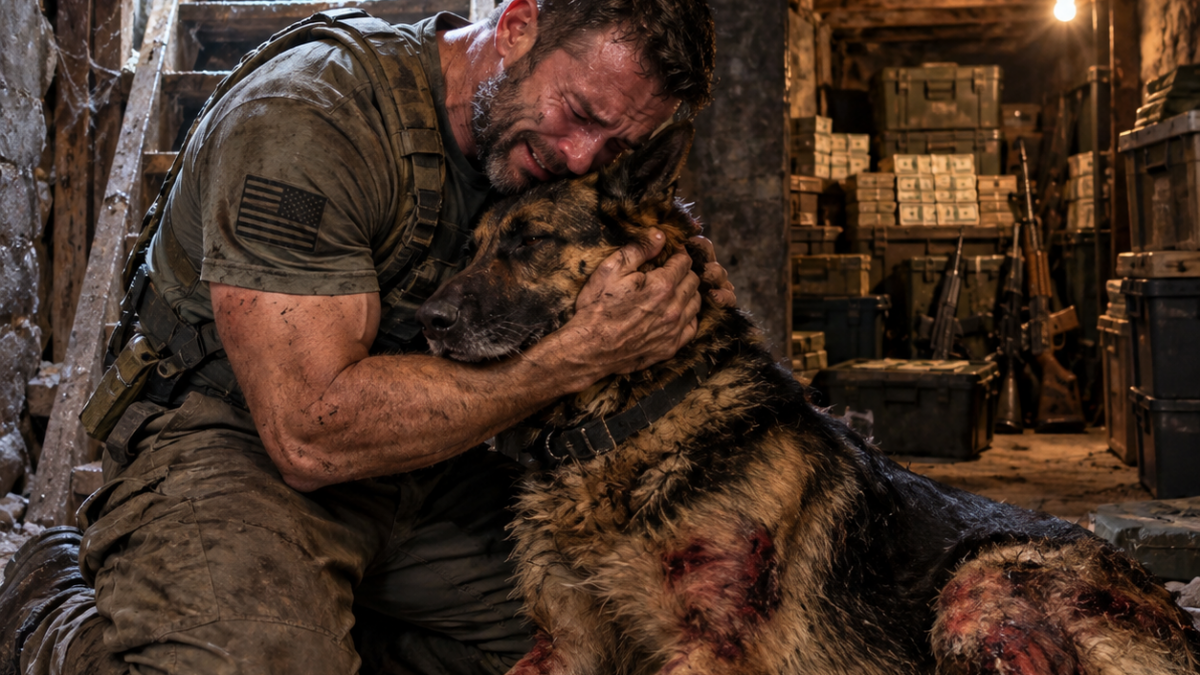
Titan lay on his side, chest rising unevenly. One hind leg was cut deep, bandaged poorly with some filthy strip of cloth that had already soaked through. His ears moved when he saw me. He tried to lift his head.
Couldn’t.
A sound came from him I had heard only once before, in an alley overseas after the blast that nearly killed us both.
A low, painful whine.
“I’m here,” I said.
My voice cracked.
That alone frightened me.
I found the lock on the pen, forced it open, and went in beside him. Titan pushed his head toward my chest with what strength he had left.
“I’m here, buddy. I’ve got you.”
His blood was warm beneath my hand.
The wound was ugly but not immediately fatal if I moved fast. I stripped off my jacket, pressed it against his leg, and applied pressure. Titan shuddered, then leaned more heavily into me.
For a few seconds, I let my forehead rest against his.
Every man has a line inside him.
A place past fear, past anger, past training.
The people who had taken Titan had crossed mine.
“We’re getting out,” I whispered. “You hear me? We’re getting out.”
His tail moved once against the concrete.
That nearly undid me.
Then I looked up.
At the monitors.
Six of them.
All live.
Monitor one showed the rainy exterior of my farmhouse.
Monitor two showed my kitchen.
My coffee cup sat on the granite counter.
Monitor three showed my living room.
Monitor four showed my bedroom.
I stopped breathing.
The cameras were hidden perfectly.
For two years, I had been watched.
Every sleepless night. Every morning routine. Every time I sat alone at the kitchen table with my hands wrapped around coffee because sleep had failed me again. Every moment I thought I was unseen. Every weakness I had allowed myself inside what I believed was my sanctuary.
The facility had not been abandoned when I bought the property.
It had been waiting.
Or worse.
It had been operating.
My life above it had been camouflage.
Who would suspect a decorated, reclusive Navy SEAL of allowing an illegal operation beneath his own house?
Who would question trucks coming and going on private land if the owner was known to be a quiet veteran who hated company?
I stood slowly, leaving the jacket pressed against Titan’s wound.
The command desk held a satellite phone, folders, an encrypted laptop, and a black leather ledger.
I opened the ledger.
Names.
Dates.
Amounts.
Routes.
Initials.
Codes I did not yet understand.
Some names meant nothing.
Some meant too much.
Then I saw one at the top of several pages.
Richard Caldwell.
My real estate broker.
The man who had sold me the house.
The man who had looked me in the eye and thanked me for my service.
It made sense in a way that filled me with ice.
Caldwell had not sold me a home.
He had installed a cover story.
A decorated veteran.
A man who lived alone.
A man with a reputation for privacy.
A man people would not casually visit.
A man who might hear things at night and blame his own memories.
I looked toward the monitors again.
They had not just watched me.
They had studied me.
That was when the far loading bay groaned.
Titan lifted his head.
His lips pulled back from his teeth.
The massive steel door at the far end of the underground room began to rise.
Someone was coming in.
I moved back into the shadows between the crates and checked the room in one sweep. Titan tried to stand.
“Stay,” I whispered.
He ignored me for half a second, because Titan had always believed my safety was his responsibility.
“Stay.”
This time, he lowered himself, trembling.
The loading door rose.
Three men entered.
They moved like professionals. Not frightened burglars. Not addicts. Not opportunists. They carried themselves with the confidence of men who had done violence before and expected to do it again.
Their leader spoke into a radio.
“Caldwell wants the inventory cleared fast. We’re moving everything tonight.”
Another man glanced toward Titan’s pen.
“What about the dog?”
“Leave it. It won’t last long.”
The room changed color in my mind.
I have been angry many times.
Anger is hot.
This was colder.
This was the kind of calm that comes when a decision has already been made somewhere deep in the body.
I will not describe everything that happened next.
Not because I don’t remember it.
Because I remember it too well.
There are things men like me are trained to do, and there are details that do not belong in a story meant to honor a dog.
What matters is this:
They underestimated the man living above them.
They underestimated the dog they had injured.
They underestimated what happens when professionals become comfortable in a place they think belongs to them.
Within minutes, the first man was down and disarmed. The second was wounded and unable to continue. The third tried to use the shadows against me and learned I had lived in darker places than that bunker.
Titan, against every command I gave him, dragged himself from the pen when one of them turned his weapon toward me.
Even injured, he moved with purpose.
Even bleeding, he protected me.
Again.
When the room went quiet, alarms began pulsing red along the walls. Somewhere in the system, someone had been notified. On the exterior monitor, headlights cut through the rain near the tree line.
Two black SUVs.
Caldwell.
I had minutes.
Not enough time to carry Titan out through the corridor and disappear into the woods. Not enough time to fully understand the facility. Not enough time to call local deputies and explain that my farmhouse was sitting on top of something that would make them think I had finally lost my mind.
But enough time to send a message.
I secured one of the men, found a medical kit near the command desk, and worked on Titan’s leg fast. Not perfectly. Fast. Enough to slow the bleeding. Enough to keep him conscious.
“Stay with me,” I said.
Titan’s eyes remained locked on mine.
“Don’t you quit now.”
His tongue moved over my wrist.
I found a burner phone on the desk and, beside it, a contact list.
Caldwell’s people.
Drivers.
Storage handlers.
Names that would matter later.
Federal names too.
That was the part that made my stomach turn.
A few years earlier, before I left service completely, I had worked a joint operation with an ATF agent named Marcus Corbett. Careful man. Serious. The kind who did not talk unless the words had value.
I had not called him in three years.
I called him then.
He answered on the fourth ring.
“This better be life or death.”
“It’s Hayes.”
Silence.
Then his voice sharpened.
“Jonathan?”
“I need a federal response in Kitsap County.”
“What kind?”
“The kind where you bring warrants, tactical support, evidence teams, and a veterinarian.”
A pause.
“What did you find?”
I looked at Titan.
Then at the monitors.
Then at Caldwell’s headlights approaching through rain.
“Something under my house.”
Corbett did not ask if I was drunk.
He knew better.
“Send location.”
“I’ll keep them occupied.”
“Hayes—”
“They took Titan.”
Another silence.
Then, very quietly, Corbett said, “Understood.”
I ended the call.
On the monitors, Caldwell stepped from the lead SUV beneath a black umbrella. Even in the storm, even wearing a long coat instead of a suit, he looked composed. Men like Caldwell believe presentation is armor. They think if they stand straight enough, speak smoothly enough, and smile at the right people, the world will keep mistaking corruption for confidence.
He pointed toward the hidden entrance.
Four men moved ahead of him.
I watched from inside the bunker’s camera system, one hand on Titan’s neck.
“Caldwell,” I whispered.
Titan growled.
“I know.”
The next few minutes were not a battle in the way movies understand battles.
There was no music.
No slow motion.
No heroic speeches.
There was confusion, rain, alarms, bad visibility, men shouting over each other, and a wounded dog trying to stand every time he thought I was in danger.
I used the facility against them.
Doors.
Lights.
Blind corners.
Sound.
Their own confidence.
I did not fight like a man defending property.
I fought like a man extracting family.
By the time federal sirens sounded in the distance, Caldwell was crawling through mud near the stone entrance, one hand pressed to a bleeding cut along his leg, his umbrella gone, his polished image washed away by rain.
I stepped into the storm and stood over him.
He rolled onto his back.
“Jonathan,” he gasped. “Listen to me. You don’t know what you’re standing in.”
“I know enough.”
“You found a storage point. That’s all. You think I’m the top? I’m not. You can’t imagine who—”
“Stop talking.”
He swallowed.
Rain ran down his face.
“I can pay you.”
That almost made me laugh.
Maybe I did.
“I don’t want your money, Richard.”
“You don’t understand. If this goes federal, people will come after you.”
I looked back toward the open stone doorway.
Titan stood there, leaning against the frame, blood dark on the bandage, ears forward, eyes fixed on Caldwell.
“They already did.”
The first federal vehicles came hard through the gravel drive. Agents emerged through rain with weapons raised and shouted commands that Caldwell obeyed immediately because cowards recognize real authority when it finally arrives.
Corbett stepped from the second vehicle wearing a rain jacket over body armor.
His eyes moved from me to Caldwell to the open wall beneath my house.
Then to Titan.
“Is that your dog?”
“Yes.”
“He looks terrible.”
“He’s had a long morning.”
Corbett looked at me again.
“So have you.”
A veterinary trauma team arrived twenty-three minutes later.
Those twenty-three minutes felt longer than any firefight I had survived.
I sat in the mud beneath the stone wall with Titan’s head in my lap, both hands holding pressure where the bandage had soaked through. Federal agents moved around us. Men were detained. Evidence teams entered the bunker. Someone asked me questions I did not answer. Someone else tried to lead me away from the entrance.
I ignored all of them.
Titan’s breathing was rough.
“Stay,” I whispered.
His eyes opened.
“You hear me? Stay.”
The veterinarian, a woman named Dr. Elaine Mercer, knelt beside us and worked with the controlled urgency of someone who had seen battlefield injuries on animals before.
“He needs surgery,” she said.
“Can you move him?”
“We can.”
“Will he survive?”
She did not give me false comfort.
“I don’t know yet.”
I nodded once.
“Then move.”
They loaded Titan into the emergency vehicle.
I tried to climb in after him.
Corbett stopped me with one hand on my chest.
“You’re bleeding.”
I looked down.
I was.
I hadn’t noticed.
“It’s not mine.”
“Some of it is.”
“Move your hand.”
“Jonathan.”
I looked at him.
He saw something in my face and stepped aside.
I rode with Titan.
At the emergency veterinary hospital, they took him through double doors and left me standing in a waiting room with blood on my clothes, mud on my boots, and my dog’s collar in my hand.
That was when the shaking started.
Not outside.
Inside.
My hands stayed steady. My face probably did too. But beneath the skin, somewhere behind the ribs, something had begun to come apart.
A receptionist asked if I wanted water.
I said no.
A deputy asked if I would make a statement.
I said not now.
Corbett arrived forty minutes later with a folder under one arm and two coffees in his hands.
He offered one.
I looked at it.
“My coffee’s still on the kitchen counter.”
“I saw.”
“You went inside?”
“Evidence team cleared the residence.”
I took the cup because my hands needed something to hold.
Corbett sat beside me.
For a while, neither of us spoke.
Finally, he said, “It’s big.”
“How big?”
“Bigger than Caldwell. Bigger than the property. That bunker was an active transfer point. Weapons, money, foreign contacts, domestic intermediaries. We’ve been chasing parts of this network for years.”
I stared at the wall.
“And I bought it.”
“You bought the house above it.”
“Don’t soften it.”
“I’m not.”
“They used me.”
“Yes.”
“They watched me.”
“Yes.”
My grip tightened around the cup until the lid bent.
Corbett lowered his voice.
“They chose you because you were useful. Reclusive. Respected. Armed enough to discourage trespassers. Isolated enough not to have guests. Decorated enough that people would hesitate before suspecting anything tied to your property.”
“And broken enough not to question noises in the night.”
He did not answer.
That was answer enough.
The surgery lasted four hours.
During those four hours, the world I thought I had built collapsed piece by piece.
Federal agents discovered hidden cameras in my kitchen, living room, hallway, bedroom, porch lights, barn roof, and driveway sensors. The bunker had independent power, ventilation, water access, and at least two entrances I had never known existed. The false wall near the root cellar was only the old access point. The modern loading bay opened through a camouflaged section of hillside beyond the south tree line.
Caldwell had handled the sale personally.
Of course he had.
He had discouraged inspections of the retaining wall by claiming old structural reports were already complete. He had recommended a local contractor for minor repairs—a contractor whose name appeared in the ledger. He had known I wanted privacy and used that desire like bait.
Titan must have found something during his patrol.
A hidden vent.
A scent trail.
A man moving where no man should have been.
They had taken him because he discovered the truth before I did.
That thought nearly destroyed me.
Not because Titan had been hurt.
Though that was bad enough.
Because I had missed it.
For two years, my dog had protected a man living above a secret he could not see.
And when Titan finally saw it, I had let him walk into danger alone.
Dr. Mercer came out at 1430 hours.
Her surgical cap was wrinkled. Her eyes were tired.
I stood before she spoke.
“He’s alive.”
Those two words took more strength from me than any enemy ever had.
I sat down hard.
“He lost blood,” she continued. “The wound was deep. There was tissue damage. But no major artery was severed. We repaired what we could, cleaned the wound, started antibiotics and pain control. He’s not out of danger, but he made it through surgery.”
“Can I see him?”
“Briefly.”
Titan lay in recovery with tubes, bandages, and a cone he would absolutely hate when he woke enough to understand it. His breathing was steadier. His muzzle looked grayer than it had that morning.
I placed my hand carefully beside his paw.
He did not wake.
“I’m sorry,” I whispered.
The words surprised me.
I had not planned to say them.
But once they came, more followed.
“I should have seen it. I should have known something was wrong. I should have—”
His paw moved.
Barely.
But enough.
His pads touched my fingers.
Dr. Mercer stood near the door.
“He knows you’re here.”
I nodded, unable to speak.
For the next week, Titan remained hospitalized while the investigation consumed my property.
My farmhouse became a crime scene.
The media found out by day three.
Former Navy SEAL discovers illegal arms bunker beneath rural home.
Broker arrested in federal weapons conspiracy.
Hidden surveillance system found in veteran’s farmhouse.
The headlines made it sound like something exciting.
It was not exciting.
It was violating.
Reporters parked near the county road. Helicopters circled once before federal air restrictions pushed them back. Old teammates called. Some left messages. Some didn’t know what to say and hung up after breathing into voicemail for a few seconds.
Caldwell’s photograph appeared everywhere.
The charming broker.
The respected businessman.
The charity donor.
The man who had sold homes to judges, doctors, retired officers, and half the county’s wealthy newcomers.
Neighbors told reporters he was polite.
Clients said he was professional.
One woman cried on camera and said, “He helped us find our dream home.”
People hate learning that monsters can have good manners.
It makes them wonder who else they misread.
I spent most of that week at the veterinary hospital.
Titan improved slowly. He hated the cone. He hated the IV. He hated everyone except Dr. Mercer, and even with her, his tolerance depended on whether she brought boiled chicken.
On the fifth day, he stood for the first time.
His injured leg trembled.
I crouched in front of him.
“Easy.”
He ignored me and took one step.
Then another.
Then his legs gave out.
I caught him before he hit the floor.
“Stubborn idiot.”
His tail moved.
Dr. Mercer smiled.
“I see where he gets it.”
I looked at her.
She raised both hands.
“Medical observation.”
On the seventh day, Titan came home.
Not to the farmhouse.
I could not live there.
Not then.
Maybe not ever.
Corbett arranged temporary housing on a secure property while federal teams continued searching the estate. I brought almost nothing with me. Clothes. Documents. Titan’s medication. His bed. His old deployment harness. The cut collar, sealed now in an evidence bag, stayed with investigators.
The first night in the temporary house, Titan refused to sleep unless he could see every door.
I understood.
I dragged his bed into the corner of the bedroom, then sat on the floor beside him. Rain moved against the windows. Different house. Different road. Same weather.
Titan lay down with a tired groan.
“I know,” I said.
His eyes stayed open.
“I don’t trust it either.”
For weeks, he woke at every sound.
So did I.
Healing, I learned, was not returning to who we had been before.
That place was gone.
Healing was building a new pattern and repeating it until the body believed it might hold.
Medication at six.
Short walk at seven.
Breakfast.
Bandage check.
Federal interview.
Nap.
Physical therapy.
Another interview.
Dinner.
Sleep if possible.
Somewhere in that routine, Titan began wagging again.
Not much at first.
A slow, cautious movement when I picked up his leash.
Then harder when Dr. Mercer brought chicken.
Then, one morning, nearly six weeks after the bunker, I opened the back door of the temporary house and Titan stepped outside without hesitation.
He stood on the porch.
Sniffed the air.
Looked back at me.
Then walked into the yard.
Not fast.
Not perfect.
But forward.
That was the first time I believed we might both survive what happened.
The case against Caldwell widened.
It turned out the Whitmore estate had been more than a bunker. It was one node in a network that had existed in different forms for decades. Charles Whitmore had built the original structure during the Cold War under legitimate defense contracts, then expanded it off-books for reasons no one fully understood. After his death, men like Caldwell discovered its value and turned the old infrastructure into something criminal.
The property had changed hands on paper.
But never truly left their control.
Until Titan found the wrong scent in the rain.
Caldwell tried to bargain.
Men like him always do.
He claimed he was a facilitator, not an architect. He claimed he had been pressured by people more dangerous than himself. He claimed he never intended for me or Titan to be harmed. He claimed the surveillance was for security, not manipulation. He claimed the operation would have moved soon anyway.
He claimed many things.
Evidence answered most of them.
The hidden cameras.
The ledger.
The messages.
The payment trails.
The men who talked once they realized Caldwell could no longer protect them.
Corbett called me after one round of interviews.
“You should know something.”
“What?”
“Caldwell asked about the dog.”
I went still.
“What did he ask?”
“If Titan lived.”
My hand tightened around the phone.
“What did you say?”
“I told him yes.”
“Why?”
Corbett paused.
“Because I wanted him to know.”
I looked across the room.
Titan was asleep on his bed, one ear twitching in a dream.
“Good.”
Months passed.
Titan recovered enough to walk a mile.
Then two.
He never regained the exact power he had before. The injury left a hitch in his stride, especially in cold weather. He pretended not to notice.
I noticed enough for both of us.
The farmhouse sat empty while proceedings continued. Federal agents removed weapons, equipment, servers, documents, surveillance systems, false panels, underground storage units, and enough evidence to keep prosecutors busy for years.
Eventually, they asked what I wanted to do with the property.
Sell it, someone suggested.
Demolish the house, someone else said.
Let the government seize it, Corbett offered, not unkindly.
For a while, I didn’t know.
That house had been my sanctuary.
Then it became a violation.
But one morning, Titan and I returned.
Corbett met us at the gate.
“You sure?”
“No.”
He almost smiled.
“That’s honest.”
The property looked different after the federal teams had gone. The driveway was torn up. Sections of earth had been excavated. The stone retaining wall stood exposed, stripped of its disguise. Yellow markers still flagged parts of the yard.
Titan stepped from the truck slowly.
I expected him to hesitate.
He didn’t.
He lowered his nose to the wet grass and began to walk.
I followed.
He led me first to the creek bed.
Then the barn.
Then the south wall.
The same route as before.
When we reached the place where I had found his collar, Titan stopped.
For a long moment, he stood there.
Then he sat.
Not in fear.
Not in confusion.
In recognition.
I crouched beside him.
“This where you found it?”
His ear flicked.
“What did you smell, buddy?”
He leaned against my shoulder.
I looked at the house.
For two years, I had believed quiet meant safety.
I had been wrong.
But maybe the house had never been the sanctuary.
Maybe Titan had.
I did not move back in.
Not permanently.
Instead, after the federal case cleared enough to allow it, I made a decision that surprised everyone, including myself.
I donated most of the land to a nonprofit that trained service dogs for veterans and first responders. The farmhouse was stripped, rebuilt, and converted into offices and temporary housing. The bunker was sealed after investigators finished with it, then partially repurposed into a secure training and storage facility under legitimate oversight.
The place that had been used to hide violence became a place built to interrupt it.
I kept five acres near the creek.
Enough for a small cabin.
Enough for Titan to patrol when he felt like being official.
Enough distance to breathe.
At Caldwell’s sentencing, I sat in the courtroom with Titan lying beside my feet in a service vest. His muzzle had more gray by then. His injured leg stretched slightly to one side.
Caldwell looked smaller than I remembered.
That happens often when men lose the stage they built for themselves.
His attorney spoke about cooperation. Pressure. Reputation. The good Caldwell had done in the community. Donations. Business leadership. Lack of prior convictions.
Then Corbett testified.
Then forensic accountants.
Then federal agents.
Then me.
I did not want to speak.
But when the prosecutor asked whether I would give a victim-impact statement, I said yes.
I stood at the podium.
Caldwell would not look at me.
I looked at the judge instead.
“Before this, I believed I knew what it meant to be watched by enemies,” I said. “I was wrong. Overseas, at least you know you’re in hostile territory. You know the walls may hide danger. You know the road may be wrong. You know sleep is temporary.”
The courtroom was silent.
“I bought that house because I wanted to stop living that way. Mr. Caldwell understood that. He used it. He sold me privacy because privacy made me useful. He sold me peace because my peace protected his crimes.”
Caldwell’s jaw tightened.
I looked down at Titan.
“My dog found what I didn’t. He paid for that with blood. Again.”
Titan’s ear moved at the sound of my voice.
I continued.
“I’m not here to ask for revenge. I’ve seen revenge. It doesn’t restore what was taken. I’m asking for accountability. Because men like Richard Caldwell count on good people being too tired, too trusting, too distracted, or too wounded to notice what’s happening beneath their feet.”
I finally looked at him.
“He chose the wrong house.”
Caldwell was sentenced to federal prison.
Not for every wrong connected to him.
No sentence ever covers everything.
But enough.
Enough to remove him.
Enough to dismantle what he thought would remain hidden.
Enough to make the men behind him start worrying about their own doors.
Afterward, outside the courthouse, reporters shouted questions.
“Mr. Hayes, do you feel safe now?”
I kept walking.
“Mr. Hayes, what will happen to the property?”
No answer.
“Mr. Hayes, is Titan a hero?”
That stopped me.
Titan stood beside me, calm despite the cameras.
I looked at the reporter.
“He’s always been one.”
Then I walked away.
Years have passed since that rain-swept morning.
Titan is older now.
So am I.
His hips are stiff. My shoulder aches when the weather changes. He sleeps more deeply than he used to, though he still wakes if I move too fast in the dark. The scar on his hind leg never disappeared. Neither did the ones I carry, though mine are harder to see.
The nonprofit on the old property has trained dozens of service dogs now.
Veterans come there with the same look I once had: tired eyes, controlled voices, bodies that sit facing exits without realizing it. Some arrive believing a dog cannot possibly help with what they brought home.
Then a dog rests its head on their knee.
And something begins.
Not fixed.
Not cured.
Begins.
There is a memorial wall in the rebuilt farmhouse. Not a dramatic one. Just photographs of working dogs past and present. Titan’s picture hangs near the center. In it, he is standing in the rain, ears forward, eyes sharp, the forest behind him.
Under the photograph are four words:
HE FOUND THE TRUTH.
People ask me sometimes if I regret buying that house.
I used to say yes.
Now I’m not sure.
I regret trusting Caldwell.
I regret not seeing the signs.
I regret every second Titan spent wounded in that cage.
But if I had never bought the house, the bunker might have kept operating. The cameras might have watched another family. The weapons might have moved through other hands. Caldwell might have kept smiling across conference tables while men like him turned quiet places into hiding spots for violence.
Titan found the truth.
I followed him into it.
That is how most important things in my life have happened.
I thought I was leading him.
Most of the time, he was leading me.
On the anniversary of the day he vanished, I still wake before 0600.
Old habits.
Titan does too, though slower now.
I open the cabin door, and he steps onto the porch, gray muzzle lifted to the morning air. He patrols less of the property these days. Sometimes he only walks to the edge of the trees and back. Sometimes he decides the porch is far enough and lies down with the dignity of a retired general.
But every year on that morning, rain or shine, he walks to the creek.
I go with him.
We stand where the first tracks were.
The mud is usually soft there.
The trees still drip with mist.
The world is quiet.
But it is not the same silence anymore.
Not heavy.
Not wrong.
Just quiet.
Titan leans against my leg.
I rest one hand between his ears.
“You found it,” I tell him every year.
His tail moves.
“You found it before I did.”
He looks toward the trees, alert even now.
Maybe he hears something I don’t.
Maybe he smells deer.
Maybe he remembers.
Maybe dogs, like soldiers, carry maps inside them of every place where life almost ended and somehow didn’t.
I don’t know.
What I know is this.
I went looking for my lost dog and found a secret beneath my own home.
I discovered that my sanctuary had been used as a mask.
I learned that betrayal can wear a tailored suit, shake your hand, and thank you for your service.
But I also learned that loyalty can bleed and still stand.
That trust, once violated, can be rebuilt somewhere else.
That a home is not made safe by walls, gates, acreage, or distance.
A home is made safe by who refuses to abandon you inside it.
Titan never abandoned me.
Not overseas.
Not after.
Not beneath that house.
Not once.
And in the end, Richard Caldwell lost the bunker, the business, the network, the lie, and the quiet man he thought would never look beneath the surface.
But Titan and I kept the only thing that mattered.
Each other.








