I Found an Abandoned Puppy at a Snowy Bus Stop With a Note—What It Said Brought Me to Tears
PART3:
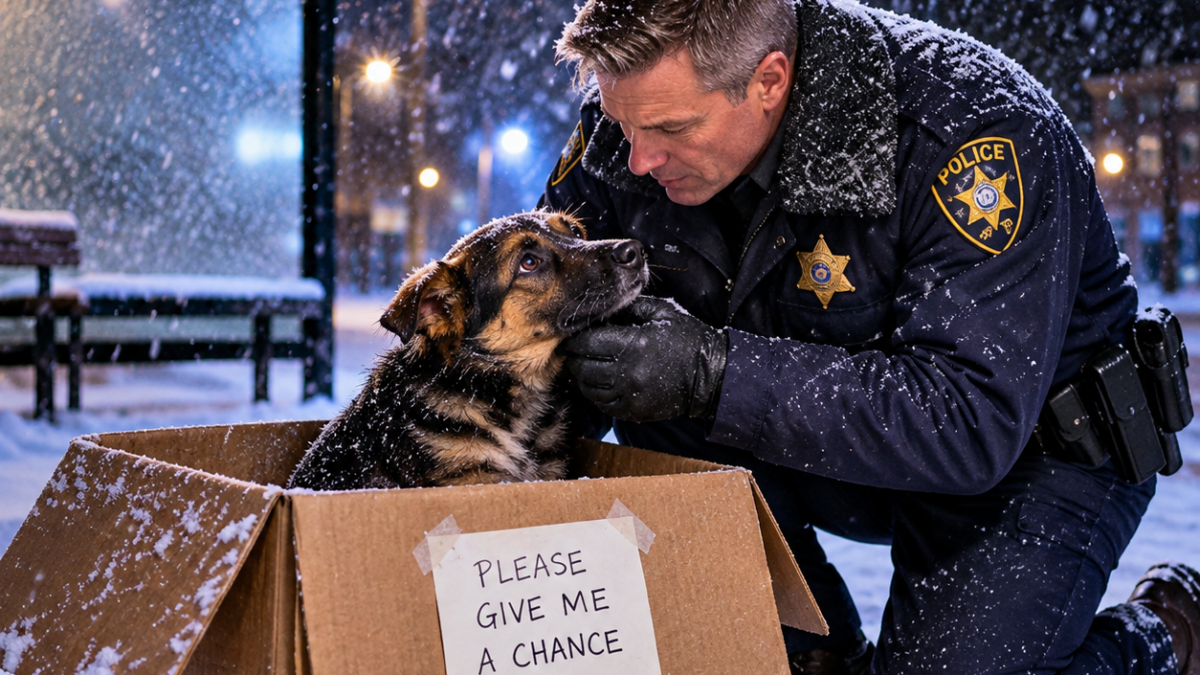
Not, Take this dog.
Not, Sorry.
A plea.
A prayer.
Maybe a goodbye.
The handwriting was uneven, hurried, almost childlike. The letters slanted badly. The word chance was pressed harder than the rest, as if whoever wrote it had been crying or cold or both.
The puppy lifted his head.
His eyes met mine.
He did not bark. He did not growl. He did not try to crawl away.
He simply looked at me as though I had already decided whether he lived or died.
“Hey there, little guy,” I said.
My voice sounded strange.
Softer than I expected.
“Where’s your owner, huh?”
The puppy blinked slowly.
Snow gathered on the back of my jacket.
Traffic light red.
Green.
Yellow.
Red again.
No cars passed.
The whole town slept while this small life fought not to disappear.
I slid my hands under him.
He was lighter than he should have been. Under the wet fur, I could feel ribs. He made one faint sound when I lifted him, then pressed his face into my chest with a sigh so tired it nearly took my breath away.
“Okay,” I whispered. “You’re coming with me.”
I opened my jacket and tucked him inside against my uniform. His little heartbeat fluttered against my ribs, fast and terrified.
I carried him back to the SUV and climbed in, slamming the door against the wind. The heater roared. The windows began to fog almost immediately. I wrapped him in the emergency blanket from the back seat, then took off one glove and stroked the damp fur between his ears.
“You’re tougher than you look,” I said.
His eyes opened halfway.
I glanced again at the note, now lying on the console beside me.
Please give him a chance.
“You need a name,” I said.
I do not know why I said it.
Maybe because names make things real.
Maybe because calling him “the puppy” felt too much like admitting he might not stay.
I looked down at him, at the dark muzzle, the paws too big for his body, the way he kept trying to stay awake but couldn’t.
“How about Max?”
His nose twitched.
A tiny sound escaped him.
It might have been a breath.
It might have been agreement.
I smiled despite myself.
“Max it is.”
I turned the heater higher and sat there for a minute, one hand resting over him while the storm battered the windshield.
I should have driven straight to the clinic.
I know that.
But for one minute, I could not move.
Because the note kept pulling at something in me.
Please give him a chance.
It sounded like something Laura would have written.
Laura had been the kind of woman who stopped for everything.
A turtle crossing the road.
A stray cat near the grocery store.
A neighbor’s trash can knocked over by wind.
A crying child in a parking lot.
“She’ll be late to her own funeral helping someone else get there,” her mother used to say.
And Laura would laugh because she knew it was true.
Before she died, we had fostered strays out of our cabin. Dogs mostly. Sometimes cats. Once a half-blind rabbit someone left behind the diner. Laura said every creature deserved at least one person who refused to look away.
After the crash, I stopped fostering.
Stopped answering shelter calls unless I was on duty.
Stopped keeping dog food in the house.
Stopped letting anything need me.
Need was dangerous.
Need gave the world another thing to take.
But now a shivering puppy lay beside me, trusting me to fix what someone else could not.
“All right, Max,” I said, shifting the SUV into drive. “Let’s get you warm.”
The Snowfield Veterinary Clinic sat on the edge of town, a squat white building with blue trim and a hand-painted sign in the window that read Emergencies Welcome. The neon sign flickered through the storm like a small lighthouse.
I parked under the awning and sat for a moment with the engine running.
Max slept under the blanket, chest rising and falling more evenly now. I rested one hand over him and listened to the storm.
For the first time in three years, I did not feel completely alone inside the sound of winter.
Dawn had begun to pale the sky by the time I finally carried him inside.
A bell chimed over the door.
Warm air hit my face, carrying the clean scent of antiseptic, pine cleaner, and coffee. The waiting room was quiet, walls lined with photos of rescued pets and handwritten thank-you cards taped behind the front desk.
Footsteps came from the back.
Dr. Maya Jensen stepped through the doorway tying the belt of her white coat.
She was in her early thirties, with chestnut hair pulled into a loose bun and sharp hazel eyes that took in everything fast. She wore dark jeans, snow boots, and a gray turtleneck beneath her coat. She had the kind of composure that told me she had seen emergencies before and knew panic never saved anything.
“You’re here early,” she said. “Emergency?”
I nodded.
“Found him at the Maple bus stop. Somebody left him in a cardboard box.”
Her eyes changed.
“In this weather?”
I unwrapped the blanket enough for her to see him.
Maya’s expression softened in a way she tried to hide.
“Oh, you poor little thing.”
The change in her was immediate. She became all movement—gloves on, table cleared, stethoscope out, lamp adjusted.
“Set him here.”
I laid Max down on the exam table. He whimpered faintly when the light touched his face.
Maya worked quickly but gently. She checked his temperature, gums, paws, ears, heartbeat. She parted the wet fur around his neck and frowned.
“There’s a rope mark.”
My jaw tightened.
“Someone tied him?”
“At some point, yes.”
“How bad is he?”
“Underweight. Dehydrated. Mild hypothermia. Some bruising. No obvious fractures, but I’ll check more once he’s stable.”
“Will he make it?”
Maya did not answer immediately.
I hated her for that.
Then respected her for it.
She listened to his chest for a long moment.
“He’s weak,” she said. “But he’s young. And he’s fighting.”
“Good.”
She glanced up.
“Good?”
“That’s why I named him Max.”
Her eyebrows lifted slightly.
“You already named him.”
“Didn’t seem right to keep calling him kid.”
Maya looked at me for a second longer than necessary.
“People name things they care about.”
I said nothing.
She prepared warm fluids and a heating pad. Max whimpered once when she placed the small IV, then settled again. I stood beside the table, one hand near his head, not touching unless he shifted toward me.
“He needs warmth, fluids, food in small amounts, and rest,” Maya said. “He’ll stay here for observation.”
“I’ll stay too.”
She turned.
“That isn’t necessary.”
“I’ll stay.”
“He’s safe here.”
“I know.”
“You look like you haven’t slept.”
“I haven’t.”
“You should go home, Officer Cole.”
My eyes did not leave Max.
“I’ll stay.”
Maya studied me, then sighed and pointed toward a chair near the heater.
“Suit yourself. If you fall asleep there, I’m not waking you.”
“Wouldn’t be the first time.”
As she washed her hands, I looked around the room. A photo on the counter caught my eye: a younger Maya standing beside an older man in a worn fishing jacket. Both smiled at the camera, wind messing their hair. In the corner, faded ink read: Me and Dad, 2004.
“Your father?” I asked.
Maya froze for half a second.
Then nodded.
“He was a vet too.”
“Was?”
“Died years ago.”
“I’m sorry.”
Her voice stayed even, but something flickered beneath it.
“Police chase on the interstate. Wrong place, wrong time.”
That kind of sentence is small until you understand what it carries.
I did.
“That why you came here?” I asked.
She turned toward me.
“Excuse me?”
“To Snowfield. Quiet town. Distance.”
Her gaze sharpened, then softened.
“Maybe.”
“Sometimes quiet helps,” I said. “Sometimes it doesn’t.”
She looked at me then in a way that made me feel more seen than I liked.
“You sound like someone who would know.”
“I lost my wife in a crash three winters ago.”
Maya’s face changed.
“I’m sorry.”
“Don’t be. Just make sure this one gets another shot.”
She nodded.
“I will.”
For a while, neither of us spoke.
The heater hummed. The clock ticked. Outside, daylight spread slowly across the snow-covered town.
Every few minutes, I reached over and rested my hand lightly on Max’s back, feeling the warmth return bit by bit.
Eventually, Maya came over again.
“He’s stabilizing. I’ll keep him here for the day.”
“You’ll call if anything changes.”
“Yes.”
I stood slowly, pulling on my gloves.
Before I reached the door, she said, “Officer Cole?”
I turned.
“You did a good thing. Most people would have driven past.”
I thought about the cardboard box under the bus stop light.
I thought about the note.
I thought about Laura’s hand slipping from mine in snow.
“Maybe,” I said. “But I’ve seen what happens when you don’t stop.”
Maya did not answer.
But her eyes followed me all the way out.
When I returned that afternoon, Max was awake.
Not strong.
Not healed.
But awake.
The moment I stepped into the exam room, his tail began thumping against the blanket.
Maya leaned in the doorway, arms crossed.
“He’s been making quite the racket.”
“That a good sign?”
“Depends who you ask.”
Max wriggled toward me with a clumsy little yip. I placed my hand in front of him, and he pressed his nose into my palm.
“Yeah,” I whispered. “I missed you too.”
Maya’s voice softened behind me.
“He’ll need small meals, medication, warmth, no rough play, and a checkup in three days.”
“Yes, ma’am.”
She handed me a bottle of medicine and a packet of instructions.
“You’re really taking him home?”
I looked at Max.
“Wasn’t planning on taking him anywhere else.”
“He may have an owner.”
“I know.”
“If someone claims him—”
“We’ll cross that bridge.”
Maya nodded.
But I could see she understood.
Sometimes the law says one thing and the heart starts preparing for another.
I carried Max to the SUV as the afternoon sun turned the snow gold. Through the clinic window, I saw Maya watching. She didn’t wave. Just nodded once.
I nodded back.
“All right, partner,” I said to Max. “Let’s get you home.”
My cabin stood on Maple Ridge Lane near the edge of the woods. It was cedar-sided, old, and too quiet. Snow covered the roof. The chimney was cold. For three years, I had lived there more like a caretaker than an owner, preserving everything exactly as grief had left it.
When I opened the door with Max in my arms, the house greeted me with silence.
The floor creaked.
Wind whistled through the eaves.
A framed photo of Laura stood on the table by the lamp. In it, she was on the porch in summer light, blonde hair loose, laughing at something behind the camera.
At me.
I swallowed.
“Hey, Laura,” I whispered. “Guess we’ve got a new roommate.”
I set Max near the stone fireplace and built the first real fire that house had seen in too long. He watched the flames catch as if witnessing magic. Then he circled three times on an old plaid blanket and collapsed with a sigh so deep it made me laugh.
“That’s better.”
I found water, then an unopened bag of dog food left from years ago, still sealed in the pantry because I had never been able to throw it away. Max ate carefully at first, then with growing confidence, tail thumping faintly.
“No rush anymore,” I said. “Nobody’s taking it.”
When he finished, he walked to me, sniffed my knee, and laid his head on my thigh.
I sat on the floor beside him while the fire warmed the room.
For years, everything in that house had been a reminder of what I lost: Laura’s books half-read on the shelf, the blanket folded over the couch, the dent in the cushion where she used to sit.
That night, those things felt different.
Not gone.
Not healed.
Just waiting.
Eventually, exhaustion pulled me into the recliner. Firelight flickered across the walls. Max breathed softly near the hearth.
Somewhere between sleep and memory, I saw Laura.
She stood in the living room doorway as she had before the accident—whole, smiling, wrapped in the glow of the fire.
“You’re finally home,” she said.
I tried to answer, but my throat closed.
She stepped closer.
Her eyes were full of the warmth I had been avoiding for three years.
“Let someone need you again, Ryan.”
I woke with a start.
The fire had burned down to coals.
Max whimpered in his sleep.
I leaned forward and pulled the blanket higher over him.
“Yeah,” I whispered, voice rough. “I hear you.”
The next morning, the house felt less hollow.
Max slept by the fireplace while I made coffee. Outside, the neighborhood moved slowly beneath new snow. Kids walked to school in bright coats. Smoke curled from chimneys. Someone scraped ice from a windshield down the street.
I stood at the kitchen window and realized I had not watched the world this closely in years.
Then came a knock.
Two light taps.
Then silence.
Max’s ears perked.
A small bark slipped out of him.
I opened the door.
A boy stood on the porch, bundled in an oversized parka that nearly swallowed him. His red knit cap sat crooked on his head, and snowflakes clung to his eyelashes.
He looked about ten.
“Hi, sir,” he said. “Um… I heard a dog.”
I blinked.
“You heard right.”
Max peeked from behind my leg, tail wagging cautiously.
The boy’s face lit up.
“He’s a German Shepherd. My favorite kind.”
“You like dogs?”
“Yes, sir. Always wanted one, but my mom says not until she can work less.”
He hesitated.
“She works a lot.”
I leaned against the doorframe.
“What’s your name?”
“Sam Parker. We live next door. The house with the blue mailbox.”
The name tugged at something.
“Your mom Lydia?”
He nodded.
“She works nights at the diner. Sometimes at the grocery store too.”
Then, as if he had said too much, he looked down and scuffed his boot against the porch.
“She’s saving for heart surgery.”
That was a lot for a child to carry in one sentence.
“You want to meet him?” I asked.
Sam’s eyes widened.
“Can I?”
“Come in. He doesn’t bite. At least not yet.”
Sam stepped into the warmth. Max trotted forward and sniffed his mittens. Within seconds, the puppy was licking his fingers, and Sam was laughing in a way that made the entire cabin feel startled by joy.
“What’s his name?” Sam asked.
“Max.”
“Hi, Max. You’re amazing.”
I watched them from near the door.
Sam’s laughter bounced off the walls.
It was the first time in three years that sound had filled my house.
“You live close?” I asked, even though I knew.
“Right next door. I can see your porch light from my window.”
“Guess that makes us neighbors.”
His smile grew.
“Can I come see Max sometimes? After school maybe? I promise I’ll help. I can feed him or walk him or teach him stuff.”
I looked down at Max, who had already sprawled across the boy’s lap like they had signed an agreement.
“After homework,” I said.
Sam grinned.
“Yes, sir.”
“Don’t call me sir. Makes me feel older than I am.”
“Yes—uh, Officer Ryan.”
“Just Ryan.”
He nodded like I had promoted him.
Before he left, I taught him how to give Max a basic command.
“Sit,” I said, raising one finger.
Max sat immediately.
Sam’s jaw dropped.
“He’s so smart.”
“German Shepherds usually are. You try.”
Sam raised his mittened hand.
“Sit.”
Max tilted his head.
Then sat.
Sam clapped both hands.
“He did it!”
I laughed.
The sound surprised me.
When Sam left, I gave him one of Laura’s old scarves because the wind had picked up and his coat didn’t close right at the neck. It was plaid, soft, one she had worn every winter.
He held it carefully.
“Are you sure?”
“Yeah. I think she’d want it keeping someone warm.”
“I’ll bring it back.”
“No rush.”
He ran home through the snow, scarf trailing behind him.
Max barked once from inside the door.
“Yeah,” I said. “He’s a good kid.”
But even with Sam’s laughter lingering in the cabin, I could not stop thinking about the note.
Someone had written it.
Someone had left Max at that bus stop.
And I needed to know whether it had been cruelty or desperation.
The next morning, I went back to Maple Avenue.
The cardboard box was gone. Public works had cleared most of the snow, but near the bus stop, the ground still held faint impressions. Small footprints, half-covered and uneven, led away from the shelter toward the alley behind the laundromat.
Not adult tracks.
A child’s.
I followed them as far as I could before they disappeared near a chain-link fence.
Standing there in the cold, I pictured a kid carrying that box through a blizzard, kneeling beneath the orange light, tying that note with shaking hands.
“A kid did this,” I murmured.
Not dumped.
Saved.
I went straight to the clinic.
Maya looked up when I walked in.
“You again? Don’t tell me Max chewed something already.”
“Not yet. I need a favor.”
Her eyes narrowed.
“That sounds dangerous.”
“I’m trying to find who left him at the bus stop. I found footprints. Small ones. There’s a gas station camera across the street.”
Maya hesitated.
“There’s a municipal feed I can sometimes access for lost pet cases.”
“Can you check around one a.m.?”
She studied me.
Then nodded toward her office.
“Come on.”
The footage was grainy.
Snow blurred everything. The bus stop appeared under the dull glow of the streetlamp, empty at first.
Then a small figure entered the frame.
A kid in a red beanie and a puffy coat too large for him, carrying a cardboard box.
He moved slowly through the snow, set the box beneath the light, then knelt beside it. He stayed there for several seconds.
Long enough to touch the top of the box.
Long enough to say goodbye.
Then he ran.
Maya’s hand stilled on the mouse.
“That’s not an adult.”
“No.”
“You think he owned Max?”
“I think he loved him.”
She leaned back.
“That’s rare.”
“What is?”
“Kindness that doesn’t expect anything back.”
I looked at her.
“You sound like someone who stopped expecting it.”
A faint, humorless smile touched her face.
“Maybe I did.”
I thought about Max in the snow.
About Sam laughing in my living room.
About Laura telling me to let someone need me again.
“Sometimes it comes back,” I said.
Maya looked at me.
“What does?”
“Kindness. Hope. Whatever you want to call it.”
She glanced toward the frozen image of the boy on the screen.
“You really think we can find him?”
“We can try.”
The still photo took me through half the town.
The diner.
The gas station.
The post office.
A woman outside the grocery store thought she recognized the red hat from Maple Hollow Trailer Park. A man at the gas station said the kid might be Ethan Marsh, fourteen, lived with his father near the south side of town.
“Good boy,” the gas station owner said. “Bad house.”
That sentence told me enough to be careful.
Maple Hollow sat at the edge of town, a patchwork of rusted trailers, plywood steps, and frozen mud. Children’s toys lay half-buried in snow. Smoke rose from patched metal chimneys. Dogs barked behind fences. People watched from windows and then looked away.
The third trailer on the left had a faded blue door and an old Christmas wreath still hanging in February.
I knocked.
Nothing.
I knocked again.
The door opened an inch.
A thin boy peered out.
Red beanie.
Pale face.
Sharp, guarded eyes.
“Ethan?”
His grip tightened on the door.
“Yeah?”
“I’m Officer Cole. I want to talk about a dog.”
Fear moved across his face so quickly he couldn’t hide it.
“I don’t know what you mean.”
“Yes,” I said gently. “You do.”
For a moment, he looked like he might run.
Then his face crumpled.
He opened the door wider.
“Come in. But keep your voice down. My dad’s working a double shift.”
The trailer was cold enough that I could see my breath. A small space heater rattled near a cot covered in thin blankets. The wallpaper peeled near the ceiling. An ashtray overflowed on the table. There were no photographs. No signs of softness anywhere except a folded dog blanket in the corner.
Ethan stood with his arms crossed tight over his chest.
“You’re not in trouble,” I said.
He did not believe me.
“I just want to understand.”
His lips trembled.
“He’s mine,” he whispered. “Buddy. That’s his real name. I had him since he was little.”
I stayed quiet.
“My dad used to like him. Before Mom left. Then everything got worse. He drank more. Yelled more.”
Ethan looked toward the floor.
“One night Buddy barked when Dad threw something at me. Dad hit him. Hard. I tried to stop him, but he kicked Buddy outside in the snow. Said if I brought him back, he’d get rid of him.”
His voice cracked.
“So I waited until he passed out. I took Buddy. I didn’t know where else to go. I thought… I thought someone would find him at the bus stop. Someone kind. I couldn’t keep him, but I couldn’t let him die.”
The silence after that felt heavier than the room.
I crouched slightly so I wasn’t towering over him.
“Ethan, look at me.”
He did.
Barely.
“You did something brave.”
His eyes filled.
“You’re not mad?”
“No.”
“I left him.”
“You protected him.”
Tears spilled down his face, and he wiped them away angrily with his sleeve.
“I wrote the note because I didn’t want anyone thinking he was bad. He’s not bad. He’s good. He’s the best dog.”
“I know.”
“You saw him?”
“Yes.”
“Is he okay?”
“He’s warm. He’s eating. He’s healing.”
Ethan closed his eyes.
For a second, he looked like a little kid instead of someone forced to survive too early.
I reached into my coat pocket and pulled out the old leather collar I had found near the box after the snow melted. The tag read Buddy.
“I thought you might want this.”
He took it with both hands.
“You kept it?”
“Things that matter shouldn’t be thrown away.”
He stared at the collar.
“Can I see him?”
“Yes.”
His head snapped up.
“Really?”
“Really. But we’ll do it carefully.”
“I don’t want to take him back. I can’t. It’s not safe.”
“I know.”
“I just want him to know I didn’t leave because I stopped loving him.”
That one hit me hard.
“I think he already knows.”
Saturday morning came clear and cold.
I met Ethan at Snowfield Park, near the frozen pond. He arrived wearing the same red beanie and a secondhand parka with sleeves too long for his arms. His boots were too big. His hope was too fragile.
Max—Buddy to Ethan, Max to the rest of us—waited in the back of my SUV, tail already wagging as if he knew.
Ethan stopped several feet away.
“Does he remember me?”
“Why don’t you find out?”
I opened the door.
For one breath, Max froze.
His nose lifted.
His ears went forward.
Ethan dropped to his knees.
“Buddy,” he whispered.
That was all it took.
Max launched himself into the snow and crashed into the boy’s arms with a sound halfway between a bark and a sob. Ethan wrapped both arms around him, laughing and crying as Max licked his face, pressed into him, wagged so hard snow flew in all directions.
“You remember me,” Ethan gasped. “You really remember.”
I stood back because the moment did not belong to me.
It belonged to a boy who loved a dog enough to lose him so he could live.
Eventually, Ethan looked up at me.
“Can I visit him?”
“Every weekend after homework.”
His smile broke open.
“Deal.”
Max barked once, as if making it official.
Footsteps crunched behind me.
Maya approached in a green coat and scarf, a thermos in one hand.
“Didn’t think you were the park type, Doc,” I said.
“I was on my way to the clinic and saw your SUV.”
“Curiosity?”
“Professional concern.”
She looked at Ethan and Max playing in the snow, and her expression softened.
“That’s him?”
“Ethan Marsh. He left Max at the stop.”
Maya nodded slowly.
“He did the right thing.”
“Even if it broke his heart.”
We watched in silence as boy and dog found their way back to each other.
Then Maya said, “I’ve been thinking about something.”
“That sounds dangerous.”
She ignored that.
“I want to start an animal-assisted therapy program. Kids dealing with grief, trauma, abuse. I can manage the clinical side. The clinic can host. But I need help connecting with schools, families, the department.”
I looked at her.
“You’re asking me to partner with you.”
“I’m asking you to help make something good out of this.”
I glanced at Max, now rolling in snow while Ethan laughed harder than I had seen any kid laugh in a long time.
“All right, Doc,” I said. “Let’s do it.”
She smiled.
“You know, Officer Cole, I think that dog isn’t the only one who got rescued.”
I looked at her, then back at Max.
“Maybe none of us are.”
The therapy program began small.
Three kids on a Saturday morning at the clinic.
Then five.
Then eight.
Some came because of grief. Some because of anxiety. Some because teachers noticed they stopped talking after something happened at home. Some because they had seen too much, lost too much, or carried too much in bodies too small for the weight.
Max became the center of it.
He had a way of knowing.
Sam came often, sometimes cheerful, sometimes quiet. His mother’s heart condition worsened that spring, and there were days when worry sat on his shoulders like a coat he could not remove.
One Saturday, Sam sat on the floor with a crayon in his hand, pretending to draw.
I knew the look.
So did Max.
Before Maya or I could say anything, Max stood from his corner, walked across the room, and rested his head in Sam’s lap.
Sam froze.
Then his small hands sank into the dog’s fur.
His shoulders began to shake.
“I don’t want my mom to die,” he whispered.
Max did not lick him or bounce or demand attention.
He simply stayed.
Warm.
Steady.
Present.
Maya crouched beside them, eyes shining.
“He always knows,” she said.
Sam pressed his face into Max’s neck.
“He makes it easier to breathe.”
I looked away because I didn’t trust my voice.
That was what Max did.
He made breathing easier.
For Sam.
For Ethan.
For Maya.
For me.
Weeks later, a blizzard hit Snowfield harder than anyone expected.
I was at the station when the call came through.
Sam Parker was missing.
His mother had been admitted to County Hospital earlier that evening. A neighbor saw Sam leave on foot around six, before the storm turned violent. He had never arrived at the hospital.
“He tried to walk there,” I said.
The dispatcher looked at me.
The room went cold in a way that had nothing to do with weather.
I grabbed my coat and keys.
“I’m taking Max.”
The drive was brutal. Snow hammered the windshield. The world beyond the headlights disappeared into white. Max sat alert in the passenger seat, ears up, eyes fixed forward.
We started near the last intersection before the road split toward Pine Ridge.
“All right, partner,” I said, stepping into the storm. “Find Sam.”
Max lowered his nose.
For a moment, the wind erased everything.
Then he moved.
Steady.
Certain.
We followed him past the edge of town and into the trees. Snow came up to my knees. Branches whipped my face. I called Sam’s name until my throat burned.
Nothing.
Then Max stopped.
Barked.
I found small footprints already filling with snow.
“Good boy.”
The tracks veered downhill toward a shallow ravine.
Halfway down, Max barked again—urgent, sharp, terrified.
I saw the red of Sam’s hat beneath a drift near the base of a tree.
“Sam!”
I dropped to my knees, brushed snow from his face, and pressed two fingers to his neck.
Pulse.
Faint.
There.
I stripped off my outer coat and wrapped it around him. Max lay beside him, pressing his body against Sam’s side, becoming a living blanket.
“Good boy,” I whispered, voice shaking. “Keep him warm.”
I radioed our location.
Rescue was ten minutes out.
Ten minutes in a blizzard can be forever.
I held Sam close while Max stayed pressed against him, unmoving, covered in frost.
“Come on, buddy,” I said to the boy. “You’re going to see your mom again.”
Sam’s lips moved.
“Buddy.”
I smiled through the cold.
“Yeah. He’s here. He’s right here.”
Sam’s fingers twitched in Max’s fur.
The rescue lights finally came through the trees like red stars.
Paramedics took Sam fast. He was hypothermic but alive.
One of them looked at Max and said, “That dog saved him.”
I sat in the SUV afterward, hands trembling on the steering wheel, Max’s head in my lap.
“You did good,” I told him. “Real good.”
The next morning, the Snowfield Gazette called him a hero.
K-9 Puppy Saves Boy in Snowstorm.
The photo showed Max dusted with snow, rescue lights behind him, eyes steady as if he had known all along what he came into our lives to do.
By spring, Snowfield had changed.
Not completely.
No town changes completely.
People still argued. Bills still came due. Grief still visited. Some parents still failed their children. Some storms still arrived without warning.
But something had shifted.
The clinic became warmer. The department became more involved with families before emergencies swallowed them. The school started referring children to Maya’s therapy program. Donations came in. Volunteers offered rides. A retired carpenter built a fenced outdoor space behind the clinic.
Ethan visited Max every weekend.
He also accepted help.
That mattered most.
His father’s drinking and violence finally came into the open after Ethan trusted enough adults to tell the full truth. Child services became involved. A relative in another county took temporary custody. The process was messy, painful, and imperfect, but Ethan was safe.
He once asked me if doing the right thing always hurt.
I told him the truth.
“Sometimes.”
He looked at Max.
“Still worth it?”
I nodded.
“Usually the things worth doing are.”
Sam’s mother recovered enough to come home after surgery. The first time she visited the clinic, she hugged Max so tightly he looked mildly confused but accepted it with grace.
“You brought my boy home,” she whispered.
Max wagged.
As if that had simply been his job.
Community Recognition Day came in April, when the last snow had melted into silver puddles and the air smelled like thawed earth and pine.
Snowfield Park was filled with families. The mayor stood on a small wooden stage under a banner celebrating acts of courage. I wore a dark blue sweater instead of my uniform. Maya stood beside me in a beige coat, her hair loose for once. Ethan stood near the front in his red beanie. Sam sat with his mother on the grass.
Max sat at my feet wearing a blue collar with a new silver tag.
MAX
THERAPY DOG
SNOWFIELD
The mayor spoke about courage, compassion, and the way one act of kindness can ripple outward.
Max tilted his head through most of it.
When they placed a ribbon around his neck, he wagged hard enough to make the crowd laugh.
After the ceremony, Ethan came up to me.
He was taller than when I first met him, but still wore that same red hat.
“Ryan?”
“Hey, Ethan.”
He looked down at Max.
“I thought I was saving him that night when I left him at the bus stop.”
“You did.”
“Maybe. But I think he was meant to find you too.”
My throat tightened.
I looked at Max, at the dog who had arrived half frozen with a note around his neck and somehow thawed an entire town.
“No,” I said gently. “He didn’t just find me.”
Ethan looked up.
“He found all of us.”
Maya reached down and scratched Max behind the ears.
“He connected us,” she said.
Later that evening, after most people had gone home, Maya, Sam, Ethan, and I sat on an old bench near the pond. The sky turned gold and rose behind the pines. Max chased a stick across the field, blue ribbon flashing in the last light.
Sam leaned against his mother, smiling.
“Max is a real hero now.”
“He always was,” I said. “The rest of us just needed to catch up.”
Ethan laughed.
“I still think he deserves a statue.”
Maya smiled.
“I think he’d rather have a field to run in.”
Then she looked at me with a small secretive expression.
“What?”
“The town council approved the grant.”
I stared.
“For the therapy dog center?”
She nodded.
“We’re calling it Max’s Promise Foundation. A rescue and rehabilitation center for dogs who can be trained for emotional therapy. You’ll be co-founder, obviously.”
I looked out at Max running across the field, paws splashing through melted snow.
“Max’s Promise,” I repeated.
Please give him a chance.
The note came back to me so clearly I could see the uneven handwriting.
One chance.
That was all someone asked for.
One chance had become a life.
Then a friendship.
Then a rescue.
Then a boy saved in a storm.
Then a program.
Then a foundation.
Then a town remembering that kindness still mattered.
“Let’s make it happen,” I said.
Maya smiled.
“I was hoping you’d say that.”
The sky deepened. Stars appeared above the ridge. Max stopped in the field and looked back at us, tail high, fur glowing faintly in the last light.
For a moment, I saw Laura again.
Not as a ghost this time.
Not as a wound.
As a warmth.
Let someone need you again.
I had.
A puppy.
A boy.
A neighbor.
A doctor.
A town.
And somehow, in needing me, they had given me back to myself.
Max barked and ran toward us, fast and joyful, the ribbon at his neck catching the sunset until it looked like a streak of gold.
I stood.
“Come on,” I said. “Let’s go home.”
Years have passed since that night at the bus stop.
Max grew into his paws. Ethan grew into his courage. Sam’s mother grew stronger. Maya and I built Max’s Promise into something bigger than either of us expected. Dogs came through that center broken, frightened, abandoned, or overlooked, and many left with children who needed them, veterans who understood silence, widows who had forgotten how to open curtains in the morning, and families learning how to be gentle again.
I kept the note.
The original one.
It sits framed near the entrance of the foundation, beneath a photo of Max as a puppy wrapped in an emergency blanket on the passenger seat of my patrol SUV.
Please give him a chance.
People stop to read it every day.
Some cry.
Some smile.
Some bend down to pet whatever dog happens to be resting beneath it.
Ethan once stood in front of it for nearly ten minutes.
He was seventeen then, taller than me, no red beanie for once.
“I wrote it because I didn’t know what else to do,” he said.
I stood beside him.
“You did enough.”
“I was scared.”
“Bravery usually starts there.”
He looked at the photo of Max.
“I thought I was saying goodbye.”
“Maybe you were.”
His eyes shifted to mine.
“To the life he had before.”
Ethan nodded slowly.
“Yeah.”
Max died old.
Warm.
Loved.
He went peacefully in the cabin near the fireplace where he had spent his first night home. Maya was there. So was Ethan. Sam too. Laura’s photo still sat on the table, watching over us in the only way photographs can.
I held Max’s head in my lap, the way I had held him in that patrol SUV years earlier.
His muzzle was gray.
His breathing was slow.
His eyes still trusted me.
“You did good, partner,” I whispered.
His tail moved once.
Just once.
That was enough.
When he was gone, the silence that followed hurt.
Of course it did.
Love always leaves a space shaped exactly like what it held.
But it was not the empty silence I had known after Laura died.
This silence was full.
Full of children laughing at the clinic.
Full of paws on tile floors.
Full of Ethan’s reunion in the snow.
Full of Sam breathing easier because Max had rested his head in his lap.
Full of Maya’s voice telling me life was asking to be let back in.
Full of every person who walked through Max’s Promise and found a reason to stay.
We buried Max beneath a pine tree on the foundation property, near the field he loved. His stone is simple.
MAX
HE WAS GIVEN A CHANCE
AND GAVE IT BACK TO EVERYONE
Sometimes, on winter nights, I still patrol Maple Avenue.
The bus stop is newer now. The old orange light has been replaced. The gas station changed owners. The laundromat finally fixed its sign.
But I always slow down when I pass.
I can still see the box.
The snow.
The note.
The trembling puppy inside.
People talk about miracles like they are loud things.
Parted seas.
Blinding lights.
Voices from heaven.
Maybe sometimes they are.
But the miracle that saved me was quiet.
A cardboard box under a bus stop light.
A child brave enough to let go.
A veterinarian who still cared even after life hurt her.
A lonely boy next door.
A town willing to try.
A dog with warm eyes and a heartbeat stubborn enough to survive the storm.
I used to believe winter had taken everything good from me.
I was wrong.
Winter brought Max.
And Max brought me back.
So whenever someone asks why I stopped that night, I tell them the truth.
I stopped because something moved in a box.
I stayed because something moved in me.
And I have spent the rest of my life trying to honor what that note asked for.
Please give him a chance.
We did.
And somehow, he gave all of us one too.








