I Found a Soaked Kitten Shivering in the Rain—Then He Taught Me I Deserved Saving Too
I Found a Soaked Kitten Shivering in the Rain—Then He Taught Me I Deserved Saving Too.
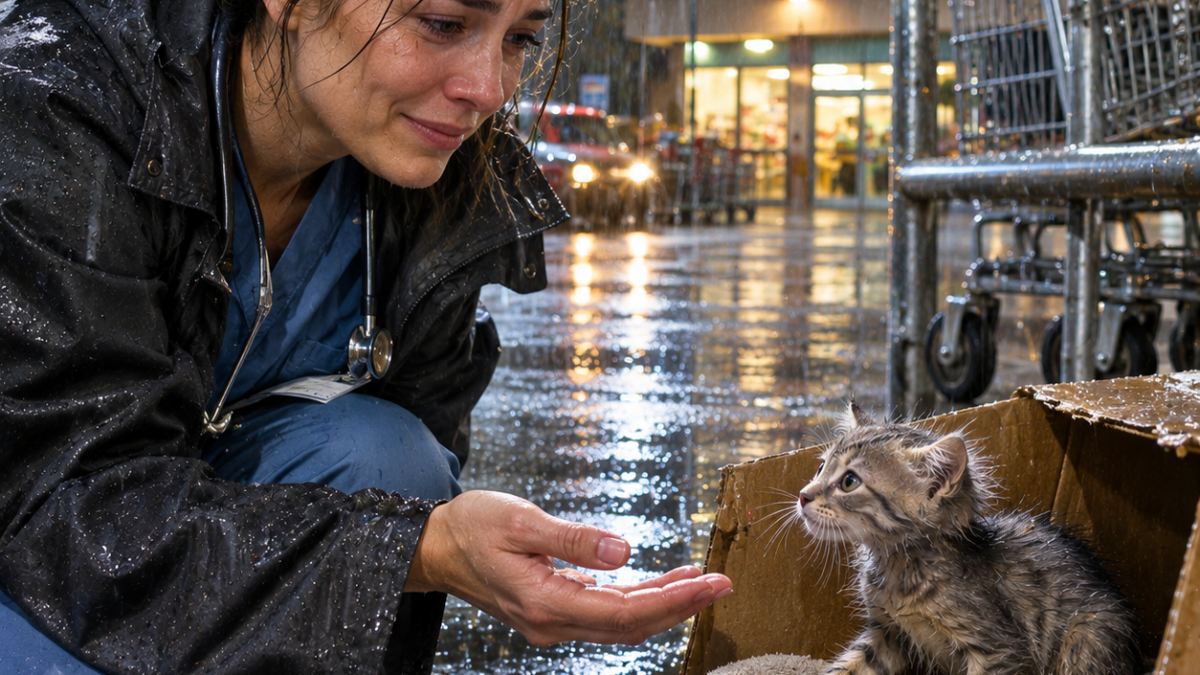
I was so exhausted that night I could barely remember driving to the grocery store, but under a row of metal shopping carts, a soaked gray kitten sat in the rain and looked at me like he was waiting for me to decide whether either of us was worth stopping for.
I told myself I could not carry one more responsibility, drove ten feet toward the exit, and then watched him take one tiny step after my headlights as if trusting me was the most frightening thing he had ever done.
I thought bringing him home would be a temporary act of mercy, but within days he had unsettled my old cat, disrupted every routine I depended on, and forced me to confront a question I had spent years avoiding: why was I willing to save everyone except myself?
My name is Mara.
I was thirty-three years old when I met the kitten in the grocery-store parking lot.
I say “met” because “found” makes it sound as if I was looking for him.
I absolutely was not.
If anything, I was trying very hard not to find anything at all.
Not another patient.
Not another problem.
Not another person who needed something.
Not another responsibility.
I had just finished a twelve-hour nursing shift at a hospital in Portland, Oregon, except twelve hours had become nearly fourteen because one nurse called out, another had to leave early, and apparently the human body has no respect for staffing ratios.
By the time I clocked out, my feet hurt inside my shoes.
My back hurt.
My head felt full of cotton.
I had eaten half a granola bar since breakfast.
There was dried hand sanitizer around my cuticles and a faint red mark across the bridge of my nose from wearing protective gear for too many hours.
I remember standing beside my car in the employee garage thinking:
You need food.
Not because I was hungry.
I had moved beyond hunger.
But because I knew what happened when I got home with nothing in the refrigerator.
I would shower.
Sit on the edge of the bed.
Tell myself I was too tired to cook.
Fall asleep with my phone in my hand.
Wake at two in the morning feeling nauseated.
Then start over.
So I stopped at a small grocery store about ten minutes from my apartment.
The rain had started while I was driving.
Not gentle rain.
Portland rain can be soft and endless, but this was different.
Hard sheets.
Water hammering the windshield.
PART2:
Wipers moving so fast they sounded panicked.
The parking lot reflected everything.
Headlights.
Store signs.
Red brake lights.
Streetlamps stretching across black pavement like paint.
I parked near the cart return.
Turned off the engine.
Put my forehead against the steering wheel.
Just for a second.
That was what I told myself.
Then I saw movement beneath the carts.
Small.
Gray.
At first, I thought it was a plastic bag caught in the wind.
Then two eyes reflected my headlights.
A kitten.
Maybe ten weeks old.
Twelve at most.
Gray tabby.
Soaked all the way through.
His fur had collapsed against his body, and that made his ribs too easy to see.
He sat beneath the metal cart corral with his paws tucked awkwardly beneath him.
Not fully hiding.
Not coming out either.
PART3:
Just existing in that narrow strip where the roof blocked some of the rain.
I stared at him.
Then immediately looked away.
“No.”
I actually said it.
Out loud.
To myself.
“No.”
I put the car in reverse.
Backed out.
Turned toward the exit.
Then looked into the rearview mirror.
The kitten had stepped out from under the carts.
One step.
That was all.
Into the rain.
Toward my headlights.
He stopped there.
Tiny body shaking.
Tail low.
It was not a confident gesture.
He wasn’t running toward rescue like some movie animal who knew exactly what he wanted.
It looked more like a dare he had made to himself.
Try one more person.
See what happens.
I closed my eyes.
“Seriously?”
Rain beat against the roof.
I looked at him again.
He had not moved.
“You do not know me.”
He obviously couldn’t hear me.
“You have terrible judgment.”
Still nothing.
I parked again.
For a moment, I sat gripping the steering wheel.
The first thought in my head was not compassionate.
It was:
I cannot do this.
I cannot carry one more thing.
That sentence had been living inside me for months.
Maybe longer.
At work, I carried people.
Not physically most of the time.
Emotionally.
A frightened patient.
A daughter who needed somebody to explain why her mother wasn’t getting better.
A confused elderly man who asked me the same question seventeen times.
A resident running behind.
A physician waiting on labs.
A family calling again.
A new admission.
An angry discharge.
A call light.
Then another.
Then another.
I had become very good at moving from need to need without ever asking whether I had anything left.
And now there was a wet kitten under shopping carts asking nothing from me except, somehow, everything.
I opened the door.
Cold rain hit my face.
Within seconds, my scrub pants were wet below the knees.
I walked slowly toward him.
The kitten backed up.
I stopped.
“Okay.”
I crouched.
Held out one hand.
Palm open.
No grabbing.
No reaching.
Just space.
He stared at my fingers.
His eyes were enormous.
Not adorable enormous.
Alert enormous.
Eyes that watched every movement before deciding whether it meant danger.
A car door slammed nearby.
The kitten flinched.
Someone getting into an SUV called toward me.
“That kitten’s been here two days.”
I looked up.
“What?”
“Two days.”
The woman pulled her coat tighter.
“Seen him yesterday too.”
“Has anyone called animal control?”
She shrugged.
“Don’t know.”
Then she got into her car.
The kitten tried to meow.
The sound barely came out.
A thin little scrape of noise swallowed by the rain.
Then he coughed.
Once.
His whole body shook.
And still he did not retreat completely beneath the carts.
I looked toward my car.
Warm.
Dry.
Quiet.
Then back at him.
And the fear came.
Not fear of the kitten.
Fear of what saying yes meant.
Food.
Vet.
Litter.
Medicine.
Another living thing depending on me.
Another life capable of getting sick.
Another thing I could fail.
My brain supplied the verdict immediately.
You can’t even take care of yourself.
That voice was always efficient.
Never needed evidence.
I stood.
Went to my trunk.
Found an old cardboard box from a case of bottled water.
Then a towel from my gym bag.
It smelled faintly like laundry detergent and the inside of my car.
I brought both beneath the overhang.
The kitten watched.
“I’m not taking you home.”
That was what I told him.
“I’m getting you out of the rain.”
I lined the bottom of the box with the towel.
Set it near him.
He stared.
I stepped back.
For maybe thirty seconds, nothing happened.
Then he moved.
One paw onto the towel.
Pause.
Another.
Then the rest of him.
He climbed into the box by himself.
Immediately pressed into the far corner.
Eyes huge again.
Like he had accepted shelter but not safety.
“Okay.”
I whispered it.
“Okay.”
I called the nearest shelter.
Automated message.
Closed.
Leave a voicemail.
Try again tomorrow.
Second shelter.
Same.
Third number redirected me to a county line that would not send anyone unless the animal was injured or creating an immediate public-safety risk.
I looked at the kitten.
“You’re not doing a very good job creating a public-safety risk.”
He blinked.
A man in a rain jacket came out of the store.
Employee badge.
He slowed when he saw me.
“Hey.”
“Hi.”
“Management doesn’t want animals near the entrance.”
He did not sound cruel.
Just tired.
The same kind of tired I saw every night at the hospital.
“I know.”
“I’m just telling you before somebody complains.”
“I need five minutes.”
He looked at the box.
The kitten pressed deeper into the corner.
Something softened in the man’s face.
“Five.”
“Thank you.”
I went inside.
Dripping water on the floor.
Bought whatever my brain could identify as immediate survival equipment.
Wet kitten food.
Small plastic dish.
Disposable pads.
A cheap fleece blanket.
No carrier.
No toys.
No giant plan.
Just the next hour.
Back outside, I opened the food.
Placed it near the box.
The kitten leaned forward.
Sniffed.
Then retreated.
He wanted it.
That was obvious.
But wanting something had not yet become stronger than fear.
So I did something strange.
I sat down.
Right there on the wet curb.
My jacket was already soaked.
Didn’t matter.
I draped part of it over the box to block the wind.
Left the front completely open so he wouldn’t feel trapped.
Then I sat beside him.
Not touching.
Not coaxing.
Not staring.
The rain tapped against the hood of my sweatshirt.
Cars came and went.
Shopping carts rattled.
For once, nobody needed me to hurry.
Nobody was timing a medication.
Nobody was asking when the doctor would return.
Nobody was calling my name.
So I sat.
After a while, the kitten shifted.
Then moved one inch toward the food.
One paw.
Pause.
Second paw.
His nose extended over the dish.
He still didn’t eat.
But he stayed there.
“That counts.”
I don’t know why I said it.
Maybe to him.
Maybe to me.
Eventually, I stood.
My legs were stiff.
“All right.”
The kitten watched.
“We’re going home.”
The moment I said it, my stomach tightened.
Because home meant Marmalade.
Marmalade was twelve.
Orange.
Large.
Opinionated.
He had belonged to me since my first year of nursing school.
He had lived through three apartments.
Two breakups.
Night shifts.
Day shifts.
My mother’s surgery.
My father moving to Arizona.
My entire transition from a twenty-two-year-old student who thought coffee counted as a personality to a nurse who could start an IV in a moving ambulance.
Marmalade was routine.
Every morning he sat on the left side of the bathroom sink while I brushed my teeth.
Every evening he waited near the door.
Treat after dinner.
Window perch after sunset.
He slept near my feet, never on my chest because he apparently believed affection required boundaries.
His world was predictable.
Mine used to be too.
Bringing a stranger into our apartment felt like violating an agreement neither of us had ever spoken.
I carried the box to my car.
The kitten did not fight.
That worried me.
A healthy kitten should probably have objected more.
I turned the heat on low.
Set the box on the passenger floor so it could not slide.
Drove home slowly.
The entire way I kept telling myself:
One night.
Shelter tomorrow.
One night.
My apartment door opened.
Marmalade sat exactly where he always sat.
Orange fur clean.
Tail curled around his paws.
Eyes half closed.
He looked at me.
Then at the box.
Then at me again.
His expression was so deeply offended that under different circumstances I might have laughed.
“Bathroom.”
I carried the box past him.
“Just tonight.”
Marmalade followed.
The kitten shifted inside.
Cardboard scratched.
Marmalade froze.
His pupils widened.
I went into the bathroom.
Put down a pad.
Food.
Water.
Towel.
Set the box near the bathtub.
Opened the top.
The kitten tried to climb out.
Stopped halfway.
Retreated.
I closed the bathroom door almost completely.
Marmalade was already outside.
Nose against the gap.
His whole posture changed.
Shoulders tight.
Tail tapping.
Not hissing.
Not growling.
Just deeply, professionally judgmental.
I knelt.
Rubbed his cheeks.
“It’s temporary.”
The word sounded weak.
Temporary is what exhausted people say when they do not have enough energy to admit they already made a decision.
That night, I went through my routine.
Shower.
Wet scrubs into the laundry.
Phone face down.
I ate crackers for dinner because apparently rescuing a kitten had not improved my own nutritional judgment.
Then I lay in bed.
Did not sleep.
I listened.
Expected crying.
Scratching.
Meowing.
Nothing.
Silence.
At two in the morning, it became unbearable.
I got up.
Sat on the hallway floor outside the bathroom.
Marmalade appeared from the dark.
Sat several feet away.
Facing me.
Like a supervisor called in because management had concerns.
I leaned toward the door.
“You don’t have to trust me.”
No response.
“Just stay.”
Nothing.
“Okay?”
The apartment hummed quietly.
Refrigerator.
Rain against windows.
Then from the bathroom:
A sound.
So faint I almost missed it.
Purring.
Uneven.
Tiny.
Not the deep motor sound people imagine.
More like a vibration trying to remember how to happen.
I smiled into the dark.
“There you go.”
Marmalade stared at me.
“Yes, I know.”
I rubbed my forehead.
“This is bad.”
He blinked slowly.
The next morning, I had work.
Of course I did.
I stood outside the bathroom at 5:30 trying to decide whether leaving was irresponsible.
Then realized calling out would create another problem.
Staffing already thin.
Patients already there.
I did not know which responsibility deserved me more.
That had become the shape of my life.
Everything mattered.
So nothing could be put down.
At work, my hands performed from memory.
Vitals.
Medication checks.
Charting.
Call lights.
Discharge instructions.
I smiled at people.
Answered questions.
Helped a resident troubleshoot an order.
But my brain stayed in my apartment.
Was the kitten eating?
Was Marmalade stressed?
Had one gotten through the door?
Was I going to come home to blood, broken furniture, or two cats who hated me?
On break, I called Tessa.
She lived across the hall.
We were friendly but not close.
She had mentioned owning cats for years.
I tried to make the request sound casual.
“Hey, weird question.”
“Those are usually the good ones.”
“I brought home a kitten.”
Silence.
Then:
“You did what?”
“Temporary.”
She laughed.
“Sure.”
“Can you just check the bathroom later?”
“Absolutely.”
“Don’t let Marmalade in.”
“Got it.”
“Make sure the kitten’s breathing.”
“Mara.”
“What?”
“I know how kittens work.”
“Right.”
“I’ll check.”
Relief hit me so strongly it embarrassed me.
“Thank you.”
“No problem.”
I hung up.
Then immediately felt ashamed.
Because apparently I had reached a point where needing a neighbor to check on a kitten felt like evidence that I was failing at adulthood.
That thought should have sounded ridiculous.
Instead, it felt normal.
At the hospital, I watched patients do the same thing all day.
Apologize for needing help.
Apologize for pain.
Apologize for calling.
Apologize for taking time.
I reassured them automatically.
That’s what we’re here for.
You don’t need to apologize.
Let us help.
Then refused to apply any of that logic to myself.
When I got home, Marmalade met me at the door.
Then immediately turned and walked toward the bathroom.
Not greeting.
Reporting.
I opened the door.
The kitten was still inside the box.
But the dish was clean.
Every bit of food gone.
Beside it were tiny wet paw prints across the disposable pad.
Little gray commas.
Evidence.
I was here.
I ate.
I survived today.
My throat tightened.
“You ate?”
The kitten stared.
“Good job.”
Marmalade sat outside the doorway.
Perfectly straight.
Watching.
I could almost hear:
Do not praise the intruder.
I started doing what I had read about cat introductions.
Separate spaces.
Scent exchange.
No forced contact.
I rubbed a cloth gently along Marmalade’s cheeks.
Placed it inside the bathroom.
Took the kitten’s towel.
Put it near Marmalade’s usual sleeping area, but not too close.
He sniffed.
Looked offended.
Walked away.
The kitten began showing signs of personality.
Very small ones.
If I dragged the drawstring of my hoodie across the floor, he would lift one paw.
Think.
Then swat.
Immediately retreat as if embarrassed by his own courage.
A cabinet closing too hard sent him flat to the floor.
A dropped shampoo bottle caused him to hide for ten minutes.
But every time fear pushed him backward, curiosity eventually brought him forward again.
He did not know how to trust.
But he kept experimenting.
That fascinated me.
So did how much effort I put into making the apartment safe for him.
Quiet voice.
Slow movements.
Consistent food.
Warm towel.
Closed doors.
Predictable routines.
No grabbing.
No forcing.
If he was scared, I gave him time.
If Marmalade was upset, I gave him space.
I kept thinking:
This is what frightened nervous systems need.
Safety.
Predictability.
Rest.
Space.
Patience.
Then I would set my alarm for four hours of sleep and go back to work.
The contradiction never occurred to me.
Not yet.
Three nights later, I cracked the bathroom door one inch.
The kitten approached.
Belly low.
He stared through the opening.
I placed my hand flat on the floor.
He moved forward.
Sniffed.
Then pressed his nose against one finger.
Warm.
Quick.
Gone.
A tiny contract.
I smiled.
Then Marmalade hissed.
Sharp.
Flat.
The sound cut through the hallway.
The kitten disappeared backward.
I froze.
Marmalade stood behind me.
Fur slightly raised.
Tail low.
Eyes locked on the bathroom door.
“Okay.”
I closed it.
Marmalade looked at me like I had betrayed him personally.
“I know.”
He walked away.
Over the next few days, his protest became quieter.
Which was worse.
He stopped waiting at the window when I came home.
He still ate.
Still used the litter box.
Still slept.
But his routines shifted.
If I reached for him, sometimes he moved away.
If the kitten made noise, Marmalade left the room.
It felt like being ignored by someone whose approval I had accidentally built part of my emotional stability around.
“I’m not replacing you.”
I told him that more than once.
Ridiculous.
Necessary.
The kitten meanwhile was becoming alive.
Not merely surviving.
Alive.
He attacked hoodie strings.
Discovered toilet-paper rolls.
Attempted to fight the reflection in the bathroom trash can.
He would fall asleep sitting up, tip sideways, wake offended, then repeat the process.
Sometimes I laughed.
Real laughter.
Not the polite hospital laugh used when a patient tells you the same joke every nurse has heard a thousand times.
I had forgotten what spontaneous laughter felt like.
Then one night, I made a mistake.
Laundry basket in one arm.
Bathroom door not fully latched.
The kitten slipped out.
I heard a soft thump.
Opened my bedroom door.
There he was.
Middle of the hallway.
Gray.
Small.
Completely frozen.
Marmalade stood at the opposite end.
Rigid.
Tail low.
Fur elevated along his spine.
No sound.
That silence terrified me.
My first instinct was to grab the kitten.
Then Marmalade.
Fix it.
Fast.
But I had learned enough by then to know fast was often the wrong answer.
I grabbed a couch pillow.
Slid it slowly between them.
A visual wall.
Then crouched.
Opened a path back toward the bathroom.
The kitten hesitated.
Looked at me.
Then followed the space I created.
I closed the door.
Sat on the floor beside Marmalade.
Did not pick him up.
Just stayed near.
Eventually he came close enough for me to rub his chest.
“You’re not replaced.”
His eyes softened slightly.
But the question remained.
What if I cannot make this home safe for both of them?
The next day, that question became something else.
What if I cannot make my life safe for me?
I finished another shift.
I remember leaving the hospital.
I remember entering the elevator in my building.
I do not remember the drive between those two places.
Not one turn.
Not one traffic light.
Nothing.
I knew I drove because the car was downstairs.
My body apparently completed the trip while my brain was somewhere else.
In the elevator, my hands started shaking.
Not violently.
Enough.
My heart felt strange.
A little fast.
Then slow.
Probably exhaustion.
Probably caffeine.
Probably hunger.
Probably every stupid thing I had been calling normal.
I got into the apartment.
Dropped my keys.
They hit the floor.
I did not pick them up.
I sat down against the kitchen cabinet.
Still wearing my coat.
Still wearing my shoes.
Back against wood.
Hands in my lap.
Marmalade watched from the bedroom doorway.
The bathroom door was mostly closed.
But not latched.
The kitten pushed it.
One inch.
Then another.
His head appeared.
He looked at me.
Then stepped out.
One paw.
Pause.
Another.
Same way he had stepped toward my headlights in the rain.
He crossed the hallway.
Slowly.
No running.
No excitement.
He sat beside me.
Not on me.
Not demanding.
Just close.
Marmalade remained in the doorway.
Watching.
My thoughts immediately started.
Get up.
You have things to do.
Feed them.
Shower.
Laundry.
Charting message.
Schedule.
You don’t get to fall apart.
You have responsibilities.
Responsibility.
That word had become a weapon.
Not a value.
A whip.
If I was tired?
Responsibility.
If I was hungry?
Responsibility.
If I wanted a day off?
Responsibility.
If someone called asking me to cover?
Responsibility.
If I had nothing left?
Other people needed me more.
The kitten lifted one paw.
Touched my fingers.
Barely.
A tap.
Question.
That broke me.
I started crying.
Quietly at first.
Then harder.
Not panic.
Not some dramatic collapse.
Something simpler.
The feeling of being noticed.
By a ten-week-old animal who had no idea what a nurse was.
No idea what overtime meant.
No idea whether I was useful.
He did not care whether I answered emails.
He did not need me impressive.
He sat beside me because I was there.
Marmalade stayed in the doorway.
The kitten stayed beside my hand.
And for the first time in a long time, I admitted something.
I was not okay.
The next morning, I asked my charge nurse if we could talk.
Her name was Dana.
Good nurse.
Direct.
Had told me twice in the previous month that I looked tired.
I kept replying:
Everybody’s tired.
We sat in a small office.
She asked:
“What’s going on?”
I almost said nothing.
Habit.
Instead:
“I need my schedule changed.”
She waited.
“I can’t keep taking the extra shifts.”
“Okay.”
That was it.
Just okay.
I had prepared arguments.
Apologies.
Explanations.
She asked:
“How many do you want to drop?”
I stared.
“You’re not mad?”
“Mara.”
“What?”
“You have covered more holes in this schedule than anyone else this quarter.”
“I know, but—”
“No.”
She leaned back.
“You’re allowed to stop volunteering.”
My eyes burned.
I hated that.
I looked away.
Dana softened.
“Are you sleeping?”
“Sort of.”
“Eating?”
I laughed.
Bad answer.
She nodded.
“Let’s fix the schedule first.”
My voice shook.
It felt like admitting defeat.
But the world did not end.
Nobody fired me.
Nobody accused me of abandoning patients.
A schedule changed.
That was all.
At home, another problem appeared.
Marmalade started leaving food.
Not all of it.
Enough.
He would approach the bowl.
Sniff.
Eat two bites.
Walk away.
The first time I noticed a nearly full dish an hour later, my stomach dropped.
I had done this.
I brought stress into his home.
I made him feel unsafe.
All the guilt rushed back.
See?
You can’t manage this.
You tried to help one animal and hurt another.
The difference this time was that I did not turn guilt into panic.
I got practical.
Separate feeding.
Marmalade’s old window perch stayed completely his.
His blanket.
His bedtime routine.
Treat after dinner.
Kitten remained primarily in the bathroom and hall.
Meals on opposite sides of the closed door.
Towels switched.
Short play sessions.
Long breaks.
No forcing.
Boring.
Slow.
Intentional.
And I gave Marmalade time alone with me every day.
No kitten.
No phone.
Just us.
His appetite gradually improved.
One evening, rain tapped softly against the windows.
Not the violent rain from the grocery lot.
Gentler.
I put two bowls in the living room.
Far apart.
The kitten came first.
He approached his bowl.
Looked around.
Started eating.
Marmalade stood in the doorway.
Watched.
A full minute.
Then took one step.
Stopped.
Another.
The kitten looked up.
Marmalade froze.
Nobody hissed.
Then Marmalade walked to his bowl.
Started eating.
I sat completely still.
Two cats.
Same room.
Eating.
That was it.
No touching.
No cuddling.
No instant friendship.
But my chest loosened.
Afterward, the kitten sat down and washed his face.
Marmalade looked at him.
Then turned.
Instead of leaving, he jumped onto the couch.
Stayed in the room.
I whispered:
“I’ll take it.”
Weeks passed.
The apartment changed slowly.
So did I.
I stopped taking every extra shift.
I left work on time more often.
Not always.
Nursing does not become predictable because you establish boundaries.
But I stopped volunteering my exhaustion in advance.
I bought groceries that required actual cooking.
Ate breakfast.
Started sleeping six hours.
Then sometimes seven.
It felt decadent.
The kitten grew.
His coat became soft instead of stringy.
Ribs disappeared beneath healthy weight.
His eyes changed most.
Still large.
But not constantly assessing exits.
He began meeting me near the door.
Not right at it.
Two feet back.
Trying to pretend he happened to be there.
Marmalade never became his best friend.
That was not Marmalade’s personality.
But one afternoon I came into the living room and found them on the same couch.
Marmalade at one end.
Kitten at the other.
About one paw-length between them.
Both asleep.
I took a photograph.
Marmalade opened one eye.
Looked at me.
Clearly said:
Do not make this sentimental.
I sent it to Tessa anyway.
She replied:
TEMPORARY, HUH?
I ignored her.
The problem was I still had not named the kitten.
I called him:
Buddy.
Little man.
Tiny guy.
Sir.
Goblin.
Menace.
Gray thing.
Anything except a real name.
Because names make things permanent.
And part of me was still pretending there was a shelter transfer coming.
A foster family.
Some responsible adult who had more energy.
More money.
More emotional stability.
One evening, I sat on the floor.
The kitten was batting a bottle cap between his paws.
I said:
“Buddy.”
His ears turned.
I realized the truth had already happened.
He lived here.
Marmalade knew it.
Tessa knew it.
My credit-card statement from the veterinary clinic definitely knew it.
I was the last person still pretending.
I pulled the adoption paperwork toward me.
The rescue organization helping with his medical care had allowed me to foster while they searched for placement.
I checked:
ADOPT.
Then came the name line.
I stared for a long time.
There was a word I had always liked.
Kismet.
Fate.
Not fate in the grand mystical sense.
I did not believe a tiny gray kitten had been sent by the universe with a treatment plan for nurse burnout.
But there was something about the accident of timing.
That parking lot.
That night.
The fact that I almost drove away.
The fact that he stepped into the rain.
I wrote:
KISMET.
Then looked at him.
“Kismet.”
His ears turned toward me.
The name settled into the room.
A period on one version of my life.
A comma on whatever came next.
A few days after the adoption became official, I made another appointment.
Not for him.
For me.
Therapy.
I had been avoiding it for more than a year.
I always had an excuse.
Schedule.
Cost.
Time.
I deal with stress fine.
Other people need appointments more than I do.
I’m just tired.
Every nurse is tired.
The list was endless.
Then I thought:
If I am teaching a frightened kitten that fear does not have to control every choice, maybe I should stop letting mine control mine.
My first therapy appointment was uncomfortable.
Of course it was.
I did not sit down and immediately discover the secret to my life.
I mostly explained why I thought I didn’t belong there.
The therapist listened.
Then asked:
“What would you say to one of your patients who told you all of that?”
I hated her immediately.
Because I knew.
I would tell them exhaustion matters.
I would tell them needing help is not failure.
I would tell them the body eventually collects whatever debt you keep forcing it to carry.
I would tell them rest is part of health.
I would say it gently.
Without judgment.
Without asking them to earn it.
She asked:
“Why are you the exception?”
I had no good answer.
That question stayed with me.
Why was I the exception?
Why did every other human being deserve context, patience, compassion, and recovery?
Why did I only deserve whatever was left after everyone else had enough?
That belief had not appeared overnight.
It was built slowly.
Praise for being dependable.
Being the person who stayed late.
The one who could handle hard assignments.
The one who never called out.
The one families asked for.
Every compliment became another brick.
Eventually, I built a cage and called it professionalism.
Kismet did not cure that.
I want to be clear.
Animals do not cure burnout.
Adopting a kitten is not mental health treatment.
In the beginning, he actually made my life more complicated.
Vet appointments.
Medication.
Slow introductions.
Money.
Sleep disruption.
Marmalade stress.
But he exposed something.
I knew exactly how to treat a frightened creature.
Gentle.
Slow.
Predictable.
Fed.
Warm.
Rested.
Safe.
And somehow I had decided I needed none of those things.
The more Kismet improved, the harder that contradiction became to ignore.
A few months after the grocery-store night, Portland had another heavy storm.
I came home from work earlier than usual.
Earlier because my shift ended.
And I left.
That still felt rebellious.
Rain streaked the windows.
Streetlights blurred in the wet glass.
Kismet sat on the sill.
Marmalade lay on the couch.
I made soup.
Actual soup.
From ingredients.
Not a packet.
Then I sat down.
Kismet jumped beside me.
Not on my lap.
He still liked one inch of personal space.
Marmalade opened one eye.
Then went back to sleep.
The apartment was quiet.
And for the first time in years, quiet did not make me think about everything I should be doing.
It was just quiet.
I realized I had stopped feeling guilty for being home.
That was bigger than it sounds.
At work, the changes showed too.
I became a better nurse.
Not because I worked harder.
Because I stopped operating every shift from deficit.
When something difficult happened, I had more patience.
When a family asked a complicated question, I could actually listen instead of mentally calculating how many tasks were waiting.
I took my breaks more consistently.
Drank water.
Ate lunch.
Once, a younger nurse apologized for asking me to watch her patients while she stepped away.
I heard myself say:
“You don’t need to apologize for taking your break.”
Then stopped.
Because I could hear my own therapist in my voice.
I laughed.
The younger nurse looked confused.
“Nothing.”
The biggest change was what happened when people asked me to cover.
Sometimes I still said yes.
Because I wanted to.
Because someone needed help.
Because nursing is collaborative.
But sometimes I said:
“I can’t tonight.”
No ten-minute explanation.
No apology.
No invented family obligation.
Just:
I can’t tonight.
The first few times, my heart raced after I sent the message.
Nobody died.
No one hated me.
The schedule survived.
Turns out hospitals had functioned before Mara volunteered for everything.
They would continue afterward.
Marmalade adjusted too.
Slowly.
He established rules.
Kismet respected approximately half.
Marmalade’s window perch remained sacred.
If Kismet tried to jump up there while Marmalade occupied it, one look was enough.
No fight.
Just seniority.
Kismet got the top of the cat tree instead.
They occasionally chased each other.
Mostly at three in the morning.
Sometimes Kismet wanted to play and Marmalade wanted to contemplate existence.
That mismatch produced spectacular irritation.
But there was also companionship.
One winter morning, I found them sitting side by side watching a pigeon outside.
Not touching.
Tails inches apart.
Kismet chirped at the bird.
Marmalade glanced at him.
Then back outside.
Peace.
Not friendship the way people want animal stories to end.
Better.
Accommodation.
Respect.
Room.
That was what Marmalade gave him.
And maybe that was another lesson.
Making space for something new does not require destroying what existed before.
I had been afraid that helping Kismet meant betraying Marmalade.
The same way I had somehow believed helping myself meant betraying my patients.
Both were false.
Care is not always a fixed amount that must be stolen from one place to give somewhere else.
Sometimes better boundaries create more of it.
One night, Tessa came over.
She sat on the couch.
Kismet immediately investigated her shoelaces.
Marmalade ignored her.
“Look at you.”
I handed her tea.
“What?”
“You own two cats.”
“They own me.”
“You cook now.”
“Sometimes.”
“You look less haunted.”
“Thank you?”
“It’s a compliment.”
We laughed.
Then she became serious.
“You know you scared me before.”
I stopped.
“When?”
“Before Kismet.”
“I didn’t know you were paying attention.”
“I live across the hall.”
Fair.
“You came home at weird hours.”
“I’m a nurse.”
“You stopped taking your mail in.”
“I forgot.”
“You looked like you were disappearing.”
That word hit me.
Disappearing.
I had never thought of it that way.
I thought I was functioning.
Working.
Paying bills.
Answering messages.
Showing up.
But maybe functioning is not the same as being present.
Tessa continued:
“I thought about asking if you were okay.”
“Why didn’t you?”
“You always said you were busy.”
I nodded.
That was true.
Busy is a very efficient wall.
Nobody can argue with busy.
You can hide almost anything behind it.
“I wasn’t okay.”
“I know.”
“Kismet didn’t fix me.”
“I know.”
I looked toward him.
He had fallen asleep with one paw on Tessa’s shoe.
“But he interrupted me.”
“That counts.”
Yes.
That counted.
The following spring, I went back to the grocery store.
Not because of Kismet.
I needed milk.
But I parked near the same cart return.
The weather was dry.
Evening light.
Nothing dramatic.
I stood beside my car.
Looked under the carts.
Empty.
Of course.
For a second, I could see him anyway.
Wet gray fur.
Shaking.
One paw forward.
I wondered what would have happened if I kept driving.
Someone else might have found him.
Maybe.
The shelter might have picked him up the next morning.
Maybe.
Or not.
There is no way to know.
Then I realized something else.
What would have happened to me?
Nothing dramatic.
That was the frightening part.
I probably would have continued.
Shift after shift.
Extra shift.
Four hours of sleep.
Crackers for dinner.
Calling exhaustion normal.
Driving home without remembering the drive.
Maybe my body eventually would have forced the issue.
Illness.
Mistake.
Collapse.
Maybe I would simply have become a harder, emptier version of myself.
Not gone.
Just less present.
Kismet did not pull me from a burning building.
He did not alert anyone to a medical emergency.
He sat in the rain.
That was enough.
Because rescuing him required me to stop.
Sit down.
Move slowly.
Accept help from Tessa.
Change my schedule.
Pay attention to food.
Sleep.
Fear.
Safety.
Need.
All the things I avoided when the subject was me.
A year after I adopted him, the rescue organization sent an anniversary email.
Automated.
One year since adoption.
They invited me to upload a photograph.
I chose one of Kismet on the couch.
Marmalade beside him.
One paw-length apart.
Still their preferred treaty distance.
The form asked:
Tell us what your adopted pet has meant to your family.
I stared at the box.
Then wrote:
He taught us how to make room.
I almost changed it.
Too sentimental.
Then left it.
That was true.
Marmalade made room for Kismet.
I made room in my life for something that was not work.
Then slowly made room for myself.
Therapy continued.
Not every week forever.
At first weekly.
Then every other week.
We talked about work.
Boundaries.
Family.
Why I equated usefulness with worth.
That one hurt.
I realized how often I described myself through what I did for other people.
Good nurse.
Reliable coworker.
Helpful daughter.
Available friend.
Even responsible cat owner.
Take away the service and I did not know what language remained.
My therapist asked me one afternoon:
“What do you enjoy?”
I answered:
“Work?”
She stared.
“Not work.”
I genuinely struggled.
That scared me.
Eventually:
Walking.
Old bookstores.
Cooking when I wasn’t exhausted.
Photography.
Rain, ironically, when I was indoors.
I started doing those things.
Badly.
Without monetizing them.
Without becoming impressive.
I took photographs nobody saw.
Cooked recipes that failed.
Read novels I did not finish.
Walked without counting steps.
It felt strangely irresponsible.
That was how I knew I needed it.
Marmalade aged.
His face became paler around the muzzle.
He slept more.
Kismet learned some restraint around him.
Not enough.
But some.
One afternoon, I saw Kismet grooming Marmalade’s head.
Three licks.
Marmalade tolerated two.
The third earned a warning paw.
Kismet backed away.
Five minutes later, he lay down beside him again.
I sat nearby and smiled.
Relationships do not have to become perfect to become safe.
Another lesson.
My work never became easy.
People still got sick.
Families still cried.
We still had impossible days.
There were nights I came home carrying things I could not discuss.
But I stopped treating suffering as a contest I had to win by carrying the most.
I learned to leave some of it where it belonged.
With the team.
With therapy.
With time.
With grief.
Not everything had to come home in my body.
One evening, after a particularly bad shift, I sat on the bathroom floor.
Same bathroom where Kismet spent his first nights.
He followed me in.
Full-grown now.
Still gray.
Still those enormous eyes.
He sat on the bath mat.
I was crying.
Not falling apart.
Just sad.
A patient I had cared for for weeks had died.
Good family.
Hard day.
Kismet walked over.
Pressed his head against my knee.
Then sat.
Exactly as he had on the kitchen floor months earlier.
I whispered:
“I know.”
He did not know.
That was okay.
He didn’t need the story.
He just stayed.
Later, Marmalade appeared outside the door.
Looked in.
Decided emotional support was overcrowded.
Left.
I laughed while crying.
That helped too.
When people hear Kismet’s story now, they sometimes say:
“He saved you.”
I understand why.
It’s a beautiful sentence.
But it is not completely accurate.
Kismet gave me an interruption.
A mirror.
An excuse to practice tenderness where I could actually see it.
I still had to ask Dana for the schedule change.
I still had to make the therapy appointment.
I still had to learn to say no.
Eat.
Sleep.
Accept help.
Those decisions were mine.
That matters.
Because if I tell myself the kitten saved me, then part of me can still believe I was powerless.
I wasn’t.
I was exhausted.
Disconnected.
Scared.
But not powerless.
Kismet showed me a door.
I walked through it.
The funny thing is, that is almost exactly what happened with him too.
I did not force him into the box.
I put it there.
Lined it with a towel.
Stepped back.
He chose to climb inside.
Later, I opened a home.
Fed him.
Gave him safety.
He still had to step forward.
One paw.
Then another.
Trust works that way.
So does recovery.
You cannot drag someone into feeling safe.
You can create conditions.
Warmth.
Food.
Time.
Boundaries.
Then wait.
I gave Kismet that in a grocery-store parking lot.
Eventually, I gave some of it to myself.
Three years have passed now.
Marmalade is older.
Grumpier.
Still in charge.
Kismet is no longer tiny.
He is long, lean, and convinced that every grocery bag exists for him personally.
When it rains hard, he sits at the window.
Sometimes I wonder whether he remembers.
Probably not in the narrative way I do.
Maybe he remembers the sound.
Wet pavement smell.
Cold.
Maybe none of it.
Animals are often better than humans at not building their entire identity around the worst thing that happened to them.
That is another skill I’m still learning.
On rainy nights, Portland streetlights smear gold across the pavement outside my apartment.
Sometimes I stand by the window with Kismet.
Marmalade is usually asleep somewhere warm.
I think about that parking lot.
The box.
The towel.
My soaked scrubs.
The woman telling me the kitten had been there for two days.
The employee giving me five minutes.
The automated shelter message.
The little paw stepping toward my headlights.
Mostly, I remember the sentence I kept repeating:
I cannot carry one more thing.
I believed bringing Kismet home meant adding weight.
In some ways, it did.
But what I did not understand was that I was already carrying far too much.
He simply made it impossible to pretend otherwise.
Saving him did not teach me that I could handle more.
It taught me that I was allowed to carry less.
That difference changed everything.
I still work as a nurse.
Still love it.
Still have difficult weeks.
I am not suddenly a person with perfect boundaries and eight hours of sleep every night.
Sometimes I overcommit.
Sometimes I eat cereal for dinner.
Sometimes I catch myself saying yes before I have checked whether I mean it.
But now I notice.
That is progress too.
There is a photograph on my refrigerator.
Kismet on the day I found him.
Small.
Wet.
Eyes enormous.
Next to it is another.
Taken a year later.
Gray cat stretched across my couch.
Marmalade behind him.
Sunlight on both.
When I look at the first photograph, I do not think:
Poor kitten.
Not anymore.
I think:
There we were.
Two frightened creatures.
One of us knew she was supposed to be the rescuer.
Neither of us understood yet that safety could go both directions.
And sometimes, when rain taps against the windows and Kismet curls beside me, I still wonder who saved whom.
Then I think maybe that is the wrong question.
Maybe we did not rescue each other.
Maybe we simply sat beside each other long enough to realize neither of us had to stay out in the rain.








