I Found a Runaway Bride Hiding in My Wagon—Then She Whispered, “Pretend I’m Your Wife,” and One Desperate Lie Changed Both Our Lives Forever
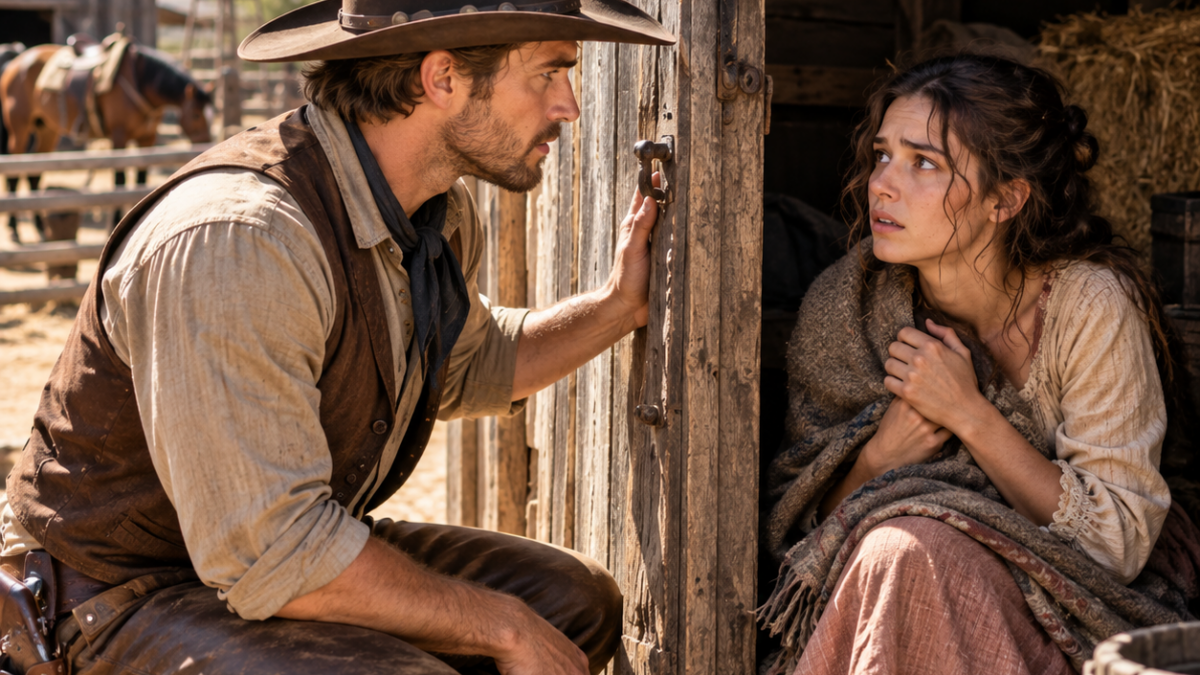
PART3:
I thought about the horses.
I thought about Ambrose Pike.
I thought about the fact that the burden of proof had not yet been met.
“My wife’s in the back,” I said. “She’s not feeling well. Motion sickness.”
The rider’s eyes moved to the canvas.
I kept mine on him.
Behind me, something shifted.
A small sound.
Then the canvas flap opened.
The young woman looked out at the riders with an expression so composed I almost believed her myself.
Her hair was loose enough to look like a woman who had been traveling badly. Her cheeks had color in them now. Later, I would learn she had pinched them hard before lifting the flap. At the time, I only noticed that she had understood exactly what kind of lie she needed to become.
“Elias,” she said, with the faint irritation of a sick wife being bothered by strangers. “Are we going?”
She used my name like she had used it a thousand times.
I had no idea how she knew it.
“In a moment,” I said.
I turned back to the rider. “Something else?”
He looked at her. Then at me. Then at her feet.
Her shoes betrayed her.
Those cream buttons did not belong to a ranch wife feeling poorly in a supply wagon. They belonged in a church aisle. Or a parlor. Or a wedding she had not wanted to attend.
The rider’s expression sharpened.
“Those are fine shoes for a sick woman,” he said.
I moved the wagon before he finished deciding what he intended to do with that observation.
“She dressed before she felt it coming on,” I said, as if that settled the matter.
Then I flicked the reins.
The horse moved.
The wagon rolled forward.
For thirty seconds, they let us go.
Then I heard them behind us.
Not chasing.
Following.
That was worse.
Chasing has heat in it. Chasing makes mistakes. Following is patient. Following means the men behind you believe time belongs to them.
I took the turn at the feed store corner without looking back, cut behind the mercantile, and dropped onto the old mill road. Nobody used it in October unless they had to. Ruts cut deep through the ground, and the wagon lurched so hard the flour sacks thumped against the boards behind me.
The woman made no sound.
Good, I thought.
Then I pushed the horse harder.
We came out on the east fork of the mountain road and kept moving until Red Willow disappeared behind the bend and the sounds of town were swallowed by wind and distance.
Only after twenty minutes did I stop hearing riders.
I still did not slow down.
A few minutes later, the canvas shifted, and the woman climbed forward to sit beside me on the wagon box without asking.
Her shoes were ruined now.
She looked at the road ahead, not back.
“They’ll take the main road,” she said.
“I know.”
“That’s why we’re on this one?”
“Yes.”
“Where does it go?”
“Eventually? My ranch. By way of a longer road through the north valley.”
She held the small bag in her lap.
“I should explain.”
“You should.”
Her fingers tightened around the bag.
“My name is Rosemary Bell.”
I said nothing.
“My mother was a seamstress in Red Willow. She died in March.”
“I’m sorry.”
Rosemary swallowed. “She left debts. More than I knew. The man those riders work for, Ambrose Pike, held the notes on most of them.”
“I know who Pike is.”
“Then you know what he wanted in exchange.”
I looked at the road.
“The wedding was today,” she said. “This afternoon. At the Pike Ranch.”
The cold in the air seemed to sharpen.
Ambrose Pike was old enough to be her father twice over. He owned half the valley outright and held notes on enough of the other half to make ownership a matter of patience. Men like Pike did not need to shout. They arranged the world until shouting became unnecessary.
“How long were you planning to stay in my wagon?” I asked.
“Until Red Willow was behind me.”
“And after that?”
She looked toward the mountains.
“I didn’t have an after that yet.”
That was the first honest thing she said to me.
Maybe not the first true thing. The lie about being my wife had been false, but the fear behind it was true enough.
We drove.
For a while, neither of us spoke. The Wyoming October stretched around us, all gold aspens and hard blue sky, the kind of beauty that warns you winter is just over the ridge. Wind moved through the grass. The wagon wheels complained over stone.
Then Rosemary began telling me the rest.
Not all at once. Some truths cannot be dragged out in a straight line. They come loose in pieces when the listener does not crowd them.
Pike had been in her mother’s business before her mother died. A seamstress could survive in Red Willow if the winters were not too hard and customers paid on time. That last winter had been hard, and customers had not paid on time. Pike had offered credit.
Friendly credit.
Reasonable credit.
The kind a desperate woman accepts because the alternative is closing her door before spring.
Only the numbers Rosemary’s mother had been told were not the numbers written on the real papers. Interest stacked on interest. Fees appeared like mold. A small debt became a mountain. A mountain became leverage.
“What was he after?” I asked.
Rosemary looked straight ahead.
“My mother’s property. A little piece south of town. My grandfather left it to her. There’s a creek running through it.”
I understood then.
Water.
Out here, water was not just water. It was grass, cattle, fences, property, survival. Pike owned land on both sides of that creek, but not the piece that mattered. Without her mother’s land, he could not control the water rights the way he wanted.
“So he made the debt big enough that marriage looked like mercy,” I said.
Her mouth tightened.
“Yes.”
“Your mother’s will?”
“She left the land to me.”
“And the notes?”
“Pike says the debt transfers with the estate. He says the property is the only asset large enough to settle it.”
“Is it named as collateral?”
She looked at me.
“I don’t know.”
“My brother was a lawyer before he came out here,” I said. “He used to talk about those things. If the land wasn’t named as collateral when the notes were written, Pike may not have the hold he claims.”
Rosemary stared at me like I had opened a door.
“Can that matter?” she asked.
“In Red Willow? Maybe not.”
The hope dimmed.
“But in front of a federal marshal,” I said, “paper still has weight. Even against men with money.”
She looked down at her bag.
“I saw some papers. I took two, but not the notes. I didn’t know which ones mattered.”
“You were running from a wedding. You took what you could.”
That made her quiet.
The road began climbing. Behind us, somewhere on the main road, Pike’s men were likely making their own calculation. Ahead of us, the mountains were turning darker.
I saw the storm before Rosemary did.
It gathered in the north with the specific authority of Wyoming weather. Not a suggestion. A decision.
I pushed the horse harder.
We did not make the ranch.
By dusk, snow hit sideways, thick and mean. I turned off toward an old line cabin I used during summer grazing. One room. Stone fireplace. Lean-to for the horse. Wood stacked outside because every October I stacked wood anywhere I might need it later.
Rosemary helped without being asked.
She held the horse steady while I unhitched. She carried supplies inside. She came back out into the storm for blankets and coffee. By the time I had a fire catching in the hearth, she had salt pork cut and flour set aside, as if the cabin had been waiting for her hands.
She did not complain.
Not about the cold.
Not about the ruined shoes.
Not about the fact that she had eaten nothing all day.
We ate in front of the fire while the storm beat the cabin walls and turned the whole world white.
I expected questions then. Or tears. Or fear finally breaking through now that we had reached temporary safety.
Instead, she cleaned the pan with practical efficiency, folded her ruined hem under her, and said, “Thank you for not asking questions before I was ready.”
“You were telling me on your own timeline.”
“My mother used to say the right person asks the right question at the right time.”
“And the wrong person?”
“Asks all the questions at once.”
I looked into the fire.
“What was the right question?”
She was quiet for a while.
Then she said, “I don’t know. I think you hear it when it comes.”
I thought about that. I thought about my brother, Thomas, who had built a house too big for one man and then died before he could fill it. I thought about four years of eating alone at the same table. Four years of not asking questions because there was no one to answer.
Then I looked across the fire at Rosemary Bell.
“Did you eat this morning?” I asked.
She blinked.
“No.”
“That was the wrong question to ask six hours ago.”
For the first time since I found her in my wagon, she almost smiled.
It started small, uncertain, then completed itself.
It changed her entire face.
I looked back at the fire because staring at her directly when she smiled like that felt like something I would need to work up to.
The storm cleared by morning.
We reached the Ward Ranch by noon.
Rosemary did not speak when she first saw it.
She climbed down from the wagon and stood in the yard, taking in the house, the barn, the porch, the fences, the kitchen garden banked with straw for winter. The place was solid, practical, and too large for the silence I had been keeping inside it.
“My brother planted that garden,” I said when I noticed her looking. “I keep it.”
She turned to me.
“I’m sorry about your brother.”
“Four years ago,” I said.
That was not an answer, but somehow she received it like one.
I showed her the house.
It was clean. Organized. Functional. It was also unmistakably a house arranged by a man who had stopped expecting anyone else’s preferences to matter. Rosemary saw that. She did not say it.
I gave her my brother’s old room.
I had kept it clean and unchanged since he died. Bed made. Window washed. Books on the shelf. A room preserved so carefully it had stopped feeling like a room and started feeling like evidence.
Rosemary set her small bag on the chair.
“I’ll pay for my keep,” she said.
“You don’t need to.”
“I will.”
“The ranch runs with one person.”
“I know,” she said. “But it would run better with two.”
I looked at her then.
Really looked.
She did not say it proudly. She said it as a fact. There was no pleading in it, no attempt to charm or soften. She was a woman with nowhere safe to go until the pass opened, and she was telling me she would not be dead weight in my house.
“There’s a mare in the east stall,” I said. “Hurt her left foreleg last week. I’ve been managing it, but a second pair of hands would help.”
“I’ll look at her in the morning.”
The pass closed on November second.
Rosemary Bell was at the Ward Ranch for the winter.
There was nothing soft or easy about it.
People who have never lived through a Wyoming winter imagine romance in the snow because they have only seen it from the safe side of a window. A real winter is work. It is chopping wood until your shoulders burn. It is breaking ice in water troughs before dawn. It is feeding cattle with numb fingers. It is checking fences in wind that cuts through wool. It is listening to storms hit the roof and knowing the world outside can kill anything foolish enough to underestimate it.
Rosemary never underestimated it.
She worked.
She was good with the mare. That surprised me, though it shouldn’t have. I had assumed, without meaning to, that a seamstress’s daughter from town would be timid around animals.
She was not.
She approached the mare with calm confidence, talking low, hands steady, patience deep enough that the animal gave her trust before I expected it. By December, the mare was sound.
After that, I began finding things repaired.
A curtain hem in the kitchen that had been torn so long I had stopped seeing it.
A loose porch rail tightened.
A split in the harness leather stitched clean.
A shirt of mine mended and folded without comment.
She did not announce these things. I simply found them done.
So I started leaving notes.
Not letters.
Notes.
Practical things on the kitchen table.
The north woodpile needs another cord before February.
Mare’s leg held through the cold.
Salt pork left if you want it for supper.
She answered in the same manner.
Curtains in your brother’s room needed mending too. I started them.
Loose stone in east barn wall. Mortared it with the kit from the shelf.
Coffee is nearly gone unless you hid more.
That last one made me laugh alone in the barn like a fool.
By January, the house sounded different.
Not louder.
Just lived in.
There was another chair slightly out of place. Another cup drying near the basin. Another set of footsteps in the morning. Supper became something shared instead of something consumed. Work became something built, not merely maintained.
That scared me more than Pike’s men had.
A man can get accustomed to loneliness if he is stubborn enough. He can dress it up as peace. He can call silence preference. He can tell himself a house is simply boards and roof and warmth.
Then someone laughs in the kitchen, and the lie comes apart.
I began thinking about April.
The pass would open. Rosemary would have choices. Red Willow might be dangerous, but the whole territory was wide. Cheyenne. Laramie. Denver, if she wanted far enough. If her property was restored, she might have money. If Pike lost his hold, she might have a life that did not include hiding in wagons and spending winters with men who did not know how to say what they felt.
I told myself this often.
It helped very little.
In February, Ambrose Pike came.
Six riders appeared on the road midmorning beneath a flat white sky. Snow lay hard across the ground, and the cold made every sound carry.
I was in the barn when I heard them.
I stepped into the yard.
Pike rode at the center.
He was around sixty, broad through the shoulders in the way of men who had once been physically imposing and now relied on reputation to do the work. His coat was expensive. His horse was better than any animal ridden by the men beside him. His face held the patient arrogance of someone accustomed to entering situations already believing he owned the ending.
“Ward,” he said.
“Pike.”
“I believe you have something that belongs to me.”
The house door opened.
Rosemary stepped onto the porch.
She looked at Pike, and I saw the old fear in her face. But I also saw something else beneath it. Four months of Wyoming winter. Four months of work. Four months of being asked for nothing she was not ready to give.
Fear was still there.
It no longer ruled her.
“Rosemary,” Pike said. “Come down.”
She did not move.
“My contract—”
“Your contract,” I said, “was built on a manufactured debt designed to create exactly this situation.”
Pike looked at me the way rich men look at fences they plan to move.
“You have no standing in this matter.”
“I have standing in anything that happens on my property.”
His eyes sharpened.
“Rosemary,” he said again, softer now.
I disliked that tone more than shouting.
“Your mother’s debts are real,” he said. “The property is legally at risk. I have been patient. I am offering you a resolution that protects your family’s land.”
“You built the debt,” Rosemary said from the porch.
Her voice was steady.
I stepped forward and put myself between her and the riders.
“She may have pretended to be my wife to get out of that town,” I said. “But she will never need to pretend anything in this house.”
Pike stared at me.
For a moment, there was no sound except wind.
“Ward,” he said, “this is not your situation.”
“She’s on my property. That makes it my situation.”
“You are one man.”
“No,” said a voice from the road. “He’s not.”
Three riders had appeared near the bend.
Tom Henderson from the east spread and the Harrow brothers from the north. Men who had seen six riders crossing snow toward the Ward Ranch and decided six riders in February usually meant trouble worth witnessing.
Pike’s men shifted in their saddles.
A man paid to frighten one rancher may reconsider when other ranchers are watching.
Rosemary came down the porch steps.
She reached into the collar of her dress and pulled out a folded paper worn soft at the creases.
She had kept it against her skin since October.
“You’re right about one thing, Mr. Pike,” she said. “I don’t have the original notes.”
Pike’s face did not change, but the air around him did.
She lifted the paper.
“But I have your letter to the creditor in Cheyenne. The one where you told him what rates to write down and what rates to actually collect.”
Pike went still.
“And Sarah Wren has the copy,” Rosemary continued. “The one already on its way to the territorial marshal. Reverend Cole helped write the letter that went with it.”
One of Pike’s riders looked away.
Another shifted his horse a step back.
That was how power ended sometimes. Not with gunfire. Not with thunder. Just one man realizing the room, or the yard, or the county, had stopped believing his version of events.
Pike looked at the paper. Then at Rosemary. Then at me.
“This isn’t finished.”
“Yes,” I said. “It is.”
He turned his horse.
His men followed.
Not all at once. Not proudly. They went the way hired men go when they realize the wages are no longer worth the danger.
When they disappeared down the road, the yard remained quiet.
Tom Henderson called, “Everything all right, Ward?”
“Yes,” I said. “Thank you.”
He nodded and rode on with the others.
Rosemary stood beside me, still holding the paper.
Her hand was shaking now.
Not from cold.
“He’ll go to the marshal first,” she said. “Before the marshal comes to him.”
“Yes.”
“Will it hold?”
I looked down the road where Pike had gone.
“It’ll hold because it’s true.”
She turned toward me.
“True things hold?” she asked.
“They have a better chance than lies.”
I should have said more then.
I wanted to.
Instead, I went to check the cattle because the cattle needed checking, and because there are some words a man needs to say correctly the first time.
That evening, I finally said them.
Supper was done. The dishes were washed. The fire had settled low and warm. Rosemary sat at the table with her mother’s Bible open beneath her hand. She read it sometimes, not exactly devotionally, more like a person holding something that still carried the warmth of the one who had owned it.
I sat across from her.
“The pass opens in April,” I said.
“Yes.”
“I can take you anywhere you need to go when it does. Any city. Anywhere you want to start over. The land in Red Willow will likely be yours clear once the marshal is finished. You could sell it or keep it. Either way, you’d have something to go forward with.”
She held the Bible in both hands.
“Is that what you’re planning to do?” she asked.
“What?”
“Take me somewhere in April.”
I looked at the table.
“I can take you anywhere,” I said. “I just don’t know how I’d come back to this house if you weren’t in it.”
She became very still.
The fire popped.
Outside, the February world lay white and enormous.
“Elias,” she said.
“Yes?”
“I repaired the curtains in your brother’s room.”
“I know.”
“And the porch railing.”
“I know.”
“And I’ve been leaving notes on the kitchen table for four months.”
“I know.”
“Because I live here,” she said.
I looked up.
Her eyes held mine with a certainty that had been arriving all winter and had finally reached the door.
“I live here,” she said again, more quietly.
It was not a question.
It was not even only about the present.
It was an intention.
I reached across the table and placed my hand over hers. The Bible rested beneath both our hands.
“Yes,” I said. “You do.”
That was all either of us needed.
We were married in May.
The pass opened in the third week of April, and the world came back green and loud with meltwater. Red Willow looked smaller when we returned, though perhaps it had always been small and I had only remembered it larger because trouble tends to magnify a place.
Ambrose Pike had left the territory in March after the marshal’s investigation confirmed what Rosemary’s paper and Sarah Wren’s copy had shown. Men like Pike rarely fall all at once. They retreat behind lawyers, taxes, disputed claims, and quiet departures.
But he was gone.
That was enough.
Rosemary’s creek land was returned to her with clear title. She did not sell it. She said some things are not kept because they are useful. Some things are kept because someone before you loved them enough to leave them behind.
We married in the small church at Red Willow.
Sarah Wren made the dress. Cream-colored. Simple. Practical enough, Rosemary said, that she could wear it to check on the mare after the vows if necessary.
I believed her.
She walked down the aisle toward me, and for one strange moment I saw everything at once.
The pink dress in my wagon.
The ruined cream shoes.
The snow at the line cabin.
The first almost-smile beside the fire.
The notes on the kitchen table.
The folded paper in her shaking hand.
The way she had said, I live here.
She reached me, and I took her hand.
The vows were simple.
Neither of us needed grand language. We had already spoken our truth in smaller ways. In a wagon. In a cabin. Across a table. In a snow-covered yard with six riders watching.
After the ceremony, outside in the bright Wyoming May, Sarah Wren leaned close to Rosemary and said something that made her laugh.
I heard only the end of it.
“Your mother would have found a way to make this happen sooner.”
Rosemary smiled toward me.
“She would have left him more notes.”
Sarah laughed.
Rosemary laughed.
I stood across the churchyard watching my wife laugh in spring sunlight and thought about the day I found her in my wagon.
I had driven the wrong road out of town.
I had told a lie to men who were looking for her.
I had brought a stranger to my ranch because the mountains closed before I could decide what else to do.
None of it had been planned.
But life rarely announces the moment it begins again.
Sometimes it hides under canvas between flour sacks and winter blankets.
Sometimes it looks up at you with frightened brown eyes and asks you to pretend.
Rosemary had asked me to pretend she was my wife.
But I never pretended a single thing after that.
Not when I drove her out of Red Willow.
Not when I gave her my brother’s room.
Not when I stood between her and Ambrose Pike.
Not when I told her I could take her anywhere but did not know how to come home without her.
The lie that got us out of town became the truest life I ever knew.
And every May, when the creek runs high and the aspens turn bright with new leaves, I still think of that first whispered request from the back of my wagon.
Pretend I’m your wife until we’re out of town.
I did.
Until pretending was no longer necessary.
Until she was home.








