I Found a Kitten Trapped Beneath a Storm Drain—Then He Grabbed My Work Glove and Wouldn’t Let Go
I Found a Kitten Trapped Beneath a Storm Drain—Then He Grabbed My Work Glove and Wouldn’t Let Go
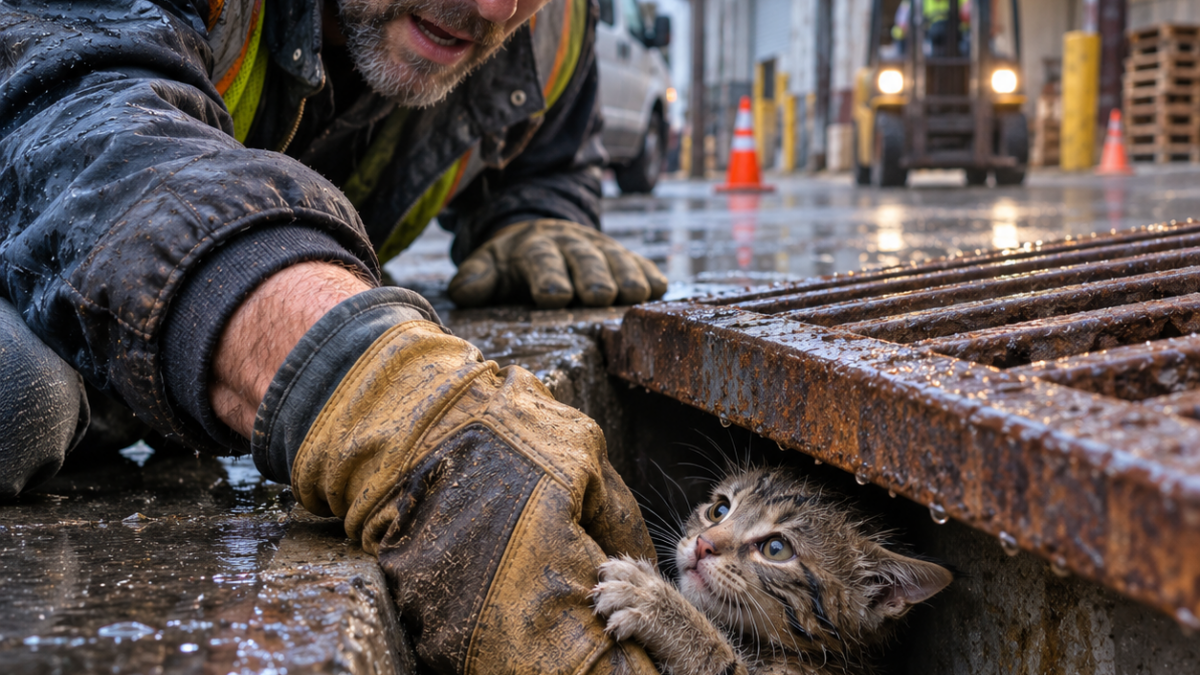
I found the kitten trapped beneath a storm-drain grate behind an old warehouse, cold enough to shake and small enough to disappear beneath one forklift tire, and when I slid my work glove through the metal opening he grabbed it with all four paws like it was the only solid thing left in his world.
I broke protocol to stop the loading zone, got reported by the warehouse manager, and spent the rest of that day telling myself I would only keep the kitten long enough to get him warm, examined, and transferred to someone more qualified.
Then he placed one tiny paw on my bare hand the night I was supposed to give him up, and I realized the terrified animal clinging to me was not the only one who had spent years learning to stay half-detached from anything that might become difficult to lose.
Most mornings, I am awake before the city really starts.
My job is not one people notice until something stops working.
Storm drains.
Pump boxes.
Utility grates.
Overflow lines.
The ugly little pieces of infrastructure underneath parking lots and loading zones that everybody ignores right up until rainwater starts going somewhere it should not.
That morning in Spokane, the rain had stopped only an hour earlier.
The pavement behind the warehouse was black with moisture.
Wind pushed wrappers across the loading area.
Forklifts were warming up inside.
Reverse alarms echoed between concrete walls.
Somebody was already shouting about pallets.
Normal morning.
Normal call.
A rattling storm-drain grate.
I parked the service van along the fence and grabbed my tool bag.
The grate sat near the edge of the loading zone.
The first sound I heard was not a meow.
It was smaller.
A breathy little scrape.
I crouched.
Nothing.
Then:
another sound.
I leaned closer to the grate.
There he was.
Pressed into a narrow pocket beside a drainage pipe.
Tiny brown mackerel tabby.
Maybe eight weeks old.
Damp fur clumped against a body that looked too small even for his age.
Eyes too large for his face.
He had folded himself into the only protected space beneath the grate, where the concrete met the pipe.
I remember thinking:
That is not a safe place.
Then immediately realizing it was probably the safest place he had found.
I spoke softly.
“Hey.”
His head moved.
That was it.
No hiss.
No cry.
No attempt to climb.
The absence of reaction frightened me more than panic would have.
Healthy kittens complain.
They fight.
They puff up.
They object to existence loudly.
This one looked like he had already learned to ration energy.
I grabbed the grate.
Pulled.
Nothing.
The bolts were rusted solid.
I shifted my weight.
Used the edge of my boot.
Pulled again.
Nothing.
PART2:
The kind of nothing that changes the problem.
Because now the obstacle is not simply metal.
It is time.
Behind me, forklift engines increased.
A loading-bay door opened.
Somebody yelled:
“Clear the lane!”
I looked down.
The kitten pressed farther against the pipe.
If I called the situation in and waited, somebody would eventually come.
Maybe animal control.
Maybe maintenance.
Maybe nobody for twenty minutes.
Twenty minutes was not long on paper.
It was long when several thousand pounds of machinery were beginning to move across the same pavement.
I lowered myself flat beside the drain.
There was one gap wide enough for my hand.
I slid my gloved fingers through.
Slowly.
Palm down.
No grabbing.
No reaching toward him.
PART3:
I simply held the glove inside.
The kitten looked at it.
Half a second.
Then he moved.
Fast.
He grabbed my glove with both front paws.
Then the rear paws joined.
All four wrapped around the leather.
He pulled himself against my hand so hard that I felt him trembling through the glove.
For one strange second, we stayed like that.
My arm through rusted metal.
His entire body wrapped around my hand.
I whispered:
“Okay.”
He tightened his grip.
“I’ve got you.”
I tried lifting the grate with my other hand.
Nothing.
My shoulder started burning from the angle.
The kitten continued holding on.
Then an engine revved behind me.
Closer.
A forklift.
Slow tires rolling toward the drainage lane.
I looked at the machine.
Then at the kitten.
No more waiting.
I pulled my arm back.
The kitten came with me as far as the gap allowed.
Still attached.
For a second I thought he might squeeze through.
He could not.
His shoulders caught.
He made one tiny sound.
More air than voice.
I stopped immediately.
“Okay, okay.”
I eased him back into the pocket.
He did not want to release the glove.
I had to slide my hand away one finger at a time.
The moment the glove disappeared, he curled against the pipe again.
A voice behind me shouted:
“Hey!”
I turned.
A man in a yellow safety vest was walking from the warehouse.
Manager, as I later learned.
“What are you doing?”
“Kitten under the grate.”
He looked down.
Then at me.
“We’ve got deliveries.”
“I know.”
“Then move.”
“There’s an animal underneath.”
He spread both hands.
“That’s not our problem.”
I stared at him.
He said:
“We’re not a shelter.”
I did not argue.
Mostly because arguing would have taken time.
I ran to the van.
Side door.
Pry bar.
Penetrating oil.
Two traffic cones.
Back across the lot.
The manager was standing beside the drain now, phone in one hand.
“What are you doing?”
I set the cones wider than I probably had authority to set them.
Pulled a chain across the lane.
He stared.
“You can’t close this.”
“I need one minute.”
“You need authorization.”
“I need one minute.”
“You’re blocking our operation.”
“I know.”
“I’m filing a complaint.”
That got my attention.
Not enough to make me stop.
“Okay.”
His expression changed.
Maybe he expected an argument.
“Okay?”
“Yes.”
I sprayed the bolts.
Wedge.
Pressure.
Metal groaned.
The grate lifted perhaps half an inch.
Then slipped.
It slammed down.
The sound exploded across the concrete.
Underneath, the kitten panicked.
He lost his footing.
Scrambled deeper.
My stomach turned.
Not because I thought I had lost him.
Because I suddenly understood what I looked like from below.
Huge person.
Metal moving.
Ground shaking.
Noise.
I had shown him a glove.
He trusted it.
Then I made the whole world crash.
I lay flat again.
Could barely see him now.
“Hey.”
Nothing.
“I’m still here.”
The manager said something behind me.
I ignored him.
The oil had begun working.
I put the pry bar back.
This time:
slower.
More controlled.
The grate lifted.
One inch.
Two.
Enough.
I wedged the bar.
Reached through.
No attempt to grab him.
Glove low.
Still.
For a few seconds, nothing happened.
Then warm fur touched the fingertips.
The kitten found the glove before I found him.
He grabbed on again.
Front paws.
Rear paws.
Claws catching leather.
He climbed.
Halfway.
Back paws slipped on the wet metal.
He dangled.
My heart dropped.
I reached farther.
Caught his body against my forearm.
Pulled.
The kitten cleared the grate.
For a moment he froze in the open air.
His eyes blinked slowly.
Then the paws tightened again.
Not on the glove now.
On my sleeve.
The manager lifted his phone.
“I’m sending this to the city.”
I looked at him.
The kitten continued shaking.
My service radio crackled.
Dispatch calling another unit.
A forklift beeped behind the chain.
And suddenly the whole moment reduced itself to one choice.
Stand there defending myself.
Or get the kitten warm.
I carried him to the van.
He remained attached to my glove until I climbed into the cab.
Only then did one paw loosen.
Then another.
I found a clean filter box in the back.
Fresh shop rag.
Set him inside.
He crouched low.
Tail tucked.
Eyes tracking everything.
I put a small cup of water near him.
He leaned forward.
Sniffed.
Then looked at me.
Did not drink.
The van heater ran full.
Windshield fogged at the edges.
Eventually the kitten made a sound.
Tiny.
Rough.
A real meow.
It surprised both of us.
“Well.”
I looked at him.
“You do have a voice.”
I called the nearest veterinary clinic.
No appointments until midday.
Emergency walk-in possible.
Wait time unknown.
Second clinic:
similar.
County shelter intake line:
voicemail.
I stared at him.
The rational solution was obvious.
Wait.
Make calls.
Use the system.
That is what systems are for.
But I could not get the drain out of my head.
The little body disappearing beneath infrastructure.
The glove.
The way he had latched on.
My work phone rang.
Dispatch.
“Where are you?”
No hello.
I checked the clock.
I was behind.
“Finishing up.”
“You were supposed to clear that call twenty minutes ago.”
“I know.”
“I need you back on route.”
I looked at the box.
The kitten looked at me.
“I’ll call when I’m moving.”
The dispatcher exhaled.
Not pleased.
I ended the call.
Then remembered another problem.
My dog.
Mara.
Border Collie mix.
Nine years old.
Smart enough to make disapproval feel administrative.
She was not mean.
But she noticed everything.
New boxes.
Changed schedules.
Different smells.
My mood.
A tiny animal entering her house would not be something she casually overlooked.
I rubbed my face.
“This is temporary.”
The kitten stared.
“Clinic.”
No reaction.
“That’s it.”
One small paw reached from the box.
Caught the fabric of my sleeve.
Barely.
No pulling.
Just contact.
I stopped.
“This is manipulation.”
He blinked.
I drove to a pharmacy.
Kitten milk replacer.
Disposable litter tray.
Small carrier.
Soft blanket.
I stood at the checkout looking at the items.
The cashier looked at me.
I expected:
New kitten?
Nothing.
She scanned everything.
I was grateful.
Back at the van, I placed the carrier beside the filter box.
The kitten leaned toward it.
Then toward me.
Took one cautious step.
By the time I reached home, clouds hung low over the neighborhood.
Mara heard the van.
Her nails clicked across the floor.
Head appeared in the front window.
Eyes locked on me.
She knew immediately.
Not what.
Just that something had changed.
I brought the carrier in first.
Bathroom.
Neutral room.
Warm towel.
Small dish.
Dim light.
No fan.
No running water.
Quiet.
Mara paced outside.
Sniffing under the door.
Tail not wagging.
Not stiff either.
Focused.
I clipped a leash on her anyway.
Not because I distrusted Mara.
Because I distrusted moments that people later describe with:
It happened so fast.
I opened the carrier.
Stepped back.
The kitten did not rush out.
He lowered himself.
Moved to the opening.
Froze.
Mara leaned forward.
Nose working.
Kitten stared.
No hiss.
No puffing.
Again, that scared me.
Too exhausted to argue.
“Easy.”
Mara looked at me.
Then at the kitten.
She sat.
Just sat.
The kitten blinked.
Put one paw onto the towel.
Then another.
I released a breath I did not know I was holding.
My phone rang.
Warehouse manager.
I answered.
He wanted my full name.
Department.
Supervisor.
He said my cones had delayed operations.
The chain had interfered with loading.
A report would be filed.
His tone was proud.
As though paperwork were a weapon.
I looked at the kitten.
One paw lifted.
He turned toward my voice.
Not panicked.
Listening.
I gave the manager the information.
No apology.
Ended the call.
Then the fear came.
Not fear of the kitten.
Fear of consequences.
My job was stability.
Mortgage.
Utilities.
Mara’s vet care.
My life.
I had spent years constructing something predictable.
And now I had blocked a private loading lane without formal clearance because a kitten had grabbed my glove.
I sat on the bathroom floor.
The kitten took one step toward my shoe.
Tapped the edge.
Retreated.
Smallest brave thing I had ever seen.
That night, I heard scratching.
Bathroom door.
Soft.
Not frantic.
I stood in the hallway.
Hand on knob.
For some reason, that moment felt larger than it should have.
I opened the door.
Sat on tile.
The kitten slipped under the vanity.
Not gone.
Watching.
Two eyes in shadow.
I moved the food closer.
Then leaned against the wall.
Looked away.
A minute.
Maybe two.
One paw emerged.
Then another.
He moved toward the bowl.
Ate.
Slowly.
Stopped several times to look at me.
I remained.
In the morning, I wrapped him loosely in a towel and drove to the clinic.
He trembled.
Face pressed into the folds.
The veterinarian examined him.
Underweight.
Dehydrated but improving.
No obvious fractures.
Minor abrasions.
Parasites likely.
Temperature stable now.
The plan was not dramatic.
Warmth.
Food.
Fluids as needed.
Parasite treatment.
Monitoring.
Vaccines when appropriate.
Consistency.
The clinic mentioned intake through a foster network.
“We can connect you.”
I nodded.
Responsible answer.
Then I pictured a voicemail.
Another transfer.
Another temporary box.
I heard myself ask:
“Can I foster him?”
The technician looked at me.
“Yes.”
“Temporary.”
“Of course.”
I signed paperwork.
Temporary.
That word became my shield.
On the drive home, my work email buzzed.
Formal complaint.
Meeting with supervisor.
Next morning.
I stared at the subject line.
Then at the carrier.
The kitten was awake.
Watching the world through the mesh.
When I got home, he batted at my hoodie drawstring.
Slowly.
Then suddenly.
A tiny burst of play.
Mara lay three feet away.
Watching.
The kitten glanced at her.
Went back to the string.
I stood there holding the complaint email and realized that in the space of twenty-four hours, a creature who had been wedged beneath a storm drain was already experimenting with being alive.
The next morning I went to work early.
Foster paperwork in my jacket.
I do not know why.
Maybe because I thought paperwork could defend emotion.
My supervisor’s office smelled of coffee and printer toner.
Blinds half closed.
He did not waste time.
“You blocked a commercial loading zone without clearance.”
“Yes.”
“You used their safety chain.”
“Yes.”
“You created liability.”
“I understand.”
“You cannot do that.”
He slid the complaint toward me.
The language was clean.
Professional.
Unauthorized interference.
Operational delay.
Improper traffic control.
I read every line.
He was not entirely wrong.
That was the difficult part.
I had acted for a reason.
A good reason, I believed.
That did not automatically make every decision correct.
My supervisor leaned back.
“You should’ve called dispatch.”
“I did after.”
“Before.”
“I didn’t think there was time.”
“That is exactly when procedure matters.”
I looked at the paper.
Then recognized something I did not expect.
Not guilt.
Familiarity.
My whole adult life had been built around avoiding situations like this.
Stay inside the lines.
Do not create unnecessary problems.
Do not get involved beyond scope.
Do not become emotionally responsible for something you cannot control.
I did that with people too.
Relationships.
Friendships.
Everything neat.
Helpful.
Slightly distant.
Close enough to be decent.
Never close enough to become essential.
My supervisor said:
“Here’s the compromise.”
I looked up.
“You accept the write-up.”
“Okay.”
“You keep personal things separate from your route.”
“What does that mean?”
“The animal goes through proper channels.”
There it was.
Remove the variable.
The messy part.
The thing that had become vulnerable.
I heard myself say:
“Okay.”
Before the rest of me agreed.
I left.
Drove home.
Repeated every rational sentence.
The foster network is competent.
The kitten will be fine.
Your job matters.
Stability matters.
You cannot keep every animal you find.
All true.
The house did not feel like relief.
The kitten was standing in the bathroom doorway.
Not underneath the vanity.
He watched me.
Then stepped into the hall.
Slow.
Pause.
Slow.
Mara lay nearby.
The kitten approached me.
I sat.
He stopped.
Reached one paw.
Placed it on my hand.
No claws.
No gripping.
Warm pressure.
Same contact as the glove.
Without panic.
I stared at it.
Pulled out my phone.
Intake number.
Call button.
My thumb hovered.
The kitten left his paw there.
And an uncomfortable thought became obvious.
I had spent years disappearing before anybody else could.
Not physically.
Emotionally.
Half committed.
Half detached.
Always leaving myself an exit.
Temporary.
Casual.
Flexible.
No expectations.
I looked at the kitten.
“You’re making this very difficult.”
He blinked.
I set the phone down.
The next morning, I returned to the veterinary clinic.
Not intake.
Clinic.
I asked questions.
Vaccines.
Microchip.
Parasite control.
Foster requirements.
Adoption procedure.
What documentation mattered.
How to keep everything legal and clear.
I was not trying to become a rescuer.
I was trying to stop hiding behind the word temporary.
At home, I changed things.
Window screens secured.
Electrical cords moved.
Bathroom became a proper safe room.
Small cat tree.
Shelves.
High places.
Places where he could observe instead of disappear.
He used them immediately.
Climb.
Pause.
Climb.
Keys jingled one evening.
He flinched.
Instead of diving under the vanity, he froze on a shelf.
Looked at me.
Waited.
Then stayed.
Mara had her own adjustment.
The kitten wandered too close to her bowl.
Mara stiffened.
I stepped between.
No yelling.
No punishment.
Redirect.
Space.
Mara exhaled.
Kitten backed away.
Then approached later more cautiously.
A rule learned without fear.
That evening, they played.
Barely.
One careful chase across the rug.
A paw tap.
Both stopped.
Looked at each other.
Then the kitten rolled partly onto his side.
Belly visible for perhaps half a second.
Back up.
Tiny flash of trust.
My phone buzzed.
Supervisor.
Need to talk. There may be one option that keeps you on schedule.
My chest tightened.
The kitten hopped from his shelf.
Trotted over.
Put both paws on my sock.
Looked up.
I texted:
When?
Phone rang almost immediately.
My supervisor sounded different.
Still formal.
Less sharp.
“We reviewed the complaint.”
I waited.
“You were wrong to improvise the traffic closure.”
“Yes.”
“But we also have a problem.”
“What problem?”
“This happens more than people think.”
“Animals?”
“Animals in utility spaces.”
Storm boxes.
Pump areas.
Under grates.
Employees either ignore them or improvise.
Neither outcome was good.
The department had a short training module.
Area control.
Who to call.
Documentation.
Animal control coordination.
When municipal employees could halt work.
When they could not.
His proposal:
I kept the write-up.
Completed the training.
Stayed on schedule.
And afterward, when animal-infrastructure calls came in, I would be one of the designated contacts.
Not animal rescue.
Not hero.
A procedure.
I said yes before he finished.
Afterward, the rest became boring.
Which was exactly what it needed to become.
Veterinary visits.
Vaccines.
Microchip.
Foster inspection.
Paperwork.
Weight checks.
Parasite treatment.
The kitten improved.
Fur fluffed.
Eyes changed.
Not less large.
Less empty.
He still startled at keys.
Doors.
Metal sounds.
But instead of vanishing, he increasingly did something new.
Freeze.
Look at me.
Decide.
That decision was everything.
The foster coordinator visited several weeks later.
She watched him explore.
Climb.
Circle back.
Tap my shoe.
Climb again.
Then she said:
“He’s bonded to you.”
I tried to make it smaller.
“He knows me.”
“He’s bonded to you.”
Silence.
“But you need to say something clearly.”
“What?”
“Are you adopting him?”
There it was.
No temporary.
No maybe.
No until.
I looked down.
The kitten sat beside my work boot.
I had not named him officially.
Mostly called him Little Guy.
Buddy.
Drain Cat, once, which the foster coordinator informed me was not acceptable.
I had avoided naming because names are another form of commitment.
I realized that while she was standing there.
“Yes.”
She waited.
“Yes what?”
I almost laughed.
“You do this intentionally.”
“Sometimes.”
I looked at the kitten.
“Yes.”
Then:
“I’m adopting him.”
The sentence felt terrifying.
Then ordinary.
Both.
The coordinator nodded.
“Good.”
We completed the paperwork.
I named him Milo.
No profound reason.
The name fit.
That evening, Milo ignored the expensive cat bed I had bought.
Of course.
He chose a spot beside the front door.
Not directly in the walkway.
Slightly to one side.
A place where he could feel people coming and going.
Mara lowered herself beside him.
Turned so her back faced the room.
Milo curled against her side.
Watching them, I thought about the storm drain.
The glove.
The warehouse.
The complaint.
The strange chain of ordinary decisions.
Rescue is often described as one dramatic moment.
Lift grate.
Pull kitten out.
Save life.
Done.
That was not the part that changed me.
The dramatic part took minutes.
The important part came afterward.
Choosing to return to the clinic.
Completing paperwork.
Cleaning litter.
Buying food.
Scheduling vaccinations.
Separating animals properly.
Teaching boundaries.
Going to work.
Coming home.
Doing it again.
Responsibility was not the spectacular act.
It was repetition.
Milo kept one habit.
Every morning, when I pulled on my work gloves, he appeared.
Sometimes from the hallway.
Sometimes jumping down from his shelf.
He would reach one paw toward the cuff.
Hook it.
Gently.
Not climbing.
Not panicking.
Just catching the edge.
I started saying:
“I’m coming back.”
Maybe that sentence was for him.
Maybe me.
The first time I returned to the warehouse after the incident, I expected trouble.
Different service request.
Same loading area.
The manager recognized me.
Of course.
He crossed his arms.
“Cat guy.”
“Apparently.”
“You got written up?”
“Yes.”
He looked satisfied.
Then:
“Cat okay?”
That surprised me.
“Yes.”
“You kept it?”
“Yes.”
He stared.
Then shook his head.
“You’re crazy.”
“Probably.”
He walked away.
No reconciliation.
No apology.
No villain defeated.
Just a man who had wanted his warehouse moving and another man who had wanted a kitten not crushed.
Sometimes conflicts are that ordinary.
I inspected the drain again before leaving.
The grate had been replaced.
New hardware.
Proper access bolts.
I took a photograph.
At home, I showed Milo.
“This is where you ruined my week.”
He attacked my phone charger.
Months passed.
Milo grew.
His legs seemed to lengthen overnight.
He became a cat of unreasonable confidence inside his own home.
He climbed everything.
Bookshelves.
Cabinet tops.
Back of the couch.
Once the refrigerator.
I still do not know how.
Mara became his reluctant older sister.
At first, she supervised.
Then tolerated.
Then participated.
Milo discovered that running past her quickly enough usually triggered a chase.
Mara discovered that she was apparently still young enough to chase.
The first time they tore down the hallway together, I stood in the kitchen laughing.
Milo hit the rug.
Skidded sideways.
Corrected.
Launched himself onto the couch.
Mara stopped beneath him.
Milo reached down.
Tapped her nose.
Mara sneezed.
He jumped three feet vertically.
I laughed harder.
Then something caught in my chest.
Not sadness exactly.
Recognition.
My house had been quiet for years.
I had told myself I liked it.
I did.
Sometimes.
But there is quiet because you are peaceful.
And quiet because nobody depends on you.
Those are not the same.
Milo changed the sound of the house.
Tiny feet at three in the morning.
Food bowl sliding.
Mara groaning because the cat touched her tail.
Something falling in another room followed by suspicious silence.
I complained constantly.
I loved all of it.
At work, the new animal-response training was not glamorous.
Twenty-seven slides.
Forms.
Contact lists.
Safety protocols.
How to secure an area without creating secondary hazards.
Who had authority over private loading lanes.
When to notify police.
When to call animal control.
How to document.
The first real call came two months later.
Pigeon trapped inside a pump enclosure.
Not a kitten.
Not dramatic.
We secured the site.
Called the correct people.
Bird removed.
No complaint.
Another:
raccoon inside a drainage access box.
Then:
ducklings in a storm basin.
Then one spring afternoon:
a cat under a municipal grate.
Older than Milo.
Very angry.
I arrived.
Another worker said:
“You’re the animal guy.”
“I’m not.”
“You are now.”
We followed procedure.
Cones.
Proper closure.
Notification.
Animal control.
No improvisation.
The cat was removed safely.
I drove home thinking about the original morning.
What bothered me most was how much had depended on luck.
I happened to hear Milo.
He happened to grab the glove.
The forklift happened not to reach the grate before I blocked the lane.
A better system meant the next animal needed less luck.
That mattered more than whether anyone thought my original decision had been brave.
Milo grew into a handsome brown tabby.
The starved look disappeared.
His coat became thick.
His eyes still looked enormous.
People visiting would say:
“He doesn’t look like the same cat.”
They meant it kindly.
But I always thought:
He is exactly the same cat.
Same animal.
Different conditions.
Safety changes what can be seen.
One evening, a friend reached toward Milo too quickly.
He flinched.
Not dramatically.
Just body low.
Eyes wide.
I saw the storm drain again.
My friend froze.
“Sorry.”
I said:
“Just let him come to you.”
He did.
Five minutes later, Milo sniffed her shoe.
Ten minutes:
sat near her.
Twenty:
accepted a treat.
That became another lesson.
Progress does not erase history.
Milo could be confident and still remember fear.
He could sleep belly-up and still startle when metal clanged.
Mara taught him something there.
Whenever he startled, she often looked toward the sound.
Then back to him.
If she remained relaxed, Milo recovered faster.
I began noticing it.
Just as he had checked my face at the clinic.
Animals read other bodies.
We all do.
Human beings just like pretending we live entirely through language.
One winter morning, I dropped my work gloves beside the door.
Milo ran over.
Grabbed one.
Dragged it through the hallway.
I chased him.
“Milo.”
Faster.
“Give me that.”
Under the table.
Mara watched.
Betrayed me completely.
Milo carried the glove into the living room.
Dropped it.
Sat on it.
I stood over him.
“You know that cost twenty-seven dollars?”
Blink.
“Work equipment.”
Blink.
“You have toys.”
He put one paw on the glove.
I laughed.
There was something about that object.
The first thing he ever trusted.
Leather.
My hand inside it.
Years later, I would still catch him sleeping beside my gloves if I left them on the floor.
I stopped thinking of it as trauma eventually.
Maybe it was.
Maybe scent.
Maybe texture.
Maybe habit.
Maybe all three.
You do not need a perfect explanation for every behavior you love.
The write-up stayed in my employee file.
That mattered too.
People sometimes wanted the story to end with my supervisor tearing it up.
He did not.
I had violated procedure.
The fact that the outcome was good did not erase that.
What changed was the procedure itself.
The department recognized the gap.
I received training.
Other employees did too.
Eventually animal-infrastructure response became a small section of standard field orientation.
Nothing named after Milo.
Thank God.
No plaque.
No award.
Just:
If live animal is present, secure per protocol and notify designated contact.
Boring.
Exactly right.
Milo did not need a legacy.
He needed breakfast.
At the one-year mark, the foster coordinator emailed.
Anniversary reminder.
I looked at the date.
I had forgotten.
That felt strange.
For months, Milo’s origin had defined him in my mind.
Drain kitten.
Glove kitten.
Rescue.
By one year, he was simply:
Milo.
The cat who stole my chair.
The cat who screamed if breakfast was four minutes late.
The cat who slept against Mara’s side.
The cat who knocked pens off the desk individually while maintaining eye contact.
That evening I took a photograph of him.
No dramatic recreation.
He was asleep upside down on the couch.
One paw over his face.
Mara beneath him.
I sent it to the coordinator.
Caption:
Still temporary.
She replied:
Sure.
Mara aged faster than Milo.
That part came later.
Gray muzzle.
Slower stairs.
Longer naps.
The roles shifted.
When Milo was young, Mara had been his anchor.
If a noise startled him, he checked her.
If a visitor entered, he watched how she reacted.
If she slept, the house was probably safe enough to sleep in.
Years later, Mara’s hearing started fading.
She became uncertain about sounds she could not locate.
The first thunderstorm after that change, I watched something I had not expected.
Mara stood in the hallway.
Confused.
Thunder rolled.
She turned one direction.
Then another.
Milo came from the living room.
Walked toward her.
Rubbed along her chest.
Then sat.
Mara lowered herself.
Milo lay beside her.
I stood there for a long time.
Maybe I was assigning meaning.
Humans do that.
But the result was real.
Mara stopped pacing.
Years earlier, she had helped Milo understand the house.
Now he was doing something similar.
Not because I had trained him.
Because relationships change both participants.
That is another thing rescue stories often flatten.
We like one direction.
Human saves animal.
Dog helps cat.
Healthy helps frightened.
But life moves both ways.
Milo depended on Mara.
Mara later depended on Milo.
I thought I was fostering Milo.
Then I realized how much of my own life he had disrupted in useful ways.
I became more connected at work.
Started having coffee with coworkers instead of eating lunch in the van.
I answered my sister’s calls more often.
Started letting people come into my house without mentally calculating when they might leave.
None of that happened because a kitten possessed supernatural healing power.
It happened because care creates habits.
You show up.
You plan.
You make room.
You tolerate inconvenience.
You stop treating attachment as an emergency.
Those habits do not remain confined to animals.
At least mine did not.
One night, years after the drain, I was getting ready for an early call.
Mara was gone by then.
Old age.
Peaceful ending.
Harder than I expected.
Milo had searched for her for weeks.
Her bed.
Hallway.
Back door.
Then gradually stopped.
Not forgotten.
Adjusted.
That morning, I sat on the bench to pull on my boots.
Milo appeared.
Older now.
Larger.
Still those eyes.
I put on one work glove.
He reached up.
Hooked the cuff.
Same gentle grip.
I looked down.
“You still doing that?”
He tugged once.
I smiled.
“I’m still here.”
He released.
I went to work.
The call was another blocked storm drain.
Leaves.
Nothing alive.
I cleared it.
Logged the service.
Drove to the next stop.
Ordinary.
On the way home, rain began.
For a second I could smell that first morning.
Wet pavement.
Warehouse exhaust.
Cold air.
Hear forklift alarms.
Feel the tiny body trembling through leather.
I realized something then.
For years, whenever I told the story, I said:
The kitten grabbed my glove.
That was the dramatic part.
The memorable image.
But the truth was, the grip itself lasted only minutes.
Everything important happened after he let go.
The clinic.
The complaint.
The foster paperwork.
The decision.
The official process.
The dog.
The house.
The routines.
The years.
Rescue did not begin because Milo held on.
It became real because after he loosened his paws, neither of us disappeared.
I used to believe reliability meant never crossing lines.
Never creating trouble.
Never needing anyone.
Do the work.
Stay clean.
Stay safe.
Milo complicated that.
Not by teaching me rules did not matter.
They do.
My write-up was deserved.
The better lesson was that responsibility is not the same thing as avoidance.
Sometimes doing the right thing means knowing the procedure.
Sometimes it means recognizing the procedure is incomplete.
Sometimes it means accepting consequences while helping build something better.
And sometimes it means sitting on a bathroom floor at midnight because a frightened kitten scratched softly on the other side of the door.
The last thing Milo kept from those first days was his habit of waiting near the front door.
Not anxiously.
Not like he wanted out.
He just liked that spot.
From there, he could hear the house.
Street.
Keys.
My boots.
He knew when I left.
He knew when I returned.
For a long time I wondered whether that bothered him.
Then I noticed something.
When I came home, Milo did not run.
He usually remained where he was.
One eye opening.
Maybe a stretch.
Absolute confidence.
He no longer needed to check whether I would come back.
He expected it.
That was the biggest change.
Not the weight he gained.
Not the soft coat.
Not the vaccines.
Not learning to play.
Expectation.
Somewhere along the way, the kitten who clung to my glove because it was the only solid thing in his world learned that solid things could remain even when he was not holding onto them.
And somewhere along the way, so did I.
People sometimes ask whether I would block the warehouse lane again.
I always answer carefully.
“No.”
They look surprised.
Then I explain.
“I’d do it properly.”
I know who to call now.
How to secure the site.
How to document the hazard.
How to stop traffic without turning myself into another hazard.
That is growth too.
Not romantic.
Useful.
The warehouse manager was right about one thing.
I could not simply make things up as I went.
My mistake was believing the only alternatives were blind obedience or reckless compassion.
There was a third option.
Build a better process.
We did.
Milo never knew any of that.
He never knew about the complaint.
The supervisor.
The write-up.
Training changes.
He did not know he influenced municipal procedure.
He did not know that when field workers now find an animal trapped in infrastructure, someone is designated to respond.
He knew food.
Warmth.
Mara.
My voice.
The sound of the van.
The drawer where treats were kept.
My gloves.
That was enough.
Maybe more than enough.
Because the part of the story I still remember most clearly is not the forklift.
Not the manager.
Not the grate coming loose.
It is the first moment I put my hand through that narrow opening.
I was trying not to frighten him.
I expected nothing.
Maybe a sniff.
Maybe retreat.
Instead, he looked at the glove.
Hesitated.
And committed everything he had left.
Four paws.
Tiny claws.
Whole shaking body.
Hold on.
That was his decision.
My part came afterward.
And years later, every time Milo reaches for the edge of my glove by the front door, gentle now, secure now, I hear the same question in a completely different form.
You still here?
I always give him the same answer.
“Yeah.”
Then I scratch beneath his chin.
“I’m still here.”








