I Found a Kitten Buried Alive in a Shoebox—But the Tiny Hole in the Lid Haunted Me Most
PART3:
That tiny hole was the only reason she had not suffocated beneath the soil.
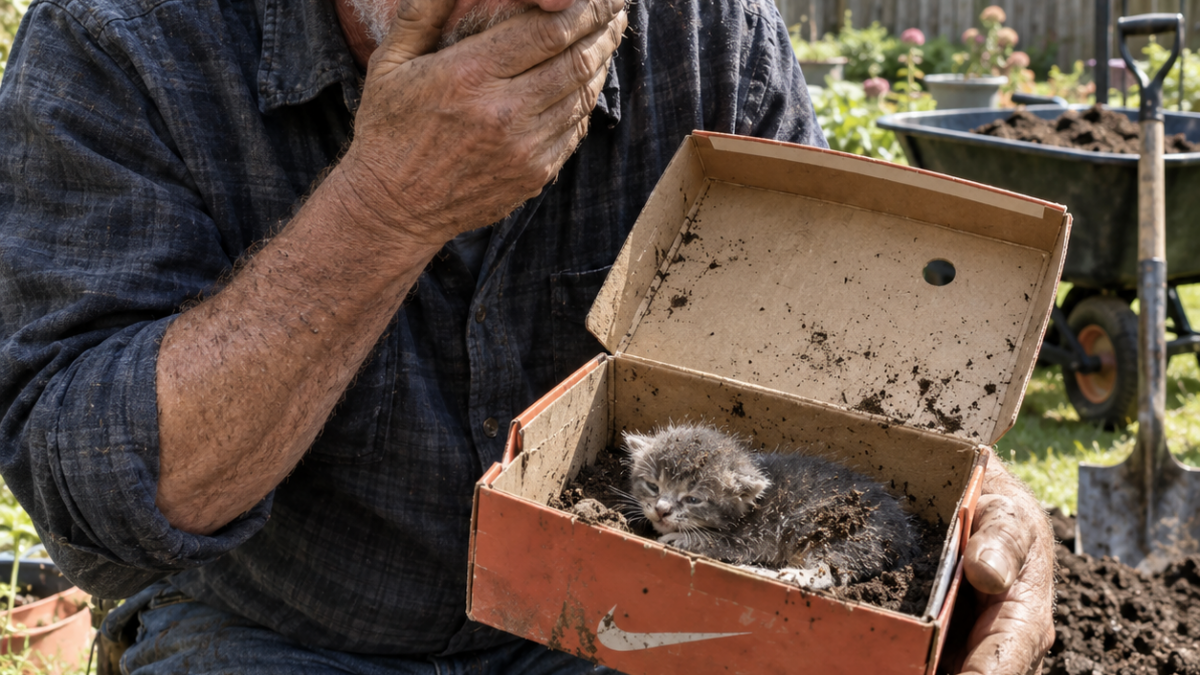
I stood in my garden holding that shoebox with my heart pounding so hard I could hear it in my ears.
My hands began to shake.
That scared me.
My hands did not shake.
They had stayed steady around high-pressure lines, hot fittings, broken valves, hospital forms, my father’s coffin handle, and every hard day I had ever been through.
But standing there with that kitten in a Nike shoebox, my hands shook so badly the lid tapped against the side.
“Carol,” I shouted.
My voice came out wrong.
She must have heard it, because she was out the back door in seconds.
“What happened?”
I turned toward her.
She saw the box.
Then she saw my face.
“Earl?”
“There’s a kitten.”
“What?”
“In the box.”
Carol hurried down the steps, robe tied crooked, coffee forgotten somewhere inside. When she looked into the shoebox, both hands flew to her mouth.
“Oh my God.”
“She’s alive,” I said.
The words barely came out.
Carol reached toward the kitten, then stopped herself.
“Bring her inside. Now.”
I carried the box like it held glass.
Inside, we cleared the kitchen table. Carol grabbed paper towels, a small bowl of warm water, and the cleanest dish towel she could find. I stood there stupidly for a second, still holding the shoebox open.
“Earl,” Carol said, sharper now. “Put her down.”
I did.
Carefully.
Carol dipped a paper towel in warm water and touched the kitten’s face.
The kitten jerked weakly.
“I know, baby,” Carol whispered. “I know. We’re helping.”
There was dirt in her nose.
Dirt in her ears.
Dirt crusted at the corners of her eyes, which were still sealed shut because she was too young for them to be open.
“She’s newborn,” Carol said.
“She has to be.”
Then she lifted the kitten just enough for us to see.
The umbilical cord was still attached.
I had to look away.
Not because I was disgusted.
Because something in me could not hold the thought.
Someone had taken a kitten so new to the world she still had her cord attached, placed her in a shoebox, closed the lid, punched one small hole through the top, and buried her in my garden.
Alive.
Carol cleaned as much dirt as she could from the kitten’s face, but each breath still sounded rough. A faint clicking came from her chest.
“She needs a vet,” I said.
Carol was already grabbing her keys.
We wrapped the kitten in a towel and put her back in the shoebox because we didn’t know what else to use. I held the box in my lap while Carol drove.
All the way to the clinic, I kept staring at the hole in the lid.
A dime-sized hole.
Not an accident.
Not a tear.
A deliberate puncture.
Someone had made it.
That was the part I could not make sense of.
I could understand cruelty, not because I accepted it, but because I had seen enough of it. Men can be cruel when they are angry. Cruel when they are drunk. Cruel when they are scared. Cruel when they want to feel powerful over something smaller.
But this was different.
Who buries a living kitten and still gives it air?
What kind of mind does both?
What kind of heart stops halfway between murder and mercy?
The veterinary clinic was twenty minutes away, and I remember every mile.
The kitten rasped softly in the towel.
Carol drove with one hand on the wheel and the other wiping tears from her face.
I kept saying, “Hold on.”
Not loudly.
Not dramatically.
Just again and again.
“Hold on. Hold on. Hold on.”
The emergency vet that morning was Dr. Elena Morris, a woman in her forties with tired eyes and the calm hands of someone who had fought death often enough not to waste time being shocked by it.
She took one look inside the box and said, “Treatment room. Now.”
We followed until a technician stopped us at the door.
“You can wait right here.”
Carol sat.
I couldn’t.
I stood in the hallway with dirt still on my boots and the empty shoebox in my hands.
The lid hung open.
The hole stared back at me.
After a few minutes, Carol reached for my wrist.
“Earl, sit down.”
“I’m fine.”
“You’re shaking.”
I looked at my hands.
She was right.
They were still shaking.
Nearly an hour later, Dr. Morris came out.
The kitten was alive.
Barely.
“She’s extremely young,” the vet said. “Maybe ten days. Possibly less. She’s dehydrated, cold, and she inhaled dirt.”
Carol pressed both hands to her mouth again.
“Inhaled?”
“Fine particles. Soil in the airway. Some made it into the lungs. We suctioned what we could and put her on oxygen.”
I felt the wall behind me and leaned against it.
“How long was she in there?”
Dr. Morris hesitated.
“Twelve to twenty-four hours is my best estimate.”
Carol made a small broken sound.
I looked down at the shoebox.
“And the hole?”
Dr. Morris followed my gaze.
“That hole is probably why she’s alive.”
“She would’ve died without it?”
“In under an hour, most likely. In a sealed box under soil? Yes.”
The hallway seemed to tilt slightly.
Someone had buried her.
Someone had saved her.
Same box.
Same hands.
Same act.
Same hole.
Dr. Morris looked at me gently.
“I know it’s hard to process.”
“I don’t understand people,” I said.
My voice was flat.
It was the only way I could keep it from breaking.
“No,” she said. “Sometimes there’s no understanding it.”
But I kept looking at that hole.
And some stubborn part of me thought, Maybe there is something to understand.
Not enough to forgive.
Never that.
But something.
A hesitation.
A second thought.
A crack in whatever darkness had made them do it.
The kitten stayed at the clinic that day on oxygen. Carol and I went home because Dr. Morris told us sitting in the waiting room would not help her breathe.
I carried the shoebox back into the house.
Carol watched me place it on the workbench in the garage.
“You’re keeping it?”
“For now.”
“Why?”
I didn’t answer.
Not because I didn’t know.
Because I knew too much and not enough.
That night, neither of us slept well. Carol set alarms just to call the emergency line for updates. I lay awake staring at the ceiling, hearing phantom scratching from inside cardboard.
At 2:00 a.m., the clinic said the kitten was still alive.
At 6:00 a.m., still alive.
By noon the next day, Dr. Morris called and said, “She’s fighting.”
That word did something to me.
Fighting.
That little thing with sealed eyes, no teeth, and dirt in her lungs had every reason to let go.
But she didn’t.
Dr. Morris said she would need round-the-clock feeding if she survived another day.
Bottle feeding every two hours.
Warmth.
Stimulation.
Medication.
Monitoring.
“She’s too young to be away from her mother,” she said. “I won’t pretend this will be easy.”
Carol looked at me across the kitchen table while I held the phone between us.
I had been married to that woman for thirty-nine years.
There are conversations married people can have without words.
This was one of them.
“We’ll do it,” Carol said.
Dr. Morris was quiet for half a beat.
“You understand what that means?”
“Yes.”
“Every two hours.”
“Yes.”
“Through the night.”
“Yes.”
“She may still not make it.”
Carol’s eyes filled, but her voice stayed steady.
“Then she won’t die alone in a box.”
That was that.
We brought the kitten home wrapped in a soft blue towel, with formula, tiny bottles, syringes, medication, heating pads, instructions, emergency numbers, and a fear so large it filled every room.
We named her Dime.
Carol said it first.
“For the hole,” she told me.
I nodded.
I couldn’t have named her anything else.
Dime was smaller than my thumb.
The first time I held her for feeding, I was terrified I would hurt her. My hands looked ridiculous around her. Big, scarred, calloused hands with thick fingers and cracked knuckles from decades of work. Hands made for wrenches, pipe threads, welding gloves, and stubborn bolts.
Not a creature this small.
Carol placed the bottle between my fingers.
“Gently.”
“I am being gentle.”
“You’re holding your breath.”
“So is she.”
“Earl.”
“I don’t know how to do this.”
“Yes, you do.”
“I really don’t.”
Carol moved closer, guiding my hand.
“Then learn.”
So I did.
Every two hours.
Midnight.
Two.
Four.
Six.
Again and again.
For four weeks, our lives became measured by Dime’s hunger.
The alarm would go off, and one of us would get up. Sometimes both. We warmed formula, checked the temperature on our wrists, coaxed her tiny mouth open, counted the drops she swallowed, cleaned her face, helped her relieve herself because she was too young to do it without help, changed towels, adjusted warmth, listened to her breathing.
Some nights she fed well.
Some nights she fought the bottle.
Some nights her breathing sounded wet again, and I stood in the kitchen with her against my chest, whispering, “No, no, no, stay here,” while Carol called the clinic.
I learned the weight of her.
The sound of her.
The difference between hungry squeak, cold squeak, irritated squeak, and the weak little complaint she made when I wiped formula from her chin.
I learned that something can be smaller than your palm and still take over an entire house.
Carol taped Dr. Morris’s instructions to the refrigerator. I added notes beneath them in my own blocky handwriting.
2:00 a.m. — 6 ml, good latch.
4:00 a.m. — 5 ml, coughed once. Watch breathing.
6:00 a.m. — stronger. Complained loudly. Good sign.
Carol laughed when she saw that last note.
“Complained loudly. Good sign.”
“It is a good sign.”
“You sound like a foreman.”
“She’s a small crew.”
“She’s one kitten.”
“She’s still a crew.”
By the second week, Dime’s breathing grew clearer.
By the third, her eyes opened.
They were blue at first, cloudy and unfocused, then brightening day by day. The first time she looked at me—not through me, not past me, but at me—I felt something shift in my chest.
It was not dramatic.
There was no music.
No heavenly beam through the kitchen window.
Just a tiny gray kitten staring up from a towel while formula dried on my thumb.
But I remember thinking, You made it this far.
And then, unexpectedly, We did too.
I had not realized how quiet our house had become before Dime.
Carol and I had raised two sons there. We had survived bills, layoffs, surgeries, holidays, arguments, graduations, empty bedrooms, retirement, and the strange silence that comes when children build lives of their own and call mostly on Sundays.
We were not unhappy.
But we had become settled in a way that sometimes felt close to stillness.
Dime changed that.
She made the house urgent again.
She made us needed.
Not in the big heroic way people imagine.
In the small exhausting way that saves you before you notice.
At five weeks, Dime fit in one of my hands.
Barely.
Her fur had turned soft and smoky gray. Her ears stood up too big for her head. She wobbled when she walked, determined and offended by gravity. She climbed onto my boot one afternoon and fell asleep on the toe like she had conquered a mountain.
Carol took a picture.
In it, my hands are cupped together, rough and stained from a lifetime of work, and Dime sits in them with her eyes half open, smaller than the crease of my palm.
Carol stared at the photo for a long time.
“That’s the whole story,” she said.
“What is?”
“Your hands and her.”
I looked at the picture.
She was right.
Everything was there.
Hard and soft.
Cruelty and care.
What almost happened and what happened after.
A few days later, I posted the photo online.
I was not a man who posted things.
I had an account mostly because my sons shared pictures of the grandchildren, and Carol insisted I needed to learn how to click the heart button instead of calling her into the room every time.
But I posted Dime.
I wrote:
I found her buried in a shoebox in my garden. She was about ten days old. Someone buried her, but they punched one hole in the lid so she could breathe. I don’t understand people. But I understand that hole. That hole saved her life.
I thought a few friends would comment.
Maybe my sons.
Maybe Carol’s sister.
By evening, the post had been shared hundreds of times.
By morning, thousands.
Messages came from strangers.
Some were angry.
Some cried.
Some asked how Dime was doing.
Some told stories about animals they had saved.
Some asked if the person who buried her had been found.
No.
They never were.
The police report was filed. An officer came, took photos of the garden, the shoebox, the hole, the location. He was kind, but honest. No camera faced our yard. No neighbor had seen anything. The box could have been buried overnight, or while we were away running errands, or before dawn while the street slept.
There was no name.
No face.
Only a hole.
People asked me if I hated whoever did it.
I did.
Some days.
Other days, I didn’t know what I felt.
That was the truth.
I hated the burial.
I hated the dirt in her lungs.
I hated imagining her breathing through cardboard under soil.
But the hole kept interrupting my hatred.
Not softening it exactly.
Changing its shape.
Because whoever did this had made a choice so cruel I still cannot say it without feeling sick.
And then, in the middle of that cruelty, they made another choice.
They made air.
Why?
Guilt?
Fear?
A child’s hand forced into an adult’s terrible decision?
Someone too desperate to keep a kitten but not empty enough to seal the box completely?
I don’t know.
I will never know.
Carol once found me standing in the garage, holding the Nike box.
The kitten was eight weeks old by then, sleeping inside the house on a heating pad she no longer needed but still liked.
Carol leaned against the doorway.
“You’re looking at it again.”
I nodded.
“You should throw it away.”
“Probably.”
“But you won’t.”
“No.”
She came closer.
“Tell me why.”
I ran my thumb around the small rough edge of the hole in the lid.
“Because somebody made this.”
“I know.”
“No,” I said. “I mean… somebody was doing the worst thing they could do, and then they stopped long enough to do this.”
Carol folded her arms.
“That doesn’t make it okay.”
“I know that.”
“It doesn’t make them good.”
“I know that too.”
“Then why keep it?”
I looked down at the box.
“Because this hole means they almost chose differently.”
Carol grew quiet.
Outside, rain tapped against the garage roof.
I kept going because once the thought finally had words, I could not stop it.
“They didn’t choose right. I’m not saying that. They still buried her. They still left her. But somewhere in them, something knew she needed air.”
Carol’s eyes filled.
“And that matters to you?”
“Yes.”
“Why?”
I swallowed.
“Because if I only look at the burial, I don’t know how to live in a world like this.”
She stepped closer and put her hand over mine.
“And if you look at the hole?”
“Then I can believe some part of them hesitated.”
Carol rested her head against my shoulder.
Dime recovered completely.
Dr. Morris said her lungs sounded clear by the end of the second week. By three months, she was racing through the house like she had never known weakness. By five months, she had become the undisputed owner of my recliner, the hallway rug, Carol’s sewing basket, and the left armrest of my chair.
She had no memory of the box.
I knew that.
She did not remember the dirt, the dark, the pressure of soil above cardboard, or the tiny circle of air that kept her alive.
To Dime, the world began with warmth.
Towels.
Formula.
Carol’s voice.
My hands.
The fireplace.
The sound of the refrigerator humming at 2:00 a.m.
Maybe that was mercy.
Maybe some creatures are saved not only by survival, but by forgetting.
I remembered for both of us.
Sometimes, when Dime slept stretched along the armrest of my chair, I would look at her chest rising and falling and feel anger come back like a storm. Not loud. Heavy.
I would think of the box.
The soil.
The coin-sized hole.
Then Dime would twitch in her sleep, make a tiny chirping sound, and roll onto her back with absolute trust.
It is hard to stay angry when something that nearly died is dreaming peacefully beside you.
Not impossible.
But hard.
The story spread farther than I expected.
A local reporter came to the house. I almost said no, but Carol said maybe people needed to hear it. So I sat at the kitchen table with Dime climbing up my sleeve while a young woman asked careful questions.
“Why did you name her Dime?”
“Because of the hole.”
“The hole that saved her?”
“Yes.”
“What do you think about the person who put her there?”
I looked at Dime.
She was biting my shirt cuff with the seriousness of a tiger.
“I think people are complicated.”
The reporter blinked, maybe expecting something harsher.
“That’s all?”
“No. I think what they did was cruel. I think it was wrong. I think I’d have a hard time standing in front of them and staying calm.”
I paused.
“But I also think they made that hole.”
The reporter looked at me.
“And that changes it?”
“It doesn’t change what they did. It changes what I think might still have been alive in them when they did it.”
That quote made it into the article.
So did the line from my post.
I don’t understand people. But I understand that hole.
People shared that sentence more than the rest.
Some understood exactly what I meant.
Others argued.
A few said I was making excuses.
I wasn’t.
There are acts that do not deserve excuses.
But I have lived long enough to know condemnation is easy when you are not the one holding the box.
Understanding is not forgiveness.
Mercy is not denial.
And seeing one small sign of hesitation inside an act of cruelty does not erase the cruelty.
It only reminds us that human beings can stand at the edge of a terrible decision and still have one trembling inch of good left in them.
Sometimes that inch is not enough.
Sometimes it is.
For Dime, it was.
The hole was not kindness enough to save the person who made it from what they had done.
But it was air enough to save her.
As Dime grew, people sent gifts.
Tiny collars.
Blankets.
Toys shaped like mice.
One woman mailed a silver charm shaped like a dime. Carol put it on a small frame beside the photo of Dime in my hands.
A class of fourth graders sent letters after their teacher read the article.
Dear Mr. Earl, I am glad you dug in the garden.
Dear Dime, you are brave.
Dear whoever put her there, please never do that again.
That last one sat on my workbench for a week.
I read it more than once.
Please never do that again.
There was more wisdom in that child’s sentence than in most adult conversations I had seen online.
Not revenge.
Not performance.
Just a plea aimed into the darkness.
Please never do that again.
By summer, Dime had become sleek and healthy, though still small. She loved sun patches, bottle caps, Carol’s yarn, and knocking my reading glasses off the side table. She followed me into the garage every morning, sat beneath the shelf where the shoebox rested, and watched me work on things that did not need fixing.
I never let her near the box.
Not because she would understand it.
Because I did.
One afternoon, my grandson Tyler visited. He was eleven, all elbows and questions. He had heard the story, of course, but children ask directly what adults circle around.
“Grandpa,” he said, staring at the box on the shelf, “why don’t you throw it away?”
Carol looked up from the laundry basket.
I set down the screwdriver in my hand.
Tyler waited.
I took the box down and showed him the lid.
“See that hole?”
He nodded.
“That’s how she breathed.”
His face tightened.
“But the person still buried her.”
“Yes.”
“That’s bad.”
“Yes.”
“So why keep it?”
I thought about simplifying the answer.
Then decided he deserved the real one.
“Because sometimes people do terrible things, and if all we remember is the terrible part, we forget to look for the one place where they hesitated.”
Tyler frowned.
“Does hesitating matter if they still did it?”
“It mattered to Dime.”
He looked toward the living room, where Dime was asleep in a patch of sun.
Then back at the hole.
“Oh.”
That was all he said.
But he reached out and touched the edge of the hole gently.
Children understand more than we think.
A year after I found her, I planted tomatoes in the same corner of the garden.
Carol asked if I wanted to use a different spot.
I said no.
Not because I had forgotten.
Because I wanted something living there.
The soil turned dark and rich beneath the shovel. I worked slowly, careful around the roots of the young plants. Dime watched from the kitchen window, tail flicking, entirely uninterested in the symbolic weight of tomato placement.
That made me smile.
I pressed the final plant into the ground and sat back on my heels.
The garden looked ordinary.
That was the miracle of it.
A place can hold horror and still grow something good.
A body can carry fear and still learn trust.
A man can find cruelty in his backyard and still choose tenderness with the same hands.
That evening, Carol and I sat on the porch while Dime chased moths inside the window screen. The sky turned pink over the maples. Somewhere down the street, a dog barked. A car passed slowly. The world kept being the world.
Carol took my hand.
“Do you still think about whoever did it?”
“Every day.”
“Still angry?”
“Some days.”
“And the other days?”
I watched Dime leap sideways at absolutely nothing.
“The other days I think about the hole.”
Carol squeezed my fingers.
After a while, she said, “You know, you made a hole too.”
I looked at her.
“What?”
“In yourself,” she said. “You could’ve closed up around what happened. You didn’t.”
I almost told her that was too poetic for a retired pipefitter.
But I didn’t.
Because she was right.
Dime is older now.
She sleeps on the armrest of my chair as if it was built for her. She climbs onto my chest when I nap and purrs against the scar under my collarbone from an old workplace accident. She steals Carol’s sewing thread and hides it under the couch. She has never met a cardboard box she didn’t want to sit in, which is both funny and painful in a way only life can be.
She does not know her story.
Not really.
She knows sun.
Food.
Warmth.
Hands.
Home.
That is enough.
The Nike box is still in the garage.
Men’s size eleven.
Dirt still clings to one corner. The lid still bears that small rough hole, no bigger than a dime.
I do not keep it because I want to remember the cruelty.
Cruelty does not need help being remembered.
It announces itself loudly enough.
I keep it because of the air.
Because of the proof that even inside something terrible, there was one small opening.
Because a kitten breathed through that opening long enough for my shovel to find her.
Because my hands shook for an hour, and then they learned how to feed her.
Because Carol set alarms through the night.
Because Dr. Morris did not give up.
Because Dime lived.
People still ask me what I think happened.
I tell them I don’t know.
Maybe I never will.
Maybe the person who buried her was cruel.
Maybe scared.
Maybe young.
Maybe desperate.
Maybe all of those things.
Maybe none.
But I know this.
Someone closed the lid.
Someone covered the box.
Someone walked away.
And before that, someone made a hole.
That hole does not redeem the act.
It does not make the pain beautiful.
It does not turn cruelty into kindness.
But it gave Dime air.
And sometimes air is the difference between a story ending in the ground and a story sleeping safely on the arm of an old man’s chair.
I don’t understand people.
I may never understand people.
But I understand that hole.
I understand that it was small.
I understand that it was not enough to make the act good.
But it was enough to keep her breathing.
And because she kept breathing, I found her.
Because I found her, Carol and I fed her.
Because we fed her, she lived.
Because she lived, our quiet house became noisy again.
Because she lived, my old hands remembered they could still be gentle.
Because she lived, a little gray cat named Dime now wakes every morning in sunlight, stretches like the world was made for her, and walks across my chest as if she has never once doubted that she belongs here.
Maybe that is what I want everyone to remember.
Not the box.
Not the dirt.
Not the cruelty.
Remember the hole.
Remember that one small mercy can be the only reason a life survives long enough for someone else to do the rest.
And when you get the chance to be that someone else, dig carefully.
Open the lid.
Use both hands.
Then carry what you find into the light.








