I Found a Dying Cat in a Cardboard Box Behind an Abandoned Store—Then His Microchip Revealed He’d Been Missing for Nearly 2 Years and Was Still Answering His Owner’s Voice
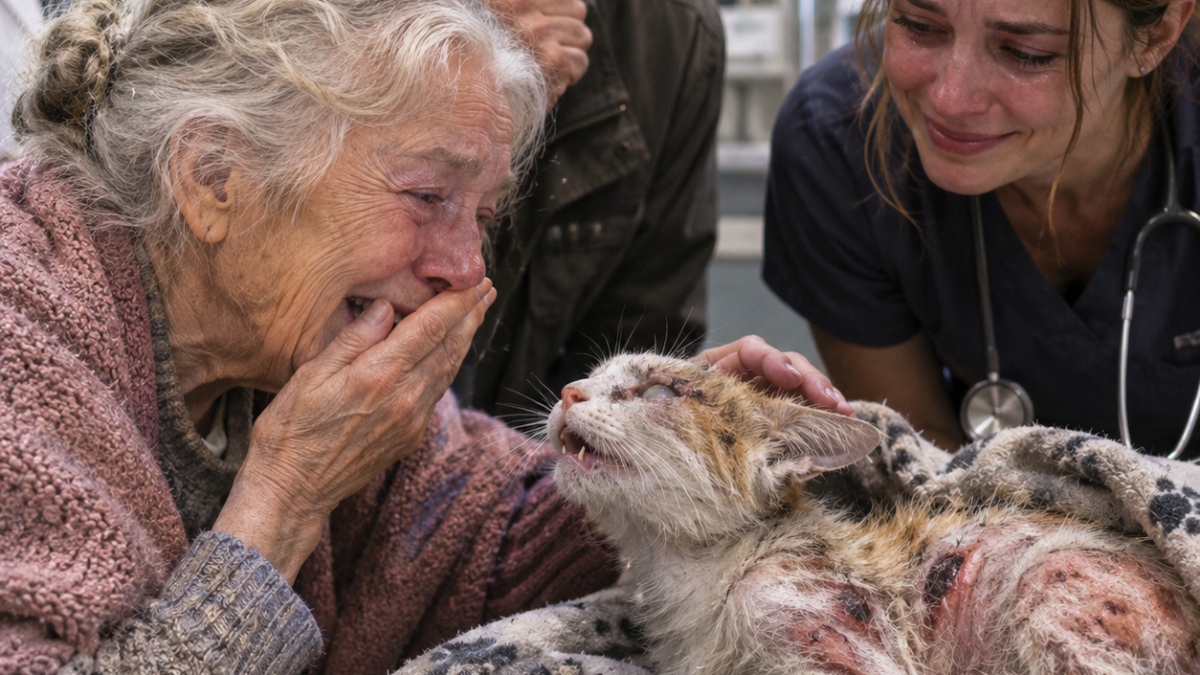
I Found a Dying Cat in a Cardboard Box Behind an Abandoned Store—Then His Microchip Revealed He’d Been Missing for Nearly 2 Years and Was Still Answering His Owner’s Voice.
The cardboard box behind an abandoned Pittsburgh grocery store moved three times, and when I finally opened it, I found a burned, starving cat so weak he could barely lift his head—but every time I spoke, he still tried to answer me.
Hours later, a microchip led us to an elderly woman who had spent nearly two years asking the same question every night from a memory-care facility: “Has Charlie come home yet?”
And when she finally whispered the two words she had used to call him since he was a kitten, the dying cat everyone thought was blind and nearly gone raised his head—and answered the voice he had somehow never forgotten.
I almost walked past the box.
That is the part of the story I still think about most.
Not the burns.
Not the microchip.
Not even Margaret.
The fact that I almost kept walking.
It was 9:18 on a Thursday night in late October, and I had just finished a double shift at Greenfield Veterinary Clinic outside Pittsburgh.
Twelve hours cleaning examination rooms.
Mopping kennel runs.
Washing surgical instruments.
Changing blankets.
Restocking syringes.
Emptying trash.
Scrubbing things from floors that I had learned not to identify before dinner.
My knees hurt.
My lower back felt like somebody had wedged a crowbar between two vertebrae.
I had a headache behind my right eye.
The only thing I wanted was to get home, take off my shoes, microwave the frozen lasagna sitting in my freezer, and spend forty minutes pretending I wasn’t going back to work in nine hours.
The shortcut behind the old Mercer Grocery saved me maybe three minutes.
The store had been abandoned for almost a year.
Windows boarded.
Sign faded.
Loading dock covered in weeds.
People dumped things back there.
Broken chairs.
Mattresses.
Black trash bags.
Once, an entire bathroom sink.
So when I saw the cardboard box beside the loading ramp, I didn’t think anything of it.
I walked past.
Then the box moved.
Not dramatically.
No animal jumped out.
One corner simply bumped against the pavement.
Once.
I stopped.
Looked back.
Nothing.
PART2:
The night was cold enough that I could see my breath.
Cars moved on the main road two blocks away.
A city bus sighed somewhere beyond the buildings.
I stared at the box.
“Please don’t be a rat.”
I waited.
Nothing.
I actually turned away again.
Then—
bump.
Second time.
I closed my eyes.
“Of course.”
I put my work bag down.
Walked closer.
The box had been taped once, but most of the tape had come loose.
The top flaps were folded inward.
A dark stain spread across one side.
I crouched.
“Hello?”
Nothing.
Then I heard it.
A tiny sound.
Broken.
Thin.
Not quite a meow.
PART3:
More like someone trying to speak after running out of breath.
My stomach dropped.
I lifted one flap.
For a second, my brain couldn’t understand what I was seeing.
There was a cat inside.
At least, I thought it was a cat.
Most of the fur along his shoulders and back was gone.
Not shaved.
Gone.
Skin exposed.
Pink in some areas.
Dark and scarred in others.
Old burns.
Open sores.
Scabs.
Ribs so prominent that each one made its own shadow.
His hindquarters were dirty.
One front paw was swollen.
His ears had crusted edges.
His eyes were cloudy and inflamed.
The left one almost completely shut.
The right one open but unfocused.
He was alive.
Barely.
“Oh, sweetheart.”
I don’t remember deciding to kneel.
I was just on the ground.
The cat tried to raise his head.
Failed.
His front paws moved weakly against the cardboard.
Then stopped.
That small effort scared me more than if he’d screamed.
I had worked around sick animals long enough to know when an animal was still fighting.
This one looked like he had already used everything.
I took off my jacket.
The temperature was maybe forty degrees.
Didn’t matter.
I wrapped him carefully.
He made that tiny sound again.
“Okay.”
I slid one hand beneath his chest.
One beneath his hips.
When I lifted him, I almost cried.
He weighed nothing.
Not literally.
But wrong.
A grown cat should have substance.
Muscle.
Resistance.
Warmth.
He felt like picking up a bundle of wet towels.
I carried the entire cardboard box because I was afraid moving him again would hurt him.
My phone was already in my hand when I reached the car.
Greenfield’s emergency line rang twice.
Dr. Claire Bennett answered.
“Greenfield.”
“Claire, it’s Nora.”
I worked maintenance and kennel support at the clinic, but after four years everyone knew my voice.
“What’s wrong?”
“I found a cat.”
Pause.
“How bad?”
I looked into the box.
“Bad.”
“Trauma?”
“Old burns. Maybe infection. Severely underweight. Barely responsive.”
“Breathing?”
“Yes.”
“Temperature?”
“I don’t know.”
“Gums?”
I lifted his lip carefully.
“Pale.”
“Bring him.”
“I’m twenty minutes out.”
“Drive safely.”
“Claire—”
“I’ll call Maya and open treatment.”
I put the box on the passenger seat.
Tucked towels around it.
Turned the heat up.
The cat didn’t move.
I drove with one hand hovering uselessly over the cardboard.
“Stay with me.”
Traffic light.
Red.
Of course.
I looked over.
His chest moved.
Barely.
“Just a few minutes.”
Another red light.
“You’re doing great.”
That was a lie.
He was doing terribly.
But people speak differently to dying things.
We give them the words we wish reality deserved.
At the third light, his breathing stopped.
I know now it probably paused.
Maybe three seconds.
Maybe four.
But time stretched.
“No.”
I reached over.
Touched the jacket.
Nothing.
“Come on.”
I pressed two fingers gently against his chest.
Then—
a faint movement.
Air.
I nearly started crying at the traffic light.
The driver behind me honked when the light turned green.
I shouted something I am not proud of.
Then drove.
When I pulled into Greenfield, the side door was already open.
Claire came out wearing navy scrubs under a winter coat.
Maya Ortiz, our senior veterinary technician, followed with a rolling treatment cart.
I carried the box inside.
“He’s cold,” Claire said immediately.
Maya touched one ear.
“Very.”
We moved him onto a padded treatment table.
The jacket peeled away.
Everyone went quiet.
Claire’s expression changed.
Not shock exactly.
Veterinarians learn to control their faces.
But I saw it.
“How long was he out there?”
“No idea.”
Maya whispered:
“Jesus.”
Claire began calling numbers.
“Temperature.”
Maya inserted the thermometer.
Waited.
Looked at the reading.
“94.6.”
Claire’s face tightened.
Normal cat temperature is above 100.
“Warm fluids.”
She touched his gums.
“Severe dehydration.”
Then his abdomen.
“Emaciated.”
She listened to his heart.
“Slow.”
Maya placed a catheter.
The cat barely reacted.
That scared me too.
Animals who are strong enough to complain still have reserves.
He didn’t.
Claire examined the skin.
“These burns are old.”
“How old?”
“Weeks at least.”
She looked closer.
“Possibly months.”
Some had partially healed.
Others had reopened.
Secondary infection.
Pressure sores.
Dermatitis.
There were circular marks around two legs.
Maya noticed.
“What caused those?”
Claire didn’t answer.
She examined the swollen paw.
Old fracture.
Maybe.
Then the eyes.
She dimmed the room.
Shined a light.
No response from one.
Partial response from the other.
“Nora.”
I looked at her.
“He may have significant visual impairment.”
“Blind?”
“Maybe.”
The word hurt more than it should have.
The cat moved his head slightly when I spoke.
Claire noticed.
I leaned closer.
“You’re safe now.”
His ear moved.
Tiny.
I froze.
“Did you see that?”
Maya nodded.
I tried again.
“Nobody’s going to hurt you.”
A sound came from him.
That same broken almost-meow.
Claire looked at me.
I swallowed.
“He’s answering.”
“Maybe reacting to sound.”
I kept talking.
“We’re going to get you warm.”
Tiny sound.
“You’re going to get food.”
Another.
“When Claire says you’re allowed.”
Claire raised an eyebrow.
“Thank you for respecting medical authority.”
I almost smiled.
The cat’s head shifted toward my voice.
Not toward Claire.
Not Maya.
Mine.
I moved slightly left.
His ear followed.
Claire watched.
“Interesting.”
“What?”
“He may be orienting to tone.”
“Because he can’t see?”
“Could be.”
I whispered:
“Hey, sweetheart.”
The cat answered.
Maya looked at me.
“Okay, that’s weird.”
“Good weird?”
“Very good weird.”
We stabilized him.
Warm IV fluids.
Pain medication.
Antibiotics.
Topical wound treatment.
Oxygen nearby in case.
He couldn’t eat normally yet.
Too weak.
Claire started tiny amounts of nutritional support.
We photographed every injury.
Not because anybody enjoyed it.
Because somebody had done something to this animal.
Maybe intentionally.
Maybe through neglect.
Either way, documentation mattered.
At 11:40, Maya ran the microchip scanner.
We didn’t expect anything.
Most abandoned animals either didn’t have chips or had outdated information.
The scanner beeped.
Maya stopped.
“Got one.”
Claire looked over.
“Readable?”
“Yeah.”
That was the first good surprise.
She entered the number into the database.
A record appeared.
Domestic shorthair.
Male.
Neutered.
Name:
CHARLIE.
Registered owner:
MARGARET ELLIS.
Pittsburgh, Pennsylvania.
Phone number.
Address.
Last update almost two years old.
I looked at the cat.
“Charlie.”
One ear moved.
Then the faint sound.
Maya stared.
“That’s his name.”
I whispered it again.
“Charlie.”
He answered.
My throat tightened.
Claire looked at the clock.
“Call.”
Maya dialed.
Number disconnected.
Second number.
Emergency contact.
She called.
Someone answered.
“Hello?”
Maya put the call on speaker but kept it low.
“Hi, my name is Maya. I’m calling from Greenfield Veterinary Clinic. Is this Daniel Ellis?”
“Yes.”
“Are you related to Margaret Ellis?”
Long pause.
“She’s my mother.”
“We have a cat here with a microchip registered to her.”
Silence.
Maya continued.
“The registration says his name is Charlie.”
Nothing.
Then the man whispered:
“Did you say Charlie?”
Maya glanced at me.
“Yes.”
The sound from the phone changed.
The man was crying.
Not loudly.
Trying not to.
“Where did you find him?”
“Behind the old Mercer Grocery.”
Another silence.
“That’s six miles away.”
I looked at Charlie.
Six miles.
Maya said:
“Is he missing?”
The man almost laughed.
A broken laugh.
“Missing?”
Pause.
“He’s been gone twenty-two months.”
I sat down.
Daniel told us the story.
Margaret had lived alone in a small brick house in Brookline after her husband died.
Charlie had been hers for eleven years.
Rescue kitten.
Orange-and-white.
Though now, beneath the injuries, I could barely see his original color.
Margaret treated him like a person.
Morning breakfast together.
Afternoon window naps.
Evening television.
Every night around nine, Margaret stood at the back door and called:
“Come home, Charlie.”
It began when he was young and occasionally slipped into the yard.
Eventually it became routine even though he rarely went outside.
She would say:
“Come home.”
Charlie would make a strange little chirping meow.
Not a normal cat sound.
A reply.
Daniel said:
“My dad used to joke that they were checking in with each other.”
Then, twenty-two months earlier, a contractor came to repair a kitchen window.
The screen was removed.
Someone left the back door partially open.
Charlie disappeared.
Margaret searched the neighborhood.
Every day.
She printed photographs.
Posted notices.
Walked alleys.
Called shelters.
Paid for flyers.
Daniel and his sister, Rebecca, searched too.
Weeks became months.
Charlie never appeared.
Then Margaret’s health deteriorated.
Pneumonia.
Fall.
Hospital.
Early dementia diagnosis.
She eventually moved into assisted living.
Then memory care.
Daniel’s voice grew quieter.
“She forgot Dad died sometimes.”
I swallowed.
“But she remembered Charlie?”
“For a long time.”
“Does she still?”
“Some days.”
He paused.
“Sometimes she’ll ask me whether I checked the back door.”
“Why?”
“Because Charlie might be waiting.”
Nobody spoke in the treatment room.
Charlie lay beneath the warming blanket.
His chest rose.
Fell.
Daniel continued:
“She still says it occasionally.”
“What?”
I already knew.
“Come home.”
Charlie made the tiny sound.
Daniel stopped talking.
“Was that him?”
I looked down.
“Yes.”
“Do it again.”
I bent closer.
“Charlie?”
A faint chirp.
The man on the phone began sobbing.
“That’s him.”
Claire turned away.
Maya wiped her face with her sleeve.
Daniel whispered:
“That’s his sound.”
I felt something inside me crack.
The noises in the cardboard box.
Maybe coincidence.
Maybe pain.
Maybe habit.
But suddenly I imagined Charlie alone somewhere in Pittsburgh.
Cold.
Hurt.
Blind.
And still answering whenever he heard a gentle voice because for eleven years a gentle voice had always meant someone was calling him home.
Daniel asked:
“Is he okay?”
Nobody answered quickly enough.
He understood.
“How bad?”
Claire took over.
She was honest.
Severely malnourished.
Hypothermic.
Infected wounds.
Old burns.
Eye damage.
Possible chronic trauma.
Critical condition.
Daniel was quiet.
“Will he live?”
“I can’t promise that.”
Another pause.
“My mother can’t handle losing him twice.”
Claire said gently:
“Right now we’re focusing on getting him through tonight.”
Daniel gave permission for treatment.
He offered payment.
Claire told him we’d discuss that later.
Our clinic had an emergency charity fund.
Not enough.
But something.
Charlie made it through the night.
Barely.
At 5:30 the next morning, I was still there.
I had technically finished work eight hours earlier.
Nobody told me to go home.
Maybe they knew I wouldn’t.
I sat beside Charlie’s kennel.
Talked.
Mostly nonsense.
“My frozen lasagna is probably offended.”
Tiny chirp.
“I don’t actually know if lasagna has emotions.”
Nothing.
“Okay, that joke was bad.”
Chirp.
I smiled.
Every time I stopped talking for too long, Charlie became restless.
Breathing faster.
Paws moving.
When I spoke, he settled.
Claire noticed.
“So you’re medicine now.”
“Do I get a raise?”
“No.”
“Worth asking.”
His temperature improved.
Blood pressure stabilized.
Bloodwork showed severe anemia and infection.
Kidneys stressed but functioning.
Liver values elevated.
No obvious internal bleeding.
The burns disturbed Claire.
Not because they were severe.
Because of the pattern.
Several were narrow.
Linear.
Repeated.
Some looked like contact injuries.
Others like chemical irritation.
“This isn’t one accident,” she said.
Maya looked grim.
“Someone did this?”
Claire chose her words carefully.
“I can’t prove intent.”
“But?”
“These injuries happened at different times.”
I stared at Charlie.
Twenty-two missing months.
Where had he been?
Daniel came to the clinic that afternoon.
Fifty-six.
Gray beginning at the temples.
He carried a folder.
Missing posters.
Old veterinary records.
Photographs.
The first photograph almost destroyed me.
Charlie before.
Healthy.
Orange-and-white.
Bright green eyes.
Round face.
Standing on Margaret’s kitchen table beside a birthday cake.
Another:
Charlie asleep against Margaret’s chest.
Another:
Margaret holding him near Christmas lights.
Another:
Charlie looking directly into camera with both eyes clear.
Daniel compared the photograph to the animal beneath our blanket.
He sat down hard.
“Oh God.”
He didn’t touch him immediately.
He asked:
“Can I?”
Claire nodded.
Daniel placed two fingers near Charlie’s cheek.
“Hey, buddy.”
Charlie didn’t react.
Daniel tried:
“Charlie.”
One ear moved.
Then Daniel said:
“Mom’s been waiting.”
The cat gave the tiny chirp.
Daniel covered his face.
I stood there because I didn’t know where else to go.
After a while, he handed me the folder.
“These are everywhere we searched.”
Animal shelters.
Lost pet groups.
Veterinary clinics.
Facebook pages.
Community boards.
Thousands of dollars in reward notices.
One handwritten note from Margaret:
PLEASE HELP CHARLIE COME HOME.
I asked:
“Can Margaret visit?”
Daniel looked uncertain.
“She’s not doing well.”
“Physically?”
“Both.”
“Does she leave the facility?”
“For appointments.”
He stared at Charlie.
“What if she doesn’t recognize him?”
I understood the fear.
Not simply disappointment.
Cruelty.
Bringing an old woman to see the cat she had mourned only for her mind to fail at the moment everyone expected a miracle.
I said:
“Then she doesn’t.”
Daniel looked at me.
“She can still sit with him.”
He thought.
“I’ll ask.”
Three days later, Margaret came.
By then Charlie was stronger.
Still critical.
But stronger.
He could lift his head.
He had taken a small amount of food voluntarily.
His temperature was normal.
His wounds had been cleaned and dressed.
He looked terrible.
There was no disguising that.
Daniel wheeled Margaret into the quiet examination room.
She was eighty-three.
Small.
White hair brushed neatly.
Blue cardigan.
Hands folded over a blanket across her knees.
Her eyes moved around the room without recognition.
Daniel crouched beside her.
“Mom.”
She looked at him.
“Where are we?”
“Veterinary clinic.”
“Why?”
He looked at me.
I brought Charlie in.
Wrapped in a soft towel.
Margaret stared.
No reaction.
My heart sank.
Daniel whispered:
“Mom, do you remember Charlie?”
She frowned.
“Charlie?”
I placed him on a padded table close enough for her to see.
She looked at him.
Long time.
Nothing.
Then she said:
“That poor cat.”
Daniel closed his eyes.
Not recognition.
Compassion.
Maybe that had to be enough.
Margaret reached toward him.
I guided her hand.
She touched Charlie’s head.
He didn’t move.
Then Margaret whispered:
“He’s very thin.”
“Yes.”
“Somebody should feed him.”
“We are.”
She nodded.
Then her gaze drifted toward the window.
Daniel swallowed.
“We should go.”
I hated that sentence.
Not because he was wrong.
Because I wanted the story to give us something.
I wanted the miracle.
I wanted Margaret to suddenly become fully herself.
Recognition.
Tears.
Music.
But real life isn’t obligated to perform on schedule.
Daniel stood.
Then Margaret looked toward the door.
“Has anyone checked outside?”
He stopped.
“What?”
“The back step.”
Daniel stared.
Margaret frowned as though trying to find a thought through fog.
“Charlie might be waiting.”
My skin prickled.
Daniel knelt again.
“Mom.”
She looked at him.
“Say it.”
“What?”
He was crying already.
“The thing you used to say.”
Margaret looked confused.
Daniel’s voice broke.
“At the back door.”
Something changed.
Not dramatic.
Her shoulders relaxed.
Her eyes lowered toward Charlie.
She touched his ear.
Then, in a voice so soft I almost missed it:
“Come home, Charlie.”
Charlie moved.
His head lifted.
Not far.
Maybe two inches.
But lifted.
His cloudy right eye turned toward her.
His ears came forward.
Then the sound.
That broken little chirp.
Margaret froze.
Charlie chirped again.
Her mouth opened.
“Oh.”
She leaned closer.
“That’s my boy.”
Daniel bent forward until his forehead rested against the wheelchair handle.
Margaret began to cry.
Not loudly.
Tears just rolled down her face.
“My Charlie.”
Charlie pushed his head weakly beneath her hand.
She stroked him.
“Where have you been?”
Chirp.
“Look at you.”
Chirp.
“You came home.”
Charlie began to purr.
Barely audible.
Claire was standing in the doorway.
Maya behind her.
Neither pretended not to cry.
Margaret stayed forty-three minutes.
For most of it she remembered him.
Then the memory changed.
Near the end, she asked:
“Whose cat is this?”
Daniel’s face fell.
Margaret continued petting him anyway.
“He’s sweet.”
Daniel looked at me.
That was dementia.
It could return a person.
Then take them again while your hand was still warm from the reunion.
But Charlie didn’t care.
He purred beneath her fingers.
Recognition didn’t have to last for love to exist.
Over the following week, Margaret visited twice.
Some visits she recognized Charlie immediately.
Once she didn’t recognize him at all.
Another time she called him Jasper, her childhood cat.
Charlie answered anyway.
That taught me something.
Maybe animals don’t need us to remember perfectly.
Maybe being loved imperfectly is still being loved.
Meanwhile, Charlie’s missing years became a question nobody could ignore.
Dr. Bennett filed an animal cruelty report.
Officer Kevin Morales from Pittsburgh Animal Care and Control came to document the injuries.
Charlie had been found outside city limits, so jurisdiction became complicated.
But records were shared.
The microchip history revealed something.
It had been scanned seventeen months earlier.
At a low-cost veterinary event in McKees Rocks.
Clinic recorded only partial details.
Adult male cat.
Orange-white.
No owner identified because the person who brought him claimed he was a stray and refused to complete intake after learning a chip existed.
We contacted the organization.
They had archived sign-in sheets.
A name:
RONALD BECK.
Address false.
Phone disconnected.
But there was a vehicle plate captured by a volunteer photograph from the event.
That eventually led to a property outside Carnegie.
Police obtained a welfare inspection after additional complaints.
What they found wasn’t a dramatic torture chamber.
In some ways, it was sadder.
Dozens of cats.
Too many animals.
Filthy conditions.
Improvised cages.
Space heaters.
Cleaning chemicals.
Unvaccinated animals.
Several cats with untreated injuries.
The man living there, Ronald Beck, insisted he rescued strays.
Maybe once he had.
Then something had gone wrong.
Neighbors said he collected animals for years.
He believed shelters killed cats.
So he took them.
But he couldn’t care for them.
He refused help.
Animals became sick.
Some escaped.
Some died.
Investigators found evidence that Charlie had likely lived there.
An old photograph on Ronald’s phone showed an orange-and-white cat in a wire cage.
Left ear marking matched.
Same nose pattern.
Charlie.
That photograph was fourteen months old.
It explained some injuries.
Contact burns from unsafe heaters.
Chemical skin damage from cleaning products.
Pressure injuries.
Malnutrition.
The blindness may have come from untreated infection.
No one could prove exactly when Charlie escaped.
Maybe weeks before I found him.
Maybe days.
Ronald was charged with multiple animal neglect offenses.
I felt strange when I learned.
I had imagined some monster.
A person who enjoyed hurting animals.
Instead, the truth was messier.
Ronald cried when officers removed the cats.
He believed he had saved them.
That didn’t make the suffering less real.
Good intentions do not feed animals.
Love without capacity can still become neglect.
Charlie had been missing because a man who believed shelters were dangerous saw the microchip and ran rather than return him.
Margaret had been six miles away.
Six miles.
I thought about that constantly.
Six miles is nothing.
A fifteen-minute drive.
But when nobody knows where to look, six miles can become another world.
Charlie spent five weeks at Greenfield.
The first week, nobody knew if he’d survive.
The second, he began eating.
Tiny portions.
Then more.
The third week, he stood.
Wobbly.
Angry.
Very cat.
Maya cheered.
Charlie hissed.
We cheered harder.
His skin slowly healed.
Not beautifully.
Scar tissue remained.
Hair grew back unevenly.
Some areas never regrew.
His eyes improved slightly.
The left eye had almost no useful vision.
The right could detect movement and light.
But hearing became his map.
My footsteps.
Maya’s laugh.
Claire opening food cans.
Daniel’s voice.
And Margaret.
Always Margaret.
“Come home, Charlie.”
Chirp.
It never failed.
I became part of his routine too.
If I entered quietly, he didn’t react until I spoke.
Then his head turned.
“Hey, sweetheart.”
Chirp.
“You hungry?”
Chirp.
“You know you already ate.”
Longer chirp.
“That’s manipulation.”
Purr.
Claire said:
“He’s training you.”
“He nearly died.”
“Doesn’t make him ethical.”
Daniel visited every evening.
He eventually confessed something.
He had stopped searching after eight months.
“I told Mom he was probably dead.”
I looked at him.
“I thought I was helping.”
He stared through the kennel glass.
“She kept asking.”
“What did you say?”
“That we’d looked everywhere.”
“You did.”
“Not everywhere.”
“No one can.”
He shook his head.
“I got irritated with her.”
That hurt him to admit.
“She asked the same question every day.”
“Daniel—”
“I once told her, ‘Mom, Charlie is gone. You need to stop.'”
He covered his face.
“Then she cried.”
I sat beside him.
“I would give anything to take that sentence back.”
Charlie was sleeping.
I said:
“You can’t.”
Daniel nodded.
“I know.”
“But you can change the next sentence.”
He looked at me.
I don’t know where that came from.
Maybe four years cleaning a veterinary clinic makes you accidentally wise around animals and useless everywhere else.
The next morning, Daniel visited Margaret.
He later told me he sat beside her bed.
She asked:
“Did Charlie come home?”
For almost two years, he had answered with some version of no.
That day he said:
“Yes, Mom.”
She smiled.
“Good.”
Then went back to sleep.
Charlie was discharged on a Tuesday.
There was debate about where he should live.
Margaret’s care facility allowed therapy animals to visit but not permanent resident pets requiring medical care.
Daniel had two cats already.
One elderly.
One territorial.
His sister Rebecca had a quiet home.
No other animals.
Worked remotely.
She volunteered.
Charlie moved there.
Before discharge, Daniel tried to pay the bill.
It was enormous.
Emergency hospitalization.
Imaging.
Medication.
Wound care.
Nutritional support.
Eye treatment.
Weeks of boarding.
Our charity fund covered some.
Donations covered more.
Because someone—Maya—posted a carefully anonymized version of Charlie’s story with permission.
People responded.
Hundreds.
Five dollars.
Ten.
Fifty.
One person sent $1,000.
Another wrote:
FOR THE CAT WHO ANSWERED.
By discharge day, Charlie’s bill was covered.
There was extra.
Claire created a small fund.
COME HOME FUND.
For microchipped animals found critically injured whose families couldn’t immediately afford emergency care.
Charlie had created paperwork.
The highest honor possible in veterinary medicine.
Rebecca brought him to Margaret every Sunday.
At first Charlie traveled in a carrier.
He hated it.
Eventually they used a soft-sided bag with the top open.
He learned the route.
Care facility entrance.
Elevator.
Second floor.
Margaret’s room.
Even before Rebecca opened the carrier, Charlie would begin chirping.
Sometimes Margaret recognized him.
“Charlie!”
Other times:
“What a pretty cat.”
He wasn’t pretty by conventional standards anymore.
Scarred back.
Patchy fur.
Cloudy eyes.
Crooked front paw.
But love has its own eyesight.
Margaret always touched him gently.
And eventually the words came.
“Come home.”
Charlie answered.
There was one visit I’ll never forget.
About nine months after I found him.
Daniel invited me.
Margaret was having a bad week.
Rarely speaking.
Sleeping more.
She no longer recognized Daniel consistently.
I almost didn’t go.
Felt intrusive.
But Rebecca said:
“Charlie knows you.”
So I went.
Charlie was heavier.
Healthy.
Soft fur had returned around his neck and sides.
His back remained scarred.
He moved carefully but confidently.
He heard my voice.
Chirped.
I crouched.
“Hey, sweetheart.”
Purr.
We entered Margaret’s room.
She sat near the window.
Snow outside.
Pittsburgh gray.
Charlie climbed onto her lap with help.
Margaret looked down.
No recognition.
She stroked him.
Five minutes.
Ten.
Then she began humming.
Daniel froze.
“What?”
I whispered.
He put a finger up.
Margaret hummed an old song.
Charlie lifted his head.
Then chirped.
Margaret stopped humming.
Looked at him.
And said:
“You always answer me.”
Daniel began crying.
Margaret smiled.
“Come home, Charlie.”
Chirp.
Then she looked toward Daniel.
For one bright moment:
“Danny?”
He dropped to his knees.
“Yeah, Mom.”
She touched his cheek.
“You found him.”
Daniel couldn’t speak.
Charlie purred between them.
The moment lasted less than a minute.
Then Margaret asked where her husband was.
But Daniel had received something he’d thought dementia had taken forever.
His mother saying his name.
Sometimes healing is not permanent.
Sometimes it arrives for forty seconds.
That doesn’t make it less real.
Margaret died the following spring.
Eighty-four.
Pneumonia.
Daniel called me.
I attended the funeral.
I didn’t know if I belonged there.
Rebecca insisted.
A photograph stood near the flowers.
Margaret holding a healthy young Charlie.
Another photograph beside it:
Margaret in the care facility.
Charlie scarred and older in her lap.
Underneath was a handwritten card.
COME HOME.
Charlie obviously couldn’t attend the church service.
But afterward, at the family house, Rebecca brought him.
Daniel sat on the floor.
Charlie walked toward him.
Chirped.
Daniel laughed through tears.
“She’s not here, buddy.”
Charlie listened.
Then climbed into his lap.
He stayed.
Margaret had spent almost two years waiting for Charlie.
Then Charlie spent the last year of her life coming back over and over.
Sunday after Sunday.
Voice after voice.
Memory after memory.
People sometimes say animals don’t understand death.
I don’t know what animals understand.
I’ve learned to be suspicious of anyone who claims certainty about what happens inside another creature’s mind.
Charlie searched Margaret’s room after she died.
Rebecca took him once to collect personal items.
He walked around.
Bed.
Chair.
Window.
Bathroom doorway.
Then sat beside the wheelchair.
Chirped.
Nobody answered.
He waited.
Then returned to Rebecca’s carrier.
That was all.
No dramatic scene.
But Rebecca told me she cried the entire drive home.
Charlie lived another four years.
He became almost completely blind.
Didn’t matter much.
He mapped Rebecca’s house through sound.
Food bowl.
Couch.
Window.
Bed.
He knew everyone by footsteps.
Daniel visited weekly.
I visited occasionally.
Every time:
“Hey, sweetheart.”
Chirp.
The Come Home Fund grew.
People kept donating.
Our clinic eventually partnered with three other practices.
We helped dozens of animals.
A diabetic terrier whose owner was hospitalized.
A senior cat hit by a car whose family had just lost their job.
A microchipped beagle found forty miles from home after a tornado.
Not every story ended happily.
Some animals died.
Some owners were never found.
Some reunions were complicated.
Some microchips led to people who said they didn’t want the animal back.
That hurt.
But we kept scanning.
Always.
Every animal.
Every time.
Maya put a sign above the scanner:
BEFORE YOU ASSUME THEY HAVE NOBODY, CHECK.
Claire pretended the sign violated the clinic’s visual standards.
Never removed it.
Years after Charlie’s rescue, a new employee asked me why I always scanned dead-on-arrival cats.
“There’s nothing we can do.”
I said:
“Maybe not for the cat.”
She looked confused.
“But someone might still be waiting.”
She understood after that.
Charlie died at sixteen.
Kidney disease.
Rebecca called me.
I went to the house.
He was lying in a heated bed near the window.
Thinner again.
Not like the box.
Never like the box.
Loved thin.
Old thin.
Different.
I sat beside him.
“Hey, sweetheart.”
His ear moved.
Then the smallest chirp.
I laughed.
“You still answering?”
Purr.
Daniel came.
Rebecca sat on the floor.
Dr. Claire made a house call.
No clinic table.
No bright lights.
Charlie hated bright lights by then anyway.
We gave him pain relief.
Time.
Rebecca held him.
Daniel touched his paw.
I stayed near his head.
And before Claire gave the final medication, Daniel leaned close.
His voice broke.
“Mom wanted me to tell you something.”
Charlie breathed.
Daniel whispered:
“Come home, Charlie.”
Charlie opened his cloudy eyes.
Lifted his head a fraction.
And answered.
One tiny chirp.
His last.
Then he settled.
Claire gave the medication.
Charlie died surrounded by voices he knew.
I cried harder than I expected.
Maybe because I had found him.
Maybe because Margaret was gone.
Maybe because that little sound had been part of my life for years.
Rebecca buried Charlie’s ashes with Margaret.
Not all of them.
She kept a small portion.
But most went beneath the lilac bush behind Margaret’s old house.
Daniel installed a simple stone.
MARGARET & CHARLIE
FOUND EACH OTHER TWICE.
That was enough.
The abandoned Mercer Grocery was demolished eventually.
Apartments went up.
I drove past during construction.
The loading dock was gone.
The pavement where the cardboard box had sat was broken into rubble.
I pulled over.
Not for long.
I thought about that night.
My knees hurting.
Frozen lasagna.
Double shift.
The first bump.
Then the second.
How close I came to walking away.
People sometimes tell me:
“You saved Charlie.”
I don’t really like that sentence.
Veterinarians saved Charlie.
Technicians saved Charlie.
Margaret’s family paid attention to a microchip years earlier.
Donors saved Charlie.
Rebecca gave him a home.
Daniel repaired something with his mother while there was still time.
Charlie did most of the surviving.
I stopped.
That was my part.
I stopped.
Sometimes that is all a person gets asked to do.
Notice.
Listen.
Open the box.
Make the call.
Drive twenty minutes.
Say one more sentence.
Stay five more minutes.
The world is full of things we can’t fix.
That fact becomes a convenient excuse if we’re not careful.
I couldn’t undo Charlie’s burns.
Couldn’t restore his eyesight.
Couldn’t give Margaret her memory back.
Couldn’t erase the twenty-two months they lost.
Couldn’t change what Ronald Beck had allowed to happen.
Couldn’t stop dementia.
Couldn’t stop death.
But I could stop walking.
And because I stopped, a scanner beeped.
Because a scanner beeped, a number appeared.
Because somebody answered the phone, a name came back.
Because someone remembered a strange little sound, we understood Charlie wasn’t just making noise.
He was responding.
He had probably spent nearly two years hearing strangers.
Cars.
Doors.
Animals.
Heaters.
Cages.
Maybe people shouting.
Maybe silence.
We will never know.
But somewhere inside that scarred body lived the memory of an elderly woman’s voice at a back door.
Come home, Charlie.
Maybe that phrase meant food.
Maybe safety.
Maybe routine.
Maybe nothing more complex than the sound that always came before warmth.
But when Margaret said it again after nearly two years, Charlie answered exactly as he always had.
That was enough for me.
I used to think home was a place animals returned to.
A porch.
A bed.
A food bowl.
A person.
Charlie taught me something different.
Sometimes home is recognition.
A voice that knows your name.
A hand that touches you without hurting.
A sentence repeated so often your body remembers even when everything else has been taken away.
Margaret’s memory failed.
Charlie’s eyes failed.
Time failed both of them.
But something remained.
Every time she said:
“Come home.”
He answered.
And years later, when Daniel said those words one final time, Charlie answered again.
I still work at Greenfield Veterinary Clinic.
My knees are worse.
My back isn’t better.
I no longer take the Mercer shortcut because the road changed after construction.
But whenever someone brings us a stray in terrible condition and says:
“Nobody’s going to be looking for this one.”
I scan anyway.
Every time.
Because once, behind an abandoned grocery store, I found a dying cat inside a cardboard box.
Everyone thought he had been abandoned.
He hadn’t.
Someone had been waiting almost two years.
And even after hunger, burns, blindness, cages, and twenty-two months away from the woman who loved him, Charlie had never stopped trying to answer her.
Sometimes the smallest voice is carrying the biggest story.
Sometimes the thing lying forgotten in a cardboard box is still somebody’s family.
And sometimes bringing someone home begins with nothing more heroic than being tired, wanting to keep walking—
and choosing to stop anyway.








