I Found a Cat Too Weak to Reach Food—Then the Vet Removed Nearly 400 Grams From His Skin
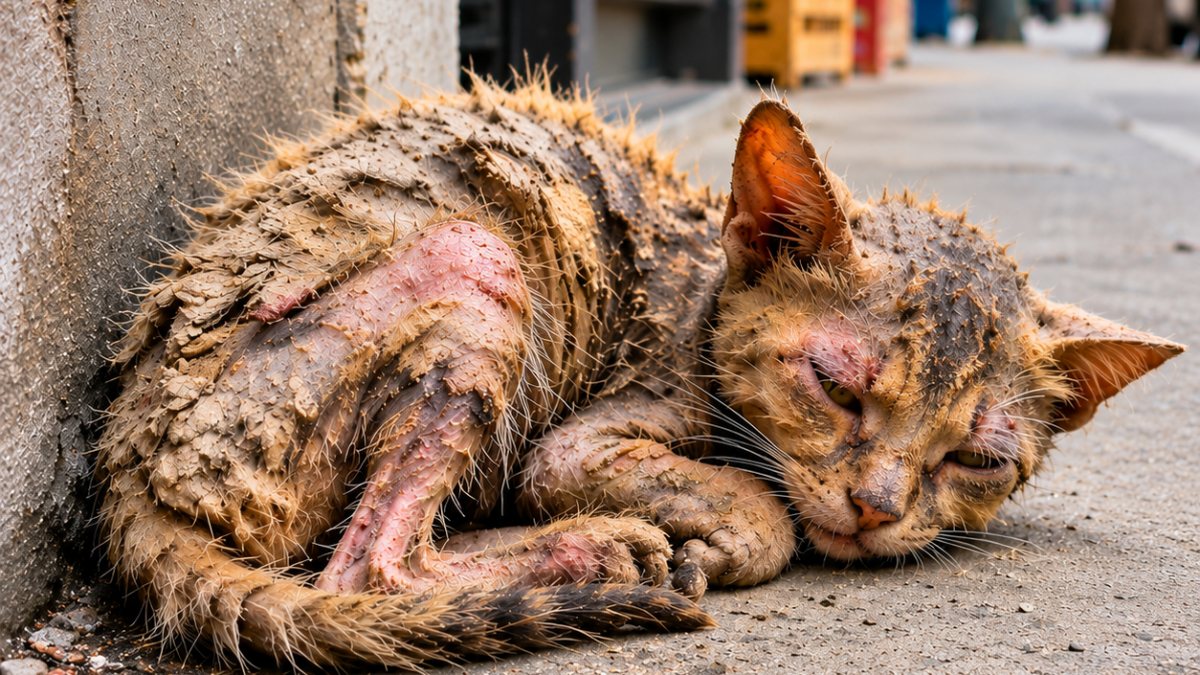
I Found a Cat Too Weak to Reach Food—Then the Vet Removed Nearly 400 Grams From His Skin.
I found Renatinho beside a neighborhood grocery store, so weak he could not even stand up when other stray cats rushed toward food, and his tiny body was buried beneath layers of hardened skin so thick that I could barely tell what he was supposed to look like.
At the veterinary clinic, I learned he was fighting malnutrition, severe skin disease, multiple infections, and a weakened immune system all at once—but the moment that truly broke me came during his first medicated bath, when nearly 400 grams of dead, crusted material finally came away from a cat who seemed far too small to have been carrying that much suffering.
What nobody around me knew was that I had spent almost two years struggling to find a reason to care about tomorrow myself, and somewhere between his first frightened meal and the night I sat beside him counting every breath, the little animal I thought I was rescuing began giving me reasons to get out of bed too.
I did not leave my house that afternoon looking for a cat.
There was nothing special about the day.
No storm.
No emergency call.
No dramatic noise that made people turn their heads.
I was simply walking through my neighborhood, taking the same route I had taken many times before.
There was a small grocery store near the corner.
Nothing fancy.
Plastic crates outside.
A faded awning.
A few motorcycles and bicycles parked near the entrance.
Stray cats sometimes gathered behind the building because people left scraps near the wall.
I had seen them before.
Most of them knew exactly how to survive around humans.
They stayed far enough away not to be caught.
Close enough to notice when food appeared.
Fast enough to get there first.
That afternoon, several cats were already moving around near the store.
Then I noticed one that was not moving.
At first, I was not certain it was a cat.
It looked more like a small bundle of dirty fabric beside the wall.
Brownish.
Gray in places.
Still.
I slowed down.
One of the shopkeepers came outside carrying a plastic bag.
He tossed food onto the pavement.
Immediately the healthier strays appeared.
They moved quickly.
Shoulders low.
Eyes sharp.
One grabbed a piece and retreated.
Another squeezed between two others.
Normal street-cat behavior.
The little shape beside the wall stayed where it was.
That was the first thing that bothered me.
Hungry cats move toward food.
PART2:
Even frightened cats usually watch it.
This one barely lifted its head.
I walked closer.
Then I understood why.
He was painfully thin.
Not simply slim.
His shoulders rose like small points beneath his coat.
His hips looked too large because there was so little between skin and bone.
But even that was not the worst part.
His fur did not look like fur.
Large sections of his body were hidden beneath thick, dry crusts.
Some areas had hardened into irregular plates.
The skin beneath looked inflamed.
His face was affected too.
Around his ears.
Neck.
Back.
Sides.
He looked as though his own body had been slowly sealing him inside something painful.
I crouched several feet away.
“Hey.”
One ear moved.
Barely.
His eyes turned toward me.
Too large for his face.
Exhausted.
I expected him to run.
Street cats usually do.
Even very sick ones try.
He did not.
PART3:
I moved one step closer.
Nothing.
Another.
Still nothing.
That frightened me more than hissing would have.
Fear takes energy.
Running takes energy.
Sometimes an animal stops trying to escape not because it trusts you, but because it no longer has enough strength to believe escape matters.
I spoke softly.
“It’s okay.”
His eyes remained on me.
I have no idea whether tone mattered.
Maybe.
Maybe not.
“I’m here.”
He did not know what those words meant.
But I needed to say them.
I reached slowly.
He flinched.
A tiny movement.
Then stopped.
My hand touched beneath his chest.
He weighed almost nothing.
When I lifted him, his legs folded inward.
No fighting.
No claws.
No panic.
His body felt hot in some places and strangely cool in others.
I remember thinking:
This cat should be heavier.
Not in the normal sense.
In the terrifying sense.
I could feel too much of him.
Spine.
Ribs.
Shoulders.
And yet the crust covering parts of his skin gave him a strange heaviness that did not belong.
I wrapped him in my shirt and carried him toward the road.
People looked.
One woman asked:
“Is that yours?”
“No.”
“Where did you find it?”
“Right there.”
She made a sad sound.
Then continued walking.
I do not blame her.
Before that day, I had walked past suffering too.
Not because I was cruel.
Because life teaches people to keep moving.
We see too much.
We assume somebody else will handle it.
Sometimes nobody does.
I called the closest veterinary clinic while walking.
“Can you take an emergency?”
“What kind?”
“Cat.”
“What happened?”
“I don’t know.”
I looked down.
“He’s extremely weak.”
“How old?”
“No idea.”
“Breathing normally?”
“I think so.”
“Bring him.”
The ride felt longer than it was.
I placed him inside a box lined with a towel.
He did not stand.
At one red light, I looked down.
His eyes were closed.
My heart stopped.
“Hey.”
No movement.
“Hey.”
I touched his side.
He opened one eye.
I let out a breath.
“Don’t do that.”
The veterinarian probably thought I was the owner when I arrived.
I had to explain.
“Found him.”
“How long ago?”
“Maybe twenty minutes.”
“Do you know whether he’s been eating?”
“No.”
“Vaccinated?”
“No.”
“Any history?”
“No.”
Every answer was no.
The veterinary team took him immediately.
They weighed him.
Checked temperature.
Hydration.
Mouth.
Eyes.
Skin.
Lymph nodes.
Listened to heart and lungs.
He barely reacted.
The veterinarian looked at me.
“Has he always been this quiet?”
“I just found him.”
She nodded.
That was right.
Then:
“We’re going to need bloodwork.”
“Do it.”
She hesitated.
“There may be several things happening.”
“I know.”
I did not know.
Not really.
I had assumed hunger.
Maybe mange.
Maybe fleas.
Something visible.
Something straightforward.
Feed him.
Treat skin.
Watch him become better.
Life rarely respects the story we want.
Bloodwork came back with problems stacked on problems.
Severe malnutrition.
Signs of infection.
Poor immune response.
Anemia.
Inflammatory markers.
Skin disease extensive enough that secondary infection was a major concern.
Dehydration.
Parasites were suspected and later confirmed in part.
His body was not dealing with one illness.
It was trying to survive several.
The veterinarian explained everything slowly.
I heard perhaps sixty percent.
“What are his chances?”
She did not answer immediately.
That terrified me.
Veterinarians who work with frightened people learn how to choose words.
“We can treat what we know.”
“That isn’t what I asked.”
“I know.”
She looked toward the treatment area.
“He is very compromised.”
“Meaning?”
“He could respond.”
Pause.
“Or his body may not have enough reserve.”
There are sentences that do not need dramatic language to hurt.
That was one.
“What do we do?”
“Support him.”
Medication.
Nutrition carefully increased.
Fluids.
Skin treatment.
Monitoring.
Warmth.
Treatment for infection.
Medicated bathing once he was stable enough.
No miracle product.
No single injection.
His body had reached a point where recovery would require dozens of small things going right.
The clinic asked whether I could leave him.
“Yes.”
“For at least today.”
“Yes.”
“Possibly longer.”
“Yes.”
I kept saying yes.
Then I went home.
The apartment looked exactly as it had that morning.
That bothered me.
The sink still contained the same cup.
Curtains half closed.
Shoes near the door.
Nothing in my life looked different.
But somewhere a tiny cat was fighting to stay alive because I happened to turn my head near a grocery store.
I sat on the edge of my bed.
For almost two years, sitting there had been one of my main activities.
I do not say that lightly.
Depression is sometimes described as sadness.
Mine was often less dramatic.
It was absence.
Things stopped pulling me toward them.
Meals became tasks.
Messages became obligations.
Mornings arrived without convincing reasons to participate.
I worked when I had to.
Answered people when necessary.
Smiled occasionally because muscle memory is powerful.
But there had been long stretches where getting up felt like performing an action for a person who no longer existed.
Me.
I had never completely stopped functioning.
That made it easier to hide.
People think depression always looks like collapse.
Sometimes it looks like paying bills.
Replying:
I’m fine.
Taking showers.
Then returning to bed because nothing inside you knows what to do with the hours.
That afternoon, I lay down.
Closed my eyes.
Then immediately thought of the cat.
Did he have water?
Of course.
Was he warm?
Yes.
Would someone notice if he stopped breathing?
Yes.
I sat up.
I had questions.
The clinic probably hated me by the third call.
“He’s stable.”
“What does stable mean?”
“Currently maintaining.”
“Is he eating?”
“A little.”
“Good?”
“Yes.”
“How little?”
The receptionist laughed softly.
“Do you want the exact amount?”
“Yes.”
She gave it to me.
That became the beginning of something.
Numbers.
Medication times.
Weight.
Food.
Temperature.
Skin.
Things I could observe.
I could not control whether the cat survived.
But I could care what happened next.
The following morning, I returned.
He was awake.
That felt like winning.
Not healed.
Not even close.
Awake.
His eyes tracked me.
“You remember me?”
No response.
The veterinarian smiled.
“He may.”
“Or he may be looking at the person blocking the light.”
“That too.”
I appreciated her honesty.
They had cleaned some areas gently.
The smell of infection was less noticeable.
He still looked terrible.
I had secretly hoped twenty-four hours of treatment would produce something visible.
It did not.
Recovery is insulting that way.
You can work very hard and still look almost identical the next morning.
He ate a small amount while I sat there.
I watched every bite.
The veterinarian said:
“Don’t celebrate too much yet.”
“I know.”
But I did.
He swallowed food.
That mattered.
He needed a name for paperwork.
“What have you been calling him?”
“Little one.”
She looked at me.
“That cannot be his official name.”
“Why?”
“It can.”
She smiled.
“But you’ll regret shouting ‘Little One’ across a clinic.”
I looked through the carrier door.
“Renatinho.”
She repeated it.
“Renatinho?”
“Yes.”
Why?
I cannot give you a meaningful explanation.
It appeared in my mind.
Sometimes names do that.
Renatinho.
The name belonged to him almost immediately.
Several days into treatment, the veterinarians decided he was strong enough for the first major medicated bath.
His skin had become one of the largest obstacles.
The hardened crusting was trapping debris.
Irritating infected tissue.
Making movement uncomfortable.
The team had already removed some loose material carefully.
But the bath would reveal how extensive it truly was.
I expected something unpleasant.
I did not expect to be shocked.
Warm water.
Medication.
Time.
Nobody scrubbed aggressively.
That mattered.
His skin was too fragile.
The goal was to soften and release what could safely come away.
At first, small pieces loosened.
Then larger areas.
Thick crusts that had built layer over layer.
The water changed.
Towels filled.
Material kept coming.
I stared.
“How much is that?”
One technician looked at the collected material.
“A lot.”
They eventually weighed what had been removed.
Nearly 400 grams.
I thought I misunderstood.
“Four hundred?”
“Close to it.”
I looked at Renatinho.
He was tiny.
I could not reconcile the number with the body.
“How was he carrying that?”
No one had a satisfying answer.
Because sometimes numbers become horrifying only when you see what they were attached to.
Nearly 400 grams of dead, hardened, crusted material from a cat whose entire body seemed hardly large enough to contain it.
Afterward, Renatinho looked smaller.
But also more like an animal.
Not a shape hidden under disease.
There were raw areas.
Thin fur.
Inflamed skin.
He did not suddenly become beautiful in the conventional sense.
But his body could move differently.
His skin could breathe.
His eyes appeared brighter.
Maybe I imagined that.
The veterinarian did not.
“He looks more comfortable.”
That was enough.
The first bath became a turning point.
Not a miracle.
A turn.
There were still bad days.
Many.
One afternoon he ate well.
The next morning, almost nothing.
One infection responded.
Another concern appeared.
His weight increased.
Then plateaued.
His skin looked better in one area and worse in another.
There were nights I went home convinced he was going to survive.
Then nights I sat beside him feeling foolish for having believed it.
The clinic eventually allowed me to help with parts of his routine.
Not medical procedures beyond what they taught me.
Food.
Comfort.
Simple prescribed exercises as he gained strength.
Bathing assistance.
Holding towels.
Talking.
Renatinho started recognizing my arrival.
At first:
eyes.
Then head movement.
Later:
one tiny meow.
The first time he meowed specifically when I entered, I looked around.
“Was that for me?”
A technician said:
“Probably.”
“Probably?”
“He might hate your shirt.”
I smiled.
“Let me have this.”
She laughed.
The worst night came several weeks in.
His energy dropped.
He refused a meal.
His breathing seemed different to me.
Maybe only because I had started watching too closely.
The veterinarian adjusted treatment.
They monitored him.
I sat beside his enclosure after closing.
I remember the fluorescent light above us.
The hum from equipment.
His body beneath a blanket.
Every breath seemed too important.
I counted.
One.
Two.
Three.
Pause.
Four.
I whispered:
“Come on.”
No response.
“One more day.”
His ear moved.
“That’s all.”
I had no right to ask.
Still asked.
“Just one more.”
Around midnight, he shifted.
Raised his head.
Then lowered it.
Tiny movement.
I cried as if he had stood up and run.
The next morning, he ate.
Not much.
Enough.
One more day became another.
And another.
Slowly, Renatinho changed.
Food stopped being something we begged him to take.
He began looking for it.
Then demanding it.
His first impatient meow at meal time made the whole clinic laugh.
“Look who has opinions now.”
He stared at the bowl.
A technician said:
“Apparently we’re too slow.”
I almost cried again.
He gained weight.
Muscle began appearing where only bone had been.
His skin improved.
Fur came back in soft uneven patches.
The color was richer than I expected.
His face changed most.
The eyes had always been large.
But before, they looked distant.
Now they looked curious.
He started kneading blankets.
First with one paw.
Then both.
I had not realized how much that tiny motion would affect me.
Press.
Release.
Press.
Release.
A cat doing something ordinary.
There is nothing dramatic about kneading.
Unless you have spent weeks wondering whether the animal will live long enough to do anything ordinary again.
He groomed himself.
The first time, only one shoulder.
Three licks.
Then stopped.
I stared.
The veterinarian walked past.
“What?”
“He cleaned himself.”
“Yes.”
“No, he cleaned himself.”
She smiled.
“I know.”
Those gestures became milestones.
Eating without encouragement.
Grooming.
Stretching.
Seeking warmth instead of merely enduring cold.
Rubbing his head against a hand.
The first head rub happened accidentally.
I was changing a towel.
Renatinho stood.
His balance was much better by then.
He moved toward my wrist.
I assumed he wanted to pass.
Instead, he pressed his forehead against me.
Once.
Then again.
I froze.
“Did you just—”
Head against wrist.
I laughed.
“You did.”
He continued.
Apparently affection, once discovered, became one more thing he believed should be available on demand.
When the veterinary team finally said he could come home, I panicked.
I had spent weeks wanting that sentence.
Then:
“What if something happens?”
“You call.”
“What if he stops eating?”
“You call.”
“What if his skin gets worse?”
“You call.”
“What if—”
The veterinarian raised one hand.
“You’ve been doing this every day.”
“Here.”
“With us.”
“Yes.”
“That was the point.”
She smiled.
“He’s ready.”
Then, after a pause:
“Are you?”
That was a different question.
I looked at Renatinho.
He was standing inside his carrier.
Watching me.
“Yes.”
I hoped it was true.
His first minutes in my apartment were almost silent.
I opened the carrier in a prepared room.
Blanket.
Water.
Food.
Litter box.
Warm bed.
Hiding place.
Renatinho remained inside.
I sat several feet away.
Did not reach.
Eventually he came out.
One paw.
Pause.
Another.
He sniffed the floor.
Wall.
Bed.
Chair leg.
Every few steps, he looked back at the carrier.
Like a traveler making sure the exit still existed.
I stayed where I was.
Then he found a corner of the room where sunlight came through the window.
He stopped.
Turned once.
Lay down.
I expected him to curl tightly.
Instead, he stretched.
Front paws forward.
Back legs extended.
Whole body long.
Loose.
Unprotected.
I covered my mouth.
That image remains one of the clearest memories of his recovery.
Not running.
Not playing.
Resting.
A body that had spent who knows how long carrying disease, hunger, pain, cold, and nearly 400 grams of hardened skin simply lying down as though nothing was about to hurt it.
I cried quietly.
Renatinho opened one eye.
Then closed it again.
Apparently my emotional collapse did not concern him.
He adapted faster than I did.
Within days, he followed me from room to room.
Not constantly at first.
Doorway.
Hallway.
Kitchen.
He would sit nearby.
Then closer.
Eventually, if I moved, he moved.
Bathroom?
Renatinho.
Kitchen?
Renatinho.
Bedroom?
Renatinho.
I joked:
“You know you’re allowed to have hobbies.”
He rubbed against my leg.
“Following me is not a hobby.”
Meow.
“Fine.”
His personality emerged in pieces.
He loved warm laundry.
Hated one particular plastic bag for reasons known only to him.
Would sit beside food while pretending he was not interested until the second I walked away.
Discovered cardboard boxes.
Immediately understood their importance.
Learned that my bed was softer than his expensive cat bed.
Rejected the expensive cat bed permanently.
He became playful.
The first real game involved a bottle cap.
I had bought toys.
Balls.
Feathers.
Soft mice.
Renatinho ignored all of them.
Then found a bottle cap.
Knocked it across the floor.
Chased.
Hit the wall.
Ran after it again.
I stood watching.
“Of course.”
Twenty dollars in cat toys.
Bottle cap wins.
He looked healthy enough that people who met him later struggled to believe old photographs.
One friend said:
“That was him?”
“Yes.”
“No.”
“Yes.”
“He looks like a different cat.”
I understood what she meant.
But part of me resisted the phrase.
He was not a different cat.
This was the same animal who had been beside the grocery store.
The difference was not identity.
Conditions.
Food.
Medicine.
Safety.
Time.
Care does not necessarily create a new creature.
Sometimes it simply reveals the one who was hidden beneath survival.
That thought became important for another reason.
Because the same thing was happening to me, though much less visibly.
I had been dealing with depression for close to two years before Renatinho.
I do not want to turn his story into an inspirational shortcut.
He did not cure me.
Animals are not medication.
Love is not a substitute for treatment.
There were still days after he came home when I struggled.
Still mornings where getting out of bed felt heavy.
Still periods where my thoughts became quiet in the wrong way.
But Renatinho created structure.
At seven:
medicine.
Then breakfast.
Skin check.
Later:
play.
Follow-up appointments.
Food shopping.
Laundry because a cat with healing skin needs clean bedding.
Simple tasks.
Specific.
External.
Before him, I could negotiate with myself endlessly.
Get up later.
Eat later.
Answer tomorrow.
Renatinho did not understand negotiation.
Breakfast was breakfast.
If I remained in bed, eventually a small face appeared.
Then a paw.
Then a meow.
At first gentle.
Then increasingly less diplomatic.
One morning I pulled the blanket over my head.
Renatinho walked across my stomach.
“Traitor.”
He sat on my chest.
“You weigh more now.”
Meow.
“That is technically my fault.”
Another meow.
I got up.
There is nothing poetic about cleaning a litter box while depressed.
That may be why it helped.
It was real.
Necessary.
Small enough to do.
I began measuring days differently.
Not:
Did I feel happy?
But:
Did Renatinho eat?
Yes.
Did I shower?
Yes.
Did we make the appointment?
Yes.
Did I answer one message?
Yes.
Did I go outside?
Sometimes.
Small things accumulated.
His recovery was doing the same.
One day at a time.
Neither of us woke transformed.
We became more alive through repetition.
Renatinho gained a habit of sitting near the front door when I put on shoes.
At first, I worried he wanted to escape.
He did not.
He simply watched.
Maybe he associated shoes with my leaving.
Whenever I returned, he met me.
Not dramatically.
No dog-style celebration.
He would appear in the hallway with his tail raised.
Sometimes make a small sound.
Then walk away as if the reunion had been completely casual.
Cats are talented at making affection look accidental.
One evening I was especially low.
No particular reason.
That is another thing people misunderstand.
Depression does not always require a new disaster.
Sometimes your brain simply decides the day weighs twice what it did yesterday.
I sat on the floor beside the couch.
Renatinho approached.
I expected him to rub against me.
Instead, he climbed into my lap.
For the first time.
Turned twice.
Lay down.
His body was warm.
He began kneading.
Left paw.
Right.
Left.
Right.
Then purring.
I had heard him purr before.
But never like that.
Deep.
Steady.
Vibration through my legs.
I put one hand against his back.
“I thought I was helping you.”
Renatinho continued purring.
“I’m starting to think this contract is unfair.”
His ear moved.
“I pay for everything.”
Nothing.
“You contribute fur.”
Purr.
I laughed.
A real laugh.
Not a huge moment.
No life-changing realization.
Just a cat on my lap and a laugh in a room that had spent too long without many.
That mattered.
At follow-up appointments, the veterinary staff celebrated every boring improvement.
Weight gain.
Healthy blood values.
Skin returning toward normal.
Immune function improving.
No secondary infection.
The phrase:
“Everything looks good.”
became something I could finally hear without immediately expecting the next sentence to reverse it.
One day, the veterinarian placed Renatinho on the scale.
Looked down.
Then at me.
“He’s officially getting chunky.”
I stared.
“What?”
“Not overweight.”
She smiled.
“But we’re no longer discussing how to make him eat.”
I looked at Renatinho.
He stared toward a treat container.
“Apparently not.”
I remembered lifting him outside the grocery store.
Almost weightless.
Now I complained because he walked across me at night like a small brick.
That was an excellent problem.
His fur eventually filled in so completely that most people could not see where the worst lesions had been.
I could.
I knew the places.
Near his shoulders.
Neck.
Behind one ear.
I would sometimes touch those areas while he slept.
Not because scars interested me.
Because I remembered what used to cover them.
Nearly 400 grams.
The number followed the story whenever people heard it.
“Four hundred grams?”
“Yes.”
“From one cat?”
“Yes.”
“How?”
I never knew how to answer.
Slowly, I suppose.
Pain can accumulate slowly.
Neglect too.
A little longer without treatment.
Another day without enough food.
Another infection.
Another crust forming over damaged skin.
Suffering rarely arrives carrying a label saying:
This is now unbearable.
Sometimes it adds weight until the body simply stops competing for scraps.
That thought frightened me because it sounded familiar.
My own depression had not arrived on one dramatic day either.
It accumulated.
Disappointment.
Isolation.
Exhaustion.
Things postponed.
Calls ignored.
Meals skipped.
Days indoors.
Small pieces.
Until getting out of bed felt like lifting something nobody else could see.
Renatinho and I were not the same.
I would never insult his physical suffering by pretending we were.
But watching him recover helped me understand accumulation in reverse.
Healing accumulated too.
One meal.
One bath.
One medication.
One night survived.
One morning.
One gram gained.
One patch of fur.
One purr.
One laugh.
Nothing dramatic.
Then months later you look backward and realize the landscape has changed.
People sometimes told me:
“You saved him.”
I never knew what to say.
“Yes” felt too heroic.
“No” felt dishonest.
I stopped beside him.
I picked him up.
I drove him to veterinary care.
I paid what I could.
Followed instructions.
Kept showing up.
Those actions mattered.
But veterinarians treated him.
Technicians bathed him.
Medication fought infection.
Food rebuilt his body.
And Renatinho himself kept doing something none of us could do for him.
He stayed.
Breath after breath.
Day after day.
He fought in the only way a sick animal can fight.
By continuing.
So when somebody said:
“You saved him.”
I began answering:
“A lot of people helped him survive.”
That felt closer to truth.
Then they would ask:
“And he saved you?”
That question was harder.
Because the phrase sounds beautiful.
Too beautiful, maybe.
Renatinho did not erase depression.
He did not replace therapy, medical care, friends, rest, or every difficult thing I still needed to learn.
What he did was give my days a living shape.
He needed me at times when I had stopped believing my presence mattered very much.
Caring for him created evidence against that belief.
If I did not get up:
breakfast waited.
Medicine waited.
Litter waited.
He waited.
That does something.
Responsibility can become heavy when you are struggling.
But it can also become a thread.
Not enough to carry an entire person alone.
Enough to help you reach the next place.
I started walking again.
Partly because I needed groceries for him.
Then because I noticed I felt slightly better after being outside.
I began visiting the grocery store where I found him.
The first time I returned, I stood beside the wall.
No cat.
Just pavement.
Someone had cleaned the area.
I looked at the exact spot where his body had been.
It seemed impossible.
How had something so small altered so much?
A shopkeeper recognized me.
“You took that sick cat.”
“Yes.”
“Died?”
The directness startled me.
“No.”
His face brightened.
“Alive?”
“Very.”
I showed him a picture.
Renatinho stretched across my couch.
Healthy fur.
Bright eyes.
The man laughed.
“That’s the same cat?”
“Yes.”
He called someone else from inside.
Soon three people were looking at my phone.
One woman said:
“I used to put food out.”
I looked at her.
“For him?”
“For all of them.”
“Did he eat?”
She shook her head.
“He stayed back.”
That matched what I saw.
She looked sad.
“I thought maybe he was old.”
“He wasn’t.”
“How old?”
The veterinarian had estimated young adult.
I told her.
She covered her mouth.
Then:
“Thank you.”
I shook my head.
“You fed them.”
“Not enough.”
“You did something.”
That mattered.
We are too quick to divide people into rescuers and people who did nothing.
Life is messier.
One person leaves food.
One notices disease.
One drives.
One treats.
One fosters.
Sometimes saving a life is a chain of ordinary people each doing one piece.
After that visit, I started carrying small packets of cat food in my bag.
Not because I became responsible for every stray.
I could not.
But because noticing once made it harder to stop noticing entirely.
I also learned something important from the veterinarians:
Feeding is useful.
Medical intervention matters too.
So I began keeping contact information for local rescue groups and clinics.
If I saw an animal that looked sick, I knew whom to call.
That felt more sustainable than trying to become a one-person rescue organization.
Renatinho, meanwhile, became increasingly convinced the apartment belonged to him.
The windowsill was his.
The couch was his.
My pillow was apparently jointly owned.
A shelf I had specifically cleared for books became his observation deck.
I tried moving him once.
He returned.
I moved him again.
Returned.
Third time I surrendered.
He won.
At night he sometimes slept at my feet.
Sometimes beside my head.
Sometimes disappeared into another room because cats remain committed to independence even after making you rearrange your entire life around them.
His favorite game involved following me secretly.
I would walk into the kitchen.
Nothing.
Turn around.
Renatinho three feet behind me.
Walk toward bathroom.
Nothing.
Turn.
Renatinho.
“You know I can see you.”
He sat.
“Terrible spy.”
Tail flick.
Sometimes I called him my shadow.
That was when the old question returned.
Who rescued whom?
I would look at him.
Healthy.
Comfortable.
Completely convinced I existed to open cans.
“Technically,” I told him, “I rescued you.”
He blinked.
“Technically.”
He walked away.
Cats do not respect narratives.
Maybe that is healthy.
The second year after I found Renatinho, I had a week where depression hit hard again.
That frightened me.
Some part of me had secretly believed progress meant it would never return.
When it did, I felt ashamed.
As though I had failed at recovery.
One morning I cancelled plans.
Stayed in bed.
Renatinho climbed onto the blanket.
I looked at him.
“Not today.”
He sat.
I pulled the blanket higher.
He moved closer.
I expected some cinematic moment.
A paw on my cheek.
A perfectly timed purr.
Instead, he stepped directly on my stomach.
“Ow.”
Then meowed for breakfast.
I laughed despite myself.
“Very supportive.”
Another meow.
I got up.
That afternoon I called someone I trusted.
Later, I made an appointment I had been avoiding.
Renatinho did not solve the bad week.
He helped interrupt one morning.
That was enough.
I began understanding healing less as a destination and more as maintenance.
Renatinho still needed routine vet care.
Healthy food.
Vaccines.
Monitoring.
His dramatic illness had ended.
Care had not.
Why should I expect myself to be different?
The idea sounds obvious.
It did not feel obvious then.
Years passed.
Renatinho remained small compared with many adult cats.
The veterinarian joked that after everything his body had endured early, perhaps he had decided growing was optional.
He compensated with personality.
He became very vocal.
The cat who barely made a sound near the grocery store now announced:
Breakfast.
Closed doors.
Empty water bowl.
Birds outside.
The unacceptable fact that I had moved while he was sleeping against me.
Visitors.
One specific cupboard.
Sometimes nothing.
I would look at him.
“What?”
Meow.
“What do you want?”
Meow.
“This is not communication.”
Louder meow.
Apparently I was the problem.
One afternoon, someone who had known me during my lowest period visited.
She sat on the couch.
Renatinho climbed immediately into her lap.
Traitor.
She scratched his head.
Then looked at me.
“You’re different.”
I felt defensive.
“How?”
“I don’t know.”
“That’s helpful.”
She smiled.
“You talk more.”
“That’s Renatinho’s fault.”
“You leave the house.”
“Also his fault.”
“You answer messages.”
“Sometimes.”
She looked down at him.
“He really changed you.”
I thought before answering.
“No.”
She waited.
“He gave me something to practice on.”
“What?”
“Showing up.”
That was closer.
Showing up for an animal every day had helped me remember how to show up in other places.
For work.
For people.
For myself.
Not perfectly.
More often.
Renatinho grew older.
His early medical history meant I remained slightly obsessive.
Every appetite change became:
Is he sick?
Every nap:
Is he sleeping too much?
The veterinarian eventually told me:
“You know healthy cats also behave strangely.”
“I don’t trust healthy.”
She laughed.
“You’re going to have to learn.”
That may have been our shared long-term project.
Trusting ordinary.
When you have known crisis, calm can feel temporary.
You wait for the next result.
Next symptom.
Next collapse.
Renatinho taught me slowly that some mornings are just mornings.
A cat sleeps because he is tired.
Does not finish food because he is not hungry.
Vomits once because cats occasionally seem committed to terrifying their owners.
Not every event is the beginning of disaster.
That lesson transferred farther than I expected.
I stopped interpreting every bad day as the return of the worst period of my life.
A difficult morning became a difficult morning.
Not proof I was back at the beginning.
Renatinho’s skin helped me understand that too.
For months, I had watched it heal unevenly.
One area perfect.
Another irritated.
Then improved.
Then dry.
Progress.
Setback.
Progress.
Nobody at the clinic said:
We are back to zero.
They adjusted.
Continued.
Bodies heal in patterns.
So do people.
Years later, I found the first photographs from the clinic.
I had avoided looking at them.
Renatinho looked impossibly small.
Crusted.
Eyes enormous.
I sat on the floor.
He was beside me.
Healthy.
Slightly overweight despite my objections.
I held the phone toward him.
“Look.”
He sniffed the screen.
“That’s you.”
No interest.
“You were terrible.”
Tail flick.
“Very expensive.”
He walked away.
I laughed.
Then enlarged one image.
The first bath.
Wet fur.
The hardened layers partly gone.
I remembered the number.
Nearly 400 grams.
For years, that detail had sounded like the title of Renatinho’s story.
The shocking part.
The thing people repeated.
But looking at the photograph, I realized the real weight was not measurable.
Hunger.
Infection.
Weakness.
Abandonment, if he had indeed been abandoned.
Fear.
The physical crust was only the part we could put on a scale.
Maybe that is why the number affected me so much.
For the first time, pain had become visible as weight.
Something that could be removed.
Not all at once.
But piece by piece.
Washed.
Treated.
Fed.
Rested.
Healed.
I wished depression worked that visibly.
Imagine a scale.
Here are the kilograms of dread.
Here is the weight of isolation.
Here is the exact amount removed after one good conversation.
Human suffering rarely gives us such clean measurements.
So we learn to notice different signs.
Got out of bed.
Ate breakfast.
Answered a call.
Walked outside.
Laughed.
Fed the cat.
Made the appointment.
Asked for help.
Another day.
Another.
Renatinho became one of my measurements.
Not because my life should depend entirely on an animal.
Because his routine made change visible.
There were stretches where I realized:
I have cared for him for six months.
One year.
Two.
I am still here.
So is he.
That mattered.
One evening, Renatinho was lying in the same position he had assumed on his first day home.
Full body stretched.
Legs extended.
Belly partly exposed.
No tension.
I sat nearby.
He opened his eyes.
I thought about the first time.
How I had cried because he could relax.
Now the position was ordinary.
That was beautiful.
We celebrate firsts.
First meal.
First purr.
First play.
But maybe the deeper victory is when what once felt miraculous becomes routine.
Safety becoming boring.
Food expected.
Affection assumed.
Tomorrow unsurprising.
Renatinho yawned.
Rolled onto his other side.
I smiled.
“You have no idea, do you?”
He closed his eyes.
Probably better that way.
He did not need to know his life had become symbolic.
He needed a nap.
That may be the healthiest thing about animals.
They do not need to turn survival into a philosophy.
Humans do that for them.
Renatinho simply lived.
I was the one who needed meaning.
And I found some.
Not in the idea that everything happens for a reason.
I do not believe a cat needed to suffer so I could learn something.
His pain was not a gift.
My depression was not preparation.
Those things were bad.
Period.
The meaning came afterward.
In what we chose to do with the life still available.
I stopped.
Picked him up.
People treated him.
He survived.
I cared for him.
Caring affected me.
That is enough.
Sometimes love arrives after something terrible without making the terrible necessary.
That distinction matters.
Today, Renatinho still follows me around the house.
Older now.
More dignified in theory.
Not much in practice.
He still demands attention at inconvenient times.
Still rejects beds purchased specifically for him.
Still believes keyboards are sleeping surfaces.
Still rubs his face against my hand as though reminding me of the first days when every small gesture felt impossible.
Sometimes I tease him.
“Remember when I rescued you?”
He looks at me with the complete indifference cats reserve for inaccurate statements.
Then I laugh.
Because the truth is more complicated.
I stopped for Renatinho on an ordinary afternoon.
That decision probably saved his life.
His arrival did not magically save mine.
But caring for him interrupted the direction I had been moving.
It gave me responsibility.
Routine.
Connection.
A reason to notice morning.
A reason to stay engaged long enough for other forms of help and meaning to reach me too.
So no, I do not think we rescued each other in exactly the same way.
Renatinho needed medicine.
Food.
Veterinary care.
A home.
I needed something different.
Purpose.
Connection.
Treatment of my own.
Time.
The courage to participate in life again.
But our recoveries crossed.
And that crossing changed both.
Whenever I pass the grocery store now, I still look toward the wall.
Usually there is nothing there.
Sometimes another stray.
Sometimes food bowls.
The pavement looks ordinary.
People enter.
Leave.
Motorcycles pass.
Nobody knows the place as anything special.
I do.
It is the place where I almost kept walking.
That thought humbles me.
Because there are many moments in life where the important thing does not announce itself.
No dramatic music.
No sign.
No voice saying:
This will change you.
There was only a sick little cat beside a shop.
He did not call me.
Did not reach out.
Did not even try to run.
I stopped.
That was all.
Then came everything else.
The clinic.
The frightening blood results.
Medication.
Baths.
Nearly 400 grams of hardened skin.
Nights counting breaths.
Tiny meals.
Kneading.
Fur.
Home.
Laughter.
Bad days.
Better days.
Years.
If I had to choose one moment that stays with me most, it would not be the dramatic first bath.
Not the 400 grams.
Not even the day the veterinarian said he could come home.
It would be the first afternoon in my apartment.
Renatinho stepped from the carrier.
Explored slowly.
Found the patch of light.
And stretched himself out.
Entire body.
No tight curl.
No defensive posture.
No expectation that he needed to be ready to escape.
For the first time since I had seen him, he looked like a creature who believed the next few minutes might not hurt.
That was enough to make me cry then.
It still is.
Because healing rarely announces itself by saying:
You are healed.
Sometimes it simply looks like a body finally taking up more space.
A frightened animal stretching.
A person getting out of bed.
A meal eaten.
A message answered.
A laugh that surprises you.
A tomorrow you decide to see.
Renatinho taught me that recovery can be small enough to miss if you are waiting only for miracles.
He survived because people kept doing small things.
Eventually, so did I.
And every night when he curls beside me—or stretches across half the bed like he pays rent—I remember the tiny creature beside that grocery store who seemed too exhausted even to compete for food.
He was carrying almost 400 grams of hardened pain on the outside.
I was carrying something nobody could weigh.
Neither disappeared in one day.
But little by little, the weight changed.
And somewhere along the way, two lives that had both become very tired of fighting began wanting tomorrow again.








