I Found a Cat Frozen to a Metal Fence at 4 A.M.—Then One Thermos of Coffee Changed Both of Their Lives Forever
PART3:
That is the part I hate.
I almost kept going.
You see things on rural roads in winter. Sometimes animals do not make it. Rabbits. Birds. Once a young raccoon curled near a ditch like it had simply fallen asleep and forgotten to wake up. If you stop for every shadow, every lump, every grief the cold leaves behind, you never finish your route, and the world has a way of teaching working people to keep moving.
But something about the shape stayed in my chest.
Maybe it was the height.
Maybe it was the way my headlights reflected off two tiny points.
Eyes.
I braked.
The road was empty behind me, empty ahead of me, the kind of empty that makes every decision feel larger. I put the car in park, grabbed my phone, and stepped out into the cold.
It hit my face so hard I sucked in air through my teeth.
Snow creaked beneath my boots.
I turned on the phone flashlight and walked toward the gate.
At ten feet away, I saw ears.
At five feet, whiskers.
At three feet, I understood.
It was a cat.
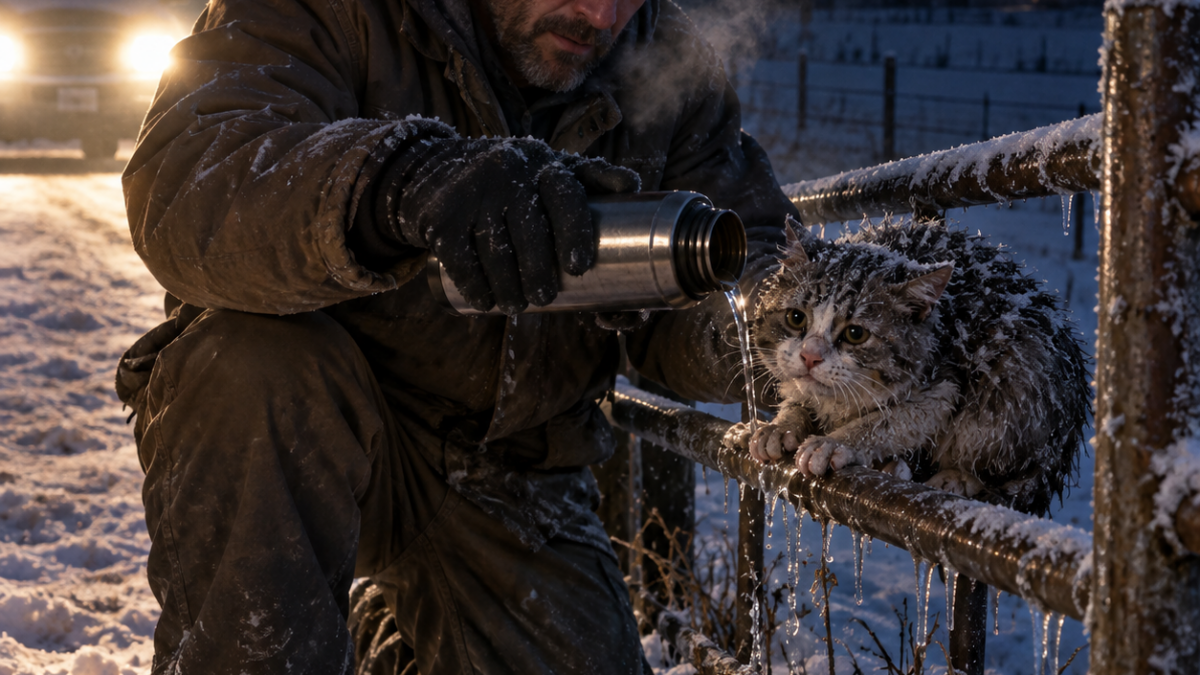
A small female, though I did not know that yet, crouched low on the upper bar of the metal gate. She was mostly gray and white, with a darker patch along one side of her face and fur fluffed out in stiff clumps from frost and fear. Her eyes were open. Wide. Glassy in the phone light. Alive.
She did not meow when I approached.
That scared me.
A trapped cat should scream, hiss, twist, fight, something. She only watched me, body flattened against the freezing steel, four paws spread awkwardly and gripping the bar.
“Hey,” I said softly. “What are you doing up there?”
My voice sounded foolish in the dark.
I reached for her carefully.
She did not run.
That scared me more.
I slid one hand beneath her chest and tried to lift.
She screamed.
It was not a normal cat sound.
It was raw, high, sharp enough to cut through the cold and go straight into the back of my skull. I let go instantly and stepped back, heart pounding.
“Okay. Okay. I’m sorry.”
The cat’s mouth stayed open for a second, but no sound came out. Her breath fogged faintly. Her eyes never left mine.
I looked down at her paws.
That was when I saw it.
Her pads were stuck to the metal.
All four.
Frozen.
The moisture from her paw pads had sealed against the steel bar in the brutal cold. Tiny rims of ice had formed around each paw where skin met metal. She was not gripping the fence because she wanted to stay.
She was trapped to it.
I felt sick.
She must have jumped up there in the night. Maybe to escape a coyote. Maybe a dog. Maybe she climbed and froze before realizing what had happened. Maybe she tried to move and pain taught her not to try again.
However it happened, she had been there for hours.
Alone.
In darkness.
At twelve degrees.
I pulled off one glove and touched the metal near her paw with one finger.
The cold bit instantly.
I jerked my hand back.
If I pulled her, I would tear her pads.
I knew that without veterinary training. Anyone who has ever had skin stick to frozen metal knows the panic of that first pull. Now imagine all four feet. Imagine being a little cat, exhausted beyond struggle, unable to understand why your own paws have become part of the thing beneath you.
I looked around.
The farmhouse beyond the driveway sat dark. No porch light. No truck in the visible yard. Maybe abandoned for the season. Maybe everyone asleep. I could run up and pound on the door. That would take time. They might not answer. I could call animal control, but at 4 a.m. in rural Minnesota, help would not arrive fast enough.
The cat blinked slowly.
Too slowly.
I needed warmth.
Not heat.
Warmth.
I ran back to the car.
My hands were shaking when I opened the door. I grabbed the thermos from the cup holder. It was still warm but not hot. I unscrewed the cap and steam rose faintly into the cold air.
Coffee.
That was what I had.
One thermos of lukewarm coffee and a cat frozen to a fence.
I ran back.
“Okay,” I told her. “I’m going to help. Don’t hate me.”
She stared.
I poured a little coffee onto the metal beside her front left paw.
Not on top of the paw at first.
Beside it.
I was terrified of burning her even though the coffee had cooled. I poured slowly, letting the liquid run along the steel where ice had formed. Brown coffee steamed faintly, then darkened the frost. I watched the thin white crust soften.
The cat trembled once.
Or maybe that was me.
I poured a little more.
The ice around the first paw loosened.
I slid my gloved finger gently beneath the edge of the paw.
She gave a small, broken cry.
“I know. I know. I’m sorry.”
The paw lifted.
One free.
I nearly sobbed.
“One down,” I whispered. “Three to go.”
The second paw took longer.
It was stuck harder, or maybe my hands were shaking worse. I had to pour twice, then stop because the cat’s body sagged and I was afraid she would twist her freed paw and injure herself more. I tucked my arm lightly against her side—not lifting, just keeping her steady—while I worked.
The second paw released with a soft, terrible peel that I felt more than heard.
She cried again.
I looked at her pads.
I could not see much in the phone light, but I saw dark wetness and raw skin.
“Hang on,” I said, though I had no right to ask that of her.
The coffee level dropped.
Fast.
My bare fingers burned with cold from holding the thermos. I put my glove back on awkwardly, sloshed coffee over my sleeve, and kept going.
Third paw.
Coffee along the metal.
Wait.
More coffee.
Gently test.
Stop when she cried.
More warmth.
The ice gave.
By then my breath came hard, and the world had narrowed to four small paws, one gate bar, one thermos, and the terrible knowledge that every second mattered.
The fourth paw was the worst.
Back right.
I think she had shifted weight onto it in panic, pressing it harder into the metal. The ice seemed thicker there. I poured the last of the coffee slowly, carefully, cursing myself for not making more that morning, for not carrying warm water, for every useless thing in the car except what I needed.
The thermos emptied.
I shook it once, desperate for a few more drops.
Nothing.
The ice around the last paw softened but did not fully release.
“No,” I whispered. “No, come on.”
I cupped my gloved hands around her paw and breathed warm air against the metal. Once. Twice. Again. My lungs burned from the cold. I rubbed the steel near the paw, not touching the pad. The cat’s eyes were half closed now.
“Stay with me.”
I do not know why I said it.
Maybe because no one else was there to say it.
I worked one finger beneath the edge.
The paw lifted.
She fell straight into my arms.
Not jumped.
Fell.
Her whole body came loose at once and dropped from the fence like something cut from a line. I caught her against my chest with one arm and nearly dropped the empty thermos with the other.
She was stiff.
That is the word.
Not just cold.
Stiff.
Her legs did not fold right. Her body felt too light inside all that fur, bones and ice and fading life. Her ears were hard at the tips. Her paws were wet, raw, and freezing. She did not struggle. She did not scratch. She did not even tuck herself against me.
That was when I became truly afraid.
Because a freezing animal that still fights has something left.
A freezing animal that goes still is closer to the edge than anyone wants to admit.
I shoved the empty thermos into my coat pocket, unzipped my parka, and slid her inside against my chest.
The shock of her body against mine made me gasp.
She was so cold it hurt.
I wrapped one arm around her through the coat and ran to the car.
Inside, I started the engine, turned the heat all the way up, and aimed every vent toward my body. The windshield fogged almost immediately. I wiped it with my sleeve, still holding the cat under my coat with my other hand.
My route bag sat beside me.
Newspapers waiting.
The rest of the houses.
The road ahead.
Seven years I had never abandoned the route.
Not for snow.
Not for flu.
Not when my car battery died and I finished half the route in a borrowed truck.
That morning, I looked at the stacks of newspapers and knew they could freeze in my back seat for all I cared.
I called dispatch with numb fingers.
Gary answered on the third ring, voice thick with sleep and irritation.
“What?”
“It’s Tom. I’m stopping the route.”
“You what?”
“I found a cat frozen to a fence. I’m taking her to emergency vet.”
Silence.
Then, “You’re kidding.”
“No.”
“Tom, we got complaints last time the north route was late.”
“Then you can tell them a cat was dying.”
“Jesus.”
“Yeah.”
He sighed hard.
“You need me to call someone?”
“I need the emergency vet address.”
“You don’t know it?”
“No.”
He gave it to me.
Forty minutes away.
I made it in thirty.
I am not proud of how I drove.
I was careful where I had to be, reckless where panic took over. Empty roads helped. Adrenaline helped. Fear helped. The cat lay under my coat against my chest, one hand holding her there while the other gripped the wheel. I could feel her through my shirt. At first, nothing. Just cold weight. Then, after ten minutes, a tiny movement.
Not good movement.
A weak shift.
I kept talking to her.
I do not remember all of what I said.
I know I told her she was doing good.
I told her she was not allowed to die after stealing my coffee.
I told her I understood being out too early in February and regretting life choices.
I told her the vet was close even when it was not.
Halfway there, she started trembling.
A small tremor at first.
Then stronger.
Her body began to shake against my chest.
I nearly cried from relief.
Most people think shivering is bad. Sometimes it is. But in that moment, I knew enough to understand what it meant.
Her body was fighting again.
She had enough life left to shake.
“Good girl,” I said, voice breaking. “That’s it. Fight.”
The emergency veterinary clinic sat beside a 24-hour gas station off the highway, lights bright against the dark. I pulled up crooked across two spaces and ran inside with the cat still under my coat.
The woman at the desk looked up.
“I found her frozen to a fence,” I said.
That sentence moved faster than paperwork.
Within seconds, a technician came through a swinging door and took her from me in a warm towel. The cat made the smallest sound then, a thin protest as she left my chest, and the sound nearly dropped me to my knees.
“She’s alive,” the tech said. “We’ve got her.”
I stood in the lobby shaking.
Without her against me, I became aware of everything at once. My wet sleeve. My numb fingers. The coffee spilled down my parka. The smell of newspaper ink still on my clothes. The fact that I had not finished work. The fact that I had no idea what this would cost.
A vet came out fifteen minutes later.
Dr. Ellen Parks. Late forties, calm face, tired eyes. The kind of person you trust because she does not waste energy pretending everything is fine.
“She is severely hypothermic,” she said. “We’re warming her gradually. She has frostbite on all four paw pads and the tips of both ears. Two pads have superficial tearing where they separated from the metal.”
I swallowed.
“Will she lose her paws?”
“I don’t think so. But there will be damage. Scarring. Pain for a while. Her ears—possibly the tips will not survive.”
I nodded like I understood.
I did not understand anything except that she was still alive.
“Was coffee okay?” I asked.
The question sounded absurd after everything, but guilt had already found me. What if I had burned her? What if I had hurt her paws worse? What if I should have done something else?
Dr. Parks looked at my coat, then at my face.
“You used warm coffee?”
“Not hot. It was just warm. I didn’t pull. I tried not to pull.”
“You likely saved her pads from far worse injury,” she said. “And her life.”
I covered my eyes with one hand.
That was when I realized my fingers were shaking too badly to hide anything.
Dr. Parks handed me a clipboard.
“Do you know who owns her?”
“No.”
“Microchip?”
“I don’t know.”
“We’ll scan her. If there’s no owner, she’ll be considered a stray. Animal control can be contacted.”
The word stray bothered me.
It sounded too casual.
As if she had simply wandered into inconvenience.
“She was on that fence for hours,” I said.
“We’ll do everything we can.”
Then came the estimate.
Three hundred eighty dollars.
Warming treatment.
Fluids.
Pain medication.
Bandaging.
Three-day stay.
Follow-up not included.
I made eleven dollars an hour delivering newspapers.
Three hundred eighty dollars was almost a month of groceries, gas, and careful breathing.
The receptionist seemed used to that look.
“We can discuss payment options.”
I thought of the bills under the mug on my kitchen table.
I thought of my route unfinished.
I thought of the cat falling into my arms, stiff and nearly gone.
“I’ll pay it,” I said.
The receptionist nodded.
I handed over my debit card before courage could change its mind.
It went through.
Barely.
That was how much my bank account knew about mercy.
Barely.
I sat in the waiting room until dawn.
Gary called twice.
I ignored him once and answered the second time.
“You alive?” he asked.
“Yes.”
“The cat?”
“Yes.”
“The phones are already lighting up.”
“Tell them papers are late.”
“I did.”
“And?”
“One guy said his coffee tasted wrong without the crossword.”
“Tell him the cat apologized.”
Gary snorted despite himself.
“You need the day off?”
“No. I need extra routes next month.”
He was quiet.
“Vet bill?”
“Yeah.”
“How much?”
“Three eighty.”
He whistled softly.
Then said, “I’ll see what I can do.”
Gary was not soft. But he was not bad.
There is a difference.
The clinic let me see her at 7:20.
She was in a warm cage on a heated pad, wrapped partly in towels. Her paws were bandaged in white vet wrap, all four of them, making her look like she wore tiny medical boots. Her ears had darkened at the tips where the frostbite had done its work. Her eyes were half closed, exhausted, but when I stepped closer, she opened them.
“Hey,” I whispered.
She blinked.
The technician smiled.
“She made it through the first critical stage.”
“What happens now?”
“We keep warming, fluids, pain management. Watch the tissue. She’s lucky.”
Lucky.
That word sat strangely beside the image of her frozen to metal in the dark.
But she was alive.
Sometimes that is what lucky means after the world has done its worst.
The clinic scanned for a microchip.
Nothing.
No collar.
No tags.
They posted found notices with local animal control and online. I checked them every day with a dread I did not name. Part of me wanted her owners found. If someone loved her, they deserved to know. But another part of me, a selfish part born in the exact moment she fell into my arms, wanted no one to come.
No one did.
During those three days, I worked extra routes.
Morning delivery.
Afternoon bundle sorting.
One evening helping load inserts into Sunday papers.
I slept in pieces.
Every day after work, I drove to the clinic.
The second day, I took the picture.
She was lying on the heated mat with her bandaged paws tucked awkwardly beneath her. Her ears looked strange, dark at the tips, and her eyes were half closed. Not dramatic. Not cute in the way people expect rescue photos to be cute. She looked tired. Worn down. Alive by effort.
I took the photo because Dr. Parks said progress can be hard to see when you are afraid.
“Take one now,” she told me. “You’ll want to remember where she started.”
I did not know then how right she was.
On the third day, Dr. Parks explained the ears.
“The tips are necrotic,” she said gently. “They’ll likely slough off over time. We’ll monitor for infection.”
“That means fall off?”
“Yes.”
I winced.
“She won’t care nearly as much as you do.”
That was true.
The cat cared about warmth, food, pain medication, and the fact that by day three, when I opened the cage door under supervision, she pressed her forehead weakly against my hand.
The clinic staff had started calling her Fence Cat.
I hated that.
Not because it was cruel.
Because she deserved a name that did not end at what happened to her.
On the discharge form, the receptionist asked, “Will you be fostering?”
I looked at the cat in the carrier.
She looked back through the little metal door with tired suspicion.
“I’m adopting her.”
The receptionist smiled.
“Name?”
I had thought about it for two days.
I considered Lucky, but she had been through too much for a name that sounded like denial.
I considered Coffee, but that felt like naming a survivor after the tool instead of the will.
I considered Grace, because my mother would have liked that.
But when I looked at her ears, her bandaged paws, the month on the calendar, and the season that had almost taken her, only one name felt true.
“February,” I said.
The receptionist looked up.
“February?”
“Yeah.”
She typed it in.
“Strong name.”
“It tried to kill her,” I said. “She gets to own it now.”
Bringing February home changed everything in my apartment.
I had never owned a cat.
Not properly.
My mother had a cat when I was a kid, a mean orange tom named Biscuit who hated everyone except her and once attacked a Christmas wreath. But I had not lived with one as an adult, and certainly not a recovering frostbite patient with bandaged paws and opinions.
Dr. Parks gave me instructions.
Keep her warm.
Limit jumping.
Change bandages as directed.
Pain medication twice daily.
Watch for swelling, discharge, odor, refusal to eat.
No outdoor access.
Follow-up in five days.
I nodded seriously, then immediately went to a discount store and spent money I did not have on a litter box, litter, cheap dishes, a soft blanket, canned food, dry food, and a toy mouse she would ignore for three weeks before suddenly deciding it was her mortal enemy.
February spent the first evening under my bed.
I lay on the floor beside it, my face pressed to the dusty carpet, speaking softly into the darkness.
“You don’t have to come out.”
A pause.
“This place is warm.”
Another pause.
“I’m sorry about the carpet. It came with the apartment.”
Her eyes reflected green beneath the bed frame.
I slid a little dish of food close enough for her to reach without exposing herself. Later, when I pretended not to watch from the couch, one bandaged paw appeared. Then another. She ate half the food and retreated.
Good enough.
That became our rhythm.
Good enough.
Recovery was not beautiful at first.
It was medication hidden in food she learned to distrust after the second dose. It was bandage changes that left both of us sweating and unhappy. It was me apologizing while wrapping tiny paws badly and then driving back to the clinic because I had done it wrong. It was litter tracking across the bathroom. It was waking at 2 a.m. because she cried once in her sleep and I panicked. It was realizing my apartment was full of things a cat could jump on and then remembering she was not supposed to jump.
She healed slowly.
The frostbitten tips of her ears darkened, dried, and eventually fell away in tiny heartbreaking pieces, leaving her ears permanently shortened and uneven. Dr. Parks had warned me, but the first time I found a little dark piece on the blanket, I sat down hard and cried.
February watched me from the radiator.
Unimpressed.
Her paw pads healed with thick scar tissue. Pink in places. Gray in others. Tough, uneven, slightly raised. When she began walking on the hardwood near the kitchen, her paws made a faint clicking sound, not nails exactly, but the thickened pads touching the floor in a way normal cat feet do not.
Click.
Click.
Click.
At first, the sound broke my heart.
Then it became the sound of her coming toward me.
That changed it.
The first time she climbed into my lap happened three weeks after I brought her home.
I had fallen asleep in the chair before work, boots on, coat half zipped, alarm set for 3:12. The apartment was dark except for the stove clock. I woke to weight on my thighs.
February stood there, scarred paws planted carefully, looking down at me like she had discovered a new piece of furniture and found it acceptable.
I did not move.
She circled once.
Twice.
Then lowered herself slowly onto my lap.
The sound I made was embarrassingly close to a sob.
She stayed for four minutes.
Then bit my sleeve and left.
I called that progress.
By April, she had become part of my morning routine.
At 3:12, the alarm screamed.
At 3:13, February glared from the foot of the bed.
At 3:18, while coffee brewed, she sat on the kitchen chair and watched me pack newspapers into my route bag. At 3:25, I poured coffee into the thermos. At 3:26, she jumped onto my lap while I sat for five minutes at the tiny kitchen table, drinking from the mug that had once held unpaid bills in place.
The first time she did that, I froze.
Same hour.
Same coffee smell.
Same dark outside the window.
But this time, she was warm.
Her body fit against me with the stubborn heaviness of a cat who had decided I was not leaving without her blessing. I rested one hand lightly on her back.
“I have to go to work,” I told her.
She closed her eyes.
Every morning after, she did the same.
She sat on my lap while I drank coffee before the route.
At 3:30, the hour the world had nearly lost her, she made sure I began the day with something alive and warm.
I no longer passed shadows without slowing.
That was the biggest change.
Before February, the route had become automatic. Muscle memory. Mailbox, driveway, porch, turn, throw, brake, accelerate, next road. After February, every shape mattered.
A black trash bag caught in a ditch.
A fallen branch.
A clump of snow.
A bundle of hay twine.
A raccoon carcass.
A real raccoon pretending not to be real.
Every shadow.
Every lump.
Every small silhouette.
I slowed.
I looked.
Sometimes I stopped.
Most times, it was nothing.
Nothing alive, anyway.
But I could no longer trust distance.
Because one of those shapes had been breathing.
One of those shadows had eyes open in the cold.
One of those almost-dead things had become February, sitting on my lap before dawn, scarred ears twitching while I drank the coffee that had saved her life.
The story spread locally after Gary heard enough of it to tell everyone badly.
“Tom abandoned the route to pour coffee on a frozen cat,” he said.
That version lacked dignity, but it was accurate enough.
The Ledger ran a small feature after Dr. Parks asked if she could share February’s recovery as a warning about pets in extreme cold. A reporter named Alicia came to my apartment and took notes while February hid under the couch like a witness in protection.
“Why did you stop?” Alicia asked.
I shrugged.
“Shape looked wrong.”
“That’s it?”
“That’s it.”
“But you were behind on your route.”
“Yes.”
“You had never stopped before?”
“Not like that.”
“And you paid the vet bill yourself?”
I shifted uncomfortably.
“Yes.”
“Why?”
I looked toward the couch, where February’s scarred paw had appeared just enough to show she was listening while pretending not to.
“Because she had nobody else standing there.”
That quote ended up in the article.
For two weeks, people recognized me.
At the gas station, a woman bought my coffee and said, “For the cat hero.”
I hated that.
At the grocery store, a man told me I was foolish to spend that much on a stray when shelters put animals down every day.
I hated that more.
A child drew February a picture with four white bandaged paws and a cape. I put it on the fridge.
That I liked.
Money came too, unexpectedly.
Not a fortune.
But a few envelopes at the Ledger office. A gift card for pet food. Someone paid fifty dollars toward her follow-up care directly at the clinic. An older couple sent a note with twenty dollars folded inside, saying they had lost their barn cat to cold years earlier and wished someone had stopped then.
I used every dollar for February.
Follow-ups.
Better food.
A heated pet bed I swore was unnecessary until she climbed onto it and refused to leave for six hours.
Extra pain medicine when the scar tissue tightened during cold snaps.
One morning, Gary handed me an envelope with my route paperwork.
“What’s this?”
“Bonus.”
“The Ledger gives bonuses?”
“No. Drivers chipped in.”
I stared.
“You guys barely make anything.”
“Yeah, well, apparently some of us are sentimental idiots.”
Inside was eighty-six dollars.
I looked away fast.
Gary cleared his throat.
“Don’t make it weird.”
“You made it weird.”
“Go deliver papers.”
So I did.
Summer came.
February hated open windows at first.
The sounds frightened her. Birds, cars, children, wind in leaves. But slowly, she learned the window screen kept the world outside and warmth inside. She sat on the sill with her shortened ears tilted forward, watching sparrows with the grave intensity of a creature who had survived nature and still found parts of it offensive.
Her fur grew soft again.
The stiff clumps disappeared. She gained weight. Her eyes cleared. Her tail, once tucked or still, began speaking in flicks and curves. She developed habits.
She sat on newspapers.
Always the one I was reading.
She stole twist ties.
She refused expensive treats but loved plain scrambled egg.
She slept on my laundry, clean or dirty, with no moral distinction.
She learned that the sound of the thermos cap meant I was leaving.
At first, that sound made her anxious. She would follow me to the door, clicking softly on the kitchen floor, and stare as I left. I started telling her the same thing every morning.
“I’ll be back before breakfast.”
I do not know when she began believing me.
Maybe animals do not believe words.
Maybe they believe repetition.
The door opens.
The man leaves.
The man returns.
Food appears.
Hands are gentle.
The world holds.
By the next February, she trusted the morning.
I did not.
Anniversaries can sneak up on a person.
Not only human anniversaries. Not only birthdays and deaths and weddings. Sometimes the body remembers a date before the mind names it. The first week of February, I felt restless. I checked the weather too often. I drove the route slower. I kept two thermoses in the car: one coffee, one warm water. I bought a small rescue kit with towels, hand warmers, and a carrier.
On the morning it had been exactly one year, the temperature dropped to ten degrees.
I sat at the kitchen table at 3:24 with coffee in my mug and February in my lap.
She was warm, heavy, and very annoyed that I had not yet given her a piece of egg.
I ran one finger along the shortened edge of her ear.
“Do you remember?”
She flicked the ear away.
Fair enough.
I remembered enough for both of us.
I remembered the headlights.
The gate.
The scream.
The coffee steaming on frozen metal.
The moment the last paw came loose.
The terrible weight of her body under my coat.
The first tremble halfway to the clinic.
I looked down at her scarred paws tucked beneath her chest.
“You lived,” I whispered.
She opened one eye.
Then closed it again.
That was February’s opinion on sentiment.
I went to work.
At 4:02, I reached the fence.
The metal gate still stood along the farm road. In daylight, months earlier, I had seen that the farm was not abandoned, just used seasonally. I never found out whether February belonged there, wandered there, or had been chased there. No one claimed her. No missing cat poster appeared. No farmer came asking.
The gate was frosted silver in my headlights.
I stopped.
Not because anything was there.
Because something had been.
I parked on the shoulder and got out with the thermos of warm water in one hand.
The cold bit my face.
I walked to the gate and touched the top bar with one gloved hand.
Metal holds memory poorly.
It looked like any other gate.
No mark.
No sign.
No evidence that a life had nearly ended there except the fact that mine had changed after it.
I stood for a minute.
Then I poured a little warm water over the bar.
Not because the gate needed saving.
Because I did.
Steam rose faintly.
I got back in the car and finished the route.
When I came home, February met me at the door.
Not immediately, of course.
She was a cat, not a dog.
She arrived after I had taken off one boot, as if she had been passing by accidentally and not waiting.
Click.
Click.
Click.
She looked up at me.
I crouched and held out my hand.
She sniffed it, smelled outside and newsprint and coffee, then pressed her forehead into my knuckles.
That was her whole sermon.
You came back.
I started volunteering twice a month with Dr. Parks’s clinic after that.
Nothing heroic. Cleaning carriers. Folding towels. Driving supplies to foster homes when my car cooperated. Sharing February’s story when the clinic posted winter safety warnings. I learned more about animals than I expected and more about people than I wanted.
People abandoned pets in all kinds of weather.
People also drove hours to help animals they had never met.
People lied.
People sacrificed.
People cried over vet bills.
People paid for strangers.
People were worse and better than I had believed.
One December, a woman brought in a half-frozen puppy found under a porch. She kept apologizing because she could not afford treatment. I remembered standing at that same counter, debit card in hand, fear like a stone in my gut.
I paid fifty dollars toward her bill.
Not enough.
Something.
She cried.
I told her not to make it weird.
Then I understood Gary a little better.
February never became an easy cat, exactly.
She loved me, but on her terms. She tolerated exactly three visitors: Dr. Parks, because February associated her with warmth despite the thermometer; Alicia the reporter, because Alicia brought treats; and Gary, because he pretended not to care and animals admire honesty.
She bit Manny from the print room once when he tried to pet her without permission.
He called her “that tiny frost goblin” and respected her forever after.
She did not like being picked up. I think the memory of being trapped remained somewhere in her body. Restraint made her tense. I learned to invite instead of grab. Pat the chair. Wait. Offer a blanket. Let her choose.
That lesson bled into the rest of my life.
I became slower to assume what people needed.
Quicker to stop.
More willing to be late for the right reason.
One morning in late March, I saw a man asleep behind the laundromat dumpster while walking back from the gas station. My old self might have noticed, worried, and kept walking because what could I do? My February self went inside, bought coffee and a breakfast sandwich, and asked if he needed help. He did not want a shelter. He did want the sandwich.
Another time, I saw a kid sitting on a curb at 5 a.m. crying into his hoodie. I stopped. He had missed the early bus to a warehouse job. I drove him. He tried to pay me two dollars. I told him to keep it.
You cannot save everyone.
I know that.
But not being able to save everyone is a terrible excuse for saving no one.
I learned that from a cat frozen to a fence.
Three years have passed now.
February is on my lap as I write this.
That is not a poetic ending. It is simply true.
She is heavier than she was, softer, still scarred. Her ears are permanently shortened where the frostbite took the tips. Her paw pads are thick with scar tissue, and when she crosses the kitchen floor, that faint clicking sound still follows her.
Click.
Click.
Click.
Proof in every step.
At 3:30 every morning, she sits on my lap while I drink coffee before leaving for the route. Same thermos, though I bought a newer backup. Same hour. Same ritual. Sometimes she presses her face against the zipper of my coat, and I remember how she felt beneath it that first morning, stiff and almost gone.
The original thermos sits on my kitchen shelf now.
I retired it after the rescue kit became part of my car. It is dented, scratched, and stained faintly inside no matter how many times I wash it. Most people would throw it out.
I cannot.
One thermos.
Four paws.
Five minutes at a frozen gate.
Thirty minutes to the emergency vet with a cat under my coat.
Three hundred eighty dollars I did not have.
A month of extra routes.
Two shortened ears.
Four scarred paws.
One small life still warm enough to complain when breakfast is late.
People sometimes tell me I saved February.
I understand why.
I poured the coffee. I drove the car. I paid the bill. I opened my coat and carried her to warmth.
But the truth is not that simple.
February saved something in me too.
Before her, I had become good at passing through the world efficiently. Head down. Route finished. Bills paid if possible. Sleep when able. Keep moving. Do not look too closely at shapes in the dark because stopping costs time, and time costs money, and money is always short.
She taught me that some shadows are alive.
Some delays are sacred.
Some small bodies are waiting for someone to notice the one detail that does not fit.
A shape on a fence.
Eyes in the headlights.
A silence that should have been a cry.
I never pass one now without checking.
Every shadow.
Every pile.
Every little form near the road.
I slow down.
I look.
Most of the time, it is nothing.
A bag.
A branch.
A drift of snow.
A dead thing I cannot help.
But sometimes nothing is not nothing.
Sometimes what looks like another frozen shape in the dark is a living creature holding on with everything it has left.
And sometimes all you have to offer is one dented thermos of coffee.
Offer it anyway.








