I Found a Cat Dragging Herself Across a Walmart Parking Lot—She Was Crawling Toward the Light
PART3:
Something low to the ground, shifting in the wind.
Then it moved again.
Slowly.
Wrongly.
Not rolling.
Not blowing.
Dragging.
I stopped with one hand on the carts.
The thing was maybe forty feet from the entrance drive, halfway between the road and the bright front doors.
The lights above the store cast long white rectangles across the pavement, and just outside those rectangles, in the darker strip between two parked cars, something small was pulling itself forward.
I squinted.
My first thought was possum.
Then raccoon.
Then I saw the ears.
Cat.
I let go of the carts and walked toward her.
“Hey,” I called softly, though I do not know why.
“Hey, little thing.”
She did not run.
She could not.
The closer I got, the worse the shape of her movement became.
Her front paws reached forward, claws scraping against asphalt.
Then her shoulders pulled.
Her chest moved.
Her body slid.
Her back legs trailed behind her like they did not belong to her anymore.
I stopped breathing.
“Oh my God.”
She was a small brown tabby, maybe six or seven pounds, soaked in places from the wet pavement, with white around her chin and dark stripes across her forehead.
Her eyes were wide, but not wild.
Her mouth was open slightly.
She was panting.
Cats are not supposed to pant like dogs.
Even I knew that.
Her back legs lay limp behind her.
Not tucked.
Not injured in a way she was protecting them.
Limp.
Completely useless.
She pulled herself another inch.
Then another.
Toward the entrance.
Toward the automatic doors.
Toward the only bright place in the parking lot.
I looked behind her and saw a small dark smear on the asphalt about forty feet back near the entrance drive.
Blood.
That was where she had been hit.
I understood it all at once, and still somehow could not accept it.
A car had struck her.
Someone had hit her and kept driving.
And this tiny creature, with both back legs broken, had spent who knew how long dragging herself away from the road and toward the store lights because maybe, in whatever way animals understand the world, she thought humans meant help.
She had crawled forty feet.
Forty feet with only her front legs.
Forty feet over wet asphalt.
Forty feet while her belly scraped the ground.
Forty feet while her claws tore down to blood.
I crouched a few feet away.
She stopped.
Her head lifted.
For a second, she looked directly at me.
I have never forgotten that look.
It was not trust exactly.
Trust would have been too much to ask from an animal lying broken in a parking lot.
It was more like a question.
Are you the light, or do I keep going?
I took off my reflective vest first because it was bright and crinkly and I did not want to scare her.
Then I pulled off my hoodie, moving slowly.
“It’s okay,” I whispered.
“I’ve got you. I’ve got you.”
I did not know if I had her.
I was nineteen.
I made twelve dollars and fifty cents an hour.
I had never rescued anything larger than a beetle from my mom’s bathtub.
I did not know where the nearest emergency vet was.
I did not know how much something like this would cost.
I did not know if moving her would hurt her worse.
But I knew she could not stay on the asphalt.
I slid the hoodie gently beside her.
She did not hiss.
Did not scratch.
Did not try to bite.
When my hands touched her sides, she trembled so hard I felt it through the fabric.
Her back legs dangled terribly when I lifted her, and a sound came out of me I am still embarrassed by.
Not a word.
Not a sob.
Just a broken noise from somewhere behind my ribs.
She looked up at me.
Then she laid her head against my forearm.
And stopped trying to crawl.
That was the moment I understood what she had been doing.
She had not stopped because the pain stopped.
She had stopped because someone was finally carrying her.
I wrapped her in my hoodie as carefully as I could and held her against my chest. She was lighter than I expected and warmer than I feared. Her heart beat fast beneath my fingers. Her breathing came in short little bursts.
I walked fast toward the store.
Not running.
I was afraid every step would jolt her.
The automatic doors opened with their usual tired whoosh, and the bright interior swallowed us.
Janelle, the cashier at the front register, looked up first.
“Tyler, what—”
Then she saw the bundle in my arms.
Her face changed.
“Oh no.”
“I found her in the lot,” I said. “She’s hurt bad.”
My manager, Ron, came around from customer service with a clipboard in his hand and the expression of a man already preparing to say no.
“An animal can’t be in the store,” he said.
I looked at him.
I do not remember deciding to be brave.
I only remember being too angry and scared to be polite.
“Then fire me.”
The words came out flat.
The whole front end went silent.
Ron stared at me.
I stared back.
The cat panted against my arm.
Janelle said, “Ron.”
That one word carried enough warning to make him look down.
He saw the blood on my sleeve then.
His face went pale.
“I didn’t mean—”
“I’m taking her to an emergency vet,” I said. “I need to clock out.”
Ron swallowed.
“Clock out. Go.”
Janelle was already pulling paper towels from under the register.
“Wait,” she said. “Put her in something. A box. We have boxes.”
“No box,” Ron said quickly. “Use my jacket.”
He disappeared into the office and came back with a black fleece jacket I had seen him wear during smoke breaks.
He spread it across the bottom of a shopping basket.
We lowered the cat into it, hoodie and all.
She barely moved.
That scared me more than if she had fought.
“Where’s the emergency vet?” I asked.
“Ridgeway Animal Emergency,” Janelle said. “Open all night. It’s off Glenstone. I took my dog there last Christmas when he ate tinsel.”
She wrote the address on the back of a receipt with shaking hands.
Ron looked at the cat, then at me.
“You need gas?”
“I’m okay.”
I was not okay.
My tank was under a quarter.
My checking account had seventy-eight dollars.
My hands were shaking so badly I could barely hold the basket.
Janelle shoved something into my hoodie pocket.
“I’m not asking,” she said.
Later, I would find two twenties folded inside.
At the time, all I could do was nod.
I carried the cat to my car and placed her on the passenger seat in the basket. Rain had started again, soft and cold against the windshield. I turned the heat on low because I did not know if warmth helped shock, only that cold seemed cruel.
Before pulling out, I looked at her.
She looked back.
Her eyes were half-open now.
“Stay with me,” I said. “Okay? Please. I don’t know what I’m doing, but I’m trying.”
She blinked slowly.
I drove like every red light had been placed there by someone personally committed to making me lose my mind.
The emergency vet was twenty-two minutes away.
It felt like two hours.
Every time the cat’s breathing changed, I looked over. Every time I looked over, I swerved slightly and yelled at myself to watch the road. I kept talking because silence felt dangerous.
“You need a name,” I said.
She panted.
“I mean, maybe you already have one. But I don’t know it. So temporarily, I’m going to call you—”
I glanced at the dashboard.
The trip meter showed 39.8 miles since I last reset it.
No.
That did not fit.
Then I thought of the distance she had crawled.
Forty feet.
“Forty,” I said.
Her ear twitched.
“Okay. Forty. That’s you for now. You crawled forty feet, which is honestly insane. I complain when I have to bring carts in from garden center.”
Her eyes closed.
“Don’t sleep too hard,” I said quickly. “Or sleep if that helps. I don’t know. I’m sorry. I’m not a vet. I’m barely a responsible adult.”
The emergency clinic lights were painfully bright when I pulled in.
I carried her inside in the basket.
A woman behind the desk stood before I reached the counter.
“What happened?”
“Hit by a car,” I said. “Walmart parking lot. She dragged herself across the pavement. Her back legs aren’t working. She’s panting. There’s blood. I don’t know if she’s owned by anyone. I just found her.”
The receptionist pressed a button.
“Tech to front. Critical cat.”
Critical.
The word made my stomach twist.
Two vet techs rushed out. One took the basket from me while the other asked questions I could barely answer.
“How long ago was she hit?”
“I don’t know.”
“Any vomiting?”
“I don’t know.”
“Did she lose consciousness?”
“I don’t know.”
“Can you authorize emergency stabilization?”
“Yes.”
“Are you the owner?”
I froze.
“I found her.”
“We need someone responsible for decisions while we check for a microchip and assess her.”
Responsible.
That word felt enormous.
“I’ll be responsible,” I said.
They took her through swinging doors.
My hoodie went with her.
The lobby became quiet.
Too quiet.
A fish tank bubbled in the corner. A woman with a terrier on her lap watched me with sad eyes. The receptionist handed me a clipboard. I filled out my name, address, phone number, employment, and wrote “Forty” under pet name because leaving it blank felt wrong.
Then I sat in a plastic chair with blood on my work shirt and asphalt dust on my knees.
I called my mom.
She answered on the fourth ring, voice thick with sleep.
“Tyler? Are you okay?”
“I found a cat.”
There was a pause.
“At midnight?”
“She got hit by a car. Her back legs are broken, I think. I brought her to Ridgeway.”
“Oh, honey.”
That was all she said at first.
Not what will it cost.
Not why did you get involved.
Not you can’t save everything.
Just oh, honey, in the voice she had used when I was little and came home with scraped knees.
“I don’t know what to do,” I admitted.
“You already did the first thing.”
“I don’t have money for this.”
“We’ll figure out what we can.”
“I named her Forty.”
“Of course you did.”
“She crawled forty feet, Mom.”
My voice broke.
“She crawled forty feet to the store.”
Mom was quiet for a moment.
Then she said, “Then she wanted to live.”
I put my hand over my eyes.
“Yeah.”
“So we’ll help her try.”
The veterinarian came out twenty minutes later.
Her name was Dr. Elena Morris. She looked tired in the way emergency vets always look tired, like she had not had a full night’s sleep since veterinary school and had made peace with that. Her scrubs had paw prints on them, and her voice was calm but serious.
“Are you Tyler?”
I stood too fast.
“Yes.”
“She’s alive. She’s stable for the moment. We gave pain medication and fluids. She is not microchipped.”
“Okay.”
“She has severe trauma to both hind limbs. We’ve taken preliminary X-rays. Both rear legs are fractured. Her pelvis has a crack, but it may heal with strict rest if everything else stabilizes. She has friction burns along her abdomen and the tops of her hind legs from dragging herself, and several front claws are worn down and bleeding.”
I gripped the back of the chair.
“She was using her front paws.”
Dr. Morris nodded.
“For a while. Based on the abrasions, maybe twenty to thirty minutes.”
The room tilted slightly.
Twenty to thirty minutes.
Dragging herself across a parking lot.
Toward the light.
“Can she live?” I asked.
Dr. Morris did not answer too quickly.
That scared me.
“She has a chance,” she said. “A real one. But she needs surgery to stabilize the hind leg fractures. Pins, possibly external support depending on what the orthopedic surgeon sees. Pain management, wound care, strict cage rest for around eight weeks. It will be expensive.”
“How expensive?”
She glanced at the estimate in her hand.
“Approximately twenty-two hundred dollars for surgery and initial hospitalization. That does not include all follow-up care.”
Twenty-two hundred dollars.
At nineteen, twenty-two hundred might as well have been a planet.
I made twelve dollars and fifty cents an hour before taxes. My car insurance was due. I owed my mom grocery money. I had seventy-eight dollars in checking and whatever Janelle had stuffed in my pocket.
I looked through the small window in the swinging doors, though I could not see Forty from where I stood.
“What happens if she doesn’t get surgery?”
Dr. Morris’s face softened.
“She would likely be in significant pain and would not regain function. With injuries this severe, without treatment, humane euthanasia would be a reasonable consideration.”
Humane.
I hated that word right then.
Not because it was wrong.
Because it was kind and terrible at the same time.
I thought about Forty crawling.
Not away from people.
Toward them.
Toward automatic doors and fluorescent light and the possibility that someone might see her before it was too late.
“She crossed the whole lot,” I said.
Dr. Morris waited.
“She didn’t give up.”
“No,” she said quietly. “It doesn’t sound like she did.”
“I can’t pay twenty-two hundred tonight.”
“We require a deposit to proceed with surgery, but we can stabilize her overnight while you explore options. There are local rescues we can contact in the morning. Sometimes we can arrange partial assistance.”
“I’ll pay what I have.”
I pulled out my wallet.
Seventy-eight dollars on a debit card.
Twenty-three in cash.
The two twenties from Janelle.
One hundred forty-one dollars total.
It felt insulting to offer it.
Dr. Morris did not make me feel that way.
“We’ll start there,” she said. “And I’ll make some calls.”
I signed the estimate with a hand that shook.
Before I left, they let me see her.
Forty lay in a warmed kennel on a towel, an IV catheter in one front leg, bandages around her paws. She looked impossibly small beneath the medical light. Her back legs were positioned carefully. Her belly had been shaved in places where the burns needed cleaning.
But when I stepped close, her eyes opened.
“Hey,” I whispered.
Her tail did not move.
Her body barely did.
But she looked at me.
I placed one finger near the kennel door.
She turned her head and pressed her cheek weakly against the bars.
That was when I knew I was not going to sleep.
I drove home at 2:13 a.m. with no hoodie, no money, and the feeling that the rest of my life had just handed me a responsibility too fragile to set down.
Mom was waiting in the kitchen.
She had not gone back to bed.
She wore an old robe, her hair pulled into a messy knot, glasses low on her nose. There was tea on the table.
I sat down and told her everything.
The parking lot.
The blood.
The crawling.
Ron’s jacket.
The estimate.
The surgery.
The word euthanasia.
Mom listened without interrupting.
Then she said, “We’ll call the clinic in the morning and ask what rescue they recommend.”
“I want to adopt her.”
The words came out before I planned them.
Mom looked at me.
“Tyler.”
“I know.”
“Your room is a disaster.”
“I’ll clean it.”
“You work nights.”
“I’ll work around it.”
“She may need medication. Follow-ups. Help walking.”
“I know.”
“You are nineteen.”
“I know that too.”
She held my gaze for a long time.
My mom had raised me mostly alone after my dad left when I was eleven. She was practical because life had forced her to be. She loved animals, but she also knew rent, utilities, insurance, and the cost of wanting more than you could carry.
I expected her to say no.
Instead, she sighed.
“What color is she?”
I blinked.
“Brown tabby. White chin. Tiny. Mad-looking, probably, when not critically injured.”
Mom’s mouth moved.
“You already love her.”
I looked down.
“She crawled toward us.”
“That wasn’t my question.”
I swallowed.
“Yes.”
Mom nodded slowly.
“Then when she can leave the vet, she can come here.”
I stared.
“You didn’t even let me finish asking.”
“I heard the question before you did.”
That was my mother.
Practical enough to scare me.
Soft enough to save me.
The next morning, I went back to Walmart after sleeping maybe two hours.
I expected trouble.
Maybe a write-up for bringing an animal inside.
Maybe Ron telling me corporate policy did not care about broken cats.
Instead, when I walked into the break room, Janelle stood up.
“How is she?”
I had not even clocked in.
“She made it through the night.”
The room erupted in questions.
“What’s her name?”
“How bad is it?”
“Does she need surgery?”
“How much?”
I told them.
Twenty-two hundred dollars.
The number landed heavily.
Most people working retail do not have extra money lying around. They have bills stacked behind their smiles, kids who need shoes, cars making weird noises, rent increases, medical debt, parents to help, gas tanks to fill. I knew that. I did not expect anyone to fix this.
But Janelle walked to her locker, pulled out an envelope, and wrote FORTY in black marker across the front.
“I’ve got another twenty on Friday,” she said. “But for now, cash goes here.”
Ron came in halfway through this and stood awkwardly by the door.
I braced myself.
He cleared his throat.
“Donation jar can’t go at registers without approval.”
The room deflated.
Then he added, “But nothing says employees can’t contribute in the break room.”
He placed fifty dollars in the envelope.
“I called the store manager,” he said. “We’re not making it a public Walmart thing. But I told him what happened. He said he’ll match up to three hundred personally if we can find a rescue to handle the medical account.”
Janelle stared at him.
“You old softie.”
Ron pointed at her.
“Say that again and I’ll deny it.”
By lunch, someone had printed a picture from my phone of Forty in the recovery kennel. Not the worst picture. A gentle one. Her front paws bandaged. Her eyes open. Under it, Janelle wrote:
She crawled 40 feet toward our lights. Help us get her the rest of the way.
I had to leave the room when I saw it.
People gave what they could.
A cashier gave five dollars in quarters from her car.
The overnight stock lead gave a hundred and refused to let anyone thank him.
Two cart associates covered part of my shift so I could visit the clinic.
Ron’s assistant manager, who had originally said, “You can’t bring that cat in here,” put fifty dollars in the envelope and cried while pretending her allergies were acting up.
By the end of the first day, we had six hundred and eighty dollars.
By the end of the second, fourteen hundred.
A local rescue called Bright Paw Coalition agreed to cover the rest and put the donations directly toward her surgery. Dr. Morris called me personally.
“We can operate this afternoon,” she said.
I sat down on an upside-down bucket in the stockroom because my knees stopped working.
“She has a real chance?” I asked.
“Yes,” she said. “Still a long road, but yes.”
The surgery lasted three hours.
I spent most of that time in the Walmart parking lot, standing near the place where I found her. In daylight, it looked ordinary. That bothered me. Cars rolled over the same asphalt. Customers walked in and out. Carts rattled. A man complained loudly into his phone about a return policy.
The blood had been washed away by rain.
No sign remained of what she had done.
I paced the forty feet from the smear near the entrance drive to the spot where I picked her up.
Then I did it again.
Forty feet is not far for a person.
It is a few seconds of walking.
A short toss.
A distance most people cross without noticing.
For a cat with two broken back legs, burns on her belly, and claws tearing against asphalt, it was a marathon made of pain.
I stood at the starting point and looked toward the store.
The automatic doors glowed in the distance.
I imagined being that low to the ground, seeing only darkness, tire shadows, painted lines, and light ahead.
I wondered how she had known which way to go.
Maybe she did not.
Maybe she simply moved toward brightness because darkness had already hurt her.
That thought has stayed with me ever since.
When Dr. Morris called, I answered so fast I nearly dropped the phone.
“She made it through surgery,” she said.
I bent forward with one hand on my knee.
“Okay.”
“We stabilized both rear legs with pins. The pelvis fracture should heal with strict rest. The friction burns will need wound care. Her front claws are damaged but should regrow. She’s still critical for the next twenty-four hours, but she did very well.”
I cried in the parking lot.
Not loud.
Just suddenly and helplessly, wearing my reflective vest while a man returned a cart ten feet away and pretended not to notice.
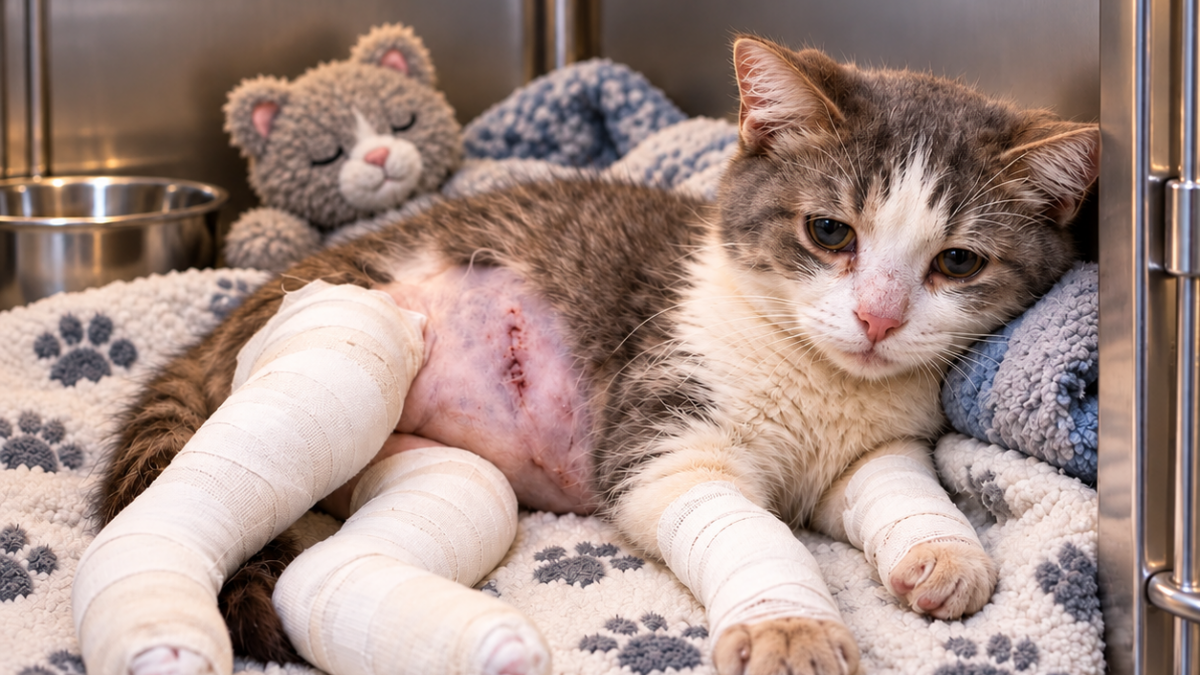
The photo taken the next day became the one everyone remembered.
Forty lay in a recovery cage with both back legs immobilized in white casts, her front paws bandaged, her belly shaved where the burns showed red and raw against pale skin. She looked directly at the camera.
Small.
Broken.
Alive.
Janelle taped the photo above the envelope in the break room.
Under it, she wrote:
Still heading toward the light.
After that, Forty became store news.
People who barely knew me asked for updates.
“How’s parking lot cat?”
“Did she eat?”
“Can she move her tail?”
“Any word from the vet?”
Ron pretended not to care and asked more than anyone.
The overnight crew sent a card signed in marker. Someone drew a cat pushing a shopping cart with flames behind it. Forty would have hated it, probably. I loved it.
I visited her during breaks when I could.
The clinic was eight minutes from the store if I hit green lights and twelve if I did not. I learned which vending machine had decent coffee, which tech worked overnights, and how to wash my hands before touching her in a way that satisfied everyone.
At first, visits were mostly me sitting beside the kennel while she slept.
She was on pain medication. Tired. Confused. Her body had been through more than I could understand. When she opened her eyes and saw me, I would whisper, “Hey, Forty. It’s cart boy.”
Once, Dr. Morris overheard me.
“Cart boy?”
“She knows me professionally.”
Dr. Morris smiled.
“I’m sure she finds your credentials impressive.”
The first time Forty ate from my hand, I felt like I had won something sacred.
It was a tiny bit of wet food on the end of a spoon. She sniffed it, looked at me with deep suspicion, then licked once.
I froze.
She licked again.
The vet tech beside me whispered, “Don’t react too much. She’ll judge you.”
“Too late,” I whispered back. “I’m being judged.”
Forty ate four bites.
I drove back to work floating.
The eight weeks of strict rest were harder than I expected, and she was not even home with me for the first part.
Strict rest sounds simple until you meet an animal whose body is broken but whose opinion of confinement is extremely clear. Once she stabilized and the pain decreased, Forty became offended by everything. The cone. The bandages. The casts. The medication. The schedule. The indignity of being helped.
“She has spirit,” Dr. Morris said one afternoon as Forty glared at all of us from inside her recovery cage.
“She looks like she wants to speak to management.”
“She probably does.”
“I can get Ron.”
“Wouldn’t help.”
After two weeks, she was cleared to come home under strict instructions.
No jumping.
No running.
No stairs.
Cage rest.
Medication on schedule.
Wound cleaning.
Follow-up X-rays.
Monitor appetite, litter box, pain, swelling, cast condition.
My mom and I turned my bedroom into what she called “the feline rehabilitation ward,” which made it sound more professional than a giant dog crate borrowed from Janelle’s cousin, blankets from our linen closet, a low litter tray, and a spreadsheet Mom made because she did not trust nineteen-year-old boys with medication timing.
“Mom, I can set alarms.”
“You can lose your phone in your own bed.”
“That happened once.”
“Twice.”
Forty came home on a Thursday.
I carried her inside like she was made of glass and lightning.
Mom opened the crate door, and I placed the carrier in front of it. Forty looked out at the room, then at me, then at the crate, and made a raspy little meow that clearly meant absolutely not.
“I know,” I said. “I’m sorry. Doctor’s orders.”
She blinked slowly, which I chose to interpret as forgiveness even though it was probably contempt.
The first night, I slept on the floor beside her crate.
Not because I had to.
Because she cried once when I turned off the light.
It was a small sound.
Nothing like the silence of the parking lot.
Still, I turned the lamp back on, grabbed a pillow, and lay beside her.
“I know,” I whispered. “You were trying to get inside. Now you’re stuck inside a smaller inside. Poor planning all around.”
She watched me.
“You’re safe, though.”
Her eyes stayed open.
“I promise.”
Around three in the morning, I woke to find her front paw pressed against the crate bars, reaching toward me.
I placed two fingers against it.
We stayed like that until I fell asleep again.
Recovery was not cute most days.
That is something rescue stories skip because pain makes people uncomfortable.
Forty needed medicine that tasted terrible and made her drool dramatically. Her wounds had to be cleaned. Her casts had to stay dry. She had accidents when getting to the low litter tray hurt too much. She sometimes trembled after moving. She sometimes refused food until Mom discovered she preferred it warmed and mashed with a fork.
“She has standards,” Mom said.
“She was hit by a car and dragged herself across a parking lot. She’s allowed standards.”
“Fair.”
There were scares.
A swollen paw.
A night she would not eat.
A follow-up X-ray where Dr. Morris frowned too long before saying the pins still looked good.
There were bills too.
Even with the rescue helping, costs did not vanish. Follow-ups, medication, supplies, special litter, gas to appointments. I picked up extra shifts. Ron approved them without comment. Janelle brought over old towels. The overnight stock lead built a small ramp we could use later when Forty was allowed more movement.
People kept showing up.
That might have been the second miracle.
Not that one person cared.
That enough people did.
The cashier who gave fifty came to visit once with a tiny blanket covered in cartoon fish.
“I don’t even like cats,” she said.
Forty sniffed the blanket and ignored her.
The cashier smiled anyway.
“She’s perfect.”
Ron never visited, but he asked every day.
“How’s Forty?”
“Mad.”
“Good. Means she’s improving.”
By week four, Forty had opinions about television. She liked nature documentaries but hated cooking competitions. By week five, she began chirping at birds through the window, though she could not get close enough to threaten them. By week six, she started trying to escape the crate during cleaning like a tiny injured criminal.
“You cannot flee rehab,” I told her.
She disagreed.
By week eight, Dr. Morris took new X-rays.
I stood in the exam room with my hands shoved into my hoodie pocket, feeling like I was waiting on test results for my own heart.
Dr. Morris studied the images.
Then smiled.
“She’s healing beautifully.”
I exhaled so hard Forty looked annoyed.
“Can she walk?”
“We start gradually. Very gradually. Short controlled movement in a small room. No jumping yet. She may always have a different gait. There may be arthritis later. But yes, Tyler. I think she’s going to walk.”
I sat down on the exam room chair.
Forty, from the carrier, meowed like she had known this and found our suspense insulting.
Her first steps at home were not dramatic.
No music swelled.
No perfect little walk across the room.
I placed her on the rug in my bedroom, a few feet from her open crate. Mom stood in the doorway with one hand over her mouth. Forty looked around, suspicious of freedom. Then she pulled herself forward with her front paws the way she had before.
My stomach dropped.
But then her back right paw shifted.
A small movement.
Awkward.
Weak.
Then the left.
Her hips wobbled.
She paused.
I held my breath.
She took one uneven step.
Then another.
Then sat down immediately, exhausted and furious.
Mom started crying.
I pressed both hands over my face.
Forty licked her chest like we were embarrassing.
“That counts,” Mom whispered.
“That absolutely counts.”
By Christmas, she could cross my bedroom.
By January, she could make it to the hallway if supervised.
By February, she had developed a wobbly, stubborn little walk that made her look slightly drunk and extremely determined.
Her back legs never moved perfectly again.
One had a tiny hitch.
Her tail did not lift as high as most cats’.
The fur on her belly grew back unevenly over the burn scars.
Her front claws regrew, though two came in strange.
She was not the cat she would have been if no one had hit her.
But she was alive.
Warm.
Fed.
Furious about closed doors.
Obsessed with sleeping on my laundry.
And absolutely certain my mother existed to provide chicken.
The first time she climbed into my lap on her own, I was sitting on the floor filling out a community college application.
I had put it off for almost a year.
Work, money, exhaustion, fear that I would fail, fear that trying and failing would feel worse than not trying. All the usual reasons young people give themselves when the future feels too expensive to enter.
Forty wobbled across the rug, stood on my paper, and looked down at me.
“Excuse me,” I said. “That’s important.”
She lowered herself into my lap.
Slowly.
Carefully.
Like every joint had to vote first.
Then she began to purr.
I scratched beneath her chin.
“You know,” I said, “you’re a terrible academic advisor.”
She closed her eyes.
I submitted the application that night.
Maybe that sounds unrelated.
It was not.
Forty had crawled forty feet with broken legs because some instinct told her light might mean help.
I could fill out a form.
I could take one class.
I could move one inch toward something brighter and stop pretending fear was wisdom.
I enrolled in a veterinary assistant program the following fall.
Not because I thought I was destined to become Dr. Morris.
I still hated blood, and I fainted the first time a training video showed an eye surgery.
But I wanted to understand the world Forty had pulled me into. I wanted to be useful there. I wanted to know what to do with my hands when something hurt and helpless came through a door.
I kept working at Walmart while taking classes.
Still collected carts.
Still wore the vest.
Still hated summer heat.
But the parking lot looked different after Forty.
Everything did.
I noticed strays near dumpsters. Birds stunned against windows. Dogs left in hot cars. Elderly customers struggling with bags. A woman crying behind her steering wheel. A man counting change for baby formula. Once you have seen a creature drag itself toward help, you stop believing suffering always announces itself loudly.
Sometimes it moves low to the ground.
Slowly.
Quietly.
Hoping someone looks down.
A year after I found Forty, Walmart held a small donation drive with Bright Paw Coalition. Officially, it was for local injured strays. Unofficially, everyone knew it was because of her.
Ron allowed a table near the entrance.
Janelle made flyers.
The cashier with allergies baked cookies.
Dr. Morris came for two hours and answered questions about emergency pet care. Mom brought Forty in a soft carrier for exactly fifteen minutes because Forty hated public life and we respected her boundaries.
People gathered.
Customers who had heard pieces of the story leaned down to look at her.
“That’s the cat?”
“She crawled across this lot?”
“Poor thing.”
Forty stared back with the expression of a retired general who did not appreciate being called poor.
A little boy asked, “Can she walk now?”
I opened the carrier door slightly, keeping one hand ready.
Forty stepped out onto the blanket on the table.
One wobbly step.
Then another.
Then she sat down and began washing her paw, because apparently miracles should be followed by grooming.
The little boy whispered, “She’s strong.”
I looked at her.
“Yes,” I said. “She is.”
We raised enough money that day to create a small emergency fund through Bright Paw for injured animals found after hours. Not huge. Not life-changing on paper. But enough that the next person who walked into a clinic at midnight with a bleeding animal and no money would not have to start from zero.
Janelle named it the Forty Feet Fund.
I pretended dust got in my eyes.
Nobody believed me.
Years passed.
Not many.
Just enough to turn the story from an emergency into family history.
Forty became less fragile and more bossy.
She learned the sound of my car.
She slept beside my mother when I worked late, then pretended she had not.
She stole socks.
She hated rain hitting windows.
She loved rotisserie chicken, warm laundry, and attacking shoelaces with the limited but passionate violence of a cat who had survived worse.
Her walk remained crooked.
Her courage did not.
Sometimes, late at night, when I came home from work exhausted and smelling like pavement and carts, she would meet me near the door. Not quickly. Never quickly. But she came. Step, wobble, step, pause, glare, step. Then she would press her head against my ankle as if confirming I had returned from whatever foolish human task had taken me away.
I would crouch and touch her forehead.
“Hey, Forty.”
She would chirp.
And every time, I remembered the parking lot.
The blood spot.
The forty feet.
The way she stopped crawling when I lifted her.
People often tell me I saved her.
That is what rescue stories like to say.
I understand why.
But it has never felt completely true.
I carried her inside.
I drove her to the vet.
I signed the papers.
I asked for help.
Those things matter.
I am proud that I did them.
But Forty did the first impossible thing.
She chose not to stop before anyone knew she needed saving.
She dragged herself through pain toward the only light she could find.
All I did was meet her there.
That lesson followed me into every part of my life.
When school was hard, I thought of Forty.
When I failed my first anatomy exam and sat in my car behind the campus building convinced I was too dumb to be anything other than a cart associate forever, I thought of Forty.
When my dad called after years of absence wanting forgiveness without apology, and I had to decide whether boundaries made me cruel, I thought of Forty.
When Mom got sick one winter and I spent nights driving between work, class, and the hospital, feeling like I was crawling through my own kind of dark, I thought of Forty.
Toward the light.
Inches count.
Help may be closer than it looks.
I eventually became a veterinary technician.
The first night I worked an emergency shift, someone brought in a dog hit by a car.
The owner was a teenage girl still wearing fast-food uniform pants, crying so hard she could barely sign the consent form. Her debit card declined for the deposit. Her dog whimpered on the table, and I saw shame flood her face before anyone said a word.
I remembered standing in that lobby at nineteen with one hundred forty-one dollars and a cat named for a distance.
I told the receptionist, “Check the fund.”
The Forty Feet Fund covered the deposit.
The dog lived.
The girl came back two weeks later with a thank-you card and a bag of homemade cookies none of us trusted but all of us ate.
I went home that night and found Forty asleep on my hoodie.
She was older then.
Rounder.
Still crooked.
Still perfect.
I sat on the floor beside her.
“You’re helping animals you never met,” I told her.
She opened one eye.
“You could look impressed.”
She closed it again.
Fair.
Forty lived eight years after the night I found her.
Eight years no estimate sheet could have promised.
Eight years of birthdays we celebrated on the date of her rescue because we did not know the real one.
Eight years of my mother saying, “She is not allowed on the table,” while moving her plate to make room.
Eight years of vet visits where she was both beloved and feared.
Eight years of me watching her sleep in sunbeams and thinking about how close the world came to losing her in a dark parking lot because one driver did not stop and almost no one looked down.
When she was old and her hips hurt more, we managed her pain.
When her kidneys began to fail, Dr. Morris—older now, still tired, still kind—helped me make plans I hated.
When Forty stopped eating one spring morning and looked at me with eyes that said she was tired in a way chicken could not fix, I knew.
I had seen her fight.
I knew the difference between a hard day and the end of the road.
I held her at the clinic wrapped in the same faded hoodie I had used the night I found her. I had kept it all those years, washed a hundred times but still, to me, carrying the memory of her first weight in my arms.
Mom stood beside me.
Dr. Morris placed one hand on Forty’s side.
“She had a long life because of you,” she said.
I shook my head.
“Because of all of us.”
Then I looked at Forty.
“Because of you first.”
Her paw rested against my wrist.
The same front paw that had pulled her across asphalt.
The same paw that had bled from refusing to stop.
I told her the truth.
“You made it to the light.”
She left quietly.
No drama.
No fear.
Held.
Warm.
Chosen.
Afterward, I drove to the Walmart parking lot.
I had not worked there in years, but the building was still there, brighter now after renovations, with new signs and different cart corrals. The asphalt had been resurfaced. The exact blood spot was gone. The lights above the entrance buzzed softly in the evening air.
I parked near the far edge and walked the distance from the entrance drive to the doors.
Forty feet.
It was still not far for me.
It had been everything for her.
I stood there until a cart associate in a reflective vest gave me a concerned look.
“You okay, man?”
I almost laughed.
“Yeah,” I said. “Just remembering someone.”
He nodded like that made enough sense for a parking lot at dusk.
Maybe it did.
A few months later, Bright Paw Coalition asked permission to put Forty’s story on the emergency fund page. I said yes, but I asked them to write it carefully.
Not as a tragedy.
Not as inspiration polished clean of pain.
As truth.
A cat was hit by a car.
She dragged herself forty feet toward a store entrance.
A nineteen-year-old employee found her.
A manager gave his jacket.
Cashiers gave cash.
A rescue paid the rest.
Surgeons fixed what they could.
She walked again.
She lived.
She mattered.
That was enough.
More than enough.
Sometimes, when I train new techs now, I tell them about Forty.
Not the whole story every time.
Just the part they need.
“When an animal comes in silent, don’t assume they’re giving up,” I say. “Sometimes they used every sound before they got here.”
Or:
“Never make someone feel small for having only a little money and a lot of love.”
Or:
“Pain can look quiet. Look closer.”
If they ask why the emergency fund is called Forty Feet, I tell them.
Some cry.
Some smile.
Some go silent in the good way, the way people do when a story enters them and rearranges something gently.
I still have the photo from the day after surgery.
Forty in the recovery cage.
Both back legs in white casts.
Both front paws bandaged.
Belly shaved, burns visible.
Eyes open.
Alive.
It sits on my desk in a simple frame.
Not because I need to remember the injury.
Because I need to remember the direction.
Toward the light.
That is the part I hold onto.
On that night, the world had given Forty every reason to stop.
A car hit her and left.
Pain overtook her body.
Darkness surrounded her.
Her back legs no longer worked.
Her belly burned against the ground.
Her claws tore open.
No one came at first.
Still, she moved.
One inch.
Then another.
Then another.
Not because she knew a nineteen-year-old Walmart employee would see her.
Not because she knew a vet would save her.
Not because she knew coworkers would give money or my mother would say yes before I even finished asking.
She moved because something inside her insisted the light was worth reaching.
That is courage.
Not the loud kind.
Not the kind that looks impressive from far away.
The kind that crawls.
The kind that bleeds.
The kind that does not know whether help is coming but keeps moving toward it anyway.
I was only supposed to collect carts before closing.
I came inside that night carrying a broken cat in my hoodie.
I thought I had found a dying animal.
Really, I had found the beginning of the person I was going to become.
Forty taught me that some lives enter yours already wounded, already fragile, already carrying a cost you did not plan for.
And still, they are worth stopping for.
Especially then.
Because the smallest body can carry the strongest will.
Because forty feet can be a lifetime.
Because someone has to be the person who looks down.
And because sometimes, in a dark parking lot near midnight, hope is not a feeling.
It is a tiny tabby cat dragging herself toward the light.








