I Found a Cat Abandoned at a Highway Rest Stop Beside Food, Water, and a Note That Said, “I Live in My Car. I’m Sorry. I Tried.”—Six Days Later, I Found Her Owner in a Hospital
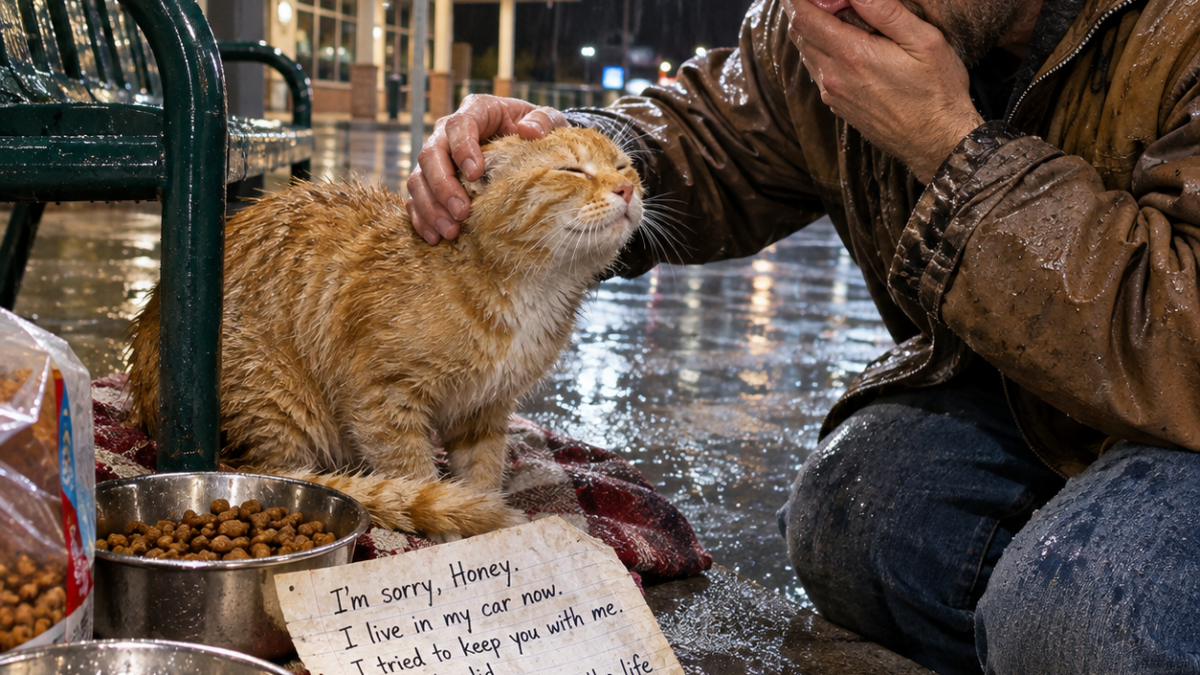
I Found a Cat Abandoned at a Highway Rest Stop Beside Food, Water, and a Note That Said, “I Live in My Car. I’m Sorry. I Tried.”—Six Days Later, I Found Her Owner in a Hospital.
I almost drove past the orange tabby sitting alone at a freezing Pennsylvania rest stop, but the clean bowl of water, carefully folded bag of food, and handwritten note beside her told me this was not the kind of abandonment people would assume.
The note said, “I live in my car now. I tried to keep you with me. I’m sorry,” and six days later I learned the woman who wrote it had lost her business, her apartment, and nearly her life before leaving the one creature she still loved somewhere she hoped a stranger would notice.
When I finally found Emily in a Pittsburgh hospital and showed her a photograph of Honey sleeping safely on my bed, she covered her face and whispered, “I thought she would hate me,” without knowing that the cat she believed she had failed was about to become the reason hundreds of strangers helped save them both.
I almost drove past her.
That is the part I remember most.
Not finding the note.
Not watching Honey run into Emily’s arms weeks later.
Not the thousands of people who eventually shared her photograph.
Not the mechanic who repaired Emily’s car.
Not the landlord who offered her a temporary apartment.
Not even the moment I realized the woman who had left the cat beside a highway had been sleeping inside a broken-down sedan while trying to decide whether she could afford food for herself or litter for the animal curled beside her.
I remember the exit sign.
And how close I came to staying on the highway.
It was a little after nine on a Sunday night in late November.
Western Pennsylvania had been cold all weekend.
Not snowing yet.
Worse, in some ways.
Thirty-six degrees.
Steady rain.
Wind pushing water across the highway in silver sheets.
I had been driving almost four hours after visiting my older sister, Marianne, and her family outside Pittsburgh.
My back hurt.
My coffee was gone.
My eyes had reached that unpleasant stage where every pair of headlights looked too bright.
All I wanted was my own bed.
I lived alone outside Harrisburg in a small two-bedroom house I had bought after my divorce.
At forty-one, I told everyone I liked living alone.
Most days that was true.
My house stayed exactly how I left it.
Nobody stole blankets.
Nobody left wet towels on bathroom floors.
Nobody asked what was for dinner.
I could read until midnight.
Eat cereal at seven.
Forget to speak for six hours.
Freedom.
At least that was the word I used.
Marianne used another.
Loneliness.
“You’re getting too comfortable being alone.”
She had said it while I was putting my overnight bag into the trunk.
Her youngest child, Ben, had been running through the driveway wearing one shoe and carrying a plastic dinosaur.
I laughed.
“That’s called peace.”
Marianne didn’t.
PART2:
“That’s what people say when they’re afraid to admit they’re lonely.”
“I am not lonely.”
“You have a relationship with the grocery delivery guy.”
“His name is Travis.”
“That does not help your argument.”
I rolled my eyes.
She hugged me.
Then she said, softer:
“I’m not saying marry somebody.”
“I’m saying your world keeps getting smaller.”
That sentence stayed with me longer than I wanted.
I drove away annoyed.
Four hours later, the words were still sitting beside me in the empty passenger seat.
Then I saw the sign.
REST AREA — 1 MILE
I almost kept driving.
Home was less than ninety minutes away.
I could wait.
Then my lower back tightened.
Coffee sounded good.
Ten minutes.
That was all.
The rest area was nearly empty.
Two tractor-trailers idled on the far side.
A white pickup sat beneath a security light.
Another sedan was parked near the bathrooms.
Rain clicked against the metal roof of the building.
PART3:
Beyond the pavement, dark trees disappeared into fog.
I went inside.
Used the restroom.
Bought terrible coffee from a vending machine.
Checked my phone.
One message from Marianne.
Home yet?
I sent a thumbs-up because sisters apparently do not require accuracy.
Then I walked toward my car.
That was when I saw the cat.
She sat beside a green metal bench near the edge of the parking lot.
Orange tabby.
Medium-sized.
Thin, though not skeletal.
Damp fur flattened along her back.
Tail wrapped carefully around her front paws.
Perfectly still.
At first I assumed she was a stray.
Rest stops attract animals.
People leave food.
Cats learn parking lots.
Usually they disappear the moment strangers approach.
This cat watched me unlock my car.
Did not move.
I opened the driver’s door.
Something made me turn around.
Maybe the stillness.
Maybe the fact that she looked less like she lived there and more like she was waiting.
That was when I saw the bowl.
Stainless steel.
Clean water.
Beside it, an opened bag of cat food.
Not dumped carelessly.
The top had been folded down twice.
The bag had been pushed beneath the bench so rain would not soak it.
A cheap plastic scoop rested inside.
My hand stayed on the car door.
This was not random.
Somebody had prepared the space.
I walked closer.
Slowly.
The cat lifted her head.
She did not run.
Her eyes were amber.
Tired.
Not frightened exactly.
Confused.
Near the food, a small white piece of paper was tucked beneath a stone.
I crouched.
The cat watched.
I picked up the paper.
The handwriting shook across the page.
I’m sorry, Honey.
I looked at the cat.
Her ears moved.
Then I kept reading.
I live in my car now.
I tried to keep you with me.
I really did.
But I can’t give you the life you deserve.
Please forgive me.
I love you.
I’m sorry.
No phone number.
No name.
No explanation.
Just apology.
I read it once.
Then again.
Then a third time.
“Honey?”
The orange cat looked directly at me.
That was all the confirmation I needed.
I crouched lower.
“Is that you?”
She stood.
For one second, I thought she would leave.
Instead she walked toward me.
Slow.
Three steps.
Then four.
Her forehead touched the back of my hand.
I sat on the wet pavement.
Not because I planned to.
My knees simply stopped supporting the rest of the moment.
Honey pressed her head into my fingers.
I started crying.
I felt ridiculous.
I didn’t know this animal.
I didn’t know the person who wrote the note.
But the entire scene felt different from the abandoned-animal stories I had heard before.
There was food.
Clean water.
A name.
A note addressed to the cat as if the person believed Honey deserved an explanation.
Whoever left her had not tossed her out because caring became inconvenient.
Someone had reached the edge of what they could survive.
That distinction did not make Honey safer.
It did not make leaving her at a highway rest stop a good decision.
But it changed the kind of heartbreak I was looking at.
“You waited?”
Honey rubbed against my knee.
The security door opened behind me.
An older man came out carrying coffee.
He stopped.
“You okay?”
I wiped my face.
“There’s a cat.”
He looked.
Then at me.
“Yes.”
I laughed despite myself.
“There’s a note.”
That made him approach.
He read it.
His expression changed.
“Damn.”
“Do you know how long she’s been here?”
“No.”
“You work here?”
“Truck driver.”
He looked toward the rigs.
“Came in forty minutes ago.”
“Haven’t noticed her before.”
I searched the rest area for cameras.
There were several.
Maybe police could identify whoever had left Honey.
Then I realized my first problem was the cat.
Not the person.
I called a local rescue.
Voicemail.
Called another.
Closed.
County animal control had an emergency number.
The dispatcher answered.
“Is the animal injured?”
“No.”
“Aggressive?”
“No.”
“Immediate danger?”
“She’s sitting at a rest stop in cold rain.”
Pause.
“Ma’am, if she’s contained and not injured, our overnight response is limited.”
“She isn’t contained.”
The dispatcher gave me a number for a volunteer rescue network.
A woman named Beth answered on the third ring.
She sounded half asleep.
I explained.
She woke quickly.
“You said there’s a note?”
“Yes.”
“What does it say?”
I read it.
Silence.
Then:
“Can you stay with her?”
I looked at Honey.
“Yes.”
“I can get someone there in about thirty minutes.”
Honey spent those thirty minutes beneath the edge of my coat.
I sat on the bench.
She climbed beside me.
Every few minutes, headlights appeared at the entrance.
Each time Honey raised her head.
Watched.
Then relaxed again when another stranger emerged.
That detail bothered me.
Who was she expecting?
The person who had left?
Did she understand?
Did she think they were inside the building?
Around the corner?
Coming back after buying food?
I had no way to know.
At 10:03, a blue Subaru arrived.
Beth stepped out carrying a plastic carrier, towels, treats, and the efficient expression of somebody accustomed to getting phone calls from emotional strangers.
She was maybe fifty.
Short hair.
Rain jacket.
“Claire?”
I nodded.
That is my name.
Claire Lawson.
She crouched several feet from Honey.
“Hey, sweetheart.”
Honey watched.
Beth read the note.
Her face tightened.
“People are going to be cruel when this gets online.”
I looked at her.
“You think it should?”
“Maybe.”
“Why?”
“Because somebody knows who wrote this.”
That was the first time I considered the owner might still be nearby.
Not emotionally.
Physically.
Living inside a car.
Sleeping somewhere cold.
Beth checked Honey gently.
No obvious injuries.
No bleeding.
Gums pink.
A little dehydrated.
Thin.
Wet.
“She’s definitely socialized.”
Honey allowed Beth to touch her paws.
“Indoor cat.”
“Probably.”
“Microchip?”
“We’ll know at the rescue.”
Honey entered the carrier with only minor protest.
Before Beth closed the door, Honey looked at me.
That sounds sentimental.
Maybe it was.
But I felt guilty anyway.
As though I were another person putting her into something and leaving.
“I’ll come tomorrow.”
I had not planned to say it.
Beth smiled.
“Careful.”
“What?”
“That’s how fostering starts.”
“I’m not fostering.”
Beth laughed.
“Sure.”
I got home after midnight.
Marianne called immediately.
“Why did your thumbs-up arrive two hours before your location stopped moving?”
“I found a cat.”
There was a pause.
“Of course you did.”
“What does that mean?”
“You’re the only person I know who can turn a bathroom stop into an emergency.”
I told her the story.
By the time I reached the note, Marianne was crying.
“Are you adopting her?”
“No.”
“Okay.”
“Why did you say that like you don’t believe me?”
“Because I know you.”
I slept badly.
Every time I closed my eyes, I saw the food bag tucked beneath the bench.
Someone had cared enough to protect it from rain.
That detail kept bothering me.
The next morning, I called Beth before breakfast.
“She’s fine.”
“Who?”
Beth laughed.
“The cat you are absolutely not fostering.”
I drove forty minutes back west.
The rescue operated from a converted veterinary office.
Honey sat at the front of her kennel.
Not hiding.
Not sleeping.
Watching the door.
When she saw me, she stood.
“Hi.”
Her tail lifted.
I felt something shift.
Beth appeared.
“She has a microchip.”
My heart jumped.
“Great.”
“Don’t celebrate yet.”
“Why?”
“Registered information is outdated.”
The chip listed:
Emily Parker
Address in Pittsburgh.
Phone disconnected.
“Can you find her?”
“We’re trying.”
“Healthy?”
“Mostly.”
“Five or six years old.”
“Spayed.”
“Mild dehydration.”
“Needs dental cleaning eventually.”
“No major illness.”
I looked at Honey.
“She has been somebody’s cat.”
“Oh, definitely.”
Beth smiled.
“She slept in my lap during the exam.”
“I thought rescue people weren’t supposed to encourage attachment.”
“We encourage appropriate attachment.”
“Convenient.”
Honey meowed.
I crouched.
“Are you going to stare at every door?”
Beth’s expression became softer.
“She did most of the night.”
That decided something for me.
“I can foster her.”
Beth smiled too quickly.
“Temporary.”
“Of course.”
“Very temporary.”
“Absolutely.”
“I’m serious.”
“So am I.”
I signed paperwork.
Bought litter.
Cat food.
A scratching post.
Three toys Honey ignored.
A cat bed she also ignored.
By evening, Honey occupied my sofa.
At midnight, she came upstairs.
At 2:00 a.m., I woke with warm weight beside my head.
Honey was sleeping on my pillow.
Not beside it.
On it.
Her face six inches from mine.
I whispered:
“You have boundary problems.”
She purred.
By breakfast, I understood Marianne had been right about at least one thing.
The house sounded different with another living creature inside.
Small sounds.
Paws on hardwood.
Litter scratching.
Water drinking.
A tiny chirp when birds appeared outside.
For someone who had spent years insisting silence was peaceful, I noticed immediately when it disappeared.
Three days later, Beth asked whether we could post Honey’s story.
“I want the owner found.”
“So do I.”
“Then yes.”
We photographed Honey beside the note.
I did not pose her at the rest stop.
I hated staged rescue photos.
Instead she sat on my couch beside the actual piece of paper.
Beth wrote:
FOUND AT HIGHWAY REST AREA — OWNER MAY BE EXPERIENCING HOMELESSNESS
Then quoted the note.
No judgment.
No insults.
Contact rescue confidentially.
Within hours, the post exploded.
Hundreds of shares.
Then thousands.
Comments split exactly as Beth predicted.
Some people wrote:
Heartbreaking. I hope the owner is safe.
Others:
No excuse for abandonment.
If you love an animal, you don’t leave it.
Homeless or not, take the cat to a shelter.
That last one bothered me because people assume shelters exist like twenty-four-hour hotel lobbies with unlimited capacity.
Beth replied once:
We do not know the owner’s circumstances. Our priority is locating her safely and keeping Honey safe.
Then stopped arguing.
On the second day, a woman named Rachel Martinez called.
She worked at a diner twelve miles from the rest area.
“I think I know her.”
“Emily?”
“Yes.”
“How?”
“She used to come in.”
Rachel’s voice tightened.
“Not to eat.”
“To warm up.”
She explained.
A woman named Emily Parker had been living in a dark-blue Ford Focus.
Mid-thirties.
Brown hair.
Thin.
Usually wearing a gray winter coat.
Honey had sometimes been visible in the back window.
Rachel first noticed her in September.
Emily would park near the diner at closing.
Buy one coffee.
Sit for two hours.
Use Wi-Fi.
Charge her phone.
Sometimes ask for hot water.
Rachel began giving her soup.
Emily initially refused.
Then accepted.
“She always fed the cat first.”
Rachel said it quietly.
“What happened?”
“I don’t know all of it.”
“Did she abandon Honey?”
Rachel sounded offended.
“She loved that cat more than herself.”
I looked at Honey.
She was sleeping against my thigh.
Rachel continued.
“Emily owned a cleaning business.”
“Small commercial accounts.”
“Offices.”
“Medical clinics.”
“Some vacation rentals.”
“Then her partner cleaned out the account.”
“What do you mean?”
“Stole from her.”
The partner was a man named Greg Dalton.
According to Rachel, he and Emily had started the business four years earlier.
Emily handled cleaning crews.
Scheduling.
Clients.
Greg handled accounting.
At first, things went well.
Twelve employees.
Steady contracts.
Two vans.
Then payments began bouncing.
Vendors complained.
Payroll came late.
Emily thought clients were behind.
They weren’t.
By the time she reviewed the financial records herself, almost sixty thousand dollars had moved through accounts she had not authorized.
Greg disappeared.
Several large clients followed him to a new company.
Emily tried suing.
The legal costs worsened everything.
She used personal credit cards to make payroll.
Then sold one van.
Then the other.
Business collapsed.
Debt remained.
The apartment went next.
“Where is she now?”
“I don’t know.”
“When did you last see her?”
Rachel hesitated.
“Six days ago.”
My stomach tightened.
“The same night Honey was found?”
“I think so.”
“What happened?”
“She came in around seven.”
“She looked terrible.”
“Wet.”
“Shaking.”
“She asked if I knew any shelters that allowed pets.”
“What did you tell her?”
“I gave her numbers.”
“All full.”
Rachel’s voice broke.
“Then she said her car wouldn’t start again.”
“Did she say where?”
“No.”
“She left before closing.”
“Was Honey with her?”
“Yes.”
“In the car.”
I looked at the note.
“Did she tell you she planned to leave Honey?”
“No.”
“I would’ve stopped her.”
Rachel began crying.
“I would’ve taken the cat myself.”
“Emily didn’t know that?”
“She knew I had three dogs.”
“Maybe she thought—”
“I don’t care what she thought.”
Rachel breathed.
“Sorry.”
“No.”
“You’re upset.”
“I keep thinking she was sitting ten feet from me and I didn’t know how bad it was.”
I understood.
That feeling would become a theme over the next week.
People had seen Emily.
Very few had seen how close she was to collapse.
The problem was finding her.
Her old apartment was occupied by somebody else.
The phone number attached to Honey’s microchip was dead.
Her business address was a mailbox store.
Social-media profiles inactive.
Beth contacted shelters.
Rachel called hospitals.
I started searching public records.
Marianne joined remotely because apparently my sister had accepted that my life now involved an orange cat and a missing woman.
“Do we know if she has family?”
“No.”
“Parents?”
“Unknown.”
“Friends?”
“Rachel.”
“She’s a waitress who knew her casually.”
“So no.”
Honey meanwhile settled deeper into my house.
That became emotionally complicated.
She followed me everywhere.
Kitchen.
Bathroom.
Office.
At night, pillow.
When I left for groceries, I returned to find her sitting at the front window.
The first time, I told myself cats do that.
The third time, I started wondering whether she had been abandoned before.
Then I corrected myself.
That word again.
Abandoned.
What had Emily actually done?
Made a desperate, dangerous decision.
Yes.
Honey could have been hit by a car.
Stolen.
Injured.
Frozen.
Leaving an indoor cat at a rest stop was not safe.
But desperate people do not choose from good options.
They choose from the bad options still available.
That did not erase consequences.
It did change judgment.
On the fifth day, a message arrived through the rescue page.
Try Allegheny General. Woman matching description came in two days ago.
Beth called.
Privacy laws prevented staff from confirming much.
So Rachel drove there.
No result.
Wrong person.
That night, Honey vomited.
I panicked.
Beth did not.
“She ate too fast.”
“You know that from one text?”
“You said whole food came up immediately.”
“Yes.”
“Slow feeder.”
“I thought you said she was starving.”
“Starving cats eat like they’re still starving even when food becomes reliable.”
The sentence hit me harder than expected.
Reliability takes time to become believable.
The next morning, Rachel called.
“I found her car.”
“Where?”
“Tow lot.”
Emily’s Ford Focus had been towed from a shopping-center parking lot four days earlier.
Abandoned vehicle.
Dead battery.
One flat tire.
Inside, according to the tow operator:
Blankets.
Two duffel bags.
Cat litter.
Empty food cans.
Medication bottle.
The registration gave us an emergency contact.
A cousin named Melissa Grant.
Beth called.
Melissa lived in Ohio.
She had not spoken to Emily in almost a year.
Family conflict.
“Why?”
I asked later.
Beth answered carefully.
“Apparently Emily borrowed money from family during the business collapse.”
“Couldn’t repay it.”
“Her mother accused her of lying about Greg stealing.”
“Relationships fell apart.”
“Did Melissa know she was homeless?”
“No.”
That answer said everything.
Melissa drove to Pennsylvania.
She started calling hospitals.
Police.
Emergency shelters.
On the sixth morning, she called me.
“We found her.”
I stood so fast Honey jumped from my chair.
“Where?”
“St. Vincent’s.”
Pittsburgh.
“What happened?”
“Collapsed outside a pharmacy.”
“Dehydration.”
“Exhaustion.”
“Respiratory infection.”
“Malnutrition.”
“Is she conscious?”
“Yes.”
“Does she know about Honey?”
“No.”
Melissa’s voice softened.
“I think you should be there.”
“Me?”
“You found the cat.”
I looked down.
Honey stared up.
That afternoon, I drove to Pittsburgh with Beth.
I brought a photograph.
Not Honey herself.
Hospital rules.
Emily Parker occupied room 414.
I had imagined someone older.
She was thirty-six.
Maybe thirty-seven.
Brown hair pulled back badly.
Face thin.
Cheeks hollow.
IV in one arm.
Hospital gown.
A plastic cup of water beside the bed.
She looked like somebody who had been apologizing for taking up space for too long.
Melissa stood near the window.
“Emily?”
She turned.
Her eyes moved from Beth to me.
“Yes?”
“My name is Claire.”
Confusion.
“I found Honey.”
Everything inside her face stopped.
Not exaggeration.
She genuinely seemed to stop breathing.
I held up the photograph.
Honey on my couch.
One paw tucked beneath her.
Green blanket behind her.
Emily covered her mouth.
Then both hands covered her face.
A sound came through her fingers.
Not exactly crying.
Pain leaving too quickly.
“Oh God.”
I stepped closer.
“She’s safe.”
Emily shook her head.
Tears ran down her wrists.
“She hates me.”
“No.”
“I left her.”
“She doesn’t hate you.”
“She thinks I abandoned her.”
I sat beside the bed.
“I don’t know what Honey thinks.”
Emily lowered her hands.
That honesty seemed to surprise her.
“I can’t promise she understood why.”
Her face crumpled.
“But I can tell you what I know.”
I turned the photograph toward her.
“She eats.”
“She sleeps on my pillow.”
“She yells at closed bathroom doors.”
“She likes chicken.”
“She hates the vacuum.”
“She waits by the front window when I leave.”
Emily laughed through tears.
“She always did that.”
“I know.”
“How?”
“Because she does it to me too.”
Emily touched the photograph.
Her fingers shook.
“She’s always slept near people’s heads.”
“That would’ve been helpful information.”
Emily almost smiled.
Then grief returned.
“I tried.”
“I know.”
“No.”
She looked at me.
“I really tried.”
So I let her tell me.
Sometimes people need witnesses more than advice.
Greg had been her friend for nine years before they became business partners.
She trusted him.
Their company started with borrowed equipment and six hundred dollars.
Emily built the client list.
Greg built the books.
When contracts increased, he began taking loans in the business name.
Then moving money.
Forging approvals.
Opening a second company.
He convinced two clients Emily was mismanaging payroll.
By the time she discovered it, he had already redirected several contracts.
She reported him.
Civil suit.
Police report.
Financial investigation.
Too slow.
Rent did not wait for investigations.
Neither did credit cards.
She kept employees paid as long as possible because several were single mothers.
Eventually there was nothing left.
Her landlord filed eviction.
She moved into the car.
Honey came with her.
“People told me to surrender her.”
Emily looked at the photograph.
“I couldn’t.”
“How long were you living together in the car?”
“Eleven weeks.”
November in Pennsylvania.
I imagined it.
“She slept under my coat.”
“I bought those reflective window covers.”
“I kept litter in a plastic storage tub.”
“We parked near a gym that let me shower.”
“I found places with outlets.”
“Sometimes motels when I had money.”
She looked embarrassed.
“I started doing cleaning jobs through an app.”
“What happened to the car?”
“Alternator.”
“Then battery.”
“I used the last of my money on a motel for two nights because it got below freezing.”
“When that ran out…”
She stopped.
“I called every shelter.”
“Human shelter?”
“And animal.”
“Some could take me, not Honey.”
“Some could take Honey, but I couldn’t get there.”
“One said there was a three-week wait.”
Emily wiped her face.
“I kept telling myself one more day.”
Then came the rest stop.
Why there?
Because it had cameras.
People.
Lighting.
Covered benches.
Bathrooms open all night.
She thought somebody would notice Honey faster there than behind a store or in an alley.
“I stayed.”
I stared.
“What?”
“I didn’t just leave.”
Emily’s eyes filled.
“I parked on the far side.”
“For almost two hours.”
The room went silent.
“You watched her?”
She nodded.
“I kept getting out of the car.”
“Then getting back in.”
“Honey would follow me.”
“So I put food down.”
“I wrote the note.”
“I walked away.”
“Then came back.”
“Three times.”
Beth sat beside me.
Emily continued.
“At the end, I drove around the building and parked where she couldn’t see me.”
“I watched.”
“People passed.”
“Nobody stopped.”
“Then my battery warning came on again.”
“I knew if the car died there, security might make me leave or tow it.”
“I drove away.”
She covered her face.
“I made it six miles.”
“Car died.”
I suddenly understood the timeline.
The Focus had later been found near a shopping center.
“What did you do?”
“Walked.”
“In that weather?”
“Yes.”
“To where?”
“Bus shelter.”
“Then a church.”
“Then pharmacy.”
She barely remembered collapsing.
I looked at Beth.
She was crying.
I looked back at Emily.
“You didn’t fail Honey.”
Emily shook her head.
“I left her beside a highway.”
“Yes.”
The word surprised her.
I continued.
“That was dangerous.”
More tears.
“But failing and making one desperate bad choice are not automatically the same thing.”
She looked at me.
“You were out of choices you knew how to reach.”
“I should’ve asked Rachel.”
“Yes.”
“I should’ve gone to the police.”
“Maybe.”
“I should’ve—”
“You were sick.”
“Cold.”
“Hungry.”
“Living in a dead car.”
“Trying to protect a cat while your own body was shutting down.”
Emily stared.
“That doesn’t make the rest stop safe.”
“No.”
“But it makes you human.”
She cried again.
Then asked:
“Can I see her?”
“Yes.”
Not immediately.
But yes.
The next problem was larger than reunion.
Emily had nowhere to go after discharge.
Hospital social workers began looking.
Melissa offered Ohio.
Emily hesitated.
Family wounds.
Distance.
No job.
Then Honey’s online story did something none of us expected.
People started asking:
How can we help the owner?
Beth refused to post Emily’s name without permission.
Emily initially refused all help.
Of course.
Shame is stubborn.
She said:
“People donated to Honey.”
“Not me.”
Beth answered:
“They are asking about both of you.”
“I don’t deserve—”
“Stop.”
Beth’s voice hardened.
“Need is not a moral prize.”
Emily stared.
Beth continued:
“You do not have to earn the right to sleep indoors.”
That sentence changed something.
Slowly.
We built a plan.
A rescue-support nonprofit found a furnished studio apartment offering ninety days of transitional housing.
A mechanic named Terry Walsh heard about the car.
He owned a repair shop near Greensburg.
“I’ll tow it.”
“Fix what I can.”
Emily asked:
“How much?”
“Nothing.”
“I can’t accept that.”
“Then pay me later if it bothers you.”
He replaced the alternator.
Battery.
Tire.
Belts.
Changed oil.
Cleaned the interior.
A woman named Dana who owned a commercial janitorial company called Beth.
“I need an evening supervisor.”
Emily’s old business experience made her overqualified.
Dana didn’t care.
“Can she show up?”
“Yes.”
“Can she run crews?”
“Yes.”
“Then I can use her.”
A retired accountant volunteered to review the business-fraud documents.
That led to an attorney who agreed to examine Emily’s civil claim against Greg without an upfront retainer.
Most important, the fundraiser was controlled.
No spectacle.
No giant pile of cash handed to somebody in crisis.
Rent.
Medical costs.
Car repair.
Deposits.
Legal expenses.
Basic emergency fund.
Specific needs.
Emily resisted every one.
Then Melissa told her:
“You spent years helping people make payroll when your business was dying.”
“Let people help you now.”
Emily cried.
Three weeks after I found Honey, I drove Emily to my house.
The entire trip she was terrified.
“What if she doesn’t remember?”
“She remembers her name.”
“That doesn’t mean me.”
“No.”
“What if she’s happy with you?”
“That’s possible too.”
Emily stared out the window.
The question beneath the question was obvious.
What if Honey chose me?
I understood why that scared her.
By then, Honey had lived with me three weeks.
She slept in my room.
Followed me.
Knew the sound of my refrigerator.
Waited outside the shower.
Part of me loved her.
That was also true.
I had avoided thinking about what happened after Emily stabilized.
The rescue paperwork said foster.
My heart had started using another word.
We pulled into the driveway.
Emily stayed in the passenger seat.
“You ready?”
“No.”
“Good.”
“What?”
“Nobody is ready for anything important.”
“That sounds made up.”
“It is.”
She laughed nervously.
Inside, Honey was in the hallway.
Beth had brought her earlier after a routine vet visit.
She sat facing the door.
Emily stepped inside.
Honey froze.
No dramatic music.
No instant leap.
Just stillness.
Ears forward.
Head lifted.
Emily began crying before anything happened.
“Honey?”
The cat’s entire body changed.
She made a sound.
Not a meow.
A small trill.
Then ran.
Emily dropped to her knees.
Honey hit her chest hard enough to push her backward.
Emily wrapped both arms around her.
The cat climbed up her shoulder.
Rubbed her face against Emily’s jaw.
Cheek.
Hair.
Purring so loudly the sound filled the hallway.
“Oh, baby.”
Emily sobbed.
“I’m sorry.”
Honey head-butted her mouth.
“I’m so sorry.”
Another head-butt.
“She doesn’t want your apology.”
Beth whispered.
Emily laughed through tears.
Honey climbed into her lap.
Then turned around.
Then back.
As though checking that every piece was still there.
I stood several feet away.
Something inside me hurt.
Not jealousy exactly.
Loss.
I knew in that moment Honey was not mine.
She loved me.
I believed that.
But this was different.
History has weight.
Emily had been Honey’s home long before my pillow.
I went into the kitchen because I needed privacy.
Marianne was there.
She had driven down that morning.
Of course she had.
She found me crying beside the refrigerator.
“You okay?”
“Yes.”
“Liar.”
“I love her.”
“I know.”
“She should go back to Emily.”
“I know.”
“It still hurts.”
“I know.”
I looked at my sister.
“Can you stop being right?”
“No.”
She hugged me.
Then whispered:
“Your world got bigger.”
I laughed through tears.
“I hate you.”
“I know.”
Honey did not move back with Emily that day.
That mattered.
Emily’s temporary apartment needed pet approval.
The rescue wanted a transition plan.
Honey needed continuity.
So for two weeks, Emily visited daily.
Sometimes at my house.
Sometimes we met at the apartment.
Honey inspected every room.
Window.
Closet.
Bathroom.
Then jumped onto Emily’s bed.
Done.
Approval granted.
When the apartment officially accepted her, I drove Honey over.
Carrier.
Food.
Litter.
Favorite blanket.
Three ignored toys.
And my pillowcase.
Emily noticed.
“You don’t need to give me that.”
“She sleeps on it.”
“It smells like you.”
“That is the point.”
Emily stared.
“You’re making this difficult.”
“For you?”
“For me not to cry.”
“Then cry.”
She did.
Honey came out of the carrier.
Walked directly toward the bed.
Sniffed the pillowcase.
Then went to Emily.
I stayed for dinner.
Pizza.
Paper plates.
Honey sat between us.
It was probably the first normal evening Emily had experienced in months.
That winter became the beginning of her rebuilding.
Not a miracle.
Not immediate.
People like clean endings.
Homeless woman gets apartment.
Cat returns.
Job found.
Happy.
Real recovery is repetitive.
Emily woke at night afraid she would lose the apartment.
She hoarded canned food.
Kept gasoline above half a tank even when money was tight.
Checked Honey’s food bag three times before bed.
Overworked.
Accepted extra shifts until Dana ordered her home.
She had panic attacks when unknown numbers called because she expected debt collectors.
The business fraud case moved slowly.
Greg Dalton denied everything.
Claimed Emily approved the transfers.
Then the accountant found something.
Digital signatures.
Several transactions supposedly authorized by Emily had been completed while she was physically cleaning client sites with employees who could verify her location.
Then banking access logs showed devices tied to Greg.
Then a former client produced emails.
Greg had told them Emily was stealing payroll taxes.
He had been poisoning her reputation while draining the company.
The civil case became a criminal investigation.
Months later, Greg was charged with financial crimes connected to the business.
When Emily learned, she did not celebrate.
She sat in my kitchen.
Honey on her lap.
“I thought I’d feel better.”
“You might later.”
“I kept imagining somebody proving I wasn’t stupid.”
I looked at her.
“Being betrayed isn’t proof you’re stupid.”
“I trusted him with everything.”
“Yes.”
“That feels stupid.”
“It feels expensive.”
She laughed.
Then cried.
Greg eventually pleaded guilty to multiple counts of theft and fraud.
Some money was recovered.
Not enough to recreate the old business.
Enough to pay debt.
Enough to close certain chapters.
Emily chose not to rebuild the company.
That surprised me.
“You don’t want it back?”
“No.”
“It was yours.”
“So was the stress.”
She stayed with Dana.
Within a year, she was operations manager.
Then regional supervisor.
She was good at it.
Not because hardship magically made her stronger.
She had always been competent.
Hardship had simply hidden that beneath survival.
Honey became famous locally.
I hated the word.
She did not care.
The rescue used her story to start a small emergency pet-retention fund.
That became the best outcome none of us planned.
The fund paid for:
Pet deposits for temporary housing.
Emergency boarding.
Pet food.
Basic veterinary care.
Transportation to pet-friendly shelters.
Short-term foster placement when owners were hospitalized.
The goal was simple.
Prevent another person from reaching the point where a rest-stop bench felt like the safest option available.
Emily volunteered.
At first behind the scenes.
Then publicly.
Her first talk was at a community center.
Twenty-three people.
She stood behind a podium holding the original note.
I sat in the back.
Honey was not there because cats do not need to attend public speeches about themselves.
Emily said:
“I used to think asking for help meant admitting I had failed.”
She paused.
“Then I learned refusing help can sometimes make the crisis worse.”
She looked at the paper.
“I loved Honey.”
“I still made a dangerous choice.”
“Both are true.”
That was one of the things I admired most about her.
She never turned her story into:
Love made everything okay.
Love did not fix the alternator.
Love did not pay rent.
Love did not create a pet-friendly shelter bed.
Love did not prosecute Greg.
Love mattered.
But systems mattered too.
Access mattered.
Information mattered.
Money mattered.
One evening, nearly a year after I found Honey, Emily and I drove back to the rest stop.
Her idea.
Not mine.
The green bench was still there.
New paint.
Same location.
We sat.
Rain had begun lightly.
Honey stayed home.
“Do you remember where?”
Emily pointed.
“There.”
Near a security light.
I looked.
“Where were you parked?”
She pointed toward the far side.
“Behind that row.”
“How long?”
“Almost two hours.”
I imagined her watching.
Honey beside the bench.
People passing.
Emily inside a failing car.
“I wish I had arrived earlier.”
She looked at me.
“Why?”
“You wouldn’t have had to drive away.”
Emily considered.
“Maybe.”
“You would’ve stopped me.”
“Yes.”
“I might’ve hated you.”
“Probably.”
We smiled.
Then she said:
“I saw your car pull in.”
I stared.
“What?”
“That night.”
“You saw me?”
“Yes.”
The world shifted slightly.
“I was still there?”
“For the first few minutes.”
“Where?”
“In the car.”
“Why didn’t you come over?”
“I was terrified.”
Emily looked toward the bench.
“I had already walked away three times.”
“I knew if I got out again, I wouldn’t be able to leave.”
I felt cold beneath my coat.
“You saw me go inside?”
“Yes.”
“You saw me come out?”
“Yes.”
“Did you see me notice her?”
Emily nodded.
“What happened?”
“I cried.”
She smiled sadly.
“You stood with your car door open for a long time.”
“I remember.”
“Then you walked toward her.”
“That was when I started the engine.”
My throat tightened.
“You left because you saw me?”
“Yes.”
“Claire, you were the first person who stopped.”
I did not know what to say.
For almost a year, I had thought I simply found Honey.
From Emily’s perspective, I had been something else.
Permission to leave.
She reached into her pocket.
Pulled out a folded paper.
Not the original note.
A copy.
“I used to hate this.”
“Why?”
“It sounded pathetic.”
“I live in my car.”
“I tried.”
“I’m sorry.”
She looked at me.
“Now I don’t.”
“What changed?”
“I meant every word.”
We sat quietly.
Cars entered.
Left.
Nobody knew what had happened on that bench.
That was fine.
The place did not need a plaque.
Sometimes ordinary locations carry extraordinary memories without announcing them.
Two years passed.
Then three.
Emily moved from transitional housing into a small apartment she chose herself.
Second floor.
Two bedrooms.
Large window Honey claimed immediately.
The first thing Emily bought was not furniture.
It was an emergency savings lockbox.
Cash.
Car-repair fund.
Vet fund.
She called it her “never again box.”
Honey grew rounder.
Beth accused Emily of overfeeding.
Emily denied it.
Honey’s veterinary chart disagreed.
I remained part of their lives.
Every two or three weeks, they visited.
Honey entered my house as though she still paid taxes there.
Straight to the couch.
Then stairs.
Then pillow.
Emily eventually stopped apologizing.
“She has joint custody.”
I said.
“Apparently.”
Marianne loved that.
“You rescued a cat and gained a friend.”
“I did not rescue Honey.”
“Fine.”
“You stopped for Honey.”
“Yes.”
“And she gave you Emily.”
“That sounds emotionally manipulative.”
“You love emotionally manipulative.”
“I do not.”
“You cried at a dog-food commercial last week.”
“The dog was old.”
My sister remained unbearable.
She was also right.
Emily became one of my closest friends.
Not because tragedy permanently binds strangers in some magical way.
We argued.
Frequently.
She hated how I loaded dishwashers.
I hated her habit of answering texts three days late.
She borrowed books and folded page corners.
A criminal act.
I introduced her to Marianne.
They immediately became friends, which felt like betrayal.
One Christmas, Emily came with Honey and a small box.
“For you.”
Inside was a framed copy of the rest-stop note.
I stared.
“What am I supposed to do with this?”
“Look at the back.”
I turned it over.
Another note.
Emily’s newer handwriting.
Steadier.
Claire—
That night I thought “I tried” meant I had reached the end of what I could do.
I know now it also meant I had survived long enough for somebody else to help.
Thank you for stopping.
I cried.
Of course.
Honey climbed into the wrapping paper.
Of course.
Years later, people still occasionally recognized Honey online.
The original post continued resurfacing.
Sometimes with inaccurate captions.
Woman abandons cat because homeless.
Emily hated that one.
Not because it was completely false.
Because it flattened everything.
Once she commented:
Please remember that homelessness doesn’t erase love, but love also doesn’t remove the need for safe resources. I should have asked for help sooner. I also needed places where asking was possible.
That became the sentence the rescue printed on its emergency-pet program brochure.
Honey reached twelve.
Then thirteen.
She developed arthritis.
Kidney values became mildly abnormal.
Emily bought steps for the bed.
Honey ignored them initially.
Then accepted them after three weeks of pretending they were beneath her dignity.
At fourteen, Honey stopped jumping onto my kitchen counter during visits.
I pretended to be relieved.
I wasn’t.
Old animals create a particular kind of gratitude.
Every ordinary habit starts carrying a number.
How many more times?
You try not to think that way.
You do anyway.
On one winter afternoon, Honey lay on my couch between Emily and me.
Snow outside.
Coffee.
No crisis.
Emily stroked the cat’s orange fur.
“Do you ever think about what would’ve happened if you hadn’t stopped?”
“Yes.”
“So do I.”
“We probably shouldn’t.”
“No.”
“But we do.”
Honey opened one eye.
Emily smiled.
“I used to think the worst thing I ever did was leaving her.”
I waited.
“Now I think the worst thing was believing I had to solve everything alone before I deserved to ask for help.”
That hit me.
Because Marianne’s sentence from years earlier returned.
Your world keeps getting smaller.
Emily and I had done opposite versions of the same thing.
She isolated because shame told her nobody wanted her problems.
I isolated because comfort told me nobody was necessary.
Different roads.
Same destination.
Alone.
Honey had interrupted both.
Not intentionally.
Cats are not therapists.
Honey wanted warmth.
Food.
Her person.
Soft pillows.
Everything else was human meaning layered on top.
But meaning is sometimes how people survive what happened.
Honey lived to sixteen.
Her last year was slower.
Kidney disease.
Medication.
More sleep.
Less appetite.
Emily managed everything carefully.
No desperation this time.
No secrets.
No pretending.
When the veterinarian finally said Honey’s body was failing, Emily called me.
“I can’t do it.”
“Yes, you can.”
“I left her once.”
“This is not leaving her.”
“It feels like it.”
I drove to her apartment.
Honey was on the bed.
Old.
Thin.
Still orange.
Emily lay beside her.
“I promised she’d never think I abandoned her again.”
“She won’t.”
“How do you know?”
“I don’t.”
I sat beside them.
“But you’ll be there.”
The veterinarian came to the apartment.
That mattered to Emily.
Honey died on her own blanket with Emily’s hand on her chest and my hand on Emily’s shoulder.
No highway.
No cold bench.
No waiting.
Afterward, Emily kept the stainless-steel water bowl from the rest stop.
Beth had saved it years earlier.
She placed the original note inside.
Not displayed dramatically.
Just on a shelf.
A private memory.
Several months later, the rescue asked permission to name its expanded emergency pet-retention program after Honey.
Emily said yes.
Honey’s Home Bridge
It helped people facing eviction.
Hospitalization.
Domestic violence.
Homelessness.
Sudden job loss.
The services were practical.
Temporary fosters.
Pet-friendly motel vouchers.
Food.
Deposits.
Boarding.
Transportation.
Not glamorous.
Useful.
That would have pleased Honey if Honey had understood human bureaucracy.
She did not.
I like to think she would have cared more about the food budget.
Emily never bought another cat immediately.
Neither did I.
For almost a year, both our homes became quiet again.
Mine bothered me more this time.
Marianne noticed.
“Interesting.”
“Don’t.”
“You miss cat noises.”
“Do not start.”
“Your world—”
“I will hang up.”
She laughed.
Then one Saturday, Emily asked if I wanted to accompany her to the rescue.
“Why?”
“Beth needs help photographing adoptable cats.”
“That sounds suspicious.”
“It isn’t.”
It was.
Three hours later, a gray-and-white senior cat named Walter was sitting in my lap.
Missing tooth.
One cloudy eye.
Eleven years old.
Nobody had applied for him in two months.
Beth walked past.
“Temporary foster?”
I glared.
Emily laughed.
“You know how this ends.”
“No.”
Walter purred.
I looked down.
“Absolutely not.”
He slept on my pillow that night.
Of course he did.
Sometimes people ask whether I saved Honey.
I never know how to answer.
I stopped.
I read a note.
I made phone calls.
I stayed until help came.
I fostered her.
Other people did the rest.
Beth.
Rachel.
Melissa.
The hospital social worker.
Terry the mechanic.
Dana.
The attorney.
Hundreds of strangers.
Emily herself.
Most of all Emily.
Because rebuilding was not something anybody could do for her.
We could open doors.
She had to walk through them.
And Honey?
Honey gave us a reason to find one another.
That’s different from saving.
It is also enough.
I still have a photograph from the first night.
Honey beside the green metal bench.
Food bag tucked beneath it.
Stainless bowl.
Rain-dark pavement.
The note beneath the stone.
I rarely show it.
When I do, people focus on the words:
I’m sorry.
I tried.
But the line I notice now is:
I love you.
For a long time, Emily believed those sentences contradicted one another.
If she loved Honey, how could she leave her?
If she left Honey, how could she claim she loved her?
Life is rarely that clean.
People can love deeply and still make frightened decisions.
They can fail at one moment without being failures.
They can need rescue without becoming helpless.
They can lose homes without losing dignity.
They can sit in cars outside highway rest stops and believe nobody in the world would understand.
Then one person stops.
Then another.
Then another.
That was what changed everything.
Not a miracle.
Not one heroic stranger.
A chain.
Rachel fed Emily when she could not afford dinner.
Someone kept Honey’s food dry.
I noticed the note.
Beth answered the phone.
A hospital treated Emily.
A mechanic fixed a car.
A landlord opened a door.
A business owner offered work.
A lawyer reopened a case.
Thousands of people gave small amounts.
Nobody alone fixed everything.
Together, they created enough room for Emily to stand up again.
Years after Honey died, Emily and I returned to the rest stop one last time.
They had renovated it.
New benches.
Better lighting.
Different vending machines.
The old green bench was gone.
Emily stood near the spot.
“I’m glad.”
“What?”
“That the bench is gone.”
“Why?”
“I don’t want it frozen forever as the saddest place in my life.”
I understood.
She looked toward the highway.
Cars moved through the rain.
“Do you remember what your sister told you that night?”
I laughed.
“Unfortunately.”
“What?”
“That I was getting too comfortable being alone.”
Emily smiled.
“She was right.”
“Do not tell her.”
“Too late.”
“You told her?”
“Years ago.”
“Betrayal.”
We walked toward my car.
Then Emily stopped.
“Claire.”
I turned.
“Thank you.”
“For what?”
“You know.”
I did.
But I shook my head.
“You’ve thanked me enough.”
“No.”
She looked back at the spot where Honey had waited.
“I don’t think I ever can.”
I followed her gaze.
“You don’t owe me.”
“I know.”
She smiled.
“That’s why I can mean it.”
We drove away.
This time, nobody stayed behind.
And whenever I think about that cold Sunday night now, I no longer remember the loneliness first.
I remember the moment I almost kept driving.
One decision.
One exit.
Ten minutes I almost decided were not worth losing.
A wet orange cat.
A folded bag of food.
Clean water.
A shaking handwritten apology.
I’m sorry. I tried.
Emily had believed those words were proof she had reached the end.
They weren’t.
They were the last words she wrote before people began finding her.
And maybe that is what I finally learned from Honey.
Sometimes a person does not need one enormous miracle.
Sometimes they just need the next stranger to stop.
Then the next one.
Then the next.
Until there are finally enough hands around them that surviving no longer has to be something they do alone.








