I Found a Blind 4-Week-Old Kitten Alone in 90° Desert Heat—Then She Climbed Onto My Shoulder and Never Really Left
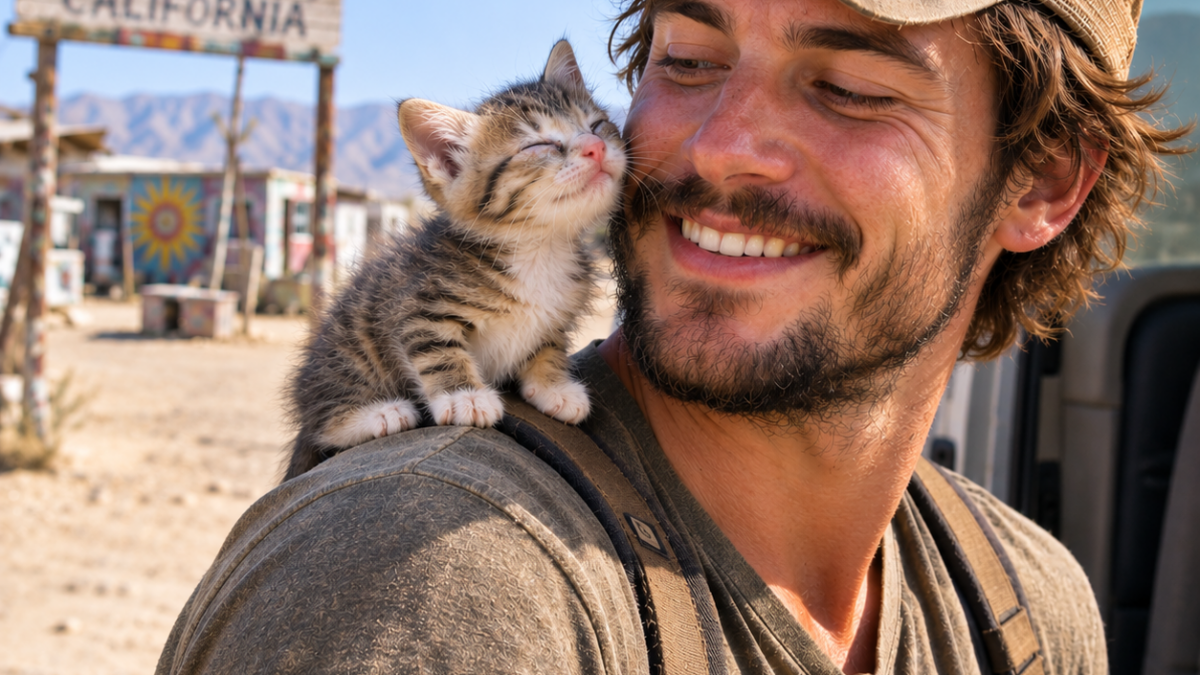
I Found a Blind 4-Week-Old Kitten Alone in 90° Desert Heat—Then She Climbed Onto My Shoulder and Never Really Left
I thought the tiny shape sitting in the middle of a desert road was a rock—until it moved, let out one desperate meow, and started running toward the sound of my van even though both of its eyes were sealed shut.
The kitten was barely four weeks old, completely alone in ninety-degree heat, sick enough that I did not know whether she would survive the night, and I was probably the least qualified person in California to save her because I had spent most of my life insisting I was allergic to cats.
I planned to keep her safe until a shelter opened Monday morning, but a few days later she climbed onto my shoulder, tucked her face against my neck, and made me realize the hardest part of rescuing her was no longer keeping her alive—it was admitting I did not want to give her away.
I was driving through Slab City, California, when I saw her.
If you have never been there, it is difficult to explain the landscape without making it sound more dramatic than it is.
Desert.
Dust.
Old roads.
Scattered structures.
Vehicles in various stages of usefulness.
Heat that seems to come from both the sky and the ground.
There are beautiful parts of it.
There are strange parts.
And there are long stretches where you can drive without seeing another person close enough to help if something goes wrong.
That afternoon, the temperature was around ninety degrees.
I was moving slowly down a rough road when something appeared ahead.
Small.
Gray-brown.
Still.
At first I thought it was a rock.
Then the rock moved.
I eased off the accelerator.
The shape lifted its head.
And I heard the smallest sound.
Meow.
Not loud.
Not dramatic.
Barely enough to carry over the engine.
I stopped.
PART2:
For a second, the animal disappeared below the front edge of my windshield.
Then I opened the door.
Another meow.
I stepped out.
That was when I realized how tiny she was.
A kitten.
Maybe the size of both my hands together.
Dusty fur.
Thin legs.
Huge ears.
And eyes that looked wrong.
They were crusted shut.
Completely.
She could not see me.
Yet the moment I shut the van door and my footsteps changed direction, she turned toward the sound.
Then she started moving.
Not away.
Toward me.
A four-week-old kitten in the middle of the desert, unable to see, had apparently decided that whatever noisy metal thing had just stopped beside her was the best option available.
I crouched.
“Whoa, whoa, whoa.”
She kept coming.
Tiny paws over hot dirt.
Unsteady.
PART3:
Determined.
“Where did you come from?”
Meow.
I looked around.
Nothing.
No adult cat.
No other kittens.
No person walking toward us.
No obvious house close enough that I could assume she had simply wandered out.
I waited.
That part matters.
When people find kittens alone, the mother may still be nearby.
I knew at least that much.
So I did not immediately scoop her up and drive away.
I checked around the road.
Looked beneath abandoned material.
Walked farther than I probably should have in the heat.
Called softly.
Waited.
The kitten remained close to the van.
Every time I walked several yards away, she cried.
When I returned, she quieted.
I checked again.
Nothing.
The temperature made the decision more urgent.
Ninety degrees for an adult cat with shade and water is one thing.
For a tiny kitten that could not see, sitting exposed near a road?
Different problem.
I crouched again.
She circled one of my ankles.
Then rubbed against my shoe.
I laughed nervously.
“This is bad.”
She meowed.
“You have no idea who you picked.”
The reason I said that was simple.
I was not a cat person.
At least I did not think I was.
I had always told people I was allergic.
Cats made my eyes itchy.
Sometimes my nose ran around them.
More importantly, my life was not designed for an animal.
I spent large amounts of time traveling.
I lived out of my van during stretches of work.
My schedule changed constantly.
The van could become dangerously hot when parked.
Even if I managed my own discomfort around cats, I could not leave a four-week-old kitten inside a vehicle in the California sun.
I took out my phone.
No signal at first.
Moved.
One bar.
I searched:
animal shelter near me.
Veterinarian.
Cat rescue.
Anything.
Sunday.
Closed.
Closed.
Closed.
Emergency options were farther away than I could safely reach without first figuring out how to transport a kitten I had not planned to meet.
I stared at her.
She stared in my approximate direction through eyes she could not open.
“I don’t know what to do.”
Meow.
“I genuinely don’t know what to do.”
She walked toward my voice.
That somehow made it worse.
I checked the area one more time.
Still no mother.
No litter.
Nothing.
So I made the smallest decision possible.
Not:
I am keeping this kitten.
Not:
I am adopting a cat.
Just:
You are not staying in the road tonight.
That I could handle.
One night.
Keep her alive.
Find professional help Monday.
Simple.
At least it sounded simple.
I drove carefully to a small store and found a cardboard box.
At a gas station, I bought water and what I believed was appropriate cat food.
Looking back, I was guessing.
I knew enough to know I did not know enough.
The kitten stayed close.
She barely weighed anything.
When I lifted her, I could feel every little movement through her body.
She shook.
Not violently.
But constantly.
I placed a towel in the box.
She tried climbing out.
I put her back.
She climbed again.
Apparently blindness had not reduced her opinion about cardboard.
Eventually she stayed near me instead.
That first evening, I watched her circle my feet.
If I moved, she followed the sound.
If I stopped, she bumped into my shoe or found my ankle and pressed against it.
It was almost funny.
Except she was sick.
Her eyes were still sealed.
She ate very little.
Drank almost nothing.
And when the sun went down and the desert finally began cooling, she started crying.
Again.
Again.
Again.
I sat beside her.
She quieted.
I moved away.
Crying.
Back.
Quiet.
“Okay.”
I sat down.
“So that’s the arrangement?”
She crawled close.
I remember feeling something I hate feeling.
Helpless.
If an engine breaks, there are tools.
If a tire goes flat, there is a procedure.
If a route changes, you find another one.
But when a living creature is four weeks old and sick and you do not understand what it needs, effort does not automatically produce the right answer.
I searched everything I could.
What should a four-week-old kitten eat?
How warm should she be?
How often should she drink?
What does eye infection look like?
When is a kitten too young to be away from its mother?
Every answer created another question.
I barely slept.
I kept waking to check whether she was breathing.
Once I startled her and she meowed at me as though I had inconvenienced her personally.
“Good.”
I laughed.
“Be mad.”
Angry was better than silent.
At some point during that first night, I touched the tip of her nose.
She pushed toward my finger.
I touched her cheek.
Her body relaxed.
Just slightly.
That tiny reaction stayed with me.
Not because it was a magical bonding moment.
I think she was exhausted.
Warmth felt good.
Gentle contact felt good.
She was a baby animal separated from everything familiar.
But sitting there, I realized how completely alone she must have been before I drove up.
No mother.
No siblings.
No vision.
Heat.
Road noise.
Then an engine.
Maybe that was why she ran toward the van.
It was not because she knew I was safe.
She could not know.
The van was simply evidence that something living was nearby.
Monday morning, I found a veterinarian.
I arrived as early as I could.
The staff took one look at her and immediately understood that I was out of my depth.
“How old do you think she is?”
“I have no idea.”
“Where did you find her?”
“Middle of the desert.”
“Mother?”
“Couldn’t find one.”
“Other kittens?”
“No.”
They weighed her.
Examined her.
Checked for a microchip even though she was so young it seemed unlikely.
Nothing.
No identification.
No owner information.
Then came the estimate.
About four weeks old.
Four.
I looked down at her.
“You’re basically an infant.”
The veterinarian explained that she was far too young to be alone.
Her eyes needed treatment.
She was already unwell.
Medication.
Cleaning.
Monitoring.
Nutrition.
Hydration.
Instructions.
I listened like someone preparing for an exam I had not known I was taking.
I asked every stupid question I could think of.
“How do I know if she’s eating enough?”
“What if she won’t drink?”
“What if she cries?”
“What if she gets worse tonight?”
“What if I mess up the medication?”
The veterinarian did not make me feel stupid.
That helped.
Giving medication was another matter.
The kitten disagreed with medical science.
Strongly.
She weighed almost nothing and somehow possessed eight legs whenever medicine appeared.
I would get her positioned.
She would twist.
Paw.
Turn.
Climb.
Meow.
I apologized constantly.
“I’m sorry.”
Medication.
“I’m sorry.”
Eye cleaning.
“I’m sorry.”
She did not forgive me.
At least not immediately.
Then something began changing.
The swelling around her eyes improved.
Crusting cleared.
One morning, an eye opened.
Not completely.
A narrow little slit.
I stared.
“Hey.”
She blinked.
“Can you see me?”
Obviously she could not answer.
The second eye followed.
Within days, I saw her face properly for the first time.
Bright eyes.
Alert.
Curious.
Completely different from the sick little animal I had lifted off the desert road.
As her vision improved, her personality arrived like somebody had opened a door.
She climbed.
Investigated.
Attacked things that were not enemies.
My fingers became unacceptable moving targets.
Shoelaces became prey.
Pieces of paper apparently deserved death.
She started eating properly.
The shaking stopped.
And she discovered that she could climb onto me.
The first time it happened, I was sitting down trying to work.
She approached my leg.
Climbed.
I caught her before she fell.
She kept going.
Chest.
Shoulder.
Then she settled against the side of my neck.
I froze.
“Excuse me.”
Nothing.
“Is this where you live now?”
Apparently.
I had expected cats to be aloof.
Independent.
Maybe mildly contemptuous.
This kitten had not received that information.
If I walked away, she complained.
If I sat near her, quiet.
If I touched her nose, she leaned forward.
If I scratched the side of her cheek, she sometimes closed her eyes like the entire world had suddenly become manageable.
Then:
up the shirt.
Onto the shoulder.
Stay.
I started joking that I had acquired a parrot.
Friends laughed.
I laughed too.
But something else was happening beneath the jokes.
She was learning me.
My footsteps.
Voice.
Smell.
Routine.
And I was learning her.
The impatient meow.
The lonely meow.
The I-am-about-to-do-something-stupid silence.
That silence was dangerous.
Whenever things became suspiciously quiet, I learned to look immediately.
One afternoon she disappeared.
I panicked.
Checked under seats.
Behind bags.
Everywhere.
Then heard a tiny sound above me.
She was on my shoulder.
I do not even remember her climbing up.
“Woah.”
She stared.
“Woah, woah, woah.”
I held out my hand.
“Say hi.”
She swatted.
“Okay.”
I laughed.
“We’re working on manners.”
At first, I still assumed someone else would adopt her.
That was the responsible plan.
I had travel.
Work.
A van.
Heat.
Allergies.
Those facts had not changed because a kitten liked my shoulder.
Friends offered.
People told me:
“I’ll take her.”
“She’s adorable.”
“She’ll have a good home.”
I should have been relieved.
Instead, every offer produced the same uncomfortable reaction.
I imagined handing her over.
Then driving away.
It felt wrong.
I tried arguing with myself.
You found her.
You got her medical care.
You kept her alive.
That is enough.
Rescue does not require adoption.
Correct.
Completely correct.
Then she climbed onto my shoulder.
Again.
And fell asleep.
I sat there longer than I needed to.
Her tiny body rose and fell against my neck.
Warm.
Safe.
Trusting someone she had known for only days.
That was when the truth became inconvenient.
I loved her.
Not in the abstract:
poor kitten, glad she survived.
I wanted to see what she looked like grown.
I wanted to know whether her ears would stay oversized.
I wanted to know what kind of cat she would become.
I wanted to see her eyes when they were fully healthy.
I wanted to be the person she ran toward.
The problem was that wanting something did not automatically make it a good idea.
I could not leave her in a parked van while I worked.
That was nonnegotiable.
Temperatures inside vehicles rise fast.
A young cat could not safely live around my work schedule that way.
So I considered every option.
Change job routine?
Boarding?
Friends?
Temporary foster?
Then I thought about my parents.
My parents had a house.
Space.
Stability.
And, importantly, my father.
My father was the kind of man who had spent years saying things like:
“We don’t need animals in the house.”
Not:
I dislike animals.
That would have been easier.
He simply seemed to believe animals were another category of unnecessary complication.
Whenever someone mentioned pets:
“No.”
Dog?
“No.”
Cat?
“Definitely no.”
I called.
“Hey.”
“What?”
“I found a kitten.”
Pause.
“Why?”
“That is not generally how finding works.”
“Where?”
“Desert.”
Longer pause.
“What do you mean, desert?”
“Like… outside.”
“Is it yours?”
“No.”
The kitten climbed onto my shoulder.
I looked at her.
“Maybe.”
My father heard the meow.
“What was that?”
“Nothing.”
Another meow.
“That doesn’t sound like nothing.”
I tried explaining.
Four weeks.
Sick.
Could not see.
Vet.
Getting better.
Needs stable place.
My father responded exactly as expected.
“You cannot keep a cat in that van.”
“I know.”
“So find it a home.”
I looked at her.
“Working on it.”
But somewhere during that conversation, the idea changed.
Not:
Could my parents take a stray kitten?
Instead:
Could my parents’ house become her home?
And could she still be mine in the ways that mattered?
The logistics were complicated.
Distance.
Nearly three thousand miles between where I was traveling and where she could safely settle.
But by then, I had stopped asking:
What is easiest?
I started asking:
What gives her the safest life?
So we drove.
A nearly three-thousand-mile journey with a kitten that had been found blind in the desert approximately one week earlier.
Nothing about that sentence sounds responsible.
But we planned.
Stopped.
Managed temperature carefully.
Made sure she ate.
Watched hydration.
Followed medical instructions.
I checked on her constantly.
She adapted faster than I did.
The first long day, I expected crying.
Some.
Then:
sleep.
Wake.
Explore.
Shoulder.
Sleep again.
Every stop became a little routine.
I would open the safe area.
She would look around.
Climb.
Inspect me as though verifying that I was still the same person.
Then settle.
We traveled through landscapes she could finally see.
The irony was not lost on me.
A week earlier, her entire world had been sound and heat.
Now she watched light move across windows.
Trees.
Buildings.
Gas stations.
Motel rooms.
My face.
Her curiosity grew every day.
There was something almost absurd about it.
She had every reason to be cautious.
Instead, once she felt safe, she wanted to know everything.
One night, I was lying awake while she slept nearby.
I thought about where I found her.
A little moving “rock” in the road.
Eyes sealed.
No visible mother.
No idea where she had come from.
If I had taken a different route—
If I had driven through ten minutes earlier—
If I had assumed she was debris—
If I had not heard the meow—
I stopped.
Those thoughts are useless after a while.
Life is full of intersections you cannot audit.
What mattered was:
I stopped.
And after that, she kept choosing closeness.
By the time we reached my parents’ house, I was nervous.
Not about the kitten.
About my father.
I carried her inside.
My mother reacted exactly as expected.
“Oh my God.”
Instant soft voice.
Instant affection.
My father stood several feet away.
Arms crossed.
“What is it doing?”
“Existing.”
“In my house?”
“For now.”
The kitten looked around.
New environment.
New smells.
New people.
Then she did what kittens do.
Ignored the emotional significance entirely.
She walked.
Sniffed.
Explored.
My father watched.
She approached him.
He stepped back slightly.
I laughed.
“You’re afraid of a four-week-old cat?”
“No.”
“She weighs less than your shoe.”
“I am observing.”
“Sure.”
The kitten sat.
Looked up.
My father looked down.
Long pause.
Then:
“What does it eat?”
There it was.
First crack.
“Specific kitten food.”
“How often?”
I stared at him.
“What?”
“I’m asking.”
Within days, the man who did not need animals in his house knew where her food was.
He noticed when her water needed changing.
He asked whether I had given her medication.
Then began talking to her when he believed nobody was listening.
I caught him once.
“What are you doing?”
“Nothing.”
“You’re talking to the cat.”
“I was telling her to get down.”
The kitten was sitting nowhere she needed to get down from.
“Right.”
Another day, she climbed onto his chair.
He did not move her.
My mother looked at me.
I looked at her.
Neither of us said anything.
Because some victories are destroyed by acknowledging them too quickly.
The temporary arrangement became permanent.
Not overnight.
We talked about it.
Really talked.
Care.
Veterinary costs.
My travel.
What happened if my parents traveled.
Indoor safety.
Long-term responsibility.
I did not want my parents taking her because I had emotionally cornered them.
Eventually, they agreed.
She could live there.
Safe house.
Stable routine.
People home often.
And I would remain responsible too.
I would visit.
Pay what needed paying.
Stay involved.
The arrangement ended up being better than the fantasy of keeping her constantly with me.
She had space.
Predictability.
Family.
And I still had her.
Or perhaps she had all of us.
She grew.
The tiny desert creature became a confident young cat.
Her eyes healed.
Her coordination improved.
Those enormous ears began looking more proportional.
She developed opinions.
Many.
She became astonishingly independent given how desperately she had once needed to remain close.
That was one of my favorite things.
When I first found her, she could not tolerate losing track of me.
Later, she could wander into another room without concern.
Explore.
Nap alone.
Sit at a window.
Then when I came home:
there she was.
Huge bright eyes.
At the door.
That look.
My playmate is back.
I would drop my things.
She would race.
I would chase.
She would hide.
Then attack from some absurd angle.
Sometimes I laughed so hard I could barely breathe.
The cat I supposedly could not keep had somehow become one of the fastest ways to make me happy.
My allergies?
Still real enough to notice sometimes.
But manageable enough that they did not decide the relationship for me.
That surprised me too.
For years, “I’m allergic to cats” had functioned as a complete argument.
No cats.
Conversation over.
Then a blind kitten ran toward my van in the desert and apparently decided the argument required revision.
She became adventurous.
That fit her.
I sometimes watched her investigate a new place and thought:
Of course.
The first meaningful decision I ever saw her make was running toward a vehicle she could not see because it sounded like life.
Curiosity may have been in her before sight was.
Maybe that was why we made sense.
Travel had brought me to that desert road.
Curiosity had put me there.
The same impulse that made me want to see what was around the next turn was now living inside this cat.
Years later, I still thought about the first night.
Her shaking.
Eyes closed.
Crying.
Me sitting there with my phone, trying to learn kitten care from scratch.
I had believed medicine was the whole rescue.
And medicine mattered enormously.
Without veterinary treatment, she might not have recovered.
But there was another part.
When she cried and I approached, she quieted.
When she climbed onto my shoulder, her body relaxed.
When she pressed against me, she slept.
I do not think love replaces veterinary care.
That would be a dangerous lesson.
It does not cure infections.
It does not replace nutrition.
It does not substitute for professional treatment.
But safety changes how an animal experiences recovery.
Medicine helped her body.
Consistency told her she was allowed to rest while it healed.
That mattered.
There was one moment I remember especially.
She was still tiny.
Her eyes were improving but not completely clear.
I was holding her.
She reached one paw toward my face.
Tiny claws.
“Ow.”
Another paw.
“Okay, that’s going to be a point deduction.”
She swatted again.
“Left paw showing.”
Another.
“Right paw.”
I laughed.
“Judge is unimpressed.”
She stared at me.
Then climbed onto my shoulder.
Again.
That became our thing.
No matter how independent she became, the shoulder remained familiar.
Sometimes she would climb partway and decide she was too grown for it.
Other times she settled there as if no time had passed.
People asked what I named her.
The answer mattered less to me than what I called her when nobody was asking.
Little tiger.
Little daughter.
My girl.
Family.
I never expected to become a “cat dad.”
Honestly, the phrase would have made me laugh before her.
Then I became exactly that.
Not because I went looking for a cat.
Not because I decided I needed companionship.
Not because someone convinced me cats were misunderstood.
A tiny blind kitten was sitting in the wrong place at exactly the moment I drove by.
That was all.
At least that was how it began.
What happened afterward was choice.
I chose to stop.
Then to wait for a mother.
Then to take her out of the heat.
Then to find veterinary care.
Then to give medication even when neither of us enjoyed it.
Then to keep her another day.
Then another.
Then to admit I was attached.
Then to recognize that attachment did not make my van the right home.
Then to drive almost three thousand miles so she could have something safer.
Then my parents chose her too.
My father, who supposedly wanted no animal, began arranging parts of his day around a cat.
My mother welcomed her without hesitation.
And the kitten chose them in return.
People like rescue stories because they usually have one dramatic moment.
Someone sees an animal.
Stops.
Saves it.
But that is rarely the part that changes a life.
Stopping the van took seconds.
The real rescue was everything after.
The clinic appointment.
Medication.
Food.
Temperature.
Sleepless nights.
Changing plans.
Asking questions.
Admitting ignorance.
Accepting help.
Making a long drive.
Choosing the home she needed rather than the one that made me feel heroic.
And then doing the ordinary work long after the dramatic part was over.
That is what changed me.
Before her, I thought helping an animal meant solving an emergency.
After her, I understood that sometimes the emergency ends and the responsibility begins.
She was not a desert kitten forever.
Eventually, she was simply a cat.
A healthy cat.
An occasionally ridiculous cat.
A cat with favorite sleeping places.
A cat who knew exactly which humans could be manipulated.
A cat who believed doors should open when she approached them.
A cat who still sometimes greeted me as though the best part of her week had just walked inside.
That ordinary life was the victory.
Not the rescue photograph.
Not the desert.
Not the first vet appointment.
The ordinary days afterward.
Once, after I had been away for a while, I came back to my parents’ house.
The door opened.
She appeared.
Stopped.
Looked at me.
For one second I saw the kitten from the road.
Two steps.
Stop.
Look.
Then she ran.
Straight toward me.
I crouched.
“Woah, woah, woah.”
She climbed.
Shoulder.
Of course.
I laughed.
“You still remember this?”
She settled against my neck.
Maybe she remembered.
Maybe she simply liked the highest available seat.
Cats do not owe us poetic explanations.
I did not need one.
I held her there.
And thought about that first afternoon.
A rock in the road.
Then movement.
Then a meow.
A blind kitten running toward the only sound she could find.
At the time, I thought she was the lost one.
I am not saying I was secretly broken and she magically fixed me.
Life is not that simple.
I had friends.
Work.
Places to go.
A life I liked.
But she opened a part of it I had never planned to make room for.
Responsibility without a schedule.
Attachment without preparation.
A relationship that began before I could list all the reasons it was inconvenient.
She made me softer in places where I had been practical.
More patient where I had been efficient.
More willing to rearrange things for something that could not explain what it needed.
Most of all, she taught me that sometimes the right decision does not arrive as certainty.
That first day, I did not know I was doing the right thing.
I knew only what I could not do.
I could not leave her there.
The next morning, I did not know whether she would become my cat.
I knew only that she needed a veterinarian.
Days later, when friends offered homes, I still did not know what the permanent answer should be.
I only knew that giving her away suddenly hurt.
Then the problem became clearer.
Keeping her in my travel life would have been selfish if I could not make it safe.
So the answer changed again.
My parents’ house.
A long drive.
Another transition.
No single moment contained the whole solution.
We found it one decision at a time.
That is why I still think about her whenever someone says:
“I could never rescue an animal. I wouldn’t know what to do.”
Neither did I.
I was standing in the California desert saying those exact words.
“I don’t know what to do.”
Twice.
Maybe more.
Knowing everything was never required.
Doing the next responsible thing was.
Get her out of the heat.
Look for the mother.
Find veterinary care.
Follow instructions.
Ask for help.
Build a safer plan.
That was enough to begin.
Today, when I see her moving confidently through my parents’ house, I have trouble connecting that cat to the tiny creature whose eyes were sealed shut.
She walks like the house belongs to her.
Honestly, it probably does.
My father would deny this.
His chair tells another story.
So does the fact that he knows her feeding schedule.
And the fact that he sometimes buys things for her and then claims my mother requested them.
My mother stopped arguing about it.
We all know.
The man who never wanted an animal ended up with a cat who apparently never received the memo.
And me?
I still travel.
Still work.
Still leave.
But there is a house I can return to where a cat sometimes meets me at the door.
She does not remember the desert the way I do.
She cannot tell the story.
She does not know she was almost invisible in the road.
Does not know how terrified I was that first night.
Does not know I spent hours trying to convince myself someone else should take her.
She only knows her life.
Food.
Safety.
People.
Places to sleep.
Things to explore.
A dad who disappears sometimes and keeps coming back.
That is probably better.
She does not need to be the kitten who almost died in the desert forever.
She gets to be ordinary.
Annoying.
Curious.
Loved.
Sometimes I think about how close I came to convincing myself I was not the person for her.
Allergies.
Work.
Travel.
Van.
Every reason was legitimate.
The solution was not pretending those problems did not exist.
It was finding a life for her that respected them.
That distinction matters to me.
Love did not mean forcing her into my schedule.
Love meant changing the plan until she was safe.
And somehow, in the process, the kitten I had intended to protect for one night became my little daughter.
The funny part is that people sometimes tell me:
“She was so lucky you found her.”
Maybe.
I understand what they mean.
But I always think about the other direction.
I was driving alone through a desert.
She could not see.
She heard one vehicle.
And somehow, out of every road, every hour, every possible direction either of us could have gone, that tiny kitten ran toward mine.
I stopped because I thought she needed me.
Years later, I am not entirely sure which one of us got luckier.








