I Fostered One Lonely Maine Coon—Then Her Cry at the Door Exposed the Brother They Had Taken From Her
PART3:
Those words sounded like something I could manage.
I spent two days preparing the guest room.
It had once been Rachel’s room, then a sewing room, then the place where things went when I did not know where else to put them. I dusted the desk, washed the curtains, vacuumed the rug twice, and moved a lamp to the corner so the light would be soft.
I bought food bowls.
A litter box.
A scratching post.
A soft blue bed near the window.
At the last minute, I took an old plaid blanket from the cedar chest and folded it on the floor beside the bed.
It had been Arthur’s.
For a moment, I stood there with my hands on it.
That blanket still held something of him.
Not the smell anymore. Time had taken that. But the memory of weight. Winter evenings. His hand resting on the arm of the sofa. Him saying, “Maine Coon? Sounds like a politician from Portland.”
I almost put the blanket back.
Then I thought of an old cat whose owner had died.
I left it there.
Elara arrived on a Thursday afternoon in a hard plastic carrier too small for her enormous paws.
Meredith brought her herself.
She was younger than I expected, maybe late thirties, with tired eyes and a rescue sweatshirt covered in fur. She set the carrier gently on the guest-room floor.
“She’s been quiet in the car,” she said.
Elara was pressed against the back of the carrier, silver-gray fur fluffed around her like a storm cloud. Her ears were tufted like little brushes. Dark markings framed her face and ran down her back in soft stripes. She had a broad chest, huge paws, and eyes the color of rainwater under cloudy skies.
But what I remember most was the sadness.
Not fear exactly.
Not even confusion.
Sadness.
Deep, patient sadness.
The kind that looked as if it had already been waiting too long.
“Oh,” I whispered.
Meredith glanced at me.
“She’s a sweetheart.”
I crouched slowly.
“Hello, Elara.”
The cat did not move.
“She may hide for a bit,” Meredith said. “That’s normal.”
“Of course.”
“She’s eating some, not a lot. Just give her time.”
I nodded.
Then Meredith handed me a folder with paperwork, feeding instructions, and the rescue’s phone number.
“She really should be an easy one,” she said, too brightly. “Just one cat. Quiet home. I think this will be good for her.”
Again, that phrase.
Just one cat.
I opened the carrier door after Meredith left.
Elara stayed inside for almost ten minutes.
I sat on the floor nearby and pretended to read the paperwork, though I was really watching the opening of the carrier from the corner of my eye.
Finally, one silver paw emerged.
Then another.
She stepped out slowly, body low, tail tucked close. She sniffed the rug, glanced at the bed, ignored the food, and went straight under the desk.
I smiled gently.
“That’s all right,” I said. “Take your time.”
I sat with her for half an hour.
She trembled beneath the desk, her long fur rising and falling with her breath.
“It’s okay,” I whispered. “You’re safe now.”
The words felt familiar.
How many times had people said them to me after Arthur died?
How many times had I nodded while feeling anything but safe?
I left the room door half closed and went to make tea.
It was only a few minutes later that I heard the first cry.
At first, I thought something had fallen.
It was a low, broken sound, so unlike a normal meow that it made my hand freeze around the kettle.
Then it came again.
Longer.
Rawer.
I hurried down the hall.
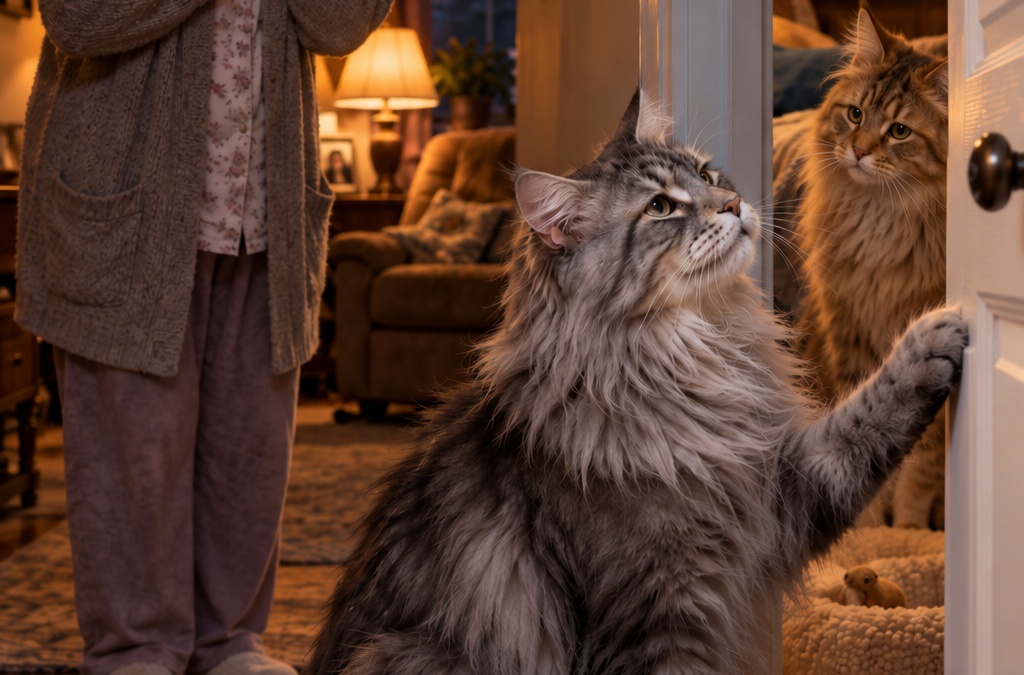
Elara was no longer under the desk.
She was standing at the guest-room door.
I had pulled it almost shut so she could feel secure, leaving a crack. She had pushed it closed somehow, and now she was pressed against it with her whole body, one enormous paw sliding along the bottom edge.
“Elara?”
She cried again.
The sound went straight through my chest.
It was not hunger.
It was not irritation.
It was not the dramatic complaint of a cat in a new place.
It was grief.
There is a difference, and anyone who has ever heard it knows.
I opened the door.
Elara did not bolt for the front entrance. She did not try to escape outside. She stepped into the hallway, lifted her head, and began searching.
Room by room.
She looked behind the living-room curtains.
She sniffed beneath the dining table.
She investigated the old recliner where Arthur had spent so many evenings. She stood there longer than anywhere else, nose hovering over the worn fabric, as if the chair’s history confused her.
Then she moved on.
She checked the closet.
The laundry room.
The space behind the sofa.
The hallway bathroom.
She returned to the guest room, circled once, came back into the hall, and cried again.
I stood there in my own house feeling helpless.
She was not trying to leave.
She was looking for someone.
That first night, neither of us slept.
Elara walked the house in slow, miserable loops.
Every so often, she would stop at the guest-room door and cry.
I tried food.
I tried quiet.
I tried sitting with her.
I tried leaving her alone.
Nothing helped.
Around two in the morning, I sat on the kitchen floor with my back against the cabinets while Elara crouched in the hallway, watching the dark.
“You lost someone too,” I said softly.
Her ears moved.
I thought of Arthur’s funeral.
The moment everyone left.
The way the house had looked exactly the same and yet nothing inside it belonged to the life I knew.
Maybe Elara was standing in that same impossible space.
The world smelled wrong.
The rooms were wrong.
The voice she expected was missing.
And nobody had explained why.
At dawn, she was lying beside my slippers.
Not touching them.
Just beside them, exhausted.
I did not call the rescue the moment they opened.
I waited until 9:02 because I was still the kind of woman who believed in being polite, even when anger had begun tapping at the inside of my ribs.
Meredith answered.
“Willow Creek Rescue, this is Meredith.”
“It’s Evelyn Carter,” I said. “I’m fostering Elara.”
“Oh, Mrs. Carter. How did the first night go?”
I looked down at Elara, who had closed her eyes but was not sleeping deeply. Her body was still tense, as if listening for a sound only she knew.
“Did Elara come in with another cat?”
Silence.
Not long.
But long enough.
“Meredith?”
She exhaled.
“Yes.”
The word changed everything.
I sat down slowly.
“Who?”
“Her brother. Jasper.”
Brother.
Not a random cat.
Not a shelter companion.
Her brother.
“They were surrendered together?”
“Yes.”
“How long had they lived together?”
Another pause.
“Nearly six years.”
I closed my eyes.
Elara opened hers immediately, as if my sadness had made a sound.
“Why wasn’t I told?”
Meredith’s voice grew careful.
“Bonded pairs are very difficult to place, Mrs. Carter.”
“That is not an answer.”
“It was a complicated intake.”
“She cried all night.”
“I’m sorry.”
“She searched my house.”
“I know this is upsetting.”
“Do you?” I asked, and my voice surprised me.
It was not loud.
It was worse.
It was steady.
“Because I watched an elderly cat spend the night looking for the only family she has left, and I’m beginning to think everyone else knew exactly who she was looking for.”
Meredith did not respond.
“Where is Jasper?” I asked.
“He’s in another foster home.”
“How is he?”
This time, the silence told me before she did.
“He’s having some trouble adjusting.”
“What does that mean?”
“He’s hiding. Not eating well.”
“Not eating well or not eating?”
“He ate a few bites the first day.”
“That was two days ago.”
Meredith’s breath shook.
“I know.”
I looked at Elara.
She was watching me with those rainwater eyes.
I thought of Arthur and me in our last winter together. How he reached for my hand at night without waking. How, even after forty-six years of marriage, he still turned toward me in his sleep as if some part of him needed to know I was there.
What would I have done if, in his final illness, someone had decided separating us made paperwork easier?
I knew the answer.
I would have burned the world down politely.
“I’ll take him,” I said.
Meredith sounded startled.
“What?”
“I’ll take Jasper too.”
“Mrs. Carter, two Maine Coons are a lot of cat.”
“And one grieving Maine Coon is too much heartbreak.”
“He may not be easy.”
“Neither is grief.”
“We would need approval.”
“Get it.”
Another pause.
“I’ll call you back.”
“Please do.”
Then I hung up and sat in the quiet kitchen with my hand over my mouth.
For the first time since Arthur died, I felt something unfamiliar move through me.
Purpose.
Not happiness.
Not yet.
Purpose.
It was sharp and frightening and alive.
Meredith called back forty-seven minutes later.
“We can transfer Jasper to you this afternoon,” she said. “But I need to be honest. The rescue director is concerned that taking both may overwhelm you.”
I almost laughed.
A house that had survived three years of silence could survive two cats.
“Tell your director I appreciate the concern,” I said. “Then tell her to bring Jasper.”
“I’ll meet you at the rescue,” Meredith said.
The Willow Creek building was smaller than I expected.
A converted office tucked behind a veterinary clinic, with donated towels stacked in the lobby and a bulletin board covered in adoption photos. Dogs barked somewhere in the back. A volunteer walked past carrying a box of litter. Everything smelled like disinfectant, wet fur, and overworked kindness.
Jasper was waiting in a carrier on a metal table.
At first glance, he looked nothing like Elara.
He was golden-brown instead of silver, with darker ruff fur around his neck that made him look like a tired little lion. One ear bent slightly at the tip, giving him a permanently windblown look. He was large, even curled into himself, but he seemed smaller because of the way he had folded his body into the back corner.
Then he lifted his eyes.
There it was.
The same sadness.
The same question.
Where is she?
Meredith stood beside me.
“This is Jasper.”
“I know,” I said softly, though I had never seen him before.
Jasper made one sound.
Quiet.
Hoarse.
Almost not a meow at all.
I had heard widows make that sound at funerals when they were trying not to collapse.
I gripped the handle of the carrier.
“What happened to their owner?”
Meredith looked toward the hallway.
“Her name was Lillian Moore. She passed away in August. The cats stayed with her adult son for several weeks, but he said he couldn’t keep them.”
“Did he say they were bonded?”
“Yes.”
“Then why separate them?”
Meredith’s face tightened.
Before she could answer, another woman stepped from the office.
She was older than Meredith, maybe mid-fifties, with short blond hair, a stiff smile, and a clipboard held like a shield.
“Mrs. Carter,” she said. “I’m Denise Alden, director of Willow Creek.”
I knew immediately that this was a woman accustomed to making difficult decisions and being praised for staying calm while others cried.
“Thank you for allowing me to take Jasper.”
“We appreciate your willingness,” Denise said. “Though I hope you understand, we were trying to increase their chances. Older bonded pairs are often overlooked.”
I looked at Jasper’s carrier.
“And so you made them both suffer separately?”
Her smile thinned.
“That is an emotional way to phrase it.”
“It is an emotional situation.”
“We run on limited space and limited resources.”
“I understand.”
“Do you?”
I turned to her then.
“Yes. I understand limited resources. I understand hard choices. I understand doing the best you can with not enough hands. What I do not understand is telling me Elara was just one calm cat when she had a brother crying for her somewhere else.”
Meredith looked down.
Denise held my gaze.
“Our priority is placement.”
“My priority is not breaking what little family they had left.”
Something flickered across her face.
I had hit something.
Not guilt, exactly.
Defensiveness.
That would matter later.
For now, Jasper mattered more.
I signed the foster transfer paperwork.
On the drive home, Jasper was silent for the first ten minutes. Then, at a red light, he made one quiet cry from the carrier.
It was so soft I almost missed it.
“I know,” I said. “We’re going to her.”
He cried once more.
Then nothing.
When I pulled into the driveway, my hands were shaking.
Inside, Elara was waiting in the hallway.
Not in the guest room.
Not under the desk.
In the hallway facing the front door.
As if she had known.
I set the carrier down carefully.
For a few seconds, nothing happened.
Jasper stayed pressed inside, eyes wide.
Elara stared.
The entire house seemed to hold still.
Then Elara made a small chirping sound.
Not a cry.
Not the broken grief from the night before.
A chirp.
Questioning.
Jasper lifted his head.
His ears came forward.
He answered.
One rough little sound.
Elara rushed to the carrier so fast I gasped.
She pressed her nose to the metal door. Jasper pushed forward from inside, and their noses touched through the bars.
Then both cats began making sounds I had never heard before.
Soft trills.
Breathless chirps.
Tiny broken meows.
Elara rubbed her cheek against the carrier door again and again. Jasper pushed his face into the bars as if he could force his body through them by longing alone.
I fumbled with the latch.
The moment the door opened, Jasper stepped out.
Not quickly.
He was weak from not eating and stiff from fear.
But Elara pressed herself against him, shoulder to shoulder, guiding him out.
They touched noses properly.
Then cheeks.
Then Elara pressed her forehead beneath his chin, and Jasper lowered his head over her like he was sheltering her with his whole body.
I sank onto the floor.
They circled each other once, twice, tails trembling.
Elara wrapped her tail over Jasper’s back.
Jasper buried his face into the fur at her neck.
And then, for the first time since Arthur died, I heard my house fill with a sound that was not memory.
Purring.
Two deep, uneven, overlapping purrs.
One silver.
One gold.
One lost.
One found.
I cried so hard I had to put both hands over my mouth.
Not because it was sad.
Because it was beautiful in the way mercy is beautiful.
Beautiful because it almost did not happen.
Beautiful because someone had made a wrong decision, and somehow love had still found its way back through the door.
Within minutes, they were asleep together in the blue bed I had placed by the guest-room window.
It was not large enough for two Maine Coons.
They did not care.
Elara curled around Jasper like a crescent moon. Jasper rested his chin over her back. One of his enormous paws stretched outside the bed and rested on Arthur’s plaid blanket.
I stood in the doorway for a long time.
The house did not feel quiet.
For the first week, I was supposed to be fostering them.
That was the arrangement.
Temporary.
Assessing.
Helping.
I used those words because they sounded safe.
Temporary means you are not risking your whole heart.
Assessing means you can pretend love is research.
Helping means you are useful, not vulnerable.
But cats are very disrespectful toward human boundaries.
Jasper claimed the sunny window on the second morning.
He sat there with his mane glowing in the light, watching squirrels with such solemn intensity that I found myself narrating.
“Jasper, if you keep glaring like that, the squirrels may unionize.”
His ear twitched.
Elara became my coffee companion.
Every morning, she followed me into the kitchen, waited while I filled the kettle, then sat beside my chair as if we had agreed on this schedule years earlier. She did not beg. She supervised.
By the fourth day, I was speaking out loud constantly.
“No, Jasper, that is not your dinner.”
“Elara, your brother was sitting there first.”
“Both of you cannot fit on one magazine.”
“Arthur would have loved this,” I said once without thinking.
The room did not punish me for saying his name.
That was new.
Before Elara and Jasper, speaking to Arthur in the house made the silence afterward feel crueler.
Now, when I said his name, Elara blinked from the arm of the sofa and Jasper snored faintly in the recliner.
The silence had somewhere soft to land.
On the fifth day, Meredith called to check in.
“How are they doing?”
I looked into the living room.
Jasper was sprawled across the rug in a patch of sun, belly exposed, all dignity abandoned. Elara sat beside him washing one massive paw.
“They’re eating,” I said.
Meredith exhaled.
“Both?”
“Both.”
“Oh, thank God.”
“Jasper ate almost a full breakfast.”
Her voice wavered.
“That’s wonderful.”
There was something in her tone that made me pause.
“Meredith.”
“Yes?”
“Is there something else I should know?”
She was quiet too long.
I had learned to distrust pauses.
“Meredith.”
She sighed.
“I’m not supposed to discuss internal decisions.”
“That sounds like the beginning of a sentence I’m not going to enjoy.”
“Elara and Jasper’s owner left a note with them.”
I sat down.
“What note?”
“When her son surrendered them, he brought some belongings. Beds, food, a folder of vet records. There was a handwritten note from Lillian.”
My hand tightened around the phone.
“What did it say?”
“I only saw part of it.”
“Meredith.”
“It said they should not be separated.”
The words did not surprise me.
They enraged me.
“Where is that note?”
“In the file.”
“Then why did Denise separate them?”
“Because Lillian’s son signed them over and said the rescue could make placement decisions. Denise believed—”
“Denise believed convenience outranked a dead woman’s final instruction?”
Meredith whispered, “I argued against it.”
I believed her.
That was the worst part.
This was not a simple story with one villain and one hero.
Most cruelty in systems is quieter than that.
It happens in meetings.
In practical language.
In words like capacity, placement, outcomes, efficiency.
It happens when one person says, “But they love each other,” and someone else says, “Love won’t get them adopted.”
“Send me the note,” I said.
“I can’t.”
“Then tell Denise I want the complete intake file.”
“She won’t give it to you.”
“Then tell her I’ll come ask in person.”
That evening, I drove to Willow Creek.
I wore my good coat.
Not because it mattered.
Because Arthur always said I became more dangerous when I dressed nicely.
Denise met me in the lobby with the same clipboard.
“Mrs. Carter,” she said. “This is unexpected.”
“So was finding out Elara and Jasper’s dead owner asked that they never be separated.”
Her expression hardened.
“Meredith should not have disclosed that.”
“Then your concern is misplaced.”
“We followed legal surrender protocol.”
“I am not asking what was legal. I am asking what was right.”
A volunteer behind the desk stopped typing.
Denise lowered her voice.
“This rescue saves hundreds of animals a year.”
“I’m sure it does.”
“We cannot operate on sentiment alone.”
“Good. Because I brought facts.”
I took a paper from my purse.
It was not much.
A handwritten log I had made of Elara’s first night. Time-stamped notes. Crying at door. Searching rooms. Refused food. Slept beside slippers. Jasper’s reported refusal to eat. Their immediate change after reunification.
Denise glanced at it.
“This is anecdotal.”
“So is grief, until someone bothers to witness it.”
Her mouth tightened.
I leaned closer.
“You told me she was calm and undemanding. You did not tell me she had a bonded brother. You did not tell me their owner asked that they stay together. You did not tell me Jasper had stopped eating. Why?”
“Because fosters back out when placements become complicated.”
There it was.
Plain as a confession.
The lobby went silent.
Even Denise seemed to realize what she had said.
I nodded slowly.
“So you made it simple by leaving out the truth.”
“I made the best decision I could with the information—”
“No,” I said. “You had the information. You decided I did not deserve it.”
Her face flushed.
For a moment, I saw the exhaustion beneath her authority.
“I am trying to keep animals alive,” she said, and this time her voice cracked. “Every week we turn away cats. Dogs. Seniors. Medical cases. Bonded pairs sit for months. People want kittens. People want easy. They do not want two large older cats with grief and special food and histories that make them inconvenient.”
I heard the truth in that.
I also heard the failure.
“Then make people see them,” I said. “Do not make their love disappear because it is harder to market.”
Denise looked away first.
That was how I knew something had shifted.
The next morning, the rescue sent me a scanned copy of Lillian Moore’s note.
It was written in blue ink on lined paper.
My hands shook as I read it.
To whoever cares for Elara and Jasper,
They are brother and sister in every way that matters. Jasper is brave only when Elara is near. Elara eats only after Jasper starts. They sleep together every night and have done so since they were kittens.
I know I cannot stay with them. That is the hardest part of leaving this world.
Please do not separate them if there is any mercy in the decision.
They have already lost me.
Let them keep each other.
— Lillian Moore
I read it once.
Then again.
Then I took it into the living room and read it out loud.
Elara was on the sofa.
Jasper was in the recliner.
Neither understood the words, perhaps.
But when I reached the line They have already lost me, Elara looked at Jasper.
He opened his eyes.
And I had to stop.
I folded the copy carefully and placed it on the mantel beside Arthur’s photograph.
Maybe that sounds strange.
It did not feel strange to me.
Arthur and Lillian were strangers in life, but in my house, their absences had become part of the same quiet lesson.
Love leaves instructions.
Sometimes the living ignore them.
Sometimes they don’t.
Three days later, the rescue board called.
Not Denise.
The board president, a woman named Helen Suarez, whose voice carried both warmth and steel.
“Mrs. Carter, we are reviewing Elara and Jasper’s case.”
“I’m glad.”
“We owe you an apology.”
“You owe them one first.”
A pause.
“You’re right.”
That was the first time anyone from the rescue said that without defending themselves afterward.
Helen explained that Willow Creek would be changing its bonded-pair intake procedure. Any animal surrendered with a documented bonded companion would be evaluated as a pair first unless medical or safety concerns required otherwise. Fosters would be told the full history before placement. Owner notes would remain attached to files, not buried in supplemental documents.
“Denise has agreed to step back from intake decisions during the review,” Helen added.
I did not feel triumphant.
I felt tired.
Justice often arrives carrying paperwork instead of trumpets.
Still, paperwork matters.
Ask anyone whose love was erased by a form.
A week after Elara arrived, Meredith called.
This was the call I had been expecting and avoiding.
“We’re preparing updated adoption profiles,” she said carefully. “For Elara and Jasper together this time.”
I looked across the room.
Arthur’s recliner had been fully conquered.
Jasper was asleep in it, head hanging off one side, mane ruffled, bent ear twitching in a dream. Elara was draped partly over him, one silver paw resting across his back.
As if she had promised never to let him vanish again.
“When would you list them?” I asked.
“Whenever you’re ready.”
The correct answer was soon.
That had always been the plan.
Foster.
Stabilize.
Say goodbye.
Help the next animal.
I opened my mouth.
Nothing came out.
Because in that moment, I realized the house had changed while I was busy calling it temporary.
The quiet had changed.
The morning had changed.
The evenings had changed most of all.
There were paw prints on the windowsill.
Fur on Arthur’s chair.
Two food bowls in the kitchen.
A bag of litter in the pantry.
A scratch on the doorframe that I should have been annoyed about but secretly liked because it meant something living had left evidence.
And me?
I had changed too.
I was cooking dinner again instead of toast.
I was opening curtains.
I was telling stories out loud.
I was laughing when Jasper tried to fit his enormous body into a box meant for canned tomatoes.
I was saying Arthur’s name without the room collapsing afterward.
Elara and Jasper had not erased my grief.
Nothing could.
No animal, no person, no amount of time can erase real love.
But they had made my grief less lonely.
They had walked into a house haunted by absence and filled it not with replacement, but with company.
Meredith waited.
I looked at Arthur’s photograph on the mantel.
Then at Lillian’s note beside it.
Then at the two cats asleep in the chair that had once held my whole world.
“Please don’t list them,” I said.
Meredith was quiet.
Then softly, “Are you sure?”
I smiled for the first time in a long while without feeling guilty for it.
“Yes.”
“Do you want to adopt them?”
“No,” I said, then corrected myself with a small laugh. “I mean yes. But that sounds too formal.”
“What should I write?”
I looked at Elara’s paw over Jasper’s back.
“Write that they’re home.”
The adoption papers were signed on a rainy Saturday.
Meredith cried.
I cried.
Denise did not attend, which was probably best.
Helen sent a handwritten note thanking me for fighting for them. I placed it in the folder with Lillian’s note.
The rescue took a photo for their page: me sitting in the armchair with Elara on one side, Jasper on the other, both looking mildly offended by the interruption. The caption said:
Elara and Jasper are officially home—together.
The post spread farther than anyone expected.
People shared stories of bonded pairs.
Old dogs separated from lifelong companions.
Cats who stopped eating after losing siblings.
Senior animals overlooked because love made them “less convenient.”
Some comments were cruel, of course. The internet has a bottomless appetite for missing the point.
“Rescues have to make hard choices.”
“They’re just cats.”
“Better separated than euthanized.”
“People are too emotional.”
I did not answer those comments.
Other people did.
Veterinary technicians.
Shelter volunteers.
Widows.
Fosters.
People who understood that practicality without compassion becomes its own kind of violence.
Then something unexpected happened.
Applications began coming in for bonded pairs at Willow Creek.
Not just Elara and Jasper—because they were already mine—but others.
Two senior tabbies named Milo and June were adopted together after eight months.
A pair of elderly beagles went to a retired couple who said, “We saw the Maine Coons and realized love comes in twos sometimes.”
A shy black cat and her blind brother found a home with a teacher who wrote, “Please don’t separate them. I know better now.”
Willow Creek created a new page on their website.
Better Together.
They posted bonded pairs there with their full stories, not hidden histories.
Denise eventually wrote me a letter.
I did not expect one.
It arrived in December, in a plain envelope with the rescue logo in the corner.
Dear Mrs. Carter,
I have started and stopped this letter more times than I would like to admit.
I separated Elara and Jasper because I was afraid no one would take them together. That is the practical answer. It is not the whole truth.
The whole truth is that years of rescue work had made me too comfortable deciding which heartbreaks were acceptable. I told myself a good outcome later justified pain now. Sometimes in rescue, delayed mercy is necessary. Sometimes it is an excuse.
In their case, it was an excuse.
I ignored Lillian Moore’s note because it made my job harder.
I ignored their bond because I was tired.
I withheld information from you because I wanted the placement to work.
I am sorry.
The new bonded-pair policy exists because you challenged me, and because Elara and Jasper proved what I should not have forgotten: survival is not the only measure of rescue.
Thank you for giving them the home I should have been brave enough to seek from the beginning.
Denise Alden
I read the letter twice.
Then I set it beside Lillian’s note.
Not because it erased what happened.
It did not.
But accountability deserves a place too.
That winter was the warmest my house had felt in years.
Not because of the weather.
Because of the noise.
Jasper snored.
Loudly.
Absurdly.
Like a tiny man pretending he did not.
Elara chirped when she jumped down from furniture, as if announcing each successful landing to the room.
They thundered down the hallway at 3:00 a.m. in what I began calling “the Maine Coon cavalry.”
They fought exactly once over Arthur’s recliner, then solved the problem by occupying it together, leaving no room for any actual human.
On Christmas morning, Rachel and Matthew came over with their families.
For the first time since Arthur died, I decorated properly.
Not just a wreath on the door and a little ceramic tree on the table.
A real tree.
Lights.
Ornaments.
Arthur’s ridiculous wooden moose wearing a scarf.
I thought it would hurt too much.
It did hurt.
But the hurt had company.
Jasper lay under the tree like a benevolent forest creature. Elara removed one ornament with surgical precision and batted it under the sofa.
My grandson Ben, who was eight and full of facts, announced that Maine Coons were “basically gentle giants but with murder paws.”
Jasper accepted this description.
Rachel watched me from the kitchen doorway while I basted the turkey.
“What?” I asked.
She shook her head.
“Nothing.”
“Rachel.”
She smiled, but her eyes were wet.
“It’s just good to hear you talking to someone when you cook.”
I glanced toward the living room.
“Elara is very interested in poultry safety.”
Rachel laughed.
Then she hugged me from the side the way she had when she was a teenager.
“I missed you,” she whispered.
The words hurt.
Because I knew what she meant.
Not that I had been physically gone.
That some part of me had been living behind glass since Arthur died.
“I missed me too,” I said.
That was the truth.
Elara and Jasper did not bring me back all at once.
No miracle works that neatly.
They brought me back in pieces.
A laugh here.
A routine there.
A reason to vacuum.
A reason to open the blinds.
A reason to say, “Good morning, you two,” and hear the sentence fill the kitchen.
Spring came again.
Elara and Jasper grew glossier, rounder, more confident. Jasper’s mane became magnificent. His bent ear remained ridiculous. Elara developed the habit of placing one paw on my knee when she wanted attention, then looking away as if the paw had appeared there independently.
On the anniversary of Arthur’s death, I did not spend the whole day alone.
I went to the cemetery in the morning.
I told him about the cats.
“You would pretend Jasper was too much,” I said, sitting beside his grave with my coat tucked under me. “Then you would give him half your chair.”
The wind moved across the grass.
“Elara would have loved you. She likes quiet men.”
I cried, of course.
I always would.
But when I came home, there were two cats at the door.
Not waiting in fear.
Waiting in expectation.
Dinner.
Affection.
Routine.
Life.
I placed my keys in the bowl and said, “I’m home.”
Jasper chirped.
Elara rubbed against my ankle.
And the house answered.
A year after their adoption, Willow Creek held a fundraiser focused on senior and bonded animals. Helen asked if I would speak.
I said no.
Then Rachel said, “Mom.”
I said no again.
Then Elara sat on the printed invitation.
So apparently it was decided.
I stood in front of a room full of volunteers, adopters, donors, and people holding paper cups of coffee, and I told the story.
Not perfectly.
My voice shook.
But I told it.
I told them about expecting one calm cat.
About Elara crying at the door.
About Jasper hiding under a bed and refusing food.
About Lillian’s note.
About the mistake of thinking love was an obstacle instead of the very thing that needed protecting.
Denise sat in the second row.
She looked thinner. Softer somehow. When I read Lillian’s line aloud—They have already lost me. Let them keep each other—Denise lowered her head.
I did not do it to shame her.
That was not the point anymore.
The point was witness.
Afterward, a woman approached me with tears in her eyes.
“My mother has two elderly cats,” she said. “She’s going into assisted living next month. We were only going to take one because it seemed easier.”
I waited.
She wiped her face.
“We’ll take both.”
That was when I understood something Arthur had once told me after I complained that kindness felt too small against the world’s cruelty.
“Small things only look small up close,” he had said. “From far enough away, a candle is a lighthouse.”
Elara and Jasper had become that.
A candle.
A lighthouse.
Two old cats who had suffered because people underestimated their love, then changed a policy because someone finally listened to their grief.
They are older now.
So am I.
Jasper’s muzzle has lightened. Elara moves more slowly on damp mornings. There are steps beside the sofa now and a ramp to Arthur’s recliner, which no longer belongs to any human in this house.
Every evening, they find each other.
Sometimes on the rug.
Sometimes in the chair.
Sometimes on the bed where Arthur once slept beside me and where, for a long time after his death, I could not bear another heartbeat.
Now there are two.
Jasper curls heavily against my legs.
Elara sleeps near my shoulder.
Some nights, I wake in the dark and listen to them breathe.
That may not sound like much.
But for someone who once feared the quiet would swallow her whole, two old cats breathing in the dark can sound like the world returning.
I still miss Arthur.
I will miss him until I am gone.
Love like that does not become past tense just because a body leaves.
But grief is no longer the only thing living in my house.
There is fur on the furniture.
Paw prints on the windows.
Two food bowls in the kitchen.
A folder on the mantel with Lillian’s note, Denise’s apology, and the adoption papers that say Elara and Jasper Carter, which still makes me laugh because Arthur would have called them “the fancy relatives.”
There is the sound of claws clicking down the hallway.
The rumble of purring from the recliner.
The ridiculous thud of Jasper jumping down from somewhere he should not have climbed in the first place.
There is Elara’s soft paw on my knee.
There is my own voice, used daily now, not just for phone calls or polite errands, but for conversation.
“Jasper, leave your sister’s tail alone.”
“Elara, I saw that.”
“No, neither of you is starving.”
“Arthur, you would not believe these two.”
And perhaps that is the part I treasure most.
The house lets me speak to the living and the dead without making me choose between them.
That is what Elara and Jasper taught me.
That love does not replace love.
It joins it.
It sits beside it.
It curls into the empty chair and makes the emptiness less sharp.
It does not ask grief to leave.
It simply gives grief company.
I thought I was bringing home one gentle Maine Coon for a quiet foster stay.
Instead, a grieving sister cried at a closed door until I listened.
I thought I was helping her heal.
Instead, she led me to her brother, to Lillian’s hidden plea, to a rescue policy that needed changing, and to the parts of my own heart I had locked away because I was afraid of losing again.
I kept two cats because they belonged together.
But the truth is, they kept me too.
They kept me from shrinking into silence.
They kept me from mistaking loneliness for loyalty.
They kept me from believing my heart had no room left simply because one great love had already lived there.
Now, when people ask why I adopted two older Maine Coons instead of one easy cat, I tell them this:
Because Elara knew what the rest of us had forgotten.
Because Jasper could not breathe until she came back.
Because Lillian’s final act of love deserved to be honored.
Because my quiet house did not need less grief.
It needed more life.
And because sometimes, when you open the door for one broken heart, another one comes home with it.
Mine did.








