I Fed a Quiet Biker for Free—Then the Hells Angels Changed My Life
PART3:
Nobody came into the Rusty Fork twenty minutes before closing in weather like that unless they were lost, drunk, desperate, or dangerous.
The man who stepped inside looked like he could be all four.
He was huge.
Well over six-foot-four, broad as the doorframe, with a wet gray beard, long hair dripping rainwater onto his leather vest, and steel-toed boots that hit the linoleum like slow hammer blows.
The patch on his back made Ariston swallow.
Hells Angels.
The winged death head stared from the leather like something carved out of bad decisions.
On the front of his cut, among other patches, one read:
SERGEANT AT ARMS.
I felt a cold knot tighten in my stomach.
The police station was ten miles down Interstate 90.
The diner was empty.
It was almost closing time.
The man did not look around.
He did not swagger.
He did not demand.
He walked to the darkest booth in the back corner and sat down like the act of staying upright had cost him everything.
Ariston shot me a look from behind the counter.
He shook his head hard and dragged one finger across his throat.
Don’t go over there.
Tell him we’re closed.
I picked up my order pad anyway.
Because fear is useful, but it is not always honest.
And what I saw in that man was not violence.
It was exhaustion.
His hands trembled.
Not dramatically.
Just enough.
His knuckles were bruised. His denim jacket was soaked through. Water dripped from his beard to the tabletop. His shoulders sagged as if the rain outside had followed him in and settled on his bones.
He did not look like a monster.
He looked like a man who had ridden too far through a freezing storm and had nothing left in the tank.
I approached carefully.
“Evening,” I said, keeping my voice soft. “What can I get you?”
He lifted his head.
His eyes were startling blue, set deep in a weathered face.
“Coffee,” he rumbled. “Black. Please.”
That please changed something.
“The grill’s still hot for another fifteen minutes,” I said. “You look freezing. You want something to eat?”
He hesitated.
Then he reached into his soaked pocket and pulled out a damp dollar bill.
After that came nickels.
Dimes.
A few pennies.
He spread them on the table with the quiet humiliation of a man who had been forced to show exactly how little he had.
It was not even two dollars.
“Just coffee, ma’am,” he said. “It’s all I’ve got on me. Got separated from my pack a few hundred miles back. Lost my wallet on the highway.”
A man that size should not have been able to look ashamed.
But he did.
I stared at the coins.
Then I thought about the eight dollars in my apron pocket.
Milk.
Bread.
Blue cereal.
The eviction letter.
The six thousand dollars I did not have.
The void opening beneath my feet.
I literally could not afford to give away one cent.
But I looked at that feared man in the leather vest and did not see a Hells Angel.
I saw someone cold, hungry, stripped of dignity, and trying not to show how badly he needed help.
I knew what that felt like.
“Keep your money,” I said.
His eyebrows drew together.
“I don’t take charity.”
“It’s not charity.”
That was a lie, but I made it smooth.
“Owner made a mistake on a big order ten minutes before you came in. Steak, eggs, hash browns, bacon. Customer walked out. It’s just sitting under the heat lamp. I was going to toss it.”
His stomach growled.
Loudly.
He looked embarrassed enough to turn away.
Then his eyes narrowed, searching my face.
“You sure?”
“Positive. Honestly, you’d be doing me a favor. Saves me scraping plates.”
I walked back to the counter.
Ariston glared at me.
“What the hell are you doing, Carina? I didn’t cook any steak.”
“Fire it up.”
“What?”
I pulled the eight dollars from my apron and slapped it onto the counter.
“Steak, eggs, hash browns, bacon. My treat.”
He stared at the money.
Then at me.
“Are you out of your mind?”
“Probably.”
“You can’t afford this.”
“I know.”
“And you do not want to owe favors to a man wearing that patch.”
“I’m not asking him for anything.”
Ariston lowered his voice.
“You feed a stray dog, he comes back with the whole pack.”
“Then cook fast before the pack shows up hungry.”
He muttered something under his breath, but he took the money.
Ten minutes later, I carried the biggest plate we could make to the back booth.
Steak.
Eggs.
Hash browns.
Bacon.
Toast.
A mug of black coffee hot enough to fog the air.
The biker looked at the plate.
Then at me.
For one second, I thought he might refuse.
Pride is sometimes stronger than hunger.
Then he bowed his head slightly, picked up the fork, and began to eat.
Not like an animal.
Not greedily.
Quietly.
Methodically.
Almost reverently.
I went back to closing duties and pretended not to notice how fast the food disappeared.
When the plate was clean, he sat still for a moment with both hands around the coffee mug.
The tremor had stopped.
Color had returned to his face.
He stood.
The room seemed smaller with him upright.
He walked to the counter, where I was rolling silverware into napkins.
“That was the best meal I’ve had in ten years.”
I smiled tiredly.
“Glad you liked it.”
He reached into his vest and pulled out a small leather notebook with a stub of pencil.
“What’s your name, sweetheart?”
I hesitated.
“Carina.”
“Last name?”
“Miles.”
He wrote it down carefully.
“Carina Miles.”
He tapped his chest patch.
“I’m Dave Sullivan. Folks call me Big Dave.”
That made sense.
“I don’t forget kindness, Carina. Neither does my club.”
I almost laughed because the sentence felt too large for a plate of diner food.
Instead, I said, “Drive safe in this rain.”
His mouth softened.
“You too.”
Then he turned and walked out.
A moment later, the roar of his motorcycle rattled the diner windows and faded down the interstate.
I touched my empty apron pocket.
Eight dollars gone.
Milk gone.
Bread gone.
Blue cereal gone.
Kindness did not pay mortgages.
But for a few minutes, at least, a cold man had been warm.
That was all I had managed to fix that day.
Thursday came with the weight of an execution.
I spent all of Wednesday making phone calls.
Banks.
Charities.
Loan offices.
Churches.
Old friends.
Distant relatives.
The answers came in different voices but meant the same thing.
Sorry.
No.
Wish we could.
Not that fast.
Have you tried applying online?
I scraped together four hundred dollars.
Four hundred dollars against six thousand.
That is not hope.
That is arithmetic laughing in your face.
By Thursday lunch rush, I moved through the diner like a ghost wearing my body.
Three burgers on one arm.
Coffee pot in the other hand.
Smile.
Refill.
Clear table.
Smile.
Don’t cry.
Do not cry at work.
Do not think about telling Lars to pack his toys.
Do not think about where we will sleep.
Do not think about the dinosaur blanket.
The bell above the door opened during the rush.
I looked up automatically.
And the room changed.
Thomas Miller walked in.
I had met him once at the Apex office.
Regional director.
Late forties.
Sharp gray suit.
Perfect hair.
Clean nails.
The kind of man who had never stood on his feet for ten hours unless it was on a golf course.
Two men came in behind him.
Big.
Cheap dark suits.
Not professionals.
Not exactly.
They looked like process servers who had spent time learning how to intimidate people without leaving marks.
Miller did not wait for a table.
He walked straight into the middle of the dining room.
“Carina Miles.”
Every conversation softened.
Then stopped.
I froze with the coffee pot in my hand.
“Mr. Miller, I’m working. Please, can we do this outside?”
“We can do this right here.”
His voice carried.
He wanted it to.
Humiliation is a tool for men like that.
He opened his briefcase and pulled out a thick envelope.
“Your grace period expired at noon. As of this moment, you are in unlawful detainer of property owned by Apex Financial Recoveries. I have the sheriff’s eviction order right here.”
Ariston stepped out from behind the counter with a spatula in one hand.
“Hey. You can’t come in here harassing my staff. Take it outside.”
One of Miller’s men stepped forward and shoved a hand into Ariston’s chest.
“Mind your business, old man.”
Ariston stumbled back.
I felt heat rise to my face.
Every regular in the place was watching.
Truckers.
Nurses.
Construction workers.
People I served every week.
People who knew my son’s name.
People who had no idea I was about to lose everything.
“I have four hundred dollars,” I said, and hated how small my voice sounded. “Please. Just give me one more week. My son is in school. I need time to find somewhere—”
“I don’t want your four hundred dollars, Carina.”
He stepped closer.
“I want the keys.”
My hand shook so hard coffee spilled from the pot onto the floor.
Miller slapped the envelope against the tray I had set on the counter, nearly knocking food onto the ground.
“You have until six p.m. to remove your belongings. If you are not gone by six-oh-one, sheriff’s deputies will physically remove you, and whatever you own will be placed on the curb.”
My knees weakened.
He held out a pen.
“Sign the acknowledgment of receipt.”
Something inside me folded.
Not broke.
Folded.
I was so tired.
Tired of fighting numbers.
Tired of smiling.
Tired of begging men in suits to see me as a mother and not a file.
Tired of pretending I could keep a roof over Lars’s head when everyone with power had already decided I could not.
My hand moved toward the pen.
Then the floor began to vibrate.
At first, I thought I was about to faint.
The coffee in the pot rippled.
Silverware rattled against plates.
Water glasses trembled on tables.
A low sound rose outside the diner.
Deep.
Mechanical.
Growing.
The jukebox was playing an old country song, but the noise swallowed it whole.
Everyone turned toward the windows.
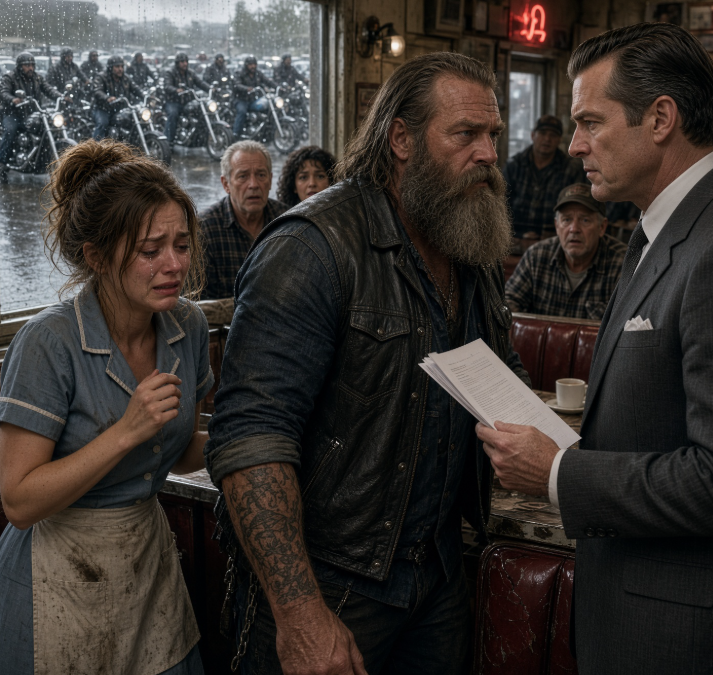
Motorcycles filled the parking lot.
Not one.
Not five.
Dozens.
Chrome, black leather, roaring engines, rain mist, headlights.
They came off the exit ramp in formation, two by two, flooding the Rusty Fork lot until Thomas Miller’s Mercedes was completely boxed in.
The sound was so loud it shook the front windows.
Then, all at once, the engines cut off.
The silence that followed felt heavier than the noise.
Through the glass, I watched more than forty men dismount.
They moved with organized calm.
No rushing.
No shouting.
Just boots hitting wet pavement, leather cuts settling over shoulders, death head patches visible through the rain.
At the front was the man from Tuesday night.
Big Dave.
The door opened hard enough to make the bell bang against the glass.
The diner seemed to shrink.
Customers pressed back into booths.
One woman pulled her child close.
Ariston dropped his spatula.
Big Dave walked in, followed by four other full-patch members.
His blue eyes found me first.
He saw my tears.
The shaking coffee pot.
Miller standing too close.
The pen in his hand.
The envelope.
Big Dave stopped inches from Thomas Miller.
Slowly, he turned his head.
“You’re in my way, suit.”
The words were quiet.
That made them worse.
Miller swallowed, but he tried to hold his ground.
“You are interfering with a legally sanctioned property seizure.”
Big Dave said nothing.
“I have a sheriff’s eviction order,” Miller continued, though his voice cracked. “If you don’t step aside, I’ll have every one of you arrested.”
One of Dave’s men smiled.
Not kindly.
Big Dave reached into his vest.
Miller’s hired men tensed.
One reached toward his waistband.
Dave pulled out reading glasses.
He slid them onto his nose.
The entire room watched in stunned silence as the most terrifying man I had ever seen transformed into what looked like an extremely displeased professor about to fail a student.
A wiry biker with a scar through his eyebrow stepped forward and handed him a thick manila folder.
Dave opened it.
“Apex Financial Recoveries,” he read aloud. “Regional Director Thomas Miller.”
Miller’s face changed.
Just slightly.
But I saw it.
Fear.
Dave flipped a page.
“Your firm specializes in buying distressed residential mortgages, accelerating foreclosures, and flipping seized properties to commercial developers.”
Miller snapped, “That is confidential company information.”
Dave ignored him.
“According to these internal emails, you target homes on the edge of new commercial zoning lines. Properties exactly like Carina Miles’s house.”
My breath caught.
Dave looked over the glasses at Miller.
“You buy the debt, then instead of offering the mandated sixty-day restructuring period, you forge notification dates. Backdate warnings. Give desperate people forty-eight hours to pay in full, knowing they can’t.”
Miller’s lips parted.
Nothing came out.
Dave pulled another page.
“Then you seize the house, bulldoze it, and sell the lot to Ironclad Holding Group for the shopping plaza project.”
The diner remained completely still.
Miller recovered enough to sneer.
“You have no idea what you’re talking about. Ironclad is a legitimate development corporation. They don’t care how I get the land. They write checks. You bikers are out of your depth.”
Big Dave removed his glasses.
Folded them slowly.
Tucked them away.
Then he tapped one thick finger against the patch on his chest.
“Ironclad Holding Group,” he said softly, “is a privately owned subsidiary of this motorcycle club.”
Miller went pale.
“We started it ten years ago to handle legitimate construction and real estate contracts,” Dave continued. “I am the majority shareholder, Tommy.”
He leaned down until his face was inches from Miller’s.
“I’m the man who writes your checks.”
A gasp moved through the diner.
Ariston dropped a coffee mug behind the counter. It shattered across the floor, but nobody looked away.
Miller’s mouth opened and closed soundlessly.
“When I heard one of our subcontractors was using forged documents and illegal intimidation tactics to steal homes from single mothers,” Dave said, “I took that personally.”
He looked toward me.
Then back at Miller.
“My club does not do business that way. We build things. We don’t crush people who are already down.”
Dave snapped his fingers.
The biker with the scar stepped forward and took the eviction envelope from Miller’s trembling hand.
He tore it in half.
Then quarters.
Then smaller pieces.
The paper fluttered to the diner floor like dirty snow.
“The deal for this district is dead,” Dave said. “Ironclad is pulling all funding from Apex Financial. Our attorneys already forwarded your forged email chain to the state attorney general’s office.”
Miller swayed.
“I imagine,” Dave continued, “they’ll be at your office before five.”
He stepped back.
“If I were you, I’d spend the next few hours looking for a very good defense lawyer. Now get out of my sight before I forget I’m a legitimate businessman.”
Miller did not argue.
He did not threaten.
He did not even look at me.
He turned and walked fast toward the door.
His two hired men followed so quickly they nearly bumped into each other.
The glass door swung shut behind them.
A moment later, the Mercedes tires screeched out of the lot.
The diner stayed silent for three seconds.
Then a truck driver in the corner booth stood up and cheered.
The room exploded.
Applause.
Whistles.
People crying.
Ariston shouted something I could not hear over the noise.
And me?
I dropped.
My legs just stopped holding me.
I slid down behind the pie case, knees pulled to my chest, and sobbed so hard I could barely breathe.
The nightmare had ended too fast for my body to understand.
Forty-eight hours of terror, shame, hunger, math, fear, and the image of Lars packing his toys all crashed out of me at once.
Heavy footsteps approached.
The swinging gate behind the counter opened.
Big Dave crouched beside me awkwardly, his massive frame too large for the narrow space.
He pulled a clean folded handkerchief from his pocket and held it out.
“Breathe, Carina.”
His voice was gentle now.
Completely stripped of the cold fury he had used on Miller.
“You’re safe. Your boy is safe. Nobody’s taking your home.”
I took the handkerchief with trembling fingers.
“I don’t understand.”
He settled back on one knee.
“You own the development company?”
“Majority shareholder.”
“You did all this because of a plate of food?”
Dave looked down.
For the first time, I saw something like discomfort on his face.
“Tuesday night, when I came in here, I wasn’t just cold.”
I wiped my eyes.
“I’m a type 1 diabetic,” he said. “Got separated from the pack in the storm. Bike stalled out. Lost my saddlebags on the highway. Cash, phone, emergency insulin. All gone.”
My stomach tightened.
He continued quietly.
“By the time I saw this diner’s neon sign, I was sliding into severe hypoglycemic shock. Vision blurring. Hands shaking. Heart going bad. Cold making everything worse.”
I remembered the tremor.
The damp coins.
The way he had eaten, controlled but desperate.
“If I hadn’t gotten protein, carbs, sugar, and heat into my system in those twenty minutes,” Dave said, “I wouldn’t have woken up the next morning. I would have died in one of your booths.”
The diner noise faded around me.
I stared at him.
I had not just fed a hungry man.
I had saved one.
“You gave me everything you had,” Dave said. “You used the money you needed for your son’s breakfast to feed a stranger who looked like a monster.”
“You didn’t look like a monster,” I whispered.
His mouth softened.
“Most people disagree.”
“I saw your hands shaking.”
He nodded once.
“In my world, kindness and loyalty are the only currencies that matter. A debt of blood and life was owed.”
He reached into his cut again.
This time, he pulled out a single sheet of heavy watermarked paper.
Not a folder.
Not a corporate file.
One page.
He placed it gently in my lap.
I looked down.
At first, I could not understand what I was seeing.
Then the words sharpened.
Deed of ownership.
My address.
My name.
Carina Elise Miles.
And stamped in red across the bottom:
PAID IN FULL.
I stopped breathing.
“When we looked into who owned the diner so we could send a thank-you gift,” Dave said, “we found the foreclosure notice tied to your home. Ironclad stepped in this morning. Bought the debt directly from the original lender before Apex could legally clear it through the county clerk.”
He nodded toward the paper.
“Then we wiped it clean.”
I touched my name.
“No.”
“Yes.”
“Dave.”
“The house is yours.”
Fresh tears spilled down my face.
“I can’t accept this. It’s too much.”
He looked almost offended.
“Six thousand dollars is a fraction of what my life is worth to my club.”
“But—”
“No.” His voice firmed. “The house is yours, Carina. Free and clear.”
I pressed the deed against my chest because I was afraid if I let go, it would vanish.
“Lars,” I whispered.
Dave nodded.
“Your boy has a home.”
I cried harder.
He let me.
No rushing.
No awkward comfort.
Just presence.
When I finally caught my breath, Dave stood with a grunt.
“But we do have one small business matter left.”
I looked up, alarmed.
“Business?”
“Ironclad hosts a corporate luncheon at the clubhouse every month. Fifty guys. Big appetites. The catering company we use serves dry chicken and potatoes that taste like wet paper.”
Despite everything, I laughed through tears.
Dave glanced toward the counter.
“Ariston here cooks a good steak. You run a tight ship. We need a new catering contractor. Three thousand a month, guaranteed. You interested?”
I looked past him.
Ariston stood by the grill, eyes red, smiling like a man who had just watched the world correct itself.
He gave me two thumbs up.
Frantically.
I laughed again.
A real laugh this time.
Bright.
Shaky.
Alive.
“I think we can fit you into the schedule.”
Dave extended one massive hand.
I took it, and he pulled me easily to my feet.
“Good.”
He nodded once.
“Drive safe tonight, Carina. And tell Lars his mom is a hero.”
“I’m not.”
“You are to him. That counts more.”
Then he walked back onto the diner floor and signaled to his men.
The Hells Angels filed out with the same disciplined calm they had entered with.
No shouting.
No showboating.
No asking for applause.
A minute later, forty engines roared to life, shaking the windows one final time before fading down Interstate 90.
I stood behind the counter clutching the deed to my home.
The weight that had been crushing me for three years was gone.
Not reduced.
Not delayed.
Gone.
I looked at the clock.
Almost three-thirty.
Lars would be getting off the school bus soon.
For the first time in years, I was not afraid to go home.
That evening, I parked in my driveway and sat in the car for a full minute.
The rain had stopped.
The little house looked the same.
Peeling paint.
Leaky gutter.
Crooked porch light.
But it was different now.
Or maybe I was.
Lars opened the front door before I could get out.
“Mommy!”
I climbed from the car and held the paper behind my back.
He ran down the steps and hugged my waist.
“You’re late.”
“I know.”
“Did you bring cereal?”
My heart twisted.
“No.”
His face fell for half a second.
Then I knelt in front of him.
“But I brought something better.”
I showed him the deed.
He stared at it.
Six-year-olds do not understand property transfers.
So I said it the only way that mattered.
“We get to stay.”
He blinked.
“In our house?”
“Yes.”
“With my room?”
“Yes.”
“With my dinosaurs?”
“Yes.”
“Forever?”
I looked at the paper.
Then at the porch Evan and I had painted years before, back when life still felt like something that could be planned.
“For a very long time,” I said.
Lars threw his arms around my neck.
I held him so tightly he squeaked.
That night, we ate scrambled eggs and toast because I still had no cereal.
It was the best dinner of my life.
The next month, the first Ironclad luncheon nearly destroyed us.
Not emotionally.
Logistically.
Fifty bikers eat like a natural disaster.
Ariston and I cooked for two days.
Steaks.
Roasted potatoes that did not taste like wet paper.
Green beans.
Biscuits.
Apple pies.
Coffee by the gallon.
I expected the clubhouse to be terrifying.
It was not.
It was loud, yes.
Old leather, polished bikes, deep laughter, smoke outside, security at the gate.
But when we carried in the food, every man in that room stood.
All of them.
Big Dave walked over first.
“Carina.”
“Dave.”
He looked down at Lars, who was hiding partly behind my leg.
“And this must be the man of the house.”
Lars stared up at him.
“You’re really big.”
Dave nodded solemnly.
“So I’ve been told.”
“My mom said you helped us keep our house.”
Dave crouched slowly so he would not tower over him.
“Your mom helped me first.”
Lars looked at me.
“You did?”
I swallowed.
“I gave him dinner.”
Dave held Lars’s gaze.
“She gave me what she had when she didn’t have enough for herself. That’s what heroes do.”
Lars stood a little taller.
After that, he was not afraid.
By the end of the luncheon, he had three club stickers, a root beer, and an invitation to sit on a motorcycle that I almost said no to until Dave looked at me and said, “Engine’s cold. I swear.”
Ariston pretended he hated the whole thing.
Then accepted three compliments on his steak and floated around for a week.
The contract saved us.
Three thousand a month did not make me rich.
But it made the ground solid.
I caught up on utilities.
Bought groceries without counting every item twice.
Fixed the bathroom leak.
Bought Lars a winter coat before the zipper on the old one broke completely.
Started a savings envelope in the back of my sock drawer.
Small things.
Sacred things.
Apex Financial collapsed into investigations and lawsuits.
Thomas Miller’s name appeared in an article online beside words like fraud, forged notices, and predatory foreclosure practices.
I read it during my break at the diner.
I thought I would feel joy.
I mostly felt tired.
Men like him leave bruises even when they never touch you.
But every time I drove home and saw my porch light on, I remembered he had lost.
Not because I was powerful.
Because kindness had traveled farther than cruelty expected.
Big Dave came into the diner sometimes after that.
Not often.
When he did, he always paid.
Too much.
The first time he left a hundred-dollar bill for a twelve-dollar meal, I chased him into the parking lot.
“Dave!”
He turned.
“You forgot your change.”
“No, I didn’t.”
“I’m not taking this.”
He crossed his arms.
“Then I’m not taking the pie you packed in my saddlebag.”
I narrowed my eyes.
“You saw that?”
“I’m observant.”
“You can’t tip me a hundred dollars every time you eat here.”
“Sure I can.”
“That’s not how normal diners work.”
“Good thing I don’t run one.”
I held out the bill.
He looked at it.
Then at me.
“Carina, let people be good to you.”
That stopped me.
He saw it land.
His voice softened.
“You’re good at giving. You need practice receiving.”
I hated that he was right.
So I kept the tip.
And the next time he came in, I charged him double for pie.
He paid it with a grin.
Life did not become perfect.
Stories make miracles sound like endings.
They are not.
The house was paid off, but the roof still leaked before we fixed it. Lars still missed his father. I still woke some nights thinking I had forgotten a bill. Some mornings I still felt the old panic before remembering it no longer had teeth.
Healing takes longer than rescue.
But rescue gives healing a place to start.
For me, that place was my kitchen table.
The same table where I had cried over foreclosure letters became the table where Lars did homework while I planned catering menus.
The same house I thought we would lose became the house where I measured his height against the pantry door every birthday.
The same driveway where I used to sit afraid to check the mailbox became the driveway where Dave once parked his Harley on Christmas Eve to drop off a wrapped box labeled:
For Lars. Not from Santa. Santa rides slower.
Inside was a model motorcycle.
Lars slept with it under his pillow for three nights.
Years later, when Lars was old enough to understand more of the story, he asked me why I fed Dave if we were so broke.
He was eleven then, sitting at that same kitchen table, long-legged and serious.
I could have given him a mother’s answer.
Because it was the right thing.
Because he needed help.
Because we should be kind.
All true.
But not enough.
So I told him the truth.
“Because I knew what it felt like to count coins and feel ashamed.”
Lars looked down.
“And because sometimes,” I said, “you help someone not because you have extra, but because you know what it feels like to have nothing.”
He thought about that.
“Did you know he’d help us back?”
“No.”
“Then why do it?”
I reached across the table and touched his hand.
“Because kindness is not a purchase. It’s a choice.”
He nodded slowly.
Then said, “But it was still a good investment.”
I laughed so hard I cried.
He got that from Evan.
Now, when people ask me about the day the Hells Angels filled the Rusty Fork parking lot, they usually want the dramatic version.
The engines.
The leather.
The debt collector turning pale.
The torn eviction papers.
The paid-off deed.
I tell them those parts.
They are true.
But the moment that changed my life happened earlier.
It happened in a nearly empty diner during a storm, when a frightening man counted wet coins on a table and tried to keep his dignity intact.
It happened when I stood behind the counter with eight dollars in my pocket and had to decide whether fear or compassion would guide my hand.
It happened when I chose to see the human being before I saw the patch.
I did not know he was rich.
I did not know he owned the company tied to my foreclosure.
I did not know he was in medical danger.
I did not know his club would remember.
I only knew he was hungry.
So I fed him.
That was all.
And maybe that is why the story still humbles me.
Because the biggest turns in life do not always arrive looking important.
Sometimes they arrive soaked in rain, ashamed to ask for food, sitting alone in the darkest booth of a diner twenty minutes before closing.
Sometimes they ask for black coffee.
Sometimes they have less than two dollars.
Sometimes they look like trouble.
And sometimes they are the answer to a prayer you were too tired to speak.
My name is Carina Miles.
I am still a waitress at the Rusty Fork.
Ariston still complains.
The coffee is still too strong.
The fryer still acts up.
The neon still flickers when it rains.
But every month, we cater lunch for fifty hungry men at a clubhouse off Interstate 90.
Every month, Big Dave shakes my hand and asks how Lars is doing.
Every month, I send extra pie because some debts are not meant to be counted.
And every night, when I unlock the front door of my own house, I remember the truth that saved me.
Compassion is not small just because it starts small.
A plate of food can become a lifeline.
Eight dollars can become a miracle.
And sometimes, when you feed a stranger everyone else is afraid of, the whole world comes roaring back to protect you.








