I Drove Past a Mother Dog Pushing a Box of Dying Puppies—Six Hours Later, I Found Her Again and One Puppy Stopped Breathing on the Way to the Vet
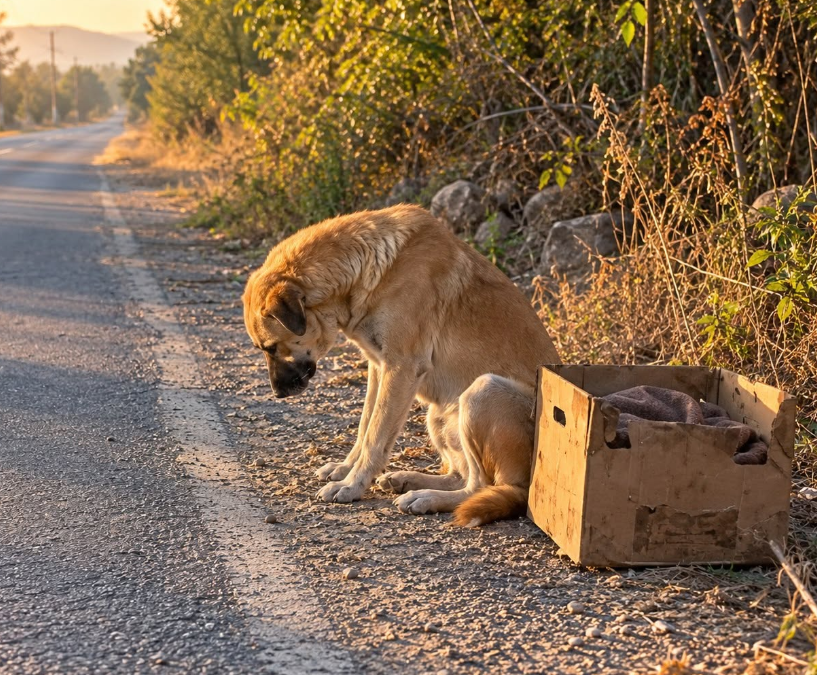
I Drove Past a Mother Dog Pushing a Box of Dying Puppies—Six Hours Later, I Found Her Again and One Puppy Stopped Breathing on the Way to the Vet.
I saw the exhausted brown dog pushing a cardboard box down a country road, and the worst part is not that I didn’t understand what she was doing.
The worst part is that I slowed down long enough to see her suffering, then convinced myself somebody else would stop.
Six hours later, when I finally opened that battered box and saw the four tiny lives she had been trying to save, I realized some mistakes do not end when you drive away from them.
My name is Will Graves, and before that August afternoon, I had never owned a dog.
I was thirty-eight years old, single, predictable, and proud of how little my life demanded from me outside of work. I lived alone in a small white house outside Owensville, Missouri, where the nights were quiet, the fields stretched wide in every direction, and my nearest neighbor was far enough away that we waved at each other from trucks instead of fences.
I worked in construction supply.
That meant lumber orders, concrete schedules, invoices, delivery delays, calls from contractors who acted like the entire world would collapse if their drywall showed up twenty minutes late, and long days spent solving problems that felt urgent until something truly urgent appeared in front of me and I failed to recognize it.
That morning started like any other.
Hot.
Dry.
Busy.
By eleven, the August sun had already turned the two-lane country road into a ribbon of shimmering heat. Cornfields stood tall on one side, pastureland on the other. The air above the asphalt wavered. Grass along the shoulder had gone yellow at the tips. Even the trees looked tired.
I was driving my old silver pickup back from a job site, one hand on the wheel, the other holding my phone on speaker while a contractor named Ray complained about a delayed shipment.
“Will, I’ve got six guys standing around doing nothing.”
“I told you the supplier pushed the load to tomorrow.”
“Tomorrow doesn’t help me today.”
“Neither does yelling at me, but here we are.”
That was when I saw her.
At first, my mind didn’t understand what my eyes were seeing.
Something tan moved on the gravel shoulder ahead.
Not running.
Not walking exactly.
Pushing.
A medium-sized brown dog had both front paws planted hard into the loose gravel, her nose and shoulder pressed against a large cardboard box. She shoved it forward a few inches, stopped, lowered her head, breathed, and shoved again.
Push.
Stop.
Breathe.
Push again.
The box scraped over rocks and dust.
I slowed.
Ray was still talking through the phone, but his voice became background noise.
The dog’s coat looked dirty and dull. Her ribs showed faintly beneath her sides. Her ears were flattened from effort, and her tongue hung out as she panted in the heat.
For maybe three seconds, I watched her through the windshield.
Three seconds.
That does not sound like enough time to change a life, but it is.
My first thought was that she had found food.
My second was that she probably belonged to one of the nearby farms.
Country dogs wander. They chase trucks. They drag strange things out of ditches. They carry dead possums, plastic buckets, feed sacks, shoes, anything they decide belongs to them for reasons no human will ever understand.
Ray said, “Will? You there?”
I looked at the road ahead.
The dog pushed the box again.
I told myself she was fine.
I told myself somebody nearby owned her.
I told myself I had appointments waiting, a customer texting me, a load of treated lumber to reroute, and a phone full of problems that were supposedly mine.
So I drove past her.
In the rearview mirror, I saw her stop pushing and lift her head.
For one second, our eyes met through the distance and dust.
Then the road curved, and she disappeared from view.
I wish I could tell you guilt hit me immediately.
It didn’t.
Not the way it should have.
For a few minutes, I thought about her. I thought, That was odd. I thought, Maybe I should’ve stopped. I thought, She probably lives around there.
Then work swallowed the thought.
By noon, I was on the phone about concrete.
By two, I was answering invoices.
By three-thirty, I was eating a gas station sandwich in my truck, scrolling through messages, telling myself the dog had probably gone home hours ago.
That is how people avoid becoming responsible.
We add probably to the beginning of things we do not want to face.
She probably belongs to somebody.
She probably has food.
Somebody probably saw her.
Somebody probably stopped.
At five, I took the same road back.
PART2:
The sun was lower now, turning the fields gold. Long shadows stretched across the ditch grass. The air had cooled only slightly, but the heat rising from the pavement had softened.
I was tired.
I was thinking about dinner.
I was thinking about a shower.
I was thinking about absolutely nothing important.
Then I saw the cardboard box.
I recognized the box before I recognized her.
It sat crooked on the gravel shoulder almost a mile from where I had first seen it that morning. One corner had collapsed. The bottom sagged. Dust covered the sides, and a dark scrape marked one edge where it had dragged over stone.
Beside it sat the dog.
She was not pushing anymore.
Her head hung low.
Her shoulders sagged.
Even from inside my truck, I could see her front legs trembling.
I drove another twenty yards.
That is the part I hate admitting.
Even then, even after seeing her again, exhausted and alone beside that box, my body kept following the road.
Then something inside me finally shouted louder than my schedule.
I hit the brakes so hard my seat belt locked.
The truck stopped half on the asphalt, half on the gravel.
For a second, I just sat there with both hands on the wheel.
Then I threw it into park and opened the door.
The dog raised her head.
She didn’t bark.
She didn’t run.
She simply watched me.
There was no anger in her eyes.
That somehow made it worse.
I walked slowly toward her, palms open, trying to remember every calm voice I had ever heard used around animals.
“Hey, girl.”
Her ears moved.
I crouched a few feet away.
“You okay?”
It was a stupid question.
Of course she wasn’t.
Her paws were planted awkwardly in the gravel. Her chest rose and fell too fast. Dust clung to the wet fur around her mouth. She looked like she had reached the end of whatever strength had carried her that far.
Then I looked into the box.
Everything inside me dropped.
Four puppies lay on torn fabric and dry grass.
Tiny.
Too tiny.
Too quiet.
Their ribs showed beneath thin fur. Their bodies were curled together, but not in the warm, squirming way puppies should be. Their breathing came in weak, shallow movements.
One barely lifted its head.
Another made a sound so faint I almost didn’t hear it.
I looked at the mother.
She stood.
Despite everything, she stood.
She moved between me and the box.
Not aggressively.
Protectively.
Her legs shook so badly she nearly fell.
And in that instant, the entire morning rearranged itself in my mind.
She hadn’t been playing.
She hadn’t found trash.
She hadn’t been dragging some useless object down the shoulder for no reason.
She had been pushing her babies.
Under the August sun.
Along gravel.
Mile after mile.
Looking for somebody.
And I had been one of the people she found.
I had slowed down.
I had looked at her.
Then I had decided somebody else would probably handle it.
“I’m sorry,” I whispered.
The dog stared at me.
I reached slowly toward the box.
She watched my hands carefully, but she didn’t growl.
“I’m going to help them.”
My voice shook.
“I should’ve stopped before. I know. But I’m here now.”
She did not understand the words.
Maybe that was mercy.
I slid my arms underneath the cardboard.
The box was horrifyingly light.
Four puppies should have weighed more.
The mother followed every movement with desperate eyes. When I lifted the box, she stumbled forward as if she thought I might take them away.
“No, no,” I said quickly. “You’re coming too.”
I carried the box to my truck and placed it carefully on the back seat. Then I opened the other rear door and stepped back.
For several seconds, she hesitated.
She looked at me.
Then at her puppies.
Then back at me.
“Come on,” I whispered. “I already left you once today. I’m not doing it again.”
She jumped into the truck.
It took nearly everything she had.
Her back legs almost failed, but she made it. The moment she was inside, she curled herself around the box, pressed her nose against one puppy’s head, and began licking.
I grabbed my phone and searched for the closest veterinary clinic.
Whitfield Veterinary Hospital.
Seventeen minutes away.
I called while starting the engine.
A woman answered. “Whitfield Veterinary Hospital.”
“I’m bringing you a mother dog and four puppies,” I said. “They’re barely moving.”
Her voice changed instantly.
“How far away are you?”
“About fifteen minutes.”
“Do you know what happened?”
“No. I found them on County Road 6. She was pushing them in a box.”
There was a pause.
Then, professionally, sharply, “We’ll be waiting. Keep the truck cool. Don’t try to give them food or water while driving. Just get here safely.”
Safely.
I looked in the rearview mirror.
The mother was panting hard, her body curled around the puppies like a wall made of bone and willpower.
Her paws left faint red smears on my upholstery.
For the first time that day, I understood exactly what my schedule was worth.
Nothing.
Not compared with five lives in my back seat.
I pressed the accelerator.
A few miles from town, the smallest puppy stopped moving.
I saw it happen in the rearview mirror.
One second, its tiny side was rising.
The next, I couldn’t tell.
The mother lowered her nose toward it and nudged.
Once.
Then again.
“Come on,” I said.
My hands tightened around the wheel.
“Come on, little one.”
I didn’t know whether I was speaking to the puppy, the mother, or myself.
I was driving too fast.
I knew it.
The speedometer climbed.
The two-lane road stretched ahead, empty except for heat and late-afternoon light.
The mother nudged the puppy harder.
A tiny movement came from inside the box.
Maybe a breath.
Maybe just the truck shifting.
I couldn’t tell.
“Stay with us.”
I had spent the whole morning believing I was too busy to stop.
Now every second felt criminal.
Whitfield Veterinary Hospital appeared ahead on the right. I turned into the lot too fast, stopped crooked across two parking spaces, threw the truck into park, and ran around the back.
A young man in blue scrubs was already coming through the clinic doors with a technician behind him.
“You called?”
“Yes.”
I opened the rear door.
The mother lifted her head.
“It’s okay,” I told her.
She didn’t know that.
Neither did I.
The veterinarian looked into the box.
His expression changed.
“Bring the whole thing.”
I lifted it.
Again, the weight frightened me.
The veterinarian took one side. The technician took the other.
The mother tried to follow.
“She comes too,” I said.
“Absolutely.”
We hurried inside.
“My name is Dr. Keller,” the veterinarian said as we moved. “How long have you had them?”
“Maybe twenty minutes.”
“Any idea how long they were outside?”
I hesitated.
“I saw them at eleven this morning.”
He looked at me.
“I didn’t stop.”
For half a second, I expected judgment.
Instead, he said, “You stopped now.”
It didn’t make me feel better.
Maybe he knew it wouldn’t.
They disappeared through swinging doors with the box and the mother.
I stood in the lobby with my hands empty.
That was the first time the whole day caught up with me.
I looked down.
There was blood on my palms.
Not much.
Thin reddish smears mixed with road dust.
At first, I thought one of the puppies had been bleeding.
Then I realized it came from the mother’s paws.
Her pads had worn raw.
I stared at my hands.
She had done that pushing the box.
How far?
The mile I had witnessed wasn’t necessarily the beginning.
Maybe she had already traveled another mile.
Two.
Maybe she had started somewhere nobody would ever know.
A receptionist approached.
“Sir?”
I looked up.
“Are you injured?”
“No.”
She pointed toward my hands.
“It’s hers.”
Her expression softened.
“We have a sink over here.”
I washed the blood from my hands.
It went pink in the water and disappeared down the drain.
That bothered me.
Her effort should not have disappeared that easily.
I sat in the waiting room.
There was an elderly woman holding a cat carrier on her lap. She looked at me for a while before speaking.
“You brought somebody in?”
I nodded.
“A dog.”
She smiled.
Then I added, “And four puppies.”
“Oh.”
“Found them beside the road.”
Her smile disappeared.
“Are they alive?”
“I don’t know.”
That sentence nearly broke me.
She shifted the cat carrier onto the chair beside her.
“They’re at the right place.”
I nodded.
Then I stared at the floor.
Minutes became thirty.
Then forty.
I counted tiles. Read the same poster about heartworm prevention four times. Checked my phone without seeing anything on the screen.
Work had left three missed calls.
I silenced it.
For once, somebody else could wait.
Eventually Dr. Keller appeared.
I stood so quickly my knee hit the table.
“How are they?”
“Come back with me.”
That answer could mean anything.
I followed him through the swinging doors.
The mother was lying on a thick blanket on the floor, an IV line taped to one leg. She looked smaller inside the clinic. On the road, because of what she had done, she had seemed almost larger than life.
Here, she looked like what she actually was.
An exhausted, underweight dog who had reached the end of what her body could give.
Beside her was a warmed box containing the puppies.
Two were moving.
One was making a soft squeaking sound.
The smallest—the one I thought had stopped breathing—lay beneath a warming towel while a technician touched its side carefully.
“Is that one alive?” I asked.
“Yes,” Dr. Keller said.
My knees weakened.
“All four?”
“All four.”
I sat in the nearest chair.
I hadn’t realized how hard I was holding myself together until that moment.
Dr. Keller continued, “They’re severely dehydrated and undernourished. The smallest two worried me, but they responded to fluids and warmth.”
“And her?”
I looked at the mother.
“She’s exhausted. Dehydrated. Her paw pads are badly abraded. She’s underweight, and she doesn’t have enough milk production right now to support all four.”
“Can she recover?”
“I think so.”
I breathed out.
“Can the puppies?”
“If we don’t run into infection or another underlying problem, their odds look much better than they did when you arrived.”
“They’re going to live?”
“I’m cautiously optimistic.”
That phrase became the most beautiful thing anyone had said to me all year.
I moved closer to the mother.
She lifted her eyes.
Same dog.
Same brown eyes.
But the desperate question I had seen beside the road seemed quieter.
“You did it,” I whispered.
Her tail did not move.
She was too exhausted.
I looked at Dr. Keller.
“Her front paws…”
“I know.”
“How far do you think she walked?”
“Impossible to say.”
“She pushed that box the whole way.”
He looked at her paws.
“The abrasions are consistent with a lot of distance on rough surfaces. Whatever happened, she worked hard.”
“She didn’t stop.”
“No.”
I shook my head.
“I did.”
Dr. Keller looked at me.
“You’re going to punish yourself with that, aren’t you?”
“I drove past her.”
“Yes.”
“She was asking for help.”
“You didn’t understand what you were seeing.”
“That doesn’t change it.”
“No,” he said.
His answer surprised me.
He didn’t offer easy forgiveness.
Then he added, “But what matters to those animals now is what you do after you understand.”
I looked at the mother.
Maybe that was the beginning of everything.
Not the moment I saw her.
Not even the moment I stopped.
The moment I realized being sorry was useless unless it changed what came next.
“What happens now?” I asked.
“We keep them here. Fluids, nutrition, wound care for her paws, supplemental feeding for the puppies. We monitor temperature, weight, and hydration.”
“For how long?”
“A few days at least.”
“And after that?”
He hesitated.
“Do they have an owner?”
“Not that I know.”
“Collar?”
“No.”
“Microchip?”
“We scanned her. Nothing.”
“What happens if nobody claims them?”
“Animal control procedures apply. After the holding period, they’ll need placement through a shelter or rescue.”
I looked at her.
Then the puppies.
Then Dr. Keller.
“I’ll take them.”
He blinked.
“All of them?”
The words had come out before I could think through what they meant.
All of them.
Five dogs.
I had never owned one.
I had no dog food at home.
No bowls.
No fence that had ever been tested against puppies.
I didn’t even know what puppies were supposed to eat at different ages.
“Yes,” I said.
Dr. Keller folded his arms.
“You understand four puppies are not four small decorations.”
“I’m guessing that sentence gets worse.”
“It gets much worse.”
Despite everything, I laughed.
He smiled.
“Puppies are chaos with teeth.”
“I’ll learn.”
“And the mother may need time to trust.”
“I’ll give her time.”
“You work?”
“Yes.”
“Long hours?”
“Usually.”
“You may need help.”
“I’ll get help.”
He studied me.
“This is a big decision to make in an exam room after a stressful rescue.”
“I know.”
“Think tonight.”
I looked at the mother.
She had turned her head toward the heated box.
One puppy shifted.
Even exhausted, she moved closer.
“No.”
“No?”
“I’ve thought enough today.”
Dr. Keller waited.
“This morning,” I said, “I decided I was too busy to stop. I’m not making another decision based on convenience tonight.”
Something changed in his expression.
He nodded.
“All right.”
I sat beside the mother until the clinic was ready to close.
Before I left, a technician gave her a little soft food. She raised her head, sniffed, then ate.
Slowly at first.
Then urgently.
I had to look away.
How long had she been hungry?
Dr. Keller estimated at least two days.
Maybe more.
Yet she had still spent whatever strength she had left moving the puppies.
Not herself.
Them.
I drove home after dark.
My house had never seemed particularly empty before.
Quiet, yes.
Organized.
Everything exactly where I left it.
That night, it felt hollow.
I walked through the living room imagining five dogs inside it. I looked at my clean floor and tried to picture puppy accidents. I looked at the couch and pictured fur. I looked at the kitchen and wondered where five bowls could fit.
Then I laughed.
“What did I do?”
The room gave no answer.
I called my mother.
She lived about three hours away and had spent years telling me I was too comfortable being alone.
She answered on the third ring.
“Will?”
“Hey, Mom.”
“What happened?”
“Why do you think something happened?”
“You never call after nine unless something happened.”
Fair.
“I adopted a dog.”
Silence.
Then, “You what?”
“A dog.”
Another silence.
I added, “And four puppies.”
My mother began laughing so hard she had to move the phone away from her mouth.
“This isn’t funny.”
“It is absolutely the funniest thing you have ever told me.”
“Why?”
“Because you didn’t own a goldfish as a child because you said feeding it every day sounded inconvenient.”
“I was nine.”
“You made a spreadsheet before buying a coffee machine.”
“It was expensive.”
“You have five dogs?”
“They’re still at the clinic.”
“Tell me everything.”
So I did.
The road.
The box.
Driving past.
Seeing her again.
The puppies.
The bleeding paws.
By the end, Mom wasn’t laughing anymore.
“Oh, Will.”
“I should’ve stopped the first time.”
“Yes.”
I stared at the wall.
I hadn’t expected her to agree so quickly.
Then she said, “And now you’re going to spend the next several years stopping.”
“You think?”
“I know.”
“You just spent five minutes explaining that I have never owned an animal.”
“That doesn’t mean I don’t know you.”
The next morning, I went shopping.
I had no idea what I was doing.
The pet store employee took one look at my cart and asked, “New dog?”
“Five.”
Her eyebrows rose.
“First dogs?”
“Yes.”
She actually stepped backward.
“Sir, are you being punished for something?”
By noon, my house contained beds, bowls, puppy pads, cleaning supplies, toys, gates, food, blankets, and several items I still didn’t understand. I bought a large exercise pen, then another. I bought washable bedding. I called a contractor I knew and asked him to inspect my backyard fence.
“You getting livestock?” he asked.
“Basically.”
I visited the clinic that afternoon.
The mother stood when she saw me.
It wasn’t graceful.
Her legs were weak.
But she stood.
Her tail moved.
One slow sweep.
Then another.
I stopped inside the doorway.
“Was that for me?”
The technician beside her smiled.
“She’s been doing that whenever she hears your truck.”
I pretended that statement didn’t affect me.
It did.
I crouched.
“Hey, girl.”
She approached slowly.
Then placed her head against my knee.
No question in her eyes this time.
Only exhaustion.
And something beginning to resemble trust.
I put my hand on her neck.
“You need a name.”
The technician said, “We’ve just been calling her Mama.”
“That can’t be her whole life.”
I looked at her tan coat.
There was something resilient about her.
Not dramatic.
Not glamorous.
She reminded me of the wild daisies that grew along the edge of the fields near my house.
Simple things that survived heat, bad soil, and being ignored.
“Daisy,” I said.
Her ear moved.
The technician smiled.
“Daisy fits.”
The puppies needed names too.
That took another day.
I wanted something connected.
Something rooted.
Strong.
Oak was the largest male, already trying to climb over his siblings.
Ash was the smallest and quietest, the one I had thought stopped breathing.
Willow was a determined little female who complained every time the technician weighed her.
Pine was somewhere between all of them, happy to sleep on whichever sibling was warmest.
Oak.
Ash.
Willow.
Pine.
A tiny forest born inside a cardboard box.
Every afternoon I visited.
Every day Daisy looked stronger.
Her paws began healing. Her hydration improved. Her appetite became impressive. The puppies gained weight. Dr. Keller kept a chart, and I became obsessed with it.
“How much did Ash gain?”
“Twenty-one grams.”
“Is that good?”
“Yes.”
“And Pine?”
“Will, you were here twelve hours ago.”
“That wasn’t my question.”
Dr. Keller eventually stopped teasing me and simply showed me the numbers.
On the third day, Daisy stood when I entered and wagged her tail hard enough that her hips moved.
It was the first time I saw joy instead of endurance.
That wag became one of the most important things anyone had ever given me.
A dog who had every reason not to trust people was happy I had returned.
That scared me a little.
Trust is flattering until you understand the responsibility inside it.
The question of where Daisy came from did not leave me alone.
Animal control checked missing dog reports.
Nothing.
No microchip. No collar. No owner calling frantically. No farmer saying his dog had wandered off with puppies.
But there was one thing.
The cardboard box.
I had forgotten about it until Dr. Keller mentioned that he had kept it because of the intake report.
“It might not matter,” he said, “but there’s a partial shipping label on one side.”
I went cold.
“What does it say?”
“Most of it’s torn off. But there’s a name.”
He took me into the back storage area and showed me.
The box sat folded against the wall, dirty and bent, one corner stained from road dust and something darker.
On the side, under scratches and dirt, was a partial label.
Crawford Feed & Kennel Supply
Route 3
I stared.
“I know that place.”
Dr. Keller looked at me.
“You do?”
“Everybody around here knows Crawford.”
Crawford Kennels sat eight miles outside town, hidden behind a long gravel drive and a metal gate. They bred hunting dogs, or at least that was the clean version people repeated. I had delivered building materials there once years earlier—metal panels, concrete mix, fencing posts.
I remembered dogs barking from sheds behind the main barn.
Too many dogs.
Too little shade.
I remembered thinking it wasn’t my business.
That thought had aged badly.
The next day, I drove to the sheriff’s office.
A deputy named Karen Mills listened while I explained.
She didn’t dismiss me. She didn’t promise too much either.
“A box with a label isn’t proof,” she said.
“I know.”
“But it’s something.”
“She pushed that box almost a mile that I know of.”
Deputy Mills looked at the photographs Dr. Keller had printed: Daisy’s torn paws, the puppies on intake, the box.
Her jaw tightened.
“I’ll make some calls.”
Two days later, she called me back.
“Mr. Graves, did you tell anyone connected to Crawford that you found the dog?”
“No.”
“Good. Don’t.”
My stomach dropped.
“Why?”
“We’re checking complaints.”
“What kind of complaints?”
A pause.
“Neglect. Unlicensed breeding. A few reports that didn’t go anywhere.”
“Is Daisy from there?”
“I can’t say yet.”
But I could hear something in her voice.
She suspected it too.
The investigation moved slowly.
That was the first thing I learned about justice.
In stories, justice arrives dramatically, with a door kicked open and someone evil dragged into daylight. In real life, it moves through paperwork, inspections, warrants, phone calls, photographs, statements, and people trying very hard not to say what they know until they can prove it.
Meanwhile, Daisy and her puppies kept fighting.
A week after I found them, Dr. Keller said they could come home.
I had imagined that moment repeatedly.
My imagination had been wildly inadequate.
The first fifteen minutes went well.
Daisy walked through the front door cautiously. She sniffed the living room, kitchen, hallway, every corner as if expecting danger to step out from behind furniture. Then she checked the puppies.
The puppies were in a large pen near the living room.
Oak immediately tried to escape.
Willow screamed because Oak was standing on her.
Ash crawled directly into the water dish.
Pine fell asleep.
I looked at Daisy.
Daisy looked at me.
“You know what you’re doing, right?”
She walked away.
“Excellent.”
That first night, I learned approximately twenty-seven things.
Puppies do not care about your sleep schedule.
Puppies do not understand that 2:17 a.m. is not playtime.
Puppies can produce bodily waste in quantities inconsistent with their size.
A mother dog recovering from starvation will hide food if she still fears it may disappear.
And five dogs make sounds that can convince a single man living alone that his house has been invaded by livestock.
At three in the morning, Willow began crying.
Then Oak.
Then Pine.
Ash joined because apparently he believed in solidarity.
I stumbled into the living room.
“What?”
Four tiny faces looked at me.
Daisy was lying nearby.
She opened one eye.
“This is your department.”
Daisy closed the eye.
“Unbelievable.”
I sat on the floor.
Within minutes, Oak had crawled into my lap. Ash fell asleep against my leg. Willow chewed the drawstring of my sweatpants. Pine somehow ended up inside the fold of my shirt.
Daisy watched.
I looked at her.
“You planned this.”
Her tail moved once.
Eventually all four puppies fell asleep.
I remained sitting because moving them seemed impossible.
Daisy stood, walked over, and lay beside me.
Then she placed her head on my thigh.
That was the moment I broke.
Not dramatically.
No sobbing.
Just tears arriving before I understood why.
I had lived alone for years.
I told people I liked it.
And I did.
Or I thought I did.
My house was quiet.
Predictable.
Nothing needed me unless a customer called.
Nobody noticed when I came home late.
Nobody cared when I skipped dinner.
Nobody waited at a window.
Nobody placed their head on my leg at three in the morning simply because being near me made them feel safe.
I looked around.
Five dogs were asleep touching some part of me.
Something in my chest opened that I hadn’t known was closed.
Daisy lifted her head because she felt me move.
“I’m okay.”
She stared.
“I’m not, actually.”
She put her head back down.
I laughed through tears.
“That’s apparently your solution for everything.”
It worked.
The following weeks were chaos.
Beautiful, exhausting, loud chaos.
The puppies learned to walk properly.
Then run.
Then sprint.
Then climb.
Every developmental milestone created three new household problems.
Oak became the explorer. If there was a gate, Oak wanted to know what existed on the other side. If there was a shelf, Oak wanted to know whether he could reach it. If there was a hole under the fence, Oak viewed it as an engineering challenge.
Ash stayed smaller. He became the cuddler. He wanted to be carried. He wanted to sit in my lap. He wanted contact almost constantly. The puppy I had once feared losing became determined never to be more than three feet from me.
Willow had opinions about everything.
Food.
Bed placement.
Weather.
Her brothers.
Vacuum cleaners.
The fact that doors occasionally closed without consulting her.
Pine was pure mischief.
Quiet mischief.
The dangerous kind.
Oak would commit a crime and announce it. Pine would steal something, disappear, and leave you wondering why one work boot was missing until you found it beneath the porch.
Daisy watched all of them with astonishing patience.
Sometimes she corrected them with one low sound.
Sometimes she physically stepped between them.
Sometimes she looked at me in a way that clearly communicated, Your problem now.
I learned routines.
Feeding schedules.
Vaccinations.
Puppy-proofing.
Training.
Nail trimming.
I learned that “leave it” may be one of the most important phrases in the English language.
I learned never to leave toilet paper within puppy reach.
I learned to keep emergency veterinary numbers on the refrigerator.
I learned that expensive dog toys were less interesting than cardboard.
Given their history, I found that ironic.
I never let them play with large boxes unsupervised.
The first time Daisy saw a cardboard box in the kitchen after coming home, she froze.
I saw it immediately.
Her body stiffened.
Her ears moved backward.
She stared.
I stopped unpacking groceries.
“Hey.”
She didn’t move.
I carried the box outside.
Daisy watched until it disappeared.
That told me something.
Whatever had happened before the road had not begun with that road.
The box meant something to her.
Three weeks after Daisy came home, Deputy Mills called again.
“We got the warrant.”
My hand tightened around the phone.
“For Crawford?”
“Yes.”
“What did you find?”
She was quiet for a moment.
“Enough.”
Later, I learned the details in pieces.
Crawford Kennels was worse than people had wanted to believe.
Too many dogs. Not enough clean water. Cramped runs. Sick litters. Missing records. Nursing mothers kept in conditions nobody with a working conscience could defend.
And in the back shed, behind feed bags and broken crates, deputies found invoices for boxes from Crawford Feed & Kennel Supply.
The same kind Daisy had pushed down the road.
They also found records of a tan female listed as “D-14.”
No name.
Just a letter and a number.
A breeding dog.
D-14 had been marked as “culled” two days before I found Daisy.
I did not know what that word meant in that context until Deputy Mills explained.
Removed from production.
Unprofitable.
A liability.
No longer useful.
Daisy had not been someone’s lost pet.
She had been used, neglected, discarded, and left with her babies like trash.
When Deputy Mills told me, I was standing in my kitchen.
Daisy lay in the next room nursing her puppies.
For several seconds, I could not speak.
Then I asked, “Who did it?”
“The owner is claiming he doesn’t know who transported her. He says an employee must have acted without authorization.”
Of course he did.
His name was Byron Crawford.
I knew him vaguely. Everyone did. He drove a new black truck, wore clean boots to dirty places, and liked telling people he came from “old farming stock” as if cruelty became respectable when it had history behind it.
He denied everything.
At first.
Then the story went public.
Not because of me.
Because Dr. Keller and Deputy Mills had built enough evidence, and because the county seized twenty-three dogs from Crawford’s property. The local paper ran photographs, carefully chosen but still devastating. Dogs in wire runs. Empty bowls. Daisy’s box.
Someone leaked the intake photo of Daisy and her puppies.
I hated that at first.
It felt too private.
Then I saw what it did.
People showed up.
Donations came in for the seized dogs.
Foster families called.
A rescue from St. Louis offered transport.
Neighbors who had “heard things” suddenly remembered specifics.
An old employee came forward.
Then another.
Byron Crawford went from denying knowledge to blaming workers to claiming the standards for animal care were “unrealistic expectations from city people who don’t understand rural life.”
That was his mistake.
Owensville might be rural, but people here knew the difference between hard living and cruelty.
At the preliminary hearing, I sat in the back row of the courtroom.
I didn’t plan to speak.
I didn’t want attention.
But Dr. Keller testified about Daisy’s condition. Deputy Mills testified about the property. Former employees testified about litters that “disappeared” when they became expensive to care for.
Then Byron Crawford’s attorney tried to suggest Daisy had been stolen from the property by animal activists.
I don’t remember standing.
I just remember Deputy Mills touching my arm and whispering, “Not yet.”
The judge allowed me to give a statement later.
I walked to the front with my hands shaking.
Byron Crawford sat at the defense table in a pressed shirt, expression bored, like all of this was an inconvenience created by emotional people.
I looked at him once.
Then I looked at the judge.
“I’m the man who found Daisy,” I said.
My voice sounded different in that room.
“I saw her at eleven in the morning pushing a cardboard box down County Road 6. I did not stop. That is something I’ll regret for the rest of my life. When I came back six hours later, she was almost a mile farther down the road, sitting beside that same box with four puppies inside.”
The courtroom was completely still.
“Her paws were bleeding. Her body was starving. Her puppies were barely alive. And whatever anyone wants to call that in paperwork, she was not trash. She was not a number. She was a mother trying to save her babies after human beings failed her.”
Byron looked away.
Good.
I hoped he saw her every time he closed his eyes.
“I can’t prove who placed that box beside the road,” I continued. “That’s for the court. But I know what I found. I know what Dr. Keller treated. I know what Deputy Mills documented. And I know that dog showed more loyalty, courage, and responsibility than the person who abandoned her ever did.”
Byron’s attorney objected.
The judge let most of it stand.
Crawford eventually pled to multiple counts related to neglect, improper disposal, and unlicensed breeding violations. It was not the dramatic punishment some people wanted. He did not spend years behind bars. Real justice often feels too small when measured against suffering.
But his kennel was shut down.
The seized dogs were surrendered to rescues.
He was banned from breeding and owning more than a limited number of animals under county supervision.
His reputation, which mattered to him more than the dogs ever had, was ruined.
And Daisy never had to know his name again.
That became important to me.
For a while, I wanted her past to matter every day.
I wanted to stay angry.
I wanted to drive past Crawford’s empty gate and feel righteous.
But Daisy didn’t need my rage.
She needed breakfast.
She needed clean water.
She needed patience when she hid food behind the couch because some old fear told her meals could vanish.
She needed me to remove cardboard boxes from rooms without making her feel foolish for being afraid.
She needed walks when her paws healed.
She needed someone to tell her no human being would ever again decide her worth based on what her body could produce.
That became the only justice I could guarantee.
Presence.
Care.
A home.
As the puppies grew, another truth became obvious.
Five adult dogs would be too much for me to manage well.
Admitting it felt like betrayal.
I had told Dr. Keller I would take all of them.
I meant it.
But loving animals does not always mean keeping every one of them if another home can give them more.
Dr. Keller was the first person to say it.
“You’re thinking about placement.”
I frowned.
“No.”
“You have the expression.”
“What expression?”
“The man realizing four puppies become four dogs.”
I sighed.
“I said I wouldn’t separate them.”
“You said that when they were critically weak.”
“That still counts.”
“It counts as love. It doesn’t have to count as a life sentence for all five under one roof.”
I looked at Daisy, lying near the exam table while the puppies investigated a cabinet.
“She fought to keep them together.”
“She fought to keep them alive.”
That stopped me.
Dr. Keller continued, “Those aren’t always the same thing.”
I hated how reasonable he was.
“What would you do?”
“Find exceptional homes. Keep them connected if you can. Make placement about expanding their family, not breaking it.”
I drove home thinking about that.
For another month, I did nothing.
Then my mother visited.
She entered the house and immediately disappeared beneath dogs.
Oak stole her scarf.
Ash climbed into her lap.
Willow barked at her suitcase.
Pine found a tissue in her purse and destroyed it.
Daisy sat beside Mom as if they had known each other for years.
My mother looked around.
“You’re happy.”
I pretended not to hear.
“Will.”
“What?”
“You’re happy.”
“I’m tired.”
“Same thing at your age.”
I laughed.
That evening, after the puppies slept, I told her I might find homes for two.
She nodded.
“That makes sense.”
“It feels awful.”
“Why?”
“I promised.”
“To whom?”
I looked at Daisy.
Mom followed my eyes.
“You think that dog expects you to keep every puppy forever?”
“I don’t know.”
“She expects you not to fail them.”
That was different.
“What if I choose wrong?”
“You might.”
“Helpful.”
“You asked.”
“I actually didn’t.”
She smiled.
“Then choose slowly.”
So I did.
No online first-come-first-served ad.
No handing puppies to strangers in a parking lot.
I asked the veterinary clinic for help.
References.
Home visits.
Questions.
Fenced yards where appropriate.
Veterinary history.
I became, according to Dr. Keller, “the most irritating unofficial rescue coordinator in the county.”
I accepted the compliment.
The first family interested in Oak seemed perfect on paper.
Large property.
Another dog.
Good veterinary records.
But during the visit, Oak avoided the man.
Nothing dramatic.
He simply kept returning to me.
Maybe it meant nothing.
I said no.
The man was annoyed.
I didn’t care.
Another applicant wanted Pine because he was “cute” but complained when I explained the adoption agreement required neutering and follow-up veterinary care.
No.
A woman wanted Ash for her five-year-old daughter.
Ash liked the child.
But the family worked long hours and planned to keep him crated most of the day.
No.
I realized something.
I wasn’t looking for homes good enough to take them away.
I was looking for homes that made letting go worth the pain.
Willow found hers first.
A young couple named Megan and Luke visited. They had recently lost a thirteen-year-old dog named Rosie. Their house felt too quiet.
Megan sat on my floor without reaching for Willow.
Willow approached on her own.
She sniffed Megan.
Then climbed directly into her lap.
I hated it.
Which was probably a good sign.
Luke laughed.
“I guess that answers that.”
“No decisions today,” I said.
They both nodded immediately.
“Of course.”
That mattered.
They came back three more times. They brought veterinary references. They let me inspect their yard. Megan sent photographs of where Willow’s bed would go.
On the final visit, Daisy did something I had not expected.
Willow was sitting beside Megan.
Daisy approached.
She sniffed Megan’s hand.
Then she licked Willow’s head once.
She turned and walked away.
I stood there.
Megan whispered, “Was that…”
“I don’t know.”
But I did.
It felt like permission.
Adoption day was brutal.
I packed Willow’s blanket.
Favorite toy.
Food.
Medical records.
A printed schedule nobody needed because I had already explained it four times.
Megan hugged me.
“You can visit.”
“That is contractually required.”
She smiled.
“I know.”
Willow jumped into their car.
Then turned around.
For one second, she looked at me through the open door.
My throat closed.
Daisy stood beside my leg.
Willow whined.
Daisy stepped forward.
They touched noses.
Then Willow settled onto the seat.
The car pulled away.
I cried before it reached the road.
Daisy stayed beside me.
I crouched.
“I’m sorry.”
She leaned against my shoulder.
I buried my face against her neck.
“You pushed that stupid box a mile and I’m giving one away.”
Daisy licked my ear.
I laughed.
“You’re terrible at serious conversations.”
The next morning, Megan sent a photograph.
Willow was asleep upside down on their couch.
Caption:
She owns everything now.
That helped.
Two weeks later, Willow returned for a playdate.
Daisy exploded with joy.
So did the others.
They ran until everyone collapsed.
That taught me another thing.
Goodbye didn’t always mean disappearance.
Ash found his home next.
Her name was Teresa.
She was fifty-six and had lived alone since her husband died five years earlier.
When she visited, she didn’t ask which puppy was cutest.
She asked which one needed the most reassurance.
I pointed toward Ash.
He was asleep against my shoe.
Teresa sat down.
Ash woke.
He studied her.
Then walked over and put both paws on her leg.
She cried instantly.
“Oh, no.”
I laughed.
“That’s usually how he gets you.”
Teresa wiped her eyes.
“My house has been too quiet.”
That sentence did it.
Not by itself.
But I understood quiet houses now.
Ash deserved to change one.
His adoption hurt differently.
He had nearly died in my truck.
Every time I looked at him, part of me still saw the puppy who stopped moving.
On the morning Teresa came to take him, I held him longer than I should have.
“You scared me.”
Ash licked my chin.
“You have no idea, do you?”
He wagged.
“You’re going to be spoiled.”
More wagging.
Teresa promised updates.
She kept the promise.
Ash slept in her bed the first night.
By the second week, he had learned where she kept treats.
Within a month, Teresa told me she was sleeping better than she had since her husband died.
That was when I stopped thinking of adoption as losing them.
Willow and Ash hadn’t left our story.
The story had gotten larger.
I kept Daisy, Oak, and Pine.
By then, there was no pretending otherwise.
Oak had become attached to the property.
Pine had become attached to Oak.
And Daisy had become attached to me.
Or I had become attached to her.
Probably both.
Our routine settled.
Every morning, Daisy woke before my alarm.
Not by barking.
She placed one paw against the side of the bed.
If I ignored her, she added another paw.
Oak was less subtle.
Pine occasionally jumped onto my stomach.
I learned to wake quickly.
Breakfast came first.
Then yard time.
Then work.
I began coming home earlier.
At first because puppies required it.
Later because I wanted to.
That surprised people.
My coworker Kevin once looked at me at 4:45 while I was shutting down my computer.
“You sick?”
“No.”
“Date?”
“No.”
“Then where are you going?”
“Home.”
He laughed.
“No, seriously.”
I stared.
He stopped.
“You have become a dog person.”
“I have dogs.”
“Three dogs.”
“Correct.”
“You show pictures to delivery drivers.”
“That happened once.”
“You have a dog camera.”
“For safety.”
“You left a customer lunch because Pine had diarrhea.”
“That was an emergency.”
Kevin shook his head.
“Dog person.”
Fine.
I was.
My mother enjoyed this transformation far too much.
She mailed birthday gifts for the dogs. She bought Daisy a winter coat Daisy refused to wear. She once introduced them to a neighbor over video call as her grandchildren.
“Mom.”
“What?”
“They are dogs.”
“Still better behaved than you were.”
Oak grew into a strong, broad-chested dog. He retained the same curiosity. I reinforced the fence twice because of him.
Pine became leaner and quicker. He still stole objects. His greatest achievement was taking my wallet from the kitchen counter and hiding it under the guest bed.
Daisy became beautiful.
Once her nutrition stabilized and her body healed, her coat filled out. The dull tan became warm gold-brown. Her eyes softened. Her shoulders filled in. Her tail, once tucked close to her body, began to wag freely when she saw people she trusted.
Her paw pads recovered, though one remained slightly scarred.
That scar mattered to me.
Sometimes when she slept, I held that paw gently.
Not because she needed it.
Because I remembered what it had done.
There were nights I still dreamed about the road.
In the dream, I drove past.
Then I came back at five.
But Daisy wasn’t there.
Only the box.
Empty.
I would wake sweating.
The first few times, I got out of bed and checked the living room.
Daisy would be asleep.
Oak nearby.
Pine upside down in a bed.
I would stand there until my heart slowed.
One night Daisy woke.
She approached.
I sat on the floor.
She placed her head on my knees.
Same gesture as our first night home.
“You know what bothers me?”
She looked at me.
“I still don’t know what would have happened if I took another road home.”
Her eyes remained calm.
“Or if you gave up.”
She leaned closer.
I scratched behind her ear.
“But you didn’t.”
That became more important than my guilt.
Daisy had not controlled who passed.
She had controlled whether she kept pushing.
She taught me more about perseverance than any motivational speech or business seminar ever had.
People like to romanticize resilience.
They talk about courage as if it feels powerful.
Daisy’s courage did not look powerful.
It looked exhausted.
Her paws were bleeding.
Her body was empty.
She sat beside a cardboard box with her head down.
But she kept going until going was no longer possible.
Maybe courage is often like that.
Not confidence.
Not strength.
Just refusing to quit before somebody finally sees you.
A year after I found them, Dr. Keller called.
“Anniversary coming up.”
“You remember?”
“I have a photo from intake.”
He texted it.
I stared at my phone.
Daisy on the clinic floor.
IV line.
Eyes half closed.
Four tiny puppies in the heated box.
Then I looked outside.
Oak and Pine were chasing each other through the yard.
Daisy was lying in the sun.
I sent him a new photograph.
His reply came a moment later.
This is why we do it.
I decided to get everyone together.
Megan brought Willow.
Teresa brought Ash.
My mother drove down.
Dr. Keller and one of the technicians stopped by after work.
For the first time since the puppies were small, all five dogs were together at my house.
Chaos.
Absolute chaos.
Daisy moved from one puppy—though they were adults now—to another. She sniffed. Licked. Corrected Oak when he became too rough. Ash immediately climbed onto Teresa’s lap. Willow stole Pine’s toy.
Everyone laughed.
At sunset, I took a photograph.
Daisy in the middle.
Oak and Pine beside her.
Willow near Megan.
Ash near Teresa.
Five healthy dogs.
One year earlier, they had been five fading bodies on a country road.
I printed the photograph and hung it beside my desk.
Underneath, I placed another image.
The cardboard box.
I had kept part of it.
Not the entire box.
That would have been ridiculous.
Before throwing it away, I cut a small square from one side.
Dirty.
Bent.
One edge stained.
For months, it sat in a drawer.
Eventually I framed it.
My mother thought that was strange.
“You framed garbage.”
“Yes.”
“Why?”
“So I remember.”
“Remember what?”
I looked at Daisy.
“To stop.”
That became the rule.
Not literally every time I saw something unusual on the road.
But enough.
A year later, I saw a dog running beside a gas station.
I stopped.
He belonged to a family half a mile away.
Another time, I saw a cat injured near an intersection.
I stopped and took it to an emergency clinic.
It didn’t survive.
That devastated me.
Dr. Keller said something afterward that helped.
“Stopping doesn’t guarantee you can save them.”
“I know.”
“It only guarantees they don’t face whatever comes next alone.”
I thought about Daisy.
Then I understood.
Several years passed.
Daisy aged gracefully.
Oak and Pine matured.
Willow and Ash remained part of our lives.
We met several times a year.
Teresa eventually began fostering dogs through a local rescue.
She blamed Ash.
Megan and Luke later adopted a second dog because Willow loved company.
The circle widened.
My mother visited more often.
Then one Christmas, she pulled me aside.
“You know something?”
“What?”
“You changed after Daisy.”
“I know.”
“No. More than you think.”
I looked at her.
She continued, “You used to act like needing people was a weakness.”
“That sounds dramatic.”
“It was annoying.”
“Thanks.”
“You worked. Came home. Ate alone. Worked again. You never asked anyone for anything.”
I glanced toward Daisy, asleep near the Christmas tree.
“And now?”
“You ask me to dog-sit.”
I laughed.
“Profound.”
“I’m serious.”
Mom’s expression softened.
“You let things matter now.”
That stayed with me.
Maybe Daisy had not only taught me to stop for others.
She taught me to allow attachment.
Attachment creates risk.
Everything you love can be lost.
That had always seemed like a good argument for keeping life simple.
Daisy showed me the flaw.
A life protected from loss can also be protected from love.
Years later, I met Claire.
Not at a dramatic moment.
No rescue scene.
No rainstorm.
She was a customer at work who needed help fixing a delivery problem.
We argued for ten minutes because she insisted our invoice was wrong.
It was.
I hated that.
Two weeks later, she returned.
“Did you fix it?”
“Yes.”
“Good.”
“You’re welcome.”
“You made the mistake.”
“Would you like to go to dinner?”
She stared at me.
“That was abrupt.”
“I spend too much time around dogs now. I’ve lost subtlety.”
She laughed.
We went to dinner.
On our third date, she came to my house.
I warned her.
“There are three dogs.”
“I like dogs.”
“No, you like the idea of dogs. There are three actual dogs.”
Oak barked when she entered.
Pine tried to steal her purse.
Daisy walked straight toward her and sat.
Claire crouched.
“Hi.”
Daisy placed her paw on Claire’s knee.
I stared.
Claire looked up.
“Is this good?”
“Apparently.”
“Why apparently?”
“She doesn’t do that with everyone.”
Daisy had decided.
Three years later, Claire and I were married in my mother’s backyard.
Daisy attended.
So did Oak and Pine.
Willow and Ash came too.
There were more dogs than some people.
I preferred it.
During the ceremony, Pine escaped from whoever was holding him and walked directly between us.
Everyone laughed.
The photographer captured Claire looking at me, me looking at Pine, and Daisy sitting in the background like she had organized the whole thing.
That became our favorite wedding photograph.
We eventually had a son, Noah.
When we brought him home from the hospital, I was nervous about the dogs.
Daisy was older by then.
Calmer.
I sat on the couch holding Noah.
Daisy approached slowly.
Claire watched.
“She okay?”
“Let her choose.”
Daisy sniffed Noah’s blanket.
Then his tiny feet.
Then she sat beside me.
For the next several months, wherever Noah slept, Daisy tried to remain nearby.
She had carried her own babies along a road under the August sun.
Watching her guard my son gave that memory another layer.
One afternoon, Noah was crying in his crib while I warmed a bottle.
Daisy came into the kitchen.
She stared at me.
“I know.”
She returned to the hallway.
Then back to me.
“I’m moving.”
Another stare.
“You pushed a box a mile. I’m making formula as fast as I can.”
Claire laughed from the doorway.
“Are you arguing with the dog about parenting?”
“She started it.”
Daisy became gentle with Noah in a way that made me trust her even more.
As he grew, we taught him boundaries.
No pulling ears.
No climbing on dogs.
No bothering them while eating.
Respect worked both ways.
By the time Noah could speak clearly, Daisy was one of his first words.
Not Mama.
Not Dada.
“Day-zee.”
Claire was offended.
I was proud.
Daisy grew older.
Her muzzle whitened.
She moved more slowly in the mornings.
Oak and Pine aged too, though they remained active longer.
We adjusted.
Joint supplements.
Rugs on slippery floors.
Shorter walks.
More veterinary visits.
The same Dr. Keller cared for them.
One annual check, he rubbed Daisy’s ears and said, “Do you realize how long it’s been?”
“I try not to.”
“She was maybe two or three when you found her.”
“Your estimate.”
“Yes.”
“She’s what now?”
“Probably ten or eleven.”
I looked at Daisy.
She was staring at the treat container.
Dr. Keller smiled.
“She’s done well.”
“She earned it.”
“She did.”
After the appointment, I drove the old road.
I did that sometimes.
The fields had changed. One property had been sold. A new fence ran along part of the shoulder. But I knew approximately where I first saw her and approximately where I stopped later.
That day, I pulled over.
Daisy was in the back seat.
She didn’t recognize the place.
Or gave no sign.
I opened the door.
She climbed down carefully.
We stood together beside the road.
Traffic was light.
The heat wasn’t as severe as that first day.
I looked toward the distance she had traveled.
Nearly a mile that I personally knew about.
Maybe more.
“You did all that?”
Daisy sniffed grass.
“I was such an idiot.”
She moved toward a weed.
“You don’t care, do you?”
She urinated and walked back toward the truck.
I laughed.
“Fair.”
I helped her inside.
The road mattered to me.
Not to her.
Maybe that was healthy.
Dogs don’t build museums for their suffering.
They live where safety exists now.
The years gave us losses too.
Ash died first.
Cancer.
He was nearly eleven.
Teresa called me after the diagnosis.
I drove to her house.
Ash was lying on his favorite blanket.
Still sweet.
Still wanting contact.
He put his head in my lap.
For one second, I saw the tiny puppy I had thought stopped breathing in the truck.
“You did pretty well,” I whispered.
His tail moved.
Teresa cried.
“He gave me eleven years.”
“You gave him eleven too.”
When Ash died peacefully weeks later, Teresa sent me a photograph of his empty bed.
Then another.
The first photograph I had ever sent her of him as a puppy.
She wrote:
My house was quiet before him. It will never be the same kind of quiet again.
That sentence hurt.
But it was true.
Love changes silence.
Willow lived longer.
Megan and Luke spoiled her shamelessly. When she died at thirteen, they planted a willow tree in their yard.
Megan invited us over.
Daisy was still alive then, very old.
We brought her.
She sniffed around the young tree.
Then lay in its shade.
Megan cried.
I put my arm around her.
“Do you ever think she remembered them?” she asked.
“The puppies?”
“Yes.”
I looked at Daisy.
“I think she remembered who was family.”
Maybe not dates.
Maybe not stories.
But scent.
Presence.
Safety.
Oak went next.
That one nearly broke me.
He had been my problem child.
My explorer.
My fence tester.
The dog who believed every closed door existed specifically to insult him.
Age weakened his hips badly.
One morning, he couldn’t stand without help.
Dr. Keller came to the house.
Claire held my hand.
Noah, old enough by then to understand death, said goodbye.
Daisy lay nearby.
Pine stood at the doorway.
I kept one hand on Oak until he was gone.
Afterward, Pine searched for him.
Room to room.
Yard.
Garage.
For weeks, he slept in Oak’s bed.
Daisy didn’t search.
She simply became quieter.
By then, she had lost three of her four puppies.
That fact haunted me.
But I reminded myself what Dr. Keller had taught me years before.
Keeping them alive had been Daisy’s job.
Giving them lives had been ours.
They got them.
Long ones.
Loved ones.
The cardboard box had not been their whole story.
Eventually, it was only the first chapter.
Pine reached fourteen.
He remained mischievous almost until the end.
At thirteen, he stole an entire package of hamburger buns from the kitchen counter.
Claire found him behind the couch.
“You’re an old man.”
Pine swallowed faster.
“You should know better.”
He did.
That was why he hid.
When Pine died, Daisy was the last.
The mother.
The beginning of everything.
By then, she was ancient.
Her hearing had faded.
Her eyes were cloudy.
She slept most of the day.
But every morning, she still followed me into the kitchen.
Every evening, she still wanted her place near the couch.
Noah was a teenager.
He had never known a home without Daisy.
One night, he asked me something.
“Dad?”
“Yeah?”
“Why did you keep her?”
The question surprised me.
“What do you mean?”
“You found five dogs. You gave two puppies away later. Why was Daisy always the one you were definitely keeping?”
I looked at her.
She was asleep several feet away.
“Because I owed her.”
Noah frowned.
“That’s a bad reason.”
I laughed.
“When did you become my therapist?”
“I’m serious.”
“So am I.”
He waited.
I corrected myself.
“At first, maybe I thought I owed her.”
“For driving past?”
“Yes.”
“But later?”
I stared at Daisy.
“Later I realized she wasn’t here because of guilt.”
“Then why?”
“Because she was home.”
Noah nodded.
That answer satisfied him.
It satisfied me too.
Daisy’s final year was gentle.
We did not chase time.
That had become important after losing the others.
I stopped measuring life only by how long we could extend it.
Comfort mattered.
Joy mattered.
Appetite.
Mobility.
Interest.
Dr. Keller helped us watch those things.
Some days Daisy surprised us.
She walked farther.
Ate like a puppy.
Barked at the mail carrier she had ignored for years.
Other days, standing was difficult.
We helped.
One spring afternoon, I decided to take Daisy back to the country road again.
Not because I thought she needed closure.
I did.
Claire came.
Noah came.
We parked safely off the road and carried a blanket into a grassy area away from traffic.
Daisy lay in the sun.
Wildflowers grew along the fence.
Including daisies.
Claire noticed first.
“You’re kidding.”
I smiled.
“No.”
Noah sat beside the dog.
“Is this where you found her?”
“Near here.”
“Where was the box?”
I pointed farther down.
“She moved almost a mile between the first time I saw her and the second.”
Noah looked at Daisy.
“She pushed four puppies that far?”
“At least.”
“Why didn’t you stop the first time?”
Children have a remarkable ability to ask questions adults soften.
“Because I assumed somebody else would.”
He looked at me.
“That was dumb.”
“Yes.”
He scratched Daisy’s neck.
“But you came back.”
“I happened to drive the same road.”
“What if you didn’t?”
I looked toward the fields.
“I don’t know.”
That was the truth.
Noah remained quiet.
Then he said, “I’m glad you did.”
“So am I.”
Daisy lifted her head.
The breeze moved through her old fur.
For a second, I could imagine the younger dog.
Bleeding paws.
Dry mouth.
Heat pressing down.
A box scraping across gravel.
But that image no longer ended with me driving away.
It ended with this.
A family sitting around her.
A boy who existed partly because Daisy had changed the man his father used to be.
A wife I might never have opened my life enough to love before Daisy taught me attachment.
A house that had been filled with dogs for more than a decade.
Lives branching outward.
Willow’s family.
Ash’s family.
The foster dogs Teresa saved.
Everything connected.
Daisy had pushed more than a box toward help that day.
She had pushed my life toward something I hadn’t known was missing.
I leaned closer.
“You really caused a lot of trouble.”
Daisy looked at me.
Her tail moved.
Barely.
But there.
Claire smiled.
“She agrees.”
Later that year, Daisy declined more quickly.
Eating became inconsistent.
Standing became difficult.
One evening, she refused dinner.
Then breakfast the next morning.
Dr. Keller came to the house.
He examined her carefully.
We talked in the kitchen while Noah sat with Daisy in the living room and Claire stood beside me.
Dr. Keller’s voice was gentle.
“We can adjust medication. Maybe get a little more time.”
“How much?”
“No way to know.”
“Will it be good time?”
That was the question.
He paused.
“Probably not much of it.”
I looked toward the living room.
Daisy was asleep while Noah stroked her head.
I remembered the road.
How long she had fought.
How she had refused to stop while her puppies needed her.
She had done enough fighting for one life.
I asked Dr. Keller, “If she were yours?”
He hated that question.
I could see it.
But he answered.
“I would let her rest before her body turns this into an emergency.”
I nodded.
Claire squeezed my hand.
We chose the next afternoon.
At home.
In Daisy’s place near the window.
That night, I slept beside her on the floor.
Just like the first night years earlier.
Except there were no puppies crawling over me.
No Oak.
No Ash.
No Willow.
No Pine.
Only Daisy.
The house felt too quiet.
I kept one hand on her.
Around two in the morning, she woke.
She looked toward me.
“Hey.”
Her eyes were cloudy but calm.
I scratched the side of her face.
“You remember that cardboard box?”
Her breathing remained slow.
“Probably not.”
I smiled through tears.
“I do.”
She shifted closer.
“I’m sorry I drove past.”
I had apologized a thousand times inside my head.
This time, saying it aloud felt different.
“I should have stopped.”
Daisy’s head rested against my arm.
“But you know what?”
I swallowed.
“You taught me.”
She breathed out.
“I stopped after that.”
I thought about every animal.
Every person.
Every moment where I had chosen not to assume someone else would handle it.
“You changed that part of me.”
Daisy closed her eyes.
“I think you can forgive me now.”
Maybe she had thirteen years earlier.
Dogs are often kinder than humans deserve.
The next afternoon, Megan and Luke came.
They brought photographs of Willow.
Teresa came holding Ash’s collar.
My mother had passed a year earlier, but I placed the photograph of her sitting under a pile of puppies beside Daisy’s blanket.
Dr. Keller arrived last.
He sat on the floor.
“Well, old girl.”
Daisy opened her eyes at his voice.
He smiled.
“You kept me employed.”
I laughed.
She had.
We fed Daisy pieces of chicken.
She ate two.
Refused the third.
Noah lay beside her.
Claire held her paw.
I sat nearest her head.
Nobody rushed.
When it was time, Dr. Keller explained every step even though I already knew.
I appreciated that.
I looked at Daisy.
“Hey.”
Her eyes moved toward me.
“Remember the question you asked me on the road?”
Of course she hadn’t spoken.
But I had heard it anyway.
Are you going to stop?
I put my forehead against hers.
“Yes.”
My voice broke.
“I’m stopping.”
I wasn’t leaving.
I wasn’t driving past.
I wasn’t assuming somebody else would handle the hard part.
I was staying.
“All the way this time.”
Daisy relaxed beneath my hands.
She died surrounded by people who knew her name.
Not beside a highway.
Not beside a cardboard box.
Not hungry.
Not overheated.
Not wondering whether anybody would stop.
She left in the house she had filled with life.
Her head in my lap.
Claire’s hand on her side.
Noah whispering that she was a good girl.
Dr. Keller beside us.
Safe.
Home.
Afterward, nobody moved for a long time.
Then Noah asked, “Dad?”
“Yeah?”
“Was she scared?”
“No.”
“How do you know?”
I looked down at Daisy.
“Because she trusted us.”
That was the last gift she gave me.
The first had been a question.
The last was trust.
We had Daisy cremated.
Noah wanted some of her ashes scattered near the road.
At first, I resisted.
“That road was the worst day of her life.”
He shook his head.
“No.”
“What?”
“It was the day she found you.”
I stared at him.
Children.
Always correcting the story.
He was right.
So a few weeks later, the three of us returned.
Not to the shoulder.
Too dangerous.
We walked into a nearby field with the landowner’s permission. Daisies grew wild along the fence. We scattered a small portion of her ashes there.
The rest stayed home.
Noah placed a small wooden marker beneath a tree.
Not a memorial anyone driving past could see.
Just ours.
It said:
DAISY
SHE KEPT GOING UNTIL SOMEONE STOPPED.
Years have passed since then.
I’m older now.
Much older than thirty-eight.
Noah is grown.
Claire still laughs when she tells people I had never owned a dog before Daisy.
Our house has never again been without one.
Sometimes only one.
Sometimes three.
For several years, we fostered nursing mothers and puppies specifically.
The first time a rescue coordinator brought us an exhausted mother with six newborns, Claire looked at me.
“You sure?”
I looked at the cardboard carrier.
Then at the mother.
Then I thought about a country road, an August sun, and a brown dog who had refused to quit.
“Yes,” I said. “I’m sure.”
The mother dog didn’t trust me at first.
That was fine.
Trust should not be rushed.
It should be earned.
So I sat on the laundry room floor for forty minutes while she watched me from the corner, her body curled around her babies, her eyes asking the same question Daisy’s had asked all those years before.
Are you safe?
I sat still.
I waited.
Eventually, she lowered her head.
That was enough for day one.
I learned patience from Daisy.
Not the pretty kind.
The real kind.
The kind that sits on the floor, cleans messes, loses sleep, makes room, and returns again tomorrow.
A local school once asked me to speak about animal rescue.
I almost said no.
I am not a public speaker.
I still sell construction supplies.
I still forget names.
I still get nervous in rooms full of people.
But Noah said, “Tell them about Daisy.”
So I did.
I stood in a school gym in front of sixty children and a few teachers, holding the framed square of cardboard I had cut from the box.
I told them I saw a dog pushing it.
I told them I drove past.
Their faces changed at that part.
Children expect adults in stories to do the right thing.
Maybe adults should expect that too.
Then I told them I came back.
I told them what was inside.
I showed them the photograph of Daisy surrounded by her grown puppies a year later.
One little girl raised her hand.
“Were you a bad person because you didn’t stop?”
The teacher looked horrified.
I smiled.
“No.”
Then I thought about it.
“Maybe I was a busy person who made a bad choice.”
The girl frowned.
“What’s the difference?”
“The difference is what you do after you realize it was bad.”
She considered that.
Another child asked, “Did the dog forgive you?”
I looked at Daisy’s photo.
“I think dogs care less about forgiveness than we do. I think she wanted to know whether I would show up the next time.”
“Did you?”
“Yes.”
“Every time?”
I swallowed.
“I try.”
That was the truest answer I could give.
Because the point of Daisy’s story is not that I became perfect.
I didn’t.
I still miss things.
I still get busy.
I still make excuses.
But there is a part of me that never again looks at suffering and comfortably thinks, Somebody else will handle it.
Somebody else might not.
That is the lesson Daisy dragged down a country road in a broken cardboard box.
Not everyone will stop.
Not everyone will understand what they are seeing.
Not everyone who slows down will choose correctly.
But one person stopping can change everything that happens next.
One person can become a clinic visit.
A warm blanket.
A second chance.
A home.
A family.
A life that branches outward into other lives.
Daisy did not know she was changing me.
She was not trying to make a statement about compassion or guilt or responsibility.
She was just a mother with bleeding paws and babies too weak to cry.
She kept going.
That was all.
But sometimes that is how the biggest changes begin.
Not with a grand decision.
With one exhausted creature refusing to quit.
With one man finally hitting the brakes.
With one box opened on the side of a road.
With one apology that turns into action.
Now, whenever I pass that stretch of road, I slow down.
Not dangerously.
Not dramatically.
Just enough to remember.
I remember the heat rising from the asphalt.
The sound of gravel under my shoes.
The smell of dust and dry grass.
The weight of the box in my arms.
The blood on my hands.
The smallest puppy going still.
Daisy’s eyes in the rearview mirror.
I remember thinking my life was already full because my calendar was full.
I had been wrong.
My life had been empty in ways I didn’t have the courage to name.
Daisy filled it.
Not gently at first.
She crashed into it with four puppies, torn paws, vet bills, ruined sleep, destroyed shoes, and a level of responsibility I had spent years avoiding.
Then she stayed.
Long enough to see her puppies grow.
Long enough to approve the woman I married.
Long enough to guard my son.
Long enough to teach me that guilt is only useful if it becomes goodness.
Long enough to become home.
I still have her photograph above my desk.
Daisy in the middle.
Oak and Pine beside her.
Willow near Megan.
Ash near Teresa.
Five healthy dogs.
Beneath it is the framed square of cardboard.
Dirty.
Bent.
Ordinary.
The kind of thing most people would throw away without thinking.
Sometimes people ask why I keep it.
I tell them it reminds me of the day Daisy saved her puppies.
That is true.
But not the whole truth.
It reminds me of the day I failed.
And the day I stopped failing.
It reminds me that compassion delayed is still better than compassion abandoned, but it should never take six hours to recognize a plea for help.
It reminds me that the world is full of living things pushing impossible burdens down lonely roads while the rest of us drive by with good reasons.
Appointments.
Messages.
Deadlines.
Schedules.
Excuses.
It reminds me that someday, somewhere, I will again be given a choice between convenience and stopping.
And when that moment comes, I hope I remember Daisy.
I hope I remember her torn paws.
I hope I remember the question in her eyes.
Are you finally going to be the one who stops?
That question made me a different man.
It gave me dogs.
It gave me a wife.
It gave me a son who understood mercy better than I did.
It gave quiet houses new meaning.
It turned strangers into family.
It brought justice, imperfect but real, to animals no one had believed mattered.
And it taught me that sometimes the life you think you are too busy for is the life that has been waiting for you on the side of the road.
Daisy was once a nameless dog pushing a cardboard box under the August sun.
Then she became mine.
Then I realized the truth.
I had been hers from the moment I opened that truck door and promised I would not leave her twice.
And after all these years, I still believe she heard me.
Not the words.
The choice.
Because that is what love is most of the time.
Not what we say when we feel guilty.
Not what we intend while driving past.
Not what we promise after someone is safe.
Love is the moment we stop.
Love is the door we open.
Love is the weight we carry once we finally understand what is inside the box.
And Daisy, who had every reason to give up on people, trusted me with that weight anyway.








