I Drained My Own Backyard Pool for Maintenance—Then My HOA Neighbor Arrived With Two Cops and Claimed I’d Destroyed Her Property
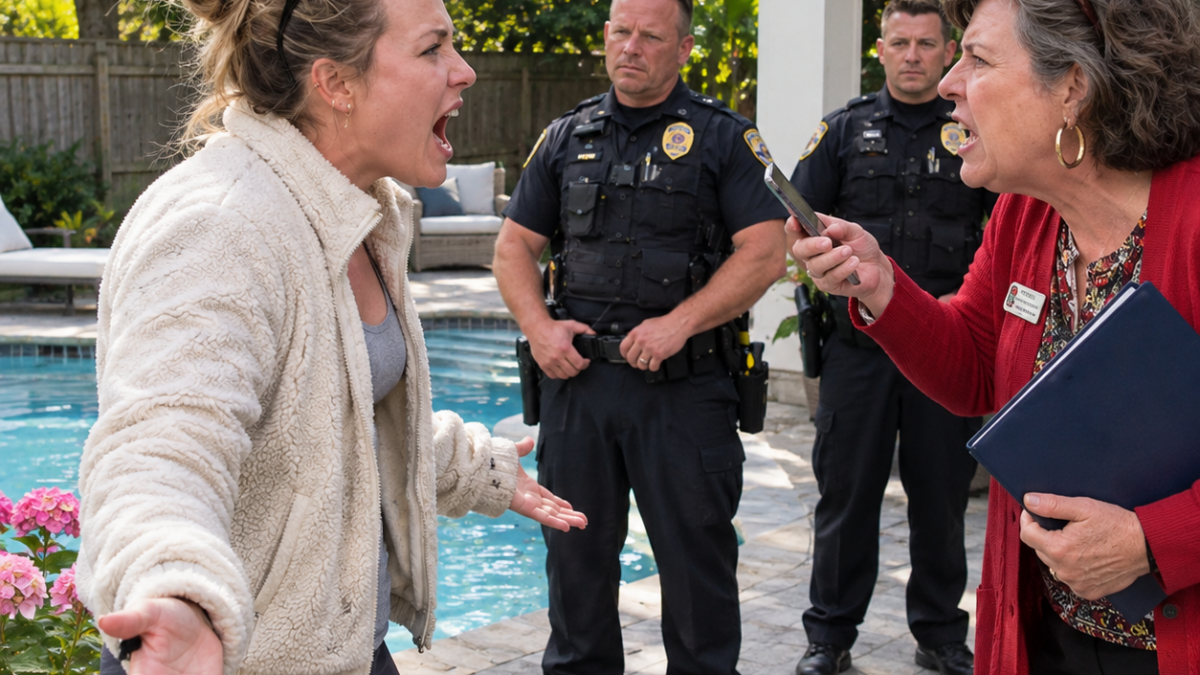
PART2:
“The tile is being cleaned. There’s some surface repair near the steps. The pump is being serviced. We start refilling Thursday.”
Sandra turned toward Martinez.
“She admits it.”
“To draining her pool?”
“My pool.”
Officer Chen looked at her.
“Ms. Fielding, do you live here?”
“No.”
“Then why do you believe the pool belongs to you?”
Sandra stared at him as though the question insulted her intelligence.
“Because it is an HOA recreational asset.”
I actually thought I had misheard.
“A what?”
She turned toward me.
“You know exactly what I mean.”
“No, Sandra. I genuinely don’t.”
“You signed the amenity agreement.”
“I signed no amenity agreement.”
“Of course you did.”
“No.”
She looked at the officers.
“This is what she does. She pretends everything is complicated so nobody can hold her accountable.”
I had learned seven months earlier that arguing directly with Sandra was like throwing wood onto her fireplace.
The more I defended myself emotionally, the more energy she gained.
So I stopped looking at her.
I looked at Martinez.
PART3:
“I have the original construction contract, county permit, inspection certificate, twelve years of maintenance invoices, homeowners insurance records, property tax documents, and photographs from construction.”
Sandra rolled her eyes.
“She’s going to bury you in paperwork.”
Martinez said:
“Evidence would help.”
I stepped away from the door.
“Come inside.”
Sandra moved forward.
I put out one hand.
“Not you.”
Her face changed instantly.
“You don’t get to exclude me.”
“Yes, I do.”
“This is HOA business.”
“This is my house.”
Martinez looked at Sandra.
“Please remain outside for now.”
Sandra’s jaw tightened.
I brought the officers into my dining room.
My document cabinet sat against the far wall.
I am an accountant.
This fact explains much of my personality and most of my closets.
People make jokes about accountants keeping receipts.
I do not consider that an insult.
I consider it risk management.
I opened the file drawer marked:
HOUSE — CAPITAL IMPROVEMENTS.
Then:
POOL — CONSTRUCTION / SERVICE.
Martinez sat at the table.
Chen remained standing.
I placed the original contract in front of them.
Pemberton Residence Pool Installation.
Property address.
My name.
Mark’s name.
Contractor.
Price.
Then the county permit.
Parcel number.
Owner:
Rachel and Mark Pemberton.
Then final inspection.
Then twelve years of bills.
Pool resurfacing.
Pump replacement.
Heater repair.
Chemical service.
Fence work.
Automatic cover motor.
Every invoice to me.
Every payment from my account.
Chen asked:
“Does the HOA contribute anything toward maintenance?”
“No.”
“Insurance?”
“No.”
“Electricity?”
“No.”
“Water?”
“No.”
“Access?”
“No.”
“Have residents ever been permitted to use it as an HOA amenity?”
“Never.”
From outside came Sandra’s voice.
“She’s lying!”
Martinez glanced toward the window.
I continued.
“Seven months ago, I sent her a certified notice instructing her not to enter my property.”
“Why?”
I opened another folder.
HOA — FIELDING.
Martinez looked at the thickness.
“How long has this been going on?”
“Depends how you define going on.”
I showed him the first email.
Sandra had moved into the house two doors down eighteen months earlier.
Within three months, she had become secretary of the Hawthorne Ridge HOA.
Four months after that, president.
She had opinions.
Mailbox paint.
Trash-can placement.
Holiday lights.
Fence stains.
Driveway basketball hoops.
My pool became interesting to her after she hosted something called the Hawthorne Ridge Summer Welcome Walk.
She emailed asking whether attendees could “finish the tour with refreshments poolside at the Pemberton recreational area.”
I replied:
No.
She emailed again.
She said the pool was “historically understood to support neighborhood social use.”
I replied:
No.
She came to my door.
I explained that the backyard was private.
She told me I was being “anti-community.”
Two weeks later, I found her inside my fenced yard with three other HOA board members.
My camera recorded it.
They had entered through the side gate.
Sandra was photographing the pool.
I told them to leave.
She said they were documenting HOA assets.
That was the first time she used that phrase.
I sent the certified trespass notice the following morning.
Three weeks later, someone damaged the gate latch.
I replaced it.
Camera footage showed Sandra near the gate earlier that afternoon.
Not enough to prove she broke it.
Enough that I kept the footage.
Martinez read quietly.
“Did you make a police report?”
“Yes.”
I handed him the incident number.
“No charges. I just wanted it documented.”
He nodded.
Good police officers like documentation for the same reason accountants do.
It gives memory a spine.
Officer Chen was looking at the pool construction permit.
“This seems straightforward.”
“It is.”
That was when Sandra knocked on my front window.
Not the door.
The window.
Three hard taps.
She held up a blue folder.
Martinez closed his eyes briefly.
Then stood.
“I’ll speak with her.”
We went back outside.
Sandra immediately pushed the folder at him.
“She conveniently forgot this.”
Martinez opened it.
First page:
HAWTHORNE RIDGE COMMUNITY RECREATIONAL EASEMENT AGREEMENT.
My stomach tightened.
Not because I recognized it.
Because I didn’t.
The document listed my address.
My parcel.
My pool.
It described a “perpetual nonexclusive recreational access easement” granting the Hawthorne Ridge HOA rights to use and manage the pool for community recreation.
Date:
May 14, seven years earlier.
At the bottom:
Rachel M. Pemberton.
Signature.
It looked like mine.
Not perfectly.
But close.
Very close.
Martinez looked at me.
“Is this your signature?”
“No.”
Sandra laughed.
“Oh, come on.”
I took the document.
My hands did not shake.
Accountants have a useful response to frightening numbers.
We stop feeling first.
We check.
Date.
May 14.
Seven years earlier.
Notary block.
County stamp.
Witness signature.
I looked at the notary.
Kelly D. Merrow.
Did not recognize the name.
Then I saw something else.
The signature line said:
Rachel M. Pemberton.
My middle name is Elaine.
Always has been.
My legal signature on every deed, mortgage, tax filing, insurance record, and permit is:
Rachel E. Pemberton.
Sandra knew me socially as Rachel.
She did not know my middle name.
Whoever built the document had guessed.
I handed it to Martinez.
“My middle initial is E.”
Sandra said:
“That proves nothing.”
“It proves whoever made this didn’t copy my legal name.”
She went still.
Only slightly.
I continued.
“And on May fourteenth of that year, I was in Boston.”
Sandra scoffed.
“Seven years ago? You remember exactly where you were?”
“Yes.”
“Convenient.”
“My daughter had surgery at Boston Children’s Hospital on May twelfth.”
That shut her up.
For approximately three seconds.
Then:
“You could have signed it before you left.”
“The document says executed before a Colorado notary on May fourteenth.”
Martinez looked back at the page.
It did.
Sandra pointed.
“Maybe the date was entered later.”
I looked at her.
“That would not help you.”
Officer Chen said:
“Ms. Fielding, where did you get this?”
“HOA archives.”
“Physical or digital?”
“Both.”
“Who gave it to you?”
“It was already there.”
“When did you first see it?”
Sandra’s answers became less precise.
“Some time ago.”
“How long?”
“I don’t remember.”
“You called police saying Ms. Pemberton destroyed your property.”
“Yes.”
“Based on this document?”
“Among other records.”
“What other records?”
Sandra smiled again.
That smile worried me more than the easement.
“The HOA owns a forty-percent beneficial interest in the pool.”
I stared at her.
“What?”
“You really should read the community financial statements.”
“I do.”
“Apparently not closely.”
I had served as HOA treasurer nine years earlier.
For exactly eleven months.
I resigned because three-hour debates over mulch colors made me question the structure of civilization.
I still read annual financials.
There had never been a pool asset.
Not mine.
Not anyone’s.
Martinez said:
“What does beneficial interest mean here?”
Sandra answered:
“The HOA funded capital improvements.”
“No, it didn’t.”
“Yes, Rachel.”
“When?”
“Over several years.”
“Show me.”
She opened the blue folder.
Ledger pages.
Pool Rehabilitation Reserve.
Payments.
$18,500.
$22,750.
$14,900.
Vendor:
Pemberton Aquatics.
I laughed once.
Couldn’t help it.
Sandra looked offended.
“What’s funny?”
“There is no company called Pemberton Aquatics.”
“It’s in the ledger.”
“I see that.”
“You received the money.”
“No.”
“The vendor name literally has your name.”
“So does Pemberton Cheese Company in Wisconsin. I don’t own that either.”
Martinez hid something that might have been a smile.
I looked at the payments.
Three years.
Total:
$56,150.
Check references.
Electronic transfers.
But not to me.
The last four digits of the destination account were shown.
4421.
My household account ended in 8176.
Pool service account?
I did not have one.
Sandra said:
“The HOA paid for your renovations. That gives the community rights.”
“No, it gives us a bookkeeping problem.”
“You accepted the money.”
“I didn’t.”
“How convenient.”
“Where did account 4421 belong?”
She blinked.
“What?”
“The payments.”
I pointed.
“Destination account ending 4421.”
“It belongs to the vendor.”
“You just said the vendor was me.”
“It was your pool company.”
“I don’t have a pool company.”
Sandra’s voice rose.
“This is ridiculous.”
I looked at Martinez.
“I’d like a copy of that ledger.”
Sandra pulled the folder back.
“No.”
Martinez said:
“You brought it as evidence.”
“I’m showing it, not surrendering it.”
“Then I’m documenting what you showed me.”
He took out his phone.
Sandra closed the folder.
Too late.
He had already seen enough.
Chen asked:
“Ms. Fielding, do you have proof the alleged easement is recorded with the county?”
“Yes.”
“Recording number?”
She looked through pages.
Found it.
That was when I became genuinely concerned.
A fake document in an HOA binder is one thing.
A fake document carrying what appears to be a county recording number is another.
Martinez called dispatch.
Requested a property-record check.
We waited on my front porch.
Sandra stood on the lawn.
I stood by the door.
The officers between us.
Ten minutes later, Martinez got the answer.
No recreational easement recorded against my parcel.
Sandra said:
“That’s impossible.”
Martinez repeated.
“No recorded easement.”
She opened the folder again.
“Here.”
He looked at the supposed stamp.
Then at the number dispatch had provided.
Wrong format.
Our county recording numbers had ten digits.
Sandra’s had nine.
The stamp looked right.
The number did not.
Officer Chen asked:
“Who prepared this?”
Sandra said:
“I told you. It was in the archives.”
“Who notarized it?”
“Kelly Merrow.”
“Do you know her?”
“No.”
“Who is Pemberton Aquatics?”
“I assume Rachel.”
I said:
“You assumed that before calling police?”
Sandra turned on me.
“You drained the pool knowing the HOA had financial rights.”
“No.”
“You were trying to destroy evidence.”
That was new.
“What evidence?”
“The water.”
Officer Martinez actually frowned.
“The water?”
Sandra looked at him.
“Yes.”
“Explain.”
She hesitated.
Then made the mistake that changed everything.
“The pool was supposed to remain operational through the appraisal period.”
Silence.
I looked at her.
“What appraisal period?”
Her face changed.
Very slightly.
Martinez heard it too.
“What appraisal?”
Sandra tried to recover.
“I mean annual HOA insurance appraisal.”
I knew that was wrong immediately.
HOAs do not routinely require private backyard pools to remain filled for annual insurance valuations when the HOA does not insure them.
I asked:
“Who was appraising my pool?”
“No one specifically.”
“You just said it had to remain operational.”
“Because it’s listed as an amenity.”
“Listed where?”
She did not answer.
I stepped forward.
“Where, Sandra?”
Martinez said:
“Ms. Fielding?”
Sandra closed the folder.
“I’m done with this.”
She turned toward the sidewalk.
Martinez said:
“We haven’t finished taking your complaint.”
“I withdraw it.”
That was the moment I knew the pool was no longer the issue.
Sandra had arrived wanting police pressure.
She expected officers to see:
Drained pool.
HOA document.
Confession that I drained it.
Then force me to refill it before someone came to inspect.
Someone.
An appraiser.
Why?
I spent the next hour making copies.
The officers did not arrest anyone.
That disappointed Sandra’s understanding of law enforcement, I suspect.
They documented.
Photographed.
Took statements.
Martinez told her the ownership issue appeared civil based on the information available, but that presenting potentially fraudulent documents could become a separate matter if evidence supported it.
She left angry.
I watched her walk home.
Then went inside.
Opened my laptop.
And started doing what I do when something does not reconcile.
I reconciled.
First:
HOA financials.
Public to members.
Annual budgets.
Reserve schedules.
Vendor reports.
I searched:
Pool.
Aquatic.
Recreation.
Pemberton.
Nothing in the clean annual statements.
Then I pulled meeting packets.
Those had more detail.
Three years earlier:
Community Recreational Asset Enhancement — $76,000.
Vague.
Next year:
Distributed Aquatic Amenities — $94,000.
Vaguer.
Current year:
Resident Recreation Preservation — $128,000.
I had read those lines before.
Assumed they referred to the clubhouse pool.
Hawthorne Ridge did have one HOA pool.
Small.
Thirty years old.
Beside the clubhouse.
I searched reserve studies.
That pool was separately listed.
Why were there additional aquatic expenses?
I called Aaron Velasquez.
Former HOA treasurer.
He had resigned four months before Sandra became president.
“Rachel?”
“Sorry for the hour.”
“It’s seven-thirty.”
“I’m an accountant.”
“Fair.”
“Do you remember a vendor called Pemberton Aquatics?”
Silence.
“No.”
“Pool Rehabilitation Reserve?”
“No.”
“Distributed Aquatic Amenities?”
Longer silence.
“I asked about that.”
“When?”
“Two years ago.”
“What happened?”
“Sandra said the board had entered maintenance-sharing agreements with several homeowners.”
My stomach tightened.
“Several?”
“Private pools.”
“How many?”
“She said nine.”
I stood up from my desk.
“What?”
“She claimed some owners had given limited HOA access rights in exchange for capital support.”
“Did you see agreements?”
“Copies.”
“Mine?”
“I don’t remember names.”
“Did you approve payments?”
“Some.”
“Account 4421 mean anything?”
“No.”
He paused.
“Rachel, what happened?”
I told him.
When I finished, he said:
“I kept backups.”
“Of what?”
“Everything.”
“Why?”
“Because Sandra once told me treasurers were replaceable.”
Accountants are petty in wonderfully useful ways.
Aaron came over forty minutes later with an external drive.
We opened archived accounting exports.
Not the polished member statements.
The underlying ledger.
That was where the truth started becoming ugly.
Pemberton Aquatics.
Three payments.
$56,150.
But vendor tax ID did not match any entity associated with me.
The routing destination went to a bank.
We could not see account owner.
Then other vendors:
Calloway Pool Holdings.
Merrick Recreation Trust.
Eastgate Swim Cooperative.
Hawthorne Private Aquatics.
Eleven entities.
Payments totaling $412,700 over thirty-one months.
Aaron stared.
“I never saw half these.”
“Because they were entered after export?”
“Or reclassified before member reporting.”
We compared timestamps.
Several entries had been created retroactively.
Administrator credentials:
SFielding.
I looked at Aaron.
“She manufactured HOA ownership interests in private pools.”
He looked back.
“Why?”
That was the correct question.
Fraud to steal pool-maintenance money was possible.
But why create easements?
Why insist the pools remain operational?
Why mention appraisal?
At 9:15, I found the answer.
Hawthorne Ridge board minutes from six months earlier.
Special financing committee.
Community infrastructure modernization.
Potential credit facility:
$2.8 million.
Collateral and asset review.
I called Aaron’s attention to it.
He frowned.
“The HOA was borrowing?”
“Looks like it.”
“For what?”
We kept reading.
Clubhouse renovation.
Road resurfacing.
Stormwater repairs.
Security gates.
Total projected cost:
$3.4 million.
HOA reserves:
$611,000.
Assessment would have been enormous.
Instead, Sandra had told residents she secured financing “without a major special assessment.”
Everybody applauded.
I had even thought:
Finally, she did something competent.
Now I understood why an appraisal might matter.
The lender would assess HOA assets and revenue.
I searched member communications.
Found Sandra’s announcement.
HAWTHORNE RIDGE INFRASTRUCTURE RENEWAL FACILITY APPROVED IN PRINCIPLE.
She wrote:
Our diverse community-owned recreational portfolio significantly strengthened Hawthorne Ridge’s financial position.
Portfolio.
Not pool.
Pools.
I called Officer Martinez.
He gave me his work email.
I sent only facts.
No accusation.
Then I called our HOA attorney listed on public filings.
Not Sandra’s personal attorney.
The association’s.
His name was Jonathan Beck.
He listened.
Then said:
“Do not contact the lender yourself tonight.”
“Why?”
“Because I need to determine what the board represented.”
“I’m a member.”
“I understand.”
“Was my property used in loan documents?”
He paused.
“I cannot answer yet.”
“That sounded like yes.”
“It sounded like I need to open a file.”
At 10:40, my backyard camera alerted.
Motion at side gate.
I opened the feed.
Sandra.
Dark coat.
Flashlight.
She was trying the gate.
I called police.
Not because I was afraid of her.
Because seven months earlier I had learned that documentation is more useful than confrontation.
I turned on the patio lights remotely.
Sandra froze.
Looked directly at the camera.
Then walked away quickly.
Officers arrived.
Different pair.
I gave them the prior trespass notice.
Incident number.
Video.
That made two police reports in one day.
Sandra’s strategy had become remarkably inefficient.
The following morning, my pool contractor arrived at seven.
His name was Dean Morris.
He had serviced the pool for nine years.
He saw police cars had been there overnight.
“What did I miss?”
“Apparently you’ve been maintaining an HOA asset.”
He looked at the empty pool.
“Do they know?”
“Know what?”
“That the HOA has never paid me a dollar?”
I turned.
“Say that again.”
He looked confused.
“They’ve never paid me.”
“You’ve never received HOA funds for my pool?”
“No.”
“Could someone have paid you through another company?”
“All invoices go to you.”
I showed him the alleged Pemberton Aquatics ledger.
Dean laughed.
“That’s fake.”
“Useful legal terminology.”
“I’m serious.”
“So am I.”
He looked closer.
“Pool Rehabilitation Reserve?”
“Yes.”
“Rachel, we haven’t rehabilitated this pool in three years.”
Exactly.
The $22,750 “repair” supposedly paid eighteen months earlier?
Nothing happened then.
The $18,500 entry?
No work.
The $14,900 entry?
No work.
My actual maintenance total across those years was less than half the supposed HOA contribution.
Sandra had invented repairs too.
At 8:20, Jonathan Beck called.
His voice was different from the night before.
“Rachel, are you home?”
“Yes.”
“I need to come over.”
“With?”
“Two board members.”
“Not Sandra.”
“No.”
“Fine.”
They arrived at nine.
Jonathan.
Aaron.
And Elise Park, current HOA secretary.
Elise looked sick.
She carried a banker’s box.
We sat at the same dining table where the officers had sat the previous day.
Jonathan placed a loan package in front of me.
Lender:
Rockland Community Bank.
Credit facility:
$2.8 million.
Borrower:
Hawthorne Ridge Homeowners Association.
Supporting asset schedule.
Page forty-six.
I stopped breathing for a second.
COMMUNITY RECREATIONAL ASSET PORTFOLIO.
Clubhouse.
Tennis courts.
Walking trail.
Playground.
Then:
Eleven private residential pools subject to perpetual recreational easements.
Estimated aggregate replacement value:
$1.73 million.
My pool was number four.
Appraised value:
$186,000.
I stared.
“That isn’t even what it cost.”
Jonathan said:
“Replacement estimate.”
“Who appraised it?”
He pointed.
Goldcrest Property Advisory.
I recognized the company.
Sandra’s brother-in-law, Patrick Fielding, worked there.
Of course he did.
I turned another page.
Photographs.
My pool.
Full.
Blue.
Summer.
Taken from inside my yard.
I recognized the date.
Seven months earlier.
The afternoon Sandra entered after I told her not to.
The photographs she took while trespassing had been included in a bank appraisal packet.
Another pool.
Another.
Another.
Eleven private backyards.
Elise whispered:
“I had no idea.”
I looked at her.
“You signed the loan resolution.”
“I signed authorization for financing based on clubhouse and common property.”
“You didn’t see this?”
“No.”
Jonathan said:
“Board members received a summary package.”
“Who prepared full exhibits?”
“President’s office and finance consultant.”
Sandra.
I turned to the supposed easements.
Eleven documents.
Different homeowners.
Notaries.
Signatures.
I knew three of the owners personally.
One was eighty-two-year-old Howard Leland.
He would sooner donate a kidney than let the HOA use his pool.
I called him.
“Howard.”
“Rachel.”
“Did you give Hawthorne Ridge a permanent easement over your swimming pool?”
Silence.
Then:
“Did I have a stroke?”
“No.”
“Then no.”
“Did the HOA ever pay to maintain it?”
“No.”
“Did Sandra photograph it?”
Longer silence.
“She came over during the garden tour.”
There it was.
Eleven pools.
Eleven asset claims.
Eleven alleged easements.
Jonathan said:
“The loan has not funded fully.”
“How much?”
“First draw was $640,000.”
“Where did it go?”
Nobody answered immediately.
That was bad.
“Elise?”
“Clubhouse design got about eighty.”
“Road contractor?”
“Not started.”
“Stormwater?”
“Not started.”
“So where’s the rest?”
Jonathan looked at Aaron.
Aaron opened his laptop.
“We’re working on that.”
I knew that sentence.
Accountants use it when the answer exists but is going to ruin somebody’s morning.
By noon, we knew enough.
$640,000 draw.
$92,000 legitimate professional fees and preliminary work.
$548,000 transferred through three entities.
Fielding Community Consulting.
Palisade Recreation Management.
HWR Capital Services.
Sandra had disclosed none as related parties.
Palisade’s registered agent was Patrick Fielding.
HWR Capital linked to Sandra’s adult son.
Fielding Community Consulting was Sandra herself.
Invoices claimed:
Aquatic Easement Acquisition.
Resident Amenity Negotiation.
Property Integration Services.
Loan Portfolio Development.
She had paid herself and family members to create the fake asset portfolio used to secure the loan.
Then charged the HOA for creating it.
Jonathan leaned back.
“I need outside counsel.”
Elise looked pale.
“Are we going to lose the neighborhood?”
“No,” I said.
Everyone looked at me.
I continued.
“The bank does not own our houses because Sandra lied about my pool.”
Jonathan nodded.
“Rachel’s right.”
“But the HOA could owe everything.”
“Yes.”
That part was possible.
Members could face special assessments.
Legal fees.
Loan default costs.
The victims of HOA fraud often pay twice.
First through the scheme.
Then through fixing it.
That made me angrier than Sandra calling the police.
At 1:10, Officer Martinez called.
County recorder had confirmed Kelly D. Merrow—the notary on my alleged easement—did not exist in the active or historical state notary database.
The recording stamp was fabricated.
Police had referred the documents to detectives.
I asked:
“Do you need the loan package?”
“Yes.”
“We have eleven easements.”
Silence.
“Eleven?”
“Yes.”
“Do the homeowners know?”
“Starting to.”
By three, they all did.
Jonathan called each owner individually.
Nine immediately denied signing anything.
One family was traveling.
The eleventh property belonged to a man named Gerald Pike.
His answer was different.
“Yes.”
I called him personally.
“You signed?”
“Yes.”
“Why?”
“Sandra paid me.”
“How much?”
“Twelve thousand.”
“For permanent HOA access?”
He laughed nervously.
“No.”
“What did you think you were signing?”
“Temporary photo release.”
My stomach tightened.
“What?”
“She said they needed a model property for a lender presentation. Pool photos. Maybe two site visits.”
“Did you read the document?”
“Not really.”
“What did you sign?”
“Something on a tablet.”
There it was.
His signature might be genuine.
Applied to a different document.
Jonathan brought in a forensic document specialist.
Not because we were trying to build a television plot.
Because digital signature systems retain metadata.
Gerald’s supposed easement was created three days after the signature capture.
His signature image was imported.
That fact gave investigators a roadmap.
Check every signature.
Check every file creation timestamp.
Check every notary.
Check every IP address.
Sandra’s scheme had looked sophisticated when viewed as paper.
Digital records made it clumsy.
By evening, Rockland Community Bank froze the remaining loan facility.
Sandra sent an emergency email to all HOA members.
SUBJECT: MALICIOUS ATTACK ON HAWTHORNE RIDGE LEADERSHIP.
She accused:
“a small group of disgruntled residents”
of sabotaging necessary improvements.
I was named.
Of course.
She said I had drained a “community-maintained recreational facility” immediately before a lender inspection to deliberately damage the HOA.
That sentence was useful.
Because it confirmed why she brought police.
The lender’s property inspector was scheduled the following morning.
My empty pool would expose the physical absurdity of Sandra’s claim.
No HOA signs.
No access gate.
No community hours.
No safety equipment required for public use.
No HOA-funded maintenance.
Just my backyard.
Sandra needed it filled and photogenic.
She believed police pressure might make me refill it overnight.
She had not anticipated the officers asking the simplest question.
Who owns it?
The next morning, the bank inspector came anyway.
Not to value collateral.
To document potential fraud.
Her name was Denise Harwood.
She stood beside the empty pool.
Looked around.
“Where would HOA members enter?”
“They wouldn’t.”
“No separate gate?”
“No.”
“Restroom access?”
“My house.”
“Liability signage?”
“No.”
“ADA access?”
“No.”
“Posted hours?”
“No.”
“HOA maintenance equipment?”
I pointed at my shed.
“My equipment.”
She looked at the file.
Then my backyard.
Then the file.
“This was represented as a managed community aquatic facility.”
I spread my hands.
“You’re standing in my yard.”
She took photographs.
The empty pool did something the full pool never could.
It showed everything.
Private steps.
Private patio.
My daughter’s old initials scratched into one concrete corner from when she was nine.
My utility lines.
My equipment.
Nothing communal.
Sandra had been right about one thing.
Draining the pool damaged her property.
Not physically.
It damaged the fiction.
The shell was evidence.
By afternoon, investigators executed warrants for HOA administrative records and Sandra’s electronics.
She was not arrested that day.
People in the neighborhood were disappointed.
I was not.
I wanted the accounts.
Arrest first, records later is satisfying television.
Records first gives prosecutors something to work with.
Within two weeks, the picture expanded.
The fake pool portfolio was only part of Sandra’s financial strategy.
She had exaggerated HOA assets to qualify for more favorable lending.
She had inflated reserve-funded project estimates.
She routed consulting fees to related entities.
And she had been planning a second phase.
“Community Recreation Consolidation.”
The phrase appeared in her files.
The proposal would have amended HOA rules to require participating private amenities to maintain minimum operational standards.
Once the fake easements were treated as established, Sandra intended to start enforcing them.
Pool must remain filled May through September.
Certain owners required to provide scheduled HOA access.
Maintenance subject to HOA approval.
Then the truly audacious part:
The HOA would charge owners an “amenity preservation fee” if their private pools failed inspection.
She planned to forge ownership rights first.
Then fine homeowners for failing to maintain the property she falsely claimed rights over.
I sat in Jonathan’s office reading the draft.
“You have to admire the circularity.”
He looked at me.
“I do not.”
“It’s professionally offensive.”
“You accountants keep saying that.”
“We have standards.”
The scheme affected eleven pool owners.
Then investigators found six private tennis courts.
Three large garden parcels.
Two private walking paths.
A pond.
Sandra had built an entire “distributed recreational portfolio” from property the HOA did not own.
Estimated asset value submitted to the lender:
$4.1 million.
Actual HOA ownership:
Zero.
One investigator eventually asked Sandra why she thought she could do it.
We learned the answer later through court filings.
She believed old HOA declarations gave the board broad authority to “promote and coordinate recreational resources within Hawthorne Ridge.”
That clause existed.
I checked.
It allowed the HOA to organize events.
Not confiscate private property.
Sandra took one vague sentence and built a financial universe around it.
That is how bad HOA leadership often works.
Not always by inventing power from nothing.
By finding five words of real authority and stretching them until they cover everything.
The neighborhood meeting that removed Sandra lasted three hours.
Every chair in the clubhouse was filled.
People stood along walls.
Sandra attended with counsel.
She sat at the front.
Still composed.
Still dressed as if appearance might outvote evidence.
Jonathan explained the bank freeze.
Aaron explained the ledger.
Denise’s appraisal review was summarized.
Then eleven pool owners stood one by one.
Howard went first.
“I did not sign any easement.”
Another.
“I did not receive maintenance money.”
Another.
“I never gave the HOA access.”
Gerald stood last.
“I signed something.”
Sandra’s lawyer almost smiled.
Then Gerald continued.
“But not what you filed.”
Smile gone.
I spoke briefly.
Not emotionally.
I brought the original pool construction photograph.
Placed it on the projector.
Twelve years earlier.
Mark beside the excavation.
Five-year-old Sophie in rain boots.
Then the permit.
Then invoices.
Then my trespass notice.
Then Sandra’s photograph from seven months earlier.
Same angle as the lender packet.
“I did not ask the HOA to build my pool.”
I looked at Sandra.
“I did not ask it to maintain my pool.”
Then at the room.
“I did not grant anyone access.”
I put up the fake easement.
“And I did not sign this.”
Sandra’s attorney objected.
This was not court.
Nobody cared.
The recall vote was 83 to 6.
Sandra lost.
One vote was hers.
Two were family.
I never discovered the other three.
Aaron said mystery was healthy.
The new board hired an independent forensic accounting firm.
That was when the numbers became final.
Over four years:
$548,000 in loan proceeds redirected through related entities.
$412,700 in purported private-amenity reimbursements.
$186,000 in consulting charges lacking adequate support.
$73,000 in legal and administrative costs tied to the fake portfolio structure.
Some categories overlapped.
Some money returned.
Some did not.
The bank worked with the new HOA board rather than immediately calling the entire credit facility.
That saved homeowners from the worst outcome.
The legitimate clubhouse and drainage projects were restructured.
The fraudulent collateral was removed.
Insurance claims were filed.
Civil recovery actions began.
The special assessment everyone feared still came.
Smaller than it could have been.
$640 per household spread over two years.
I hated paying it.
Paid anyway.
Fraud makes innocent people buy the cleanup.
Sandra was eventually charged with multiple counts connected to forged documents, financial misrepresentation, and misuse of association funds.
Her defense argued that several disputed transactions were legitimate HOA business and that she had relied on advisers.
Some charges took longer than neighbors expected.
Some allegations ended in civil rather than criminal resolution.
Real accountability is rarely as neat as the rumor mill wants.
Patrick Fielding’s appraisal work was reviewed separately.
His company terminated him before the professional board finished.
The fake notary identity traced back to document templates created through an online service.
Kelly D. Merrow had never existed.
That detail bothered me.
Not because it was clever.
Because it was lazy.
Sandra assumed nobody would check.
That was the entire scheme in miniature.
Nobody will check the middle initial.
Nobody will call the notary.
Nobody will compare the bank account.
Nobody will ask homeowners.
Nobody will inspect the metadata.
Nobody will notice eleven pools.
Nobody will drain one.
That last assumption ruined her.
Months after the investigation started, Dean finished my maintenance.
New tile around the steps.
Pump seals replaced.
One small crack repaired.
Then we refilled.
It took longer than usual because I refused to use the highest flow rate.
I had become irrationally sentimental about a concrete hole.
Sophie came home from college that weekend.
She stood beside me watching the water rise.
“Mom.”
“What?”
“Did somebody really try to steal our pool?”
“On paper.”
“That’s somehow weirder.”
“Yes.”
“She called the cops?”
“Yes.”
“Because you drained it?”
“Yes.”
Sophie looked into the half-filled pool.
“So if you hadn’t drained it…”
I knew what she meant.
Would we have discovered the scheme?
Eventually, maybe.
The bank might have completed inspection.
The loan might have fully funded.
Sandra’s next rule amendments might have triggered challenges.
One of the other homeowners might have questioned an easement.
The financial discrepancies might have surfaced.
But maybe later.
After more money moved.
After the HOA had more debt.
After the fake asset portfolio had been treated as established fact long enough that unwinding it became even harder.
“I don’t know,” I said.
Sophie nodded.
Then:
“Maintenance saved the neighborhood.”
“Do not tell Dean that.”
“Why?”
“He’ll increase his rates.”
She laughed.
I did too.
The pool filled.
No ceremony.
No ribbon cutting.
No HOA inspection.
Just water.
The first time I swam after everything, I floated in the deep end and looked at my own roofline.
Same view I had seen for twelve years.
Nothing about the pool had physically changed very much.
That was the strange part.
Sandra’s claim had made me defend something I had never previously thought needed defending.
Ownership often feels invisible until somebody challenges it.
Then every ordinary detail becomes evidence.
The bill for the heater.
The cracked tile you chose not to replace.
The photo of your child beside fresh concrete.
The gate key in your drawer.
The fact that you know exactly which step gets slippery when algae starts.
Paper proves ownership legally.
Life proves it emotionally.
I never needed Sandra to understand either.
I only needed the record to.
Officer Martinez stopped by several months later.
Not officially.
He was driving through the neighborhood.
I was getting mail.
He rolled down his window.
“How’s the pool?”
“Still mine.”
He smiled.
“Good.”
“You guys get many stolen-pool calls?”
“First.”
“Disappointing.”
“Your neighbor set a high bar.”
I laughed.
Then he said:
“You did the right thing that day.”
“What part?”
“Not arguing.”
I looked toward Sandra’s former house.
She had moved after the recall.
House sold during the civil litigation.
“Arguing wouldn’t have helped.”
“No.”
Martinez tapped the steering wheel.
“Most people think police calls are won by whoever tells the best story.”
“And?”
“Usually we’re just trying to figure out which story survives the first document.”
That sentence stayed with me.
Sandra’s story was louder.
Mine survived documents.
Years passed.
Hawthorne Ridge became boring again.
Exactly what I wanted.
Board meetings lasted under an hour.
Budgets became understandable.
Every related-party transaction had to be disclosed.
Independent financial review every year.
Loan documents available to members.
No “distributed recreational portfolio.”
The phrase was formally banned from board presentations after Aaron moved that it be classified as “psychologically harmful accounting language.”
The motion passed unanimously.
Even Jonathan laughed.
Howard still had his pool.
He put a sign by the fence:
HOWARD’S POOL.
NOT YOURS.
The board asked him to remove it because signs violated exterior rules.
Howard asked whether the HOA wanted to litigate pool ownership again.
The sign stayed.
My own side gate got a better lock.
Not because I expected another Sandra.
Because good controls are designed after you learn where weak ones fail.
Accountant habit.
One summer, the new HOA president asked whether I would host a neighborhood barbecue.
I stared at him.
He immediately raised both hands.
“Voluntarily.”
“That word matters.”
“I know.”
“No permanent easement?”
“No.”
“No asset appraisal?”
“No.”
“No financing instrument?”
“Rachel.”
“I’m checking.”
He laughed.
I agreed.
Thirty people came.
Howard brought potato salad.
Aaron brought beer.
Sophie brought friends.
Children swam.
Neighbors used the pool.
My pool.
Because I invited them.
That distinction was so simple it almost felt profound.
Community does not require ownership.
Sharing does not require surrender.
You can let people into your backyard without giving them a legal interest in it.
You can say yes Saturday and no Sunday.
That is what private property means.
Choice.
Sandra never understood that.
To her, if something benefited the neighborhood, the HOA should control it.
If the HOA controlled it, Sandra controlled it.
And once she believed that, paperwork became a tool for making reality catch up with entitlement.
But reality is stubborn.
So are county records.
So are bank transfers.
So are camera timestamps.
And accountants.
Especially accountants.
I kept the fake easement.
A copy.
The original went into evidence.
Mine sits in the same file cabinet where all this began.
HOA — FIELDING.
On top of the first page, I wrote one note in red ink.
CHECK THE INITIAL.
That was the first crack.
Rachel M. Pemberton.
One wrong letter.
Everything Sandra had assembled looked official.
County-style stamp.
Legal description.
Notary block.
Formal language.
Signature close enough to mine that a stranger might accept it.
But fraud has a strange weakness.
It requires the person creating it to know details they often consider too small to matter.
My middle name.
My daughter’s surgery date.
My real bank account.
The fact that no contractor had done the repairs.
The fact that Howard hated the HOA.
The fact that Gerald thought he had signed a photo release.
The fact that digital files remember when they were created.
The fact that a private pool looks extremely private once the water is gone.
Sandra had focused on the big story.
HOA owns recreational rights.
Bank sees $4.1 million in assets.
Loan approved.
Money moves.
What defeated that story were little things.
An E instead of an M.
A dry concrete shell.
A contractor saying:
“I never got paid.”
A former treasurer keeping backups.
A police officer asking for a recording number.
Small facts.
Large consequences.
I think about that every autumn when I drain the pool below the tile line for winter preparation.
Not completely.
Colorado soil makes fully draining a pool unnecessarily risky unless maintenance requires it.
Dean taught me that years ago.
Now whenever the water drops, I can see more of the shell.
The steps.
Returns.
Deep-end drain.
Concrete that normally lives underwater.
The hidden structure.
That is what happened to Hawthorne Ridge too.
Sandra thought draining the pool destroyed her evidence.
It did the opposite.
It lowered the water far enough for all of us to see what had been underneath.
Not damage.
Not HOA property.
A private swimming pool.
Mine.
And behind the fake claim to that pool, a financial scheme she had spent years assuming nobody would ever bother to drain far enough to find.








