I Donated My Dead Cat’s Blanket—Then an Old Shelter Cat Used It to Save a Kitten No One Wanted
PART3:
I walked toward the donation shelf with the stiff, careful steps of someone carrying a bowl filled to the very top. There were already leashes there, towels, a plastic bag of tennis balls, a stack of folded fleece blankets, an unopened bag of kitten food, and a little red sweater that made my eyes burn because some other animal had probably died or outgrown warmth.
I set Maja’s box down.
For one second, my fingertips stayed on the cardboard.
Then I pulled away.
There.
Done.
I turned to leave before my body could embarrass me.
That was when I noticed the old cat.
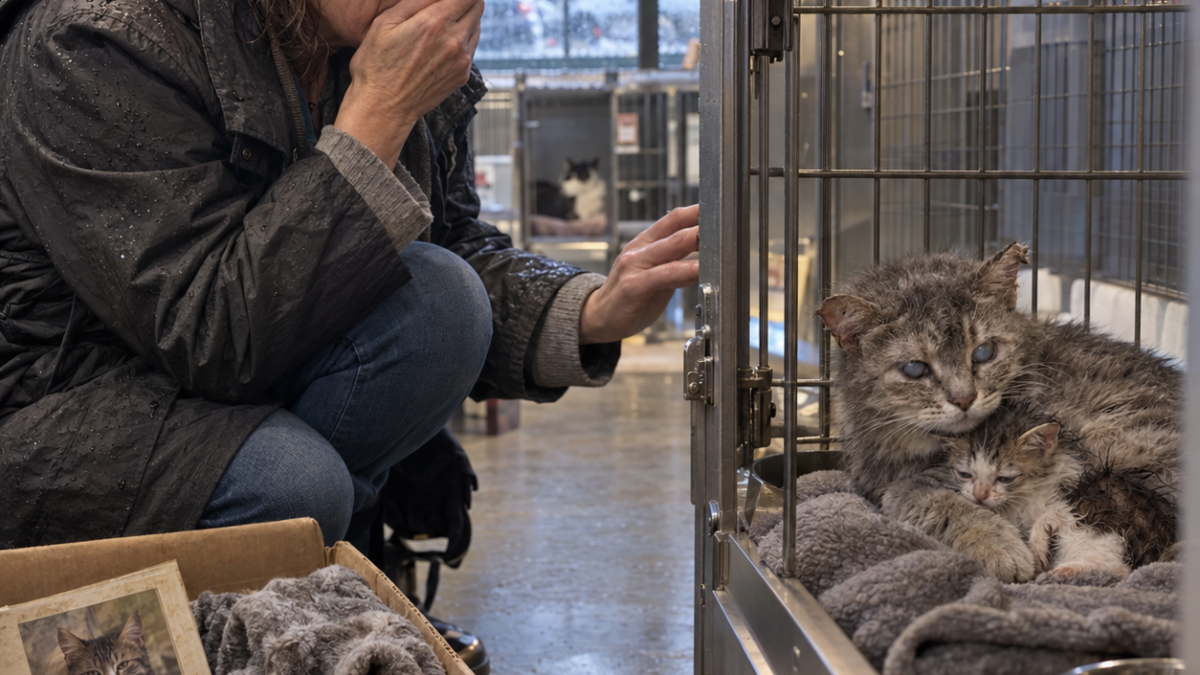
She was in a bottom kennel near the far corner of the cat room, the kind of kennel people barely glance at because bending down takes effort and hope usually lives at eye level. She had patchy gray-and-cream fur, one ear with a chunk missing, cloudy eyes, a bent white whisker, and a narrow face that looked as if life had taken several hard swings at it and never apologized.
She was not cute.
That was my first unkind thought.
Not cute in the way kittens are cute. Not sweet-faced in the way adoption posters like. Not sleek, fluffy, bright, or charming. She looked old enough to remember every person who had ever failed her.
Her name card was taped crookedly to the kennel door.
ADA.
Senior female. Estimated 13+. Quiet. Needs patient home. Prefers calm environment.
Under special notes, someone had written in blue ink: Very gentle.
At the far end of Ada’s kennel, tucked near the back wall, was a kitten.
Tiny.
Too tiny.
All bones and damp-looking fluff, with ears too large for its head and a body that trembled so hard the movement seemed separate from the animal itself. Its little paws were pressed against the kennel floor. Its eyes were half-open, sticky at the corners. There was a shallow dish of food nearby, but it had not touched it.
Ada had one blanket.
A thin little square of fleece, faded yellow, flattened from use.
It was under her front paws.
I stood there because something about the scene caught me.
Maybe it was the unfairness of it. This old cat with nothing. This shaking baby with less than nothing. The two of them shoved into a lower cage under fluorescent lights while people walked past looking for something younger, prettier, easier to love.
A girl of about nine came into the room with her mother, saw Ada, and wrinkled her nose.
“That one looks creepy,” she whispered.
“Hush,” her mother said, but she did not stop walking.
Ada did not react.
That was worse somehow.
She looked like a creature who had long ago stopped expecting better from strangers.
Then Ada turned her head toward the kitten.
Slowly.
Every movement seemed expensive.
She looked down at the blanket under her paws. She hooked one paw into the edge and tugged.
The blanket moved maybe an inch.
Ada paused, breathing through her nose.
Then she tugged again.
The blanket bunched beneath her chest.
She shifted with visible effort, rising on stiff legs. Her back end trembled. One paw slipped. The kitten made a faint sound, not even a real cry, just a thin broken squeak.
Ada tugged again.
And again.
Little by little, inch by inch, she dragged her only soft place across the hard kennel floor.
I stepped closer without realizing I had moved.
“Look at that,” someone murmured behind me.
It was Ellen from the front desk.
Neither of us spoke after that.
Ada kept pulling until the blanket reached the kitten. It did not fully cover the floor beneath the baby, so she nosed at it, pushed it, adjusted it with clumsy tenderness until the smallest part of the kitten’s shaking body rested on fleece instead of metal and plastic.
Then, after giving up the only comfort she had, Ada lowered herself down.
Not on the blanket.
Beside the kitten.
Pressed close enough to warm it.
Close enough to say, without words, I have almost nothing, but what I have is yours.
I do not know how long I stood there.
I know I stopped breathing for a second.
Because that was Maja.
Not literally. I was not foolish enough to think my dead cat had come back to me in a broken old shelter cat’s body.
But I knew that kind of love.
I knew that move.
Maja had done it for years.
On nights when I could not sleep, she left her favorite chair and climbed onto my chest as if she had diagnosed the problem and prescribed her whole warm weight. When I cried after Daniel moved away, she sat outside the bathroom door and yelled until I came out. When my divorce papers arrived in the mail, I dropped them on the kitchen table and sat there staring, numb and humiliated, and Maja jumped onto the chair beside me, put one paw on the envelope, and looked at me like she was ready to fight a lawyer.
She had not fixed my life.
Animals rarely fix anything in the tidy way people want to talk about.
But she had witnessed it.
She had stayed.
And sometimes staying is the miracle.
Watching Ada give away her only comfort to something smaller and weaker than herself, I felt a crack open inside me.
I had been so sure grief meant love was over. I thought once the creature who held your routines and your private voice and your last soft place was gone, all that remained was memory and management. I thought healing meant packing the evidence into cardboard, driving through rain, leaving it on a shelf, and walking away empty-handed like a grown woman should.
But here was this old, unwanted cat proving something I had forgotten.
Love was still alive.
It just needed somewhere to go.
I crouched in front of the kennel, my knees protesting so sharply that I had to grip the metal frame to keep from making a sound. Ada lifted her cloudy eyes to mine.
She did not cry.
She did not paw at the bars.
She did not perform need.
She simply looked at me with the exhausted calm of a creature who had lived long enough not to expect rescue from anyone.
I slid my fingers through the kennel bars.
“If I take you home,” I whispered, “you need to know I’m not doing great.”
My voice broke on the last word.
Ada stared at my hand.
Then, slowly, she leaned forward and pressed the side of her face into my fingers.
That was all.
No music.
No spotlight.
No grand sign from heaven.
Just one old cat, still willing to trust somebody.
I started crying right there in the shelter.
Not quiet, elegant tears either. These were ugly tears. Nose-running, shoulder-shaking, cannot-find-a-tissue-fast-enough tears. Ellen looked away with the practiced kindness of someone who had seen grief arrive carrying pet supplies many times before.
“You want to meet her?” she asked softly.
I laughed through a sob.
“I think I already did.”
Ellen unlocked the kennel.
Ada did not rush out. She stood carefully, looked back once at the kitten, then stepped toward the open door with the dignity of a queen leaving a country that had disappointed her. Ellen lifted the kitten first, wrapping it in the yellow blanket, and handed it to another volunteer.
“Is the baby okay?” I asked.
“We’re working on it,” Ellen said. “Found in a storm drain this morning. Cold, dehydrated, scared half to death. Ada’s been with her since intake.”
“They put them together?”
“Ada chose that.” Ellen glanced down at the old cat. “She does this. Any frightened kitten we place near her, she settles them. We don’t leave them together long without supervision, but she has a gift.”
“A gift,” I repeated.
Ada stood on the floor between us, looking unimpressed by the compliment.
“She’s been here nine months,” Ellen said.
Something in the room seemed to quiet.
“Nine months?”
Ellen nodded.
“Her owner died. Family brought her in. Said they couldn’t keep an old cat with medical issues. She was confused for a long time. Stopped eating at first. We thought we might lose her.” She swallowed and tried to smile. “Then someone brought in a litter of bottle babies, and Ada perked up. Started grooming them through the bars. Since then, she’s been our unofficial grandmother.”
I looked at Ada’s missing ear, her thin legs, the ridge of her spine beneath the patchy coat.
“Nine months,” I said again.
Longer than some marriages recover from being abandoned.
Longer than some people wait before getting rid of a dead woman’s cat.
I thought about Ada’s owner dying.
I imagined an old woman like me, maybe older, maybe with a warm lap and a medicine organizer on the kitchen counter. I imagined Ada sleeping at the foot of a bed, expecting morning, expecting the same hands, the same voice. I imagined strangers entering the house, gathering photographs, deciding what mattered, deciding what was inconvenient.
And I imagined Ada being placed in a carrier by people who called it necessary.
My chest tightened.
“Does she need medication?”
“Yes,” Ellen said. “Arthritis medicine. Nothing complicated. She needs a quiet home, soft places, someone patient. She may have kidney issues later, maybe not. Her bloodwork is stable right now. She’s old. That’s the truth of it.”
Old.
People say it like a warning label.
I looked down at Ada.
She had moved close enough that one paw rested on the toe of my shoe.
“How much time does she have?” I asked.
Ellen’s expression changed.
The professional part of her wanted to answer carefully. The human part already knew there was no careful answer.
“With senior cats, we don’t promise years,” she said. “But she could have good time.”
Good time.
Not a guarantee.
Not a cure.
Not safety.
Just good time.
I thought of my empty apartment.
Maja’s chair.
Maja’s blanket, now in a donation box ten feet away.
The silence waiting for me like a punishment I had accepted because I thought accepting it meant I was strong.
“I’m not sure I remember how to do this,” I said.
Ellen smiled.
“Neither do most of them.”
Ada looked up at me then, and I had the strangest feeling that she was not asking me to save her.
She was asking whether I wanted to stop pretending I did not need saving too.
The adoption paperwork took forty-five minutes.
It should have been simple, but my hands shook so badly that I wrote my phone number wrong twice. Ellen reviewed the medical notes with me. Arthritis. Dental wear. Cloudy eyes. Mild hearing loss. Old injury to the left hip. Needs soft bedding, easy-entry litter box, patience with stairs, wet food if possible. No small children unless supervised. Calm dogs only. Prefers quiet.
Prefers quiet.
So did I.
A volunteer named Marcy brought Ada out in a battered blue carrier with a towel inside. Ada made one rusty sound of protest when Marcy set the carrier on the bench beside me.
“First complaint,” Marcy said. “That’s a good sign.”
I almost smiled.
Then Ellen appeared holding the cardboard box I had left on the donation shelf.
“Maja’s things,” she said.
I stared at it.
“I donated those.”
“I know.” She held the box out anyway. “But I saw the blanket in there. You might want it.”
The gray blanket.
My first instinct was to refuse.
I had come here to let go.
But grief is not a door you close once. It is a house you learn to walk through differently.
I took the box.
“Thank you,” I whispered.
Ellen touched the top of Ada’s carrier.
“You be good, old lady.”
Ada blinked slowly, as if good behavior was beneath her but she would consider it.
Outside, the rain had lightened to a mist. I carried the box in one arm and Ada’s carrier in the other, moving awkwardly across the wet parking lot while my purse slid down my shoulder. Halfway to the car, a young man coming in with a golden retriever held the door open for me.
“New cat?” he asked.
“Yes,” I said.
The word felt impossible and true.
At home, I placed Ada’s carrier in the living room and set Maja’s gray blanket on the floor near the couch. Then I opened the little metal door.
Ada did not come out right away.
She sat in the carrier, looking at the room as if she were reading a contract.
“This is it,” I told her, suddenly embarrassed by the apartment. “It’s not much. Kitchen’s small. Heat clanks in the winter. The upstairs neighbor vacuums like he’s angry at the carpet. But the windows get morning sun.”
Ada blinked.
“There used to be another cat here,” I added.
My throat tightened.
“She was… she was everything.”
Ada remained inside the carrier for another full minute.
Then she stepped out.
Slowly.
Stiff through the hips, one paw careful before the next. She sniffed the rug, the coffee table leg, the baseboard near the radiator. She paused at Maja’s old chair, raised her head, and breathed in deeply.
I braced myself for pain.
It came.
But not as sharp as I expected.
Ada moved to the gray blanket. She sniffed it for a long time. Then she turned once, lowered her old body onto it, and let out a breath so deep it sounded like she had been holding it for years.
I sank onto the floor beside her and cried again.
Not because I missed Maja less.
I did not.
I never would.
But because for the first time in three months, home did not feel finished.
It felt wounded.
It felt uncertain.
It felt alive.
That first night, I barely slept.
Part of it was habit. Since Maja died, sleep had become shallow, full of little awakenings that left me staring at the ceiling with my heart racing for reasons I could not name. Part of it was fear. Ada was so old. So thin. So quiet. I kept imagining I would wake up and find that I had brought her home only to lose her immediately, as if grief had followed me from the shelter and was waiting to make a point.
Every time I opened my eyes, I looked toward the couch.
There she was.
A small, ragged shape curled on the gray blanket, her torn ear folded back, her ribs moving beneath patchy fur.
Not Maja.
Never Maja.
Ada.
Relief and guilt came together inside me each time I saw her.
Relief because I was not alone.
Guilt because I was relieved.
Grief can make you feel like a traitor for surviving your own life.
Around five in the morning, I woke with the old body-memory that Maja had trained into me for sixteen years.
Breakfast.
I sat up before I remembered.
The room was gray with early light. Rain tapped softly against the windows. The apartment held its breath.
For one terrible second, I looked toward the kitchen expecting to hear Maja’s impatient cry.
Nothing.
Then I heard a tiny sound from the living room.
Not a meow.
More like a question that had rust on it.
I turned.
Ada stood beside the blanket, shoulders hunched, cloudy eyes fixed on me. She looked neither demanding nor pitiful. She looked as if she wanted to know whether morning still happened in this house.
I laughed and cried at the same time.
That seemed to become my new talent.
“All right,” I said, wiping my face with my sleeve. “You can have breakfast too.”
In the kitchen, I opened one of the cans Ellen had sent home. Ada followed, slowly, and stopped in the doorway. She did not rush the bowl when I set it down. That was one of the first things I noticed about her.
Hungry, yes.
Desperate, no.
She ate like someone who had learned not to trust good things enough to hurry toward them.
After breakfast, she climbed with great effort onto the low windowsill and sat there nearly an hour, watching rain drip from the fire escape.
I made coffee and watched her watch the world.
There are animals who enter a room like they own it.
Maja had been that way. She stretched across furniture like she had personally signed the lease. She knocked pens off tables with the confidence of a landlord. She yelled at visitors who sat in her chair.
Ada was different.
She occupied space the way some people do after a hard year.
Small.
Careful.
Ready to apologize for existing.
During the first week, she hardly made a sound. No purring. No crying. No scratching at doors. She simply followed me from room to room with quiet, measured patience. When I sat, she settled nearby but not too close. When I cooked, she lay in the kitchen doorway like an old guard who had stopped expecting excitement but remained committed to supervision. When I showered, she waited outside the bathroom.
That nearly undid me the first time.
I opened the bathroom door with a towel around my shoulders and found Ada sitting on the bathmat, cloudy eyes steady, one paw tucked beneath her chest.
Maja had waited there too.
For years.
I had to grip the sink because my knees suddenly went weak.
It is a strange thing when a new creature does an old thing.
People think it heals you.
Sometimes it does.
Sometimes it breaks you open all over again.
The first call from Daniel came four days after I brought Ada home.
I had not told him yet. Not because I meant to hide it, exactly, but because I knew how he would sound. Careful. Concerned. Reasonable in that way grown children can be when they love you and think love gives them voting rights over your life.
My phone rang while Ada was asleep on the gray blanket.
Daniel’s face appeared on the screen, smiling from his office. Behind him were framed diplomas, a bookshelf, and a window looking out at a city I had visited four times but still could not picture without GPS.
“Hey, Mom,” he said. “How are you?”
That question had become complicated.
“I’m okay.”
“Really okay or Ruth Porter okay?”
I smiled despite myself.
“What does that mean?”
“It means you say okay when you’ve got pneumonia, a leaking sink, and a raccoon in the pantry.”
“I had one raccoon in the pantry sixteen years ago, and you will not let me die in peace.”
“I’m your son. That’s my job.”
For a moment, we were easy with each other. I missed easy. Before distance, before divorce, before my life shrank into routines he worried about from afar, Daniel and I used to be easy.
Then Ada shifted on the blanket behind me.
Daniel saw the movement.
He leaned closer to the screen.
“Wait. Was that a cat?”
I turned the phone slightly.
Ada lifted her head, gave the screen a look of grave disappointment, and lowered it again.
Daniel went quiet.
“Mom.”
One word.
So much inside it.
“I adopted an old cat,” I said.
“How old?”
“Old.”
“Mom.”
“What?”
“I thought you said you didn’t want to go through that again.”
“I didn’t.”
“But you did it anyway.”
“I did.”
He sighed. Not loudly. Not cruelly. Just enough for me to hear all the thoughts he was trying to arrange politely.
“How old is old?”
“Thirteen, maybe older.”
“From a shelter?”
“Yes.”
“Does she have health problems?”
“She has arthritis. Some old injuries. She needs medication. She’s stable.”
“Stable,” he repeated, as if the word were a cracked step I was trusting with my full weight.
I looked at Ada sleeping on Maja’s blanket.
“She was in a bottom kennel,” I said. “There was a kitten with her. The kitten was freezing, and Ada dragged her blanket over and gave it to her.”
“That’s sweet,” he said.
But he said it like a man acknowledging a pretty cloud before returning to the hurricane.
“Mom, why not get a younger cat?”
There it was.
The practical question.
The question people ask when they think love should come with a warranty.
“Because she was there,” I said.
“That’s not really an answer.”
“It was for me.”
“Mom, you were devastated when Maja died.”
“I know. I was there.”
“I’m not trying to upset you.”
“Then what are you trying to do?”
He rubbed his forehead. A tired gesture. He looked older than I expected suddenly, and that hurt in a different way.
“I’m trying to protect you.”
“From a cat?”
“From another loss.”
The apartment seemed to tighten around me.
Outside, a truck hissed along the wet street.
Ada slept on.
“I am sixty-eight years old, Daniel,” I said. “At this point, everything I love comes with the possibility of loss.”
“That doesn’t mean you have to invite it in.”
I flinched.
He saw it and immediately looked sorry.
“Mom, I didn’t mean—”
“Yes, you did.”
His mouth closed.
I stood and carried the phone into the kitchen because I did not want to cry in front of Ada, which made no sense but felt important.
“Do you think lonely people don’t deserve something to love?” I asked.
“That is not what I said.”
“It is what you meant.”
“No. I meant maybe grief is making your decisions.”
The sentence landed hard because it was not entirely unfair.
That is the worst kind of hurt.
The kind with a little truth in it.
Maybe grief had made the decision. Maybe I had seen Ada through the blur of missing Maja. Maybe I had mistaken an old cat’s kindness for a sign because I needed one so badly.
But truth can still sound cruel when it arrives wearing judgment.
“I know what I’m doing,” I said.
“I don’t think you do.”
It was quiet after that.
There are silences that are empty, and there are silences full of weapons neither person wants to pick up.
Finally I said, “How are the kids?”
He let the subject change because he did not want to fight either.
We talked about Emma’s spelling test and Jack’s soccer practice. We talked about Lauren’s new job schedule and the broken dishwasher. We talked about everything except the old cat asleep in my living room and the fact that my son was afraid I had become too fragile to choose my own tenderness.
When we hung up, I sat at the kitchen table staring at the dark phone screen.
Ada appeared in the doorway.
Slowly, she crossed the kitchen and leaned one side of her narrow body against my shin.
Not dramatic.
Not healing me on command.
Just contact.
I put my hand on her back and felt every bone.
I thought, not for the first time, how strange it is that the thinnest things can hold up an entire person.
A week later, I took Ada to my own veterinarian.
Ellen had given me the shelter records, but I wanted someone outside the adoption process to look at her. Maybe part of me wanted reassurance. Maybe part of me wanted someone official to say Daniel was wrong and I had not made a reckless decision. Maybe I wanted permission to keep loving what I had already brought home.
The clinic was small and familiar. I had taken Maja there for twelve years. Walking through the door with a different carrier in my hand felt so wrong that I almost turned around.
The receptionist, Paula, looked up.
For a second, her smile was automatic.
Then recognition moved across her face.
“Mrs. Porter,” she said softly.
“Hi, Paula.”
Her eyes went to the carrier.
I saw the memory pass between us.
Maja in that same waiting room.
Maja yelling from inside a carrier as if she were being transported to prison.
Maja on the final day, too weak to complain.
Paula came around the desk and touched my arm.
“It’s good to see you.”
I could only nod.
Ada was silent inside the carrier. The waiting room had a fake plant in the corner, a fish tank with one orange fish staring bitterly at the world, and three other people pretending not to listen to one another’s fear. A man held a trembling beagle on his lap. A teenage girl cradled a rabbit carrier like it contained her own heart. A woman in business clothes sat with a tabby kitten tucked under her jacket, whispering, “You’re okay, you’re okay,” in a voice that sounded like she needed to hear it too.
Dr. Samuel Pike came out himself when it was our turn.
He was in his fifties, with kind eyes and careful hands, the sort of man who always spoke to animals before people.
“Well,” he said, crouching in front of the carrier. “Who do we have here?”
“This is Ada.”
Ada looked at him through the carrier door.
Dr. Pike smiled.
“Hello, Ada. You look like you have opinions.”
“She does not share many yet.”
“That means she’s wise.”
In the exam room, he moved slowly. He listened to her heart. Checked her teeth. Pressed gently along her hips and spine. Watched her walk across the table. Ada endured all of it with exhausted dignity, except for one moment when he lifted her tail and she turned to stare at him as if he had disappointed generations of her ancestors.
“She’s old,” he said finally.
“I know.”
“Arthritis, especially in the hips. Old trauma here.” He touched gently near her left side. “Vision is limited but not gone. Hearing reduced. Teeth are rough, but I would not put her through dental surgery unless absolutely necessary. Weight is low. We can work on that. Kidneys are not perfect, but not alarming from the shelter bloodwork.”
“So Daniel is right,” I said before I could stop myself.
Dr. Pike looked up.
“Who is Daniel?”
“My son. He thinks I made an emotional decision.”
“Most good decisions are at least partly emotional.”
“He thinks she’ll break my heart.”
The vet’s expression softened.
He lowered Ada back onto the towel.
“She probably will.”
I was not expecting honesty to sting that much.
Dr. Pike leaned against the counter.
“Mrs. Porter, senior animals are not the safe choice. Anyone who says otherwise is lying. You may get years. You may get months. You may get a very hard goodbye sooner than you want.”
I looked at Ada.
She was sitting on the exam table with her paws tucked beneath her, glaring mildly at the fish poster on the wall.
“But,” he continued, “safety is not the only measure of whether something is worthwhile.”
My eyes filled so fast I had to look down.
He pretended not to notice.
“The question is not whether she will hurt you someday. The question is whether she has good life left and whether you want to share it with her.”
Ada blinked slowly.
“I do,” I whispered.
“Then we make the good time good.”
There it was again.
Good time.
He sent us home with medication, a supplement powder, instructions for warming wet food to bring out the smell, and a recommendation for an easy-entry litter box. I paid with a credit card and tried not to look startled by the total. Outside in the car, I sat behind the wheel with Ada’s carrier buckled into the passenger seat and Daniel’s voice echoing in my head.
This is going to break you.
For the first time, I was afraid he might be right.
That evening, Ada would not eat.
I warmed the food.
Changed the bowl.
Added water.
Moved it closer.
Moved it away.
Spoke gently.
Pretended not to hover.
Hovered anyway.
She sniffed and turned her head.
Panic rose in me so quickly that I felt foolish. She had eaten breakfast. She had been examined, vaccinated, handled, driven around. Maybe she was tired. Maybe she was offended. Maybe she disliked the new food.
But grief had taught my body that appetite could be a clock counting down.
I sat on the kitchen floor with the bowl in one hand and a spoon in the other.
“Come on,” I said. “Just a little.”
Ada looked at me.
“I know,” I whispered. “I hate people fussing too.”
I touched a bit of food to the spoon and held it near her mouth.
She waited long enough to make clear that this was her decision, not mine.
Then she took one bite.
Then another.
Three.
Four.
After the fifth, she lowered her head onto my wrist.
I stayed there until my back ached and my legs went numb.
If I had known exactly how hard it would be to love her, I still would have taken her home.
That may upset some people.
It upset Daniel when he understood it.
It upset my neighbor Marlene downstairs, who caught me two days later carrying a bag of prescription food and said, “You got another cat already?”
Already.
The word was a slap dressed as surprise.
I was standing in the lobby with my umbrella dripping onto the mat. Marlene had lived below me for eight years. She was not a bad woman. She collected coupons, watered fake flowers in the lobby planter because she said dust needed discouragement, and knew everyone’s mail schedule better than the post office. She had liked Maja in the vague way people like animals that do not inconvenience them.
“She’s a senior,” I said.
Marlene peered into the bag.
“Special food?”
“Yes.”
“Expensive?”
“A little.”
She made a sympathetic face.
“Well. I suppose everyone grieves differently.”
There was judgment in it, but also curiosity.
I smiled because sometimes smiling is cheaper than honesty.
Upstairs, I unpacked the food and thought about the word already until it became heavier than it deserved.
Already.
As if love were a parking space and taking in Ada meant Maja’s place had been reassigned.
As if grief required a waiting period.
As if loyalty meant leaving the apartment cold.
You do not replace a life.
You do not replace a marriage either, though people talk that way after divorce.
You do not replace a child who moved away by getting busy.
You do not replace your younger self with a better-decorated version who pretends she was never frightened.
What you do is continue.
Messily.
Badly some days.
With whatever battered courage you can still lift.
Ada did not replace Maja.
Ada met me in the wreckage Maja’s absence had made.
That is not the same thing.
By the end of the second week, Ada had begun to show me who she was.
Not the shelter summary.
Not the medical chart.
Not the tragic old cat in the bottom kennel.
Her.
She liked warm laundry but only if I pretended not to notice her lying on it. She liked classical music in the morning and talk radio in the afternoon, though she seemed to judge most callers harshly. She disliked any food labeled seafood medley because, apparently, medley was not a legally binding promise. She slept lightly, woke slowly, and stared at the hallway door whenever footsteps passed outside. She did not climb well, but she studied furniture as if calculating whether dignity was worth the risk.
The first time she purred, I was not ready.
I was sitting in the armchair, reading the same paragraph of a library book for the fourth time because concentration had become slippery since Maja died. Ada was beside me on the cushion, not touching but close. My fingers moved absently over the patch between her shoulders where the fur was thickest.
At first I thought the chair was vibrating.
Then I realized the sound was coming from Ada.
It was not a strong purr.
More like an old engine trying to start after a hard winter.
I froze.
Ada opened one cloudy eye, giving me a look that clearly said, Do not make this weird.
Then she closed it again.
I cried anyway.
These tears were different.
Not sharp.
Not drowning.
Warm.
Steady.
Almost embarrassing.
Because I had not realized how badly I needed proof that something in my home could soften again.
The second fight with Daniel began over a photo.
I sent him one of Ada asleep on the windowsill in a rectangle of afternoon sun. Her torn ear was visible. Her paws were tucked under her chest. Her face looked peaceful in a way it rarely did when she was awake.
I thought he might finally see what I saw.
He called ten minutes later.
“I showed Lauren the picture,” he said, “and she thinks Ada looks sick.”
“She’s old.”
“Mom, that’s my point.”
I closed the dishwasher harder than necessary.
“She went to the vet.”
“I know, but that doesn’t mean this is a good idea.”
“Why are you so bothered by it?”
He was quiet.
Then he said, “Because I know you. You’re going to pour your whole heart into this cat. And when something happens, I’m the one on the other end of the phone trying to hold you together.”
That one hit.
Because beneath the frustration was a son remembering.
A son who had heard me sob after Maja died.
A son who had felt helpless from far away.
A son who loved me and was angry at geography for making him useless.
But love can become controlling when fear takes the wheel.
“I do not need your permission to care for something,” I said.
“I’m not trying to control you.”
“It feels like you are.”
“I’m trying to be realistic.”
Realistic.
One of those respectable words people use like a broom to sweep inconvenient tenderness off the floor.
“I was realistic for three months,” I said. “It was miserable.”
“That does not mean every emotional decision is wise.”
“And it does not mean every careful decision is kind.”
Neither of us spoke.
Then he said, very softly, “I just don’t want to watch you disappear again.”
My anger loosened so suddenly it left me tired.
Some fights are not really fights.
They are two people standing in different rooms of the same fear.
“I disappeared because there was nowhere for my love to go,” I said. “Not because I loved too much.”
He exhaled.
A long one.
We did not fix it.
But we stopped hurting each other on purpose.
That counts for something.
A month after I adopted Ada, I went back to the shelter.
I told myself it was just an errand. I had bought a bag of litter, a few cans of kitten food, and some towels from a thrift store. Nothing dramatic. Nothing symbolic. Just supplies.
But my hands trembled a little when I walked through the door.
Ellen was at the desk.
Her face lit up when she saw me.
“How’s Ada?”
The question made me straighten as if I were carrying news from the front.
“Bossy,” I said.
Ellen grinned.
“That’s wonderful.”
“She purrs now.”
“Oh, Ruth.” Ellen pressed a hand to her chest. “That old girl.”
I glanced toward the cat room.
“The kitten,” I said. “The one in her kennel that day. Did she…”
“Survived,” Ellen said quickly. “And adopted two days later.”
Relief moved through me.
Then something else.
A small, guilty stab of uncertainty.
Because I had not chosen the kitten.
I had walked past the baby, the tiny obvious rescue, and gone home with the old one.
Even though I knew the kitten had needed medical care more than adoption in that moment. Even though I knew I could not take both. Even though I believed Ada had been my answer. Some part of me imagined strangers judging the story.
People love simple morals.
Pick the baby.
Save the innocent.
Choose the one with the longest future.
What makes them uncomfortable is when you say there are other kinds of rescue.
When you say the old life matters too.
That gratitude is not the only measure of worth.
That length is not the same as depth.
That some souls have already spent years being overlooked, and maybe they should not have to audition for tenderness one more time.
Ellen took the supplies and asked if I wanted to visit the cat room.
I should have said no.
I went anyway.
The room was exactly as I remembered. Fluorescent lights. Clean cages. Little beds. Name cards. Hope and despair sharing square footage. A mother and teenage daughter stood at one kennel cooing over a pair of orange kittens. A man in a baseball cap asked whether any cats were “low maintenance.” A volunteer explained, with admirable restraint, that living creatures rarely came with that guarantee.
I found myself looking at the bottom kennels.
The geography of being less wanted.
There was a black cat there this time.
Older.
Large-headed.
A scar over one eye.
No one looking at him.
His card said Bruno. Ten years old. Diabetic. Sweet once he trusts.
He sat with his back against the kennel wall, watching the room with the expression of someone who had stopped asking to be picked.
I crouched.
He blinked.
“Don’t,” I whispered to myself.
Ellen heard me.
“I wasn’t saying anything,” she said.
“You were thinking loudly.”
She smiled.
“You don’t have to adopt every one you feel for.”
“I know.”
But I stood there longer than I meant to.
When I left the shelter, I was grateful Ada was waiting at home and ashamed I could not do more. That is a common feeling among people who spend time near suffering. The mind understands limits. The heart calls them betrayal.
For three days, I thought about Bruno.
I even looked at Ada one evening and said, “Do not worry. I am not becoming one of those women with twenty cats.”
Ada stared at me from Maja’s chair.
“Yes, I know. You currently own the chair. That is different.”
The truth is, what troubled me most was not that I could not adopt every passed-over animal.
It was realizing how easily people build entire moral systems around doing only what fits comfortably into one life.
Maybe that is practical.
Maybe it has to be.
But practicality has never once kept the world warm.
In the second month, Ada got sick.
Not dramatically at first.
That almost made it worse.
She ate less.
Moved less.
Stopped climbing onto the windowsill.
Her eyes took on a distant look that made my stomach go cold.
I watched her all day and pretended not to watch. At night, I sat on the floor near her blanket and counted her breaths like prayer beads.
Grief teaches you numbers you never wanted to know.
How many hours since the last meal.
How many steps from water bowl to bed.
How many times a body shifts before pain becomes obvious.
How long silence can last before panic begins speaking.
The next morning, I called Dr. Pike.
Paula found us an appointment at eleven.
The clinic smelled like disinfectant and anxious dogs. Ada sat silent in her carrier. Too silent. I kept sliding my finger through the little door to touch her paw.
Dr. Pike examined her, ran bloodwork, checked her temperature, listened to her heart.
“A flare,” he said finally. “Pain, likely. Could be arthritis worsening. Could be something internal beginning to show itself. Her kidney values are slightly up, but not catastrophic. We adjust medication. Add fluids today. Watch closely.”
Maybe manageable.
Maybe not.
That is one of the hardest parts of loving old beings.
There is so much maybe in it.
On the drive home, Ada made no sound.
I kept one hand on the wheel and one hand near her carrier as if I could hold her in the world by proximity.
That evening, she would not eat from her bowl.
So I sat on the floor with a spoon again.
“Please,” I whispered.
She turned away.
I warmed the food.
Tried chicken.
Tried broth.
Tried begging.
At ten at night, she took two bites.
At midnight, one more.
At two, she drank water.
I slept on the couch so I could hear her.
Around dawn, she moved slowly across the rug and lay beside my shoes.
Not on the blanket.
Not in the chair.
Beside my shoes.
As if she intended to go wherever I went if she could manage it.
I called Daniel at seven.
He answered groggy.
“Mom?”
“Ada is sick.”
He woke fully at once.
“What happened?”
I told him everything. The vet. The bloodwork. The medication. The maybe.
He did not say I told you so.
I had been afraid he would, and ashamed for thinking so little of him.
Instead, he said, “Do you want me to come?”
The question undid me.
“Don’t be silly,” I said automatically.
“Mom.”
“You have work. The kids have school.”
“I asked if you want me to come.”
Ada lifted her head at the sound of his voice through the phone.
I looked at her, then at the rain-streaked window.
“Yes,” I whispered.
Daniel arrived the next afternoon.
He looked tired when I opened the door. Older again. He had driven six hours after rearranging meetings and missing Jack’s practice and probably arguing gently with Lauren about whether this was necessary. He carried an overnight bag and a grocery sack.
For one second, we stood there awkwardly.
Then he hugged me.
Not a quick grown-son hug.
A full one.
The kind he had given me as a boy after nightmares, when he believed my arms could rearrange the universe.
I held on too long.
He did not let go first.
When he came inside, Ada was on the gray blanket. She opened her eyes and watched him with deep suspicion.
Daniel crouched several feet away.
“Hi, Ada,” he said softly.
She did not move.
“She looks better than I expected,” he said.
I laughed once.
“That is a terrible compliment.”
“I know. I’m working on it.”
He stayed two nights.
The first evening, he cooked dinner while I hovered around Ada. He made pasta the way he had as a teenager, too much garlic, not enough salt, every pan in the kitchen used for one meal. Ada ate four bites from the spoon and drank water. Daniel watched without speaking.
Later, while I washed dishes, he stood in the doorway.
“I was scared,” he said.
I turned off the faucet.
He looked down at his hands.
“After Maja died, you scared me. You sounded… gone. I know that’s not fair. I know grief is grief. But I’d call and hear your voice, and I’d think, what if I lose her too and don’t notice until it’s too late?”
The kitchen light hummed.
I dried my hands slowly.
“I didn’t know it was that bad for you.”
“I didn’t want to make your grief about me.”
“That has never stopped anyone in our family before.”
He smiled weakly.
Then his face crumpled just a little.
“I’m sorry I made Ada the problem.”
I leaned against the counter.
“She is a problem. She is expensive, stubborn, medically complicated, and she hates seafood medley.”
Daniel laughed.
Then he cried.
Just once, quietly, wiping his face fast like he was embarrassed.
“I just wish I lived closer,” he said.
There it was.
The true wound under all the practical warnings.
Not the cat.
Distance.
Helplessness.
The terrible adult knowledge that the person who raised you still has a life you cannot fully protect.
“I know,” I said.
He nodded toward the living room.
“Does she let anyone pet her?”
“Barely me.”
“Good. I respect standards.”
The next morning, Daniel sat on the floor near Ada with his coffee.
He did not reach for her.
He did not perform affection.
He simply sat close enough that if she wanted company, she would not have to ask.
I saw him learn that from me, and I loved him so fiercely in that moment that it hurt.
After twenty minutes, Ada stood.
She stretched slowly.
Walked toward him.
Paused.
Then pressed her torn old face against his knee.
Daniel froze.
He looked at me with wide eyes, as if a wild deer had chosen him in a forest.
“What do I do?”
“Nothing,” I whispered. “You’ve been accepted. Don’t ruin it.”
He did not move for five full minutes.
When Ada finally walked away, he exhaled.
“She’s warmer than she looks,” he said.
“Yes.”
“She’s… sweet.”
“Yes.”
He swallowed.
“I get it a little more now.”
That was not everything.
But it was a bridge.
Sometimes healing does not arrive as an apology large enough to fix the past.
Sometimes it is your grown son sitting on your living room floor, letting an old cat with cloudy eyes teach him that not all fragile things need to be avoided.
Ada improved after a rough week.
Not fully.
Not forever.
But enough.
Enough to return to the windowsill with help.
Enough to slap a sock across the bedroom floor one night with such sudden disgust that I laughed until my stomach cramped.
Enough to develop a preference for sleeping half on Maja’s blanket and half off, as if refusing to be sentimental on anyone else’s terms.
Enough to purr that rusty little purr when I rubbed the place between her shoulders.
Enough that one afternoon, without warning, she climbed with enormous effort into Maja’s old chair.
I was folding laundry when I noticed.
For months after Maja died, I had not sat in that chair.
I could not.
It felt like disturbing a grave.
Maja’s chair sat near the window, upholstered in faded green fabric, one arm scratched bare from years of feline ownership. I had vacuumed around it. Dusted beside it. Avoided looking directly at it on bad days.
Now Ada was in it.
Old bones.
Torn ear.
Bent whisker.
Patchy fur glowing in a strip of sun.
I stood in the doorway and stared.
Then I laughed out loud.
“Bold move,” I told her.
Ada opened one eye, unimpressed.
The chair had belonged to Maja in the way furniture belongs to cats without paperwork.
Now Ada had taken it.
And instead of feeling robbed, I felt something inside me loosen.
Love does not honor the dead by staying untouched.
It honors them by remaining usable.
By becoming shelter.
By being willing, when the time comes, to warm something living.
Daniel started asking for pictures after that.
Not every day. Not dramatically. But often enough.
How’s the old lady?
Did she eat?
Is she still judging your radio shows?
Lauren joined one video call with Emma, my seven-year-old granddaughter, who gasped when Ada walked into frame.
“That cat looks like she knows everything,” Emma said.
“She thinks she does,” I told her.
“Can cats be grandmas?”
“In spirit, absolutely.”
“When can I meet her?”
Lauren’s expression shifted in the background. Careful, but not cold.
“We’ll visit Grandma soon,” she said.
It was not a promise.
Still, it was not a no.
Three weeks later, they came.
The apartment had not held that many people in years.
Emma came in first, gap-toothed, bright-eyed, wearing a purple raincoat and carrying a stuffed cat under one arm. Jack, five, followed with a toy dinosaur and the emotional control of a weather system. Lauren carried a tote bag and gave me a hug that was warmer than I expected. Daniel brought up the rear with groceries because he had apparently decided I could not be trusted to own enough soup.
Ada disappeared under the couch immediately.
Jack dropped to his knees.
“Cat?”
“No chasing,” Daniel said quickly.
Emma crouched beside the couch but kept a respectful distance.
“Hi, Ada,” she whispered. “I’m Emma. I’m not scary.”
Ada’s eyes glowed from the shadows.
Jack tried to show her the dinosaur.
“Also not scary,” Emma told Ada, though the dinosaur was objectively alarming.
Lauren watched from the kitchen doorway.
“She’s smaller in person,” she said.
“Most of us are.”
She looked embarrassed.
“I’m sorry. I didn’t mean—”
“I know what you meant.”
She lowered her voice.
“I think I was afraid for Daniel. He worries about you more than he says.”
I glanced at my son, who was pretending not to listen while unloading groceries incorrectly.
“I know.”
“And I was afraid for you too.”
“That makes three of us.”
Lauren smiled faintly.
During lunch, Ada remained under the couch. Emma placed one small piece of chicken several feet away, then backed up and sat cross-legged.
“She doesn’t have to come out,” Emma announced. “She can decide.”
Daniel looked at me over his coffee cup.
I raised my eyebrows.
He shrugged as if to say, I told her what you said.
After ten minutes, Ada came out.
Slowly.
Suspiciously.
She ate the chicken.
Emma held her breath so hard I thought she might faint.
Ada sniffed the floor.
Then she walked to Emma and touched her nose to the child’s knee.
Emma’s face changed.
I have seen children receive birthday presents, applause, praise, and candy.
This was different.
This was the look of a child understanding that trust is a gift, not a right.
“Grandma,” she whispered, “she picked me.”
“Yes,” I said, my throat tight. “She did.”
Maja had loved Daniel as a boy. She had slept on his homework, stolen his shoelaces, and bitten one terrible girlfriend hard enough to become family legend. But she never met Daniel’s children. She died before Emma could remember her and before Jack learned that cats were not just soft furniture.
Watching Ada sit beside my granddaughter, I felt grief and joy twist together until I could not separate them.
That is life after loss.
Not replacement.
Not forgetting.
Braiding.
The old love and the new one crossing each other in ways that hurt and shine.
That evening, after Daniel and Lauren took the kids back to their hotel, I found a drawing on my coffee table.
Emma had drawn Ada in purple crayon.
The cat had enormous ears, three legs for reasons unexplained, and a crown.
Underneath, in careful uneven letters, she had written:
ADA IS A GRANDMA CAT AND SHE IS BRAVE.
I taped it to the refrigerator.
Ada stared at it for a full minute, then looked at me.
“I agree,” I told her.
She walked away as if the matter had been obvious.
The public humiliation came at the shelter fundraiser.
I did not expect one old cat to bring me into conflict with a woman named Patricia Bell, but life becomes strange when you begin showing up for things.
Ellen called one afternoon and asked whether I would be willing to speak at the shelter’s annual adoption event.
“Speak?” I repeated, as if she had asked whether I would perform surgery.
“Just a few minutes,” she said. “About adopting a senior pet. Ada’s story has encouraged people here. We thought hearing from you might help.”
“I am not a public speaker.”
“You worked in a school office for thirty years.”
“That means I know how to make announcements about lost lunch boxes. It does not mean I can inspire strangers.”
“You don’t have to inspire them. Just tell the truth.”
That was how I found myself standing in the community center gym on a Saturday afternoon beneath a banner that said SECOND CHANCES ADOPTION FAIR.
There were tables with brochures, raffle baskets, pet portraits, bake sale cookies shaped like bones, and a row of portable kennels holding cats who looked deeply unimpressed by civic engagement. Dogs met potential adopters in a fenced area near the basketball hoops. Volunteers wore matching shirts. Children darted between adults. Someone’s terrier barked at a balloon for ten minutes with unwavering moral outrage.
I brought Ada in a soft carrier because Ellen insisted people would want to see her.
Ada hated the car ride.
She hated the gym.
She hated the balloon.
But she tolerated the small quiet room Ellen had set aside for cats who needed breaks, and she allowed three volunteers to admire her from a respectful distance.
The trouble began when Patricia Bell arrived.
Patricia was on the shelter’s board. I knew that because she introduced herself that way within thirty seconds. She was in her early sixties, tall, polished, with silver-blonde hair shaped into a helmet of expensive confidence. She wore cream-colored slacks, a navy blazer, and a necklace with a gold paw print that looked less like charity and more like branding.
“So you’re Ruth,” she said, looking me over.
“I am.”
“And Ada is the senior success story.”
“She’s Ada.”
Patricia smiled as if correcting me would be impolite but necessary.
“Of course. Wonderful. We love a good emotional angle.”
I disliked her immediately and tried not to, because disliking people immediately is rarely generous and often accurate.
She leaned toward Ada’s carrier.
Ada stared back.
Patricia’s smile tightened.
“Oh,” she said. “She is… quite rough, isn’t she?”
“She is old.”
“Yes, yes. Very noble. But for the stage, perhaps we should use one of the prettier senior cats. Something more visually appealing. We don’t want people feeling depressed.”
The sentence hung between us.
I felt heat rise in my face.
Ellen, who had just walked in behind Patricia, stopped.
“Ada is the story,” she said.
Patricia waved one manicured hand.
“The story is senior adoption. The specific animal is flexible.”
“No,” I said.
Patricia turned to me, surprised.
“No?”
“If you want me to talk about Ada, then Ada is there. If you want a prettier cat, ask someone else.”
Her smile cooled.
“Mrs. Porter, the goal here is adoption. Presentation matters. People respond to hope, not decay.”
Decay.
She said it quietly.
But not quietly enough.
Ellen’s eyes flashed.
I looked down at Ada.
My old cat sat in her carrier with one paw visible against the mesh, cloudy eyes calm, unaware that a woman wearing a golden paw print had reduced her to something unsuitable for hope.
Something in me steadied.
For three months after Maja died, I had mistaken silence for dignity. I had swallowed words because loneliness makes people afraid of seeming difficult. I had let Marlene say already. I had let Daniel say realistic. I had let people’s careful little judgments collect like dust.
But I would not let Patricia Bell stand in a shelter fundraiser and call Ada decay.
“Hope is not always pretty,” I said.
Patricia blinked.
“Excuse me?”
“Hope limps sometimes.”
Ellen looked at me, and I realized my voice had carried.
Two volunteers nearby turned.
Patricia’s cheeks colored.
“I think you’re taking this personally.”
“I adopted an old cat. Taking it personally is the point.”
She gave a small laugh meant to make me look unreasonable.
“I simply want the event to succeed.”
“So do I. That is why people should see the animals who actually need them. Not just the ones who photograph well.”
Now more people were looking.
Patricia’s expression hardened in the way powerful people’s faces do when politeness stops working.
“Mrs. Porter, you are very emotional.”
There it was.
The oldest dismissal.
A woman cares too visibly, so the problem must be her feelings, not the cruelty in the room.
I lifted Ada’s carrier.
“Yes,” I said. “I am. You should try it before putting on that necklace again.”
A volunteer made a noise that might have been a cough or a suppressed laugh.
Patricia’s mouth opened.
Ellen stepped forward.
“Ruth speaks with Ada,” she said. “That was already decided.”
Patricia looked from Ellen to me, then to the small crowd pretending not to listen.
“This organization needs professionalism,” she said.
“No,” Ellen replied quietly. “It needs people who remember why we’re here.”
The speech was supposed to happen at three.
By then, my hands were trembling again.
Not from fear exactly.
From anger.
From the old humiliation of being called too emotional in public by someone whose cruelty had furniture polish on it.
Ellen found me in the cat break room ten minutes before I was due on stage.
“I’m sorry,” she said.
“For what?”
“Patricia. She has donated a lot over the years, and she confuses that with ownership.”
“That happens.”
“Too often.”
Ada was on a folded towel on the table, resting after the ordeal of existing near balloons.
“I don’t know if I can speak now,” I admitted.
Ellen pulled out a chair.
“Then don’t give a speech.”
“I thought you needed—”
“Tell them what you told me when you adopted her. That you weren’t doing great. That she wasn’t either. Tell them what happened.”
I stroked Ada’s back.
Her purr started.
Rusty.
Uneven.
Real.
When I walked onto the little stage in the gym, I carried Ada wrapped loosely in Maja’s gray blanket. Dr. Pike stood near the back. Daniel had driven in that morning to surprise me and stood beside Lauren with Emma on his shoulders and Jack holding his hand. Marlene from downstairs had somehow come too, wearing a raincoat and an expression of suspicious interest.
Patricia stood near the front with her arms crossed.
I adjusted the microphone.
It squealed.
Everyone winced.
“So,” I said, “that went well.”
A ripple of laughter moved through the room.
My heart was pounding.
Ada shifted in my arms.
“I came to this shelter a few months ago with a cardboard box,” I began. “Inside were the belongings of my cat, Maja. She had been with me for sixteen years. Through divorce, loneliness, retirement, and more quiet dinners than I want to count. When she died, I thought the loving part of my life had ended with her.”
The room grew still.
“I told myself I was too old to start again. Too old for another pet. Too old to risk another goodbye. I thought bringing her things here would help me let go.”
Ada’s head rested against my arm.
“But then I saw this cat in a bottom kennel.”
I looked down.
“She had one blanket. One. And there was a tiny kitten shaking at the far end of the cage. Ada looked at that kitten, looked at her blanket, and with hips that hurt and a body that had already given more than enough, she dragged that blanket across the floor and gave it away.”
I heard someone sniff.
“She did not keep the soft place for herself. She gave it to the one who needed it more.”
My voice shook.
“I had spent three months thinking grief meant love was over. Ada showed me love was still alive. It just needed somewhere to go.”
In the front row, Patricia looked down.
I continued.
“People ask why anyone would adopt an old animal. They ask why not choose a kitten. Why not choose healthy. Why not choose easy. I understand those questions. I asked some of them myself. But I think there is another question we should ask more often.”
I lifted my eyes to the room.
“Who gets chosen when they are no longer easy?”
No one moved.
“Who deserves comfort when they cannot promise you years in return? Who still has worth when the shine is gone? Who gets warmth when they have already spent too long in the bottom kennel?”
Ada’s purr grew louder against the microphone.
A few people smiled through tears.
“I did not rescue Ada because I am noble,” I said. “I rescued her because I was lonely and grieving and afraid my home was finished. She came into my apartment old, tired, limping, and carrying her own ghosts. And little by little, she made the silence alive again.”
I looked toward Daniel.
He was crying openly.
That nearly ended me.
“My son worried she would break my heart,” I said. “He was probably right.”
A soft laugh moved through the crowd.
“But I have learned something from Ada. A heart protected from pain is not always safe. Sometimes it is just unused.”
The gym went completely quiet.
“So if you came here today looking for perfect, I hope you find something better. I hope you look down. I hope you bend your knees. I hope you notice the old ones, the scared ones, the ones who do not know how to ask anymore. Not because everyone can adopt them. Not because love ignores reality. But because worth should not depend on being young, pretty, simple, or convenient.”
I looked at Patricia then.
Not cruelly.
Directly.
“This is Ada. She is old. She is patchy. Her ear is torn. Her eyes are cloudy. Her hips hurt. She photographs terribly unless you love her.”
Another laugh, broken and warm.
“And she is the reason I am standing here today instead of sitting alone in an apartment that felt done. That is what hope looks like sometimes. Not polished. Not easy. Not marketable.”
Ada lifted her head.
I smiled.
“Sometimes hope has a bent whisker and steals your dead cat’s chair.”
The applause began slowly.
Then rose.
People stood.
Not everyone, but enough.
Ellen was crying. Dr. Pike wiped his eyes. Emma clapped so hard Daniel had to hold her legs to keep her from toppling off his shoulders. Even Marlene was dabbing her face with a napkin she had probably brought from home.
Patricia did not clap.
At least not at first.
But by the time the applause faded, she had turned and walked away toward the side doors.
I thought that was the end of her.
It was not.
The article came out the next morning.
The local paper ran a piece about the shelter event, mostly cheerful, with photos of adopted dogs, volunteers, and a terrible picture of me holding Ada mid-blink. The headline was kind: Senior Cat Inspires Adoptions at County Shelter Fair.
By noon, Ellen called.
“You are not going to believe this.”
“What?”
“Four senior cats got applications after your speech. Bruno is one of them.”
I sat down hard in the kitchen chair.
“Bruno?”
“A retired nurse. Diabetic herself. Said she knows how to handle insulin and does not mind a grumpy man.”
“Oh,” I said, and then could not say more.
“There’s more.”
“What more?”
“The kitten Ada warmed? Her family saw the article. They’re coming by with her today to take a picture with Ada, if you’re willing.”
I looked at Ada, who was licking one paw with the weary focus of a cat who had never agreed to fame.
“I’ll ask her publicist.”
Ellen laughed.
That afternoon, I carried Ada back to the shelter.
The kitten was no longer a trembling scrap of bones and fluff. She had become a bright-eyed little tortoiseshell menace named Poppy, wearing a purple collar and climbing her adopter’s shoulder like a mountain goat. Her family was a young couple with a teenage son who looked at Poppy as if she had personally invented joy.
When Poppy saw Ada, she froze.
Ada sat in her carrier.
For a moment, nothing happened.
Then Poppy made a tiny chirping sound.
Ada’s ears shifted.
The kitten climbed down from the boy’s shoulder, trotted across the room, and pressed herself against Ada’s carrier door.
Ada leaned forward.
Their noses touched through the mesh.
The room went silent.
Ellen covered her mouth.
Poppy’s adopter started crying.
I did too, because apparently that was simply who I was now.
Not every rescue gets a reunion.
Not every act of love gets witnessed.
But this one did.
The photo went online that evening.
Old Ada and young Poppy, nose to nose.
The caption said: She gave her blanket when she had nothing else.
By the next day, it had been shared across town. By the end of the week, donations had doubled. People started asking specifically about senior cats. Ellen called the sudden interest “the Ada effect,” which made me laugh because Ada herself remained deeply unimpressed. She cared only about warm food, sun patches, and whether I had remembered her medication on time.
But something changed in me.
It was not fame.
Please understand, there is nothing glamorous about being a sixty-eight-year-old woman recognized by a bank teller as “the cat lady from the paper.”
What changed was that my grief had become useful.
Not gone.
Useful.
For months, I had carried Maja’s absence like a private room I could not let anyone enter. Now, somehow, because of Ada, that locked room had windows.
I started volunteering at the shelter on Wednesday mornings.
At first, I only folded laundry.
That felt safe.
Laundry does not ask difficult emotional questions unless it belonged to a dead cat, and I avoided those piles. I washed towels, sorted blankets, wiped counters, and pretended I was not memorizing every name card on every bottom kennel.
Then Ellen asked if I would sit with the senior cats.
“Just sit?” I asked.
“Just sit.”
So I did.
I sat with Bruno before he went home to the retired nurse.
I sat with a white cat named Pearl who hissed at everyone for a week and then fell asleep with her head on my shoe.
I sat with a twelve-year-old orange cat named Captain who had been surrendered because his family moved into a building that did not allow pets, though I privately believed there are buildings and then there are betrayals.
I sat with a blind black cat named June who found my hand by scent and purred like thunder.
I learned that older animals do not always ask for much.
A warm lap.
A clean blanket.
A voice nearby.
The dignity of being seen as someone, not something almost over.
One Wednesday, Patricia Bell came into the shelter while I was cleaning a kennel.
I saw her before she saw me.
She was dressed less formally than at the fundraiser but still polished, still composed. Ellen walked beside her, speaking quietly.
Patricia stopped when she noticed me.
For a moment, I expected another elegant insult.
Instead, she looked at the towel in my hand and said, “Mrs. Porter.”
“Mrs. Bell.”
Ellen excused herself with the speed of a woman unwilling to be trapped between two weather systems.
Patricia glanced toward the cat room.
“I owe you an apology.”
That surprised me enough that I said nothing.
“What I said about Ada was cruel,” she continued. “And foolish. I was thinking about donors. Optics. Presentation.” Her mouth twisted slightly. “I do that. Too much.”
I leaned against the counter.
“Why?”
The question came out sharper than I intended.
Patricia looked at me.
For once, her polished face shifted.
“My mother died in a nursing home,” she said.
I did not expect that.
She clasped her hands in front of her.
“She had dementia. By the end, she was not… herself. At least that is what I told people. What I told myself. I visited less because it








