I Caught a Woman Falling From Her Wheelchair on Christmas Eve—Then She Asked Where I Got My Dead Wife’s Key.
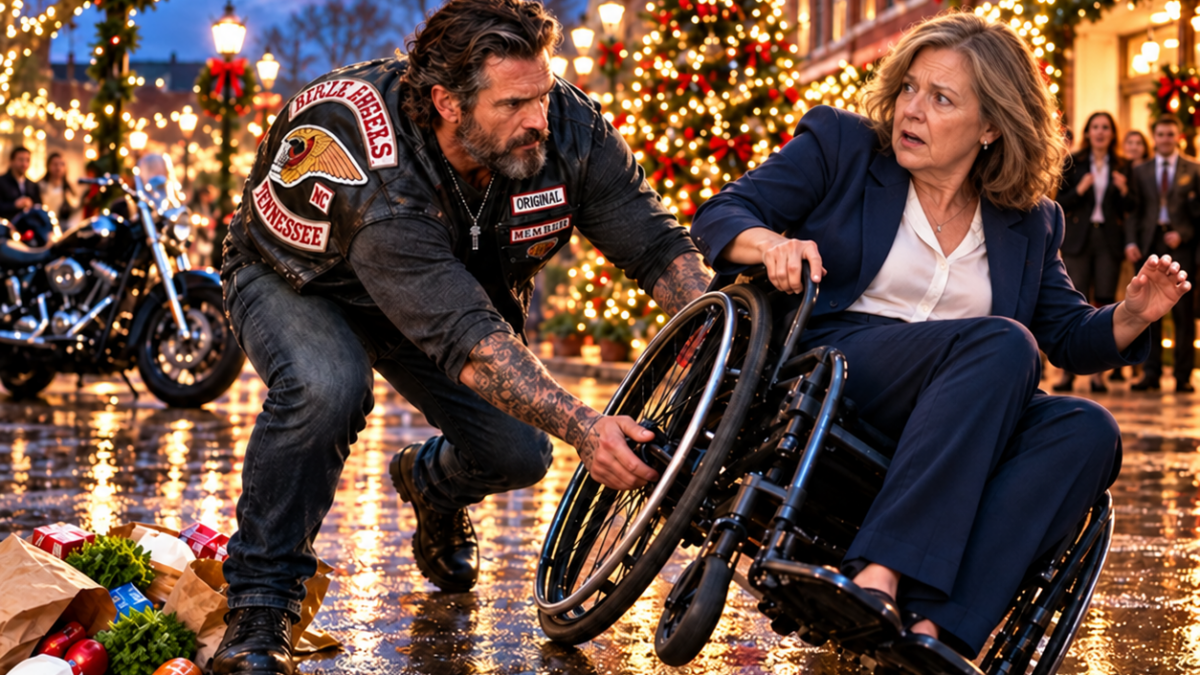
PART3:
Fear and hope fighting for the same space.
“Where did you get that key?” she asked.
Her voice was barely above a whisper.
I looked down.
Then back at her.
“My wife gave it to me.”
“Your wife?”
I nodded.
“Lena.”
The woman’s hands tightened on the arms of her chair.
For a moment, the rain, the lights, the broken jar, the people moving around us all disappeared.
“She told me you might come,” the woman said.
My chest went cold.
“My wife has been dead four years.”
“I know.”
Those two words hit me harder than the chair had.
Before I could ask how, a black SUV pulled to the curb. A driver stepped out and hurried toward us.
The woman looked at me one more time.
“My name is Vivian Bennett,” she said. “Do not give that key to anyone. Not anyone.”
“Vivian—”
“Tomorrow morning. Bennett Mobility Foundation. Nine o’clock. Bring the key.”
The driver helped her into the SUV.
I stood on the wet sidewalk, surrounded by the spilled contents of her grocery bags, with Lena’s key cold against my chest and the feeling that the world had tilted beneath me.
Sierra knew something was wrong the second I walked through the door.
She was in the kitchen wearing one of Lena’s old sweaters, which she did only on days when she missed her mother and did not want to say it.
“You forgot the cinnamon rolls,” she said.
Then she saw my face.
“What happened?”
I set the coffee on the counter.
“I met someone who knew your mother.”
Sierra went still.
That was how grief worked in our house. It did not always announce itself with crying. Sometimes it entered through an ordinary sentence and made every object in the room feel newly breakable.
I told her everything.
The wheelchair.
The curb.
The key.
Vivian Bennett.
Sierra listened without interrupting. When I finished, she looked at the chain around my neck.
“Mom told you you’d know when the moment came.”
“She did.”
“And do you?”
I touched the key.
“No.”
Sierra stood.
“Then I’m coming with you.”
“No.”
“Yes.”
“This might be complicated.”
“I assumed that from the dead-wife mystery key.”
“Sierra.”
“Dad.”
She had Lena’s tone when she said it.
Soft.
Final.
“You raised me to understand that when someone vulnerable ends up in your path, you don’t step around them because the timing is inconvenient. Mom raised me that way too.”
That one landed clean.
I looked away first.
“Fine,” I said.
Sierra smiled sadly.
“Good. Also, you’re not doing the scary quiet thing alone.”
The next morning, Christmas Day, we went to the Bennett Mobility Foundation.
It occupied a renovated brick building near the medical district, with automatic doors, low counters, wide hallways, and the kind of thoughtful accessibility that told me someone had designed the place by listening instead of guessing.
Vivian met us in a ground-floor office.
She was forty-one, elegant, composed, and in control of the room in a way that had nothing to do with standing. Her wheelchair was sleek and custom fitted. Her desk was arranged with careful precision. Photos covered the walls: adults learning to use new mobility equipment, families beside wheelchair-accessible vans, rehab graduates holding certificates, older men and women standing with walkers, smiling like independence had returned to them in pieces and they were grateful for every one.
Beside Vivian stood a man in a tailored gray suit.
“Victor Hale,” he said. “Foundation counsel.”
I shook his hand.
He had the posture of a lawyer who had survived enough complicated rooms to know when not to overfill the air.
Vivian looked at Sierra.
“You must be Lena’s daughter.”
Sierra swallowed.
“Yes.”
Vivian’s face softened.
“She talked about you as if you were the proof that the world was still worth betting on.”
Sierra blinked fast and looked down.
I did not sit.
I could not.
“Tell me how you knew my wife.”
Vivian folded her hands in her lap.
“Lena came here as a volunteer seven years ago. Before her diagnosis.”
I stared at her.
“No.”
“I know she didn’t tell you.”
“She told me where she went.”
“Did she?”
I opened my mouth.
Closed it.
Lena had said things like errands, appointments, helping a friend, running by the clinic, meeting someone from church, stopping at the library.
She had never said Bennett Mobility Foundation.
Vivian continued.
“She started quietly. Filing intake forms. Driving people when transport fell through. Sitting with clients during equipment fittings. She had a way of making people feel like needing help was not something to apologize for.”
That sounded like Lena.
Too much like Lena.
“She stayed after she got sick,” Vivian said. “During treatment. Between appointments. Sometimes when she had no strength for anything else, she would still call and ask who needed a ride, who needed forms reviewed, who had been denied coverage for equipment.”
I felt Sierra’s hand slide into mine.
Vivian’s voice tightened.
“She sold jewelry to fund rehab grants. She used savings to cover mobility equipment for families who could not afford it. She visited me after my sister died, when I did not want to keep leading this place or living my own life with any courage.”
She looked directly at me.
“Your wife saved me, Demon.”
No one outside the club used that name unless they knew something.
I looked at Victor.
Then Vivian.
“Why didn’t she tell me?”
Vivian’s expression changed.
“Because she knew what you would do.”
I felt anger spark under the grief.
“What does that mean?”
“Not that you would hurt anyone,” Vivian said gently. “That you would put yourself directly in the middle of it. Immediately. Loudly. With your whole chest. Because that is how you loved her.”
Sierra’s fingers tightened around mine.
Vivian turned slightly toward Victor.
He opened a folder and slid documents across the desk.
“Lena discovered irregularities in foundation finances during the final months of her life,” he said.
The words were dry.
The room was not.
“What kind of irregularities?” I asked.
“Payments to transportation vendors that did not exist. Equipment suppliers with addresses tied to empty lots. Repeated withdrawals hidden under approved program expenses. Hundreds of thousands of dollars over several years.”
I looked at the documents.
Invoices.
Transfers.
Vendor names.
Program accounts.
Victor had highlighted patterns. Even without financial training, I could see what he meant. The fraud was not brilliant. It was confident.
The kind of stealing done by someone who believed no one would look closely enough.
“Who?” Sierra asked.
Vivian answered before Victor could.
“My brother. Conrad Bennett.”
A silence followed.
Then a door opened behind us.
A man in an expensive wool coat entered without knocking.
Fifty or so.
Polished.
Calm.
The sort of calm that comes from assuming rooms will rearrange themselves around you.
“Vivian,” he said. “I was told we had visitors.”
Her face did not move.
“Conrad.”
His eyes passed over Sierra, then me, then my vest.
There it was.
The small tightening around the mouth.
Not fear.
Disgust wearing manners.
“I see,” he said. “This is the gentleman from last night.”
I held his stare.
“This is Demon Ferris,” Vivian said. “Lena’s husband.”
Something flickered in Conrad’s eyes when he heard Lena’s name.
Small.
Fast.
But there.
Victor noticed too.
Conrad smiled.
“Then I’m sorry for your loss. But I’m not sure what relevance Mr. Ferris has to foundation business.”
“If someone is stealing money from disabled people,” I said, “it becomes relevant to every man with a spine.”
His smile thinned.
“This is a family matter.”
“No,” Vivian said.
The word was quiet.
It hit harder because of that.
Conrad looked at her.
She held his gaze.
“The foundation does not exist because of our family. It exists because people believed in my sister’s mission.”
Conrad’s expression cooled.
“Careful, Vivian.”
That was when I understood him.
Not fully.
Enough.
He had spent years speaking to her as if warning and care were the same thing.
I took out my phone.
“What are you doing?” he asked.
“Documenting.”
I photographed every paper on the desk.
Conrad’s jaw tightened.
“You have no authority to investigate anything.”
“Good,” I said. “Then this shouldn’t bother you.”
I noted who was in the room.
Time.
Date.
Names.
Statements.
Conrad watched me with growing irritation.
“You’re making a mistake.”
“Then document that too.”
He left shortly after, but not before saying enough to confirm what kind of man he was: powerful friends, donor relationships, public reputation, questions about Vivian’s judgment, concern about outside influence, the danger of letting people like me near legitimate institutions.
People like me.
I had heard it all before.
Biker.
Criminal.
Threat.
Useful labels for men who wanted others dismissed before they were heard.
Outside the foundation, Sierra looked at me.
“What now?”
I called my brothers.
Not for a fight.
That is not what this story was.
The men under my patch were mechanics, shop owners, retired investigators, former tradesmen, men who understood engines, records, phone trees, county property maps, and the value of not losing your temper when the other man was counting on it.
Our rule was simple.
Nobody gets threatened.
Nobody gets touched.
Everything gets documented.
By nightfall, Conrad had started spreading his version.
A Hells Angels captain had inserted himself into the affairs of a vulnerable disabled woman.
A grieving widower had been manipulated by old emotional ties.
The foundation’s internal family matters were being distorted by outsiders with dangerous reputations.
My brothers heard it from donors, business owners, county contacts.
I told them the same thing every time.
“Let him talk. Every lie gets logged.”
We built a file.
Dates.
Calls.
Statements.
Copies.
Screenshots.
Connections.
No shouting.
No visits to Conrad’s house.
No dramatic midnight warnings.
Men like Conrad knew how to use fear. Give him one raised voice, one threat, one brother standing too close in a parking lot, and he would turn the whole investigation into a story about intimidation.
So we gave him nothing but records.
Two days later, an anonymous message came through one of the secure channels my brothers used for sensitive tips.
Former employee of the foundation.
Left after what I witnessed.
Lena found more than financial irregularities.
She secured it.
Then a number.
I stared at the message.
Then I took the key from under my shirt for the first time with the intention of examining it, not remembering her.
On the narrow side, almost hidden by wear, tiny engraved numbers caught the light.
Victor confirmed the rest.
There was an old train station building downtown with private document lockers used by businesses and individuals. Lena had filed a sealed addendum with him before she died. He had instructions to release it only if someone connected the key to the investigation.
“She planned all of this?” Sierra whispered.
Victor shook his head.
“She prepared for it.”
That felt more like Lena.
We drove to the station together: me, Vivian, and Victor. Sierra wanted to come, but I asked her to stay with two brothers at the clubhouse and help organize the documents we already had. She did not like it. She did it anyway.
The old station was quiet in the way functional old buildings get quiet on winter mornings, all tile, echoes, fluorescent lights, and history layered into corners.
The lockers lined a long corridor.
214 was shoulder height on the right.
A plain metal door.
A plain lock.
Four years of waiting behind it.
I put the key in.
It turned with one clean click that sounded too loud.
Inside was a black case.
My hands did not shake until I opened it.
A USB drive.
Photographs.
Handwritten notes in Lena’s unmistakable script.
Financial pages marked in the margins.
And one folded sheet on top.
I opened it.
If you’re reading this, Vivian is still fighting.
Help her finish what we started.
For a moment, I could not move.
The letter blurred.
I heard Vivian quietly crying beside me.
Then footsteps sounded at the end of the corridor.
Conrad stood there.
Not alone.
Two men stood behind him, big enough and placed carefully enough to turn the hallway into a message.
Conrad looked at the open locker.
Then at the case in my hands.
“You should not have opened that.”
I closed the case.
“It was addressed to me.”
His voice remained controlled.
“You have no idea what you are involving yourself in.”
“I’m learning.”
“I control the foundation’s finances.”
“Not for long if these papers are right.”
“I can freeze funding pending internal review. I can raise questions about Vivian’s fitness to lead. I can make donors reconsider their confidence. I can make sure every person in this county sees this for what it is.”
“And what is that?”
“A biker exploiting a disabled woman’s grief to attack her family.”
Vivian rolled forward until her chair was beside me.
Conrad looked at her like she had disappointed him by existing in the wrong place.
“You still think this is about me,” I said.
He blinked.
“It isn’t.”
Vivian looked at her brother.
“The foundation is not yours.”
His jaw twitched.
“Vivian—”
“No.”
She said it the way she had in her office.
Soft.
Immovable.
“You used my sister’s work as cover for theft. You used my grief as cover for control. You used my chair as proof I could be managed.”
Conrad’s face hardened.
“You’re making a public mistake.”
“No,” she said. “For the first time in years, I am making a public decision.”
We walked out with the case.
No one touched anyone.
No threats.
No drama.
Just the evidence leaving the dark.
That evening, my brothers gathered at the clubhouse.
Not for beer.
Not for noise.
For work.
We spread Lena’s documents across the long table.
The USB drive held the financial trail: vendor names, payment dates, shell structures, repeated transfers, program codes, and notes that connected them to foundation accounts. Lena’s photographs showed addresses tied to the supposed transportation companies. Empty lots. Closed garages. Mail drops. Buildings with no signs of business.
She had been thorough.
Of course she had.
She had been dying and still more organized than most living men.
Then one of my brothers found something that made the room go silent.
Victor’s signature appeared on eleven approvals tied to fake vendors.
I looked at the documents for a long time.
Victor had given us access.
Victor had stood beside Vivian.
Victor had handed me the addendum.
But his name was there.
A younger version of me would have called him immediately. Demanded answers. Let anger decide the order of events.
Lena’s note sat beside my hand.
Help her finish what we started.
Not avenge.
Not expose without care.
Finish.
“Trace it,” I said.
One brother looked up.
“Demon—”
“Trace it before we accuse anyone.”
It took two days.
Two long days of records, system access logs, metadata, document histories, and help from people who knew how digital signatures could be stolen without making television drama out of it.
The answer was clean.
Victor’s signatures had been copied from legitimate documents. His login credentials had been accessed through an internal system Conrad controlled as finance director. The approvals had been fabricated and buried where Victor would not see them unless he went looking for those specific files.
When Victor learned, he went completely still.
Not angry first.
Wounded.
He reviewed each invoice one by one, his face pale.
“I never approved these.”
“I know,” I said.
He looked at me then.
Really looked.
“You believe me?”
“Yes.”
The gratitude in his face made me furious on his behalf.
Not dramatic fury.
The useful kind.
The kind that sharpens work.
The second hidden compartment in Lena’s case was found under a false bottom.
Inside was one photograph.
At first glance, it was Lena and Vivian standing outside the foundation. Vivian seated in her chair, Lena leaning beside her, both laughing at something beyond the frame.
But this version showed more.
In the background, slightly blurred but unmistakable, stood Conrad.
Watching.
On the back, in Lena’s handwriting, were four words.
He knows I know.
I sat down.
For the first time since this began, I felt sick.
Lena had not stumbled onto fraud and run out of time before she could act.
She had known.
Conrad had known she knew.
She had carried that danger through the last months of her life while I sat beside her believing cancer was the only enemy in the room.
She had not told me because she knew exactly what I would do.
I would have confronted him.
I would have stood in his office and made him understand that dying did not make my wife unprotected.
And by doing that, I would have destroyed the evidence before it could become useful.
Lena chose the truth over the comfort of telling me.
She chose Vivian’s future over her own need to be less alone.
That realization did not make me proud.
Not at first.
It broke me in a new place.
Sierra found me in the garage after midnight, sitting on an overturned crate with the photograph in my hand.
“Dad?”
I handed it to her.
She read the back.
Her face changed.
“She was scared.”
“Yes.”
“And she still did it.”
“Yes.”
Sierra sat beside me on the cold concrete.
“I wish she told us.”
“So do I.”
“But I think I understand why she didn’t.”
I looked at her.
Sierra’s eyes were wet.
“Because if she gave you someone to fight, you would have fought him. If she gave you something to protect, you protected it.”
The truth of that hurt.
I closed my hand around the key.
“She knew me better than I knew myself.”
“She loved you that much.”
That was the thing grief teaches slowly.
Love is not always disclosure.
Sometimes love is withholding the thing that would make the person you love feel powerful while ruining what actually needs saving.
The garage became the final link.
Lena’s notes pointed to an abandoned property on the south edge of town, a garage that had once belonged to a transportation business. One of my brothers recognized the address. He had worked on a van there years ago before the company folded.
We did not go there.
Not at night.
Not in a pack.
Not with flashlights and anger.
We took the full file to the proper authorities through Victor and a legal channel that could survive challenge: financial trail, forged approvals, stolen credentials, photos, vendor addresses, Lena’s original notes, metadata, the USB drive, the locker record, and Victor’s sworn statement.
A warrant was issued.
The garage was searched.
Inside locked file cabinets, investigators found what Lena had been missing: original fake invoices before cleanup, duplicate shell company registrations, payment ledgers matching the transfers, transportation contracts bearing Conrad’s real signature, and correspondence linking him directly to each stage of the operation.
The gap closed.
Conrad’s first defense was predictable.
Forgery.
Misunderstanding.
Family dispute.
Outside influence.
Then Lena’s photographs entered the record.
Original dates.
Four years old.
A dead woman’s work, waiting patiently for the living to catch up.
At one meeting, Conrad looked at the photograph of himself in the background and then at me.
“Why would Lena trust a biker with this?”
I thought of her in bed, pressing the silver key into my palm.
I thought of Vivian laughing in a photograph.
I thought of all the times Lena had believed better of people than they believed of themselves.
“She didn’t trust a biker,” I said.
I paused.
“She trusted her husband.”
Conrad was arrested on a cold morning under a sky the color of wet steel.
I was not there.
That mattered.
I did not need to watch.
The point had never been to see him in cuffs.
The point was to make sure Vivian’s foundation survived him.
That work began immediately.
Because justice does not become complete the moment someone is caught.
The stolen funds would take time to recover. The accounts were frozen pending review. Donors were nervous. Patients still needed equipment. Rehab programs still needed transportation. Families who depended on the foundation could not wait for court schedules.
So my brothers went to work.
Phone calls.
Meetings.
Documentation.
Medical partners.
Community organizations.
Donors who needed facts instead of rumors.
No favors.
No intimidation.
Just truth repeated patiently until it outlived the lie.
The foundation survived.
Damaged, yes.
Shaken, yes.
But alive.
On Christmas morning, one year after I caught Vivian’s chair at the curb, she came to my house.
Sierra had coffee ready. My brothers drifted in and out of the kitchen the way men do when they know they are welcome enough not to knock. The house smelled like cinnamon, pine, leather, engine oil from my jacket, and the kind of quiet that comes after a storm has finally moved on.
Vivian brought a small wrapped box.
Inside was a silver keychain.
Delicate.
Precise.
A replica of Lena’s key.
I looked at Vivian.
“What’s this?”
She smiled.
“Something I’ve been thinking about for four years.”
Then she handed me a folder.
Inside were the first documents for a new program funded through recovered assets and protected donations.
The Lena Ferris Mobility Fund.
I stared at the name.
Vivian spoke carefully.
“It will provide mobility equipment, transportation support, and rehabilitation assistance for adults whose families cannot cover the cost. The work she was already doing. Quietly. We just gave it a structure.”
I looked at the page for a long time.
Then I said the first honest thing that came to mind.
“Lena would have hated having her name on it.”
Vivian laughed.
“I know.”
That laugh.
It caught me off guard.
Not because it sounded like Lena’s.
It did not.
But it carried something Lena had given her.
A looseness.
A returned piece of life.
The kind of laugh people have when someone once stayed long enough to convince them they were worth saving.
And I understood then that Lena had not simply helped Vivian survive.
She had loved her.
In the clear, practical, stubborn way Lena loved people.
By showing up.
By staying.
By doing.
By making sure the last thing she built would still shelter someone after she was gone.
I took the old key from my neck.
For four years, I had worn it because it was the last thing my wife gave me.
Now I understood that she had not given me a keepsake.
She had given me a choice wrapped in silver.
If the world placed a vulnerable person in my path, I could keep walking.
I could say I was tired.
That grief was heavy enough.
That someone else would handle it.
That I had already lost too much.
Or I could stop.
On Christmas Eve, I stopped because a woman’s wheelchair was tipping toward the curb and stopping was simply what my body did before calculation could interfere.
Because I stopped, Lena’s final act of kindness survived long enough to reach the people it was meant to protect.
Because I stopped, Vivian did not have to fight alone.
Because I stopped, my daughter learned something about her mother that grief had hidden from us.
Because I stopped, a foundation lived.
I placed the original key on the kitchen table beside the replica.
Two small silver objects.
One from the woman I lost.
One from the life she protected after she knew she had to leave.
My brothers stood quietly around the edges of the room.
No speeches.
No noise.
Just presence.
The ordinary kind of loyalty.
The kind that stays after the dramatic part is over.
Vivian reached across the table and touched the replica key.
“She always said you would understand when the moment came.”
I looked at Sierra.
Then at Vivian.
Then at the old key.
“I wish she had been wrong.”
Vivian’s eyes softened.
“No, you don’t.”
She was right.
I did not.
I wished she were alive.
I wished she had told me.
I wished I could have carried the fear with her.
I wished for a hundred impossible things.
But I did not wish she had been wrong about me.
That was the gift hidden inside the pain.
Lena had trusted me.
Not with vengeance.
Not with anger.
Not with a secret designed to make me feel important.
She trusted me with restraint.
With patience.
With a vulnerable woman’s future.
With proof.
With the work that comes after grief.
Four years earlier, I thought she had handed me a key to remember her by.
She had done more than that.
She had handed me the last unfinished piece of her love and trusted that, when the time came, I would know what to do with it.
I still wear the original key sometimes.
Not every day now.
Some days it rests in a small box beside Lena’s wedding ring.
Some days, when the weather is cold and the road is wet and Christmas lights reflect in the pavement, I put it back around my neck.
Not because I do not understand what it opens.
Because I do.
It opens the part of a man that grief tries to close.
It opens the door between what we lose and what we are still responsible for protecting.
It opens a locker.
A truth.
A future.
A fund with my wife’s name on it, even though she would roll her eyes and tell us all to stop making a fuss.
And every Christmas Eve, I walk past the curb where Vivian almost fell.
I stop there for a moment.
Not long.
Just long enough to remember that a life can change because you do not keep walking.
Long enough to hear Lena’s voice in my head.
You’ll know when the moment comes.
She was right.
I knew.
And I stopped.








